
Welcome back!
I hope you all enjoyed the book review on Sunday. If you missed that, you can go and read it here. Too academic for your taste? Let me take you on a much more casual tour of my bookshelves, and tell you a little bit more about my background and experience ❤
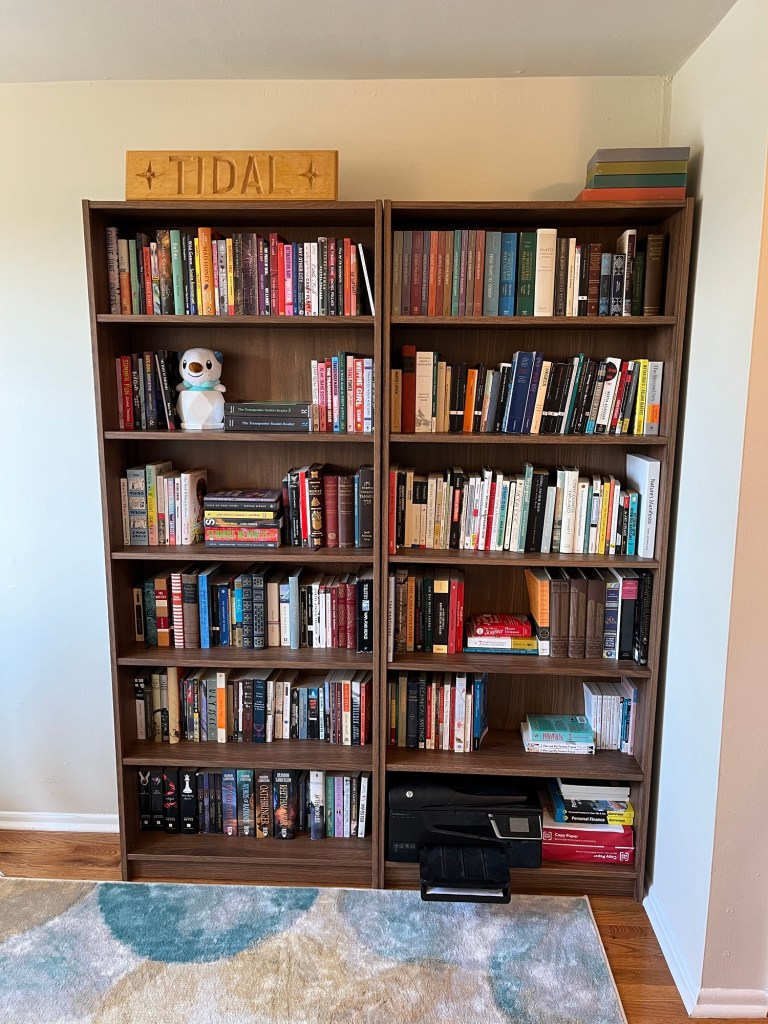
I’ve got two lovely brown IKEA bookshelves, filled to the brim with my collection. This is only a fraction of my books – most of them are sitting in my childhood bedroom at my dad’s house, including the vast majority of my Young Adult fiction and my full 58-book set of The Canon(tm) that I inherited from my great-grandpa.
What books did I choose to bring to my apartment? I try to cultivate a functional bookshelf – the idea is to keep books that I think I might either reread, cite, or reference and store the rest elsewhere. Everything on these shelves is either a personal favorite, addresses one of my research interests, or otherwise has some utility in my everyday life. There’s a lot to learn about me here! So let me show you some of the highlights~
Before we get into the books, you’ll notice my two decorations 🙂 Yes, that is an Oshawott in a flower pot. His name is Oshapott. Oshawott was my first starter in my first Pokemon game, so he’s got a special place in my heart.
The wooden plaque resting on top of the bookshelves that reads ‘Tidal’ is actually modeled off of the nameplaque for a sailboat! I carved and stained it myself at the Chesapeake Maritime Museum in St. Michaels when I was seventeen. If you’re ever out on Maryland’s Eastern Shore it’s a super cool museum, so you should definitely make it a roadtrip stop. Woodworking isn’t my primary hobby, but I’ve been doing it on and off since I was nine – one of my other great-grandparents was a big wood-worker, so the craft runs in the family.
Now, this blog is obviously dedicated to my trans books, so you’ll be hearing a lot about those in the coming months and years. I won’t linger too long on this section, but we’ll start there.
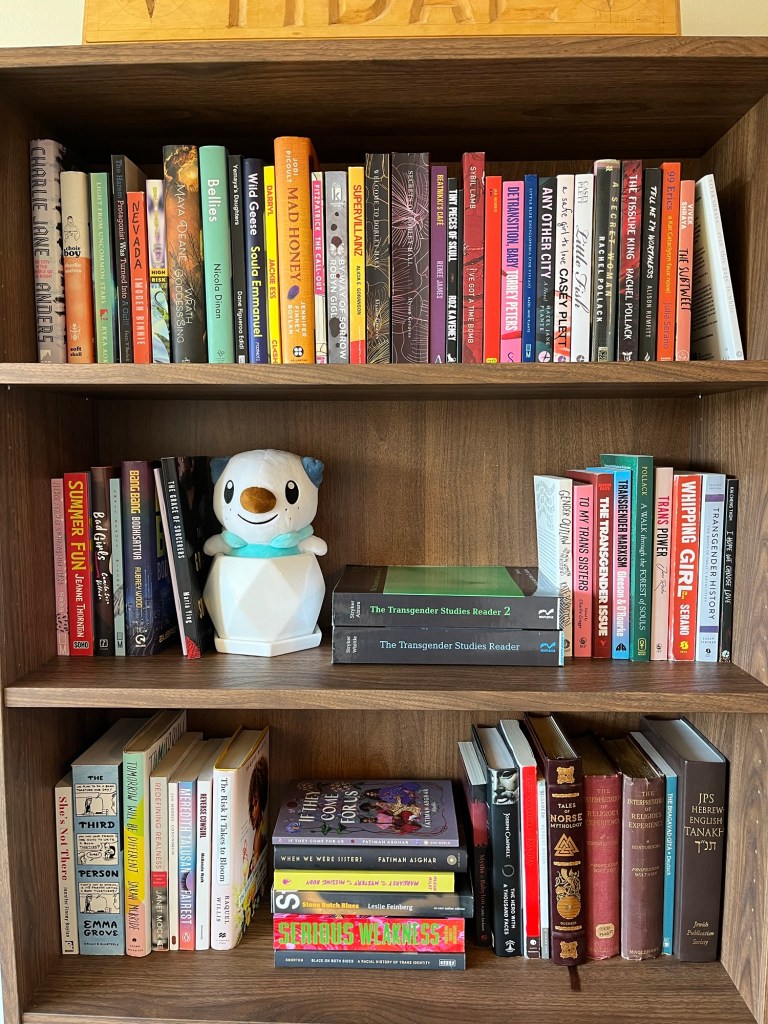
My bookshelves are primarily organized by topic, then ordered by time period and commonality. My section of transfeminine literature is the only place where there’s any alphabetical organization on the whole bookcase! The top shelf and the books to the left of Oshapott is my collection of all the transfeminine novels that I’ve already read (my TBR lives under my bedside table). On the other side of Oshapott, we’ve got my theory books, including the first two volumes of the Transgender Studies Reader stacked on their side for the aesthetic. On the third shelf, we’ve got my collection of trans memoirs, then my small collection of fiction from non-transfemme trans people to top it all off.
Obviously, it’s much easier to find traditionally published fiction in a bookstore, so most of the books I have in print fall into that category. That being said, there are a couple of books I’ve collected that are a little harder to find! Let me give you a closer look 🙂
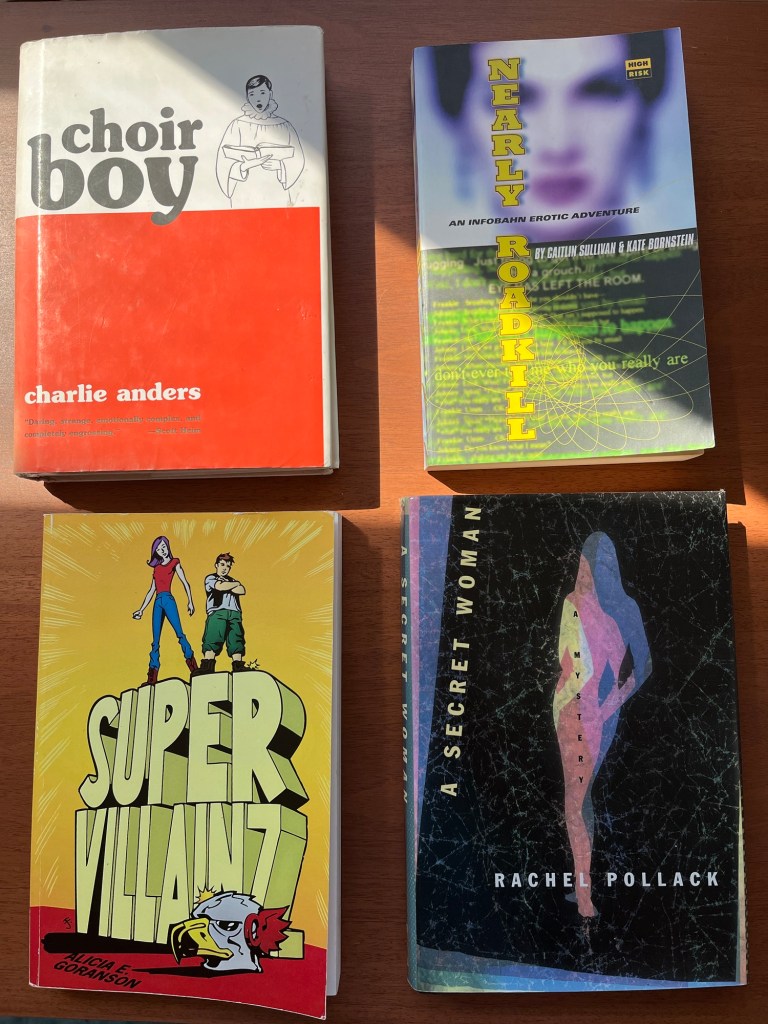
Four of my books by transfemmes are out of print and rather hard to track down. A lot of the fiction published in the 90s and 00s never got a Kindle edition, which means it’s only possible to read them if you can track a copy down. All four of these were ordered online through second-hand booksellers like AbeBooks. I’m super pleased to have a copy of all of these. Supervillainz is my personal favorite, but my friends seem to like Nearly Roadkill the best. I think they get a kick out of all the terrible sex scenes.
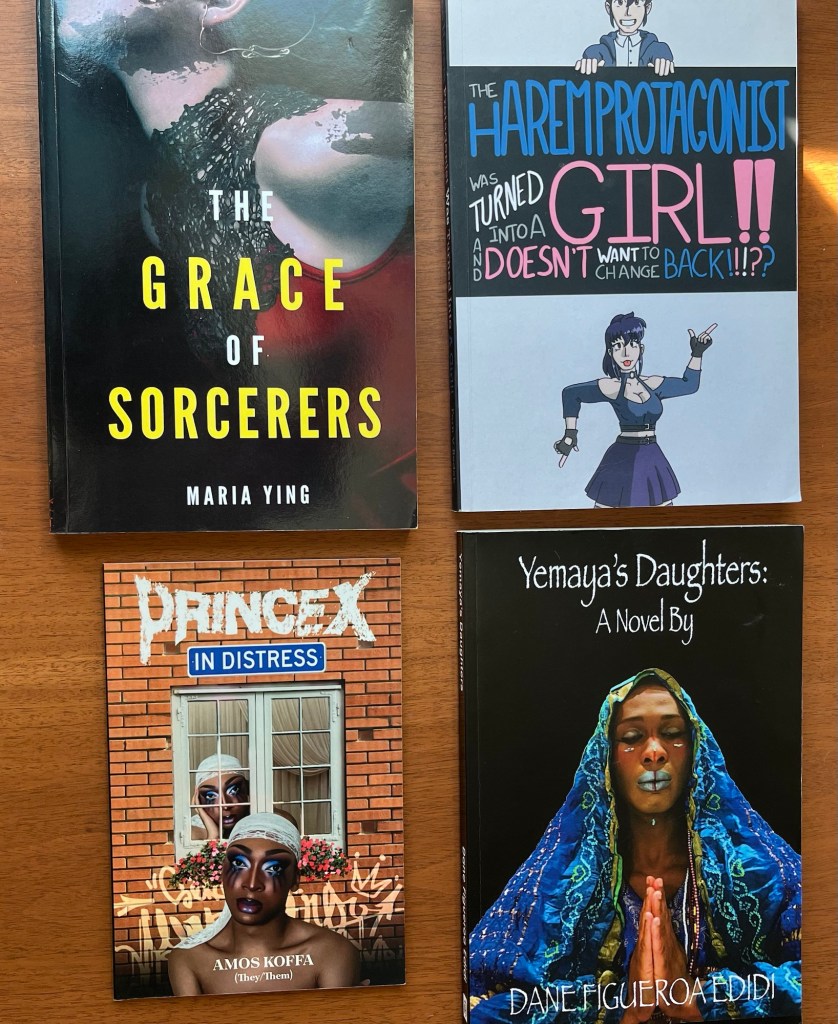
A smaller but not insignificant portion of my collection is self-published fiction! Most of this was ordered directly from the author. I find that self-published books are a lot more accessible online, but it’s always nice to sit down with a good book, especially when the authors have the know-how to get around the dreaded self-pub cover issue. Yemaya’s Daughters especially is a book that needs to be read in print. And speaking of gorgeous self-pub covers…
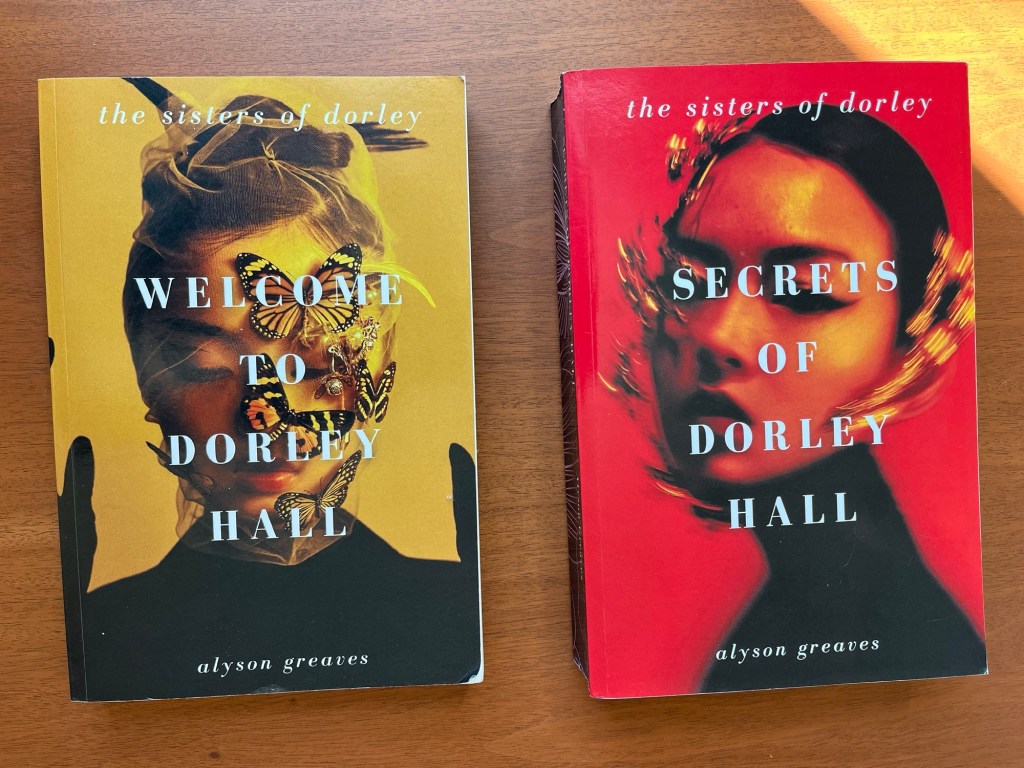
Here’s a hill that I’ll die on – The Sisters of Dorley have the single best cover design in the entire trans publishing industry. Fight me lol. Words cannot express how badly I want that gorgeous gray cover for Enemies of Dorley Hall – alas.
There’s one last oddity in my trans section that you might be interested in:
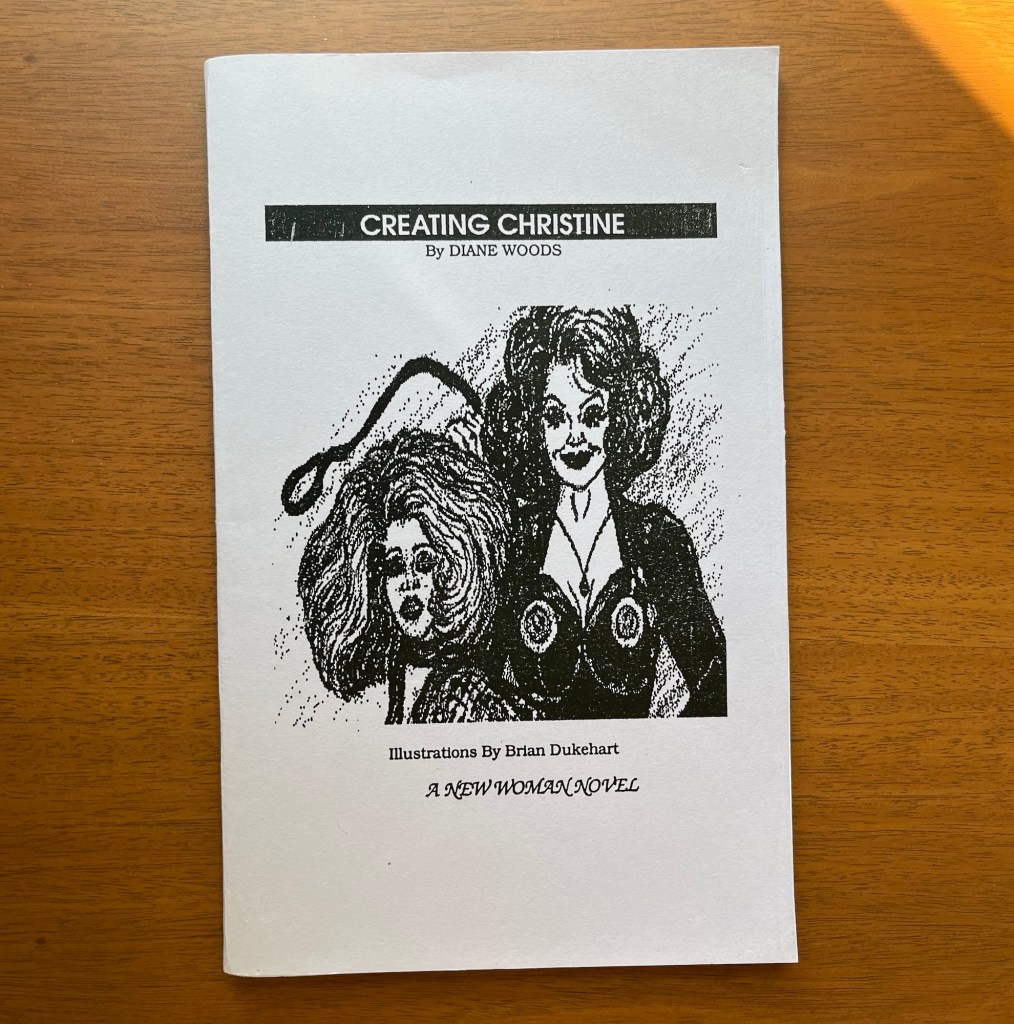
This is what a classic folio booklet from Reluctant Press looks like. If you were in with white cross-dresser circles in the second half of the 20th century, there was an entire underground industry dedicated to mail-ordering these booklets. You would get a catalog in the mail, check off the books you wanted, and send it back with cash. There are absolutely oodles of interesting little details in here – I’ll share the two pages that interest me the most:
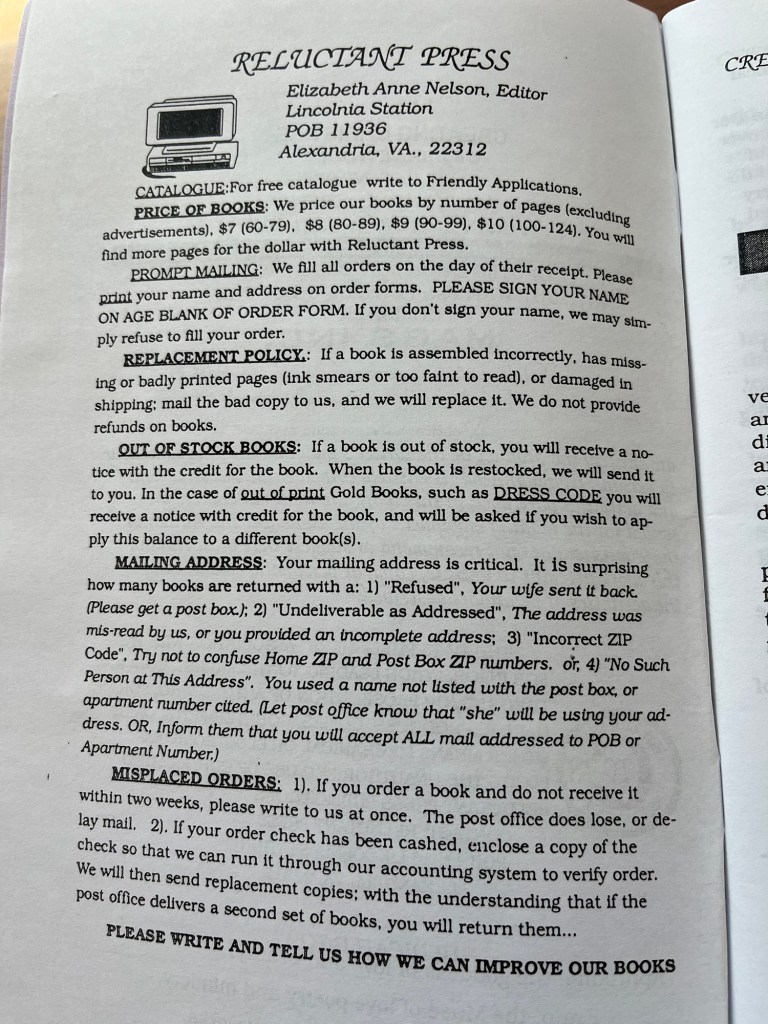
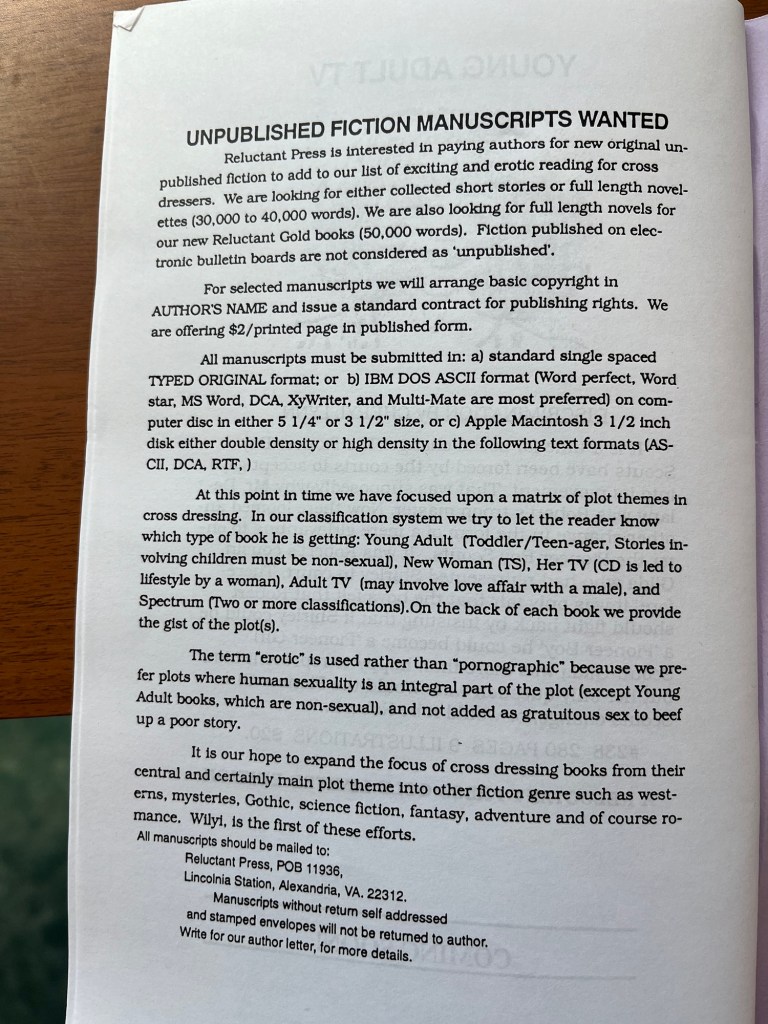
I’m a total geek when it comes to underground publishing mechanics, so this is the sort of stuff that totally fascinates me. It’s a very cool book to have in the larger collection (and I’m a huge fan of Diane Woods, so what have you).
Okay, before we move on to cislit, let me give you a glimpse of my current TBR:
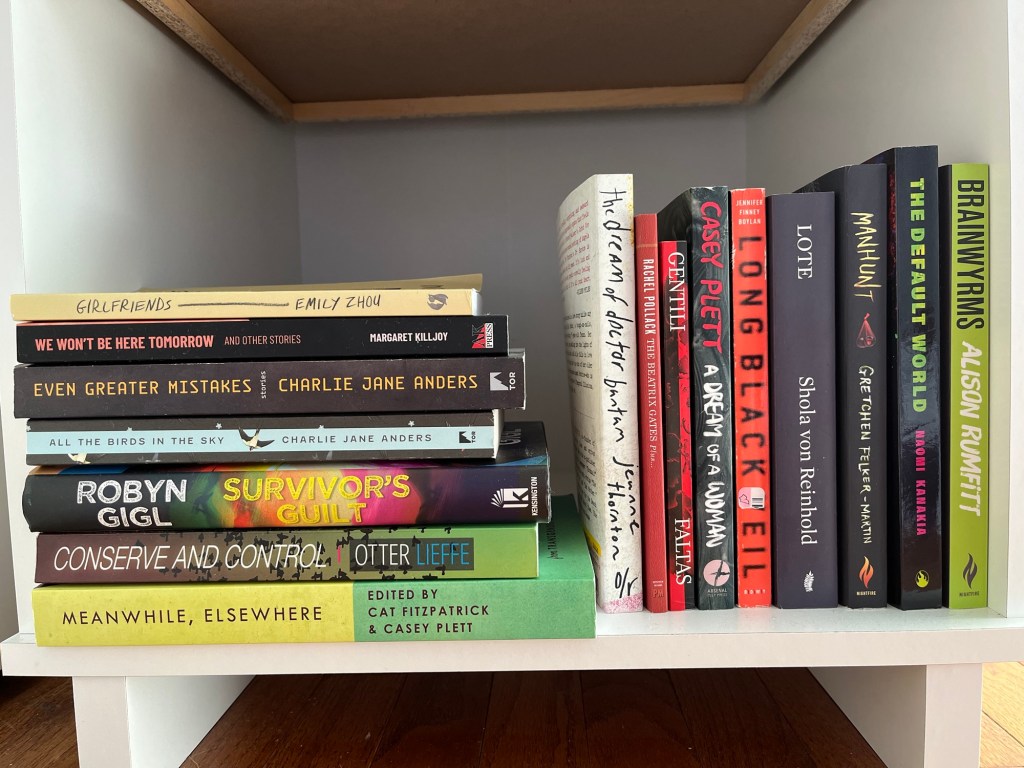
As you can see, I’ve got work to do lol. I’ll keep y’all in the loop once I’ve read all of these. Maybe I’ll do a readathon at some point.
Okay, time to move on. First up is every trans person’s absolute favorite – religion!
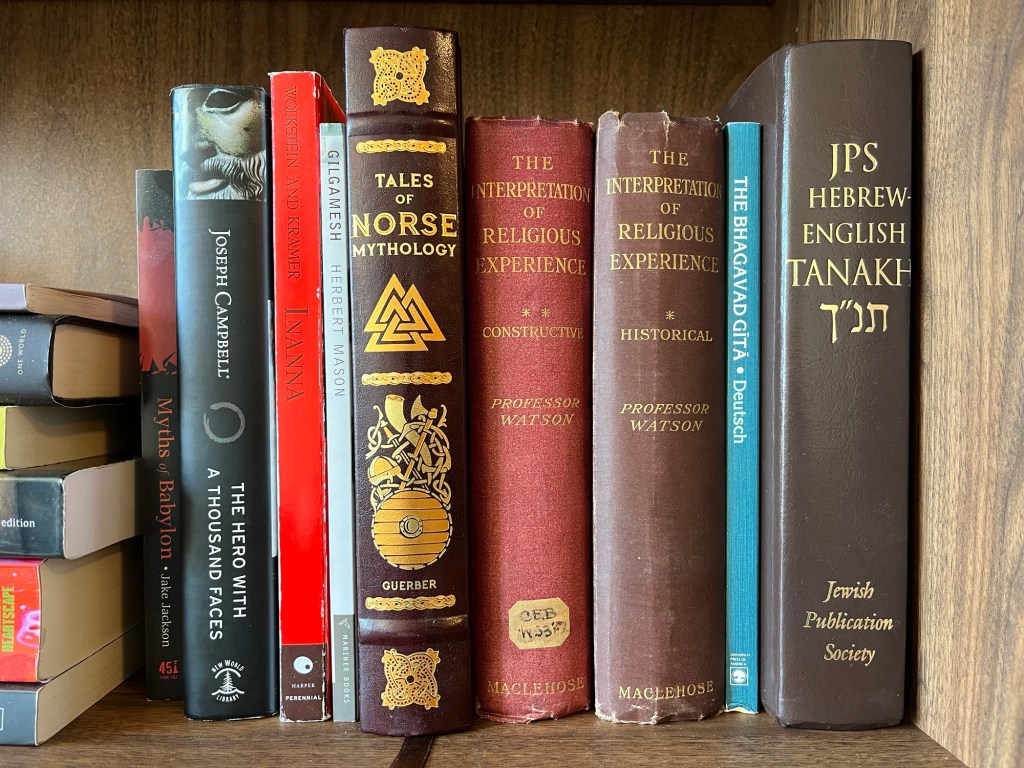
Not much to talk about here – it’s mostly next to the trans books cause that’s where it fit on the shelf. The one book that I do want to mention: I know that lots of transfemmes are interested in the mythology surrounding Inanna/Ishtar. I am as well. If you want to read a book on the subject, I would highly recommend Inanna: Queen of Heaven and Earth by Diane Wolkstein and Samuel Noah Kramer. It is undoubtedly the definitive resource on the topic for a layman, and it makes the ancient Sumerian verse super accessible.
Next up we’ve got my three shelf section of non-trans fiction, and there’s a whole bunch to talk about here! Let’s break it down shelf-by-shelf.
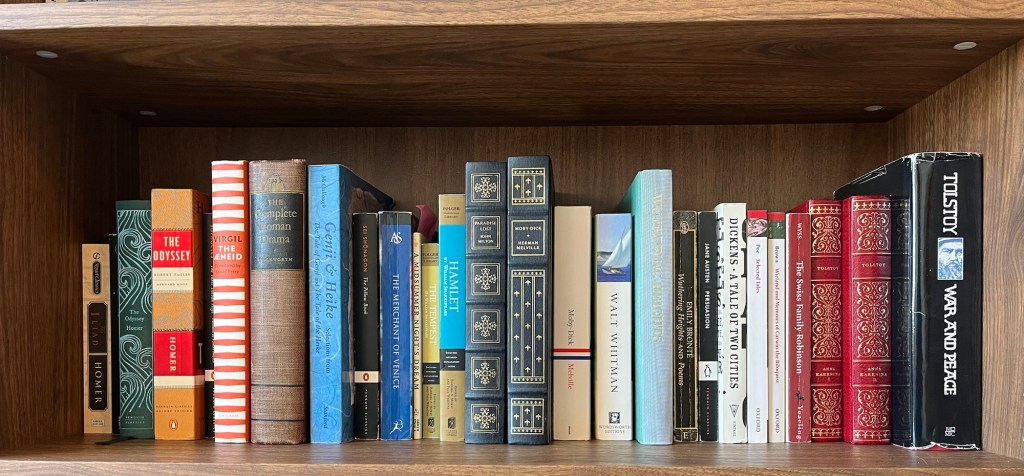
My classics shelf! This is my personal list of all of the “Great Books” that I think are worth my time, and I’ve read all of them. In fact, I would estimate that I’ve read somewhere between 85% and 90% of all the books on these shelves (obviously excluding TBR). Most of the ones I haven’t read are philosophy books or other non-fiction that I keep on hand for reference.
As you can probably see, I’m a bit of a slut for special editions of classic literature. There’s just something timeless about a good book-binding. Let me show you my two favorites:
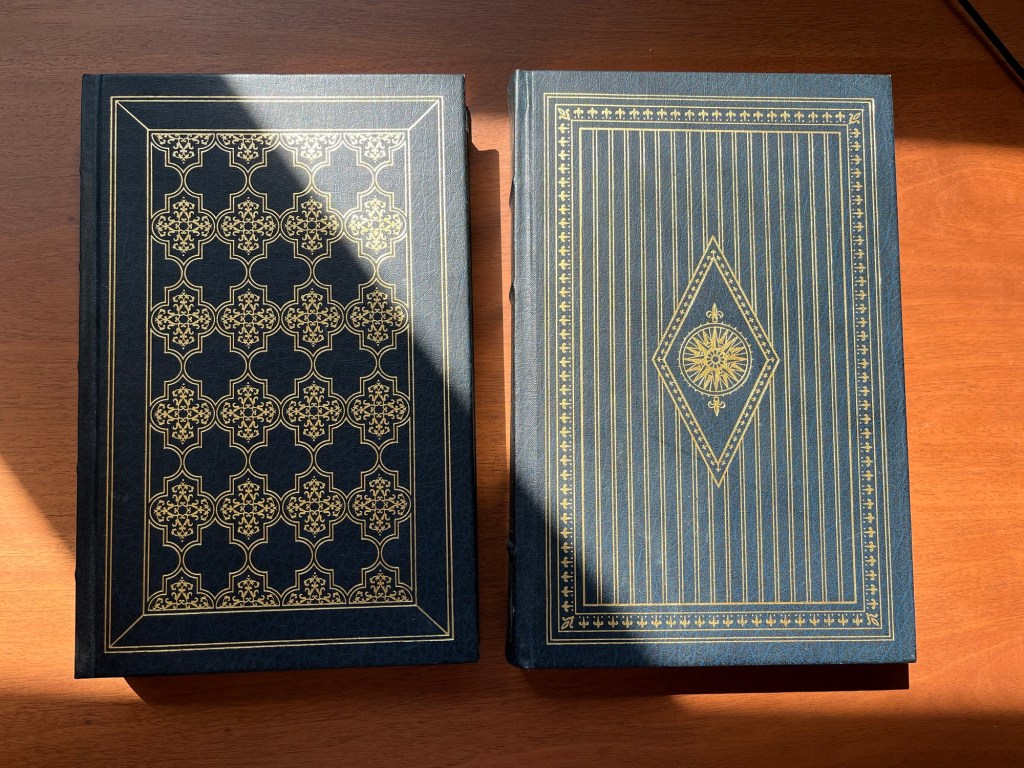
I found these absolutely beautiful 1979 editions of Paradise Lost and Moby-Dick in the rare book section of what, in my opinion, should be considered one of the greatest roadside bookstores in America, The Unicorn Bookshop, which is also out on the Eastern Shore of Maryland on the side of Route 50. Alongside Mrs. Dalloway, Hamlet, and the book I’m about to show you next, Moby-Dick and Paradise Lost are two of my five favorite works of Western literature, and y’know, you gotta wine and dine your favorite books. There’s nothing better than lounging in a hammock on a windy July day with classic literature and a popsicle. Books like this are meant to be read, not displayed. And speaking of gorgeous editions that I read all the time…
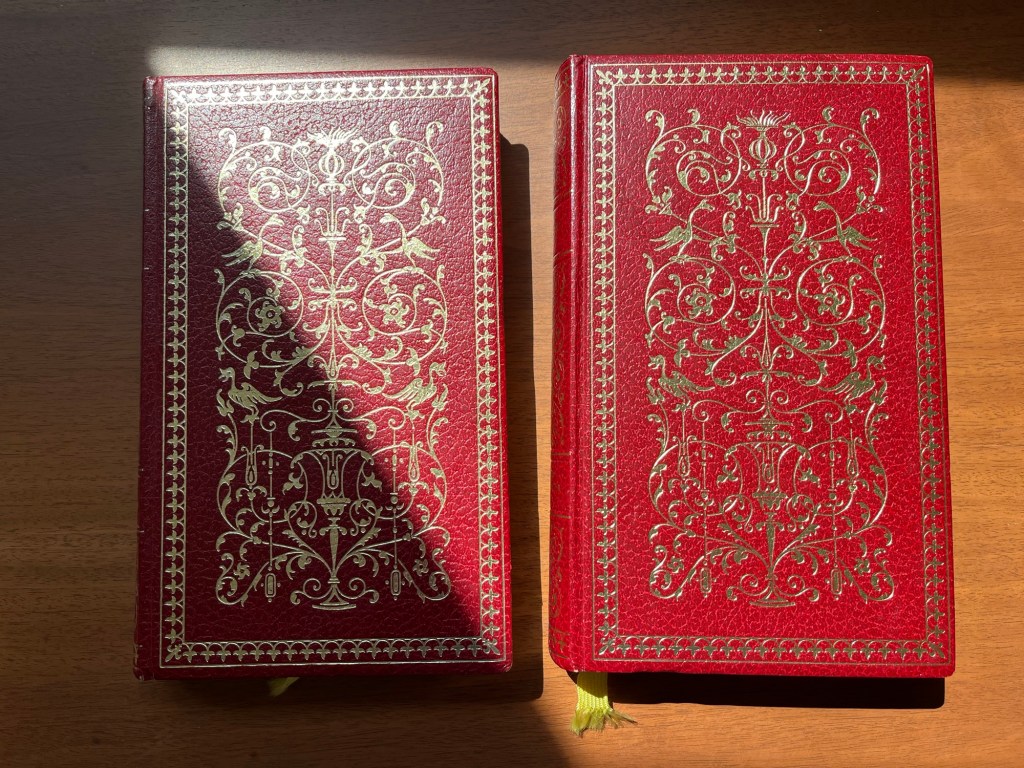
This, my friends, is my gorgeous 1970 two volume edition of my favorite book of all time, which is of course Anna Karenina by Leo Tolstoy. These come from a 37-book set of Russian Literature, but unlike the last two, which I’ll admit I splurged a bit on, I found these at a used sale. Wanna know how much I paid for them? $3. One of the best purchases I’ve ever made in my entire life. I love this book to absolute death. Tolstoy has inspired so much about my writing style, the way I think about fiction as a craft. I will always have a special place on my bookshelf for this one.
Okay, next up is my shelf for 20th Century fiction:
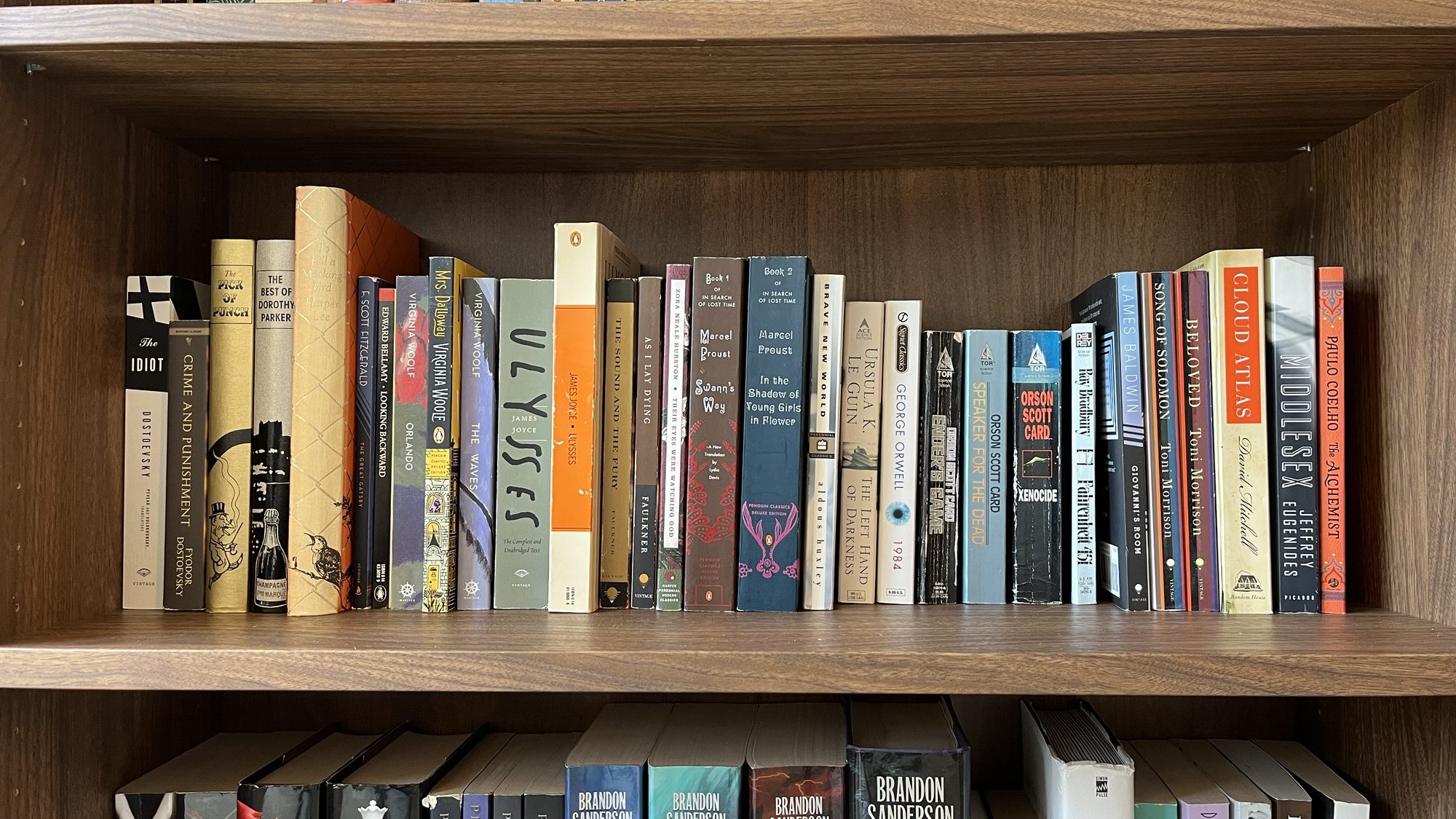
Okay, unlike the last few shelves, I don’t have any rare or interesting editions to talk about here. Just a solid collection of trade paperbacks and modern reprints for books I love (except you, Middlesex. I don’t like you. You’re here for the trans lit project and nothing else). Obviously Mrs. Dalloway is on this shelf as the last book rounding out my top five classics. I’ve got my modernist books (Woolf, Joyce, Proust, Faulkner), my black literary classics (Morrison, Hurston, Baldwin), my classic science fiction (Orwell, Huxley, Le Guin, Bradbury, Card), and the odd other favorite like The Alchemist by Paulo Coelho and Cloud Atlas by David Mitchell.
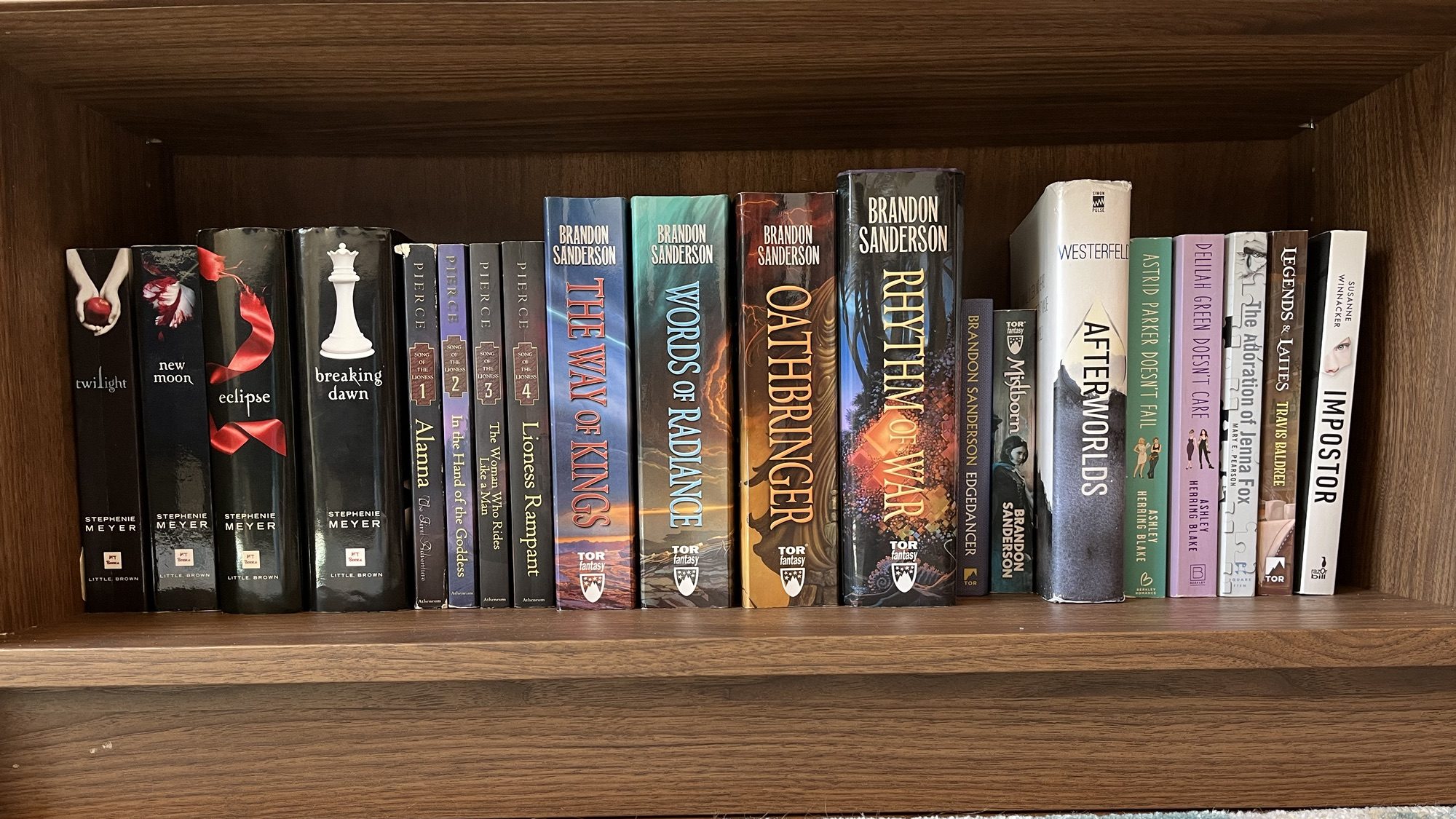
Okay, this shelf is just comfort food, pure and simple. These are the childhood books that I couldn’t bear to part with, so obviously I had to take them with me to adulthood ❤ Only book on this shelf that I’ve not read yet is Legends and Lattes, but I’ve heard it’s so good. Delilah Green Doesn’t Care is probably my favorite non-transfemme novel that I’ve read this decade. Let me give you a closer look at my beloved favorites from when I was a kid:

If you’ve read any of these, you’ll probably immediately notice a common theme. They’re all books about evolving girlhood, about coming of age as a woman in a changing world, about secret identities and lost self-hoods and earth-shattering identity crises. I fell in love with all four of these before I figured out I was trans, which should tell you a lot lol. My bookcase was honestly one of the biggest pillars of support in early transition – I didn’t have a stereotypical trans childhood in most ways, I hadn’t been cross-dressing since the womb, and this was a place that I was able to turn back and say, okay, this is not a normal thing for a cis boy to be relating to. Of these four, I would have told you at various points that both Afterworlds and In the Hand of the Goddess were my favorite novels of all time. While Anna Karenina may have stolen that crown, they’re both still resoundingly in the top five along with Mrs. Dalloway and Moby-Dick.
I’ve gone to see Tamora Piece speak twice, and my copy of In the Hand of the Goddess is actually signed by her (don’t mind the quarter over the deadname lol):
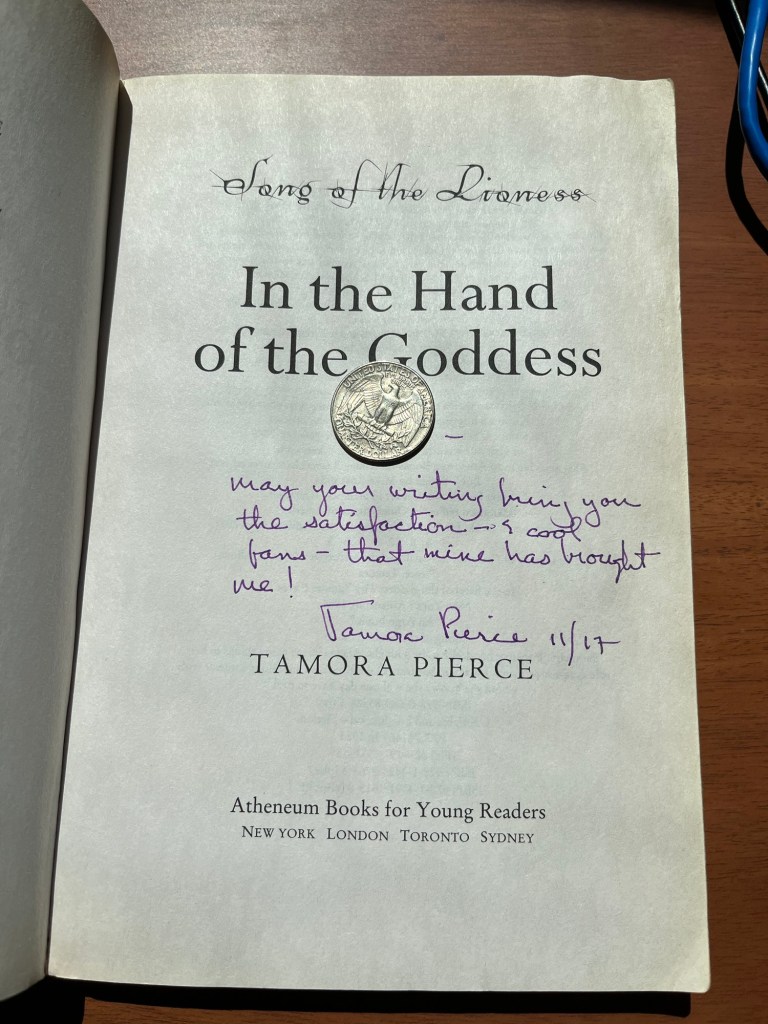
Thank you, Tammy ❤ It has absolutely brought me the satisfaction – and the cool fans, well, you’re reading this blog post, aren’t you?
Okay, that’s it for fiction! On to Bookshelf #2! The next section is a doozy.
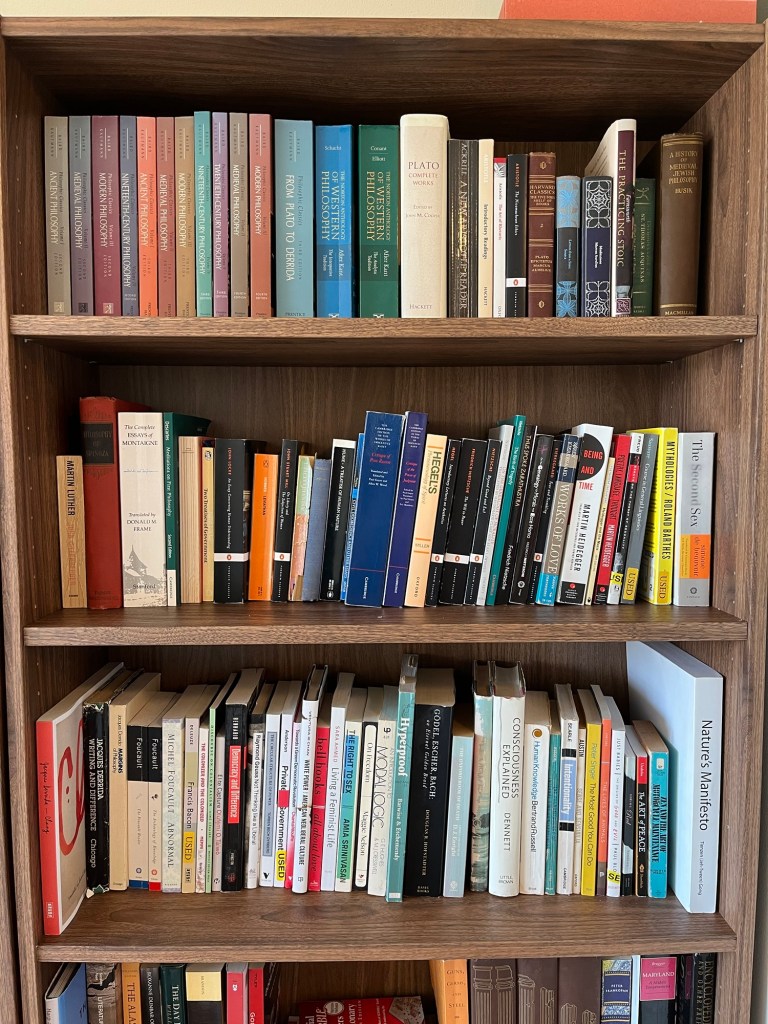
Okay, here’s where we lay my cards on the table lol. This an incomplete but fairly thorough cross-section of what my academic background in philosophy looks like. My read rate here is probably closer to 70% than 90% – one of my professors retired while I was graduating, and she offered me the pick of her bookshelves. I was very much not shy about filling out the gaps in my collection. That ridiculous stack of omnibuses in the top left corner (some of which are duplicate editions of the same book) all came from her. But you would probably be surprised how much of this I picked up and read on my own time. There are a couple texts here of particular note, so I’ll give you a brief tour of my favorites:
Now, I know that most of you who have transitioned probably were never on puberty blockers. They’re expensive and legally contested, and I know that I’m lucky I got them at all. That doesn’t change the fact, however, that the sixteen months when I was on puberty blockers but not yet allowed to take estrogen were some of the most physically miserable months of my entire life (and let’s be clear – testosterone was worse). The human body is not meant to exist without hormones after a certain age, and I had to fight my way through trans therapy and parental doubt before I was able to get the medical care I needed. I was depressed, my grades went to shit, I couldn’t focus, I literally would spend hours in my room blasting music so loud that I still have tinnitus cause it was the only way to drown out the physical badfeels. And though I did finally get estrogen about a week before my seventeenth birthday, by the time I did, I had lost an enormous amount of strength and mental stability that I’m still figuring out how to recover.
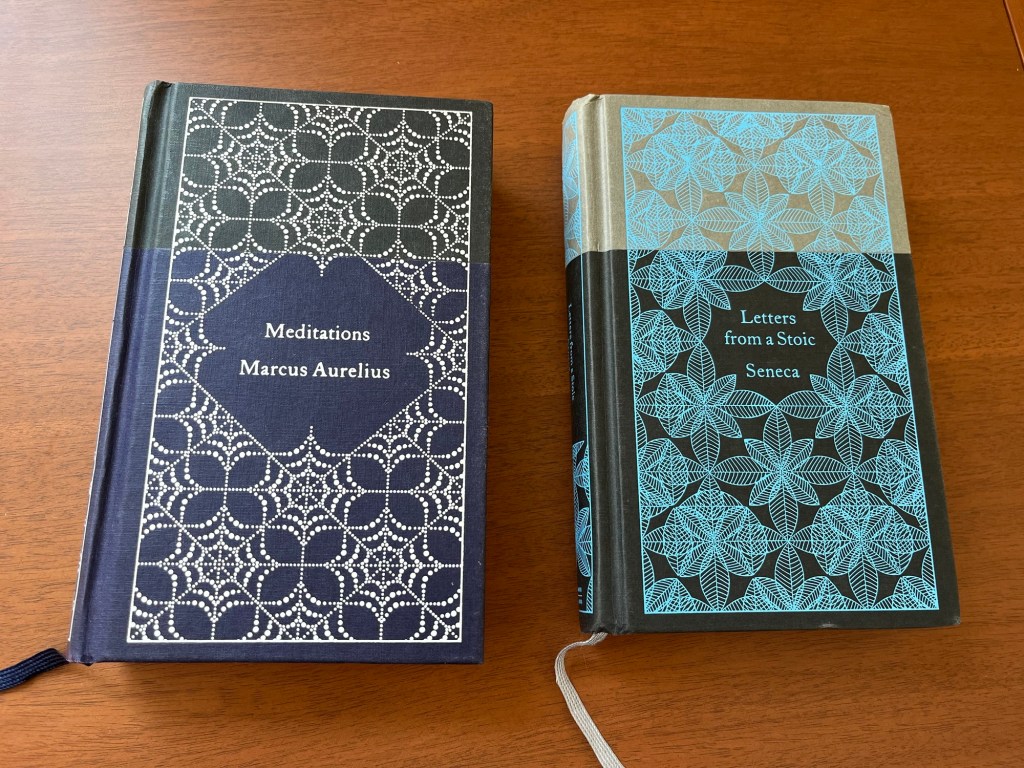
Stoicism (and fanfiction, but that’s another story) kept me alive during those years. I would read Marcus Aurelius and Seneca on a daily basis; I brought these books to school, I slept with them, they were a physical lifeline for me. People like to make fun of stoicism as a “hypermasculine” discipline of philosophy, something for finance bros, but like. These books matter so much to me, and I wouldn’t be who I am today if I hadn’t had the ancients guiding me and nurturing my intellectual curiosity. I am and will always be grateful for that.
Another “dudebro” philosopher who was super important to me during high school was Nietzsche:
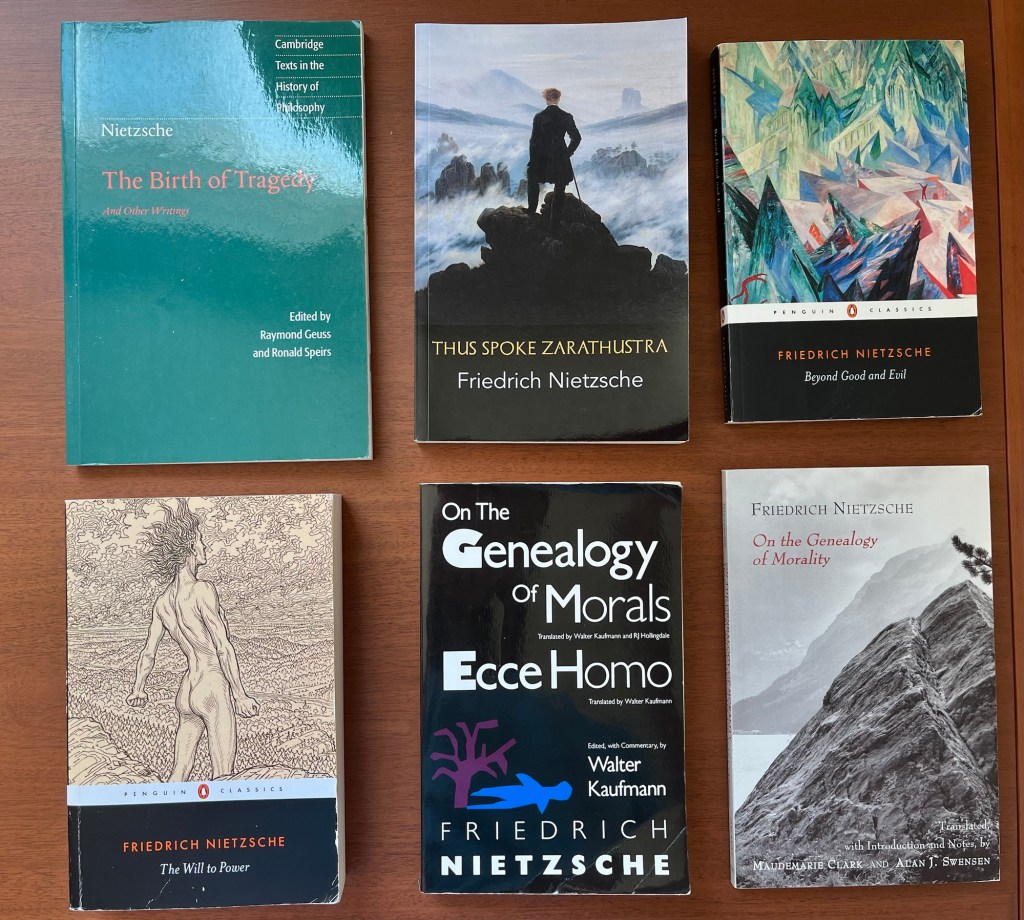
Don’t get it twisted – Friedrich Nietzsche was a pathetic sniveling racist anti-semetic little shitstain of a man. But he’s also probably the one writer more than anyone else who taught me how to think. I still can’t help but be enamoured of his rhetorical style, the effortless way that he parses and dissects social systems. Did he have good politics? Fuck no. But there’s a lot to be learned from the way he writes and argues. Ironically Nietzsche was the first philosopher who I think really made me start to question the ideas and beliefs I grew up with (albeit in the wrong direction at first). Just, yknow. Don’t take anything he says as truth or gospel. That way lies the alt-right pipeline.
In college, I was primarily trained in the Continental tradition of Western philosophy, which for those out of the know means largely French and German philosophy from the 1800s and 1900s. In particular, I took interest (as so many transfemmes do) in the ideas and tenants of the Structuralist and Post-Structuralist schools, and with Post-Modernist thought more broadly. Anyone familiar with the history of Trans Studies as a field will know that the discipline is rooted in this Continental branch of Post-Modern philosophy, especially in traditions that arose from Donna Haraway in her “Cyborg Manifesto.” There’s extensive writing elsewhere about trans studies and post-modernism, so I won’t take your time with it, but if you’re looking for more information, I would check out Rita Felski’s classic article about it, which you can find here in the Trans Studies Reader for free.
Of those Post-Structuralist philosophers, by far the one whom I have the greatest affinity for is Jacques Derrida:
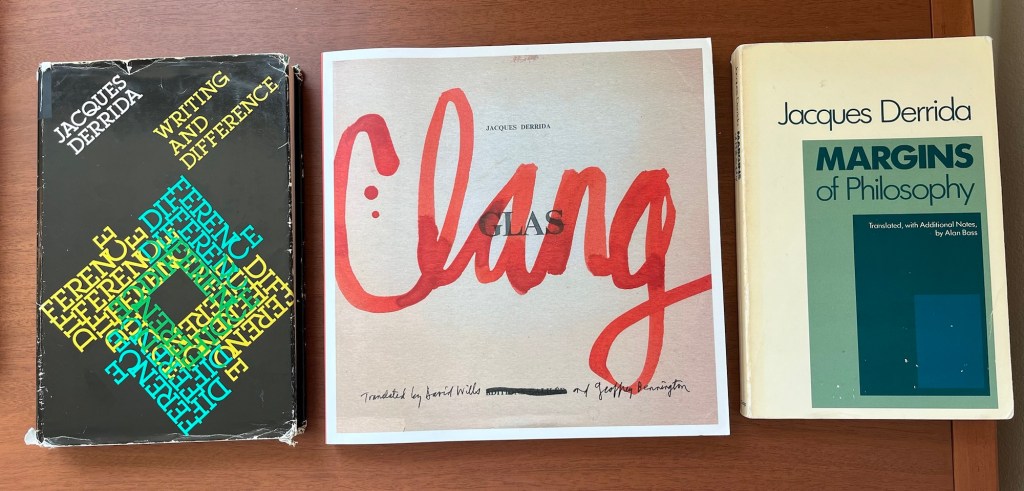
I have a whole essay planned down the line about Derrida, Judaism, and transfemininity. For now, I’ll just show you my pretty Derrida books and leave you in suspense :))
Philosophy, fiction, and books by trans people are obviously the three largest collections of books on my shelf. But I’ve got a few smaller ones too that I’ll show you before you go.
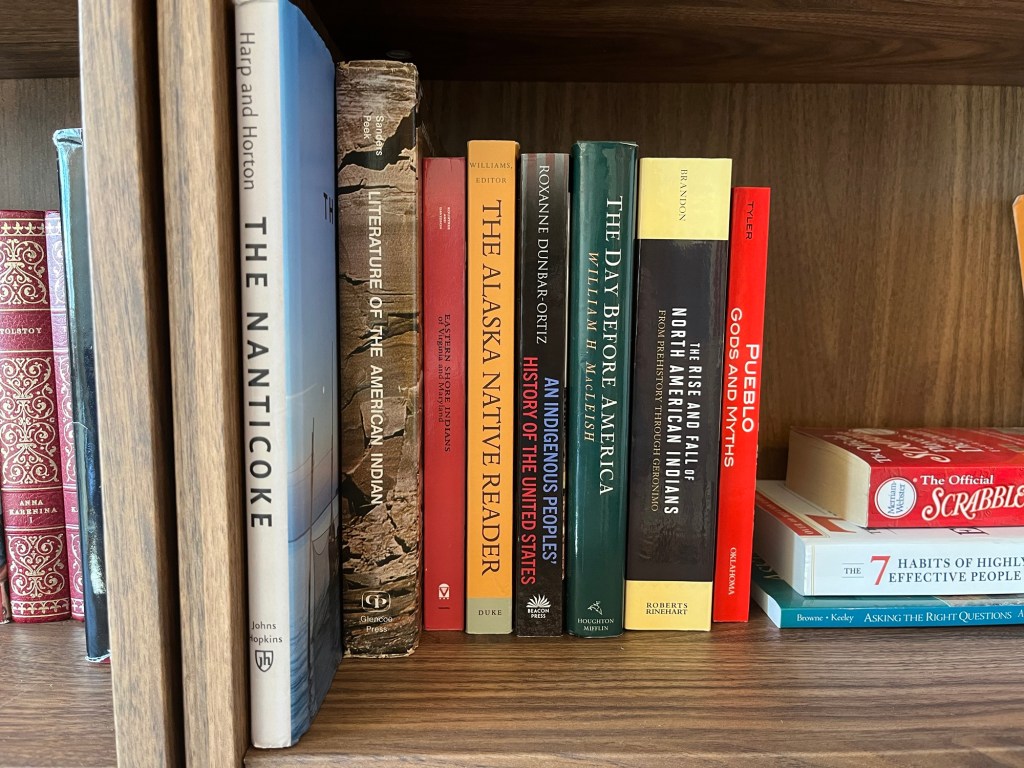
I’ve always been very aware of the fact that I live in a country built on stolen land. I am also deeply aware of the fact that my family, if they didn’t directly participate in it, at least bore witness to the majority of that history. My first ancestor in this country immigrated to Havre de Grace, Maryland in the 1640s when the Chesapeake Bay was very much still a contested space between colonists and the many nations that already existed here in that time. Following my family’s history, I also know that my ancestors moved West at some point during the 1800s. I may be mostly Ashkenazi Jewish, descended from those who fled Poland, Ukraine, and the surrounds in the 1900s, but that WASP heritage is still a part of my family history, and it’s never something I’ve wanted to shy away from grappling with.
It’s been a lifelong pursuit, trying to bridge the gap between the cheerful bullshit about our native peoples I was fed in school and some semblance of the actual truth of the matter. My focus has shifted around over the years. I became first aware of it as a little kid visiting my grandparents’ house in Santa Fe, New Mexico, which is a city where you’re never more than a block away from a piece of Pueblo culture. In high school, when I started getting really into linguistics, I became fascinated by the Athapaskan language family, and spent a lot of time studying Navajo and Slavey and various related languages. In college, my focus shifted toward political history, specifically the history of the nations near where I grew up. I poured dozens of hours into studying the history of Colonial Maryland (where of course my ancestors had lived), digging up the old treaties, learning about how complex the relationships were between the various peoples of the Eastern Shore and all of the horrible politicking that Maryland did to rip them apart. In particular, I did a lot of research on the Nanticoke tribe, who historically were on the lower part of the Maryland Eastern Shore, and still remain in parts of Delaware. More recently, I’ve been helping an Inupiaq friend research their family’s tribe and historical dialect, which has been extremely rewarding work.
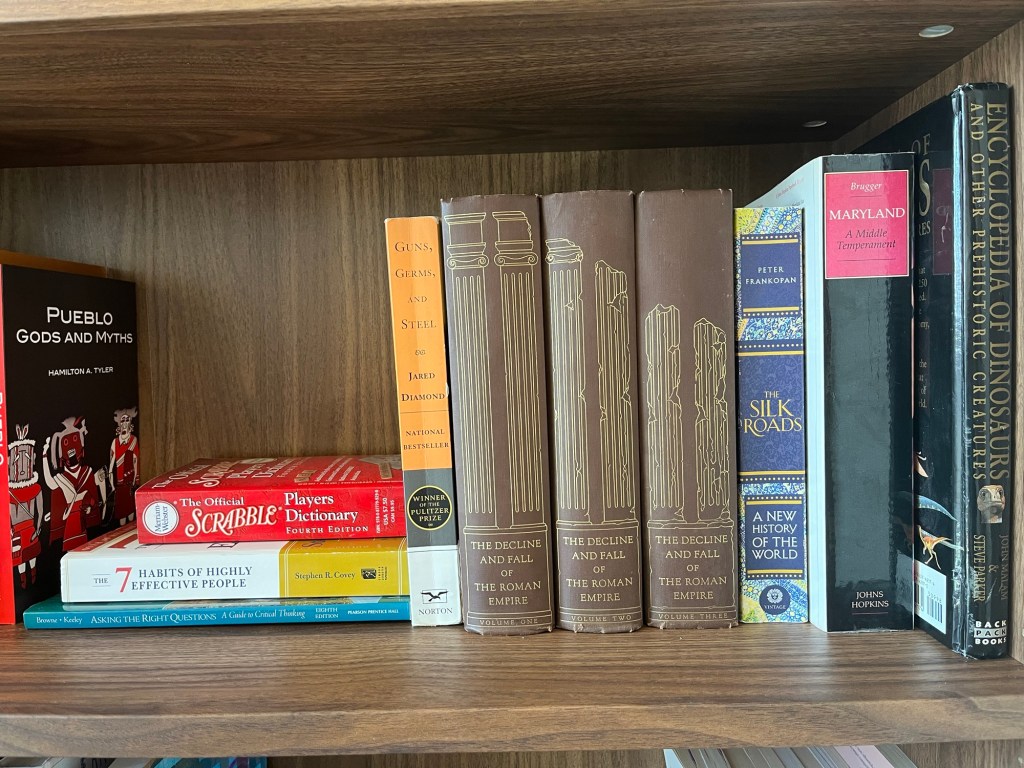
On the other side of that shelf, we’ve got some general non-fiction that didn’t really fit anywhere else. Most of it is history, including my three-volume set of The Decline and Fall of the Roman Emperor that I also got at The Unicorn Bookstore, but there’s also my Scrabble dictionary and my dinosaur encyclopedia (you never know when you’re gonna need your dinosaur encyclopedia).
Moving on to the final shelf!
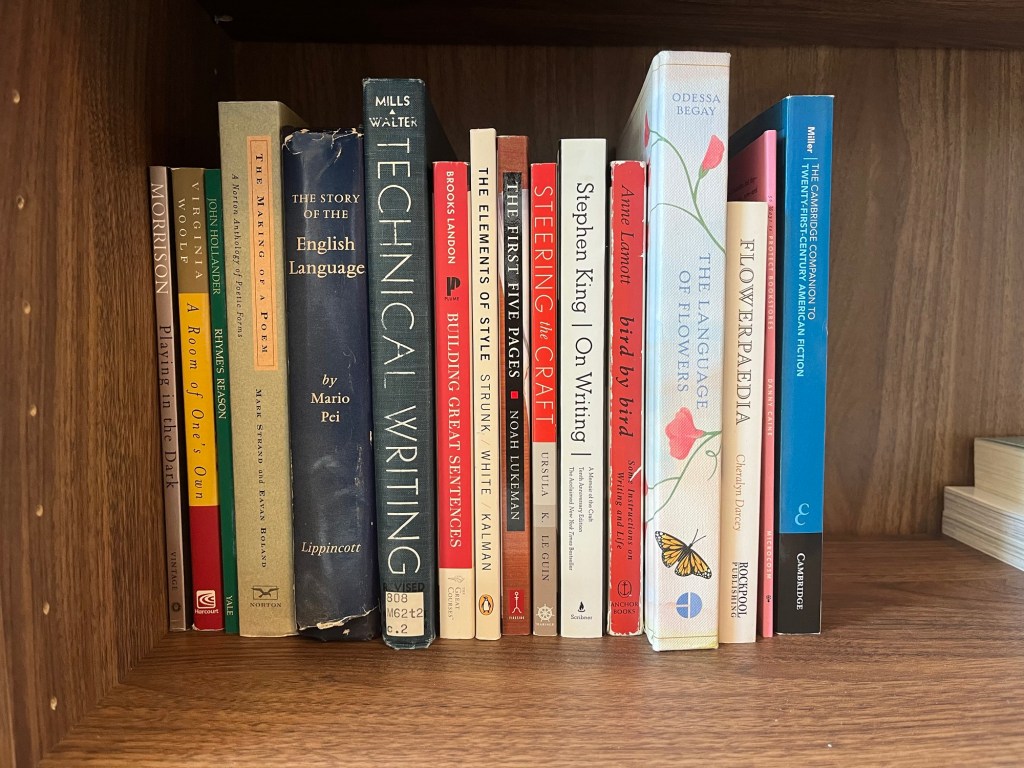
Here’s all of my ‘why the hell weren’t you an English major’ books! Most of them are what they say on the tin, but I’ve got four that I would recommend above the others:
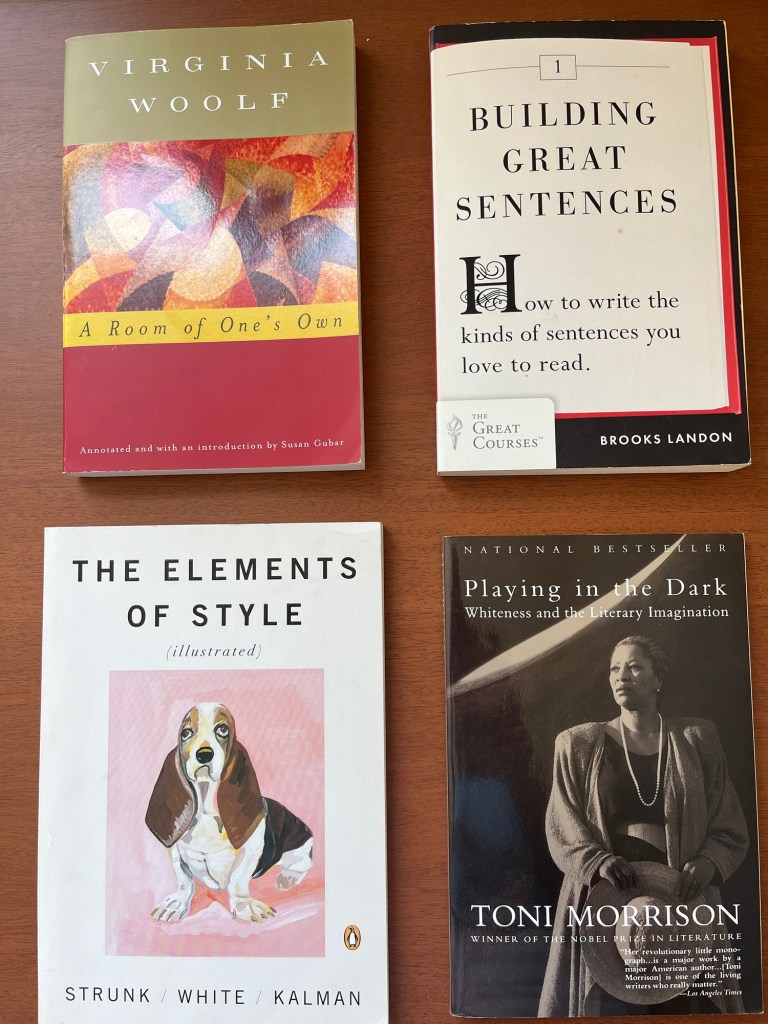
Two of these are criticism books; two of these are craft books. To the criticism, Virginia Woolf completely changed my perspective on what it means to be a (trans) woman writer. If you’re interested in this blog, you will get value out of it if you haven’t read it yet. To those who’ve read Woolf and still have an interest in the history of feminist literary criticism, I would also recommend that you go check out Mary Wollstonecraft and George Eliot’s “Silly Novels by Lady Novelists,” but I don’t have either of those in print. Similarly to how A Room of One’s Own changed my perspective on the intersection of gender and writing, Playing in the Dark did something similar for race. Besides, if you haven’t read Toni Morrison, you’re absolutely missing out. As to craft, Building Great Sentences is the single best book about the craft of good writing that I have ever read. It breaks down the technical aspects of a complex sentence, how to write one, how to make sure it works – it is utterly brilliant and anyone who wants to level up their prose should read it.
And, I mean, Strunk and White.
You can’t go wrong with Strunk and White.
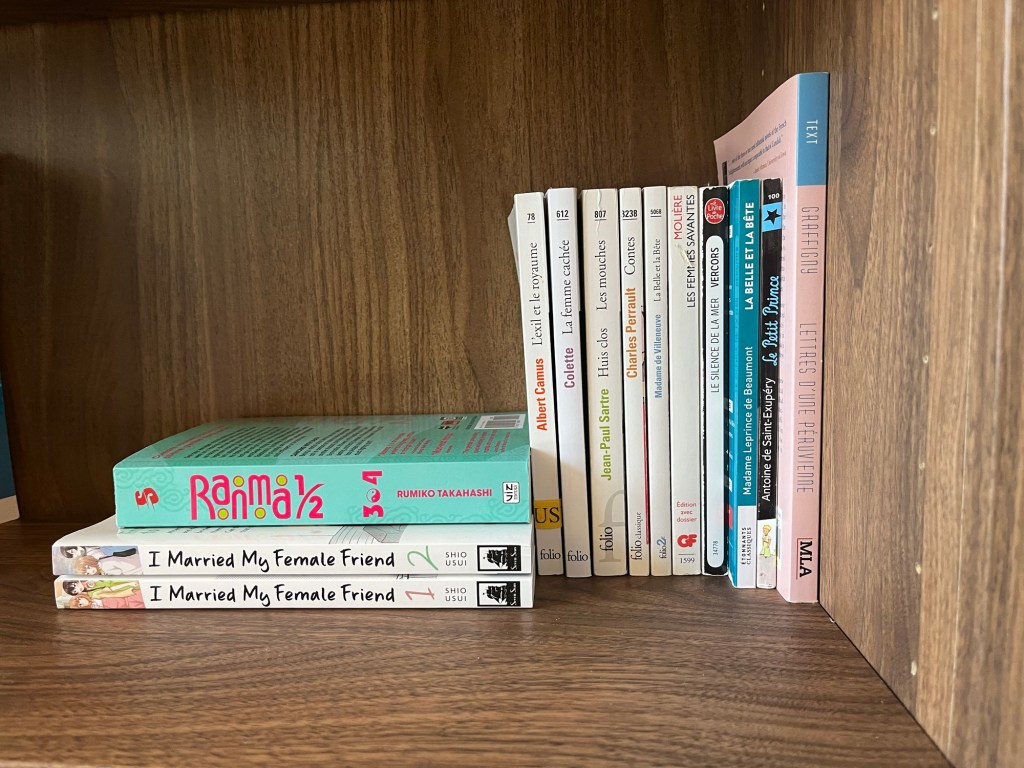
Finally, at the end of my bookshelf, we’ve got a small selection of foreign books. The manga is in English cause I can’t read Japanese, but all of the French books are in French. I should be a case study for the failures of the American foreign-language education system lol. I took eleven (11) years of formal French education, and I do not think that I ever even reached what could be called proficiency lol. I can muddle along but I don’t think I’ve ever had a conversation in French where I haven’t made a total fool of myself. “Franglais” was the word my teachers always used to describe my particular ailment. In 11th grade, my teacher would rip my essays up in front of the entire class because they were so bad. I sincerely apologize to the people of France – I really did try! My brain always recognizes the vestigial architecture of medieval French within English grammar then substitutes that fancy archaic English grammar whenever I’m supposed to have modern French knowledge…. Oh well. At least I’ve got some cool books to show for it.
And that’s about it! I’m really happy with the way the shelves turned out. Maybe I’ll look into getting fairy lights or something, and then I can really live up that BookTok aesthetic.
Let me know which of my books is your favorite in the comments ❤
Cheers, Beth
LAST WEDNESDAY: #1 – Kicking Things Off
NEXT WEDNESDAY: #3 – How to Find Books by Transfeminine Authors at Barnes and Noble

 The Transfeminine Review
Join the discussion! All comments are moderated. No bigotry, no slurs, no links, please be kind to each other.