
This article assumes that you have read “The Trans Literature Preservation Project: A Practical Guide to Resisting Censorship.” If you don’t have the spoons to read the whole article, here is a link to the section explaining what a microlibrary is and why it’s important.
- Introduction & Considerations
- You can build a trans microlibrary for free!
- Microlibraries can have any type of media
- You don’t have to make it alone
- This isn’t the moment for performative activism
- Do not exploit working-class trans authors
- Practice good digital hygiene
- This is urgent, but not a sprint
- Build that habit with your friends
- Take advantage of opportunities
- Microlibraries can be a tool of any liberation movement
- How to Start
- Stage One: Free Archival Work
- Stage Two: Using Your Wallet (For Readers)
- Stage Three: Using Your Wallet (For Collectors and Archivists)
Introduction & Considerations
Okay! The launch of our TLPP initiative has been wildly successful so far – thousands of people have either read or laid eyes on the article, and I’m already seeing a really great discussion about ways we can defend and preserve trans publishing against a hostile censorship regime. If you want to understand the why behind all of this, feel free to go reread (and download) that article! It’s meant to be a resource to be referenced and returned to, not a manifesto you need to binge in a single go. If you haven’t downloaded that article yet, you can do so at the link right here:
This article isn’t going to talk about what we’re up against at all. Rather, what I want to do is to help you start your own microlibrary! We’re going to make the process as accessible and streamlined as we possibly can, and to that end, I want to immediately clear up some key misconceptions about microlibraries that you might have.
You can build a trans microlibrary for free!
There is absolutely no financial investment or level of income required to participate in this work. As a matter of fact, some of the most time-intensive and important work will be preserving free online materials by trans writers, artists, and content creators. Moreover, there are a lot more free trans books on the internet than you’re probably aware of.
I can say with absolute confidence that I could create a trans microlibrary with hundreds of books in it and thousands of other serialized and underground works of fiction without spending a single penny!
So please don’t turn this into an expensive hobby you can’t afford, or feel like you can’t participate because you don’t have enough disposable income. Everyone can do this work, and the more people who do, the better we’ll be able to preserve trans literature as a whole.
Microlibraries can have any type of media
Did you know that your local public library probably has an expansive collection of movies, videos, journals, articles, and other non-book types of media? Yours can too. You can make a microlibrary of video games, or music, or obscure Youtube videos from the mid 2010s by trans Youtubers who haven’t uploaded in half a decade.
There’s no rules – it’s your library. So have fun with it :))
You don’t have to make it alone
This is a great project to undertake with friends, especially if those friends live close to you. Pool your resources, share your communal knowledge, divide and conquer. You may not be able to make much of a dent on the vast ocean of the internet on your own, but a concerted effort by a group of people can save an incredible amount of media.
This is doubly important if you have the means to purchase physical copies of books. If your entire polycule lives within five blocks of each other, then your money may be better spent if each person picks a different book to buy rather than getting five copies of Nevada.
This isn’t the moment for performative activism
Your primary objective here is to keep this books safe from state censorship and to retain vital access to trans creativity and thought for both yourself and your community. It is NOT for you to virtue signal on social media or to showboat about how many trans books you’ve gotten and how large your microlibrary is compared to everyone else. In fact, doing so may endanger both you and your library down the line.
If you’re talking about your library in a public setting, it should be for the explicit intention of spreading access to other trans people, and even then, you need to be careful about how you go about that.
Do not exploit working-class trans authors
Pirating indie books in the name of ‘literary preservation’ from small-time trans authors who need the income to pay rent is not progressive. This is a moment to give more support and direct mutual aid to your favorite trans authors, not less. If you’re spamming pirated copies of self-published books across the internet, then YOU are the problem – especially if you’re doing so before any form of actual censorship has come into effect.
We need to look at this issue from both sides. Authors need your support, but low-income trans readers also need to be able to access trans literature. In my last article, I outlined how trans authors and publishers can meet the needs of lower-income readers by using platforms like itch.io, which have built-in support for “Pay What You Can” programs, putting books on sale, and perhaps even directly distributing copies to readers who cannot afford them. Readers, make sure you’re looking for trans books through those channels if you can’t afford them otherwise. Disseminating literature can be a very powerful form of mutual aid.
Keep buying trans books from indie authors until the moment they are banned.
Practice good digital hygiene
You can check out the sections of my last article about the importance of this here and here. Some key points:
- Do not store your microlibrary in the cloud. If you have no choice but the internet, then you need to invest now in a good VPN and an encrypted foreign storage solution. I recommend Proton for this. You should be using a VPN regardless.
- Encrypt data on any flashdrive or external hard drive and password protect them.
- Make a plan to hide your microlibrary in unexpected locations or with other people in a worst case scenario.
- Having books in print is always a good solution.
- Make multiple copies and keep them in multiple spots.
This is urgent, but not a sprint
Please don’t burn yourself out by trying to download the entire trans internet in a single day. If you download fifty books on one day, get burnt out, and stop, then you’ll have downloaded way, way fewer books than if you download five books or pieces of media a day every day until they get banned. Like, a lot more. Don’t underestimate how fast a “five books a day” habit will build out your collection.
If you make a commitment to yourself today that every day, you will download three pieces of trans media and add them to your secure microlibrary, then by the inauguration, you will have downloaded 192 pieces of trans media that could be at risk of censorship before Trump even enters office. If even just 100 people commit to doing this, then our community will have preserved potentially up to nearly 20,000 pieces of media in that same timeframe.
Make it a habit that you do regularly on the side. Don’t spent all your time (or money) on it. You will still be doing intrinsically valuable work.
Build that habit with your friends
Even if it’s just one other person, making a collective commitment that you’ll both download three pieces of media a day can make both of you far more likely to succeed in actually doing it. Hold each other accountable, share notes. Division of labor is super important!
Take advantage of opportunities
Haymarket Books is currently giving out copies of ten of their most cutting-edge leftist books for absolutely free (which I would highly recommend my readers take advantage of, regardless of none of them being explicitly trans-focused). If there’s a deal, if you see a moment to grab a trans book, take advantage of it. You never know what you’ll be glad to have later.
Microlibraries can be a tool of any liberation movement
While I’m obviously running a website dedicated to trans women in publishing here, it’s important to recognize that my observations about censorship and our potential counter-tactics can be extrapolated to any marginalized group trying to organize under an oppressive regime. I would urge you to diversify and secure all your reading, not just trans books. Republicans have shown themselves to be perfectly willing to censor anything they see as even remotely “woke,” and just cause trans books are first up at the chopping block doesn’t mean they’ll be the last.
How to Start
If you’re like me and have big-time ADHD, then it’s likely that you also have problems with task initiation! I get it, y’all. But I’ve got good news – do you own a single piece of trans media?
Then you already have a microlibrary!
There is no “minimum size” for a collection of trans books. If you’ve got even a single copy, then you’ve already started doing this work. And if you don’t, then I’ll make it as easy as the press of a button to get started. I would recommend that you download an archive of every TFR article I’ve published so far, as well as Essays Against Publishing by Jamie Berrout, which contains more radical guidance about how to rethink publishing from beyond the frame of the centralized institutition:
Okay, you’ve got a library now :)) You did it!
Now we need to talk about what you’re going to do with it.
Step One: Assess what you already have
This is an important first task, not in the least because it may become important for you to be aware of what trans books you have in your possession down the line. Go through your whole library, it’s entirely possible that you’ll have more trans books that you realize.
Digital assessment is also important. Go through all of the files on your computer and identify what’s trans and what’s not. In my experience, we tend to accumulate a lot of random shit on our hard drives, and we need to make sure we know what we have that’s trans. Go through your downloads and documents. Take this opportunity to delete and shred anything you don’t need or want anymore.
Authors: This includes your manuscripts and drafts. If you’ve ever written anything textually trans before, you need to be aware of what and where it is. Try to collect as much of it as you possibly can. It does not matter how stupid or ridiculous it is. If you’ve written trans fanfiction, that counts here too.
Step Two: Figure out how you’re going to store your microlibrary
You need to figure this out before you start collecting and archiving in earnest. A book that’s stored in a secure location has a much better chance of surviving a strict censorship regime than one that’s kept on an unsecured harddrive or in a Google Drive.
You have a couple options here:
- If you have physical copies of your books, your obvious answer may be your bookshelf or home. Printing out digital materials can also be a great way to store them. Personally, I keep a binder with all of my writing in it – but big binders can be a great option for any material.
- A digital microlibrary can be kept on a thumbdrive or external hard drive. Make sure you encrypt the data and password-protect it.
- If you want to store your microlibrary in the cloud, you need to do so on an encrypted server that isn’t American-based. Get in the practice of only accessing that data from a secured device that uses a VPN. You need to encrypt whatever laptop you use to access it, and prepare to lose that access entirely in the future. Good data security is absolutely crucial – if you pursue this route, please do some research on best practices. This is by far the most dangerous of the three options under a scenario of severe censorship.
Step Three: Make your backup plan
If you need to remove your microlibrary from your home, where will you store it? If you need to hide your books, how will you keep them hidden? If you need a trusted person to hide them for you, who will that person be? If you need to jettison or destroy your books for your own safety, do you have a plan to do so?
Do you have the digital tools to protect yourself and your literature? Do you have the knowledge to do so? Do you have printing materials or extra drives? Do you have a plan for what to do if you lose access to the internet?
You don’t need an answer to these questions at this moment, but it’s good to start thinking about them before you urgently need to follow through.
Step Four: Find like-minded people to work with
It’s okay to ask people if they want to do things with you! If you have a trans friend, or even if you just casually know another queer person but never really connected with them, this is a great moment to start building or deepening that connection.
Another important observation – sometimes your biggest allies in this work won’t be your friends, and that’s okay. You do not need to be friends with them – or even like them – to work together toward your mutual interest in preserving trans literature. You’re doing it for the books and your community, not for them as an individual. Finding a kindred bibliophile to work with whose guts you hate but who actually does the work will be far more effective than pouring all of your time and effort into mobilizing a bunch of friends who don’t read and honestly don’t care if trans literature survives or burns.
Look for people who want to build a microlibrary because they like the books, not because they like you.
Step Five: Take care of yourself
It’s okay if this work isn’t for you. There are going to be a million fires to put out over the next few years, and you’re only one person. I’m doing this work because I’m deeply passionate about it – you don’t need to force yourself, and you don’t need to do something you hate purely because you feel like you’re supposed to. We all have our own skills and talents to bring to the table, and if your energy and effort is better served elsewhere, then by all means, you have my blessing to click off this article and go pursue it.
Stage One: Free Archival Work
I’m going to take a moment to lay out the sheer scope of the work ahead of us, so that you can get a sense of the magnitude of the challenge we’re facing right now. But before I get to that: be aware that there is a massive repository of free trans fiction and non-fiction on the internet that you can and should be taking advantage of. What I’m talking about, of course, is the website of the hour:
Trans Reads
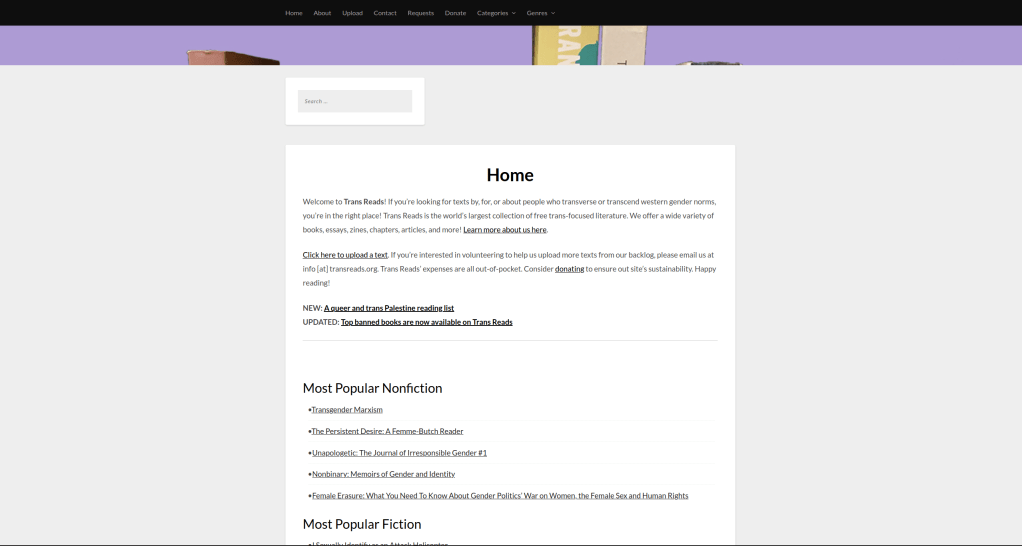
One of the things that I find the most mind-boggling is how few people realize that there is an entire free online library with thousands of trans books, including some of the most crucial texts of the last thirty years. Reading everything here would give you about the equivalent of a free degree in Gender and Sexuality Studies or Trans Studies. This is an immense resource, and is also likely to be one of the first sites to be forced to shut down in a worst-case scenario. You have access to this right now, though, and you should check out as many (or all) of these books as you possibly can!
This doesn’t just include novels and theory texts. There are also journals, magazines, articles, zines, and so much more. This website is the trans Library of Alexandria, and preserving just the books here alone could make a massive impact on the overall survival of the field of trans literature.
I’m going to go through and drop some links to core texts that I believe should be in everyone’s library, but I would heavily encourage you to take the time to browse the website thoroughly and make your own selections.
Even if you’re not an academic, there’s still a lot of value in having access to the academic theory that underlies Trans Studies as a field! That’s why I think every person who reads this, regardless of their feelings on the field, should get all three volumes of the Transgender Studies Reader, which includes some of the most critical core texts of transfeminism, including but hardly limited to “The Empire Strikes Back” by Sandy Stone and “My Words to Victor Frankenstein by Susan Stryker.
Julia Serano’s core trilogy of transfeminist works is also on here:
As are classic texts from Kate Bornstein:
And C. Riley Snorton:
And Paul Presciado:
And Patrick Califia:
And Leslie Feinberg:
And Susan Stryker (who obviously also edited the Trans Studies readers already cited):
And Andrea Long Chu:
And Jamie Berrout:
And Sylvia Rivera and Martha P. Johnson:
There’s also a whole bunch of memoirs:
- Conundrum by Jan Morris
- Redefining Realness by Janet Mock
- We Both Laughed in Pleasure by Lou Sullivan
- A Finer Specimen of Womanhood by Sharon Davis
And the trans Marxist book:
I’m not going to link nearly as much of the fiction, but there’s a lot of that on there too. The important thing is that many of the “canonical texts” of contemporary trans literature: books like Nevada, etc, can be found here:
Hopefully you should be starting to see why I don’t think it’s unreasonable for even someone who can’t purchase books to develop a really rigorous and meaningful microlibrary to fight back against state censorship.
I’ve said it before, and I’ll say it again: IF YOU HAVE THE MEANS, SUPPORT THESE AUTHORS. SUPPORT ALL TRANS AUTHORS. DON’T USE THIS AS AN EXCUSE TO BE SCUMMY TO MARGINALIZED AUTHORS.
For example, I do have the means to purchase these books, and have done so for a lot of them! If you can support trans authors, I would strongly urge you to do so.
On this single website alone, there’s an enormous amount of good work to be done. Link here:
Surveying the scope of internet trans fiction
Once we get out into the wild west beyond Trans Reads, however, our path forward becomes a lot murkier. I don’t think that many people understand the sheer scope of internet trans fiction, so I’m going to take a second to go site-by-site and sketch out for y’all the immensity of what we’re dealing with here.

Let’s start with the classics. At the time of writing this essay, Fictionmania currently has 47,966 stories on it. This is the classic TG/TF website and goes all the way back to the 90s, so there is an immense breadth and depth here that, as far as I know, has little if any archival work or documentation done for it.

TGStorytime was seen as a successor to Fictionmania when it first came out, and played its own pivotal role in the history of TG/TF. While many of the stories are crossposted elsewhere, there is a very significant chunk of its 5,932 stories that are not.
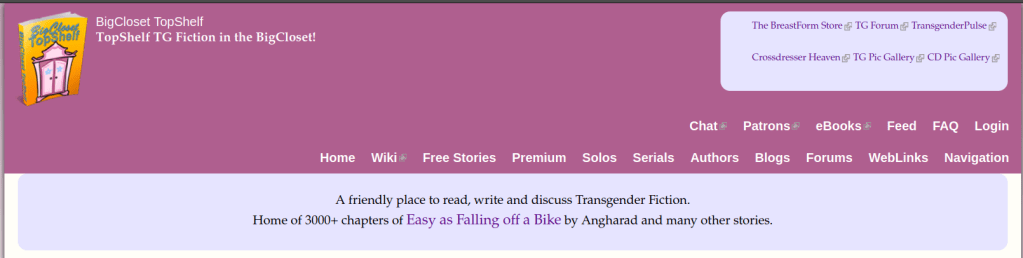
BigCloset TopShelf is a tough website to accurately calculate how many stories there are, given that authors tend to post one chapter at a time and are disposed to long serials. By my estimate, there are about 50,000 free chapters posted on the site – even if each serial has an average length of ~25 chapters, that would still mean that there are about 2,000 stores on here that would be at risk of getting lost permanently if the site went down.
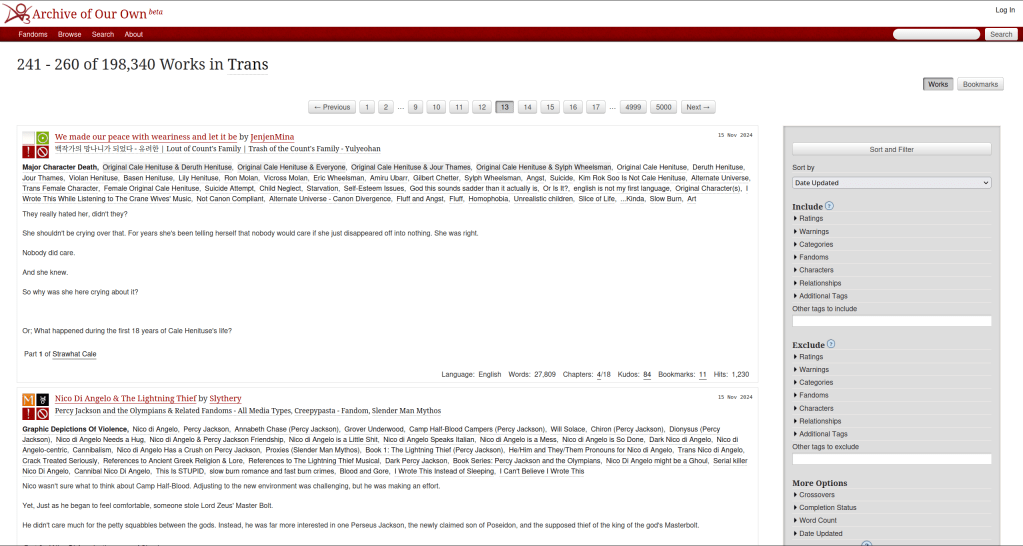
Yeah, this is the big one. There are almost 200,000 works of trans fanfiction on Archives of Our Own. And as someone who knows the trans fanfiction sphere really well, I can say with confidence that this is only a fraction of the broader scope of what’s actually out there.
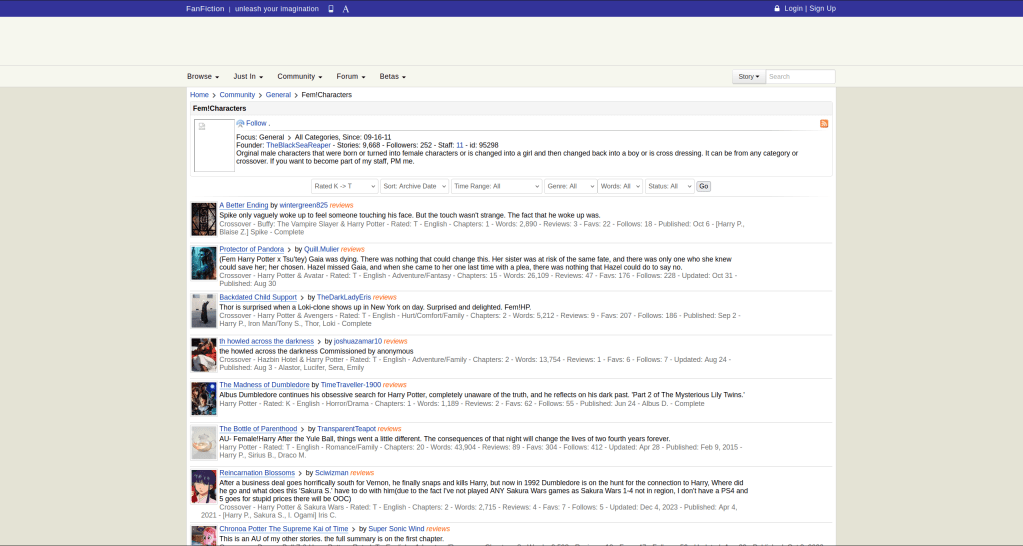
For example, the classic transfemme community on Fanfiction.net has 9,668 stories in it. And that’s just the stories with textual MtF genderbending – and not even all of them at that – which only scrapes the surface of what’s buried in the archive here. My guess is you could easily double that number, but we’ll stick with a very conservative estimate of about ~15,000 stories with trans characters or by trans authors.
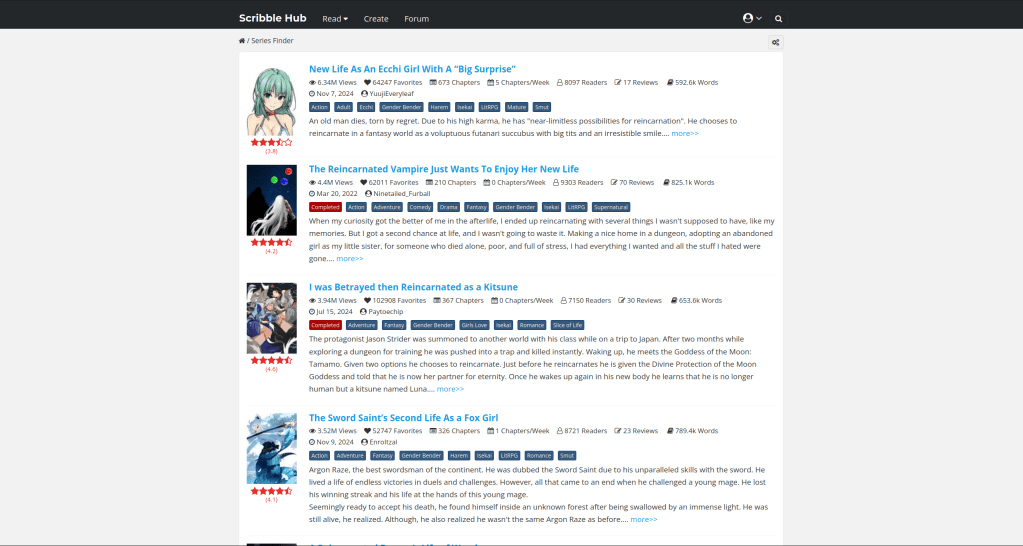
Scribblehub is another website where it’s really challenging to get an accurate headcount of trans stories. Trans works are both labeled under the “Gender Bender” category and the “Male to Female” and “Female to Male” tags, which are distinct and don’t have a clear way to parse out overlap. There’s about 2,950 stories in the Gender Bender category, so my estimate is that there’s something in the ballpark of about ~3,100 trans stories on Scribblehub.
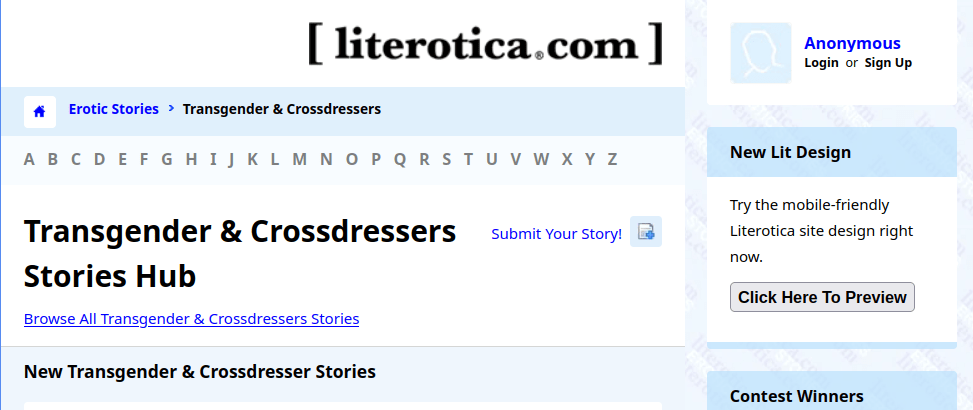
Look, nobody likes the “Transgender & Crossdressers” category of Literotica. It’s the absolute dogshit tier transphobia-ridden bottom-of-the-barrel tranny porn hellhole of the online trans fiction world. But that doesn’t change that there are 22,400 stories on this website, most of which stand at risk of deletion.

Nifty is one of the OG queer online fiction sites, and primarily focuses on gay men. It’s also completely impossible to count how many stories there are. But my ballpark estimate would be somewhere on the magnitude of ~2,000, many of which date all the way back to the 90s (!) and can be found nowhere else.
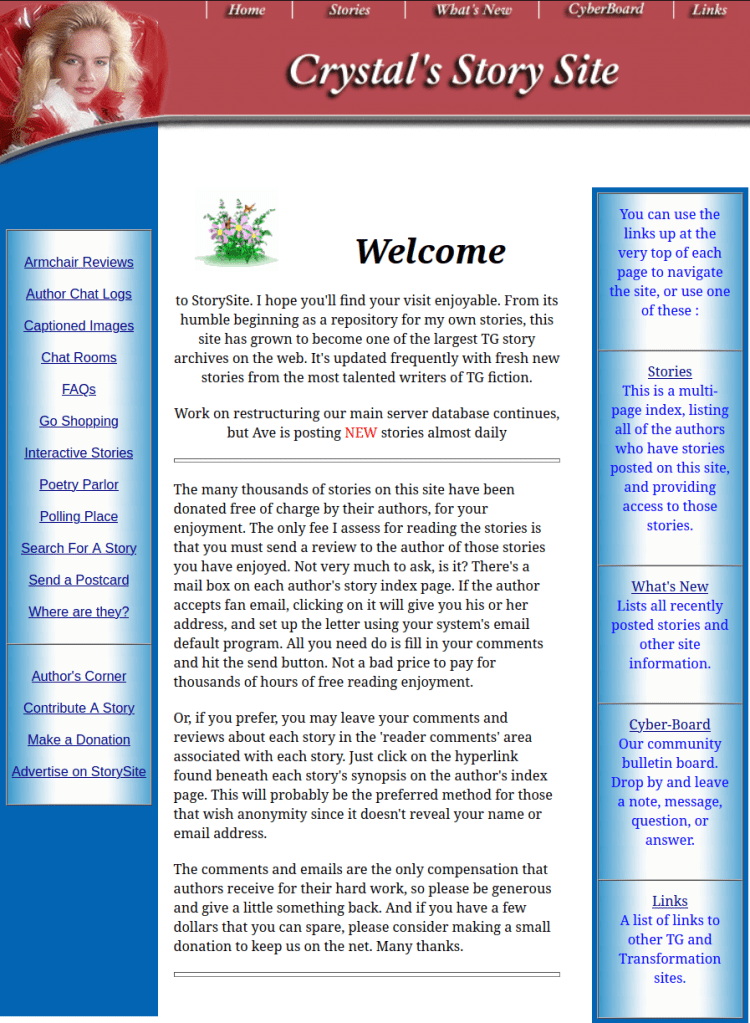
Crystal’s Story Site is another one where I have literally no idea how you would even begin to count the number of stories on here. It’s pretty vast. My estimate would be somewhere in the ballpark of ~2,000 to ~4,000, and I guarantee that just about nobody has thought about trying to save them since the aughts.
There are a lot more sites that I can reference here, but they’ll start hitting reposts and diminishing returns after this, so we’ll have to settle for these for now.
Doing the math
- Archives of Our Own: ~200,000
- Fictionmania: 47,966
- Literotica: ~22,400
- Fanfiction.net: ~15,000
- TGStorytime: 5,932
- Crystal’s Story Site: ~3,000
- BigCloset TopShelf: ~2,000
- Nifty: ~1,500
- Lots and lots of smaller/lesser known sites
Even at a conservative estimate of the scope of the field, there are more than 300,000 works of trans fiction scattered across the internet, all of which are at severe risk of deletion if the trans internet goes dark.
Look. There is a wild degree of contrast in the quality of these stories. Some of them are spectacular works of trans artistry, others are the literal slime of the earth and deserve to be shredded and forgotten by history. That’s not the point. The quality of the work doesn’t matter, precisely because a fascist will take a look at this entire corpus and say “I see no different between disgusting transphobic porn and that fluffy eggfic on AO3.” They won’t be selective about what they ban, and we don’t have the time to quibble about what “deserves” to be saved and what doesn’t.
I have no idea how to go about preserving a body of work this large. Here’s my advice: save anything you care about. Cover whatever ground you can. Unless you’re a hacker who knows how to scrape the content of an entire website and dump it in some offshore server that the US Government can’t touch, we’re only human and frankly you will not be able to save everything. So pick your battles wisely, and prioritize the work you actually care about. You can’t save everything, and neither can I – my only goal here is to inform people how much underground storytelling we stand to lose.
Stage Two: Using Your Wallet (For Readers)
As we’ve laid out, there’s a lot of work that can be done to preserve trans literature without spending a single cent. However, that doesn’t change the fact that there is a lot of literature that’s completely inaccessible without paying for it, and we need to make a plan for distributing and preserving that too. I’m going to lay out a bunch of best practices here, but here’s the most important one: spend within your means. If you can’t afford a book or a Patreon subscription, then you can and should focus on the free steps I laid out in the last section.
This is a big project, and we need people who want to focus on all stages of it. Your preservation work is just as valuable if you’re saving trans fanfictions on AO3 as if you join me in tracking down rare or expensive print editions of out-of-print novels.
Additionally, this is a really important moment to remember the key principle – build your microlibrary as though it’s the only trans literature you may have access to in the future. With free pieces of trans media, there’s no reason not to grab as much of it as you want – but when you need to spend your hard earned money, prioritize your favorites.
It might be noble to buy thirty obscure books in a genre you don’t like, but if that comes at the expense of access to your favorite book, then what’s the point? Remember that you’re not buying these books just to archive them, but to read them. Libraries are meant to be used, and your trans microlibrary should be no exception.
Build yourself a library that makes you want to curl up in your favorite chair with a cozy book and I promise it will pay you dividends.
Collect your favorites first
Are there trans books you adore but only ever read on Kindle, or from the library? That’s a great place to start building out your collection! Having a print copy or an EPUB of your favorite book is a great way to invest yourself into your library. Plus, you’ll be able to support your favorite authors, which is always an upside :))
Support the authors
If you already have secure copies of your favorite books, consider supporting the authors anyway! You can check out their other books, support them directly if they have a Kofi or Patreon, request your local library to buy copies, or follow them on social media. Buy a copy for your family or friends as a Christmas or Channukah present!
Go through your TBR (To Be Read List)
Continuing with the theme of ‘start with the books you’re excited about,’ this is a great moment to finally get around to reading those books you’ve been procrastinating on for years! Even if you aren’t going to read it immediately, you should try to get your hands on a copy now. The last thing you want is tot remember the book in a year, only to realize you can’t buy it anymore. There’s no ‘right’ way to go through your TBR – just pick whatever speaks to you and start there.
Practical considerations
Diversify Your Collection: Don’t have any books by trans women of color? Haven’t read a trans mystery or horror novel before? Are all of your books written in a particular style or genre? Now is a fantastic moment to broaden your horizons. Variety is the spice of life, and it’s always great to give yourself as many options and possibilities as possible. We all know the old adage, but a microlibrary is honestly a great reason to become a jack-of-all-trades.
Find Affordable Options: Platforms like itch.io offer ways for authors to run “pay what you can” programs for their books. If you’re willing to do a little extra research, it’s worth looking into all of the ways you can buy a book before you purchase it off Amazon. In particular, before you buy a book, see if you can buy it through either itch.io or Bookshop, both of which are more consumer-friendly and author-friendly than a major digital marketplace.
Don’t Avoid a Book Because You Think It “Isn’t Important Enough:” Again, we’re trying to preserve everything, not just the books that pass some inscrutable test of merit. Your favorite eggfic or fluffy little vignette isn’t “silly” or “superfluous” – it matters, and by all means, you should support both it and its author.
It’s Not Your Job to Save Everything: It’s not anybody’s job. Don’t put that on yourself. You’re making this library for yourself and your community, not some nebulous ideal or just cause. They’re your books – the most important thing is that you make them work for you, and not the other way around.
Looking for recommendations?
Here’s our “Start Here” page with dozens of good gateway books: https://thetransfemininereview.com/start-here/
Here’s a list of Black transfeminine novelists you should read: https://thetransfemininereview.com/2024/10/09/black-transfeminine-novelists/
Here’s a list of horror and paranormal recs that’re still awesome even after Halloween: https://thetransfemininereview.com/2024/10/30/spooky-books-halloween/
Here’s where you can find my spreadsheet of every transfeminine book I’ve ever read, including purchase links and my short reviews: https://thetransfemininereview.com/bethanys-masterlist/
And if you’re still looking for more and none of this is helpful, check out this guide on how to discover transfeminine fiction for yourself: https://thetransfemininereview.com/2024/09/18/how-i-discover-transfeminine-fiction/
Stage Three: Using Your Wallet (For Collectors and Archivists)
Okay, let’s be straight: everything I’ve already listed is a lot of work! Hell, it’s more work than our communities could probably do in a decade, and we should honest with ourselves about that. 99% of the people who read this article will have neither the resources nor the desire to participate in this step, much less the knowledge or means to know how to do so, and that’s okay. I’ll be doing this work, I know that others have already begun it too. If you’ve got disposable income and you want to join the effort, then I do still have some more advice for you.
Pick your lane (and stick to it)
Here’s what I’ve discovered from doing this work for almost two years – the more books you find, the more you acquire, the more books you’ll become aware of. Trans literature is a gargantuan iceberg, and once you’ve delved a little deeper, the sheer scope of what’s really out there becomes evident.
What does this mean? You can’t buy everything, and if you try, you’re gonna end up with a relatively shallow collection. Your goal right now should be depth, not breadth.
If you decide that you’re gonna preserve, say, the full catalog of an author, then that’ll probably have a bigger impact that preserving the most popular book from ten different authors. If you decide you’re gonna preserve as many trans romances as you can, you’ll probably have a bigger impact than if you attempt to save one book from each genre. If you decide you’re going to catalog every trans book that one publisher has ever published, you’ll probably have a bigger impact than if you buy two or three from each major trans publisher.
Remember that the books at the greatest risk of loss are the ones that the mass-market hasn’t discovered yet. Book collection and archival work is as much a search for the greatest novel nobody has ever read as much as anything else.
Self-published and indie literature needs extra attention
Anything that’s been published through a press stands a better chance at survival that a book published by the author alone. If you find a Kindle Unlimited title that also has a paperback, consider buying the paperback instead. If there’s a book that nobody has ever heard of with zero reviews, record it. It might be good, it might not, who cares – we’re casting a broad net right now, and trying to cover as much turf as possible.
This same principle also goes for indie presses. There are underground trans presses like DopplerPress and Reluctant Press with literally thousands of titles that most people have never even heard of, and most of their catalogs have no good free method of acquisition. Saving the entire catalog of a press like Reluctant would likely be an investment on the scale of tens of thousands of dollars, and I certainly can’t afford that! But that doesn’t mean we shouldn’t try to brainstorm possible solutions nonetheless.
I’ve compiled an incomplete list of trans indie presses here: https://thetransfemininereview.com/2024/10/02/trans-forward-publishers/ You should be aware that this is only some of the many trans presses, though.
You can invest on the digital side too
We need people who understand server infrastructure and digital security and a thousand other pieces on the tech side of this puzzle. Creating a safe space for trans archival work can matter just as much as doing the work yourself.
Direct action and mutual aid are lifelines for trans authors
At the end of the day, if you’ve got some wealth to dispose of and genuinely want to help the transliterary community get through the next few years, the best thing you can do is support authors directly. Many authors have a Patreon, a monthly subscription site that helps to fund their art and support their survival. Ko-fi, Paypal, and other sites let you donate directly. Many authors have GoFundMe or Kickstarter campaigns for various needs, and you can make a big impact by donating to those. Making money as a trans person in the publishing industry was already a hostile prospect before this latest political turn, and trans authors will need your support now more than ever.
Communicate with our field
You don’t – and probably shouldn’t – do this work alone. If you need help figuring out what to invest your money and time in, then you should absolutely reach out to trans people and ask them for guidance and ideas. We want to facilitate your interest in transliterary preservation, so don’t be shy about it either (though you shouldn’t be rude, obviously).
We don’t really know what’s out there
The scope and historical fabric of trans literature seems to expand with every day of research I put in on the topic. I can honestly say that I have no idea how much work there is to be done. What I do know: we can’t preserve anything that we didn’t know needed saving in the first place. Our archival work right now isn’t just securing and preserving the trans literature we already know about – it’s also a matter of finding what’s even out there.
Get creative with it. Discover new books, and tell people about them. I’ll be at the front lines right alongside you.
Okay, that’s all I’ve got for you today! I’m still pretty drained from the last article TBH, but I wanted to make a quick follow-up to give people some more pointers and tools about what building a microlibrary might look like. If you’ve got any questions, please don’t hesitate to share them in the comments! This is a communal activity, and I want to help you figure out how to get started with this super important work 🙂
One of my editors, NobleHeroine (Aly), who understands more about tech than I do, will be posting an article with digital advice in the coming weeks, so keep an eye peeled for more information on how to download, store, and preserve whatever archival data you do collect.
Cheers, Beth.

 The Transfeminine Review
Join the discussion! All comments are moderated. No bigotry, no slurs, no links, please be kind to each other.