This article has been translated into French by Alex Sirac! Lire en français: https://alexsirac.com/soutenir-la-litterature-trans-sans-les-gafam/
- Let’s Go ‘Analog’
- Step One: Make an Encrypted Email Account with Proton Mail
- Step Two: Subscribe to Mailing Lists like They’re Social Media Accounts
- Step Three: Start Building a Vetted Contact List for Direct Communication
- Step Four: Go Offline
- Conclusion
Happy new years, all.
On Monday, Donald Trump was officially certified as the 47th President of the United States, and the shadow of his inauguration in just two short weeks is hanging over the entire trans community, especially those of us in America. Between Florida’s recent court decision that mandates detransitioning transgender inmates (Link), Congressional Republican’s transphobia-forward agenda (Link), and Meta’s new explicitly anti-trans content guidelines (Link), all warning signs for a widespread anti-trans backlash are blaring bright red and sounding their klaxons, and they have been for a while now.
In November, I published an article entitled “The Trans Literature Preservation Project: A Practical Guide to Resisting Censorship,” where I laid out a comprehensive action plan for resisting several potential degrees of anti-trans censorship under the incoming administration. It’s my hope that reading that piece has motivated you to take some preemptive action so as to not be caught flatfooted by a worst-case scenario – I know that many have already begun, and it’s been a real joy to watch so many people take literary presentation and the hard work of free speech and expression into their own hands. I followed that article up with “How to Build Your Trans Microlibrary,” which focused more on the acquisition and storage of books, and my editor NobleHeroine has since begun her “Archiving Your Trans Microlibrary” series, which digs deeper into the complicated considerations of digital archivism.
If you’re been paralyzed by the weight of it all or procrastinating your ass off, it’s not too late to start now. What I want to do today, however, is to shift the focus from books to communication channels.
As it stands right now, the transfeminine literary community is heavily reliant upon centralized third-party internet hubs to develop, organize, and market their work. While websites like Bluesky are undeniably better than anything run by Meta or Xitter, they remain severely vulnerable to crackdowns by authoritarian governments, bad-actor corporations, and transphobic malfeasance. So long as transfeminine authors lack a viable business model without social media and its assorted apparatuses, their work and lives stand at a exponentially more severe risk of erasure.
Do you have a business plan for a total age-restriction or ban of trans topics on social media?
That’s a realistic question that trans authors (American or not) need to be asking themselves right now.
I said this in November, and I’m gonna say it again now: it is imperative that we start laying the groundwork for this before restrictive legislation gets passed. Even if the Republicans flounder around for the next four years and get nothing done, the action I’m going to propose in this article can be carried out regardless, and will generally be good practice even if it never becomes necessary.
Let’s Go ‘Analog’
Long before social media was conceived, trans organizers were making real, meaningful change by organizing our communities through the mail.
This is an old tradition – in this article, I touched on the origins of mail-based trans publishing and organizing; suffice it to say, the history of trans organizing in the post goes back to the 19th Century. Much of modern national trans organizing can be traced back to the work of Louise Lawrence, a transfeminine activist who built an enormous mailing list of crossdressers, transvestites, female impersonators, homosexuals, sexologists, and transsexuals in the 1940s and 1950s. Lawrence was the architect for many of the most crucial connections of her era – she worked with Kinsey, Bowman, and Benjamin, she used her mailing list to pioneer the magazine Transvestia (which would then be coopted by Virginia Prince about a decade later). When we talk about a “transgender community” in the United States that exists on the national scale (as opposed to regionally or locally), that is in no small part due to Lawrence’s decades of correspondence with trans people around the world.
Now, in the year 2025, I’m sure that many people would bristle as much as me at the idea of one person collecting a massive list of physical mailing addresses. But just because snail mail isn’t viable as it would have been thirty years ago doesn’t mean that we should overlook the insights of successful organizing campaigns past.
Here’s the fact of the matter: social media is an incredibly powerful tool for publishing and marketing, but it is not the lifeblood of the publishing industry. Underground trans fiction had a viable business model before the advent of the internet, and it can have one even after the internet is gone. Capitalism constantly instills within us a hostility and distrust of any technological “regression” – perhaps our unthinking thereof must begin with a recognition that just because a technology is simple (email, the post) doesn’t mean it should be overlooked.
This does NOT mean that all forms of email are equal right now. If you are investing your author platform into a Gmail or Outlook account, you are no less dependent on the whimsies of a tech monopoly than if your marketing relies completely on your Instagram.
Fun fact: Google scans every single email that comes in and out of your inbox, and keeps a permanent record thereof in their system. Their system is not encrypted, and they use third-party companies to provide scanning services! They are, in a word, not secure.
What the transliterary community needs right now is a robust backup network of secure mailing lists, author newsletters, and community-run and curated listservs that can act as a rigorous failsafe in case Trump decides to roll into office and pass a KOSA-like bill within his first few months. There are a lot of working-class trans authors who rely on a global readership to support themselves, and it falls upon us, their readership, to establish a community norm of newsletter and mailing list subscriptions. If we do, then no matter what happens to major platforms like Bluesky, Scribblehub, itch.io, Patreon, and all of the other places we’ve been using to connect and communicate, the connections between readers and trans authors can continue to grow regardless.
The necessity of this shift goes beyond trans publishing. Trans mailing lists have been a vital lifeline of news, advice, and lifesaving community support for decades if not centuries, and it’s a time-honored tradition that our generation needs to practice once again.
In this article, I’m going to walk you through a series of simple steps you can take to build this infrastructure. While there are some extra steps for authors (namely advertising your mailing list while it’s still easy to do and creating one if you haven’t), this is advice for everyone and generally good practice. So, without further ado:
Step One: Make an Encrypted Email Account with Proton Mail
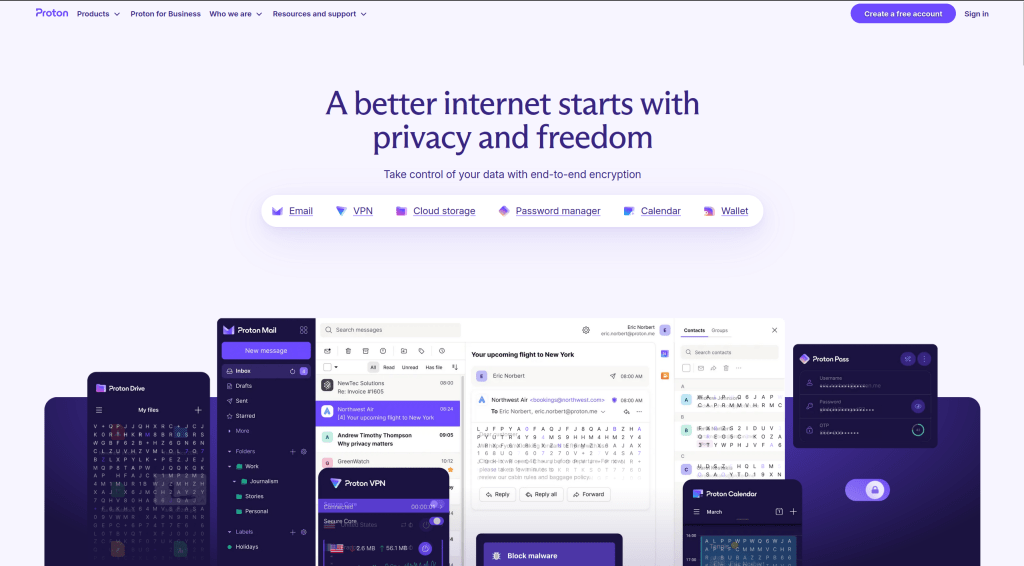
Why should I use Proton? Note that this isn’t sponsored – from all of my research, this is what I’ve arrived at being the best and most secure option if you’re looking for an email alternative. Here’s the main selling points.
- It’s free. You can make a free account at no charge, and while there are additional safety features and services that cost extra money, the end-to-end encrypted email account (i.e. your primary place to receive news and updates about trans fiction) is completely open to general use.
- Proton is a Swiss company. Switzerland has some of the best privacy laws in the entire world, and it is one of the places least likely to be affected by whatever a Trump administration or American tech monopolies may try to pull on the international scale.
- If you decide to upgrade, the paid features are worth it. Proton also has its own built-in password manager, aliases that can mask your email from third parties for extra privacy, a Google Drive/OneDrive alternative, and a VPN that I’ve been using for months now.
You can find a full breakdown of the pricing plans (including the free one) here. My advice would be to sign up for the free account first, read the rest of the article, and then worry about the plans afterward.
Oh, and here’s one last thought – protect your anonymity. Don’t make your handle “firstname.lastname@proton.me.” I promise you that there are better options.
Communication is king, and end-to-end encryption is Operational Security 101. Messaging to and from an encrypted email account will be one of the safest way for trans authors and readers to communicate if social media really goes down the tubes.
Step Two: Subscribe to Mailing Lists like They’re Social Media Accounts
This goes without saying, but I’m going to say it anyway: Use your encrypted email to do this. If you’ve already subscribed with your Gmail or Outlook account, subscribe again. If you have a premium account, I would recommend making an alias and using that to subscribe.
I would advise you (at least for now) to think of your Proton account as a social media account if you don’t feel like fully switching over to a new email provider, which is a pain in the ass. I am not telling you to relocate your entire digital life. If anything, the purpose of this account is to curate for yourself a personal feed of trans news and trans books, much like you may already be doing on Bluesky or the like. It’s a resource and a failsafe, and it is entirely up to you how you want to curate it.
(If you already use Proton as your primary email, then congrats, you don’t have to fight the ‘but Google is more convenient how will i function’ brainworms)
Most authors have mailing lists or newsletters. Most websites have mailing lists or newsletters. Most publishers have mailing lists or newsletters. Most organizations have mailing lists or newsletters. Most bookstores have mailing lists or newsletter.
In curating your feed, you’re gonna have two primary goals you want to accomplish:
Goal #1 – Keep access to your favorite authors, publishers, critics, and news sources under a censorship scenario. You want to continue to support them, and they’re still gonna need your support, whether you can reach them or not.
Goal #2 – Gather as many local queer resources as you can. Research the authors, orgs, and bookstores in your area, and prioritize them before more national and international lists.
Here’s my recommended order of operations:
- Go find your favorite authors first. Hell, if you aren’t already on their newsletter, you’re probably missing out! More of what makes your favorite author awesome – what’s not to love?
- Find queer bookstores in your hometown or places you frequent. You need to know where you can buy queer books if the internet becomes more hostile, and queer bookstores are often a vital portal to local trans communities. Look for queer bookclubs too. If there are any local trans orgs near you, see if they have a mailing list. You want to collect as many local resources as you possibly can – places where you can go, physically, with your body, and find either community, help, or trans literature.
- Seek out trusted third party sources who can gather and disseminate info from lots of other sources. Journalists, critics, community leaders, people who will have access and connections to more people than you will – that’s where you’ll get a lot of value here, even if you aren’t directly interested in their work.
- Go wild. Go down the list of trans authors you follow on Bluesky and subscribe to all of their newsletters. You can go to my Masterlist to find the website of every author whose work I’ve personally read. Cast a wide net – you have no idea what you’ll want to read in the future. Just don’t skip straight to this step – take it slow, gather your essentials first.
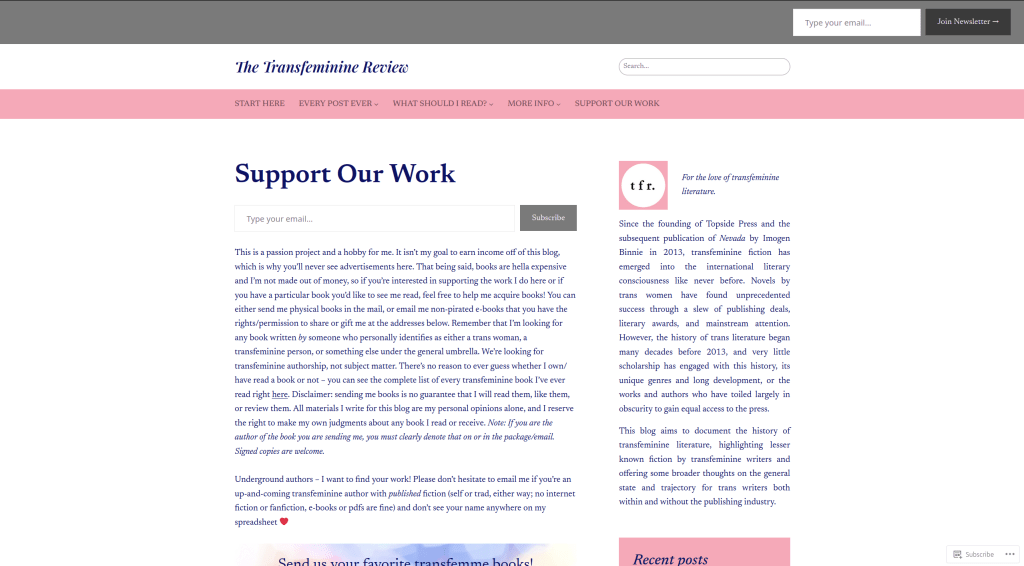
And, of course, I would be remiss not to point out that you can subscribe to email updates about new articles from TFR here:
For authors: Obviously if you don’t have a newsletter yet, I would strongly recommend that you make one and start pushing it hard to your social media followers. It is one of the most effective ways to build up a dedicated fanbase that doesn’t rely on search algorithms or social media engagement.
Remember: most newsletter providers are still third-party American tech companies. While this is a better solution than social media, it doesn’t change the fact that a newsletter company still can and will kick you off their platform if you violate their terms and services. Newsletters are a solution, and they’ll outlast social media because they are by nature decentralized (and also most people don’t pay attention to them lol), but they are not a true safe haven.
There’s also a non-zero chance that they may be owned by one of the tech conglomerates, so make sure you’re checking that.
If you’re trying to figure out the best newsletter provider to use, I don’t have personal recommendations, but I would advise you to look for providers that are non-American companies. Look for jurisdictions with good data privacy laws. People who run newsletters will probably have advice.
Ultimately, though, our goal is to cut out as many third-parties from the tech equation as possible. Which is why…
Step Three: Start Building a Vetted Contact List for Direct Communication

We all love our mutuals. They’re there for our shitposts, our book announcements, our horrible discourse diatribes – all of it. But ask yourself this: if you and your trans mutuals all lost complete access to social media today, would you be able to find each other? If your trans friends lost complete access to social media, how would you contact them?
I want you to make a secure email address not just for you to subscribe to newsletters, but to stay in touch with each other. We don’t have to carry around our email addresses in our pockets like we do our phone numbers.
Let’s bring back the age-old art of letter writing, baby!
The best and most decentralized way to keep in literary community is to take your communication directly to your audience. Tech billionaires over the last 20 years have done a really, really good job at peculiarizing the notion of direct interpersonal communication. Why would you email your friends when you can scroll through their Twitter feed? Why would you send them a photo when you could post it on Facebook? While email still gets used for impersonal business communiques and close friends and family, there is an entire middle ground of loose acquaintances and friends who’ve been cut completely out of the picture.
Emails can have just as much vitality as a tweet or a meme. Remember chain emails?
Here’s the point – if things get really bad, we could lose not just social media, but also author websites, third party newsletter access, and more. Email is a simple, elegant solution; it’s a tool that you’re already using, the newsletters and listservs have just been automated for you by a tech CEO who’s trying to turn a profit, and they don’t have to be. We can still put community over convenience and capital. Email is hardly infallible, but it’s a fallback. It’s another layer of protection. It is certainly not the first place they’ll go after, and will likely remain a viable avenue for marketing and communication long after the rest of the trans internet falls apart.
If Louise Lawrence could do it in 1945, then you can do it now too.
The most critical thing is to keep these networks decentralized and private. I’m not gonna compile a list of ten thousand trans readers, and you shouldn’t either. In theory, so long as a trans person is connected to the social network by even a single contact, they still have access to everyone. It’s social media distilled down to its purest form.
If you have trans friends on the internet and you want to make sure you stay in touch, ask them to make a Proton account too and share your contact details as a backup. Exchange contact information with your publishers, your agents, your author friends.
There’s a lot of creative things you can do with this, and I’m not going to list most of them here.
Authors, it’s worth brainstorming contingency plans for your newsletter if you have to relocate to a different mailing service for whatever reason.
If you are a trans author, an industry insider, mutuals with me on Bluesky, or a Philadelphia-based trans reader, please send an email from your Proton email to tfrmailinglist@proton.me and DM me on Bluesky from your proper account once you have so I can confirm you’re you. I want to be able to continue supporting and sharing your work no matter what goes down in the US over the next few years. Trans Philly readers, let’s connect ❤
Step Four: Go Offline
Join a bookclub. Volunteer with a local queer group. Email mutuals who live near you and meet them IRL.
At every stage of this process, you should try to make an intentional effort to focus your efforts locally. Find your local authors, your local bookstores, your local fellow readers. Make community wherever you go. If you’re in a major metropolitan center, there is almost certainly a queer community that you can engage with. If they haven’t discovered trans literature yet, you can be the one who introduces them to it. Find other trans people near you. You don’t have to go this alone.
Right now, we have an incredibly powerful tool in the internet to find likeminded people who live near us and share our interests. It’s absolutely imperative that we take full advantage of that while we can.
Conclusion
As with most of the guidance I’ve offered during this strange interregnum between Biden and Trump Two: Electric Boogaloo, we don’t know what’s ahead of us, and all of this may be rendered moot in coming years. It’s entirely possible that come 2028, I’ll still be happily posting away on Bluesky and all of this will seem like an overreaction.
But, if it’s not, I want all of us to be as prepared as possible, and that means equipping ourselves with the skills and technology to deal with whatever comes next.
To summarize the points of this article in brief:
- Make yourself a free Proton Mail account. It takes less than five minutes and costs you absolutely nothing.
- Take a couple minutes and go subscribe to mailing lists from your favorite authors, critics, websites, news sources, and publishers. Then tomorrow, go subscribe to a couple more.
- Share your new email with your trans friends, and anyone else who you want to keep in touch with no matter what happens over the next four years.
- Authors, Industry People, Mutuals, and Philly Trans Readers: Drop me a line from your Proton email at tfrmailinglist@proton.me and DM me on Bluesky once you have.
- Find opportunities to nurture local trans community, and bring trans literature into your towns and homes.
Thanks so much for reading, and we’ll see you on Friday with an exciting guest column from Roz Milner reviewing Disobedience by Daniel Sarah Karasuk!
LAST WEDNESDAY: #9 – Three Things You Can Do Right Now to Combat Anti-Trans Censorship

 The Transfeminine Review
Join the discussion! All comments are moderated. No bigotry, no slurs, no links, please be kind to each other.