Before we begin – The Transfeminine Review is now on Patreon! If you want to help us continue to produce vigorous public scholarship like this, please consider supporting us there.
This article was made possible by our Sponsors!
Note: this is a very long article (around 47,000 words) so please use the table of contents below to help navigate. Also, just a general trigger warning for all of the slavery, genocide, and other horrors that come with the Antebellum Period. It’s grim.
- The Trojan Horse of Modern Conservatism
- The Birth of Fascist Censorship in the Deep South
- Deportation and Ethnic Cleansing in 1830s Missouri
- St. Louis, MO: America’s First Crossdressing Ban
- New York State: Revolt, Repression, and the Myth of the ‘Masquerade’
- Columbus, OH: Popular Sovereignty and the Election of 1848
- The Dred Scott v. Irene Emerson Case of 1838
- Bentonites, Barnburners, and the Democratic Schism over Slavery
- Dickinson, Cass, and the Convention of 1848
- How the Democrats Flipped Ohio in 1848
- Ohio’s Original Constitution
- The Marion Riot of 1839
- The Jones v. Van Zandt Case of 1847
- The State of Ohio v. Forbes and Armitage Case of 1846
- Ohio’s New Constition and the Expansion of the (White) Judiciary
- Nashville, TN: “The Grand and Noble Scheme”
- Chicago, IL: Black Laws and the Birth of a Nation
- Support Our Work
This is the fourth essay in our A Brief History of Transfeminine Literature series. You can find the first essay “The Moral Origins of Obscenity” here, the previous essay “American Evangelicalism and the Ineptitude of the Whig Party” here, or a complete series listing at the end of the essay.
The Trojan Horse of Modern Conservatism
Transphobia – it is a political imperative, a legal ideology, and it has not always existed. Just 200 years ago, anti-trans sentiment was far less articulate or cohesive than it is today. As with any legal movement, the origins of anti-trans law in the United States can be directly traced, and doing that work is absolutely crucial to anyone seeking to fight back against it in our modern day.
Writing this article has been a struggle for me – this whole series has taken an extraordinary amount of emotional labor, but this part is particularly challenging. The Antebellum Era, the Civil War, the failures of Reconstruction; it’s fucking heavy.
But we need to remember the past, now more than ever.
One of the primary reasons that the last three articles in this series were so long is because I am going to be drawing on them extensively to help piece this argument together. This is both the longest and the most important essay in this series, and also one of the most undertheorized areas of modern trans studies. I’m going to do my best to earmark the places where I’m referring back to past discussions, but please know that you’ll have the best reading experience here if you’ve already read the last three parts.
Take a deep breath. Here goes nothing.
Peelian Conservatism in the 1820s
Over the course of this series, I have been introducing you one-by-one to the white men who are responsible for transphobia in the modern world. It brings me absolutely no pleasure to bring us up to the next one, one Sir Robert Peel, Prime Minister of the United Kingdom and father of the British Conservative Party. Robert Peel was a contemporary and a political opponent of John Campbell, the man responsible for the Obscene Publications Act of 1857, and he was also a prominent opponent of the Reform Act of 1832 (which Baron Campbell helped to push into law). We discussed both of those laws in Part Two and they will both be relevant in this article, so go back and reread that section on Baron Campbell if you need a refresher.
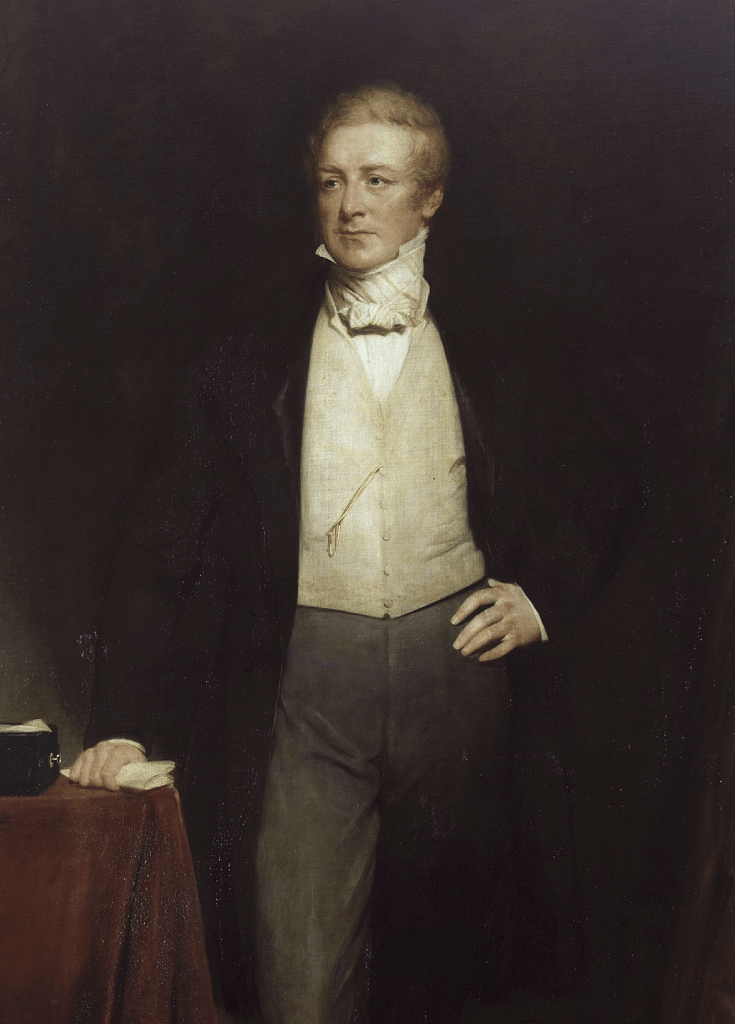
Let’s cut straight to the chase – Robert Peel essentially invented modern policing, and he is the man who formalized the death penalty for sodomy and buggery in the UK. He was a major actor in many of the policies we discussed in “Trans-Atlantic Relations” from the Whiggish point of view, and thus it now falls upon us to recant them from the perspective of the other side, i.e. the Tories, opponents of abolition and moral reform alike.
In Part Two, we discussed how the first British obscenity statute was passed as part of the Vagrancy Act of 1824, which was created in explicit opposition to French Jacobism and sought to suppress homelessness and crime from refugees in the wake of the Napoleonic Wars. As we discussed earlier, William Wilberforce was a staunch opponent of this act, which he saw as too harsh on the homeless. Unfortunately (and still resounding to this day), Wilberforce fell ill right before the vote and wasn’t able to oppose it on the floor. One of the many societies that had sprung up in the model of Wilberforce’s Society for the Suppression of Vice (which would become one of the primary drivers of anti-trans censorship) was the Society for the Suppression of Mendicity, which was supposedly aimed to reform the issue of “begging” but in reality drove a broad wave of criminalization against the poor. Founded in 1818, the Society for the Suppression of Mendicity offered the following objectives in its first publication:
It will be recollected that in the early part of the year 1818, a very powerful impression was made upon the public mind by a sudden and alarming increase in the number of Vagrants in the Metropolis.
Groups of miserable objects, many in the garb of seamen, others in a state nearly approaching to nudity, thronged in our principal streets, or were found, night and day, upon the bridges and in the most frequented parts of the town, presenting an aggregate of human suffering which it was evident no ordinary distribution of alms could hope to mitigate. […]
In addition to this, (and which was of infinite importance) the public attention was by peculiar circumstances excited to a serious consideration of the subject, as connected most intimately with the alarming increase of juvenile crime – with our present system of police; and with the momentous question of the parochial relief of the poor. The period appeared therefore particularly adapted for the establishing in the Metropolis a Society, of a nature similar to those which had been already instituted with success in other parts of the kingdom; and thus was formed the present Institution.2
Here we arrive at what is perhaps the most critical concept in this whole article, that of recuperation. Political recuperation is a process by which the radical and progressive ideas of social movements are warped, co-opted, and ultimately reassimilated into the normative power structures of oppression they initially sought to oppose. The story I want to tell you in this article is a story of how the social progressivism of the Evangelical movement was recuperated over the course of the 19th Century, and it begins here, with a copycat society that (successfully) sought to use the aesthetics of Wilberforcean moral reform to pioneer the contemporary police force.
In 1824, the Society for the Suppression of Mendicity successfully lobbied Sir Robert Peel (who was then Home Secretary) to make the language of the Vagrancy Act significantly harsher. But that was only the preamble to Robert Peel’s influence on the British legal system. Over the next few years, the British Parliament would pass a series of laws known to history as Peel’s Acts, which would standardize and reimagine vast swathes of the British criminal code, including the Offenses Against the Person Act of 1828, which formalized the death penalty for sodomy and buggery as we briefly discussed in Part Two.
At the apex of this historic run of legal reform, Sir Robert Peel would be responsible for the creation of the London Metropolitan Police, which is perhaps his most enduring legacy. He created a set of tenets for modern policing known as the “Peelian Principles,” which are still commonly circulated among police departments to this day. They read as follows:
1. To prevent crime and disorder, as an alternative to their repression by military force and severity of legal punishment.
2. To recognise always that the power of the police to fulfil their functions and duties is dependent on public approval of their existence, actions and behaviour and on their ability to secure and maintain public respect.
3. To recognise always that to secure and maintain the respect and approval of the public means also the securing of the willing co-operation of the public in the task of securing observance of laws.
4. To recognise always that the extent to which the co-operation of the public can be secured diminishes proportionately the necessity of the use of physical force and compulsion for achieving police objectives.
5. To seek and preserve public favour, not by pandering to public opinion; but by constantly demonstrating absolutely impartial service to law, in complete independence of policy, and without regard to the justice or injustice of the substance of individual laws, by ready offering of individual service and friendship to all members of the public without regard to their wealth or social standing, by ready exercise of courtesy and friendly good humour; and by ready offering of individual sacrifice in protecting and preserving life.
6. To use physical force only when the exercise of persuasion, advice and warning is found to be insufficient to obtain public co-operation to an extent necessary to secure observance of law or to restore order, and to use only the minimum degree of physical force which is necessary on any particular occasion for achieving a police objective.
7. To maintain at all times a relationship with the public that gives reality to the historic tradition that the police are the public and that the public are the police, the police being only members of the public who are paid to give full time attention to duties which are incumbent on every citizen in the interests of community welfare and existence.
8. To recognise always the need for strict adherence to police-executive functions, and to refrain from even seeming to usurp the powers of the judiciary of avenging individuals or the State, and of authoritatively judging guilt and punishing the guilty.
9. To recognise always that the test of police efficiency is the absence of crime and disorder, and not the visible evidence of police action in dealing with them.3
I include the full list of principles here for a couple reasons. It’s important to acknowledge that, on fact, there is a motion toward virtue here, an ideal of civic governance that still animated conservative politics to this day. But the moment you start to dig, the cracks begin to show.
Firstly, Robert Peel’s vision for the Metropolitan Police centers not on upholding the law or promoting justice, but upon the active cultivation of public opinion. In other words, Peelian policing is a police force whose primary objective is the maintenance and reproduction of its own existence. In this theoretical mode, the police are as engaged in propagandism and civil outreach as they are in actual law enforcement – telling, then, that the appearance of “police efficiency” rests in the invisibility of criminality to the public eye, not the actual mechanisms by which the law is enforced.
Secondly, I want to draw your attention to the idea that “the police are the public and the public are the police.” This philosophy draws an explicit boundary between a law-abiding “public” and the law-breaking “vagrant,” producing a direct justification for our modern prison system as a need to keep the “public” and the “vagrant” isolated from each other.
Peel’s vision for accomplishing this should feel darkly prescient for a reader in the 2020s:
Peel believed that the function of the London Metropolitan Police should focus primarily on crime prevention—that is, preventing crime from occurring instead of detecting it after it had occurred. To do this, the police would have to work in a coordinated and centralized manner, provide coverage across large designated beat areas, and also be available to the public both night and day. It was also during this time that preventive patrol first emerged as a way to potentially deter criminal activity. The idea was that citizens would think twice about committing crimes if they noticed a strong police presence in their community. This approach to policing would be vastly different from the early watch groups that patrolled the streets in
an unorganized and erratic manner. Watch groups prior to the creation of the London Metropolitan Police were not viewed as an effective or legitimate source of protection by the public.It was important to Sir Robert Peel that the newly created London Metropolitan Police Department be viewed as a legitimate organization in the eyes of the public, unlike the earlier watch groups. To facilitate this legitimation, Peel identified several principles that he believed would lead to credibility with citizens including that the police must be under government control, have a military-like organizational structure, and have a central headquarters that was located in an area that was easily accessible to the public.4
What I want to underscore here – apart from the obvious similarities between Peel’s London police and the police state in modern America – is that modern policing came about in direct tandem with the formalization of common law into strict misdemeanor codes that defined legality and criminality down to the smallest act. If you recall back to Part One of this series, many of the anti-obscenity laws we discussed came in the form of vague royal decrees. They were not statutes, they were edicts – but that’s exactly the impact men like Robert Peel had on Western governance during the 19th Century.
British Reform and the Tamworth Manifesto
Despite the sweeping expansion of the regulatory state by Tory leadership during this era, the British population was growing increasingly vocal in support of reform. In 1830, the Tories lost power and a Whig government was installed; and within a few short years, that new government had passed both the Reform Act of 1832 and the Slavery Abolition Act of 1833, all while Robert Peel vocally stood as the opposition leader in their stead.
The seismic impacts of this moment in British political history would be felt across both sides of the Atlantic. Before we cross the pond, we need to linger on Robert Peel’s political thought as this period of reform came to a close (Wilberforce was dead, slavery was nominally abolished) and the Tories came back into power, shaken by how much the Whigs had managed to change in such a short time.
Robert Peel’s opposition to the Reform Act is very illustrative in this regard. Historian of the bill Antonia Fraser recounts:
Lamentably, Peel saw principles in operation which he believed would be fatal to ‘the well-being of society’. Whenever the Government showed signs of resisting those principles, he would give them his support; conversely, when the Government encouraged them, he would offer ‘his decided opposition’. Unlike the Duke of Wellington, Peel was careful not to set his face publicly against all change: he was in favour of reforming every institution that really required it, but he preferred to do so ‘gradually, dispassionately, and deliberately’ in order that Reform might be long-lasting. Peel was setting the tone for an Opposition which took its stand on integrity and tradition, not on a mulish determination to cause havoc.5
And so a tale of two “reforms” begins to emerge. On one side, we have the dramatic abolitionism and electoral reform of the Whigs, which entirely reshaped the political map of Britain, and on the other side, we have the Tories, who strongly believe in gradual change (i.e. gradualism, that pesky ideology that slavery ought to be banned, but ‘not yet’) to be engineered and carried out in the fine print of the law, through lengthy penal codes and militarized citizen police forces to enforce them in the streets.
Starting to sound familiar?
As we extensively discussed in Part Three of this series, the American Whig Party never did anything that could remotely be described as “dramatic abolitionism and electoral reform.” While there were limited progressive factions who might have preferred such outcomes, most American Whigs had vested interests in slavery, gerrymandering, and the Electoral College, and had absolutely no such designs in mind.
However.
To a frightened Southern planter class with tightly wound economic ties to the British Crown, the optics of a liberal Whig Party banning slavery and rewriting the political map to remove Conservative districts was nothing short of a night terror. The brief reign of the British Whigs between 1830 and 1834 was more than enough to stoke fears of a repeat performance by their American counterparts.
A fully emboldened American Whig Party taking power and attempting the same in the States was nothing short of unacceptable.
As he returned to power as the Prime Minister of the United Kingdom in December of 1834, Robert Peel published a document known as the Tamworth Manifesto, which contained a new philosophy of conservatism that would reverberate far beyond the halls of Parliament. I open this article with Peel’s political philosophy because understanding the prominent conservative philosophy of this era will be crucial to understanding why and how cross-dressing was criminalized in the manner that it was.
Recuperation. The Reform Act had been passed, slavery had been abolished. Sir Robert Peel knew that there would be no return to the prior situation of the Tories, and so he instead declared his support for the change:
Now I say at once that I will not accept power on the condition of declaring myself an apostate from the principles on which I have heretofore acted. At the same time, I never will admit that I have been, either before or after the Reform Bill, the defender of abuses, or the enemy of judicious reforms. I appeal with confidence in denial of the charge, to the active part I took in the great question of the currency – in the consolidation and amendment of the Criminal Law – in the revisal of the whole system of Trial by Jury – to the opinions I have professed, and uniformly acted on, with regard to other branches of the jurisprudence of this country – I appeal to this as a proof that I have not been disposed to acquiesce in acknowledged evils, either from the mere superstitious reverence for ancient usages, or from the dread of labour or responsibility in the application of a remedy.
But the Reform Bill, it is said, constitutes a new era, and it is the duty of a Minister to declare explicitly – first, whether he will maintain the Bill itself, secondly whether he will act on the spirit in which it was conceived.
With respect to the Reform Bill itself, I will repeat now the declaration I made when I entered the House of Commons as a member of the Reformed Parliament – that I consider the Reform Bill a final and irrevocable settlement of a great constitutional question – a settlement which no friend to the peace and welfare of this country would attempt to disturb, either by direct or by insidious means.
Then, as to the spirit of the Reform Bill, and the willingness to adopt and enforce it as a rule of government: if, by adopting the spirit of the Reform Bill, it be meant that we are to live in a perpetual vortex of agitation; that public men can only support themselves in public estimation by adopting every popular impression of the day, – by promising the instant redress of anything which anybody may call an abuse – by abandoning altogether that great aid of government – more powerful than either law or reason – the respect for ancient rights, and the deference to prescriptive authority; if this be the spirit of the Reform Bill, I will not undertake to adopt it. But if the spirit of the Reform Bill implies merely a careful review of institutions, civil and ecclesiastical, undertaken in a friendly temper combining, with the firm maintenance of established rights, the correction of proved abuses and the redress of real grievances, – in that case, I can for myself and colleagues undertake to act in such a spirit and with such intentions.6
This is classic conservative snake oil, but it’s crucial to recognize that at this moment in political history, the London Metropolitan Police was a radical and untested source of authority. Robert Peel believed in it, to be certain, but history had yet to make much of its novelty. Peel could credibly claim to support government reform because he had reformed the criminal justice system, he had reformed municipal order in one of the biggest cities in the world.
By nominally endorsing Reformism in his new government, Robert Peel was able to position his legislative vision for the modern city at the very heart of the burgeoning Reform movement. Just as the Peelian Principles mandated, Peel’s Tory government did not stand in opposition to the people’s desire for change, but rather sought to harness and redirect it toward projects like the Metropolitan Police, which seemed on face a continuation of Reformist policies but in actuality would move the nation into a far deeper conservatism than before (this was, after all, a prelude to the notoriously conservative and prudish Victorian and Edwardian eras).
If this tactic sounds familiar, it’s because it’s the exact same thing that right-leaning politicians around the world are doing with trans issues over 190 years later.
The police, misdemeanor codes, and Peelian Conservatism are some of the most successful Trojan horse tactics in the history of modern politics, and the history of anti-trans censorship is a shining example of how they have been deployed in the United Kingdom and the United States alike to grim effect.
The Birth of Fascist Censorship in the Deep South
How Slave Revolts Shaped the Antebellum
The chain of dominos that would eventually lead the city of St. Louis to make both cross-dressing and possessing obscene literature a formal misdemeanor began with slave revolts, as so many things in the 19th Century did.
Two slave revolts – one in Charleston, South Carolina, in 1822 [Denmark Vesey] and the other in Southampton, Virginia, in 1831 [Nat Turner] – had triggered a war on Black literacy that eventually engulfed the entire South. The revolt leaders were highly literate and leveraged the knowledge and communication ability that literacy provided to catalyze their followers. Between the revolts, a third Black man – free and living in the North – had written a manifesto and started shipping it into the depths of slavery’s empire. He called on Black people, free and enslaved, to shake off the mental chains of slavery through education and seize freedom as their birthright by any means necessary.7
The history of anti-literacy campaigns against the Black population in the South is an enormously complicated topic, and it’s been covered admirably in the book by Derek W. Black I just cited, entitled Dangerous Learning: The South’s Long War on Black Literary. It’s an excellent piece of scholarship and I highly recommend you go and read it for yourselves. I’m gonna be quoting mostly from the introduction to give you a broad overview, but there’s a lot of textural nuance here that I simply don’t have time to cover in this article.
The manifesto that Black references in this passage is “An Appeal to the Coloured Citizens of the World” by David Walker, first published in 1829. Rather than attempting to trace out the criminalization of Black literacy during the 1820s, I find it instructive to hear it directly from the primary source:
It is a fact, that in our Southern and Western States, there are millions who hold us in chains or in slavery, whose greatest object and glory, is centered in keeping us sunk in the most profound ignorance and stupidity, to make us work without remunerations for our services. Many of whom if they catch a coloured person, whom they hold in unjust ignorance, slavery and degradation, to them and their children, with a book in his hand, will beat him nearly to death. I heard a wretch in the state of North Carolina said, that if any man would teach a black person whom he held in slavery, to spell, read or write, he would prosecute him to the very extent of the law.—Said the ignorant wretch,* “a Nigar, ought not to have any more sense than enough to work for his master.” May I not ask to fatten the wretch and his family ?
These and similar cruelties these Christians have been for hundreds of years inflicting on our fathers and us in the dark, God has however, very recently published some of their secret crimes on the house top, that the world may gaze on their Christianity and see of what kind it is composed.
Georgia for instance, God has completely shown to the world, the Christianity among its white inhabitants. A law has recently passed the Legislature of this republican State (Georgia) prohib-
iting all free or slave persons of colour, from learning to read or write; another law has passed the republican House of Delegates, (but not the Senate) in Virginia, to prohibit all persons of colour, (free and slave) from learning to read or write, and even to hinder them from meeting together in order to worship our Maker ! ! ! ! ! !Now I solemly appeal, to the most skilful historians in the world, and all those who are mostly acquainted with the histories of the Antideluvians and of Sodom and Gomorrah, to show me a parallel of barbarity. Christians ! ! Christians ! ! ! I dare you to show me a parallel of cruelties in the annals of Heathens or of Devils, with those of Ohio, Virginia and of Georgia—know the world that these things were before done in the dark, or in a corner under a garb of humanity and religion.8
I didn’t know this pamphlet existed before I began the research for this article, and wow – it’s a lightning rod. Go and check it out yourself.
Given how the early parts of this series have been jumping back and forth across oceans and chronologies, I believe that it’s important to take a moment to signpost the order in which all these important events took place. At the same time that the Tories were passing sweeping criminal reform in the 1820s, the South was passing stringent laws to control Black speech, movement, and literacy, imposing harsher and harsher penalties against anyone who might seek to overturn slavery’s reign. Walker’s Appeal was published in 1829, the same year that Robert Peel created the London Metropolitan Police.
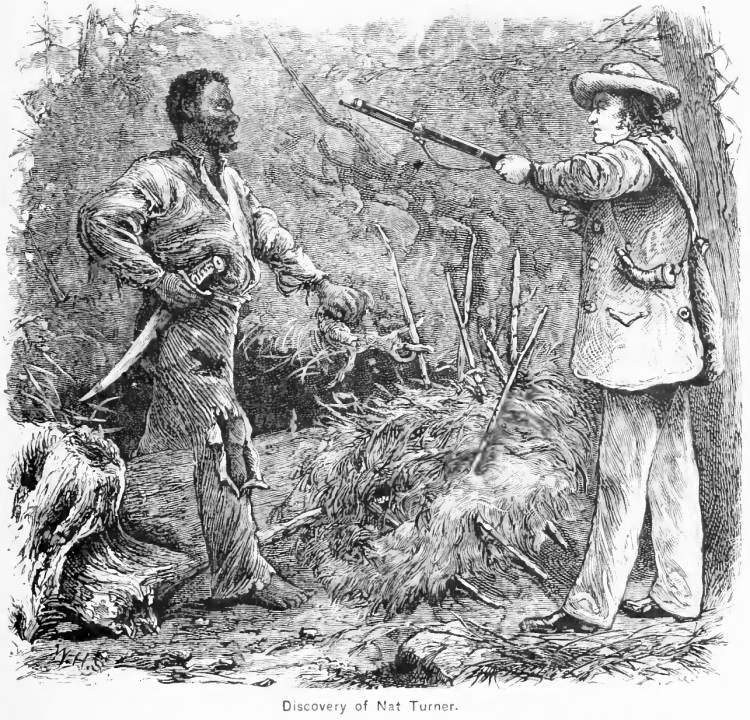
By 1831, the Reformist movement in the UK had taken full steam, and the Whig Party had already begun to drive hard toward the passage of the bill. By the time Nat Turner revolted that winter, its passage had become a distinct possibility. Within the two year period after Nat Turner’s revolt, the British passed both the Reform Act of 1832 to strip several conservative politicians of the seats and the Slavery Abolition Act of 1833 to permanently outlaw British slavery.
In this charged political moment where the promise of abolition suddenly seemed not just possible, but likely, the American Anti-Slavery Association was founded in December of 1833 with the explicit intent of reproducing British abolition in the United States. By the time the Tories resumed power in late 1834 with Sir Robert Peel as the Prime Minister, the AA-SS had already embarked upon their grand pamphlet campaign – the one which sparked the panic in the Jackson administration that we previously discussed.
While I am doing my best not to repeat what has already been said in this series, I think it’s important to remember that Andrew Jackson and his Democratic proponents, specifically John C. Calhoun, the Southern Democrat member of the Great Triumvirate we discussed the least of the three, were explicitly leery of the idea of using the federal government to censor abolitionist publishing, on the rationale that the same power could easily be deployed by a Whig government to promote an anti-slavery agenda.
No – another path forward needed to be created, a path that would mandate the power of Southern slave states, irrespective of who occupied the White House.
The 1835 Postal Controversy and Censorship-by-Mail
We return to Black’s account in the wake of Nat Turner’s 1831 revolt, the prelude to all of this abolitionist activity:
Hysteria ensued across the South. White leaders were convinced that Black literacy was to blame for the rebellions and that the manifesto would provoke more. Literacy alerted Black people to Congress’s slavery debates, sparked notions of revolution, inflated their expectations of a better way of life, and exposed them to contradictory biblical passages that, in white Southerner’s view, would overwhelm their capacity to understand. The only safe course of action was to keep dangerous information secret.
By the early 1830s, all but a few Southern states had imposed severe sanctions on any enslaved person caught trying to read or write, as well as on any person, white or Black, caught teaching them. Some states went further, criminalizing literacy for free Black people, too. The punishment for a first offense was fifty lashes. For the second, in some states, it was death. […]
The hysteria extended to books and newspapers, too. Even for white people, it was a crime to possess certain texts. At first, abolitionist newspapers were banned. But once abolitionist literature was expunged, governments in the South looked for new villains. Some leaders claimed that all Northern literature, including its magazines and textbooks, was infected with anti-Southern bias that would undermine the Southern way of life. As a replacement, they pushed textbooks and literature from the South, by the South, and for the South. By the mid-1830s, a pall of orthodoxy had descended over the region, constricting not only Black people’s literacy but white people’s access to information. The orthodoxy only grew more belligerent, more unpersuadable, and more repressive with time.10
By the time the AA-SS’s pamphlet campaign sparked the postal kerfuffle of 1835, the South had already worked itself up to a fever pitch on the issue of abolitionist publishing and incendiary literatures. It is at this turning point in our history that we receive this critical account of the events of 1835 from historian Susan Wyly-Jones:
The wave of anti-abolition meetings that swept across the South in the fall of 1835 provides several important insights into the beliefs and strategies of Southerners as they confronted the emergence of an activist antislavery movement. First, the meetings highlighted the importance to the region of enforcing community consensus and solidarity on the issue of slavery. Like an insurrection scare, the postal campaign spurred white Southerners to come together in a ritualistic display of racial unity and dedicate themselves to the defense of slavery. The emphasis in the meetings on unanimity, nonpartisanship, and collective action reflected the importance of mobilizing all members of the community behind Southern institutions. The assertion that abolitionists sought to “deluge the land in blood” provided a potent rallying cry to all white Southerners, regardless of their personal interest in slavery, as well as a useful rationalization for the suppression of antislavery publications and the use of violence to defend their communities. Rather than flushing out Southern moderates, as the abolitionists had hoped, the postal campaign pushed opinion more decisively toward a defiant public defense of the South’s domestic institutions.
The meetings also demonstrated the evolution of a constitutionalism, distinctly Southern and proslavery, that established slaveholder interests as the dominant policy positions in Federal and interstate matters concerning slavery. Before the 1830s, Southern thinkers had been preoccupied with checking the “consolidationist” tendencies of the Federal government toward slavery, but the postal campaign of the AAS forced Southerners to reckon with a new enemy. In 1835, this bold, new threat led them to demand noninterference not only from other governing bodies, but also from private citizens, and to broaden the definition of interference to include private speech as well as legislative action. Of course, Southerners had been arguing for decades that slavery was exclusively a local institution over which the Southern states alone had jurisdiction. But the arguments they reached for in 1835 were not purely in the vein of states rights doctrine. Instead, they illustrate a point made long ago by historian Arthur Bestor about the crisis over slavery in the territories–Southern notions about state sovereignty verged toward the consolidation, not the decentralization of power, and were used not to protect but to override individual rights. (42) On the one hand, Southerners who purged antislavery literature from the mails claimed that their own laws, in addition to the “higher law” of self-preservation, trumped the dictates of Federal statutes and the civil liberties enshrined in the Constitution. States rights, in this case, meant the right to dismiss Federal law regarding the rights of citizens of other states. On the other hand, Southerners argued that the “fraternal bonds of Union” obliged Northern states not merely to mob abolitionists out of existence but to suppress them legally. In this argument, comity and Northern deference to Southern law, not the duty of Northern states to protect the rights of their own citizens, reigned supreme. This Machiavellian tendency to disregard state rights and individual liberties when they conflicted with proslavery political strategies appeared repeatedly over the next two-and-a-half decades in such incidents as the successful Southern effort to impose a gag rule on abolition petitions to Congress, John C. Calhoun’s sweeping Senate resolutions in 1837 which argued that Congress had a duty to protect slavery from its critics, and Southern calls in the 1850s for a congressional slave code for the territories.11
There are a couple of really important points I need you to take away from this long passage. Firstly – and if you know what the Comstock Act of 1873 is, you’ll understand why this matters – the Postal Service of the United States was an explicitly White supremacist institution during this period of American history. Often operating in direct opposition to the law, members of the Postal Service systematically sought to control and censor the flow of information in and out of the American South. They did this with the tacit consent of both political parties, as Northern Whigs also believed that abolitionists had no business in trying to spread their persnickety ideas southwards. The USPS did this in the explicit support of Southern slavery and the soft power of the planter class. Keep that in mind.
Secondly, censorship law in the United States, much like in Britain with King George’s various proclamations against seditious speech, has always begun as a direct response to insurrectionism. Moreover, it is assuredly a deeply American fact that those insurrections always, always had to do with slavery and the ownership and control of the Black body. In the United States, which rose up against the British in no small measure to protect the right to own slaves, insurrection is and always has been a racially coded action. A noble act for the white man, savagery for the Indian or the Black man – so the sentiment went. In Part Two, we discussed how the entire project of American independence was structured around the colonization of Haudenosaunee land. Here’s where I begin to tip my hand – I have spent this much time laying out the histories of Black and Indian resistance during this period because both played a direct role in the formulation of American cross-dressing bans.
Thirdly, and this is perhaps the most crucial bit of information here, is the fact that the South figured their new adversary as the private citizen, and her primary weapon against slavery as private speech, constitutionally protected under the First Amendment from prosecution by the federal government. This shift in the States’ Rights doctrine is absolutely crucial to understanding the politics of the 1840s vis a vis the criminalization of trans life. The battle against abolitionist speech had to be waged on the level of the state, yes, but there was the troublesome issue of Northern interference with Southern affairs.
What emerges here is a distinct separation between the legislative developments on the state level between Northern and Southern states over the course of the 1830s, 40s, and 50s. This locality is critical to understand why anti-trans law emerged where it did. In the South, where a combination of White unity and federal complicity gave the Democrats leeway to do whatever they wanted, a severe authoritarianism would emerge that would form the blueprint for the proto-fascist nation of the Confederate States of America. This was an exercise of direct power on the level of the state government, where the South had already begun to essentially operate as its own enclave state.
This was insufficient for the planter class, though. So long as abolitionist sentiments continued to fester in the North, there would always be the danger of another slave revolt, another incendiary pamphlet, another federal attempt to outlaw slavery for good. There was the danger of the Whig Party and the possibility that they might try to follow in the British footsteps of the Slavery Abolition Act of 1833. And using the federal government to that end was also out of the question – that would give too much possibility of power to the Whigs.
No, the suppression of abolitionist speech in the North would need to be a soft power campaign to sway the popular opinion in the North against the abolitionist movement.
If only there were a hot new right-wing ideology specifically designed to police private citizens while justifying and maintaining its existence in the court of public opinion and codifying a recuperated new system of criminal ‘reform’ (that mythical idea so beloved by the liberal Whigs) into law…
Let’s put it in plain speech – this “Law of Self-Preservation” that the South cites in their turn toward authoritarianism that culminated in 1835 is strongly reminiscent of the verbiage of self-preservation Sir Robert Peel cites in his principles of policing, as well as the language of the Tamworth Manifesto. But the South had no need of a “Metropolitan Police” department, because the dividing line between the “public” and the “vagrant” was as clear and self-evident as the color of your skin. Every White man was an officer, every White woman an informant, every Black man a criminal, every Black woman an accessory to his crimes.
THE POLICE ARE THE PUBLIC
THE PUBLIC ARE THE POLICE
The Confederate States of America was the world’s first police state, the world’s first fascist state, and it began not when the shots were first fired at Fort Sumter, but when the Southern block began to actively violate federal law through the censorship of the post.
Deportation and Ethnic Cleansing in 1830s Missouri
A Quick Tour of the Show-Me State
Oh, god. Missouri.
Fucking Missouri. How can I describe to you, my dearest reader, the sheer depths of my loathing for the state of Missouri?
For the next section of this article, the physical geography of the states of Missouri and Illinois is going to become reasonably important. I know that there’s a lot of non-Americans reading this, so I hope that my American audience will excuse me for a moment to give folks a quick geography primer on one of the most obscure states in America.
Firstly, for those unaware, during the American Civil War (1861-1865), not every state in the Union had abolished slavery. There were four states that remained with the Union despite continuing to allow slavery: from East to West, Delaware, Maryland, Kentucky, and Missouri. The East-West axis also predicts how much the states wanted to secede; Delaware never even tried, while Missouri had rival governments until the Union consolidated power in 1862. A fifth “border” state, West Virginia, was created in 1863 out of territory captured from the Confederacy. Here is a political map of the (extremely not) United States in 1863:
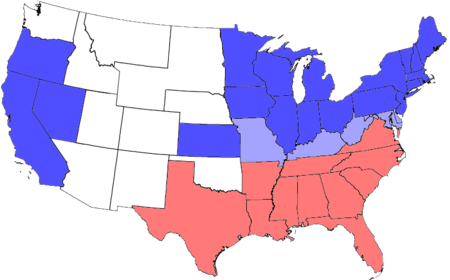
Missouri is the state in light blue at the left-most edge of the border region.
For those who are not used to the fuckery of American geography, you may notice that Missouri’s northern and southern borders are both straight lines, while its eastern and western borders are both squiggly. Let’s zoom the map in a little bit.
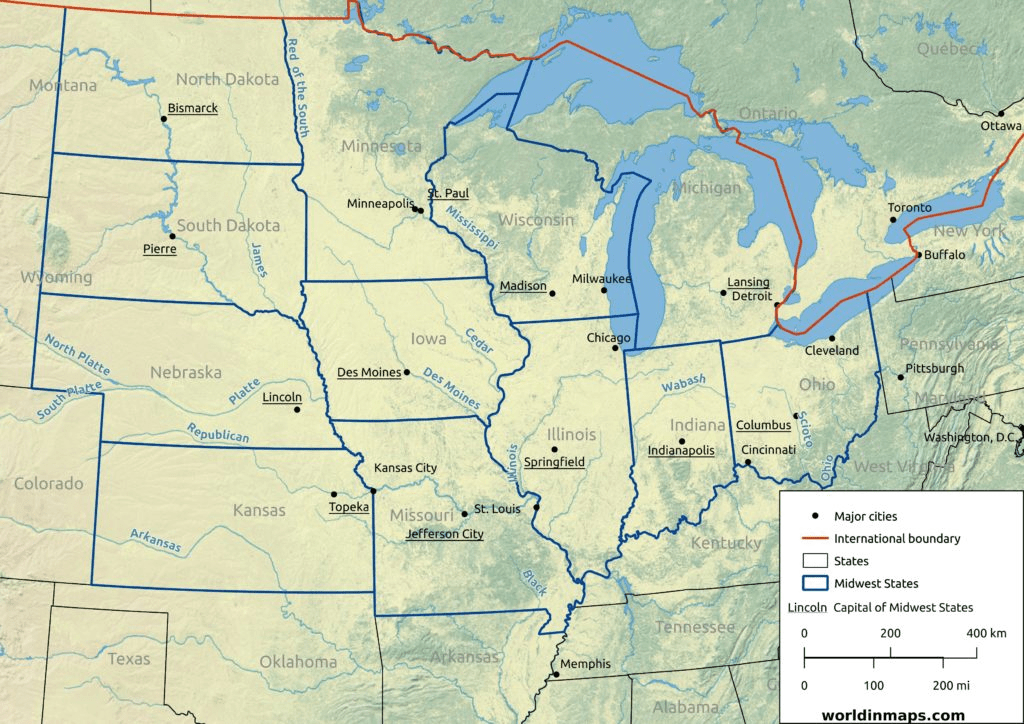
Our primary concern right now is with the band of four states in the middle of the map: Missouri, Illinois, Indiana, and Ohio. We will also be discussing Kentucky, which borders all four of them to the south, and Tennessee, which is south of Kentucky below that.
Missouri’s borders are dictated by the Missouri Compromise of 1820, which we discussed at the beginning of Part Three of this series. The entire point of the Compromise, the literal sole reason that Missouri exists in the state that it does, was for the preservation of slavery. In the Senate of the United States, each state has two Senators regardless of the size of its population – a system of governance invented by Virginia during the Constitutional Convention to protect the interests of white Southern slaveholders against the “tyranny” of a northern majority.
The Missouri Compromise follows the colonial boundaries between the colonies of Virginia and Carolina, which if you’ve ever seen a map of colonial North America, the British would determine borders at the coast then extend that shit all the way to the other side of the map. Manifest Destiny began when white men took a ruler to a map and declared the entire West their property. As we discussed in Part Two, much of the colonial conflict between the UK, France, Haudenosaunee, and what would become the US was a contest over that imagined endless Western parallel, and the right to expand beyond the Mississippi River.
Missouri was not a state – Missouri was an ideal. If you look at a map of the United States in 1820, almost half of the damn country is labeled as “Missouri Territory.” “Missouri” was the entire Louisiana Purchase north of Arkansas, and then some. Missouri was the project of American imperialism in its most literalized terms.
Why is this state Missouri, then, and not the rest of the region? With the complicated exception of Louisiana, which has its own history, Missouri was the first state created to the west of the Mississippi River, the first state to be made out of the formerly French territory bought by Thomas Jefferson. It was the site of a fierce struggle about the soul of a nation, and the Missouri Compromise that created it is a damning picture of that country.
The Mississippi River to the East. The Missouri River to the West. From north to south, Missouri is bordered by the two longest rivers in North America, rivers which span directly from the Gulf of Mexico to Canada.
Missouri’s straight northern border is fashioned after the Mason-Dixon line that divides Pennsylvania and Maryland, also a border between slave states and free states. Missouri’s straight southern border was thus negotiated to be the new free-slave border that all future states would be evaluated by.
In a very literal sense, the geography of Missouri is like a perfect Venn diagram of the United States. It has the slave parts of the North and the slave parts of the South; it has a gateway to the entire pre-Louisiana Purchase nation and remains the open transverse upon which this country built its expansion west.
Crucially, Missouri’s biggest city lies right on its eastern border, right at the the transitional point from free to slave, from east to west, from north to south. At this point in American history, St. Louis is the midpoint of American political geography.
Let’s zoom in again.
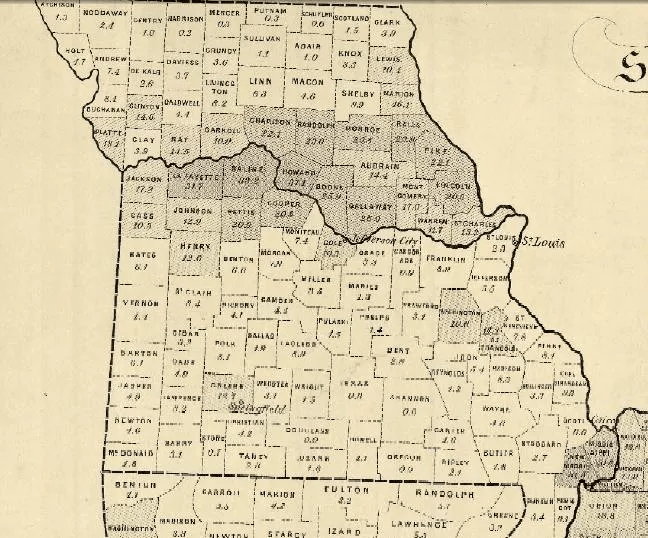
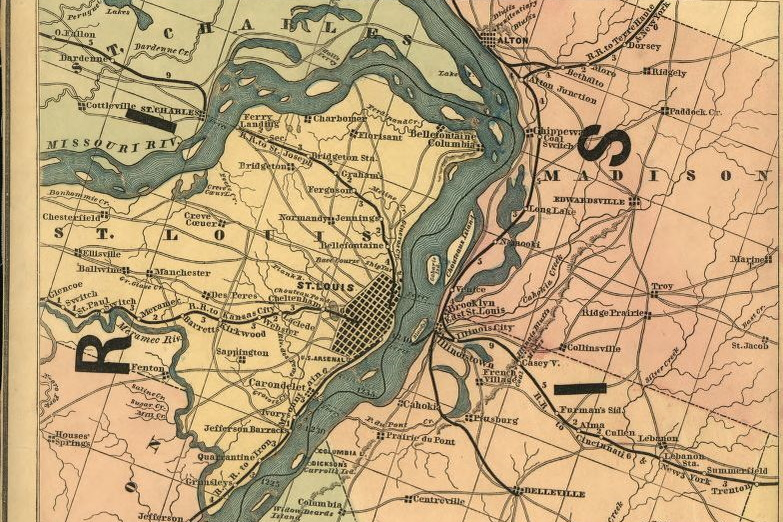
St. Louis has some of the most ridiculous geography of any city on the planet. On the map to the left, you can see that the Mississippi runs up the full eastern border of Missouri, whereas the Missouri river runs down the upper part of the Western border before cutting across the state to join the Mississippi. The city of St. Louis is built at the junction point of the two largest rivers in North America.
I want you also to pay close attention to the map on the left – the counties with darker shading are counties which had a higher density of enslaved people. As you can see, slavery in Missouri was not concentrated in the Southern part of the state as one might expect, but rather along the east-west transverse of the fertile Missouri River plains. Why? The entire southern half of Missouri is part of a region known as the Ozarks, which can be difficult to traverse and farm, and to this day is still one of the less-dense areas of that part of the country.
The Missouri Compromise was a coup for Southern slaveholders because the real value of Missouri was in its Northern half, not its Southern half. A Missouri without the Missouri River Valley would have been useless to the plantation owners.
Indian Removal and the Ethnic Cleansing of the Sauk People
There was, however, a major problem for the budding proto-fascist Confederacy, and that was that the entirety of that fertile Northern slave-friendly heartland only had one singular point of access, and that was along the very, very long span of the Mississippi River that ran between the impassable Ozarks and the deep-blue state of Illinois. If you wanted to ship human chattel from Mississippi to Missouri, the only way that you could do so both legally and efficiently was on the Mississippi River, and all traffic to the Missouri River and the returned security of deep slave country was forced to run through the city of St. Louis.
You can see the free country of Illinois from the docks of St. Louis, which meant that any slave in the city knew that if they could just find a way to swim or sneak across, they had freedom within palm’s reach.
For slaveholders in Missouri, that was an unacceptable state of affairs.
Missouri was the site of human traffic in both senses of the term for the entire 19th Century, but the 1830s were a particularly busy time for the Show-Me State (a nickname which comes from the fact that Missouri was one of the first states to demand train passengers show their tickets on entry). The flow of bodies in and out of the state was not an auxiliary concern – it was the primary issue of both Missouri’s state government and the city of St. Louis, and so much of the history I’m about to share with you reflects that.
The first group of trafficked peoples relevant to our history are the indigenous peoples of Missouri, namely Thâkîwaki (the Sac and Fox Tribe in English), the group that inhabited the northern parts of the state. One of the uniting factors that binds together the six states in our immediate inquiry is that none of them have Native American reservations – which means that during the genocides of the 19th Century, the entire Native populations of Missouri, Illinois, Indiana, Ohio, Kentucky, and Tennessee were either killed or forcibly relocated to another state.
Here’s an instructive map of American states by which ones have Native reservations and which ones don’t:

That big blob of states in the middle of the country with zero Native reservations? That’s where the American cross-dressing ban was born.
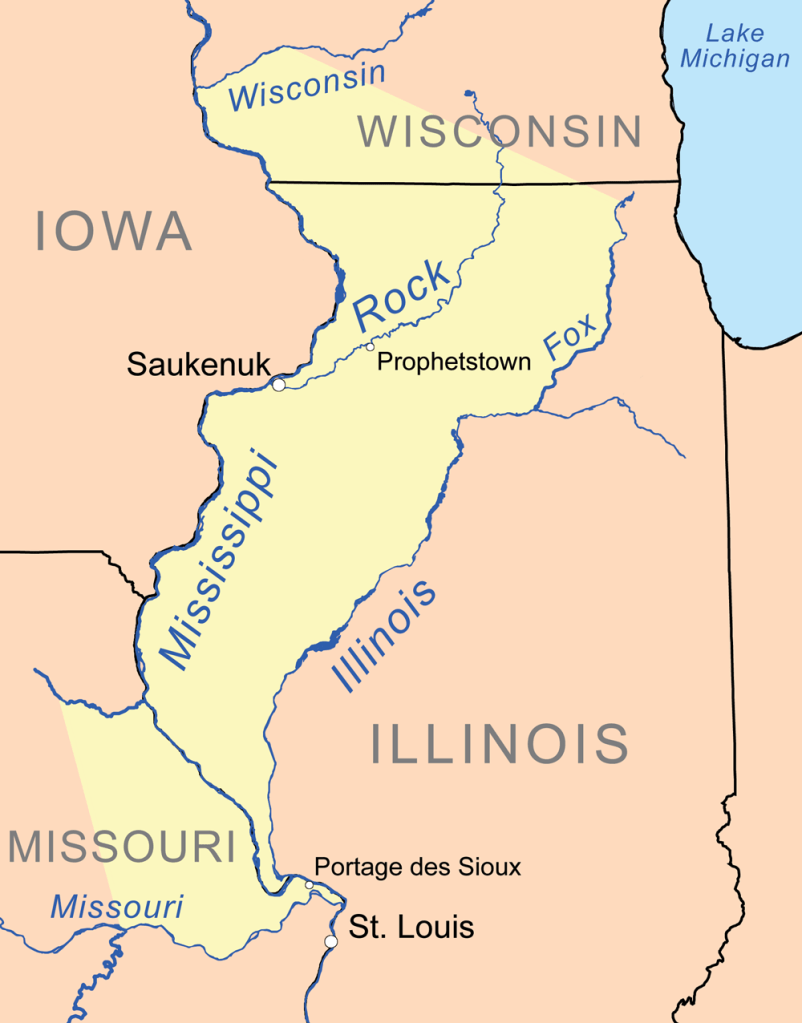
The critical legal document of note here is the 1804 Treaty of St. Louis, which officially ceded Northern Missouri from the Sac and Fox Tribe to the US government, including the vast majority of what would become Missouri’s slavery heartland. It’s really striking how much the Missouri part of this map lines up against the slavery density map I showed you earlier. Throughout this series, we have been discussing how the boundaries of indigenous lands have informed the transverses of American politics long after those indigenous peoples had been killed or displaced, and the land cessation from the Treaty of St. Louis is absolutely no exception.
We will be talking extensively about how the political relationship between the St. Louis region and Western Illinois informed the modern shape of cross-dressing bans, and I don’t want you to forget for a second that these two regions were one nation for most of North American history, arbitrarily divided by a white man’s lines on the map.
For a first hand account of the signing of this treaty, we turn to the autobiography of Black Hawk, a leader of the Sauk who had not authorized its signing:
Quashquame, Pashepaho, Ouchequaka and Hashequarhiqua were sent by the Sacs to St. Louis to try and free a prisoner who had killed an American. The Sac tradition was to see if the Americans would release their friend. They were willing to pay for the person killed, thus covering the blood and satisfying the relations of the murdered man.
Upon return Quashquame and party came up and gave us the following account of their mission:
On our arrival at St. Louis we met our American father and explained to him our business, urging the release of our friend. The American chief told us he wanted land. We agreed to give him some on the west side of the Mississippi, likewise more on the Illinois side opposite Jeffreon. When the business was all arranged we expected to have our friend released to come home with us. About the time we were ready to start our brother was let out of the prison. He started and ran a short distance when he was SHOT DEAD!
This was all they could remember of what had been said and done. It subsequently appeared that they had been drunk the greater part of the time while at St. Louis.
This was all myself and nation knew of the treaty of 1804. It has since been explained to me. I found by that treaty, that all of the country east of the Mississippi, and south of Jeffreon was ceded to the United States for one thousand dollars a year. I will leave it to the people of the United States to say whether our nation was properly represented in this treaty? Or whether we received a fair compensation for the extent of country ceded by these four individuals?18
I hardly think I would be alone in saying that this was anything but a fair deal – but I know for a fact that the future state of Missouri would beg to disagree.
The 1804 treaty ceded the Northeastern part of the state, but the Western half of the state would not be ceded until an 1824 treaty with the Iowa people (four years after Missouri statehood) that surrendered the rest of the land. For a taste of that treaty:
THE Ioway Tribe or Nation of Indians by their deputies, Ma-hos-kah, (or White Cloud,) and Mah-ne-hah-nah, (or Great Walker,) in Council assembled, do hereby agree, in consideration of a certain sum of money, &c. to be paid to the said Ioway Tribe, by the government of the United States, as hereinafter stipulated, to cede and forever, quit claim, and do, in behalf of their said Tribe, hereby cede, relinquish, and forever quit claim, unto the United States, all right, title, interest, and claim, to the lands which the said Ioway Tribe have, or claim, within the State of Missouri, and situated between the Mississippi and Missouri rivers and a line running from the Missouri, at the mouth or entrance of Kanzas river, north one hundred miles, to the northwest corner of the limits of the state of Missouri, and, from thence, east to the Mississippi.
It is hereby stipulated and agreed, on the part of the United States, as a full compensation for the claims and lands ceded by the Ioway Tribe in the preceding article, there shall be paid to the said Ioway tribe, within the present year, in cash or merchandise, the amount of five hundred dollars, and the United States do further agree to pay to the Ioway Tribe, five hundred dollars, annually, for the term of ten succeeding years. […]
The undersigned Chiefs, for themselves, and all parts of the Ioway tribe, do acknowledge themselves and the said Ioway Tribe, to be under the protection of the United States of America, and of no other sovereign whatsoever; and they also stipulate, that the said Ioway tribe will not hold any treaty with any foreign powers, individual state, or with individuals of any state.19
Yes, you read that correctly – the 1824 treaty gave the US Government more land for less money over two decades later.
These treaties were terrible deals for the Native peoples of Missouri, and they provided the necessary pretext for the complete ethnic cleansing and displacement of the entire Native population of the state. As the Indigenous tribes of the region grew increasingly privy to the genocidal intentions of the United States, they began to resist more stringently, and in 1829 launched an armed insurrection known as the Big Neck War after their leader Moanahonga AKA Big Neck, pictured left. Though the revolt was quickly squashed by the state militias of Missouri and its leaders were acquitted of wrongdoing (a fortunate result given how these things often went), it left a psychological unease on the psyche of the colonizers of Northern Missouri, who had grown increasingly paranoid at the possibility of Native and slave revolt alike.
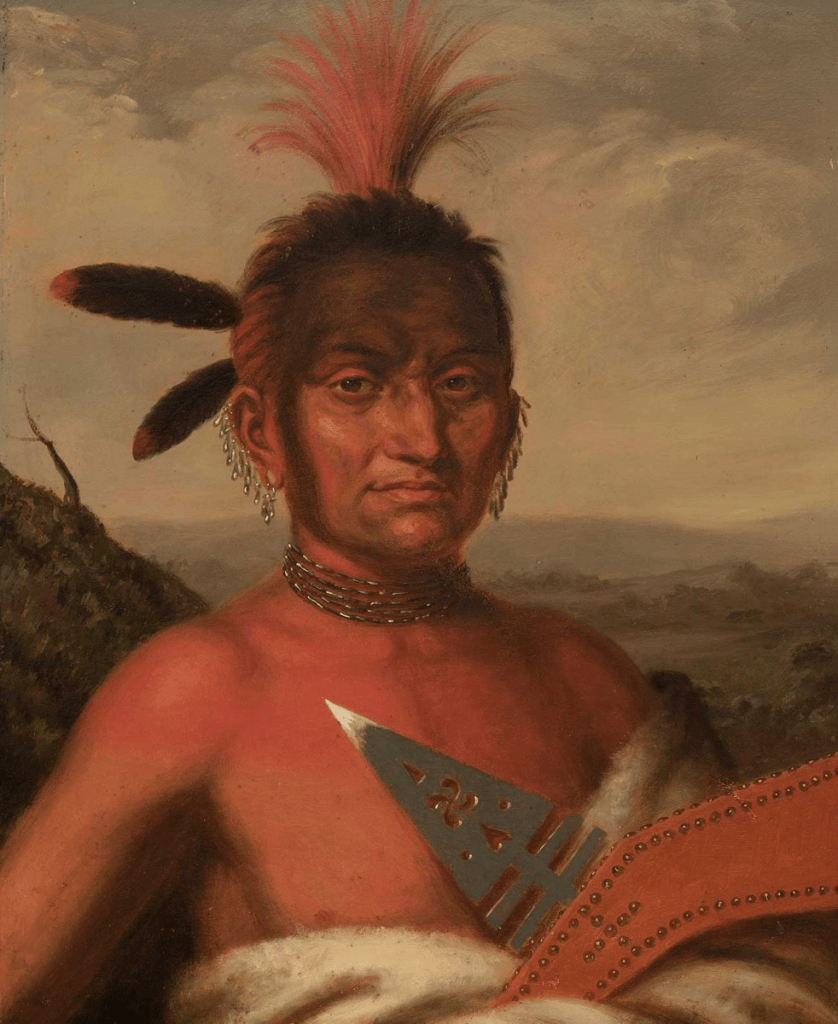
Freedom Licenses and Anti-Black Surveilance
The Show-Me State began to earn its nickname in 1835, where it began to pioneer a first-of-its-kind program to police the movement of Black bodies with the innovation of the “freedom license.” Freedom licenses were a uniquely Northern form of institutionalized slavery – they required that any freedman in the state of Missouri had to carry around official documentation of their free status in order to reside in the state, and to be prepared to show it to a white inspector at any moment. Ebony Jenkins writes about the law:
On March 14, 1835 the General Assembly of the State of Missouri passed “An act concerning free negroes and mulattoes”. The act stated that all free persons of color had to apply for a freedom license. The courts could, if they chose, grant a license to “any free negro or mulatto, possessing the qualifications required by this act to reside within the state”. The act was another hurdle that African Americans living in Missouri had to overcome. Not only did they have to go to the court and possess the qualifications to apply for a freedom license, but the applicant also had to be either born in Missouri or prove that they “were residents of this state on the seventh day of January, in the year eighteen hundred and twenty-five, and continue to be such residents at the taking effect of this act” and “produce satisfactory evidence that he is of the class of persons who may obtain such license, that he is of good character and behavior, and capable of supporting himself by lawful employment, [that] the court may grant him a license to reside with the state”21
“An act concerning free negroes and mulattoes” is one of the more evil pieces of legislation I have had the displeasure of reading for this project, and let me tell you, it’s worse than it appears on face. Firstly, this bill essentially regulates that an enslaved Black person from the South could not be freed in the state of Missouri if they were trafficked north after its passage, as they could not legally receive a freedom license. Missouri’s freedom license program is one of the earliest models for deportation in the United States – starting in 1835, there would be a steady stream of state removals of free Black bodies from the state, aimed with the ultimate goal of creating a society where there would only be Black slaves in the borders of the state. Missouri’s deportation programs during this period are, in many ways, early shadows in American history of the future institution of ICE.
Secondly, the provisions that free Blacks needed to have “class” and “good character and behavior” were the early legal pretexts for Missouri to begin experimenting with Peelian conservatism in the state. By creating a legitimate interest for the government to be policing the actions of private citizens – checking Black people for freedom licenses – Missouri had artificially begun to create the need for an administrative force that could adequately patrol and surveil the movement and possessions of Black Missourians, especially those in St. Louis who stood dangerously close to the free banks of Illinois.
Thirdly, it’s important to understand that slavery worked a little differently in Missouri than the rest of the slaveholding South. While plantation slavery did exist, the primary way that slaveowners profited off their slaves was essentially by renting them out to do gig labor along the Missouri River and in St. Louis. This also meant, however, that the difference between an enslaved man’s labor and a freeman’s labor was often as nominal as the words on a piece of paper.
Here is a blatantly pro-slavery biased description of Missourian slavery from the National Park Service:
Slavery in Missouri was different from slavery in the Deep South. The majority of Missouri’s enslaved people worked as field hands on farms along the fertile valleys of the Mississippi and Missouri rivers. St. Louis, the largest city in the state, maintained a fairly small African American population throughout the early part of the nineteenth century. Life in the cities was different for African Americans than life on a rural plantation. The opportunities for interaction with whites and free blacks were constant, as were those for greater freedom within their enslaved status. Because slavery was unprofitable in cities such as St. Louis, African Americans were often hired out to others without a transfer of ownership. In fact, many enslaved people hired themselves out and found their own lodgings. This unusual state of affairs taught African Americans to fend for themselves, to market their abilities wisely, and to be thrifty with their money.22
And the Civil War was about state’s rights, hm?
With the constant movement of enslaved peoples up and down the Missouri River, often without the direct supervision of their masters, the state of Missouri had a unique need for a method of surveillance to distinguish between free and enslaved Black bodies, and the Freedom Licenses were their solution to that problem.
German Immigration and Sectarian Violence
Racial animus may have been the core of Missouri’s turn to policing in the 1840s, but the other big driver of state politics during this period was not race and slavery, but rather the omnipresence of sectarian conflict and violence, specifically that between Evangelicals, Catholics, Mormons, and the Southern planter class. As we extensively discussed over the first three parts of this series, the ideals of abolitionism were deeply bound with the American Evangelical movement, millenialism, and the Second Great Awakening; the national politics of the time were a broad conflict between the Evangelical Whig Party and the pro-slavery Democrats, and Missouri was firmly Democratic territory. We’ve been discussing how the Missouri Freedom License program was a prototype for modern immigration enforcement, but it’s important to understand that mass religious migration was also exploding during this time and reshaping the fabric of Missouri’s demographics.
Britain was not the only country heavily affected in the aftermath of the Napoleonic Wars; the United States also started to experience a significant increase in immigration during this timeframe. Compared to future waves of immigrants, the 1830s were a relatively inactive period of immigration, but compared to previously, it was significant. Notably, the demographics of who was immigrating to the United States also began to shift away from Northern and Western Europeans toward Central and Southern Europeans. While German immigration wouldn’t take off until the latter half of the 1840s, Missouri in particular was an early hub for German immigration to the United States, and St. Louis was one of its early metropolitan centers.
The Germans defied the current political balance in the country in the 1830s. They were not particularly fond of slavery, but they also had a deeply ingrained drinking culture, and were rather hostile to the temperance movement. This flew in the face of the Evangelical ethic. In addition, many in the first waves of Central European immigration were Catholics, which was of course a far bigger problem in the Evangelical mind.
Let us return to Lyman Beecher’s “A Plea for the West” to see what the general consensus among Evangelicals was toward these immigrant groups:
Four years ago the Catholic population was estimated at half a million, and in the single year of 1832 one hundred and fifty thousand were added, and the numbers every year since have greatly increased, and the Catholics predict still greater numbers the current and coming years. […] But the numerical power, without augmentation, would be too small to accomplish the end ; and, therefore, Catholic Europe is throwing swarm on swarm upon our shores. They come, also, not undirected. There is evidently a supervision abroad — and one here — by which they come, and set down together, in city or country, as a Catholic body, and are led or followed quickly by a Catholic priesthood, who maintain over them in the land of strangers and unknown tongues an ascendency as absolute as they are able to exert in Germany itself. Their embodied and insulated condition, as strangers of another tongue, and their unacquaintance with Protestants, and prejudices against them, and their fears and implicit obedience of their priesthood, and aversion to instruction from book, or tract, or Bible, but with their consent, tend powerfully to prevent assimilation and perpetuate the principles of a powerful cast. Hence, while Protestant children, with unceasing assiduity, are gathered into Catholic schools, their own children, with a vigilance that never sleeps, and is upon them both when they go out and come in, and is conversant with all their ways, are kept extensively from Sabbath schools, from our republican common schools, and from worship in Protestant families, and from all such alliance of affection as might supplant the control of the priesthood over them; so, that, as the bishop of Cincinnati said, to a Protestant, ” We multiply by securing all our Catholic children, so that every family in process of time becomes six.”23
This is nativism at its most virulent. Remember that Ohio and Kentucky were the epicenter for the Second Great Awakening – German immigrants would travel West from the coast seeking fertile land to farm, only to encounter hostile Protestant vitriol and get pushed even further west and north. This is why Wisconsin, Minnesota, and Missouri has such significant German populations – the Whiggish Midwest wanted nothing to do with the new German settlers, and so the Germans went wherever they encountered political resistance the least.
You might imagine, given how strongly the Evangelical voted for the Whig party, why the Germans voted for the Democrats. The perception that the German immigrants both disliked temperance (true) and liked slavery (false) surely was only a reconfirmation for men like Lyman Beecher and his ilk of their moral lack. Ohio and Illinois, which were both free states, were hotbeds for such Evangelical thought; comparatively, Missouri in the late 1830s was far less sympathetic to the Evangelical (cum Abolitionist) cause, and thus was a safe haven for German immigrants looking for a fresh start. The Giessen Emigration Society in Germany had described Missouri as “the American Rhineland24;” the St. Louis Genealogical Society writes:
German immigration into St. Louis began in the 1820s, but numbers continued small until the 1830s. Gottfried Duden came to Missouri in 1824 and stayed until 1827 when he returned to Germany and wrote a book on his experiences in Missouri. This book, along with many others of that period, as well as letters from the early German arrivals, promoted German emigration. At the same time in Germany the organization of emigration aid societies, rulers forcing churches to unite, quicker travel by rail as well as steam instead of sail, and rapidly increasing German taxation all contributed to a desire to emigrate. From the mid-1830s until the World Wars, Germans flooded into St. Louis. Because many forms of transportation centered in St. Louis, some only passed through on their way to other Missouri destinations or other states. But because so many stayed, population in St. Louis more than tripled from 4,977 in 1830 to 16,469 by 1840. The first German church in St. Louis was founded in 1834 by German Evangelical Protestants, but it was quickly followed by German Catholics and German Lutherans, who also formed churches in 1835/6 and 1839.25
Of the German hostility to temperance, Heidi Mathis writes:
The newly arrived Germans could not have understood that the Temperance movement had a long history and was bound up with the women’s movement and abolition. They only saw that the natives did not want to allow them their Sunday family time, which happened to include beer. Germans arrived with a culture of Sunday picnics (biergartens), where the whole family enjoyed games, dances, and some beer. These were moderate family times, very unlike the male-only culture of American saloons.26
German immigration was not the only religious force driving the Missourian hostility to the Temperance movement. Mormon immigration to northwestern Missouri was another major driver of state politics at the time, and it would end in significant bloodshed during the Missouri Mormon War of 1838.
The Church of Jesus Christ of the Latter-Day Saints, AKA Mormonism, is a religious movement founded by Joseph Smith in 1830 at the height of the Second Great Awakening. Joseph Smith proclaimed himself a prophet who had heard the word of God, and wrote a new Third Testament, the Book of Mormon, which described how the holy people (members of his cult) would go to the holy land of Zion at the end of days to enter the kingdom of Heaven.
The Book of Mormon is a truly perplexing piece of American literature, and I am not going to even attempt to interpret it. It’s an incredibly strange piece of Christian fantasy, appropriation of Native American heritage, and apocalyptic scripture. Here’s what you need to know: Mormons believe to this day that the Garden of Eden was in the current-day boundaries of the United States, and that America is the promised holy land of God. They believed that the holy city of Zion would be founded somewhere on the continent – and in 1838, Joseph Smith declared that the city of Zion would be founded in Jackson County, Missouri.
You need to understand how deeply reviled the Mormons were by most other Americans in the 1830s. Joseph Smith was repeatedly arrested; the Mormon church was forced to move from New York, to Ohio, to Illinois, to Missouri, back to Illinois, before finally getting driven halfway across the continent to Utah, where they remain today. From the perspective of people in Missouri, a foreign and fanatical cult of Evangelicals began to move en-masse across Missouri, claimed a large chunk of land, and declared it the holy site of their hostile religion. This was, to put it mildly, a serious recipe for sectarian violence. Widely considered a heretical cult, the Mormons were also characterized for their policy of total abstinence from alcohol, a disdain which was only compounded in the minds of the “old settlers” of Missouri (i.e. the Southern slaveholders who had moved north to the new slave state less than two decades earlier) by the fact that the Evangelical temperance movement had recently begun its shift toward “Teetotalism,” or an ideology within the temperance movement that called for total abstinence instead of moderation.
The Missouri Mormon War ended very poorly for the Mormons. Missouri Digital Heritage describes the event:
It soon became clear that Missouri non-Mormons and Mormons could not live in the same area harmoniously. In 1836 a “separate but equal” proposal was finally devised to solve this problem, whereby the state legislature created a new county, “Caldwell,” in northwest Missouri as a Mormon refuge. But the booming Mormon population, swelled by the immigration of thousands of eastern converts doomed this to failure, as Mormon settlers burst the borders of Caldwell County and spilled into neighboring counties. Violence broke out again at an election riot in 1838. Old Settler mobs and Mormon paramilitary units roamed the countryside. When the Mormons attacked a duly authorized militia under the belief it was an anti-Mormon mob, Missouri’s governor, Lilburn Boggs, ordered the Saints expelled from the state, or “exterminated,” if necessary. The conflict’s viciousness escalated, however, even without official sanction, when, on October 30, 1838, an organized mob launched a surprise attack on the small Mormon community of Haun’s Mill, massacring eighteen unsuspecting men and boys. Over the next year, around eight thousand church members, often ragged and deprived of their property, left Missouri for Illinois.27
Fun fact: Missouri remains to this day one of the most alcohol-friendly states in the entire nation! It all goes back to this perfect storm of politics, religion, racism, and immigration that coalesced into a very hostile political climate for the Whigs.
So, let’s recap. By 1837, there was a constant movement of Blacks, Mormons, Germans, and all other manner of settlers and travelers along the Missouri river, making St. Louis one of the most important transit hubs in the country. Moreover, Missouri had begun to establish a significant record of deporting “undesirable” citizens; first the Indians, then free Blacks who failed the Freedom License test, and finally the Mormons in blood. But despite all of this hostility to foreign movement, the number of people flowing through and across Missouri each year was only increasing exponentially (and would continue to do so for the next century).
Prior measures to control the public and their movement through Missouri had become a critical priority for the state. Drastic measures were required.
The 1837 Murder of Elijah Lovejoy
Missouri’s policing against abolitionist politics in St. Louis would slowly escalate over the coming years, and it would become increasingly dangerous to be either an abolitionist or a Free Black in the state. One extremely important piece of abolitionist history in the city of St. Louis was the murder of abolitionist newspaper editor Elijah Lovejoy, who was a friend of Edward Beecher and the AA-SS, and was far better liked on the national abolitionist circuit than he was in the State of Missouri. His positions grew more and more radical over the 1830s until, in 1837, he professed his belief in total abolition. Missourians took this poorly:
Lovejoy’s editorials raised local anger, despite the fact that they increased the paper’s national circulation. A group of local citizens, including future Senator Thomas Hart Benton, declared that freedom of speech did not include the right to speak against slavery. As mob violence grew over the issue of emancipation, Lovejoy, now a husband and father, decided to move his family to the town of Alton, across the Mississippi River, and in the free state of Illinois, where he believed he could write without fear. When his printing press was shipped to Alton, however, local thugs smashed it when it arrived at the docks. In spite of this, local citizens raised money for a new press, and Lovejoy published successfully for another year. His position on slavery continued to be unequivocal, and on July 6, 1837, he published another editorial condemning the practice. His press was destroyed again that night, as well as his later replacement. Sensing the importance of his work and its accompanying danger, friends of Lovejoy organized a militia in order to secretly buy and install yet another press. The violence escalated further in November 1837. A mob formed at the site of the arrival of the Missouri Fulton, the steamboat carrying the press. They greeted the ship and tried to set fire to warehouse where the equipment was being stored, driving out the militia. As Lovejoy ran to defend the site from impending flames, he was shot. […] Hailed by John Quincy Adams as the “first American martyr to the freedom of the press and the freedom of the slave,” the cruel circumstances of Lovejoy’s death inspired abolitionists across the country, and he became a symbol of reform. Many historians have pointed to his death as a primary catalyst in the fight against slavery. History also remembers Lovejoy as a defender of the First Amendment freedom of the press, for which he is remembered as the first of more than 2,200 names on Washington, D.C.’s Newseum’s Journalists Memorial.28
Lovejoy’s murder is important for a couple reasons. Firstly, Elijah Lovejoy lived and published in Illinois, not Missouri. His death across state lines reveals an increasing belief among White Missourians that their local politics could not just revolve around their own state; any effective pro-slavery regime would need to control the state politics of Illinois as well. Secondly, the murder reflects an extension of Southern policing practices that placed the death penalty upon anyone trying to disseminate abolitionist literature. This was not an extra-judicial killing in the minds of Southern democrats; it was master’s duty to kill a slave found with the tools of his liberation. That it was a white man in Illinois made little difference when they saw him as a threat to their livelihoods and way of life.
Thirdly, I want to draw your attention to the central role of the steamboat in this narrative. For slave owners in St. Louis in 1837, here was a direct example of foreign malfeasance creating an armed abolitionist militia to transport inflamatory publishing materials in secret, using the Mississippi River to do it. If Lovejoy could “hijack” the steamboat waterways to bring those abolitionist Evangelical ideals into Missouri, then that meant that anyone could do the same. It stood to reason, then, that so long as the Illinois Evangelicals had leeway to come and go from the state as they pleased, there would always be the possibility of enslaved Blacks simply boarding a steamboat and leaving for safer waters.
Fourthly, as Molly Wicker mentioned, Elijah Lovejoy became a nationwide martyr for the abolitionist cause among Evangelicals in the years following his death. His murder attracted national attention, but perhaps the most significant commentary came from one Illinois State Senator Abraham Lincoln, at that point a rising star in the Whig Party. Wicker observes:
In 1837, officials in Illinois made little comment about Lovejoy’s death, with one notable exception. Twenty-eight year old State Representative Abraham Lincoln stated publicly: “Let every man remember that to violate the law, is to trample on the blood of his father, and to tear the charter of his own, and his children’s liberty . . . Let reverence for the laws be breathed by every American mother . . . in short, let it become the political religion of the nation . . .” The unjust murder of Lovejoy seems to have been a seminal event in the formation of Lincoln’s political views. Twenty years after Lovejoy’s death – and before becoming president – Lincoln wrote to his friend, the Reverend James Lemen, reflecting, “Lovejoy’s tragic death for freedom in every sense marked his sad ending as the most important single event that ever happened in the new world.” (March 2, 1857). He went on to say, “The madness and pitiless determination with which the mob steadily pursued Lovejoy to his doom marks it as one of the most unreasoning and unreasonable in all time, except that which doomed the Savior to the cross.”29
I agree with President Lincoln’s assessment: the 1837 murder of Elijah Lovejoy is one of the most important turning points in American history, though with the benefit of hindsight I do believe that it was more symptom than cause. This was perhaps the first time in American history that we begin to see the South’s vision for a Peelian police state in the North unfold; a mandate of censorship on private citizens, patrolled by the mob of the public rather than the federal jurisdiction of the state. When Lincoln is alarmed at the disregard for the law, he is recognizing the earliest symptoms of what would ultimately become the ruling mandate of the Confederacy; small wonder, perhaps, that he would proceed to dedicate his entire life and career to fighting that Confederate ideology, right up to the day that it shot him in the back of the head.
St. Louis, MO: America’s First Crossdressing Ban
I have spent a ridiculous amount of time explaining the history and politics of Missouri in the 1830s to you because it’s crucial you understand that Southern Democrats used the state of Missouri as an incubator, just as national Republicans continue to do to this day. Missouri is a deeply right-wing state, but it also shares many characteristics and political imperatives with its more liberal neighbors in Illinois, Ohio, and Kentucky. The implementation of successful conservative policy in Missouri can therefore be exported across the broader Midwest, even to liberal states who might otherwise balk at a right-wing suggestion. Missouri’s lingering DNA as a “northern” or “border” state combined with its unique geography and colonial history have positioned it perfectly as a testing grounds for an American politik of recuperation. It is a very old strategy, and one that continues to deliver results to this day for American Conservatives.
Elijah Lovejoy’s murder in 1837, much like the Freedom Licenses of 1835, was a Southern Democratic experiment to see how much repressive violence the people of North would tolerate on their own soil. If a mob of white Missourians could murder an white abolitionist in Illinois and get away with it, there was very good reason that Missouri’s new program for policing private citizens could be replicated even in Whig strongholds like Illinois and used to keep abolitionist speech under strict control and out of the public circulation.
Fortunately for the Southern Democrats, the Tory administration in the UK had demonstrated a very clear roadmap for taking “vagrant” violence and turning it into a militarized metropolitan police force, one which lawmakers in Missouri did not hesitate to follow.
Racialized Cross-Dressing in Early American Minstrelsy
Before we continue down this thread, we need to briefly reconnoiter to the other side of the country, where the first minstrel shows are being performed in New York during the 1830s. Minstrel shows consisted of white men dressing up in blackface to sing and dance to offensive songs and perform caricatures of enslaved Black people before a rapturous audience. They were considered a bawdy new form of entertainment during this decade, and the medium quickly caught on and spread across the country.
It was also, crucially, performed almost entirely by men.
In 1893, Mary Barnard Horne published one of the first female minstrelsies in American history, where she narrated the following:
Until recently the field of Amateur Minstrelsy has been open solely to the male sex. It was, however, only necessary for the weaker sex to turn its attention to burnt cork, to eccentric costumes, to negro songs, and to fun generally, to draw upon it the attention of the public and the verdict that, in this field as in many others, it could hold its own.30
This means – yes, you guessed it – that minstrel shows in the 1830s and 1840s were probably the primary way that cross-dressing showed up in the American pop culture of the time.
I will confess that this is not an angle I had fully uncovered when I wrote Part Three of this series in October. While we discussed the racist implications of Henry R. Robinson’s portrait of “The Man-Monster,” I did not mention how Mary Jones was caricatured after the stereotype of the wench, which would likely have been known to Robinson given how tawdry his life was. Henry R. Robinson was a salacious businessman and cultural commentator in New York City in the 1830s, right at the epicenter of where the Jim Crow character was first created – while I do not have concrete evidence of this, I am quite certain that minstrelsy would have been a known factor for him.
I also did not consider how the “Granny Harrison” line used by the Southern Democrats during the Election of 1840 to cast Harrison as too old for office may also have been a racist dogwhistle to cross-dressing stereotypes of Black womanhood in minstrel shows. Given how the entire thrust of the Democratic campaign was “Harrison is a danger to our way of life (slavery),” it’s not an implausible hypothesis.
On the prevalence of cross-dressing in minstrelsy, scholar Katrina Thompson Moore observes the following:
The literature on early blackface minstrelsy has been heavily focused on the white male performers and the mockery of Black males on stage (Jones). These often include, but are not limited to, examinations of White male actors; White male anxieties and desire towards Black men; the racist nature of White men mocking Black men; the psychological pleasure received by majority White male audiences; and, more recently, conversations on either the pro-slavery or anti-slavery nature of the performance (Lott; Llamon; Cockrell). However, the emphasis in early minstrelsy studies has often neglected Black women and the caricature type used to represent them, the wench. The wench was the per- formance of Black women by White men on stage, either through cross-dressed, drag performance or referenced in skits, songs, and advertisements. Although cross-dressing and the homoerotic nature of those drag performances in the minstrel show has been the focus of some scholarship, the construction of Black women in this popular form of entertainment has been neglected (Bean, Hatch, McNamara).
The popularity of the American minstrel show peaked from the 1840s to the 1880s with the formation of numerous minstrel troupes (Leonard). The earliest and most influential troupe in determining the style of blackface minstrel shows were the Virginia Minstrels and Christy Minstrels, both establishing the style of early minstrel shows (Bean, Hatch, McNamara). Early on the minstrel show was a tripartite show in which the “first part offered up a random selection of songs [. . .] the second part (or ‘olio’) featured a group of novelty performances (comic dialogues, malapropistic ‘stump speeches,’ cross-dressed ‘wench’ performances [. . .] and the third part was a narrative skit, usually set in the South” (Lott 6). From the start, the wench performance was a staple aspect of the show. Music scholar William Mahar states that the first Black woman caricatured as a wench was performed in 1835 by Dan Gardner, who was double crossed-over through female impersonation and blackface. Soon after the various iterations of female impersonation became a staple aspect of the minstrel show and was displayed in character, skit, and song (Mahar 94). Minstrelsy was performed primarily in Northern cities and eventually traveled to the West throughout the antebellum period. Blackface performances became the most popular entertainment of its time and were reflective of its era.31
There is so much to unpack here, but I want to draw your attention to a relatively strange part of it – the fact that minstrelsy began in Northern cities, and especially in the 1830s, would not have properly arrived in the American West yet (read: Missouri and Illinois). This is absolutely critical context that makes the passage I am about to cite much more peculiar.
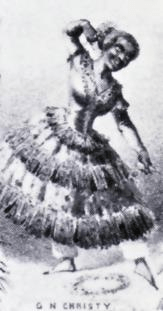
By the early 1840s, the aftershocks of the Lovejoy murder had worn off enough for Whig publications to tentatively resume their work in St. Louis, notably focusing on the issue of temperance. The Illinois and Missouri Temperance Herald was a short-lived publication based in St. Louis which, while fleeting, provides us with some extremely valuable first-hand accounts of this moment in St. Louis’ history. One of the most fascinating anecdotes that I found during this research period, however, is that the 7th Governor of Missouri was widely known to have performed in minstrel shows during the campaign of 1840, the same campaign that the Granny Harrison line was getting thrown around. We receive this illustrative anecdote from the Herald:
It is a graphic but dark and melancholy picture for Missouri. But we have no doubt it is faithfully drawn. […] In most of the counties, rum-selling, drunkeness, ignorance, and every grade of vice and immorality precail to a deplorable extent. As a prominent fact in confirmation of this deplorable state of public morals, which must stand out to the everlasting disgrace of the state, it is well known that during the last gubernatorial canvass, the THING that could get drunk, and play the monkey best, and dance and sing to the tune of Jim Crow before the congregated multitudes, while soliciting their sufferage, was elected to the highest executive office in the state.33
In the original draft of this article, I had absolutely no idea what to make of Thomas Reynolds and his open participation in blackface and minstrel theater. The more I learn about him, however, the more convinced I become that this man’s fingerprints still linger on the DNA of Jim Crow laws, anti-trans laws, and racial segregation nearly 200 years later.
The Mystery of Governor Thomas Reynolds
First things first – this man was an early adopter of minstrel shows, especially for a politician from Missouri. You did not ‘happen’ to perform in minstrel shows in Missouri in 1840 unless you were actively seeking them out – which means that not only did Thomas Reynolds use minstrel as a tool during his campaign, he was likely one of the first people to ever perform a minstrel show in the state of Missouri. Secondly, it appears that despite the apparent success of that 1840 political campaign and the spate of criminalization and segregation laws he passed in its wake, Reynolds developed a deep depression (‘melancholia’) in 1844 and ended up taking his own life in the governor’s mansion, leading to the birth of mental health care in Missouri as a result.
In his suicide note, Reynolds wrote:
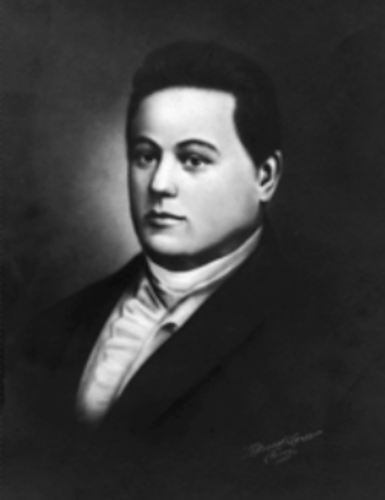
I have labored and discharged my duties faithfully to the public, but this has not protected me from the slanders and abuse which has rendered my life a burden to me…I pray to God to forgive them and teach them more charity.35
That is the entire note.
It’s difficult to know what exactly Reynolds meant by ‘slanders and abuse,’ and his tenure in office is pretty poorly documented. I have no additional details on where, when, or how he performed blackface, and I very much do not have the time to comb through St. Louis newspapers to find out. However, we do have a clear example above of the Whigs mocking the man for performing in minstrel shows, and there is another extant article from an abolitionist newspaper gloating over his suicide:
DEATH AND SUICIDE OF GOVERNOR REYNOLDS OF MISSOURI.
The Missouri Republican of this morning announces the suicide of Gov. Reynolds of Missouri, at Jefferson. It was communicated by the Auditor to the Post Master, at Fulton. who writes that Governor Reynolds committed suicide by shooting himself through the head, with a pistol, on Friday, the 9th inst., at 9 o’clock, A. M.
This individual must have been a slavehold. er, if so, we wonder if he set his slaves free, and pardoned those three young men that was sent to the penitentiary for doing that which is right in the sight of God. If he has done this, we think he has done that which is right in the sight of the world. It is some what strange to us, that slaveholders, when in their official duty are snatched from time to eternity. This reminds us of the case of the Aimsted, in that controversy one of the Judges was snatched from his duty, and launched into eternity, there to give an account of his Stewardship here be low
The Bible says, you had better have a mill stone about your neck and cast into the depth of the sea, than to offend one of these little ones; or words to this amount. Offences have been committed against some of those little ones; because, these young men belong to a free state, and now are shut up in confinement in state where slavery exists. Perhaps it is for this cause, that God has been pleased to re- move some of the obstacles that is in the way of emancipation.36
Certainly paints a rosy picture of the man. The State Historical Society of Missouri offers us a more straightforward account of the broader political thrust behind these articles:
Having officially organized the year before, Missouri’s Whig Party embraced the 1840 presidential campaign of William Henry Harrison, the famous general who had fought Native Americans on the western front during the War of 1812. Missouri Whigs held a three-day convention beginning on June 18 at Rocheport in Boone County. Delegations from several counties made their presence known, with St. Louis Whigs traveling up the Missouri River in three steamboats laden with banners and a brass band. Artist and Whig politician George Caleb Bingham painted a four-sided banner, six feet square on each side, which included a portrait of Harrison, a depiction of the Battle of the Thames from the War of 1812, and the log cabin that had become associated with him. Despite the show of support for Harrison and his successful campaign, he did not carry Missouri. Whigs in the state never claimed majority support in the years that followed, and because of the state’s electoral makeup, few of its leading Whig politicians were willing to commit to running for any of the statewide offices or even its congressional districts. Instead, Whigs frequently worked to take advantage of fissures within the dominant Democratic Party. As monetary and banking policy divided Missouri Democrats in the 1840s, Whigs offered support to Democratic politicians who held positions that were closest to their own instead of presenting a separate slate of candidates37
Short of a much deeper dive into Missouri state newspapers during Reynolds’ tenure, it’s likely impossible for us to make an accurate speculation about which abuses, precisely, lead to the Governor’s suicide. I will leave that work to any archivists who might seek to take up the question at a later date. This article suggests it was a mental-health induced paranoia with no basis in reality.
I also want to highlight once again the prominence of the steamboat in the political conscience of Missouri at the time. We discussed in Part Three the showiness of the Election of 1840, and Missouri was no exception to that rule – steamboats to the left, minstrel shows to the right, a chaotic mess all around.
Thomas Hart Benton and Missouri’s Political Prerogatives
The financial divide in the Missouri Democratic Party during the 1840s centered around their controversial but long-serving senator, Thomas Hart Benton, who was an unpleasant figure in the national conscience, to put it mildly. For example, here is a delightful caricature of Benton that Henry R. Robinson published in 1837:
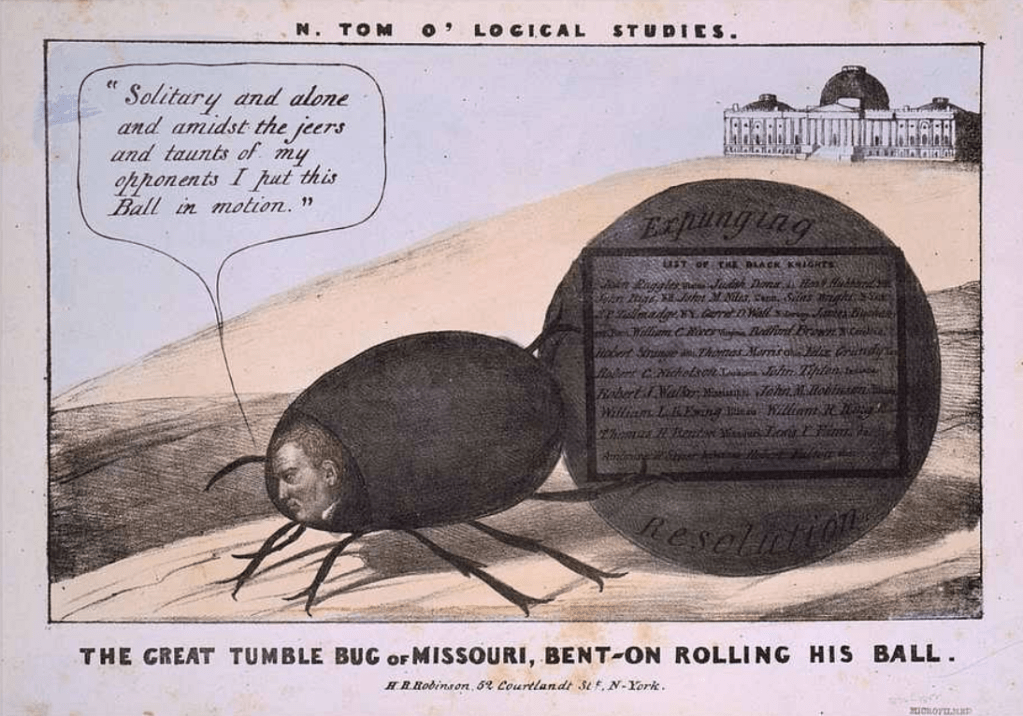
There are so many fucking horrible stories about this evil, evil man, and we simply don’t have time to recount them all. Firstly, Benton was a staunch Democrat and an ardent Jacksonian. Because he was in Congress for thirty years, making him one of the longest-serving senators ever, that means that Benton supported basically everything that the Democratic Party did between 1821 and 1851, which, yeah. This man was a fanatic expansionist and imperialist, a primary architect of decades of genocide against the Native Americans, the author of the freaking Homestead Acts, a major proponent of the annexation of Texas, and God, that’s only what he did in office.
Benton was under the personal mentorship of Andrew Jackson from a young age. He was expelled from collage for petty theft, gave them the middle finger, and returned to his plantation to manage his family’s slaves. He killed a man in a duel in 1817. Thomas Hart Benton was also a pedophile and sex trafficker, responsible among many other heinous acts for trafficking a teenage girl from France in a three-year fling and keeping 12-year-old enslaved girl Phoebe Moore as a concubine for four years before selling her at sixteen to Henry Clay (remember that bastard?), who sired two children with her39.
Thomas Hart Benton was the scum of the earth, and I sincerely hope that people are still pissing on his grave to this day.
As I had the horrible displeasure of discovering, Benton was also a huge windbag whose speeches were regularly published as magazine-length pamphlets and whose autobiography is over 1000 pages long. I find his take on the Election of 1840 to be instructive:
From the beginning it had been foreseen that there was to be an embittered contest—the severest ever known in our country. Two powers were in the field against Mr. Van Buren, each strong within itself, and truly formidable when united—the whole whig party, and the large league of suspended banks, headed by the Bank of the United States—now criminal as well as bankrupt, and making its last struggle for a new national charter in the effort to elect a President friendly to it. In elections as in war money is the sinew of the contest, and the broken and suspended banks were in a condition, and a temper, to furnish that sinew without stint. By mutual support they were able to make their notes pass as money; and, not being subject to redemption, it could be furnished without restraint, and with all the good will of a self-interest in putting down the democratic party, whose hard-money policy, and independent treasury scheme, presented it as an enemy to paper money and delinquent banks. The influence of this moneyed power over its debtors, over presses, over travelling agents, was enormous, and exerted to the uttermost, and in amounts of money almost fabulous; and in ways not dreamed of. The mode of operating divided itself into two general classes, one coercive—addressed to the business pursuits and personal interests of the community: the other seductive, and addressed to its passions. […]
The class of inducements addressed to the passions and imaginations of the people were such as history blushes to record. Log-cabins, coonskins, and hard cider were taken as symbols of the party, and to show its identification with the poorest and humblest of the people: and these cabins were actually raised in the most public parts of the richest cities, ornamented with coonskins after the fashion of frontier huts, and cider drank in them out of gourds in the public meetings which gathered about them: and the virtues of these cabins, these skins, and this cider were celebrated by travelling and stationary orators. The whole country was put into commotion by travelling parties and public gatherings. Steamboats and all public conveyances were crowded with parties singing doggerel ballads made for the occasion, accompanied with the music of drums, fifes, and fiddles; and incited by incessant speaking.40
Thomas Reynolds idolized this man, for the record. During his tenure as the Governor of Missouri, he spent nearly all his energy implementing Benton’s economic ideals, both through the creation of a state bank for Missouri and the reduction of Missouri’s debt. It’s hard to imagine that Senator Benton was particularly fond of him in return, given that Reynolds apparently engaged in the same “seductive passions” as the Whigs in his gubernatorial campaign. Reynolds is not mentioned a single time in Benton’s entire autobiography.
At the same time, this disconnect between the national and state-level officials of Missouri was precisely why Thomas Hart Benton was such a strong advocate for a decentralized Treasury system that put the money in the hands of the (slaveholding) states. Missouri was very far removed from the federal government, and as such had to operate at a certain degree of fiscal and regulatory independence. He recounts:
But the system is to be abolished; and we are to take our chance for something, or nothing, in place of it. The abolition is to take place incontinently—incessantly—upon the instant of the passage of the bill! such is the spirit which pursues it! such the revengeful feeling which burns against it! And the system is still to be going on for a while after its death—for some days in the nearest parts, and some weeks in the remotest parts of the Union. The receiver-general in St. Louis will not know of his official death until ten days after he shall have been killed here. In the mean time, supposing himself to be alive, he is acting under the law; and all he does is without law, and void. So of the rest. Not only must the system be abolished before a substitute is presented, but before the knowledge of the abolition can reach the officers who carry it on; and who must continue to receive, and pay out public moneys for days and weeks after their functions have ceased, and when all their acts have become illegal and void. […]
The census of 1840 gives many States, and Missouri among the rest, three times their present relative weight; and no permanent measure ought to be discussed until this new relative weight should appear in Congress. Why take the census every ten years, if an expiring representation at the end of the term may reach over, and bind the increased numbers by laws which claim immunity from repeal, and which are rushed through without debate? Am I to submit to such work? No, never! I will war against the bank you may establish, whether a simple or a compound monster; I will war against it by every means known to the constitution and the laws. I will vote for the repeal of its charter as General Harrison and others voted for the repeal of the late bank charter in 1819. I will promote quo warranto’s and sci. fa.’s against it. I will oppose its friends and support its enemies, and work at its destruction in every legal and constitutional way. I will war upon it while I have breath; and if I incur political extinction in the contest, I shall consider my political life well sold—sold for a high price—when lost in such a cause.41
Thomas Hart Benton was a polarizing figure in American politics in no small part because of his fiscal policies and stodginess. His top priority during the Panic of 1837, a financial crisis that was blamed in no small part on Andrew Jackson’s financial policies, was to repeal a Congressional censure of Jackson’s unilateral decision to withdraw funds from the federal reserve. This is the ball of dung that Robinson caricatures Burton as pushing up the hill, for the record. For his part, Reynolds was an enthusiastic proponent of Jacksonian economics in Missouri, and supported many of Burton’s policies regardless of whether his constituents agreed with them or not.
Steamboats, Slaves, and the Washingtonian Movement
By the time that Thomas Reynolds was elected Governor of Missouri in 1840, Missouri had been a state for just twenty years. He was not a Missourian by birth; in fact, Reynolds served a significant portion of his political tenure in the Illinois Supreme Court and state legislature. This was common in this period of American history – career politicians would routinely shuffle between states, especially as the interests of expansion drew the whole country westward. There was a significant degree of coordination between the Democratic Parties of Illinois and Missouri, who had a common goal in preventing the flow of fugitive slaves across the Mississippi River.
So. We have Thomas Hart Benton representing Missouri in the federal government, one of the most loyal Democratic partisans and a prominent architect of many of the worst atrocities of the Antebellum Era. We have Thomas Reynolds in the Governor’s office, a man who openly participated in minstrel shows when they were still hip and who staunchly believed in guaranteeing Missouri’s fiscal independence from federal influence and the security of enslaved chattel against escape or revolt. We have a state of Missouri that actively engaged in multiple ethnic cleansings in the past decade, invented first-of-its-kind repressive measures to police the free flow of human traffic, and was created from its inception as a guarantor of the institution of slavery.
The last piece of this puzzle, the only thing that stood in the way of Democrats running their new experimental legal framework for the surveillance and control of private citizens, was the city of St. Louis itself, through which all of the steamboat and waterway traffic would have to invariably run.
Fortunately for them, the Missouri Whig Party was so weak in the wake of the Elections of 1840 that they made an active effort to support moderate Democrats instead of putting forward their own candidates. This was in no small part because Reynolds’ Whig electoral opponent for Governor was accused of election fraud, got into a massive duel, and later turned out to be a Confederate traitor! But that’s a story we really don’t have time to discuss.
For the first time in St. Louis history, a Democrat was elected as mayor of the city in 1842, and Missouri Democrats did not hesitate to take advantage of the chance.
As you’ll recall from our discussion in Part Two, the 1824 Supreme Court case Gibbons vs. Ogden ruled that no state could award a monopoly on steamboat travel through a state to any one company. While the 1835 “An act concerning free negroes and mulattoes” helped Missouri slaveowners to control and surveil the movement of Black residents, it ultimately did not solve the issue of the Mississippi River for the state or St. Louis. At the end of the day, there was no absolute action that Missouri could take to stop a theoretical fugitive slave from getting on a steamboat in Mississippi and debording to freedom in Illinois. Missouri could neither demand sole ownership of their waterways nor constrain the flow of goods from other American states – yet.
The Temperance movement was aware of the vulnerability, and sought to make the steamboat one of their primary cultural battlegrounds for the state. An earlier article in 1841 from the Illinois and Missouri Temperance Herald describes how the temperance movement had involved itself in the issue of steamboats on the Mississippi River during this time. It reads:
Another indication that public sentiment is prevailing against intemperance is the fact, that nearly or quite all the steamboats that now leave the ports of Alton and St. Louis, have recently, by mutual consent, dispensed with the practice of furnishing liquors for their tables. – We will remember when about three years ago, a proposition was made to some of them to do this very thing, it was rejected almost without serious consideration. […] And why did they adopt it! Clearly because they had become convinced that there was such a change in the views and practice of the community in regard to this thing that they would be sustained in it.42
It was amidst this rise in the prominence of the temperance movement in St. Louis and its surrounds, and the growing presence of Illinois within the state politics of Missouri, that Abraham Lincoln would travel to Springfield in 1842 to give one of his less-remarked upon addresses, the Temperance Address of 1842. This era of temperance history was defined by the Washingtonian Movement, a brief-lived but intense period of advocacy for total abstinence that swept the country at the beginning of the 1840s. On the rise of the Washingtonian Movement in the region, Milton A. Maxwell writes:
On December 21, 1841, a team of three, probably including Vickers, began a campaign in St. Louis, laying the foundation for a Washington society that numbered 7,500 within a few months. Many communities in Kentucky, Indiana and Illinois were also visited. It is interesting to note that on February 22, 1842, Abraham Lincoln addressed the Washington Society of Springfield, Ill. Just how quickly the West was cultivated by the Washingtonian missionaries, operating chiefly out of Cincinnati, is shown by the May 1842 claims of 60,000 signatures in Ohio, 30,000 in Kentucky, and 10,000 in Illinois. Of these, it was claimed, “every seventh man is a reformed drunkard, and every fourth man a reformed tippler.”43
What sets Lincoln’s Temperance Address, and indeed the Washingtonian Movement as a whole, apart from previous efforts in Missouri is that it was primarily aimed not at the laws of the state, but rather at the hearts and minds of the people. He said:
It is true, that even then, it was known and acknowledged, that many were greatly injured by it; but none seemed to think the injury arose from the use of a bad thing, but from the abuse of a very good thing. The victims of it were pitied, and compassionated, just as now are the heirs of consumptions, and other hereditary diseases. Their failing was treated as a misfortune, and not as a crime, or even as a disgrace. […] Another error, as it seems to me, into which the old reformers fell, was, the position that all habitual drunkards were utterly incorrigible, and therefore, must be turned adrift, and damned without remedy, in order that the grace of temperance might abound to the temperate then, and to all mankind some hundred years thereafter. There is in this something so repugnant to humanity, so uncharitable, so cold-blooded and feelingless, that it never did, nor ever can enlist the enthusiasm of a popular cause. […] By the Washingtonians, this system of consigning the habitual drunkard to hopeless ruin, is repudiated. They adopt a more enlarged philanthropy. […] To these new champions, and this new system of tactics, our late success is mainly owing; and to them we must mainly look for the final consummation.4445
And should one think that Missouri might not take this approach as a threat to slavery, Lincoln quickly puts those doubts to rest:
Turn now, to the temperance revolution. In it, we shall find a stronger bondage broken; a viler slavery, manumitted; a greater tyrant deposed. In it, more of want supplied, more disease healed, more sorrow assuaged. By it no orphans starving, no widows weeping. By it, none wounded in feeling, none injured in interest. Even the dram-maker, and dram seller, will have glided into other occupations so gradually, as never to have felt the change; and will stand ready to join all others in the universal song of gladness. And what a noble ally this, to the cause of political freedom. With such an aid, its march cannot fail to be on and on, till every son of earth shall drink in rich fruition, the sorrow quenching draughts of perfect liberty. Happy day, when, all appetites controlled, all poisons subdued, all matter subjected, mind, all conquering mind, shall live and move the monarch of the world. Glorious consummation! Hail fall of Fury! Reign of Reason, all hail! And when the victory shall be complete — when there shall be neither a slave nor a drunkard on the earth — how proud the title of that Land, which may truly claim to be the birth-place and the cradle of both those revolutions, that shall have ended in that victory. How nobly distinguished that People, who shall have planted, and nurtured to maturity, both the political and moral freedom of their species.46
Powerful words – and a direct threat to slaveholder power in Missouri, coming from the mouth of the most vocal critic of Elijah Lovejoy’s murder. As the rhetoric of the Whigs shifted away from a criminalization of alcohol to a moral salvation of the drinker in this brief historical moment, accompanied by a series of victories for the temperance crusader in St. Louis, it should perhaps not surprise us that the state of Missouri became intensely occupied with the presence of Free Blacks in the state and the possibility of a renewed abolitionist movement.
The DNA of Legal Discrimination
Missouri’s radical new legislative experiment began amidst this climate, when the state legislature would double down on its 1835 act to pass the late-1842 act “An act more effectually to prevent free persons of color from entering into this state, and for other purposes.” This ban was horrible for so many reasons. Not only did it completely forbid free people of color from entering the state of Missouri, it also made illegal to employ a free person of color in the state. To understand why this is so fucked up, remember that it was very common practice in Missouri at the time for slaveowners to rent out their slaves to other businesses to do labor. What this means is, essentially, it was impossible for a black person to have a livelihood in Missouri unless they were enslaved. The Act also significantly restricted access to the aforementioned Freedom Cards and made it illegal to bring a slave who would be freed into the state. It was, in essence, a piece of legislation designed to eliminate the possibility of being a freed Black person in Missouri.
The bill also demanded that any black person entering the state by steamboat was required by law to be detained for their entire stay in Missouri:
That, from and after the time specified in this act, no free negro, mulatto or person of color, shall come into this State, on board of any steam boat, or other vessel, as a cook, steward, mariner, or in any employment on board such steam boat or vessel, or as a passenger, or in any other manner; and if any steam boat, or other vessel shall arrive at any port, harbor or landing on any river of this State from any other State, having on board any such free negro, mulatto or person of color, the harbor master or other officer having charge of such port, or any person or persons residing at or near said port, or any landing, shall forthwith notify the nearest judge of any circuit or county court, or justice of the peace in the county in which said port, harbor or landing is situated, or the arrival of such steam boats, or other vessel, whereupon the said judge, or justice of the peace shall immediately issue a warrant to apprehend and bring every such free negro, mulatto or person of color, before him, and on the execution of such warrant by bringing before him such free negro, mulatto, or person of color, he shall forthwith commit him, or her, to the county jail, there to be confired until said steam boat, or vessel shall be ready to proceed to her place of destination, when the master, or commander of such steam boat or other vessel shall, by the written permit, or order of said judge or justice of the peace, take and carry away out of this State every such free negro, mulatto or person of color, and pay the expenses of his or her apprehension and detention.47
This was the first section of the law. As should be evident, the primary concern of the Missouri legislature was a severe increase of the surveillance of watercraft on the Mississippi River. With the passage of this law, any steamboat in Missouri waters could be searched at any time, for any reason, to “check” for free Blacks aboard. Crucially, this law did not require any cooperation from Illinois or surrounding states; it gave Missouri unilateral authority to control the flow of enslaved and abolitionist goods through the primary Western gateway to freedom in the North.
Not only did this bill make it severely difficult for free blacks to find employment and create legal justification for the search and incarceration of any person of color in the state, it also expanded the “good morals” clause of the 1835 provision and placed a hefty price tag on the possession of a freedom license. Jenkins writes:
The bonds required by this law were written documents stating that the person applying for the freedom license promised to be of good and moral character and uphold the laws of the state. If the person was convicted of any crime they had to pay the amount on the bond, would have their license forfeited, and had to depart from the state. […] The bonds varied in amounts, from $100 all the way up to $1,000. The “securities” mentioned in the law were individuals who could attest to the good behavior of the person applying for the license. If the person on the license were convicted of any crime, the securities also risked their money and reputations; they would be charged with having to pay the amount of the bond. If the bond was not paid, some individuals lost their property due to it being sold to pay the debt to the state.48
And here we finally, finally arrive at the first anti-trans law in American history.
It’s critical to recognize that St. Louis’s new misdemeanors code, passed on September 16th, 1843, was an extension and enforcement of the statewide standard set by “An act more effectually to prevent free persons of color from entering into this state, and for other purposes.” Equally so, we must recognize how this moment in Missourian political history mirrors the British dynamics of the decade prior. With the rise of a moral conscience of Reform via the Washingtonian movement, Missouri Democrats echoed Sir Robert Peel’s new Conservatism and focused on the word of the law and its mechanisms of enforcement as a proactive methodology for suppressing abolitionist revolt.
St. Louis’ misdemeanors bill was passed by Democrats to support a statewide Democratic legislature and their goals. The bill did a lot of things, and almost all of them were designed to allow the warranted surveillance of Black bodies in the city off of the steamboats too. It was an itemized, comprehensive list of any and all reasons that a person of color could be checked for a freedom license, and ensured not to be a fugitive slave. One statue of the code makes this exceedingly clear:
§ 36. Whenever a minor or servant shall have been arrested for the violation of any ordinance, the parent or guardian of such minor or servant, if known, shall be summoned to appear and defend for said minor or servant. If the parent guardian or master of said minor or servant shall fail to appear, or shall appear and shall fail or neglect to pay the fine and costs, the minor or servant shall be dealt with as if of age or free.49
‘Servant’ meaning slave, and slave meaning any person of color, who will be presumed as a fugitive slave under St. Louis law unless proven otherwise.
And here, earlier in the law, is the statute of note:
§ 7. Every person who shall appear in any street, alley, avenue, market place or public square or in any other place within the city, when naked, or in a dress not belonging to their sex, or in an indecent or lewd dress, or shall be guilty of any indecent or lewd act or behavior, or shall exhibit any indecent or lewd book, picture, statue, or other thing, or who shall exhibit or perform any immoral or lewd play or other representation, shall be deemed guilty of a misdemeanor.50
Let’s break this down. In one single statute, the city of St. Louis lumps several items of note together into one singular misdemeanor. Section 7 of the 1843 misdemeanor code makes it a misdemeanor to A) indecent exposure, B) cross-dress, C) be a prostitute, D) publicly sell erotica, and E) perform in an “immoral” public performance. The fact that all five of these things are banned in the same statute gives us an enormous amount of information about the conceptual origins for this laws, and allows us to draw some hypotheses about them (and I do want to stress that this is hypothesis, not fact).
This bill was passed a year after the Black Tariff of 1842 and the subsequent prosecution of lithographer Henry R. Robinson, who created several images of cross-dressing that had become famous around the country at the time. Both Granny Harrison and the Man-Monster would have likely made their rounds to Missouri by the fall of ’43. Moreover, we also have discussed how minstrel shows were also a Northern innovation, one which was deployed by the Whigs in the 1840s presidential campaign (much like the Granny Harrison attack). Governor Reynolds had campaigned using minstrel as well, and later killed himself due to ‘attacks upon his character’ – minstrel was controversial in Missouri in 1843, and, as we have mentioned, one of the primary vectors of cross-dressing in the state.
One hypothesis we can draw from this bevvy of evidence is that § 7 may have been a broad attempt by Democratic lawmakers in both St. Louis and Missouri at-large to ban what they may have seen as trendy new influence from the North, which assuredly would open the door to abolitionist sentiments. This influence could have come in the form of “incendiary” lithography, minstrel shows, the 1840 presidential campaign, or a perceived temperance/abolitionist influence from down the Mississippi or across the Illinois border, especially in the form of newspaper provocateurs. It also must be noted that each and every one of these manifestations of cross-dressing at the beginning of the 1840s is racially coded, and were occasionally used as a platform for abolitionist speech. One could thus posit that the “dress not belonging to their sex” line was a pretext used to shut down progressive-leaning minstrel performances, and had very little to do with any direct stated animus toward what we might now call trans people at all.
A second hypothesis is that much as the modern Conservative “War on Porn” catches drag queens and trans people in its cross-hairs, this statute could similarly be read as primarily an anti-porn law that singles out cross-dressing as a symbol of sex work in the city of St. Louis. This is an interesting hypothesis, but one that I ultimately think has less substantiation that the first. I haven’t found any specific evidence to show a presence of cross-dressed sex work in St. Louis in the 1830s or 40s.
A third hypothesis concerns fugitive slaves cross-dressing to evade slavecatchers, though I will leave that discussion to later in the article, as I couldn’t find evidence specific to Missouri.
What these hypotheses have in common is that they suggest that this first anti-trans law was not designed to specifically implicate “trans people” as we might know them today. I have not found any evidence that a historical equivalent of trans people were ever a primary topic of discussion during this period.
Critically, this was a misdemeanor bill designed and passed during a complete Democratic control at all levels of St. Louis governance. It was not a species of Whig or Evangelical moral reform – it was a direct repudiation of those same trends on the state and local level. This is a pattern that will hold across this period, and also a key distinction between municipal censorship of trans literature, which is often passed by Democrats, and national censorship of trans literature, which was pioneered by the Evangelical Whigs and the Tariff of 1842. The United States has never passed a federal cross-dressing ban, and this is one of the primary reasons why.
Finally, and perhaps most obviously, it should be striking to us that the first anti-trans law in the United States of America was rolled into the same statute as a law against “indecent and lewd books.” What this tells us: the history of trans literature cannot be extricated from the legal history of trans bodies in America. From the beginning, censorship, sex work, and trans expression have been intimately intertwined – and it is only through an analysis in tandem that we can hope to truly untangle the origins of our present-day quandries.
New York State: Revolt, Repression, and the Myth of the ‘Masquerade’
Why ‘Masquerade Laws’ is an Unproductive Collective Noun
Aside from the complexity of the relevant histories here, another reason I have just spent 20,000 words really digging into the nuance and complexity of Missouri’s 1843 cross-dressing ban is because my historical analysis here somewhat contradicts the current prevailing wisdom in the field of Trans Studies on anti-trans law during this period.
In Transgender History, Susan Stryker correctly observes that anti cross-dressing law begins in cities in the Midwest:
Not until the mid-nineteenth century, however, did social conditions take shape that would foster a mass transgender movement for social change in the century that lay ahead. Starting in the 1850s, a number of US cities began passing municipal ordinances that made it illegal for people to appear in public “in a dress not belonging to his or her sex.”51
However, her argument remains perplexed as to the causes of this, and ultimately falls back on analysis that predicates early anti-trans law on sentiments against homosexuality, which have not come up at all during my research into the origins of this St. Louis law:
Very little historical research helps us explain why cross-dressing became a social issue seemingly so in need of regulation in the 1850s, but an old argument about capitalism and gay identity offers some suggestive parallels. According to historian John D’Emilio, modern gay and lesbian communities weren’t possible until the middle of the nineteenth century, with the rise of modern industrial cities and their large working-class populations. It wasn’t until men could leave tight-knit rural communities, characterized by intimate and interlocking forms of familial and religious surveillance, that they had the opportunity to form different kinds of emotional and erotic bonds with other men. […]
It is important to recognize that we still know very little about the social history of cross-dressing or the public expression of transgender feeling in earlier periods. And yet, the same circumstances that supported the development of same-sex social worlds also would have applied to people who sought different ways to express their sense of gender. People assigned female at birth who could successfully present themselves as men had greater opportunities to travel and find work. People assigned male at birth who identified as women had greater opportunities to live as women in cities far removed from the communities where they had grown up. In practice, the distinctions between what we now call “transgender” and “gay” or “lesbian” were not always as meaningful back then as they have since become.52
This non-explanation was one of the primary incitements to grounding this series in 19th Century history rather than beginning with the first surviving textually trans books. I wanted to understand why these issue emerged – not just when and where.
But there is another little nugget in Transgender History, one which I am going to put next to the 1843 St. Louis ban that we have just exhaustively discussed:
§ 7. Every person who shall appear in any street, alley, avenue, market place or public square or in any other place within the city, when naked, or in a dress not belonging to their sex, or in an indecent or lewd dress, or shall be guilty of any indecent or lewd act or behavior, or shall exhibit any indecent or lewd book, picture, statue, or other thing, or who shall exhibit or perform any immoral or lewd play or other representation, shall be deemed guilty of a misdemeanor.
St. Louis, MO, 1843
If any person shall appear in a public place in a state of nudity, or in a dress not belonging to his or her sex, or in an indecent or lewd dress, or shall make any indecent exposure of his or her person, or be guilty of any lewd or indecent act or behavior, or shall exhibit or perform any indecent, immoral or lewd play, or other representation, he should be guilty of a misdemeanor, and on conviction, shall pay a fine not exceeding five hundred
dollars.
San Francisco, CA, 186353
Yeah. Twenty years apart, we see an almost direct copy-and-paste job from Missouri to California, thousands of miles away.
This should give us immediate pause. I know it did for me. When I realized for the first time that almost all of these municipal cross-dressing bans had near-identical text, that many of the statutes also include a prohibition on “lewd books,” often in the very next clause, it was a total ‘oh, shit’ moment.
The argument that I am going to make in the following sections is that while the 1843 St. Louis law seems to have arisen due to the messy historical confluences of Missouri in the 1830s and 1840s, which cannot be reduced down to any one ‘trans’ or even ‘cross-dressing’ influence that sparked it, the subsequent spread of anti-cross-dressing laws across the United States reflects a coordinated local political strategy by pro-Slavery Democrats to calcify the slaveholding interest within every level of American governance. I do not believe that the cross-dressing statute of these duplicated laws arose out of any sort of national anti-cross-dressing sentiment, but rather are somewhat of a historical accident, a tangential piece of a much broader political experiment that began in the American Midwest and would eventually lead to the Civil War and Jim Crow segregation.
In essence, what I’m suggesting is that there may not have been any sort of “transphobic” origins for American anti-trans law. My suggestion is that it is an accident of the Peelian white conservatism that helped to birth the Confederacy, a complete byproduct of American slavery, and that the reason of its inclusion may really be as petty and arbitrary as obnoxious political cartoons, or a random forgotten Missouri governor being embarrassed about having done blackface in drag for a minstrel show. I believe that the 1843 St. Louis provision was arbitrary, and that its duplication across the country is pure sloth on the part of Pro-Slavery lawmakers, an utterly banal lack of imagination, copied homework, and shared notes.
There are a couple significant challenges to this argument, which I’m going to lay out for you as we dive deeper into this coordinated political strategy across the 1840s and 1850s. For a sense of the prevailing argument I’m trying to debunk, here’s a random article from Pink News – but know that you can find a similar argumentation in other sources, including some academic texts:
From the mid-19th to the mid-20th century, dozens of areas in the US enacted legislation prohibiting appearing in public in “disguise” or “masquerade”, collectively referred to as masquerade laws.
Even when these laws didn’t explicitly crack down on gender expression, they were interpreted as applying to cross-dressing or dressing as another gender more broadly as a criminal form of concealment.
One of the oldest of these laws dates back to 1845, when New York declared it a crime to appear in public with a painted face or when wearing a disguise designed to prevent identification.
In 1848, a law in Columbus, Ohio forbade a person from appearing in public “in dress not belonging to his or her sex”, and Chicago, Illinois, passed a similar measure three years later.
They weren’t alone.
According to William Eskridge, the author of Gaylaw, “cities of every size and in every part of the country” adopted laws to enforce gender-conforming dress codes during this period.54
I would describe this as the current “queer conventional wisdom” about the history of cross-dressing bans. While these accounts often acknowledge that the New York law had some key similarities to municipal cross-dressing bans at the time, they tend to bundle all of these laws up into one big pile as “Masquerade Laws,” effacing some of the key distinctions that are critical to actually understanding how this regime came about. The primary problem with this argument is that the New York statute is the exception to the general textual trends among these laws, not the rule. I find the flattening of municipal statutes in Midwestern states into a federal statute passed in New York to be a rather cosmopolitan take on both queer and American history, and I take object to describing this corpus of legislation as “masquerade.”
Understanding the Anti-Rent War’s Racial Connotations
Although it was on the other side of the country, New York was facing many of the same political factors as Missouri at the time. Minstrelsy was the racy new entertainment for the masses; Henry R. Robinson was a New Yorker, and his cartoons animated the city; the ongoing struggle between Democrats, Cotton Whigs, and Conscience Whigs had continued well into the 1840s.
In 1839, New York would leave nearly a decade of Jacksonian-Democrat state level control for its first Whig governor, one William H. Seward, who was notably pro-Black for his era. The election of 1838 was largely split between Jacksonian Democrats, who unintuitively had New York City as one of their strongholds at the time, and a populist Whig movement in the rural communities of the Hudson River Valley and the western parts of the state, which were much closer to Ohio, Kentucky, and the Western Evangelical base. Seward’s victory was part of a much broader wave of Whig candidates, a direct reaction against Democratic corruption during the economic instability of the Panic of 1837. It was a change election, and people were pissed.
At the time, there was a broad sentiment among rural New Yorkers that they had been exploited by the urban elite and the wealthy landowners who maintained a vestigial system that mirrored the British aristocracy. Governor Seward may have been a Whig, but he was also a major landowner in the rural parts of New York State; he was an agent for the Holland Land Company for years, and ultimately did not represent any meaningful challenge to the economic dominance of the patroon system.
In 1839, a populist uprising of tenets facing eviction in the Hudson River Valley declared a second American Revolution against the patroon system, stating, “We will take up the ball of the Revolution where our fathers stopped it and roll it to the final consummation of freedom and independence of the masses.”55 This revolt would be known as the Anti-Rent War. The Anti-Renters felt strongly that they had been exploited during the financial panic, and that the attempts to evict them from their land were unjust and monarchial. This led to several violent clashes over the course of 1839, ultimately culminating in Governor Seward deploying over 700 troops to quell the revolt, while making promises in private to protect tenets rights (he never did).
Though the Anti-Rent War never fully erupted into a true conflict, insurrection boiled beneath the surface of New York politics for the next six years. Notably, the tenets took up guerilla tactics against their landlords in much of a similar vein to how Haudenosaunee had once sent raiding parties into colonial territories. They called themselves “Calico Indians,” and we are fortunate enough to still have a picture of them:

Once again, we have cross-dressing figured primarily as a racially-coded activity. Just as the cross-dressing wench would have been animating minstrel stages in Manhattan, the cross-dressing Calico Indian wearing colorful dresses to invoke the fear of Native American raids was animating the New York Countryside. This was not a particularly gendered activity on the part of the Calico Indians – unlike early minstrel performers, who do seem to have some examples of transvestites using the medium as an excuse to cross-dress, the Anti-Rent War was fought predominantly by angry young white men, wearing dresses as a costume and political statement.
It was not a signification of gender – it was a populist statement from a demographic of white settlers who felt that their landlords had reduced them to the station of the Indian.
Again, we follow the history. In 1842, the Whigs passed the extremely unpopular Tariff of 1842, and then proceeded to immediately use it to criminalize some of the most influential political cartoonists in New York City. Harrison was dead, and Tyler was hardly proving himself a scion of Whiggery. Is it any wonder that the Democrats retook almost every level of the New York government that fall?
Governor Seward and his Democratic successor William C. Bouck were both lukewarm toward the Anti-Renter cause, half-heartedly attempting to moderate the conflict without taking much of a stance in either direction. When Bouck was primaried by New York Democrats in favor of his successor, however, New York politics would take a sharp turn against the Anti-Renter cause. Silas Wright may have only been governor of New York for two years, but he had a massive impact on state politics that would be felt long after his tenure, largely stemming from his draconian crackdown on insurrection in the state.
Eric Arnesen gives us the following account:
However the new Democratic governor, Silas Wright, did not support anti-rent and especially deplored the disorderly activities of the calico Indians. Wright took office at the height of Indian violence in January 1845 and demanded and received a law making it a felony to appear in disguise. Law-and-order posses stepped up efforts to root out Indian cells, and anti-rent strongholds descended into civil war as posses and Indians engaged in pitched battles. Indians tarred and feathered deputies; and shootings, arson, and other lawless acts increased. […]
Governor Wright and Delaware County officials declared a state of insurrection in the county and sent the militia to help the sheriff crush the rebellion. Law-and-order tactics proved so brutal and the trial of the insurgents so staged however that voters statewide rallied to the anti-rent cause, overwhelmingly approving the measure for a constitutional convention.57
This sharp rightward turn toward strict law enforcement and anti-insurrectionist crackdowns is a classic example of Confederate-style governance being deployed in the North. And New Yorkers? They didn’t like it! But much as the St. Louis model gave national Democrats an example of the success of such policies, the New York experiment of 1845 provided a critical roadmap to how the same approach could produce failures – and which institutions could survive the scrutiny of even the most fervent and progressive Evangelical more.
‘Masquerade’ as a Pretext for the Metropolitan Police
One of Wright’s successful innovations was, of course, the archetypal ‘masquerade’ laws that made dressing in disguise a state felony, and cross-dressing by extension. The text of the law reads:
4. Being masked or in any manner disguised by unusual or unnatural attire or facial alteration, loiters, remains or congregates in a public place with other persons so masked or disguised, or knowingly permits or aids persons so masked or disguised to congregate in a public place; except that such conduct is not unlawful when it occurs in connection with a masquerade party or like entertainment if, when such entertainment is held in a city which has promulgated regulations in connection with such affairs, permission is first obtained from the police or other appropriate authorities58
This is much less explicit about cross-dressing than the St. Louis law. However, in a discussion of the law’s relevance, the New York courts give the following explanation:
“New York’s first anti-mask law, “An Act to prevent persons appearing disguised and armed,” was enacted in 1845, as sections 1 and 6 of Chapter 3 of the Laws of 1845. … The purpose of the “Act” was to quell the “anti-rent riots,” an armed insurrection by farmers in the Hudson Valley. “This particular statute was addressed to a specific group of insurrectionists who, while disguised as ‘Indians,’ murdered law enforcement officers attempting to serve writs upon the farmers. The ‘Indians’ were in fact farmers, who as part of their costumes, wore women’s calico dresses to further conceal their identities.””59
It’s important to recognize that this law, while textually very different from the St. Louis law, ultimately stems from the same fundamental source: racial fears of abolition, sedition, and the overthrow of white supremacy. It also suggests that while I do not believe that these laws were created in tandem with each other, the Anti-Rent war and the subsequent legislation its Democratic opponents produced likely corroborated the cross-dressing ordinance of the St. Louis code as a politically useful tool for fighting racial insurrection, rather than a peculiarity of one city in the West.
The second and far more crucial innovation that Governor Wright and the New York Democrats made during this period is the adoption of Peelian policing in the United States.
Many of [Peel’s] ideologies were also adopted by American police agencies during this time period and remain in place in some contemporary police agencies across the United States. It is important to note that recently, there has been some debate about whether Peel really espoused the previously mentioned ideologies or principles or if they are the result of various interpretations (or misinterpretations) of the history of English policing. […]
While some regard slave patrol as the first formal attempt at policing in America, others identify the unification of police departments in several major cities in the early to mid-1800s as the beginning point in the development of modern policing in the United States. For example, the New York City Police Department was unified in 1845, the St. Louis Metropolitan Police Department in 1846, the Chicago Police Department in 1854, and the Los Angeles Police Department in 1869, to name a few. These newly created police agencies adopted three distinct characteristics from their English counter-parts: (1) limited police authority—the powers of the police are defined by law; (2) local control—local governments bear the responsibility for providing police service; and (3) fragmented law enforcement authority—several agencies within a defined area share the responsibility for providing police services, which ultimately leads to problems with communication, cooperation, and control among these agencies. It is important to point out that these characteristics are still present in modern American police agencies.60
It is not a coincidence that New York and St. Louis were the first two unified Peelian metropolitan police departments in the United States. Far more than any hallucinated connection between the 1843 St. Louis municipal cross-dressing ban and the 1845 New York state masquerade law, this rapid adoption of New York’s new approach to policing in the face of an active armed insurrection indicates a growing political strategy in the Pro-Slavery Democratic party emerging over the course of the 1840s. New York may not have cared about Missouri, but Missouri was absolutely trying to figure out how to wean itself from the influence of New York, and how to inure both itself and the rest of the slaveholding country from Northern abolitionist sentiment. Silas Wright had managed to pass these laws in the same state where William Seward, who would soon become Lincoln’s “right hand man,” had governed not four years prior – any Democratic policy that could survive in New York would certainly be able to thrive in the new American West.
Ergo, St. Louis took notes – they would reorganize law enforcement in the city after the newly centralized model in New York City, and perhaps reevaluate the cross-dressing statute as a core part of their enforcement books. Note that this was, once again, one of the first changes made upon a Democrat retaking the office from a Whig. The St. Louis Public Library observes:
The police system of the City was made a regular department of the municipal government in 1846. Before this time there had been night watchmen and some daytime patrol duty, but no regular Police Department. The Ordinance approved on August 17, 1846, included the duties of the City Marshal, City Guard, Day Police and the Keeper of the Calaboose. These four divisions of the department reported directly to the Mayor. The duties of the Marshal and Police were made separate. The Marshal enforced Ordinances and served Processes of the Court as well as the Orders of the Health Department. The Police were Peace Officers and were to arrest violators of State Laws and City Ordinances. The City Guards (night police) consisted of one Captian, six Lieutenants and 42 Privates. The Day police was a smaller body and consisted of seven Privates under one Lieutenant. It was in 1846 also that the Independent Police were organized for doing extra work of a detective nature. This Independent Detective Force was under the control of James McDonough. He later became Chief of Police under the system of state control which went into effect by order of the Missouri State Legislature in 1861.
St. Louis’ anti-cross-dressing ordinance appears to have been somewhat of an accident. New York’s masquerade law was a political reaction to overt rebellion.
What comes after that reveals the beginning of a new coordinated political strategy, one intentionally designed and executed with the sole intention of preserving America’s “peculiar institution” of slavery for generations to come.
Columbus, OH: Popular Sovereignty and the Election of 1848
We now need to turn our attention to court cases from the late 1840s, one of which will likely be familiar to my readers and several of which will not.61
The Dred Scott v. Irene Emerson Case of 1838
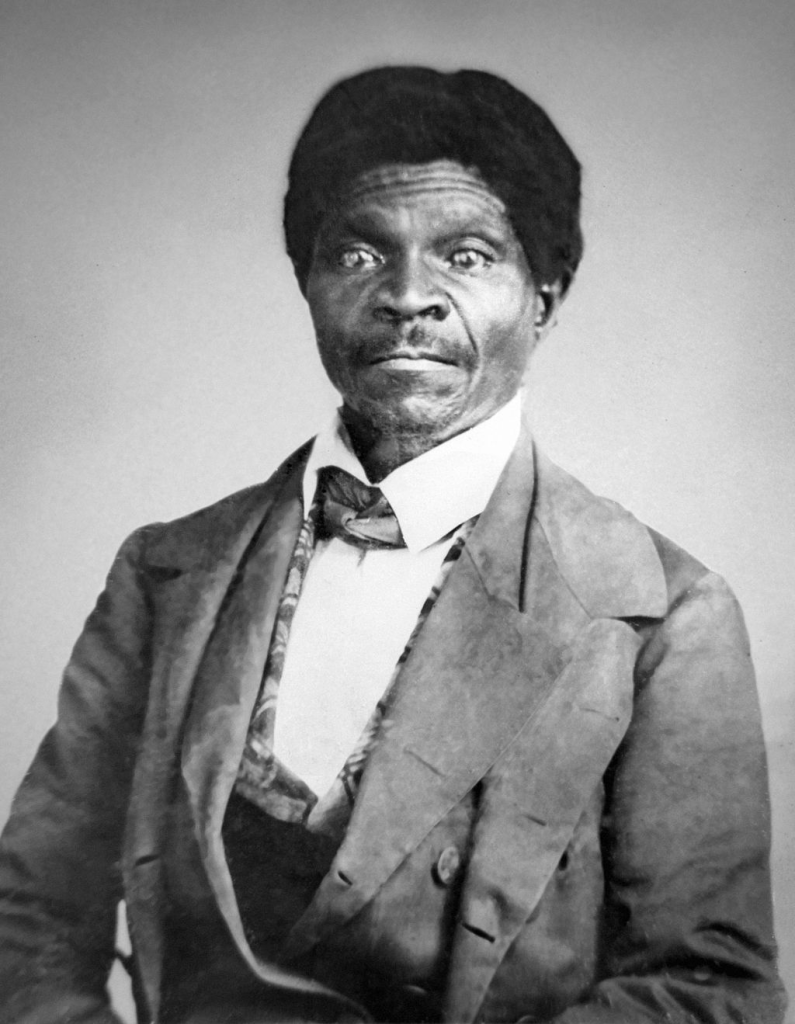
Dred Scott’s story is a complicated one, and it intertwines with much of the history we’ve been discussing throughout this article. He had multiple claims to freedom – a labor stint in Illinois while his masters were in Missouri, a daughter who ought to have been free when born on the Mississippi River – yet remained enslaved well into the 1840s. Scott was perhaps archetypal of Missourian slavery. He primarily worked for hire, both in and out of Missouri, and had a certain degree of freedom not available to many slaves. He earned a wage, had a recognized civil marriage ceremony, and got to remain with his family for his entire life.
I want you to observe how many of the threads we’ve been discussing come together here: the complicated politics of steamboats, Missouri-Illinois relations, increasingly authoritarian restrictions on Black people in Missouri. Scott’s first claim to freedom, being left in Illinois while his master was in Missouri, happened in 1837, the same year that Elijah Lovejoy was murdered in Illinois by a Missourian mob. Eliza Scott, Dred’s daughter born in free waters, never received a freedom license in the state of Missouri – while it’s surprisingly hard to find historical comment on the matter, one can quickly extrapolate that given a choice between losing his infant daughter to deportation or raising her a slave, the Scotts chose the latter, if they were given a choice at all.
Notably, the first attorney who brought Dred Scott v. Irene Emerson to trial, one Francis B. Murdoch, had also been involved with prosecutions relating to Lovejoy’s murder. Dred Scott was involved with several other figures in Lovejoy’s circles, including Reverend John R. Anderson, who typeset for Lovejoy’s press and preached at the Scott’s church.
Dred Scott lost his first 1846 appeal on a technicality, and remained in chains. Walter Ehrlich observes:
Dred Scott v. Irene Emerson elicited no particular interest or reaction in St. Louis or elsewhere, except to those people immediately concerned. It involved neither unusually prominent litigants nor extraordinary or controversial principles of law, and hence its occurence passed almost unknown. Only one St. Louis newspaper even mentioned the case, and then only in a routine daily list of cases in the city’s court.63
The years ticked on. Another Whig was elected president and died in office. The Mexican American war ended. An epidemic of cholera swept the country. A large part of St. Louis burned down. In 1850, during an appeal of that first decision, Dred Scott was granted his freedom by a jury of his peers, who declared that Dred, Harriet, and their two daughters were all free, and had been so since 1833. Ehrlich notes:
Once again it is absolutely clear that the political issue of slavery in the territories did not enter into the proceedings, despite the fact that this question was then, in 1850, the subject of intense and bitter nationwide debate in the halls of Congress, in the press, and from the pulpit and podium. At no time did any of the participants in the trial challenge the validity of the slavery prohibitions in the Ordinance of 1787 or the Missouri Compromise, nor did they even express any opinions about them.64
But there was a shift in those years – a seismic one which would destroy the Whig Party completely, radicalize the Democrats toward secession, lay the groundwork for the Republican Party, and ultimately set the stage for the Civil War.
Bentonites, Barnburners, and the Democratic Schism over Slavery
Silas Wright and Thomas Reynolds may have governed on opposite sides of the United States, but they represented the same side of a somewhat comparable schism in Democratic politics around the country at the time. As we’ve already discussed, Thomas Reynolds was in a faction of Missouri Democrats that supported Senator Benton – what we did not discuss is the fact that Thomas Hart Benton’s political career fell apart in 1850 due to his opposition to the Compromise of 1850.
A key document to study here are Missouri’s Jackson Resolutions of 1849, a statement of stringent pro-slavery sentiment that was specifically designed to exploit Benton’s moderatism on the issue of slavery. The resolution reads:
4. The right to prohibit slavery in any territory belongs exclusively to the people thereof, and can only be exercised by them in forming their constitution for a State government, or in their sovereign capacity as an independent State.
5. That in the event of the passage of any act of Congress conflicting with the principles herein expressed, Missouri will be found in hearty co-operation with the slave-holding States, in such measures as may be deemed necessary for our mutual protection against the encroachments of Northern fanaticism.
6. That our Senators in Congress be instructed and our Representatives be requested to act in conformity to the foregoing resolutions.65
It’s profoundly strange to think of the Missouri Democrats who passed such horrible anti-black laws as ‘moderates’ on the issue of slavery. But this moment represented a changing of the guard – the party of the old Jackson Democrats was fading, and a new rabidly Pro-Slavery Democratic party had begun to take its place. Most of the laws we have discussed prior to this point in the article were distinctly Jacksonian in their conception – it was aftershocks of 1835. This was something new even by Jacksonian standards, a political philosophy that saw even Reynold’s anti-black laws as insufficient to protecting their political objectives.
Pay very close attention to the verbiage “belongs exclusively to the people thereof” – we will be circling back to it in a second.
We return once more to Ehrlich:
The background to this crucial transition in the Dred Scott case lay in the deep-rooted struggle to unseat Senator Thomas Hart Benton of Missouri. Political conflict centering around “Old Bullion” was nothing new. The immediate issue arose from the highly partisan proslavery resolutions introduced by John C. Calhoun in the United States Senate on February 19, 1847, which asserted, in effect, that Congress had no power to prohibit slavery in the territories. Benton, a free-soil Democrat, vehemently opposed the resolutions, denounced them as erroneous “firebrand” abstractions, and campaigned against them both in Missouri and elsewhere. When Benton’s enemies gained control of the Missouri state legislature, they sought to undermine his political power so they might unseat him in the senatorial election coming up in 1850. On March 6, 1849, they pushed through the so-called “Jackson Resolutions,” which not only reaffirmed Calhoun’s proslavery principles, but also instructed Missouri’s senators to conform with them. Benton was in a precarious situation. If he abided by the Jackson Resolutions, he would have to support a precept that desecrated every freedom principle he had so strongly and so long supported. On the other hand, if he continued in what he believed to be right, he would be violating the instructions of the legislative body to which he soon had to look for reelection. Benton faced the situation squarely, and on May 26, 1849, in the famous “Appeal,” he declared his position for the electorate of Missouri. Denouncing the Jackson Resolutions as a political plot against him and accusing its sponsors as nullifiers and disunionists, Benton appealed to the people of Missouri to stand by him to maintain the Union. The stage was set for a bitterly vitriolic senatorial campaign.66
Benton was a “Free Soil” Democrat, a legislator who supported slavery but distrusted its continued Western expansion as a danger to the Union. He was also a prominent supporter of Martin van Buren, who had been Andrew Jackson’s vice president and President from 1837 to 1841 (right before Harrison). Martin van Buren would continue to try and win back the presidency over the course of the 1840s, never succeeding, but he had his ardent loyalists around the country who fiercely propped him up long after his political fortunes had passed.
Silas Wright was an even bigger supporter of Van Buren than Benton – he was widely considered his right-hand man, and was forwarded as his spiritual successor for the Democratic ticket in 1848 before his untimely 1847 death. Moreover, Governor Wright represented one side of a sharp factional divide in New York state politics in the 1840s. On one side, there were the radical “Barnburners” to which Silas Wright belonged. The Barnburners believed in local state control and banks, favored a violent approach toward the Anti-Renters, and also took the ‘radical’ stance of opposing slavery in a way that the Bentonian Democrats in Missouri would not. They were strongly anti-corporate and anti-Cotton Whig, and they would become one of the early backbones of the Republican Party in the coming years.
In reconciling the Barnburners’ anti-slavery stance, which seems to directly contradict Reynold’s Missouri laws, and the violent suppression and criminalization of the Anti-Rent movement, it’s important to remember that much like Benton, Martin van Buren was also a prominent architect of the genocide against Native Americans. We’ve spent so much time laying out how the American Midwest is bound together by its native heritage because one must understand that this shared foundation of genocide and ethnic cleansing predicated the possibility of a national anti-black regime even across bitter slavery and anti-slavery divides. The memory of Indian revolts in St. Louis was much fresher than New York; as a tool for countering insurrection first, the Native second, American metropolitan policing only emerges from the old regime of sheriffs, night patrols, and slave catchers in light of such fears. Even during the American Revolution, slavery sharply divided the colonies. As we have extensively discussed throughout this series, the entire theater of the Sixty Years War, the basic mandate of the United States, cannot exist without that fundamental glue of the individual right of the settler to kill natives and expand West.
Understanding this peculiar dynamic of the Free Soil/Bentonian/Barnburner Democrat – anti-native, pro-local control, anti-slavery expansion, pro-status quo – is critical to understanding the next cross-dressing ban we’re gonna talk about.
Dickinson, Cass, and the Convention of 1848
As we briefly motioned earlier, New York had two Democratic governors during the Anti-Rent War – Silas Wright was the second, representing the radical Barnburner approach to stamping out revolt, while the other governor, one William C. Bouck, represented the emerging interests of the opposing coalition, the “Hunkers.” Bouck is not of interest to us – far more important to our history is his Lieutenant Governor, Daniel S. Dickinson, who was Silas Wright’s political rival and a US Senator by the time we arrive at 1850.
The Hunkers were supporters of President James K. Polk, the architect of the Mexican American War and Martin van Buren’s political opponent. They were much stauncher in their Pro-Slavery convictions, but hailing from a Northern state, many of them needed to walk a much finer line to keep their seats in Congress than their Southern counterparts. This led to a schism between the “Softs,” who believed that the Democratic Party needed to reconcile their divides in order to move forward, and the “Hards,” who believed that their faction alone was the future of the Democratic Party, and indeed the country at large. Daniel S. Dickinson belonged to the latter group.
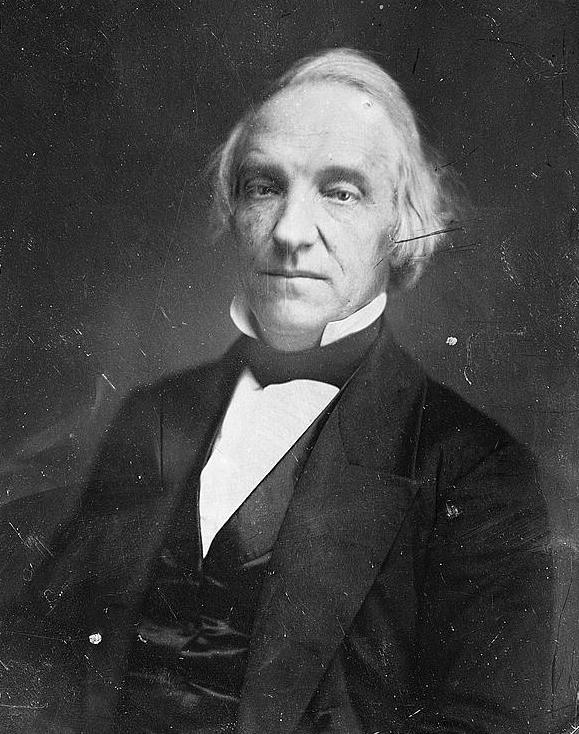
The primary political discourse in 1846 revolved around a Barnburner proposal called the Wilmot Provisio by Pennsylvania Democrat David Wilmot. The Wilmot Provisio was essentially a flat ban on using any territory gained during the Mexican-American War to expand slavery, which was one of the explicit war goals of many Slaveholders in the South:
Provided, That, as an express and fundamental condition to the acquisition of any territory from the Republic of Mexico by the United States, by virtue of any treaty which may be negotiated between them, and to the use by the Executive of the moneys herein appropriated, neither slavery nor involuntary servitude shall ever exist in any part of said territory, except for crime, whereof the party shall first be duly convicted.68
The Provisio would repeatedly passed by the Northern-led House then struck down by the Southern-led Senate. In response, the general Polkian response, led by Calhoun, was to offer the Missouri Compromise line to be extended across the rest of the country. The second time this proposal was brought forward, it was by then Illinois Representative Stephen A. Douglas, whose name should ring bells for anyone who knows the history of the Civil War. That proposal, too, was shot down; the nation was brought to gridlock.
As the Lieutenant Governor of New York during a significant portion of the Anti-Rent War, Daniel S. Dickenson had first-hand experience with negotiating with the armed Anti-Renters. He had witnessed the shock-and-awe tactics of the Barnburners, and how badly that had backfired on them, leading to a Whig government and a constitutional convention that massively increased New Yorker tenets rights. When confronted with the Wilmot Proposal, it must have seemed like the Wright Administration’s response to the Calico Indians on a national scale; far too radical, and certain to backfire in the face of everyone involved. At the same time, the South’s proposal to extend the Missouri Compromise line to the coast was political kryptonite in the North by 1846. So long as the Democrats remained divided along such lines, there would be no progress whatsoever on the Slavery Question. A different approach was needed.
Daniel S. Dickinson would be the first American lawmaker to suggest the new doctrine of popular sovereignty,69 which has in centuries since been distilled down to what we now call “State’s Rights,” a position that could elude both Wilmot and Calhoun’s visions for the future of slavery. Simply put, “popular sovereignty” was a political doctrine that held that the people (white men) of newly settled territories ought to have the right to decide whether their new state holds slaves or not. In practical approach, popular sovereignty was a much more complicated Democratic strategy for taking control of the slavery issue, and it began not with Southern Democrats like Calhoun, but with Northern Huskers like Dickinson, trying to plot ways to peel the Northern vote away from the Whigs.
At the beginning of this article, I introduced you to the concept of “recuperation,” and here is where it finally comes into play: my argument is that the popular sovereignty strategy in the 1850s, which would become the backbone for the Lost Cause myth and Jim Crow, aimed to use the tools of Barnburner administration – policing, misdemeanor codes, black laws – to harness the populist energy of the rural Anti-Renter Whigs – THE POLICE ARE THE PUBLIC – toward the ultimate ends of the Southern planter class, that being the continued security of the slaveholding apparatus.
Daniel S. Dickinson is responsible for orchestrating one of the most consequential splits in Democratic Party history. At the 1848 Democratic National Convention, Dickinson and the rest of his Hunker faction refused to seat the New York delegation in support of Martin van Buren, leading Martin van Buren and many of his supporter to outright leave the party and run instead as a Free Soil candidate. James K. Polk had refused to run for reelection, and the most prominent other Southern Democrat had left the convention, which left the doors wide open to forward Lewis Cass as the Democratic nominee, who would quickly become the loudest and most prominent supporter of the popular sovereignty doctrine.
As a Senator from Michigan, Lewis Cass was the perfect figurehead for Dickinson’s idea of popular sovereignty. He was a veteran of the War of 1812, a member of Andrew Jackson’s cabinet, a prominent supporter of Indian Removal, and a former ambassador to France with strong foreign policy credentials. In a famous 1830 letter, Cass expressed his strong support of the genocide against Native Americans:
We believe, if the Indians do not emigrate, and fly the causes which are fixed in themselves, and which have proved so destructive in the past, they must perish. We might distrust our own conclusions, though derived from personal investigation, did not experience confirm them. But alas! it is the admonition of experience, more than anything else, that claims and urges us to employ all honorable means to persuade these hapless people to acquiesce in the policy which is proposed to them. . . . We esteem it to be our duty, on this occasion, to correct an error which has obtained in regard to this business of emigration. It seems to be thought by some, that the Indians are opposed to removal, and that force is meditated to be employed to compel them to go. In regard to the disposition of the great body of the Indians within our states, we speak advisedly when we say, they are anxious to remove.70
Charming. Lewis Cass was first and foremost an expansionist and an imperialist. Initially, he cast his votes in favor of the Wilmot Provisio, but by the end of 1847, he had been convinced to Dickinson’s new popular sovereignty approach. In what became known as “The Nicholson Letter,” Cass corresponded with one A. O. P. Nicholson of Nashville, Tennessee (remember that) on Christmas Eve, where he wrote the following:
The theory of our Government presupposes that its various members have reserved to themselves the regulation of all subjects relating to what may be termed their internal police. They are sovereign within their boundaries, except in those cases where they have surrendered to the General Government a portion of their rights, in order to give effect to the objects of the Union, whether these concern foreign nations or the several States themselves. Local institutions, if I may so speak, whether they have reference to slavery, or to any other relations, domestic or public, are left to local authority, either original or derivative. Congress has no right to say, that there shall be slavery in New York, or that there shall be no slavery in Georgia; nor is there any other human power, but the people of those States, respectively, which can change the relations existing therein; and they can say, if they will, we will have slavery in the former, and we will abolish it in the latter.71
There are two absolutely critical things we need to observe here. Firstly, I want to highlight that Lewis Cass specifically refers to the determining principle of popular sovereignty as their internal police. I do not think this language is accidental. Secondly, it’s crucial to observe the performance of a Northerner giving this spiel to a Southerner. What the political theater of the Nicholson Letter does, in effect, is to frame the issue as “We’ll make our choices, and you’ll make yours.” The people of Michigan would be free, and the people of Tennessee would be slaves, and a common parlance could be found among their individual policing of such realities; in essence, that the will of the people would carry out their state-level economy as they saw fit.
The Ohio State Journal in Columbus reprinted this letter, and did not mince words about their editorial opinion thereof:
In compliance with requests from various quarters, we place before our readers to day the letter of Lewis Cass to A. O. P. Nicholson, of Tennessee, upon the subject of the War and the Wilmot Proviso. This letter speaks not merely the sentiments of its putative author. Brought into existence, without doubt, by the joint action of Gen. Cass and the “peculiar circle” to which he belongs, and probably called out at his and their suggestion, it has been copied extensively by the Locofoco press every where, and its sentiments endorsed and commended as the deliberate judgment of that party throughout the Union.
We have neither time nor disposition to comment upon the absurd ferocity of the doctrines contained in the letter, nor to expatiate upon their narrow, selfish and inhuman tendency; and we only at this moment desire to warn the people of the United States against any course which shall elevate to the chief magistracy of this nation a man whose construction of the Constitution is so one-sided and illiberal, and whose practice at the same time, as an executive officer, promises to be so autocratical and despotic.72
Why are we suddenly in Ohio? Around the same time that this article was published – and I haven’t found an exact date – the nation’s third cross-dressing ban was passed in Colombus, and it looked nearly identical to the one in St. Louis.
How the Democrats Flipped Ohio in 1848
Here’s the statute – if its introduction feels abrupt, that’s because it feels that way in the history too:
§ 7. Every person who shall appear in any street, alley, avenue, market place or public square or in any other place within the city, when naked, or in a dress not belonging to their sex, or in an indecent or lewd dress, or shall be guilty of any indecent or lewd act or behavior, or shall exhibit any indecent or lewd book, picture, statue, or other thing, or who shall exhibit or perform any immoral or lewd play or other representation, shall be deemed guilty of a misdemeanor.
St. Louis, MO, 1843
§ 282. Whoever shall appear upon any public street or alley in any public place in the City of Columbus in a state of nudity or in a dress not belonging to his or her sex, or in an indecent or lewd dress, shall be deemed guilty of a misdemeanor, and, upon conviction thereof, shall be fined not exceeding thirty dollars, or imprisoned not more than thirty days, or both.
§ 285. Whoever shall exhibit, sell, offer for sale, circulate, distribute, or cause to be distributed any indecent or lewd book, picture or other thing whatever of an immoral or scandalous nature, or exhibit or perform any indecent, immoral or lewd play or other representation shall, upon conviction thereof, be fined not exceeding one hundred dollars for each and every offense, or be imprisoned not exceeding thirty days, or both.
Columbus, OH, 1848
There is obviously a conversation to be had about the shift from “their sex” to “his or her sex,” which I shall leave to other people. What I am far more interested in is how the verbiage of the Columbus cross-dressing ban is word for word the same as the one in St. Louis save that persnickety insertion of the sexed pronouns. This perplexed me for a few reasons – firstly, because the Whig Party held complete control over all levels of Columbus’ government at this time, and secondly, because the state of Ohio would repeal their Black Laws of 1804 and 1807 just one year later in 1849, a significant rarity during this period. Evidently, the Columbus example vexes much of the theory we’ve put forward in this article. I was tempted to write off my broader intuitions about this timeframe as speculative nonsense, but I couldn’t stop coming back to the identical language and a gut feeling that there was something here. Having now poured over primary texts for hours, I believe that looking at the development of the political sovereignty argument, especially in the context of the next statute being in Nashville just two years later, offers a possible end to this difficulty.
Ohio was the only state flipped by Lewis Cass during the Election of 1848 for the Democrats, even though the Whigs maintained control at most other levels of government. Why? For much the same reason that the Whig Party collapsed in Missouri in the early 1840s – the promotion of moderate Democrats in the interest in weakening their more pro-slavery counterparts. The Journal recounted:
The coming election brings new men into the field, and all agree that the Locofoco party is destined to suffer the following losses, the only question being as to their probable extent.
- Democrats who vote for Van Buren.
- Democrats who vote for Taylor.
With each of the first the party incurs the loss of a single vote; with each of the others the loss is equal to two votes. Of the first variety the numbers are very large; of the second less in number, but the effect more severe; between the two the party must ineur very considerable losses, which are to be subtracted from the known maximam as exhibited in the Governor’s vote; while the whole political field does not offer a single element whose operation will be to in- crease the strength of the party.
Such, we honestly believe, is the condition of the Locofoco party on the eve of the election. We are conscious that its leaders feel that everything that could be, has been done, and that more is wanting still. The character of General Cass has effectually stopped the party from making any acquisitions, and equally prevents them from again rallying its whole force for the November trial. They cannot do it.73
What the Ohio Whigs failed to account for was the fact that the Free Soil Party, founded just that year with Martin van Buren at its head, would draw just as much support from Ohio Whigs as Democrats.
The third party vote had increased from 8,050 in 1844 to more than four times that figure in 1848. To understand that change it must be kept in mind that the third party movement had become broader. The Barnburner bolt had brought it an unexpected accretion from the side of the Democrats. The activities of James W. Taylor and the Ohio delegates to the Utica Convention indicate that this defection was very perceptible in the State. The attraction of certain policies in the Free Soil platform such as the unrestricted grant of public lands was capable of uniting wage-earners in the East with the men of the Northwest even though both might be indifferent to slavery as a moral issue. The Democratic revolt, however, did not assume proportions in Ohio that were dangerous to the party. The fact is clear that the rebellion was much more harmful to the Whig Party, for the reason that its vote in 1848 fell below that of 1844.74
Poor political strategy on the part of National Whigs led them to lose the state in the electoral college. The Whig candidate Zachary Taylor was a Southerner and a slaveholder himself, making many Whigs in the Northern parts of the state hold their nose and vote for Van Buren. But that neither confirms nor denies the Journal‘s assertion that Lewis Cass had “stopped the party from making acquisitions.”
By 1849, the writing was clearly on the wall that the people of Ohio wanted to be rid of the Black Laws of 1804 and 1807. Who, then, was responsible for repealing those laws? Why, the Democrats, of course. In some stroke of political genius, Cass Democrats managed to strike a deal with the Free Soilers and Centrist Whigs to overwhelming repeal the Black Laws in exchange for one of their own becoming the Speaker of the Ohio House. The Ohio History Journal narrates:
By way of background for understanding why these Independents and the Democrats voted as they did, it should be recalled that in 1849, with no prospect of federal or state patronage to benefit them and with a growing suspicion of undue southern influence in national Democratic circles, Ohio Democrats were not about to pass by an opportunity to improve their party’s position on the local level. The opportunity was presented when the two Independents, John Morse and Norton Townsend, joined forces with them to capture control of the legislature. The Democrats secured from the Independents the necessary votes to elect one of their members as Speaker of the house and to seat the Democratic contestants from Hamilton County. As the other part of the bargain, Democrats delivered the votes for the election of a United States Senator of Free Soil outlook, Salmon Chase, and also for a better public education law for Negroes and repeal of the Black Laws.30
In the opening days of the 1848-49 Assembly a number of bills were introduced which would have repealed all or part of the Black Laws. It is not certain why of all the bills Morse’s (HB52) was the one that was pushed to a vote. His measure did have the directness of repealing all racial distinction laws, and we know that Chase was quite anxious that Morse have something to show for his voting with the Democrats in organizing the house.31 Whatever the reason, Morse’s bill passed the house by a vote of 52-10, with 4 Democrats and 6 Whigs voting against the measure. Later in the day a Whig and a Democrat, who one correspondent reported had locked themselves in the Sergeant at Arms’ room to dodge the vote, appeared, and with their negative votes the final count was 52-12. Townshend recalled later that considerable party pressure was necessary to secure passage, and he was probably correct. One Whig reporter wrote, “One Loco-foco followed another, like a flock of sheep clearing a barn yard gate. The old stagehorses from the Reserve sat in mute astonishment.” […]
On January 3, 1849, the Democrats secured the Speakership of the house for their party, and on the 26th the two contestants of their party from Hamilton County were accorded legitimacy. On January 30, Morse’s bill passed the house, and on February 6 the senate passed a modified version which subsequently became the law of the state. How did Ohio political circles view this victory for Negro civil rights? As we have seen two house members attempted to dodge the vote; others, in the senate, rather ludicrously proposed amendments exempting their constituencies. When one examines Table II, showing Democratic voting on previous repeal attempts, and then compares this record with the vote on HB52 (Re), it becomes obvious that the repeal vote was about the ultimate in turnabout for the Democratic party. One explanation Democrats gave was that it was time to end the Whig use of the repeal issue for party purposes to attract abolitionist support. Perhaps more than one Democrat agreed with the Enquirer’s correspondent that the Black Laws were a repressive failure and, if nothing more than on grounds of expediency, should be repealed.34 Still, after reviewing the record of Democratic voting in regard to racial questions, these explanations seem to have come after the fact. In any case, this instance of cooperation by Democratic legislators with abolitionists appears to have been an aberration.75
If doing history about the Antebellum Period has taught me anything, it’s that Pro-Slavery Democrats never acted in the interests of abolition unless they gained something from it. Certainly never so abruptly. A different article in the Ohio History Journal notes:
It was not, however, until the legislature of Ohio met in 1848 that the antislavery movement in the State began to show real political dividends. In this legislature, the antislavery element held the balance of power between the Democrats and the Whigs. Led by Col. John F. Morse and Dr. Norton S. Townshend, the “Free-Soilers” offered political deals to both the Democrats and the Whigs. The Whigs shunned a deal which would have involved their backing Joshua R. Giddings for election as United States Senator. The Democrats promised to repeal the “Black Laws” of Ohio and elect Chase to the United States Senate in return for assistance for their political measures. The deal went through. Chase became Senator and the “Black Laws” were repealed, although accomplished in a clandestine manner.76
Which then led me down a footnote rabbit hole to an 1874 biography of Salmon P. Chase, the Free Soil Senator who was elected by the Democrats upholding their side of the deal. This biography, far more contemporary than either journal article, offers really crucial insight into the Democratic psyche at the time.
As observed in the body of this chapter, the Ohio Democrats were pretty strongly imbued, at this time, with antislavery sentiments. They had recently witnessed the election by the Whigs of a Southem slaveholder over their Northern Democratic candidate, and free from the embarrassment of a national administration or a pending national political contest, were predisposed to a favorable consideration of the Free-Soil proposition. This predisposition was largely due also to their desire to have the cooperation of the Free-Soil members in the legislative appointments and elections about to be made. At any rate, they took the bill into consideration and agreed to support it. […]
Prompt action in a favorable conjuncture of circumstances, thus secured the enactment by decisive majorities in both Houses, of a humane and beneficent law, which, under almost any other circumstances, would have been rejected by majorities equally decisive. ‘ It was one of those acts in advance of the sentiments and yet in accordance with, the moral convictions of the people, which required but tact and courage to be accomplished, but once accomplished, are not likely to be reversed. It relieved the colored people from all their most onerous disabilities ; gave them entrance into the schools, and awakened great hopes for the future. Laws were afterward enacted in derogation of the right of suffrage allowed by the constitution to colored persons, half and more than one-half white, but the advantages gained to them by the act of 1849 were never lost.77
Quite the rosy outlook, though perhaps not one unexpected from a man writing at the height of Reconstruction. Earlier in the chapter, Shuckers notes that it was the Whigs, in fact, who were too staunch in their pro-slavery sentiments to form a coalition – those same Whigs would protest the election of Salmon A. Chase as too abolitionist for Ohio. We ought to be somewhat inclined to distrust, however, the notion that Ohio Democrats were enamored with abolition, however, given that they had just flipped the state for Lewis Cass despite being in the minority.
No – what the Democratic Party of Ohio wanted was nothing short of a constitutional convention. And they got it.
Ohio’s Original Constitution
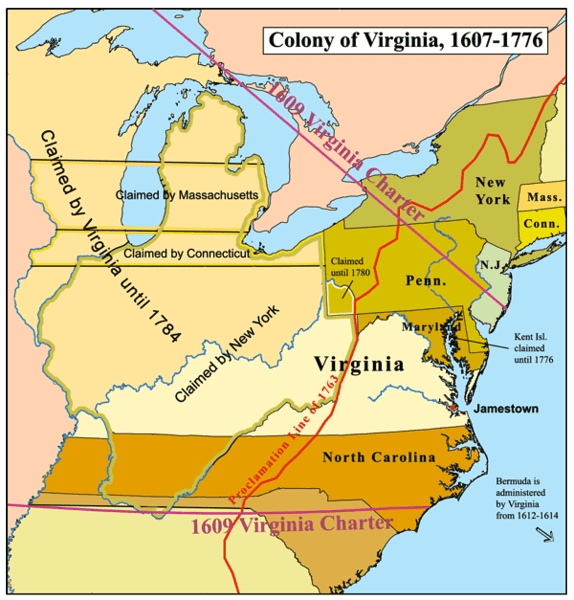
To understand the events that led to the Ohio Constitution of 1851, we need to return once again to colonial period to follow the politics. If this map looks convoluted, that’s because it is. The key thing to note here is that the messy area claimed by four different states around the Ohio River Valley maps pretty closely to the historical territory of Haudenosaunee. The two primary competitors for territorial control over the Ohio region were New York and Virginia, which is relevant to our history. I also want you to note that Kentucky used to be a part of Virginia, which we’ll also come back to.
During the creation of Ohio’s first constitution in 1804, there was a sharp divide between the Virginian Jeffersonian Republicans (Thomas Jefferson was from Virginia) and the more Northern Federalists. One of the biggest clashes – the Virginians wanted a central and more powerful judiciary, while the Northerners wanted a decentralized legal system that would keep power local for the settlers. Ultimately, however, it would be moderate Jeffersonian Republicans from Cincinnati in Hamilton County who would flip in favor of the North:
Agreement on the judicial branch took longer. Republicans agreed that they wanted the judiciary under the control of the legislature to the extent that it would appoint them. But they disagreed as to where the supreme court should sit. The committee on the judiciary, chaired by Charles Willing Byrd, a Republican who had been a territorial judge and at odds with St. Clair, recommended that it sit in the state capital. This pleased the Virginians, who wanted a court system modeled on that of their home state, because it meant that the court would be in Chillicothe near their base of power. Some delegates from the more populous counties, including Republicans, objected to the great distances that citizens would have to travel to the court. Federalists argued for a more decentralized system based on the Pennsylvania model. According to delegate Cutler, the Federalists argued that the court should be taken to the people. Ultimately Republicans from Hamilton County sided with the Federalists to require the court to sit at least once in each county annually.79
The Ohio Constitution of 1804 resulted in a state government that was extremely lopsided toward the legislative branch, with a weak Governor’s seat and a judiciary that overly relied upon its Supreme Court to handle basic matters. To fill in the gaps, Ohio relied on an old British office known as the “Justice of the Peace,” which is still a term in uncommon modern use for a marriage officiant. While performing marriages was one of their duties, the justices had the virtue of being one of the only offices elected by local voters, and they had an enormous amount of law enforcement power in their respective townships. Notably:
The General Assembly held most of the power, including unlimited terms in office, broad appointment power (including all judges except justices of the peace), and the ability to create new counties. Although the constitution prohibited slavery, delegates rejected African American suffrage by one vote; only white men who paid taxes could cast ballots.80
The Justice of the Peace was the only office in the Judiciary elected by the people. Additionally, given that Ohio had never had slavery and had one of the most complete genocides of Native Americans of any state in the country. Ergo, the rural townships where Justices of the Peace had the most power were often 100% white. Barbara A. Terzian writes of the power of the office:
Ohio’s new constitution established a Republican paradise for white men. After one year’s residency, a young white man became fully vested in the polity—a full member of the community. He did not even have to own his land outright or have made his fortune. As long as he showed his commitment to his new home through residency and by either paying a state or county tax, or even just by working on his local roads as was expected of every able-bodied man, he could vote. He could elect his state representative and his state senator. He could be assured that his representatives in the general assembly would look out for his and his neighbors’ interests or be quickly replaced, since they came up for reelection annually or biennially. If he had political aspirations himself, he need only meet the age requirement to qualify to hold office. No property qualifications stood in his way. He could vote for the governor and feel confident that the successful candidate could not build up a corrupt and oppressive patronage system since the constitution gave the governor little power. Although his elected legislators selected the state and county judges, he could elect his local justice of the peace, who could handle the minor criminal and civil disputes of daily life. He could elect all of his county and township officials. He could even serve in the militia and elect his own officers.81
At the county level, the Sheriff’s office was also one of the only offices elected by the people, further underscoring how law enforcement was one of the only means of suffrage available to white men in Ohio beyond the state legislature and national government:
After statehood became a reality, only three public offices in Ohio were filled through the electoral process system. The position of Sheriff was one of them. […] Since the early 1800’s, Ohio Sheriffs have been elected on the county level by the people they serve. By virtue of this process, this office has become the oldest law enforcement position in the United States.82
These were the shortcomings of the 1804 Ohio constitution that would eventually lead the state to the faultlines of the Antebellum era.
The Marion Riot of 1839
For the first half of the 19th Century, Ohio was a microcosm of the broader country – the North was largely populated by Whiggish Evangelical settlers, the South by the descendants of Virginia and Kentucky slaveholders. Just as Missouri and Illinois were locked in a constant battle over the issue of fugitive slavery, so too were Ohio and Kentucky. The Ohio legislature was beset by Kentuckian lobbyists and former Kentuckians for decades, seeking to preserve their local ‘peculiar institution’ in the laws of their northern neighbor.
Things came to a head in 1839 when Kentucky successfully persuaded Ohio legislators to pass a fugitive slave act, designed to crack down on the growing presence of the Underground Railroad, especially in the river city of Cincinnati on the Ohio-Kentucky border. The new law was incredibly unpopular, and was immediately tested in Cincinnati when a group of Virginians came to try and remand William Mitchell to slavery. In a highly public trial, Mitchell was declared to be free, which was promptly when the Virginians attempted to kidnap him anyway, sparking the Marion riot of 1839.
I went back and forth about how much of the primary source to include, as it was exceptionally racist and clearly biased toward the pro-slavery faction. Ultimately, I decided that people need to understand how despicable the forces at play here are though. It follows:
In 1839 occurred a riot in Marion between slavery and anti-slavery partisans, which not only made a lasting impression upon the minds of the citizens, but fixed in them more strongly than ever the old party prejudices upon the most serious question that ever vexed American politics. Marion was a depot on the underground railroad.” “Bill Anderson” was the name of a negro who took up his abode in Marion about a year previously. He was as black as any negro, weighed not less than 200 pounds, and, to use a phrase common in those days, was a very “likely nigger.” By his good behavior and willingness to work at a fair price, he had gained the good will of the people. With the “boys,” he stood at the top notch, in consequence of his ability to sing the old melodies of the plantation and finger the banjo to perfection. While William was thus enjoying the “fat and hominy” of the land, what should disturb his peace and quiet but the appearance of a brace of Virginians” named McClanahan and Goshorn, and one or two other men, claiming that said “Billy” was the property of one Mitchell, who had previously bought him of one Anderson. The “darkey” was, accordingly, by legal process, stowed away in one of the cells of the old white oak jail to await a requisition from his native State. Considerable sympathy was manifested for him, and he was not to be delivered over to the agent of Mitchell without a trial. The day came for the agent to prove” property,” etc., and after a bearing, Judge Bowen decided that under the statutes of Ohio the prisoner could not be delivered to Mitchell’s agent, as he had failed to show that he at any time had possession of him. Bill was thereupon released from custody.
This started a whirlwind. Without process, the Virginians seized Bill by the arms and started for the office of Judge John Bartram, then United States Commissioner, before whom it was proposed to try the case under the laws of the United States. Main street had just been macadamizd with stone fresh from the quarry, and while Bill was on the way to Judge Bartram’s, anti-slavery men began to pelt the Southerners freely with the stones. The captors, however, succeeded in reaching the Judge’s office with their prize, where occurred a scene of confusion and excitement beyond description. The Judge stood in his office door and endeavored to disperse or quiet the mob so that the trial could proceed, while the Southerners flourished bowie knives and pistols, and loud talking of every kind shattered the very air. At this juncture, some half a dozen men broke open the “arsenal,” seized each an old United States flint-lock musket, rushed into the crowd and demanded entrance into the Commissioner’s office, which was refused. One Elias G. Spelman, a law student, with his musket firmly grasped and the bayonet fixed, made a charge upon Judge Bartram, which probably would have been fatal had not Rodney Spaulding successfully interfered by knocking the gun to one side, which entered the wall of the building about four inches. This climacteric performance, of course, directed all eyes to the spot, at which opportunity Billy made good his escape through a back door that some one had opened. Goshorn and others followed, and in a minute or two Goshorn threw a bowie knife at him, striking him in the small of the back, but rebounding without injury. Billy ran all the faster, and soon hid himself in a shock of corn in a field where John Dumble once made brick, but which ground is now occupied by a railroad. William S. Hutchison sagaciously sounded the shock with his foot, saying, “Keep dark, Billy.”83
We have been talking about slavery at some degree of abstraction for this entire article. I think it’s important now, over 30,000 words in, to take a moment to breathe and linger with the nauseating reality of it.
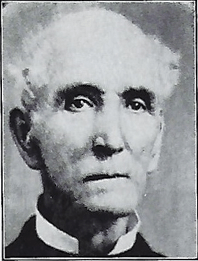
The most important part of this story will not be clear without context – while historians have aptly described this as a riot, I believe it may be more accurate to call it a “Tale of Two Justice Systems.” On one hand, we have the abiding decision of Justice Ozais Bowen, who was appointed to his position on Ohio’s Second Judicial Circuit by the Ohio State Legislature, and who ruled that Bill was a free man. On the other hand, we have John Bartram, who was the local postmaster (hence the United States Commissioner title), but more importantly, the local Justice of the Peace, who was elected by the people. When the Virginians received a hostile verdict from the state courts, they did not recognize its verdict – instead, they used violence to take Bill to the local representative of the area’s white men, who they hoped to be more friendly.
Given that a man literally tried to skewer Bartram with a stolen bayonet to stop the trial, it is not entirely unreasonable to suspect that John Bartram may indeed have ruled in the Virginians’ favor. And again – I want you to remember that the office of the Postmaster was an original source of state censorship, and had been weaponized over the course of the 1830s to destroy any abolitionist literature making its way south.
The Jones v. Van Zandt Case of 1847
The Marion riot deepened the severe unpopularity of the Fugitive Slave Act of 1839 in Ohio, even as it received broad national coverage and criticism, especially from the South. However, it was an 1842 case that would ultimately prove to be the act’s greatest impact upon not just Ohio history, but the world. That dishonor goes to the Jones v. Van Zandt case, which would eventually work its way up to the Supreme Court.
Much like the township of Marion, John Van Zandt was a part of Ohio’s Underground Railroad for fugitive slaves, and was in 1842 caught helping several slaves escape in a wagon. Unlike the Anderson case, where Bill managed to escape north to Canada, many of the slaves were taken back to a jail in Kentucky by slavecatchers. Shuckers recounts:
On the night of Friday, the 22d of April, nine slaves escaped from Kentucky into Ohio. […] Moved by sympathy, Yan Zandt undertook to carry them some distance in his wagon. One of the slaves, Andrew, acted as driver.
About fifteen or sixteen miles north of Cincinnati, on the public road and in broad daylight, two bold villains, Hargraves and Hefferman, with the help of some other persons of like character, violently stopped the travelers, and succeeded in securing all the fugitives except two : Andrew the driver, and another, who escaped. One of these subsequently returned to Kentucky. The slaves were put into a wagon, and without authority from any claimant, without any knowledge to whom the alleged slaves belonged, or indeed any certain knowledge that they were slaves at aU, and without resort to legal proceedings of any kind, they were carried to Covington, Kentucky, and there lodged in jail.
Hargraves and Hefferman and their associates received as a reward for this shameful business four hundred and fifty dollars ; but were indicted for kidnapping by the grand-jury of Warren County, where the act was committed. Hargraves and Hefferman kept out of the way of trial ; but the other offenders were acquitted, as much by public sentiment as by the jury.86
Once again, we see an exercise of citizen policing to capture fugitive slaves, and once again, it occurred in direct opposition to the Ohioan justice system. The difference here, however, is that the slavecatchers bypassed local law entirely and took their case straight to the federal judiciary – perhaps grown wise to the outcome in Marion three years prior. With the slaves shackled in Kentucky, there was no mob of abolitionist Ohioans who could force justice under local law – and so even though the 7th Circuit was located in Ohio, the Jones v. Van Zandt case was fought on friendlier pro-slavery ground.
If guilty, Van Zandt was charged for $1,200 in damages, around $46,000 in 2025. No small fee for the father of eleven children.
In court, the defense was represented by Salmon P. Chase – that same man who Democrats later helped elect as part of their deal with the Free Soilers. By the time the case reached the Supreme Court in 1846, he would be joined by William Seward, the former Governor of New York who was followed by Dickinson and Wright. In this sense, Jones v. Van Zandt seems very much to be a microcosm of all the history we have discussed throughout this article.
John Van Zandt was found guilty, and the court sentenced him to pay $500. The defense appealed. The most important count of the appeal went as follows:
The court erred in charging the jury that it was not necessary, in order to establish the plaintiff’s right to recover, to prove actual notice to the defendant from the claimant, or someone acting in his behalf, that the persons alleged to be harbored or concealed by him were fugitives from labor, within the meaning of the act of Congress; but charged, that it was sufficient if the jury should be satisfied, from the evidence, that the defendant knew that such persons were fugitives from labor.87
Again, the due process at the time in Ohio required that fugitive slavecatchers appeal to a local Justice of the Peace or similar figure of authority, who would then provide them with permission to apprehend the slave. What was at stake here was the jurisdiction of the law, a question of who had the right to legislate on the issue of slavery. Did federal protections for slavery give slavers the right to operate beyond the due process of the state of Ohio?
The Supreme Court’s answer, unfortunately, was yes.
Now the act of Congress does not, in terms, require the notice to be in writing, nor does the reason of the provision, nor the evil to be guarded against, nor any sound analogy. The reason of the provision is merely, that the party shall have notice or information sufficient to put him on inquiry, whether he is not intermeddling with what belongs to another. If the information given to him, orally or in writing, is such as ought to satisfy a fair-minded man that he is concealing the property of another, it is his duty under the Constitution and laws to cease to do it longer. […]
Any other construction would go, likewise, beyond the evil to be avoided by the notice, which was the punishment of an individual for harboring or concealing a person, without having reasonable grounds to believe he was thereby injuring another. Any other construction, too, would be suicidal to the law itself, as before a notice in writing could be prepared and served on the defendant, the fugitives would be carried beyond the reach of recovery in many cases, and in others would have passed into unknown hands.
“Suicidal to the law itself.” That was the official position of the Supreme Court in 1847. In the wake of this ruling, the Virginia slavers involved in the Marion riot wouldn’t have needed to appeal to the judge or the Justice of the Peace – they would simply have been allowed to kidnap upon reasonable suspicion.
With regards to the Fugitive Slave Act of 1793, the court continued:
While the compromises of the Constitution exist, it is impossible to do justice to their requirements, or fulfill the duty incumbent on us towards all the members of the Union, under its provisions, without sustaining such enactments as those of the statute of 1793.
We do not now propose to review at length the reasoning on which this act has been pronounced constitutional. All of its provisions have been found necessary to protect private rights, under the cause in the Constitution relating to this subject, and to execute the duties imposed on the general government to aid by legislation in enforcing every constitutional provision, whether in favor of itself or others. This grows out of the position and nature of such a government, and is as imperative on it in cases not enumerated specially, in respect to such legislation, as in others.
That this act of Congress, then, is not repugnant to the Constitution must be considered as among the settled adjudications of this Court.88
Jones v. Van Zandt set up the groundwork for both the Fugitive Slave Act of 1850 and the Dred Scot v. Sandford decision of 1857, but I bring it up here largely to help us frame our discussion of popular sovereignty. The single most important phrase to note here is private rights. What begins to emerge in this legal framework amounts to a quasi-common law wherein the maintainance of slaveholding property is the primary goal, and all branches and levels of government operate to sustain it. When we are talking about ‘local control,’ it’s not a question of preferring municipal over state or federal government; the state and federal governments should serve their interests too. What they mean is the direct control of private property – the ‘local’ institution, slavery – over the meddling affairs of any government official.
It’s a misunderstanding to frame the “states’ rights” argument as a preference for state politics over federal politics. If you’re inclined to say “Well, if they want state’s rights, then liberal states have a right to make progressive policies,” you’re missing the point. All of this was happening in Ohio, one of the most hostile states to slavery in the nation; it was the active meddling of Kentucky, Virginia, and other southern interests in the politics of another state. Here’s the secret:
STATE’S RIGHTS ARE PRIVATE RIGHTS
PRIVATE RIGHTS ARE THE STATE
The police are the public. The public are the police.
I want to underscore how quickly all of this developed across the 1840s. Less than a decade earlier, Missouri was seriously struggling to police the movement of Black bodies within their own state, forgot Illinois. In New York, Democratic overreach in response to the Anti-Rent War led directly to a strong Whig government and a massive expansion of tenet rights. Even though it frames itself as a ‘local’ debate, the popular sovereignty strategy is directly, explicitly designed to control the politics of OTHER states, free states, states that posed a fundamental threat to private rights. It arose as a direct response to Democratic failures in the 1830s and 1840s, and the degree to which it succeeded in its primary aims cannot be overstated.
The State of Ohio v. Forbes and Armitage Case of 1846
But there is one more court case we need to talk about, this one pertaining directly to the city of Columbus, to fully understand the nature of the new beast that pro-slavery forces had unleashed.
In an 1873 history of the city of Columbus, Jacob Henry Studer recounted:
Few events in the history of Columbus have excited a deeper or more general interest than the arrest, under the fugitive slave law, of Jerry Finney, a colored man, who had resided in the city fourteen or fifteen years. On the night of the 27th of March, 1846, Jerry was, by some means, cajoled or decoyed to the office of William Henderson, a justice of the peace, in Franklinton. There Jerry was arrested as a fugitive slave, and summarily delivered over by the justice to the persons claiming him, one of whom, Alexander C. Forbes, held a power of attorney from Mrs. Bethsheba de Long, of Frankfort, Kentucky, to whom it was claimed that Jerry owed service or labor. Handcuffs were placed upon the alleged fugitive slave ; he was placed in a carriage that was ready at the door, and taken to Cincinnati, thence to Kentucky, and returned to the woman who claimed that she was his rightful owner.89
The dynamics here are even more obvious than in the last two cases. William Henderson, a Justice of the Peace in Franklin Township, collaborated directly with slavers from Kentucky to kidnap an upstanding resident of Columbus in direct violation of an Ohio state law designed to combat the illegal traffic of free Blacks. Technically, there are two legal cases here that we need to talk about, but they concerned the same issue. In Ohio, the perpetrators who carried Finney back to slavery were arrested and tried; and in Kentucky, the State of Ohio would bring a case to attempt to get Finney freed from his self-proclaimed master.

During the trial of the kidnappers, William Henderson would be represented with Noah Swayne as his defensive council. Swayne was a future Supreme Court justice and the pupil of John McLean, who had presided over the Ohio portion of the Van Zandt case; at the time, he was the US Attorney for the district of Ohio, appointed by Andrew Jackson. I find this brief vignette of Swayne’s character to be illustrative:
Noah H. Swayne, an associate justice of the supreme court of the United States, was a native of Virginia and was born in the year 1804. He was of Quaker parentage. He was quite precocious in his youth and rapidly developed into intellectual attainments, particularly in the law, which was his chosen profession. At the early age of nineteen he obtained his license to practice law, and removed from Virginia to Ohio and commenced the practice of his profession. Mr. Swayne was one of those native born Virginians not frequently, but sometimes, met with who, while generally upholding and defending the peculiar institutions of the south, entertained a horror and aversion to the institution of slavery which constrained him to leave his kindred and his state to avoid coming in contact with the hated evil.91
The Kentucky men would be acquitted during the trial, but Henderson would lose his case and was (temporarily) incarcerated. Studer recounts:
All the defendants, except Forbes, who had not been arrested, were put upon trial at the September term of the court. The prosecuting attorney, A. F. Perry, and Wm. Dennison, Jr., conducted the prosecution ; and N, H. Swayne and F. J. Matthews managed the defense. The trial occupied several days, and excited much interest in the city and abroad. During its progress, one of the jurors. Dr. George Eiekey, was discharged on account of serious illness. It was agreed, on the part of the State and of all the defendants, to proceed with the remaining eleven jurors. The result was that the jury returned a verdict of “guilty” as to “William Henderson, and of ” not guilty ” as to the other defendants. The latter were discharged, and Henderson was remanded to jail.
Numerous exceptions had been taken on the trial by the defendants’ counsel to the rulings of the court. The case was taken to the State Supreme Court on writ of error. The principal error relied on was that it was not competent to a defendant on trial in a criminal case to waive his objection to the absence of a juror, and that it was error in the court below to try the case with only eleven jurors. The point was sustained by the Supreme Court, and Henderson was set at liberty.92
A Justice of the Peace on trial in the legislature’s courtroom. What a stir it must have caused. But while the ‘Not Guilty’ verdict on September 18th, 1846 for the majority of the kidnappers frustrated the Columbus press, its primary attention seemed to remain on Finney’s plight. The primary coverage of the case was in the Statesman, which frustratingly doesn’t seem to be digitized, but the Ohio State Journal reported thusly on the verdict:
Closed before noon yesterday. The Jury returned a verdict after dark, last evening, having been out seven hours. They acquitted all but Henderson, the Justice of the Peace, on the ground mainly, we believe, that those thus acquitted were ignorant of the law and unaware of the facts as to Jerry’s freedom. We are not aware what motion will be made in reference to Henderson, to save him from the Penitentiary. We hardly know how the Jury could avoid the conviction of all those engaged in the affair, though some or most of them were undoubtedly misled by Forbes. We desired not so much the punishment of the kidnappers as the vindication of the law and the establishment of a correct precedent. The jury was undoubtedly composed of men inclined to leniency towards the prisoners, or none of them would have escaped conviction. As it is we are satisfied; and we trust the lesson will be a useful one to magistrates and others.
The Judge, in his charge to the Jury, which is said to have been a very clear and sound one, recognized distinctly the freedom of Jerry, as secured by Allguire bringing him to Cincinnati, as well as the permission afterwards given him to return by his mistress.93
It’s safe to say that the ‘correct precedent’ was not established, a fact that would only be cemented within a year by Jones v. Van Zandt and the Supreme Court’s declaration of the de facto legality of Henderson’s actions.
Unlike the Marion case, where William Mitchell was protected before he could be taken back to Virginia, Jerry Finney was taken back to Kentucky before his freedom could be tried in an Ohio court of law. Determined to see justice, however, the State of Ohio would bring legal proceedings against his kidnappers in Kentucky, naming A.C. Forbes and Jacob Armitage as the defendants and demanding Finney’s freedom and release. Reading the text of this case is enormously helpful in no small part because Ohio laid out their full argument against Finney’s re-enslavement, which will help us to parse what vulnerabilities the popular sovereignty strategy sought to exploit.
The main question is upon the first point. Was Jerry a slave at the time Forbes and
Armitage aided in seizing him at Columbus?
- Slavery is contrary to the law of nature, contrary to the law of nations, and exists only by
force of the municipal law of the land.- Slavery is strictly local, and confined within the territorial limits of the State where it is
sanctioned, and cannot follow the fugitive beyond those limits, except by positive law,
binding on both sides of the line.- The only law varying these great principles of natural and international law, is that to
be found, 1st in the ordinance of 1787 for the government of the North Western Territory;
2d, in the Constitution of the United States; and 3d, in the Law of Congress of 1793, which
latter cannot be so construed as to extinguish the guaranty of liberty, contained in the
ordinance of 1787, or to extend the rights guaranteed to the owners of fugitive slaves by
the Constitution of the United States.- The clauses of the ordinance of 1787, of the Constitution of the United States and the
law of Congress of 1793, authorizing fugitives from labor to be pursued into the North
Western Territory, being contrary to the law of nature, contrary to the laws of nations, and
restrictive of human liberty, must be strictly construed.- Strictly construed, these clauses can extend to but one case—that of an escaping slave.
This implies a voluntary act of the slave contrary to the wilt of the master, and if by any
other than by his own will he is carried into the North Western Territory, the relation of
Slavery ceases as completely, as if he had been carried into France, or any other foreign
State.- If the slave becomes free but for a moment, he can never again be reduced to slavery;
not even by his own act, because the right of freedom is unalienable.- It matters not that the slave was carried beyond the line by a bailee to whom he was hired; if he is carried over in the relation of a slave, even by a person having a temporary dominion over him, be becomes ipso facto free, and the owner has his right of action against the bailee for the loss of his services. The law governing chattels does not apply to property in human beings. God gave man dominion over, and property in the beasts of the field, &c., but the property in man he reserved to himself. The property in animals is natural and binding every where; That in man is conventional, municipal, local, and to be kept within the literal meaning of the written law.94
We tie all corners of our argument together here. The Ohio case rested heavily upon the Evangelical ethic, invoking God and the Constitution in equal measure. Earlier in the speech, the council lays out how this “strict construction” of Federal law on fugitive slavery would have rendered Kentucky’s 1820 constitutional amendment on fugitive slavery null and void, and further uses that textual assumption to pose Finney’s freedom largely upon the technicalities of the law. But most importantly, the State of Ohio relied on a vision of “strictly local” that confined the slaveholding interest within “territorial limits of the state” and the “municipal law of the land.”
The popular sovereignty strategy deconstructs this anti-slavery rhetoric from a couple angles. Firstly, Jones v. Van Zandt explicitly lays out that not only is the Fugitive Slave Act of 1893 not strictly construed, but moreover that it would be unconstitutional to construe it so. Secondly, through the extrajudicial kidnapping by Ohioans to return Finney to Kentucky, much as Kentucky bypassed Ohio law to take Van Zandt’s prosecution straight to federal courts, the verdict in The State of Ohio v. Forbes and Armitage did occur in the municipal law of Kentucky.
Ohio argued that the ‘local institution’ of slavery could only be governed by positive law on both sides of the state lines. There was truth to this – but the whole point of popular sovereignty was to create those positive law interfluxes. The Justice of the Peace was a legal official of the State of Ohio, elected by the people. What emerges here is a growing recognition of the power of the judiciary to check abolitionist sentiments. By shifting jurisdictions, by manipulating the balance of power between the three branches of state government, by influencing local politics in hostile states to operate independently of their legislatures, by enabling an extra-judicial common law of the white slaver, a law enforcement by the white men whose interests stood to be protected, pro-slavery outcomes could be reached in Ohio, New York, anywhere in the United States.
And that realization brought power.
The State of Ohio v. Forbes and Armitage did not have a happy ending for Jerry Finney:
By the authority of the Legislature of the State, Hon. William Johnson, a distinguished lawyer, and now residing in Cincinnati, was employed to institute proceedings in the Kentucky courts, with the view of settling certain legal questions, and which would, as claimed by our authorities, result in the liberation of Jerry from bondage. Mr. Johnston appeared before the Kentucky court, argued his case with masterly ability, but the decision was against him; and here closed all legal proceedings growing out of this case.
Jerry remained in Kentucky for some months as a slave, until by subscription from the citizens of Columbus, a sufficient amount of money was raised to purchase his freedom, and restore him to his family. He returned–but with the seeds of consumption sown in his system. Within a short time he wasted, sickened and died..95
Both the Marion riot of 1839 and the 1842 proceedings of Jones v. Van Zandt sharply inflamed public opinion against the Ohio Fugitive Slave Act of 1839. By 1843, the pressure against it had grown overwhelming enough to merit its immediate repeal, and would set the stage for the repeal of the state Black Laws in 1849. I want to paint the contrast of these three cases for you. The Marion case was argued in Ohio, Ohio v. Forbes and Armitage was argued in Kentucky, and Jones v. Van Zandt argued in Federal courts – and of the three, only the Marion case went in favor of the fugitive slave, as did the conviction of William Henderson. Within a year of the repeal of the Fugitive Slave Act of 1839, Ohio Democrats had already begun to clamor for a constitutional convention to reform their judicial system, only to be blocked by Whig politicians at every turn.
Ohio’s New Constition and the Expansion of the (White) Judiciary
By the time that Lewis Cass and the popular sovereignty argument entered the national mainstream, Ohio Democrats had grown so furious at the legislative overreach of the Ohio State House, constituted in no small part by their control over the state courts, that their rhetoric had taken a turn for the revolutionary. At the 1848 Ohio Democratic convention, they wrote:
The spirit of Revolution is abroad in the land. By the mad acts of the majority in your last Legislative Assembly, that spirit was raised and fostered, for he (Mr. Spalding) felt, that the blow of revolution was struck, when, without law, without right and in defiance of the Constitution, an attempt was last winter made to reorganize the law making power of the Government so as to take the power from the majority and to give it to a minority of the people.
This Convention has met, as a Convention of safety — to shield the State from the effect of those acts, — to guard the rights of the people. The Delegates are fresh from the people — they know their wants, their feelings and their wishes, and they are here to represent them, and to meet, as our fathers met, to provide for the public safety. The Revolution was commenced last winter, by the acts of the whig party, through their Senators and Representatives in Legislative council assembled. To guard the rights of your absent constituents — those who have entrusted you with their delegated power, is our object in coming up here.96
Democrats were furious at a classic bit of American gerrymandering; the Whigs were attempting to give an extra representative to Cincinnati, which they saw as a continued overextension of the powers of the legislature. But it is the rhetoric that follows where we really need to pay attention to what they were saying as Cass’ election approached, and more importantly why they were saying it:
You may be, nay, you are already told, that a revolution is about to be precipitated upon you. We answer, that a revolution has already been forced upon you; the constitution has been violated, and if submitted to, the law making power of the state, is, by fraud and trickery, taken from the majority, and forever and irrevocably fixed in the hands of an unscrupulous minority, as has been the case in other States of this Union.
There is yet one method by which these wrongs can be righted, and an apportionment bill constitutionally passed. That method is pointed out in the second resolution adopted by the Convention. It is for the Governor to exercise the power placed in his hands, by the Constitution, and to call the Legislature together in extraordinary session. This will save the law-making power of the State from annihilation, for it seems to be a conceded fact, that to preserve that power, under the constitution a quadrennial apportionment is necessary. […]
Before the time fixed for the annual meeting of the Legislature, the law making power in Ohio will have expired for want of an apportionment, under which Senators and Representatives can be elected. No inconvenience will be experienced by the people. The loss of a winter’s legislation cannot be seriously missed ; the people will then peaceably and certainly reform the government; a new constitution will be adopted, embracing a reorganization of the Judiciary, making all offices elective by the people, prohibiting any increase of the State debt without a direct vote of the people, providing a system of taxation that will operate equally upon all classes, in short: in the language of the third resolution of the Convention, a constitution “in consonance with the spirit and improvement of the age.”97
We cannot overlook how “save the law-making power of the State from annihilation” seems to directly mirror the rhetoric of legal suicidality in the Jones v. Van Zandt decision. It also must be observed that the Democrats wanted to extend the elected nature of the Justice of the Peace system to all parts of the state judiciary. There is the classic populist ‘us vs. them’ rhetoric of posing the legislative branch of the ‘minority’ against the judicial branch of the ‘majority. And here, we finally arrive back at that fateful deal struck between the Free Soilers and the Democrats at the eve of 1848, and the beginning of a coalition that would lead Ohio to adopt its new constitution in 1851.
Terzian writes:
Whether to hold a new convention had been a political bone of contention between the Democrats and the Whigs for a number of years. The Whigs had repeatedly blocked efforts to hold a convention, but a Democratic-Free-Soil legislative coalition in 1849 made it possible to pass legislation to place a referendum on the ballot. […]
Samuel Medary, the editor of the Ohio Statesman (an influential Democratic newspaper in Columbus) and longtime advocate of constitutional change, led the way in promoting the convention. In May he established the New Constitution, with its motto that “power is always stealing from the many to the few,” to generate voter support for the convention and clarify the constitutional changes he believed were needed. The prospectus for the New Constitution contained the “leading and more prominent features” in need of change:
- A total reform in our Judiciary system and the practice of our Courts.
- The election of ALL OFFICERS BY THE PEOPLE!
- No increase of the state debt, except by a vote of the people themselves.
- A system of common schools and of education, worthy the age and the state.
- No legislation but what the people can reform or annul, when found injurious98
Upon arrival to the constitutional convention, it quickly became apparent that though the Democrats had repealed the Black Laws to generate popular consent, their interests were anything but kind to the African-American population of Ohio:
While discussing the powers of the legislature, the delegates debated proposals to use state funds to support colonization of black Ohioans in Africa and to ban black immigration. A delegate proposed to empower the legislature to appropriate money for consensual colonization to Africa “whenever in the opinion of the General Assembly it can be done without causing an immigration of such persons from adjoining States.” Advocates of African American rights objected that the use of state funds for colonization violated the limits on the government’s right to tax. David Chambers, of Muskingum County, disagreed. Colonization “was thought by many to be the grandest scheme now in existence, to build up a nation and erect a free government in Africa.” It was “a great and worthy object” to move the African American population to Africa, and he believed “it was perfectly justifiable to tax all the people of Ohio” for such a “great measure.” But D.P. Leadbetter, of Holmes County, warned the delegates they were “beginning in the wrong place—if you desire to remedy the evil, you must first shut down the gate and prevent any more from coming in.” Funding colonization without preventing further immigration would make Ohio “the great lazar house for all runaway and emancipated negroes from the Slave States,” for the southern states would “thrust upon [Ohio] their worthless emancipated slaves.”99
Extreme! The proposed constitutional amendment to ban Black people from entering the state of Ohio failed, but it should definitively put to rest any rosy notion that Ohio Democrats repealed the Black laws out of the kindness of their hearts or anti-slavery sentiment. While the Democrats may have failed to fully secure their ideals of a White Ohio, they did succeed in their primary goal: a new Constitution was passed, and the Ohio judiciary was reformed, now to be elected by the people.
Okay. That was a lot.
What are we to make of all this in the context of the 1848 Columbus cross-dressing statute? While we may not have much direct account of why this statute was passed, we can identify it within a broader trend of Columbus politics at the time. The Jerry Finney case was responsible for the very public imprisonment and subsequent release of a local Columbus Justice of the Peace; right as statewide anti-Black laws were being repealed, the city of Columbus began increasing policing within the municipality, and the similarities to St. Louis are hard to mistake. While the Columbus Police Department would not incorporate into a formal metropolitan model until 1867, the next few years would see a flurry of police organizing in the city, which is cited in historical materials from the Columbus Police Department as an extension of the duties of the Justices of the Peace:
It was in 1849 that the City watch was organized, and provided for, by Council, and the duties of the Marshal was increased. “The City Council,” says the ordinance, “shall appoint as many watchmen in the month of May annually, as may be deemed necessary; and as many more in the month of November annually to serve during the winter or such time as they may be engaged for and such watchmen shall be ex-officio police officers for the enforcement of ordinances and the laws of the state, and shall be under the direction of the City Marshal.” […]
In 1850 a new charter was granted and under this the Mayor continued to be a sort of City Justice of the Peace, but was not named or constituted a chief executive.
That function belonged to the City Marshal, who was elected by the people for a term of one year.
In 1851 an ordinance was passed providing for the appointment of a Captain of the City watch and as many watchmen as might be deemed necessary, the term of service being one year. In May, 1851, the new market house on Fourth Street was ready for occupancy and here the Mayor and other municipal officers had headquarters. room 20 x 13 feet was set apart for the City Marshal, and two cells fitted up for arrested persons.100
We cannot ignore that Columbus had one of the largest Black population of any city in the North at the time, certainly the largest in Ohio. Moreover, the similarities between the St. Louis and the Columbus models become even more striking when you realize that Missouri also made a significant change to their judiciary at the beginning of the 1850s to allow popular election of judges:
Missouri’s first constitution provided the state’s judges would be nominated by the governor, with advice and consent of the senate, and could hold office “during good behavior” until the age of 65. The 1820 Constitution allowed the legislature to ask the governor to remove any judge from office with a two-thirds vote of each chamber.
But during the 1830s and 1840s, the public became concerned that the legislatures to which the courts essentially were subordinate were too powerful and beholden to special interests. In what became known as Jacksonian Democracy, states began moving away from gubernatorial appointment and toward popular election. Missouri followed suit in 1850, adopting judicial selection by direct partisan elections. The 1850 Constitution also set the judges’ terms at six years, just half the length of the 12-year terms for Supreme Court judges the legislature had prescribed in 1847. 101
And here we finally circle back around to the Dred Scott v. Sandford case that we discussed at the beginning of the section. But as we are firmly leaving Ohio behind us now, I want to take a moment to conclude our discussion on Columbus first.
The Columbus statute was, by far, the most complicated to research in this article, and I don’t truly feel that I’ve reached a satisfactory conclusion about it. That doesn’t mean, however, that we can’t take important lessons away from this portion of the history. The way I have begun to think about these cross-dressing statutes are like isotopes, carbon dating – the statutes themselves seem to have no overt transphobia that produced them, but rather stand out in the record as radioactive traces of a much broader legal and political battle over fugitive slavery and the future of the United States. They do seem to be coordinated, but only insofar as what we might call “trans issues” today were an extremely marginal puzzle piece to the cultural battlegrounds at the time. I have not found any evidence whatsoever of a broader Democratic discourse about cross-dressing, nor does there appear to be any evidence that these laws were passed with the explicit goal of targeting cross-dressers at all.
I am not omniscient; hundreds of hours of research, and I barely feel that I have scratched the surface on these issues. It’s entirely possible that there’s evidence that would disprove this in the archives, or a key text that I have overlooked. But given everything I have laid out for you, and with a lack of any material evidence to the contrary, I find it difficult to frame it anyway else.
Nashville, TN: “The Grand and Noble Scheme”
Bitching about Profiles in Courage for a Few Paragraphs
I want to draw your attention to how the last quote described this process of judicial reform as “Jacksonian Democracy,” and pose it against those 1849 Jackson Resolutions passed by the Missouri legislature. Judicial reform and the calcification of the slaveholding interest were little separated from each other in many border. I want to return one final time to Thomas Hart Benton, the political target of that resolution, and discuss how the Compromise of 1850 would end his political career.
Now, when I was doing the research on the Missouri section, I had several people react positively when I brought up Thomas Hart Benton’s name, although none of them seemed to know how to respond when I told them he was a pedophile, a slaver, and a true believer in genocide. It quickly became apparent that Benton’s name recognition in 2025 can largely be attributed to his staring role in President John F. Kennedy’s 1956 Pulitzer-prize winning book Profiles in Courage, which was enormously influential in the mid-century and widely read among my grandparent’s age group.
Profiles in Courage is a Cold War agitprop that simply drips in the red, white, and blue of American exceptionalism, but it’s instructive to look at President Kennedy’s worldview in regards to the events then a century prior.
The first Senator ever to serve thirty consecutive years, Thomas Hart Benton achieved a prominence which no other Senator from a new state could claim, and he championed the West with a boundless energy no opposing candidate could match. The Pony Express, the telegraph line and the highways to the interior were among his proud accomplishments — and a transcontinental railroad and fully developed West, rich in population and resources, were among his dreams. Defeat Benton, father of the Senate and defender of the people? “Nobody opposes Benton, sir,” he would roar. “Nobody but a few black-jack prairie lawyers; these are the only opponents of Benton. Benton and the people, Benton and Democracy are one and the same, sir; synonymous terms, sir, synonymous terms.”
But by 1844, handwriting of inevitable defeat had already appeared on the wall. Missouri, a slave state, gradually came to feel more strongly that her allegiance belonged to her sister states of the South. She tended to look with increasing suspicion upon her rebellious Senator whose primary loyalty was neither to his party nor his section, but to the Union for which he had fought — on the battlefront and in Congress — and upon the rugged independence of his views for which he intended to fight, in or out of Congress. His devotion to the Union was far greater than his devotion to the South or the Democratic party. (His opponents charged that Benton told the 1844 Democratic National Convention, as it prepared to abandon Van Buren, that he would “see the Democratic party sink 50 fathoms into the middle of hell fire before 1 will give one inch with Mr. Van Buren.”)102
It becomes quickly apparent when doing this field of research that the Civil War had an enormous distortion effect on the decades leading up to it. Kennedy’s suggestion that Benton was not dedicated to the Democratic Party, for example, is a complete fabrication; the man was a rabid partisan, he was simply in Congress so long that his ideas fell completely in and out of favor. As we have already motioned in earlier sections, Benton was such a central force in Missouri politics that all his peers were either Bentonian or Anti-Bentonian Democrats; and in the Democratic schism of the 1840s between the proponents of popular sovereignty and their deeply Jacksonian opposites, he fell firmly into the later category.
Benton’s fall maps very closely onto the rise of the popular sovereignty movement. Kennedy follows along with many of the events we’ve already discussed in this article, noting:
When Calhoun initiated a series of secret, nightly meetings of Congressmen from slave states, strongly supported by Benton’s Missouri colleague Atchison, Benton refused to have anything to do with it. When Calhoun’s colleague from South Carolina challenged him to a duel, he refused to have anything to do with him. When he was warned not to deliver his great eulogy in appreciation of that foe of slavery, John Quincy Adams, he refused to heed such warnings. And finally, when in 1848 the slavery issue split the Democratic party at its convention, Benton, deploring the split and denying the importance of the issue, refused to support either camp actively. He was now a man without a party, a politician without a recognized platform, and a Senator without a constituency. ‘
The noose was set early in 1849. Calhoim, successful in obtaining adoption of his resolutions by several Southern legislatures, denounced Benton to his Missouri enemies as one “false to the South for the last ten years. … He can do us much less injury in the camp of the abolitionists than he could in our own camp. His will be the fate of all traitors.” By an overwhelming margin, the Missouri Legislature adopted Calhoun’s resolutions, expressed Missouri’s desire to cooperate with other slaveholdmg states, and instructed her Senators to vote accordingly. Outraged at this setback, Benton charged that the resolutions had been inspired in Washington and falsified real opinion in Missouri.103
President Kennedy’s observation that Benton took the side of neither the Barnburners or the Hunkers is interesting, because it adds nuance to our previous observations of the Democratic factional divides between Missouri and New York. Bentonian politics sought to police and control Black bodies and to prevent their flow in and out of the state, yes, but I think a key thing that distinguishes Benton and Reynolds from, say, the Ohio and Kentucky Democrats who orchestrated the rise of popular sovereignty in the state judiciary is that they did not particularly seek to implement their repressive regime outside of Missouri. Thomas Hart Benton was a Jacksonite to the core – he believed deeply in the fiscal conservatism of local banks and true state-level control, not the extrajudicial authority of the White Southern demographic.
JFK describes Benton as a Unionist – there’s truth to that, but I think it’s more accurate to say that Benton was deeply hostile to the extra-judicial prerogatives of the popular sovereignty movement, the sharp sectionalism of men like Dickinson, Cass, and Douglas, which he saw as both an economic and political overreach. Missouri could be as proto-fascist as it wanted to be, but that didn’t mean it had any right to dictate the economics of Kansas. Benton was stodgy, obstinate, and conservative in the purest sense of the word. I believe that his closest equivalent in the modern Senate would be Bernie Sanders, though their politics could not be more disparate – much like Sanders, Benton was unyielding and utterly convicted in his fiscal beliefs, and he bent them to no man or institution, not even slavery.
One of the most interesting things about this history seems to be that the ‘peculiar institution’ that would become the earliest roots of modern legal transphobia was first recuperated not by pro-slavery forces from Evangelicals, but from pro-slavery Democrats to even more pro-slavery Democrats. The shift from American policing as a Bentonian/Barnburner project in the 1840s to a Hunker/Confederate project in the 1850s took me months of research to tease out, but it’s really quite significant once you recognize that the Free Soil party founded by Martin Van Buren in the wake of the Democratic Convention of 1848 would become the basis for the future Republican Party of Lincoln (and Trump, eventually).
Dred Scott v. Sandford and the Weaponization of the Courts
The politicization of the Dred Scott v. Sandford case and its eventual role as one of the primary causes of the Civil War can be directly traced to this collapse of the Bentonian coalition in Missouri politics. We return here to Ehrlich, but I want to emphasize the eerie similarities between the deal struck between the Anti-Bentonians and Missouri Whigs, and the Ohio Democrats and Free Soilers. The script reads almost exactly the same:
The accusation has been made that Napton and Birch saw in the Dred Scott case not only their long-awaited chance to overthrow past decisions based on the Ordinance of 1787, but also a glorious opportunity to deliver a crushing blow to their hated political foe Thomas Hart Benton. It was part of a grand conspiracy, charged Edward Bates, then a prominent St. Louis Whig and later President Lincoln’s attorney- general, aimed at uniting anti-Benton Missouri Democrats with vacillating Whigs. The anti-Benton Democrats would give their support to the Whig candidate Henry S. Geyer; in return Geyer would support proslavery and states’ rights measures when he got into the United States Senate. To give the coalition needed moral strength, the Missouri Supreme Court, with Napton and Birch taking the lead, would reaffirm judicially the political views of Benton’s enemies, even though it meant overturning previous decisions of Missouri’s courts on the subject of slavery. Coming from so estimable an institution as the state’s supreme court, such a declaration would be tantamount to a judicial sanction to crush Benton. If the plan worked, Benton would be defeated, the Whigs would be compensated with a senator, and the anti-Benton Democrats would be in control of Missouri. The Dred Scott case, by pure coincidence before the Missouri Supreme Court at the time, provided the ideal opportunity for the judicial phase of the conspiracy.104
If this sounds fucked, that’s because it was.
The Missouri Supreme Court had three Justices, and Napton and Birch were both Anti-Benton. As the lone Bentonite on the bench, Justice John Ferguson Ryland was initially opposed to the proposition – but his vote had flipped by the time the decision was reached. Ehrlich follows:
Shortly after the court convened, Ryland changed his mind and agreed to concur with Napton and Birch so a unanimous decision could be delivered. He did this for several reasons. In August 1850 a new Missouri state legislature had been elected, and the composition of that body indicated that Benton might not be reelected anyway; indeed, when the legislature met, it chose Geyer to replace Benton. With Benton already defeated, his enemies no longer needed that strong proslavery pronounce- ment from the supreme court. Another factor was that Napton finally was able to convince Birch that the decision need not go so far as to declare the Missouri Compromise unconstitutional. This meant that the Napton-Birch majority decision could be toned down considerably, making it more palatable to Ryland. The latter, not one of Missouri’s most consistently distinguished jurists anyway, had in the meantime modified his thinking toward the anti-Benton viewpoint, although not nearly as proslavery as Napton’s and Birch’s. As a result Ryland agreed to concur with a majority opinion that, although not as strongly anti-Benton as originally planned, nevertheless still would overturn all Missouri precedents that upheld the binding force of the Ordinance of 1787. The documents in the Dred Scott case were thereupon turned over to Napton to write the now unanimous decision.
But Napton never wrote that decision. He intended to include in it passages from Lord Stowell’s classic opinion in the Slave Grace case. These materials, though, were not available in the Missouri state library, and Napton sent away for them, putting off writing the decision until they came. But in August 1851, before the materials arrived, in an election of judges for Missouri courts, Napton lost his seat on the Missouri Supreme Court. His failure to write the decision before the election meant, of course, that the case would pass over to the newly elected court. That court now consisted of Hamilton R. Gamble, John F. Ryland, and William Scott. Only the “moderate” Ryland remained from the previous court. But he and Scott-a majority of the new court- already had committed themselves to overthrowing precedents based on the Ordinance of 1787.105
Ironic, that the man who once might have opposed such a verdict ultimately became its deciding vote. Play the devil’s game, and win his infernal prizes.
The Southern Convention of 1850
By this point, though, the ball was already hurdling down the hill, and Bentonite Missourians could not have opposed the forces of popular sovereignty in any meaningful way even if they tried. Lewis Cass might have lost the Election of 1848, but with President Taylor dead in office in the middle of 1850 and his hapless Vice President Millard Fillmore now in the Oval Office, the Whig Party was in a death spiral, and Southern Democrats were more than happy to swoop in to fill the vacuum. The Compromise of 1850 would hold the Union together with duct tape and a prayer, but even the Fugitive Slave Act of 1850 was insufficient for the Southern planter class; by this point, the notion of an independent South had grown from an idle whim to a real consideration, and 1850 was the year that the Confederate States of America began to take its true form.
Senator John C. Calhoun was an early adopter of the popular sovereignty theory, a prominent architect of the judicial reforms of ‘Jacksonian Democracy,’ the primary instigator of the Jackson Resolutions in Missouri, and the man who organized an 1849 meeting in Mississippi to debate the future of slavery and Western expansion. At that meeting, an agreement was reached that a broader convention should be held in Nashville, Tennessee, where all the slaveholding states would come together and find a solution to their troubles. The call:
That, in view of the frequent and increasing evidence of the determination of the people of the non-slave-holding States, to disregard the guaranties of the constitution, and to agitate the subject of slavery, both in and out of Congress, avowedly for the purpose of effecting its abolition in the States ; and, also, in view of the facts set forth in the late ‘Address of the Southern Members of Congress/ this convention proclaims the de¬ liberate conviction that the time has arrived when the Southern States should take counsel together for their common safety; and that a conven¬ tion of the slave-holding States should be held at Nashville, Tenn., on the first Monday in June next, to devise and adopt some mode of resistance to these aggressions; and that this convention do appoint twelve delegates and twelve alternates — being double the number of our Senators and Representatives in Congress — to attend such convention, and that the other slave-holding States be invited to appoint delegates agreeably to the same ratio of representation.106
The Nashville Convention was primarily held from June 3rd to June 11th in the summer of 1850, with a follow-up session that November. It was attended by 179 delegates, 101 of whom were from Tennessee herself. While the aims of many in attendance was the discussion of the possible secession of the South, the meeting ultimately resulted in a compromise position that demanded the Missouri Compromise line be extended to the Pacific Ocean (the last significant vote that Thomas Hart Benton ever made was to block the division of California along that line).
At the convention, there were more people from Davidson County and Nashville proper than anywhere else in the country. I take particular interest with the demographics of the Tennessee group:
The Tennessee group was most diversified as to vocation. Agriculture was the leading occupation, with thirty-five delegates pursuing it alone, while eight lawyers also farmed. Fifteen lawyers devoted themselves exclusively to the practice of law, but six others followed some other activity—four lawyer-writers, one lawyer-teacher, and one lawyer-physician-editor-writer. Eight doctors, four merchants, three clerks, two military men, and one each of other miscellaneous occupations, including the keeper of the state penitentiary and the superintendent of the city cemetery in Nashville, composed the rest of the delegation.
Almost half of the Tennessee delegates show no record of public service, which further indicates their lack of prominence within the state and even their counties. Twenty-nine served at some time in the General Assembly. William Hall and Aaron V. Brown had been Tennessee governors, while William B. Bate served many years later. Daniel Graham and John E. R. Ray each held the position of Secretary of State for Tennessee at one time. Bate, Brown, Washington Barrow, Thomas Claiborne, A. O. P. Nicholson, and James M. Quarles were congressmen during their careers. Nicholson, Quarles, Westly Humphreys, and William Williams had judicial service to their credit. Among the delegates were three former diplomats— Barrow, Donelson, and Robert Armstrong.
Practically all the Tennessee delegates were Democrats. The Whigs, for the most part, had denounced the convention and blocked the selection of delegates in the legislature. Barrow and Quarles were probably Whigs; there might have been others. […]
Because the Tennessee delegates supported the proceedings, the Whigs bitterly criticized their course at the convention. Rhett described the Tennesseans as being “wheeled into line.” Hammond related that the ultra-southern group took the Tennessee delegates away from their leaders, and finally captured the leaders themselves except the brother of the late President, William H. Polk, “a poor devil.” Evidently, the Tennessee group faced a dilemma at the convention. Though the delegates were aware public opinion in Tennessee was quite different from that of the lower South, pro-southern sentiment strongly affected them. As a result, their views and actions sometimes appeared inconsistent.107
A couple things here. Firstly, A. O. P. Nicholson was the recipient of the Nicholson letter from Lewis Cass that we discussed in the last section, and will be the prominent figure we follow during this moment in Nashville politics. Not only did Nicholson figure prominently during the Campaign of 1848 and would have likely received a position in Lewis Cass’ administration, but he also seems to have been a prominent organizer and mouthpiece for the Tennessee delegation to the Convention. Secondly, I am particularly interested in how the Tennessee delegation was far more of a local gathering than a national one; a consequence of holding the meeting in the state, certainly, but it also would have opened the doors for local coordination. While he was not in attendance, the Democratic Governor of Tennessee, one William Trousdale, was a strong supporter of both the convention and Nicholson.
In 1850, Nicholson’s political fortunes had seriously waned from the attention he had received to his letter from Cass. The 1848 Democratic ticket had been defeated, he was out of his sporadic job as a newspaper editor, and his nomination to lead the Tennessee bank had been blocked by Tennessee Whigs. At the Nashville Convention, many of the delegates from the Deep South were ardent Polk supporters who had never lost faith in Calhoun’s argument against the Wilmot Provisio and distrusted the Cassian Democrats for pioneering the popular sovereignty position. Considered too moderate for many of the rabid secessionists present in the audience, and far too pro-slavery by many Tennessee Whigs, A. O. P. Nicholson was something of a political pariah by the time 1850 rolled around and the Convention finally arrived.
Because of his various misfortunes, Nicholson’s career is poorly documented and undertheorized. For example, here is his brief mention in an 1890 history of the city of Nashville:
But space fails us to allude to Russell Houston, Neill S. Brown, Judge Guild, Judge Nathaniel Baxter, John Trimble, John Reid, Chief-justice A. O. P. Nicholson, and Judge William F. Cooper, worthy successors of those of whom we have above spoken.108
Illustrative. One would think that a man who would eventually go on to be a US Senator would have an old biography lying around somewhere, but Alfred O. P. Nicholson seems to have been largely written off to the dustbins of history as a secessionist traitor, and a marginal one at that.
As a Cass Democrat, Nicholson and the rest of his Tennessee Democrats had a lot more in common with the Democratic Party of Ohio than Alabama. While nobody would have called Tennessee a ‘Northern’ state, it was nevertheless a rather Whiggish one, and remained on the outskirts of the Second Great Awakening and its various aftermaths. Although he voted in favor of the resolutions of the Southern Convention, as it was then called, Nicholson would also be vocal in coming days about his reservations with the rabidness of the pro-slavery and secessionist stance.
Here’s a taste of the dominant view on slavery at the Convention:
- Resolved, That slavery exists in the United States independent of the Constitution. That it is recognized by the Constitution in a threefold aspect, first as property, second as a domestic relation of service or labor under the law of a State, and lastly as a basis of political power. And viewed in any or all of these lights, Congress has no power under the Constitution, to create or destroy it anywhere; nor can such power be derived from foreign laws, conquest, cession, treaty or the laws of nations. nor from any other source but an amendment of the Constitution itself.
- Resolved, That the Constitution confers no power upon Congress to regulate or prohibit the sale and transfer of slaves between the States.109
Even by the standards of the time, this was a radical stance. It was blatantly treasonous, professed an open and complete disregard for American law, and established the groundwork for the Confederacy in the next decade. It bears remark that this was the toned down position of the Nashville Convention; the sentiments of many in that church were far, far more violent.
Many in Nashville were rightfully alarmed at how many Tennessee delegates had cosigned this resolution, and Nicholson was singled out as a ringleader and a hypocrite. In an attempt to repair his public image, Nicholson would publish a very long letter defending his participation in the Nashville Convention, which gives us an enormous wealth of insight into the psyche of Tennessee Democrats at the time:
To have peace, quiet and security in the South, the doctrine of non-interference with slavery in the States must prevail and be recognized in the northern States, and especially in Congress. The union of the South, therefore, not merely as to the settlement of the territorial question but as to the settlement of the whole question is absolutely necessary, I regarded the Nashville Convention as a mere preliminary or pioneer movement in the grand and noble scheme for the preservation of southern rights, and through their preservation the perpetuation of our Union. I therefore felt that the first great business of this first Southern Convention would be, by the moderate and conservative character of its proceedings and action, to put down forever the fears, suspicions, insinuations or calumnies which it had to encounter. I regarded its next most important duty to be, to confine its deliberations and action to those subjects on which the southern mind could be harmonized and united, and scrupulously to avoid all topics which would have a necessary tendency to divide and distract the South. I cannot but flatter myself that the Convention has effectually performed its first duty, and that in the South at least a quietus is given to the idea that, it assembled for treasonable purposes. But I fear that we have not been equally successful in the discharge of the duty of avoiding topics calculated to divide and distract the South.110
While the brash and brazen traitors were off banging the drums of sedition, Nicholson and his ilk were already beginning to lay the groundwork for what would eventually become the Lost Cause myth. The “grand and noble scheme” he refers to does not have to be guesswork for us in this modern era – we have nigh upon 175 years evidence of its nuances and techniques.
A. O. P. Nicholson and the Intellectual Origins of Segregation
After the Compromise of 1850 was passed in the fall, a second session of the Nashville Convention was convened in November in protest. Patricia P. Clark writes:
With the passage of the compromise measures in the Senate, the more radical of the convention participants hastily reassembled in Nashville for a seven-day session which was conducted in a decidedly more militant atmosphere. Most of the delegates were new, which merely meant that the moderates (like Sharkey) had failed to return. Tennessee’s delegation while not as numerous as before was still led by Pillow, Donelson, Nicholson, and Brown, and their combined efforts to temper the proceedings this time met with little success. In lieu of the committee’s recommendations, they introduced the Tennessee Resolutions, penned by Brown with oral emendations from Nicholson. Designed to give the compromise the benefit of a fair trial, the resolutions suggested some form of commercial reprisal as an alternative. In their support Nicholson had prepared an address but was blocked by parliamentary maneuvers from gaining the floor. After Cheves had delivered an inflammatory speech encouraging immediate secession, the convention adopted aggressive resolutions, including what amounted to an immediate call for a secession convention. In an atmosphere of near bedlam, Donelson tried to gain the floor, but was shouted down. Abruptly, the convention adjourned sine die, or as Watterson quipped, “it died in its sins.” 111
In response to this total failure of the second session to respond to the Compromise of 1850, Nicholson would publish a second letter on November 29th, 1850 that contains one of the clearest-eyed articulations of racial capitalism that I have ever read in print. He wrote:
Wherever capital can employ white labor more profitably than black labor, there African slavery will not prevail. The thick mists of the morning do not more certainly disappear before the rising sun than does African slave labor give way to free white labor in every locality in which capital can employ the latter more profitably than the former. It is this unerring law of self-interest more than legislation that has converted half of the original slave states to free-soil states. It is this law which will inevitably give the ascendancy in political power in our confederacy to the free-soil States It scarcely admits of a doubt that within the next twenty years this ascendancy will be complete and overwhelming by the multiplication of new free states. This is a result as fixed as destiny. There is no escape from it and we are bound to look the consequences full in the face. It would come if every abolitionist and free-soiler in existence was now annihilated and their generation forever extinguished. It may come the sooner but not the more certainly from the efforts of abolitionists and free-soilers. It would come with no less certainty if the late legislation of Congress had conformed in every respect to the wishes of this convention. Every southern man should allow this truth to take strong hold upon his mind.112
A. O. P. Nicholson was a dangerous man not because of his outspoken advocacy for secession, but because he was one of the pro-slavery theorists who helped to mastermind the Southern strategy both before and after the Civil War. His proposal for the remedy to this problem is extremely sinister, not in the least because it seems to have succeeded in the longue duree.
Nicholson identifies two primary groups of Northern white men driving the turn away from slavery: hardline abolitionists, and capitalists who saw abolition as more profitable than slavery. He wrote:
I regard the former of these are the least dangerous; they are actuated by a fanaticism which amounts to moral insanity. The latter are political adventurers who are seeking to turn to their own account the fanaticism of abolitionists and the universal feeling of opposition to slavery in the North. […] They would abandon their abolition allies at any moment if they could thereby subserve their interests. The greater portion of the northern people are neither abolitionists nor free soilers, but being all opposed to slavery and to its extension, they have presented the appearance of being identified with them in their crusade against southern institutions. […] The only guaranty that the South has, that they will not become abolitionists in fact, is their self-interest. If this teaches them that the rights of the southern people ought to be respected and maintained, they will combine against the abolitionists and free-soilers and render them powerless. […] This is the basis of my hopes for the future and this has determined my course on the present occasion.113
Lewis Cass was hardly the only Democratic candidate for president who Nicholson was closely involved with – he also had close ties with Andrew Johnson114, who inherited the presidency after Lincoln died and who is widely considered one of the worst presidents ever for his active efforts to block pro-Black measures during reconstruction. Nicholson was one of the loudest advocates for Johnson’s stint as Governor of Tennessee. In turn, Andrew Johnson would be the primary cause of Nicholson’s appointment to the US Senate, and his later pardon of Nicholson’s Confederate activities would be the primary legal defense that secured Nicholson’s 1869 election to the Tennessee Supreme Court.
Nicholson’s experience during the Civil War explains much of his lack of historical memory:
This was the nadir of Nicholson’s career. He had no place in either government–federal or confederate. Although he had communicated to Harris his acquiescence in the right of the people to separate from the Union, his course prior to the mandate of June 8 had not been satis- factory to the more ultra southern leaders, and his services were not. requested by the Nashville government. Federal authorities twice imprisoned him, in 1862 and again in 1865, as a southern sympathizer. […] Johnson visited him while he was in military prison and made arrangements for his release. Civil authorities then charged him with conspiracy for having been a United States senator and removed him from general amnesty. The intervention of Johnson with a special pardon in August, 1865, removed him from this indictment.
With his estate in shambles and his former livelihood denied him, he resumed the practice of law along with many former Confederates who found themselves in this same predicament.115
With personal enemies overseeing the local Reconstruction of Tennessee after the war, an embittered Nicholson fell back upon his political connections with Johnson. Among the many unpleasant vignettes included in Clark’s account, I found this one particularly telling:
For a time the Negroes were backward about hiring, but in the last few months there has been a marked change. I must say that they are conducting themselves, as a general thing, with unexpected propriety. The idle or worthless portion of them will soon die out or get themselves into the prisons. The race is doomed to an early extinction but in the meantime they will perform a great deal of valuable work.116
Nicholson never lost his crystal clarity on the economic dimensions of racial capitalism, and I take particular interest in the fact that in the fall of the Radical Republican government in 1869, he would emerge not as a mouthpiece for the Southern slaveholder, but the new and reasonable majority who sought to ‘protect’ the rights of the freedmen. Moreover, we should take particular interest in the dimensions of his political and legal thrust, which may appear familiar to us:
In addition to his effort on behalf of the Negro voter, Nicholson contributed to the deliberations in other areas, principally the Judiciary. He offered three resolutions: that with the adoption of the constitution the judges, attorneys-general, and district attorneys would all vacate; that these offices would be filled by executive appointment with the advice and consent of the senate; and that nine special judges (three per division) be appointed with limited commissions to help clear the supreme court docket. When made the special order of the day February 1, the first resolution passed easily. After a substitute proposal for a general election to fill these offices
was voted in lieu of his second resolution, Nicholson requested that the third be tabled.On the eve of adjournment, several members realized they had failed to obviate an amendment passed by the Radical legislature–that of the appointment of county officers by the governor. This provision, particularly offensive to conservative Tennesseans who had been kept from the polls by the Brownlow appointments, was negated by one Nicholson drafted, and the convention adopted unanimously, which called for the election of such local offices.117
Because President Johnson was a Tennessee man and the state had gotten special treatment during the early years of Reconstruction, being one of the only states not under martial law, Nicholson’s guidance during the recreation of the Tennessee judiciary would influence not just his own state, but the entire South.
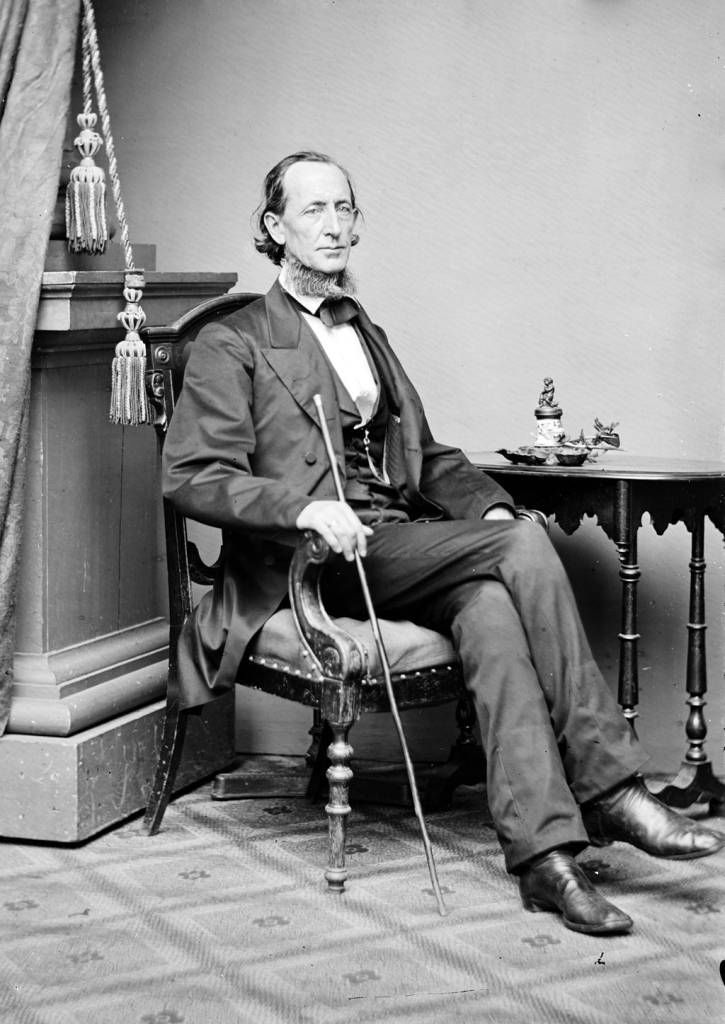
Nicholson was a pragmatic man, and one who often sought the success of others before himself and was sensitive to achieving his ends through unexpected or seemingly counter-intuitive means. Even though his career is littered with statements of caution or guarded support for the progress of the times, one cannot help but notice that he had his fingers in almost every major conservative development in Tennessee politics for the span of his life. He nearly elected one president and helped orchestrate the success of another; he may have never had the prominent statesman career of a man like Thomas Hart Benton, but given his various subtle efforts to impede and subvert the tide of Reconstruction, I do not think it is an entirely unmerited claim to label him one of the quieter architects of Jim Crow segregation.
The Evolution of Trans-Flavored Book Bans Across the 1840s
Circling back to 1850. At this point in his career, Nicholson was already one of the most respected legal scholars in Tennessee. He had literally compiled the book on the law on two separate occasions, first as the associate of Robert L. Caruthers in 1836, and then as the lead author on an 1848 addendum. He was closely involved with the Tennessee Chancery – the courts of equity in Tennessee for which Justices of the Peace were the lower officer – and in 1851 would serve as the acting Chancellor for Middle Tennessee, which includes Nashville.
Though the municipal records for this period are very spotty – plotting seccession tends to take up all the airtime in any account of ‘Nashville in 1850,’ and Tennessee’s entire judiciary and legal system was dismantled during and after the Civil War – the Nashville government appears to have also restructured its local law enforcement in either 1849 or 1850, turning the office of the High Constable into the City Marshall. Unlike the Columbus PD, there’s no helpful department-authored history for us to consult, and none of the city histories speculate or even mention this moment, so it’s a matter of guesswork to wonder how concise or expansive that change might have been.
For many of those same reasons, it’s severely difficult to find meaningful evidence as to why the city of Nashville passed a cross-dressing ban in 1850 nearly identical to the ones in St. Louis and Columbus. While there is a preponderance of similarities between the three cities at the time of passage, it’s entirely possible that the Southern Convention and concentration of Democratic legal thinkers in the city had nothing to do with it. Likewise, we have no evidence that Nicholson was involved. Rather, what I hope you take from this section is both a better understanding of the political currents at work in the city at the time, and a better sense how men like Nicholson were able to survive the Confederacy like cockroaches and come out the other side more powerful than before.
And of course, the textual similarities between these statutes are unmistakable:
§ 7. Every person who shall appear in any street, alley, avenue, market place or public square or in any other place within the city, when naked, or in a dress not belonging to their sex, or in an indecent or lewd dress, or shall be guilty of any indecent or lewd act or behavior, or shall exhibit any indecent or lewd book, picture, statue, or other thing, or who shall exhibit or perform any immoral or lewd play or other representation, shall be deemed guilty of a misdemeanor.
St. Louis, MO, 1843
§ 7. Whoever in this city shall appear in any public place naked, or in a dress not belonging to his or her sex, or in an indecent or lewd dress, or shall make any indecent exposure of his or her person, or be guilty of any indecent or lewd act or behavior, or shall exhibit, sell, or offer for sale, any obscene, vulgar, or libellous book, picture, painting, papers, or publication of any character whatever that shall be adjudged vulgar, libellous or obscene, or shall exhibit or perform any indecent, immoral or lewd play or other representation, shall be deemed guilty of a misdemeanor.
Nashville, TN, 1850
They even have the same section number! I had to correspond directly with the city of Nashville to get my hands on this, and they couldn’t find an earlier book, so while there are multiple sources that cite 1850 as the year this was written, it’s possible it was edited in between.
We can take a similar look at Columbus:
§ 282. Whoever shall appear upon any public street or alley in any public place in the City of Columbus in a state of nudity or in a dress not belonging to his or her sex, or in an indecent or lewd dress, shall be deemed guilty of a misdemeanor, and, upon conviction thereof, shall be fined not exceeding thirty dollars, or imprisoned not more than thirty days, or both.
§ 285. Whoever shall exhibit, sell, offer for sale, circulate, distribute, or cause to be distributed any indecent or lewd book, picture or other thing whatever of an immoral or scandalous nature, or exhibit or perform any indecent, immoral or lewd play or other representation shall, upon conviction thereof, be fined not exceeding one hundred dollars for each and every offense, or be imprisoned not exceeding thirty days, or both.
Columbus, OH, 1848
§ 7. Whoever in this city shall appear in any public place naked, or in a dress not belonging to his or her sex, or in an indecent or lewd dress, or shall make any indecent exposure of his or her person, or be guilty of any indecent or lewd act or behavior, or shall exhibit, sell, or offer for sale, any obscene, vulgar, or libellous book, picture, painting, papers, or publication of any character whatever that shall be adjudged vulgar, libellous or obscene, or shall exhibit or perform any indecent, immoral or lewd play or other representation, shall be deemed guilty of a misdemeanor.
What’s most fascinating about these side-by-sides is that the 1850 Nashville statute appears to borrow exact language from both statutes, but different language from each! It includes the same peculiar combination of topics as St. Louis, along with an word-for-word copy of the “indecent or lewd act or behavior” clause that Columbus does not (and despite adding in a separate indecent exposure clause!); yet ports the “his or her” change from the Columbus statute and includes several other word-level markers, like the addition of “indecent” to the performance clause.
Moreover, much as the Columbus updated the St. Louis statute to better fit local mores, the Nashville statute also includes some very telling new additions that can teach us a lot about the city at time. What unites them? Each update made the prohibiting clause against ‘indecent books’ more restrictive and censorious.
Let’s put them side by side:
Every person who […] shall exhibit any indecent or lewd book, picture, statue, or other thing
St. Louis, MO, 1843
Whoever shall exhibit, sell, offer for sale, circulate, distribute, or cause to be distributed any indecent or lewd book, picture or other thing whatever of an immoral or scandalous nature
Columbus, OH, 1848
Whoever […] shall exhibit, sell, or offer for sale, any obscene, vulgar, or libellous book, picture, painting, papers, or publication of any character whatever that shall be adjudged vulgar, libellous or obscene
Nashville, TN, 1850
There’s a slightly different angle to each of these statutes. The St. Louis statute seems to have the greatest resemblance to England’s Vagrancy Act of 1824, which we discussed in Part Two:
[E]very person wilfully exposing to view, in any street, road, highway, or public place, any obscene print, picture, or other indecent exhibition120
In the Columbus statute, we see an expansion from “exhibit” to a broad blanket attempting to criminalize any sale or distribution. Between that and the clarification of a “immoral or scandalous nature,” it seems the intention of Columbus’ law was less focused on Black vagrancy and more focused on pornography and erotica. While I don’t have any means of confirming this, my speculation is that, reading the Columbus statute as an interpretation of the St. Louis statute, Whig councilmen may have put a spin on it. But the inner workings of its passage remain a mystery.
Nashville’s statute seems to interpret the St. Louis statute in the other direction – “obscene, vulgar, or libelous” are all less tooled towards pornography, and rather seem to be aimed at catching incendiary publications on top of sexual ones. The telling phrase here is “papers or publications,” absent in the other two, which suggests the sort of tract publishing that Southern lawmakers were so concerned about disseminating through the mail. Abolitionist posters, handbills, or pamphlets could all be theoretically implicated under such an ordinance.
Again, this last bit is mostly speculation. But it poses interesting questions nonetheless.
A Note on Methodology
At this point, we have extensively outlined the set of patterns, occurrences, and political trends that seem to have contributed to the passage of these early laws. We’ve examined them in the West, the North, the South; free states, slave states; under Whig and Democratic control alike. Our methodology has not been perfect, and there are undeniable holes in our argument, but I hope that either way, I have given you a rigorous foundation off which to found future scholarship, which I hope can strike closer to the heart of the matter than I ever could.
Before we arrive at the final section of this essay, I want to take a moment to consider what I didn’t discuss in this article, and how that might sway its conclusions.
Even though we’ve spent thousands of words discussing fugitive slavery and its implications, I have not spent much time in the newspaper records of cross-dressing slaves and how they showed up in the Antebellum psyche. C. Riley Snorton has done some of this work in Black on Both Sides with his consideration of the Crafts121 – but that account largely began in late 1848, and thus seems to have come after many of these earliest laws I’ve considered here. Many of these accounts were localized, and tracing their broader impact on Antebellum lawmakers is a tall task, especially for an article that has already stretched this long.
Another angle I have not lingered on is sex work – many of these statutes implicate sex workers as much if not more than figurations of Blackness in Antebellum culture, and it’s entirely possible that there’s a dimension I’ve overlooked there. I’m not nearly as versed in researching the history of sex work as I am race or gender, but I would be intensely curious to read a sex work-forward recounting of this same history to add context and nuance that I may have missed.
Our picture of this legal history owes a lot to a 1999 book by William N. Eskridge Jr. entitled Gaylaw: Challenging the Aparteid of the Closet,122 which has an invaluable list of many of these statutes. However, that list was woefully incomplete, and has since been shaded in by a number of scholars. I also found the scholarship of Claire Sears123, Jen Manion124, and Kate Redburn125 invaluable while compiling the research for this article; this article by Redburn contains a full list of statutes, and made this article possible. HOWEVER. The records for this period tend to be quite spotty, and are overly disposed toward a national accounting of slavery issues. Many of the municipal records from the period have been destroyed or lost, or else are buried at the bottom of obscure historical societies scattered across the United States; I want to emphasize that it is entirely possible that these laws originated elsewhere, or at an even more hyper-local level than I have already posited; we don’t know, and I don’t have the resources to travel the whole country scouring random cities for the answer.
This article would not have been possible without the internet. I have not been to a physical archive or library – all of my sources are the result of either reading digitized sources, or communicating directly with the municipal governments with access to the resources. There is, of course, a certain degree of confirmation bias that comes with this – there are plenty of boring municipal records from the 1800s that nobody has ever cared enough to digitize, and if they contain more accurate accounts of these issues, I have missed them. Ultimately I don’t believe this is a question that can be definitively answered unless someone rolls up their sleeves and slogs through state and local paper archives, and that researcher will not be me.
What is this article? What have I created – what have you just read?
One of the primary difficulties I faced when I began this research was a lack of secondary material to ground my study, forcing me to do most of the strenuous legwork of piecing broader context together by myself. All of the scholarship that did exist was either focused on particular instances, like Snorton, Manion, and Sears, or was so broad that it contained little useful material to work from, like Stryker and Eskridge.
You may have been surprised by how little of this article discusses the actual cross-dressing. But creating a “history of cross-dressing” was never my goal. What I have set out to do here is to produce a trans-sensitive framework for interrogating this period of American history in all of its mess and ugliness – to situate laws like these within their broader social context so that the next person who wants to do theory won’t have to interpret the entire Antebellum period for themselves. History is a tool and a weapon, and my intention is to give you the raw materials to do what you want with them. In that, I believe I have succeeded.
Many of my claims in this article are bold. I have not limited myself to a strict interpretation of primary sources – there is no trans history if you do that, the nature of the discipline requires some level of reading between the lines. Nuance, subtext, words unspoken – all this was the terrain of gender-queer bodies during the middle of the 19th Century. What this means, however, is that there are almost certainly places where I have made reaches, or misinterpreted the sources; places where I have overstated, places where I have understated.
My hope – as I have often said – is that this article will be the beginning of a larger conversation. If even one scholar can use some of these ideas to aid their own research, I will be entirely satisfied in my labor.
This article is not an authoritative or even complete resource on this topic. What I have done is assembled a great many threads, some of which will be woven into the final tapestry and some of which will not. I have specified dimensions, perhaps constructed the broad frame and outlined key areas of interest. The weaving, however, is yet to be done.
Chicago, IL: Black Laws and the Birth of a Nation
The Banality of Anti-Trans Law in America
One final note before I put this very long article to rest:
In 1851, less than a year after the Nashville statute was passed, Chicago would be the fifth place in the United States to pass a statute criminalizing cross-dressing. This one appears to be a near-exact copy job from both the Columbus and Nashville statute:
§ 7. Whoever in this city shall appear in any public place naked, or in a dress not belonging to his or her sex, or in an indecent or lewd dress, or shall make any indecent exposure of his or her person, or be guilty of any indecent or lewd act or behavior, or shall exhibit, sell, or offer for sale, any obscene, vulgar, or libellous book, picture, painting, papers, or publication of any character whatever that shall be adjudged vulgar, libellous or obscene, or shall exhibit or perform any indecent, immoral or lewd play or other representation, shall be deemed guilty of a misdemeanor.
Nashville, TN, 1850
§ 285. Whoever shall exhibit, sell, offer for sale, circulate, distribute, or cause to be distributed any indecent or lewd book, picture or other thing whatever of an immoral or scandalous nature, or exhibit or perform any indecent, immoral or lewd play or other representation shall, upon conviction thereof, be fined not exceeding one hundred dollars for each and every offense, or be imprisoned not exceeding thirty days, or both.
Columbus, OH, 1848
§ 1603. If any person shall appear in a public place in a state of nudity, or in a dress not belonging to his or her sex, or in an indecent or lewd dress, or shall make any indecent exposure of his or her person, or be guilty of any lewd or indecent act or behavior, he shall be subject to a tine of not less than twenty dollars, nor exceeding one hundred dollars.
§ 1606. No person shall exhibit, sell or offer to sell or circulate or distribute any indecent or lewd book, picture or other thing whatever of an immoral or scandalous nature, or shall exhibit or perform any indecent, immoral or lewd play or other representation, under the penalty of not less than twenty dollars nor exceeding one hundred dollars.
Chicago, IL, 1851126
This is by far the most obvious example we have of language being directly lifted from one city to the next.
Three years after that, the Chicago Metropolitan Police Department would be incorporated in 1855, in a trend that follows every city we’ve examined thus far. Fortunately, Chicago’s police department is one of the most documented and studied in the entire country, and so we have a very useful account of the history of crime in the city at the time when this misdemeanor bill was passed:
Sam Lowe, the ex-high constable, had now become a justice of the peace, and he appears to have been kept busy attending to city criminal matters About this time there was a bloody fracas at the “Farmer’s Home,” a tavern that stood upon the corner of LaSalle and South Water streets. Soldiers from the fort had been drinking there, and the usual disturbance followed. Constable Hines interfered in the interest of good order and was knocked down with a club, “which cut his head open frightfully.” Another constable was served in like manner, and then both were forced out of the room. At this stage, three additional city watchmen appeared and demanded admission. On being refused they broke down the door with huge clubs. “Once inside, they assaulted the soldiers, knocked them down with their clubs and dragged them bleeding to the calaboose.” Notwithstanding this gallant conduct on the part of the “watch,” a Tax-payer writes to the Gem of the Prairie, under date of August 17, 1850, protesting against the method of selecting watchmen, alleging that although the power was in the council, it was delegated to one man – meaning the mayor – bad material was selected, and the force was composed of strangers instead of respectable citizens. The writer further says that he heard “a man” remark that the city was best protected when the watch was asleep. Complaint is made by other citizens that Erie and Champlain sailors, of unknown character, were preferred to well-known residents for positions on the force.
J. N. Barker was the assistant marshal at this time, and he gives notice to the public that he will collect the census returns for 1850. Duties foreign to regular police service were enforced upon the officers generally, and toward the close of the year the Gem of the Prairie confesses that the police cannot be justly blamed for the numerous robberies reported, as the force is entirely too small. The paper demands a large and an immediate increase in the number of men.127
Despite being free country, Illinois politics had long been a Democratic affair, differentiating it from Ohio or Tennessee. Stephen A. Douglas, that proponent of popular sovereignty we have already tangentially discussed, was an Illinois man as much as Abraham Lincoln; in 1851, Democrats controlled every level of government in the state, including the mayor’s office in Chicago. We know that Missouri politicians had been conspiring to try and protect slavery across Illinois state lines for decades; and in 1853, they would finally get their wildest dreams in the form of a new law entitled “An Act to prevent the immigration of free Negroes into this state,” which practically drips with near-identical language to Missouri’s “An act more effectually to prevent free persons of color from entering into this state, and for other purposes” from a decade earlier.
It should be noted that the Democratic speaker of the Illinois House of Representatives at this time was John Reynolds, who was a friend (though not related to) of Thomas Reynolds. John and Thomas had served together on the Supreme Court of Illinois; they shared similar understandings about slavery, and the law reflects it. Moreover, the law was introduced by John A. Logan, a Democrat from Murphysboro, which is located just 75 miles away from St. Louis in one of the Illinois-Missouri border counties.
I found a PDF of the legislation, but frustratingly it’s written in a cursive style that I find nearly illegible, and nobody’s ever bothered to transcribe it. So, no close reading of the law. It’s here if you want to give it a shot.
While the new Black Laws do not appear to be a primary consideration in the creation of the police force (or at least not one that the department historians saw fit to record), slavery was nonetheless at the heart of the issues that led Chicago to adopt Peelian policing. In 1854, at the height of the Kansas/Nebraska drama, Senator Douglas would visit the city for a scheduled speech, where the rage of Chicago citizens toward the slaveholding interest would overflow in his town hall:
The gathering did not take place inside, but immediately in front of the Market House. Mayor Milliken, who had consented to preside at the meeting, being a democrat and a strong personal friend of Douglas, took every precaution to preserve the peace. Marshal Darius Knights and Luther Nichols, captain of the watch, with almost the entire regular constabulary, and a large number of specials sworn in for the occasion, were on hand, but their presence was next to useless, for the constables were careful not to offend their fellow citizens, nor to interfere with them in the interest of peace when the question at issue happened to be a political one, and besides, each and every one of them had his own personal and political sentiments to indulge and his own prejudices to nurse. But a majority of the constables were Irishmen, and their sympathies were naturally with the senator. However, during all the disgraceful and riotous proceedings of the night, it is certain that Mayor Milliken’s police shirked their duty, or were overawed by the howling, angry mob with which they had to deal. […]
It proved to be the signal which the mob was waiting for, nevertheless. Pandemonium ensued. “Douglas was instantly assailed by all manner of epithets,” says Cook, upon “every name that vile tongues could invent were hurled at him. In a moment he was surrounded by a howling, raging mob, hungry to do him personal injury. But all undaunted he fearlessly faced the enemy, at the same time keeping down a little company of friends on the platform, who were all eagerness to resent the insults and affronts so brutally heaped their idol. He boldly denounced the violence exhibited as a preconcerted thing, and in defiance of yells, groans, cat calls and every insulting menace and threat, he read aloud, so that it was heard above the infernal din, a letter in- forming him that if he dared speak he would be maltreated.” It was reported at the time that he had been pelted with rotten eggs, but this has been denied, and rotten apples, it is said, were the most offensive missiles used. […]
It was Chicago’s first experience with a mob, and when the angry passions which had been excited so readily by political differences had cooled down, citizens began to ask themselves what would have been the result that night if a single shot had been fired? What was there to check a riot? Upon what protection could peaceable citizens depend? The police force was unworthy of consideration. The example set by this mob might be followed by other and more desperate ones. Better protection was demanded on all sides. The more the subject was discussed the more dangerous the situation appeared. It only required a few months to prove that this alarm was not groundless.128
The second mob referred to in this history was a German one, spurred by the anger of German tavernkeepers in the wake of proposed temperance measures for the city of Chicago. With anti-Black sentiment and Nativist sentiment uniting the various political factions of the city, Chicago would set out to modernize their police department to the Metropolitan model in the pursuit of avoiding similar violence in the future.
Concluding Thoughts
I wanted to end this article with this case not because I have a broader argument like with the other four cases, but rather because this whole process seems to have grown rather perfunctory and straightforward by the 1850s. Chicago was not reinventing the wheel – they were not importing fancy Conservative policies from Britain, or plotting their way to a Confederacy, or attempting to find new ways to keep an enslaved populace under control. The misdemeanor code was borrowed from Columbus and Nashville; the police department was borrowed from New York and St. Louis; the Black Laws were imported across the Mississippi River.
Assuredly we can point at figures in this story who may have influenced the proceedings – Douglas, Reynolds, etc. – but in truth, they have little to differentiate them in this specific context from the various Democratic politicians we have already discussed.
By the mid-1850s, the looming Civil War was a black hole that had begun to consume all attention, both historically and with the people at the time. The closer we come to the event horizon, the harder it becomes to isolate these municipal policies from the broader national timeline. The country was in constant crisis, and frankly, these municipal statutes were barely on the radar of most citizens.
The propagation of misdemeanor codes and police departments across the latter 1850s and 1860s seems to gain a certain inertia, then – governed less by intention than the pressing need for short-term solutions to existential problems. When the war ended, the tinted goggles of Reconstruction had taken hold, and everything else was viewed through it. These misdemeanor codes were Northern policies, so they were good; but the South wanted Black Codes, so those were bad. Recall that the New York Metropolitan Police had been created in response to insurrection – perhaps it should not surprise us that the police so quickly spread across the country.
The truth is that I’m not going to cover the American Civil War during this series. I have no idea how to even begin. When we pick our history back up in the next article, it’ll be toward the end of Reconstruction, and I’ll confess that I fully intend to leave the Civil War period as something of an unsolved mystery for other scholars.
Even this article, covering this much of the Antebellum Era, was an enormously taxing emotional labor for me. This is some of the most difficult theoretical terrain for any Americanist, and having somehow clawed my way through to the other side of it, I have a hard time stomaching the mere suggestion of retreading my past steps. There is something uniquely galling about the idea that the criminalization of cross-dressing, already somewhat of a historical accident, had become a matter of sloppy short-term problem solving and rote bureaucracy less than a decade after its inception. It is unbelievably rage-inducing to pour hundreds of hours of research into the topic, just to walk away with the conclusion that many of the first anti-trans laws in this country may not have even cared about cross-dressers or what would become trans communities.
‘Trans people’ did not figure in the Antebellum imagination, not as a group, not as any historical corollary for what we now understand as an identity category. We were merely caught in the crossfire.
I believe this to be a bleak but necessary truth about the nature of our legal discrimination.
Now, the same cannot be said about the UK, and we’ll be discussing the completely different origins of British anti-trans law in the next article. Imported from Britain as it is, this current wave of American transphobia seems to owe more to the British history of criminalization. But I do believe that the fundamental position of anti-trans law in America as a side product or accident is an important piece of why trans issues continue to be seen as such a ‘marginal’ piece of the broader puzzle of American discrimination, yet still manage to figure at the heart of the current fascist movement tearing this country apart at the seams.
This is ridiculously complicated subject matter – at once local and national, at once marginal and central. Modern transphobia is much the same. In 175 years, how will scholars be able to reckon the historical currents of modern transphobia and fascism with the fact that all of this could have begun because Elon Musk couldn’t accept his trans daughter? Looking back, how are we to reckon with the fact that this whole chain of legal events could have just as easily sprung from the political humiliation of a Missouri Governor as the broader motion of slavery and capital?
History is human. History is bigger than any of us.
Certainly bigger than me.
This is Part Four of an eleven-part series on the historical development of transfeminine literature. Part Five, “Petticoat Punishment and the Comstock Act of 1873,” will be coming soon.
Support Our Work
This article took months of pain-staking research and hundreds of hours to write – and all of that is free, open, and accessible to the general public. That’s possible thanks to the incredibly generous support of our sponsors.
If you want to read more labor-intensive articles like this on The Transfeminine Review, then please consider joining our Patreon! You’ll gain exclusive access to my longer book reviews, and you’ll support independent trans journalism in the process ❤
Ooooh look a fancy button, don’t you just want to click it ^^^
A Brief History of Transfeminine Literature
- Part One: The Moral Origins of Obscenity
- Part Two: Trans-Atlantic Relations and the Obscene Publications Act of 1857
- Part Three: American Evangelicalism and the Ineptitude of the American Whig Party
- Part Four: The Birth of American Anti-Trans Law
- Part Five: Petticoat Punishment and the Comstock Act of 1873
- Part Six: Continental Erotica, Magnus Hirschfeld, and the Nazis
- Part Seven: Virginia Prince and the ‘Invention’ of the Transfeminine Press
- Part Eight: Jan Morris and the Conundrum of the Transsexual Author
- Part Nine: Transfeminine Publishing and the Digital Revolution
- Part Ten: Topside Press, Nevada, and the ‘Transgender Tipping Point’ Myth
- Part Eleven: Detransition, Baby, the Pandemic, and Transfeminine Publishing Today
Reading List
Primary Texts
- Fugitive Slave Act of 1793 (United States)
- Treaty of St. Louis of 1804 (United States)
- Missouri Compromise of 1820 (United States)
- Ratified Indian Treaty 122 of 1824 (United States)
- “The … Report of the Society for the Suppression of Mendicity” – Society for the Suppression of Mendicity (1818)
- Vagrancy Act of 1824 (United Kingdom)
- Offenses Against the Person Act of 1828 (United Kingdom)
- Walker’s Appeal, in Four Articles; Together with a Preamble, to the Coloured Citizens of the World – David Walker (1829)
- Metropolitan Police Act of 1829 (United Kingdom)
- “General Instructions” – London Metropolitan Police (1829)
- “Removal of the Indians” – Lewis Cass (1830)
- “To the Electors of the Borough of Tamworth” – Sir Robert Peel (1834)
- A Plea for the West – Lyman Beecher (1835)
- “An act concerning free negroes and mulattoes” of 1835 (Missouri)
- “N. Tom o’ logical studies. The great tumble bug of Missouri, bent-on rollin his ball” – Henry R. Robinson and Edward Williams Clay (1837)
- Speech to the Young Men’s Lyceum of Springfield – Abraham Lincoln (1838)
- “On the bill to separate the government from the banks” – Thomas Hart Benton (1838)
- Anti-Renters’ declaration – Leaders of the Anti-Rent movement (1839)
- “Our Correspondent ‘Missouri’” – Missouri and Illinois Temperance Herald (1841)
- “A point gained with steam boats” – Missouri and Illinois Temperance Herald (1841)
- The Temperance Address – Abraham Lincoln (1842)
- “An act more effectually to prevent free persons of color from entering into this state, and for other purposes” of 1843 (Missouri)
- 1843 ordinances of the city misdemeanor code (St. Louis)
- Suicide note – Thomas Reynolds (1844)
- “Death and Suicide of Governor Reynolds of Missouri” – Palladium of Liberty (1844)
- “Disguises of the Delaware Anti-Renters, 1845” – Unknown (1845)
- Penal Law 240.35(4) aka New York’s 1845 “Masquerade law” (New York)
- “The Trial of the Kidnappers” – Ohio State Journal (1846)
- 1846 The State of Ohio v. Forbes and Armitage case (Kentucky)
- The Wilmot Provisio of 1846 (United States)
- 1847 Dred Scott v. Irene Emerson case (Missouri)
- 1847 Jones v. Van Zandt case (United States)
- “The Nicholson Letter” – Lewis Cass (1847)
- “To the people of Ohio. Proceedings and address of the Democratic state convention, held at Columbus, May 10, 1848” – David T. Disney (1848)
- “The Nicholson Letter” – Ohio State Journal (1848)
- 1848 ordinances of the city misdemeanor code (Columbus)
- “The way the Locofocos intend to carry Ohio” – Ohio State Journal (1848)
- The Jackson Resolutions of 1849 (Missouri)
- “Resolutions Adopted by the Convention” – Nashville Union and American (1850)
- “Hon. A. O. P. Nicholson’s Letter” – A. O. P. Nicholson (1850)
- 1850 ordinances of the city misdemeanor code (Nashville)
- Compromise of 1850 (United States)
- The Fugitive Slave Act of 1850 (United States)
- “Mr. Nicholson’s Speech” – A. O. P. Nicholson (1850)
- Official reports of the debates and proceedings of the Ohio State Convention, called to alter, revise or amend the constitution of the state, held at Columbus, commencing May 6, 1850, and at Cincinnati, commencing December 2, 1850 – J. V. Smith (1851)
- 1851 ordinances of the city misdemeanor code (Chicago)
Secondary Texts
- History of Franklin County: A collection of Reminiscences of the Early Settlement of the county with biographical Sketches and a complete History of the county to the present time – William T. Martin (1858)
- Columbus, Ohio: its history, resources, and progress – Jacob Henry Studer (1873)
- The life and public services of Salmon Portland Chase, United States Senator and Governor of Ohio; Secretary of the Treasury, and Chief-Justice of the United States – Jacob P. Shuckers (1874)
- Autobiography of Ma-ka-tai-me-she-kia-kiak, or Black Hawk – Black Hawk (1882)
- Thirty Year’s View – Thomas Hart Benton (1883)
- The history of Marion County, Ohio, containing a history of the county; its townships, towns, churches, schools, etc; general and local statistics; military record; portraits of early settlers and prominent men; history of the Northwest Territory; history of Ohio – Leggett, Conaway, & Co. (1883)
- History of Nashville, Tenn., with full outline of the Natural Advantages, Accounts of the Mound Builders, Indian Tribes, Early Settlement, Organization of the Mero District, and General and Particular History of the City Down to the Present Time – John Wooldridge (1890)
- Delaware County, New York; History of the Century, 1797-1897 – David Murray (1898)
- The Nashville Convention of 1850 – Dallas T. Herndon (1905)
- History of the Police Department of Columbus, Ohio – The Columbus Police Benevolent Association (1908)
- “The Election of 1848 in Ohio” – Erwin H. Price (1927)
- “Fugitive Slave Cases in Ohio Prior to 1850” – Leo Alilunas (1940)
- “The Washingtonian Movement” – Milton A. Maxwell (1950)
- Profiles in Courage – John F. Kennedy (1956)
- “A. O. P. Nicholson of Tennessee: Editor, Statesman, and Jurist” – Patricia P. Clark (1965)
- History of the Chicago police – John J. Flinn (1971)
- “Politics and Repeal of Ohio’s Black Laws, 1837-1849” – Leonard Erickson (1973)
- The Nashville Convention: Southern Movement For Unity, 1848-1851 – Thelma Jennings (1980)
- Preservation Plan for St. Louis – St. Louis Cultural Resources Office (1995)
- Gaylaw: Challenging the Aparteid of the Closet – William Eskridge (1999)
- “The 1835 anti-abolition meetings in the south: a new look at the controversy over the abolition postal campaign” – Susan Wyly-Jones (2001)
- “Ohio’s Constitutions: An Historical Perspective” – Barbara A. Terzian (2004)
- “Anti-Rent War” – Eric Arnesen (2007)
- They Have No Rights: Dred Scott’s Struggle for Freedom – Walter Ehrlich (2007)
- Arresting Dress: Cross-Dressing, Law, and Fascination in Nineteenth-Century San Francisco – Claire Sears (2014)
- Perilous Question: The Drama of the Great Reform Bill 1832 – Antonia Fraser (2014)
- Black on Both Sides: A Racial History of Trans Identity – C. Riley Snorton (2017)
- Transgender History: The Roots of Today’s Revolution – Susan Stryker (2017)
- “We the People: The Ohio Constitution of 1851” – Ohio Memory (2017)
- “On This Day in History: Abolitionist Elijah Lovejoy Killed By A Pro-Slavery Mob” – Molly Wicker (2018)
- Female Husbands: A Trans History – Jen Manion (2020)
- “Slavery in Missouri” – National Park Service (2020)
- Policing: The Essentials – Archibold, Huynh, and Mrozla (2021)
- “Mid-19th Century Germans in St. Louis” – Heidi Mathis (2021)
- “Women in Minstrelsy?” – Else Buck (2021)
- “The Wench: Black Women in the Antebellum Minstrel Show and Popular Culture” – Katrina Thompson Moore (2021)
- “Before Equal Protection: The Fall of Cross-Dressing Bans and the Transgender Legal Movement, 1963–86″ – Kate Redburn (2022)
- “US drag bans are nothing new – states were outlawing ‘cross-dressing’ in the 1800s” – Maggie Baska (2023)
- Dangerous Learning: The South’s Long War on Black Literacy – Derek W. Black (2025)
- “Freedom Licenses in St. Louis City and County, 1835-1865” – Ebony Jenkins (Accessed 2025)
- “The Missouri Mormon War” – Missouri Digital Heritage (Accessed 2025)
- “Germans in St. Louis” – The St. Louis Genealogical Society (Accessed 2025)
- “Minstrel Show Female Impersonators” – Ken Padgett (Accessed 2025)
- “Governor’s Suicide Calls Attention to Mental Illness” – Henry V. Guhleman (Accessed 2025)
- “The Whig Party in Missouri” – Zachary Dowdle (Accessed 2025)
- “What was the New York mask law?” – New York Courts (Accessed 2025)
- “History of the Sherrif” – Seneca County Sherrif’s Office (Accessed 2025)
- Pickersgill, Henry William. Detail of Sir Robert Peel, 2nd Bt. Oil on canvas. Unknown. https://commons.wikimedia.org/wiki/File:Sir_Robert_Peel,_2nd_Bt_by_Henry_William_Pickersgill-detail.jpg ↩︎
- Society for the Suppression of Mendicity. “The … Report of the Society for the Suppression of Mendicity.” London: J.W. Whiteley, 1818. https://books.google.ca/books?id=0iwMAQAAMAAJ&printsec=frontcover&source=gbs_ge_summary_r&cad=0#v=onepage&q&f=false ↩︎
- “Principles of Good Policing.” Civitas. Accessed March 14th, 2025. https://www.civitas.org.uk/research/crime/facts-comments/principles-of-good-policing/ ↩︎
- Archibold, Carol A., Huynh, Carol M., and Mrozla, Thomas J. “The History of the Police,” in Policing: The Essentials. Sage Publications, 2021. 3-4. https://us.sagepub.com/sites/default/files/upm-binaries/50819_ch_1.pdf ↩︎
- Fraser, Antonia. Perilous Question: The Drama of the Great Reform Bill 1832. London: Phoenix, 2014. 87. https://archive.org/details/perilousquestion0000anto_m8r0 ↩︎
- Peel, Robert. “To the Electors of the Borough of Tamworth.” December 18th, 1834. https://en.wikisource.org/wiki/The_Tamworth_Manifesto ↩︎
- Black, Derek W. Dangerous Learning: The South’s Long War on Black Literary. New Haven: Yale University Press, 2025. 19. ↩︎
- Walker, David. Walker’s Appeal, in Four Articles; Together with a Preamble, to the Coloured Citizens of the World. Boston, 1830. 59-60. ↩︎
- Shelton, William Henry. Discovery of Nat Turner. Wood engraving. Unknown. https://commons.wikimedia.org/wiki/File:Nat_Turner_captured.jpg ↩︎
- Black, Dangerous Learning, 19-20. ↩︎
- Wyly-Jones, Susan. “The 1835 anti-abolition meetings in the south: a new look at the controversy over the abolition postal campaign.” The Free Library. December 1st, 2001. https://www.thefreelibrary.com/The 1835 anti-abolition meetings in the south: a new look at the…-a082885407 ↩︎
- Tom. “USA Map 1864 including Civil War Divisions.” Digital image. Wikipedia. July 3rd, 2006. Licensed under Creative Commons 3.0 with attribution. https://en.wikipedia.org/wiki/Border_states_(American_Civil_War)#/media/File:USA_Map_1864_including_Civil_War_Divisions.png ↩︎
- World In Maps. “Map of the Midwest region.” Accessed May 14th, 2025. https://worldinmaps.com/midwest/ ↩︎
- Untitled map, 1860. Accessed through Famous Trials website by Douglas O. Linder. https://famous-trials.com/celia/179-maps ↩︎
- Lloyd, James T. “Lloyd’s map of the lower Mississippi River from St. Louis to the Gulf of Mexico; compiled from Government surveys in the Topographical Bureau, Washington, D.C.” New York, 1862. https://www.loc.gov/item/98688409/ ↩︎
- “Native American Reservations by State.” World Population Review. Digital, accessed February, 2025. ↩︎
- Kmussser. “St. Louis Treaty Map 1804.” Wikipedia. Digital. December 23rd, 2010. https://commons.wikimedia.org/wiki/File:Stlouistreatymap1804.png ↩︎
- Black Hawk. Autobiography of Ma-ka-tai-me-she-kia-kiak, or Black Hawk. J. B. Patterson, 1882. ↩︎
- Ratified Indian Treaty 122: Iowa. District of Columbia. August 4, 1824. https://catalog.archives.gov/id/122642976 ↩︎
- King, Charles Bird. Moanahonga (Great Walker), An Ioway Chief. Oil on panel. 1824. https://commons.wikimedia.org/wiki/File:Charles_Bird_King,_Moanahonga_(Great_Walker),_An_Ioway_Chief,_ca._1824,_oil_on_panel.jpg ↩︎
- Jenkins, Ebony. “Freedom Licenses in St. Louis City and County, 1835-1865.” National Park Service. Accessed March 14th, 2025. https://www.nps.gov/jeff/learn/historyculture/upload/Freedom%20License%20Report.pdf ↩︎
- “Slavery in Missouri.” National Park Service. June 5th, 2020. https://www.nps.gov/jeff/planyourvisit/slavery.htm ↩︎
- Beecher, Lyman. “A Plea for the West.” New York: Leavitt, Lord & Co., 1835. https://archive.org/stream/pleaforwest00beec/pleaforwest00beec_djvu.txt ↩︎
- “9 – Peopling St. Louis: the Immigration Experience.” A Preservation Plan for St. Louis. Government of St. Louis, accessed September 8th, 2024. https://www.stlouis-mo.gov/government/departments/planning/cultural-resources/preservation-plan/Part-I-Peopling-St-Louis.cfm ↩︎
- “Germans in St. Louis.” The St. Louis Genealogical Society. Accessed September 8th, 2024. https://stlgs.org/research-2/community/ethnic/germans ↩︎
- Mathis, Heidi. “Mid-19th Century Germans in St. Louis.” Family Locket. April 11th, 2021. https://familylocket.com/mid-19th-century-germans-in-st-louis/ ↩︎
- “The Missouri Mormon War.” Missouri Digital Heritage, accessed March 14th, 2025. https://www.sos.mo.gov/archives/resources/mormon.asp ↩︎
- Wicker, Molly. “On This Day in History: Abolitionist Elijah Lovejoy Killed By A Pro-Slavery Mob.” Human Trafficking Institute, Nov. 7th, 2018. https://traffickinginstitute.org/on-this-day-in-history-abolitionist-elijah-lovejoy-killed-by-a-pro-slavery-mob/ ↩︎
- Ibid. ↩︎
- Buck, Else. “Women in Minstrelsy?” St. Olaf College. October 12th, 2021. https://pages.stolaf.edu/americanmusic/2021/10/12/women-in-minstrelsy/ ↩︎
- Moore, Katrina Thompson. “The Wench: Black Women in the Antebellum Minstrel Show and Popular Culture.” The Journal of American Culture, 2021. https://www.academia.edu/104953898/The_Wench_Black_Women_in_the_Antebellum_Minstrel_Show_and_Popular_Culture ↩︎
- Padgett, Ken. “Minstrel Show Female Impersonators.” Blackface! Accessed March 14th, 2025. https://www.black-face.com/minstrel-female-impersonators.htm ↩︎
- “Our Correspondent ‘Missouri.’” Missouri and Illinois Temperance Herald, October 1st, 1841. https://www.newspapers.com/image/612839832 ↩︎
- Illinois Supreme Court. “Illinois Supreme Court Justice Thomas Reynolds.” 1825. https://commons.wikimedia.org/wiki/File:Judge_Thomas_Reynolds.png ↩︎
- Guhleman, Henry V. “Governor’s Suicide Calls Attention to Mental Illness.” Missouri Department of Mental Health. Accessed March 14th, 2025. https://dmh.mo.gov/about/history-mental-illness ↩︎
- “Death and Suicide of Governor Reynolds of Missouri.” Palladum of Liberty. February 28th, 1844. https://libraries.udmercy.edu/archives/special-collections/index.php?collectionCode=baa&record_id=152 ↩︎
- Dowdle, Zachary. “The Whig Party in Missouri,” in Missouri Encyclopedia. The State Historical Society of Missouri: accessed March 14th, 2025. https://missouriencyclopedia.org/groupsorganizations/whig-party ↩︎
- Clay, Edward Williams, and Robinson, Henry R. “N. Tom o’ logical studies. The great tumble bug of Missouri, bent-on rollin his ball.” Lithograph. January, 1837. https://www.loc.gov/item/2008661310/ ↩︎
- I couldn’t stomach hyperlinking this one, but here’s an absolutely nauseating New York Times article from 1891 about Phoebe Moore’s ‘romantic life:’ https://www.nytimes.com/1891/04/26/archives/phoebe-moores-romantic-life-she-had-been-owned-by-col-benton-and.html Actually one of the worst things I’ve ever read. ↩︎
- Benton, Thomas Hart. “Presidential Election,” in The Project Gutenberg eBook of Thirty Years’ View, Volume 2. Project Gutenburg: 2014. https://www.gutenberg.org/cache/epub/44837/pg44837-images.html#CHAPTER_LVIII ↩︎
- Ibid, “Repeal of the Independent Treasury Act; Mr. Benton’s Speech.” https://www.gutenberg.org/cache/epub/44837/pg44837-images.html#CHAPTER_LXV ↩︎
- “A point gained with steam boats.” Missouri and Illinois Temperance Herald, January 1st, 1841. ↩︎
- Maxwell, Milton A. “The Washingtonian Movement.” QUARTERLY JOURNAL OF STUDIES ON ALCOHOL, VOL. 11, 410-452, 1950. https://silkworth.net/wp-content/uploads/2020/12/TheWashingtonianMovement_ReffrenceAndResource.pdf ↩︎
- https://www.abrahamlincolnonline.org/lincoln/speeches/temperance.htm ↩︎
- An interesting connection, though this is conjecture: I do wonder whether Missouri’s creation of its first asylum in the wake of Gov. Reynolds’ suicide was influenced by the ideas and aesthetics of the Washingtonian movement. But that’s likely a conversation for another scholar. ↩︎
- Lincoln, Abraham. “Temperance Address.” Springfield, February 22nd, 1842. https://www.abrahamlincolnonline.org/lincoln/speeches/temperance.htm ↩︎
- “An act more effectually to prevent free persons of color from entering into this state, and for other purposes.” Missouri State Legislature. February 23rd, 1843. https://mdh.contentdm.oclc.org/digital/collection/molaws/id/40608 ↩︎
- Jenkins, “Freedom Licenses,” 4. ↩︎
- Chambers, A. B. The revised ordinances of the city of Saint Louis, 1835-36, 1843, 1846, 1850, 1860-61. St. Louis: Chambers & Knapp, 1861. 309. https://archive.org/details/revisedordinanc01mogoog/page/302/mode/2up ↩︎
- Ibid, 303. ↩︎
- Stryker, Susan. Transgender History: The Roots of Today’s Revolution. New York: Seal Press, 2017. 50-51.https://transreads.org/wp-content/uploads/2021/12/Transgender-History-The-Roots-of-Todays-Revolution-by-Susan-Stryker-z-lib.org_.pdf ↩︎
- Ibid. ↩︎
- Ibid. ↩︎
- Baska, Maggie. “US drag bans are nothing new – states were outlawing ‘cross-dressing’ in the 1800s.” Pink News, April 16th, 2023. https://www.thepinknews.com/2023/04/16/us-drag-bans-masquerade-laws/ ↩︎
- This is quoted in a lot of places, none of which seem to be able to cite an original source. I found it on Wikipedia, but it’s also mentioned in a Howard Zinn podcast episode on the topic if you’re curious: https://genius.com/Howard-zinn-chapter-10-the-other-civil-war-annotated ↩︎
- “Disguises of the Delaware Anti-Renters, 1845.” Photograph. 1845. You can find this photograph in a lot of place, here’s an article in the New York Almanack: https://www.newyorkalmanack.com/2013/10/halloween-history-new-yorks-anti-mask-law/ ↩︎
- Arnesen, Eric. “Anti-Rent War,” in Encyclopedia of U.S. Labor and Working-class History, Volume 1. Taylor and Francis, 2007. 119. https://books.google.ca/books?id=zEWsZ81Bd3YC&pg=PA118&redir_esc=y#v=onepage&q&f=false ↩︎
- “What was the New York mask law?” New York Courts, accessed September 9th, 2024. https://askalawlibrarian.nycourts.gov/legalresearch/faq/410210 ↩︎
- People v Aboaf, 187 Misc 2d 173, 183 [Crim Ct 2001] quoting People v Archibald, 58 Misc2d 862 (App Term, 1st Dept 1968 dissenting opinion). ↩︎
- Archibold, Huynh, and Mrozla, “The History of the Police,” 4. ↩︎
- It is useful to remember that Thomas Reynolds served as one of the first Justices of the Supreme Court of Illinois from 1822 to 1825, and indeed that his judicial experience preceded his legislative and executive terms. Reynolds was a man with experience in all three branches of state government by the time he signed “An act more effectually to prevent free persons of color from entering into this state, and for other purposes” into law – while we don’t have direct evidence of this, I would not be surprised if the bill was not designed to bring court cases not just to the Missouri Judiciary, which was heavily Democratic and Pro-Slavery, but indeed to the Supreme Court. Given the single biggest impact of the Missouri Supreme Court during this period was the court case that would ultimately lead to the 1857 Dred Scott v. Sandford decision… This is pure speculation, though, so I’ve left it in the footnotes. ↩︎
- “A photograph of Dred Scott, taken around the time of his court case in 1857.” 1857. https://commons.wikimedia.org/wiki/File:Dred_Scott_photograph_(circa_1857).jpg ↩︎
- Ehrlich, Walter. They Have No Rights: Dred Scott’s Struggle for Freedom. New York: Applewood Books, 2007. 37. https://books.google.ca/books?id=3HUDVbRUu4UC&pg=PA37&redir_esc=y#v=onepage&q&f=false ↩︎
- Ibid. ↩︎
- “The Jackson Resolutions.” Missouri State Legislature. June 1st, 1849. Reprinted by Chris Floersch. https://johannfloersch.net/the-jackson-resolutions/ ↩︎
- Ehrlich, They Have No Rights, 58. ↩︎
- Brady, Mathew Benjamin. “Daniel S. Dickinson.” Daguerotype. Unknown. https://commons.wikimedia.org/wiki/File:Daniel_Dickinson_NY.jpg ↩︎
- Wilmot Provision, 1846. https://loveman.sdsu.edu/docs/1846WilmotProviso.pdf ↩︎
- Price, Erwin H. “The Election of 1848 in Ohio.” Thesis. 1927. https://resources.ohiohistory.org/ohj/search/display.php?page=61&searchterm=tecumseh%20and%20his%20descendants&vol=36&pages=188-311 ↩︎
- Cass, Lewis. “Removal of the Indians.” North American Review, January 1830. https://nationalhumanitiescenter.org/pds/triumphnationalism/expansion/text4/cassremoval.pdf ↩︎
- Cass, Lewis. “The Nicholson Letter.” December 30th, 1847. https://ohiomemory.org/digital/collection/p16007coll22/id/15988/rec/28 ↩︎
- “The Nicholson Letter.” Ohio State Journal. July 18th, 1848. https://ohiomemory.org/digital/collection/p16007coll22/id/15988/rec/28 ↩︎
- “The way the Locofocos intend to carry Ohio.” Ohio State Journal. November 1st, 1848. https://ohiomemory.org/digital/collection/p16007coll22/id/4575/rec/7 ↩︎
- Price, “The Election of 1848.” ↩︎
- Erickson, Leonard. “Politics and Repeal of Ohio’s Black Laws, 1837-1849.” Ohio History 82, nos. 3/4 (1973): 154-175. https://resources.ohiohistory.org/ohj/browse/displaypages.php?display[]=0082&display[]=154&display[]=175 ↩︎
- Alilunas, Leo. “Fugitive Slave Cases in Ohio Prior to 1850.” Ohio Archaeological and Historical Quarterly. XLIX (1940), 160-84. https://resources.ohiohistory.org/ohj/search/display.php?page=53&searchterm=Array&vol=49&pages=160-184 ↩︎
- Shuckers, Jacob P. “The life and public services of Salmon Portland Chase, United States Senator and Governor of Ohio; Secretary of the Treasury, and Chief-Justice of the United States.” New York: D. Appleton, 1874. 98. https://archive.org/details/lifepublicservic00schuuoft/page/98/mode/2up ↩︎
- Kmusser. “Colony of Virginia, 1607-1776.” Wikipedia. Digital. December 8th, 2006. https://commons.wikimedia.org/wiki/File:Virginiacolony.png ↩︎
- Terzian, Barbara A. “Ohio’s Constitutions: An Historical Perspective,” 51 Clev. St. L. Rev. 357 (2004). https://www.teachingcleveland.org/wp-content/uploads/2016/12/Ohios-Constitutions_-An-Historical-Perspective.pdf ↩︎
- Ohio Memory. “We the People: The Ohio Constitution of 1851.” June 9th, 2017. https://ohiomemory.ohiohistory.org/archives/3339 ↩︎
- Terzian, “Ohio’s Constitutions,” 368-9. ↩︎
- “History of the Sherrif.” Seneca County’s Sherrif’s Office. Accessed March 14th, 2025. https://senecacountyso.org/about/history-of-the-sheriff/ ↩︎
- Leggett, Conaway, & Co. The history of Marion County, Ohio, containing a history of the county; its townships, towns, churches, schools, etc; general and local statistics; military record; portraits of early settlers and prominent men; history of the Northwest Territory; history of Ohio. Chicago: Legget, Conaway & Co., 1883. https://archive.org/details/historyofmarionc00legg/page/364/mode/2up ↩︎
- “Ozias Bowen.” Photograph. Unknown. https://en.wikipedia.org/wiki/Ozias_Bowen#/media/File:Ozias_Bowen.jpg ↩︎
- “Judge John Bartram.” Daguerotype. Unknown. Preserved digitally by Michael Brewer. https://www.findagrave.com/memorial/60383581/john-bartram#view-photo=167137449 ↩︎
- Shuckers, “Life and Public Service,” 54. https://archive.org/details/lifepublicservic00schuuoft/page/54/mode/2up ↩︎
- Jones v. Van Zandt, 46 U.S. 215 (1847). https://supreme.justia.com/cases/federal/us/46/215/ ↩︎
- Ibid. ↩︎
- Studer, Jacob Henry. Columbus, Ohio: its history, resources, and progress. Washington: Library of Congress, 1873. 46. https://archive.org/details/cu31924028849219/page/46/mode/2up ↩︎
- Howe, Henry. “High Street, Columbus.” In Historical Collections of Ohio: An Encyclopedia of the State …. Volume I. Columbus: Henry Howe & Son, 1891. Wood engraving. 1846. https://hd.housedivided.dickinson.edu/node/22913 ↩︎
- 22. ↩︎
- 47. ↩︎
- “The Trial of the Kidnappers.” Ohio State Journal. September 19th, 1846. https://ohiomemory.org/digital/collection/p16007coll22/id/20563/rec/17 ↩︎
- The state of Ohio vs. Forbes and Armitage. KF 223 .P48 F67 1846 LL TRIALS. April 10th, 1846. https://tile.loc.gov/storage-services/service/ll/llst/039/039.pdf ↩︎
- Martin, William T. History of Franklin County: A collection of Reminiscences of the Early Settlement of the county with biographical Sketches and a complete History of the county to the present time. Columbus: Follet, Foster, & Co., 1858. https://genealogytrails.com/ohiofranklin/history_1858history5.html ↩︎
- Disney et al. “To the people of Ohio. Proceedings and address of the Democratic state convention, held at Columbus, May 10, 1848.” Columbus: Office of the Statesman, 1848. https://archive.org/details/topeopleofohiopr00demo/page/4/mode/2up ↩︎
- Ibid. ↩︎
- Terzian, Ohio’s Constitutions,” 370-1. ↩︎
- Ibid, 374. ↩︎
- History of the Police Department of Columbus, Ohio. Columbus: The Columbus Police Benevolent Association, 1908. 14-15. https://babel.hathitrust.org/cgi/pt?id=nnc1.cu56389345&seq=21 ↩︎
- “1940 – Voters adopt Missouri Nonpartisan Court Plan.” Accessed March 14th, 2025. https://www.courts.mo.gov/page.jsp?id=174544 ↩︎
- Kennedy, John F. Profiles in Courage. London: Hamish Hamilton, 1956. 99. https://archive.org/details/in.ernet.dli.2015.460987/page/n99/mode/2up ↩︎
- Ibid. ↩︎
- Ehrlich, They Have No Rights, 37 ↩︎
- Ibid. ↩︎
- Herndon, Dallas T. The Nashville Convention of 1850. Montgomery: Alabama Historical Society, 1905. 210.https://archive.org/details/nashvilleconvent00hern/page/210/mode/2up ↩︎
- Jennings, Thelma. The Nashville Convention: Southern Movement For Unity, 1848-1851. Memphis: Memphis State University Press, 1980. 132.https://archive.org/details/nashville-convention/page/132/mode/2up ↩︎
- Wooldridge, John. History of Nashville, Tenn., with full outline of the Natural Advantages, Accounts of the Mound Builders, Indian Tribes, Early Settlement, Organization of the Mero District, and General and Particular History of the City Down to the Present Time. Nashville: South, Barbee, and Smith, 1890. 519.https://archive.org/details/historyofnashvil00wool/page/516/mode/2up ↩︎
- “Resolutions Adopted by the Convention.” Nashville Union and American. June 15th, 1850. https://www.newspapers.com/image/604000865/ ↩︎
- Nicholson, A. O. P. “Hon. A. O. P. Nicholson’s Letter.” Nashville Union and American. June 26th, 1850. https://www.newspapers.com/image/604642926/ ↩︎
- Clark, Patricia P., “A. O. P. Nicholson of Tennessee: Editor, Statesman, and Jurist.” Master’s Thesis, University of Tennessee, 1965. 70-1. https://trace.tennessee.edu/cgi/viewcontent.cgi?article=4791&context=utk_gradthes ↩︎
- Nicholson, A. O. P. “Mr. Nicholson’s Speech.” Nashville Union and American. November 29th, 1850. https://www.newspapers.com/image/603933890/ ↩︎
- Ibid. ↩︎
- This has absolutely nothing to do with the article, but it’s incredibly fucking funny that Johnson has an entire Wikipedia page dedicated to the fact that he was drunk during his inauguration as Vice President. ↩︎
- Clark, “A. O. P. Nicholson of Tennessee,” 131-2, 4 ↩︎
- A. O. P. Nicholson to Andrew Johnson, February 27, 1866 ↩︎
- Clark, “A. O. P. Nicholson of Tennessee.” ↩︎
- Lellyett, John. Ordinances of the city of Nashville of a public nature in force August 1st, 1872. Nashville: Roberts & Purvis, 1872. 236. https://babel.hathitrust.org/cgi/pt?id=nyp.33433012347344&seq=9 ↩︎
- Also shoutout to Austin, the wonderful metro clerk with the city of Nashville who helped me track this one down. ↩︎
- Vagrancy Act, 1824. https://www.irishstatutebook.ie/eli/1824/act/83/enacted/en/print.html ↩︎
- See Snorton, C. Riley. Black on Both Sides: A Racial History of Trans Identity. Minneapolis: University of Minnesota Press, 2018. Chapter Two discusses the topic. ↩︎
- See Eskridge, William. Gaylaw: Challenging the Aparteid of the Closet. Cambridge: Harvard University Press, 1999. ↩︎
- See Sears, Claire. Arresting Dress: Cross-Dressing, Law, and Fascination in Nineteenth-Century San Francisco. Durham: Duke University Press, 2014. ↩︎
- See Manion, Jen. Female Husbands: A Trans History. Cambridge: Cambridge University Press, 2020. ↩︎
- See Redburn, Kate. “Before Equal Protection: The Fall of Cross-Dressing Bans and the Transgender Legal Movement, 1963–86.” Law and History Review 40, no. 4 (2022): 679–723. https://doi.org/10.1017/S0738248022000384. ↩︎
- Jamieson, Egbert and Adams, Francis. Municipal code of Chicago : comprising the laws of Illinois relating to the city of Chicago, and the ordinances of the City Council. Chicago: Beach and Barnard, 1881. https://archive.org/details/municipalcodeofc00chicrich/page/376/mode/2up ↩︎
- Flinn, John J. History of the Chicago police. New York: Arno Press, 1971. 67-69. https://archive.org/details/historyofchicago0000flin/page/58/mode/2up ↩︎
- Ibid, 68. ↩︎

 The Transfeminine Review


#/media/File:USA_Map_1864_including_Civil_War_Divisions.png)

,_An_Ioway_Chief,_ca._1824,_oil_on_panel.jpg)

.jpg)


Join the discussion! All comments are moderated. No bigotry, no slurs, no links, please be kind to each other.