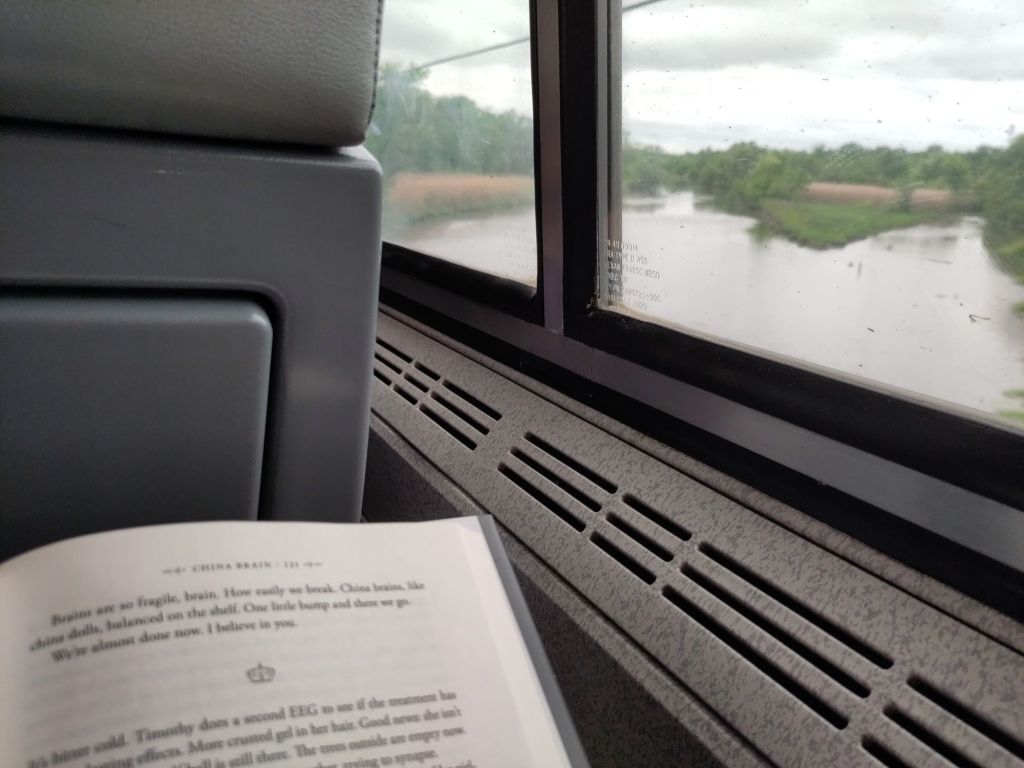
In a certain sense, I’ve had an ordinary gap year between the end of college and the beginning of grad school. I’ve moved into (and out of) my first apartment, tried a few odd jobs, experimented in several different fields, and started to figure out what I want out of life.
Normal twenty-three year old stuff, and all that.
Let me give you an example:
The day is January 29th, 2025, and I am around a week into my unwitting new role as a political crisis journalist. High-stress job! The White House has decided that it’s ‘Bring Your Anti-Trans Executive Order to Work’ week, which means that we’re about three days deep into an absolute barrage of discrimination, and my social media feeds are freaking out. Rumors are bubbling – there’s gonna be another one tonight. This time about schools. The entire online trans community is either panicking or trying to reassure the people who are panicking; I am doing the latter.
Political crisis journalism is not a job that I’m being paid to do, nor one I have any training for. There’s a lot of ways to get into political commentary, and as a general rule, ‘having an online publication as a transgender person’ probably shouldn’t be one of them. But I had a young and growing digital publication – a platform, I told myself, as I had heard so many celebrities and influencers echo across the 2010s – and so I would do my best to help my community.
All day, I was braced for the inevitable. I tried to read – didn’t really work. I’m a literary critic, but I found myself repeatedly refreshing the White House’s EO page, waiting for the other shoe to drop.
And it did.
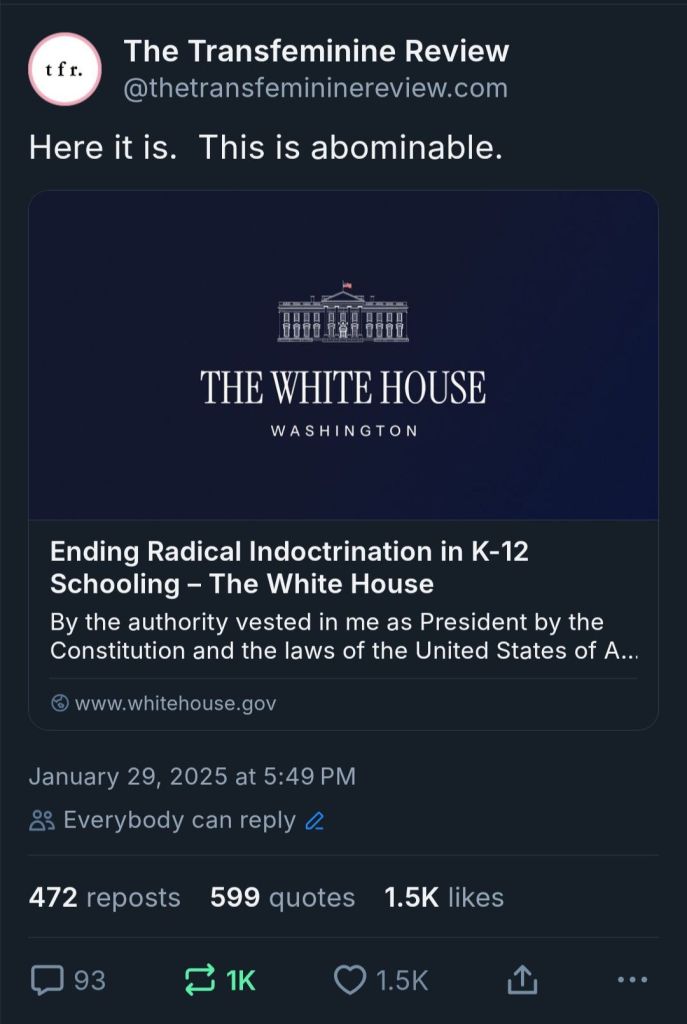
In truth, I don’t quite know what I expected, trying to be the first person to post about this. Maybe I wanted to help. Maybe I wanted clout. Or maybe I just wanted to be the first to yell about it. It doesn’t really matter – one way or another, my post ended up helping to break the news that night. And the news was bad. Really bad.
Worse than anyone expected.
My feed exploded. Like, 3000-notifications-an-hour levels. I was freaking out. Everyone was freaking out. Fortunately I had therapy in ten minutes, but the deluge was so overwhelming that my therapist and I basically just spent the entire session taking deep breaths. I left, and there were over a hundred quote skeets to scroll through. People were terrified. Angry. Sick. It was overwhelming. I put my phone on Do Not Disturb, which sorta helped, but I have ADHD and couldn’t really look away. Will Stancil quoted the post. It was like having the entire force of the national news cycle blasted at my face for about six hours, and it sucked.
I kept up with my ‘internship’ that nobody had ever given me for a few more horrible anti-trans executive orders, but my heart wasn’t really in it after that night. My dad used to say that every bad job helped to teach you what you don’t want out of your career. 2025 has certainly taught me that a high-stakes career in independent political journalism is not for me.
It’s nice to have a job that doesn’t give you panic attacks.
Here are two facts:
1 – The Trump Administration is engaged in an discriminatory campaign against trans people in the public sphere. This is probably related to all those times that Elon made Nazi salutes on national television.
2 – I have a work phone now that I keep on Do Not Disturb mode. It’s pink.
The Hebrew meaning of the word ‘Seder’ is order. Literal order, not a power structure, though in some ways Passover represents that too. It’s a very methodical holiday; you drink four cups of wine at various points during the service, using your pinky to draw forth ten drops in solemn remembrance of the Ten Plagues that God cast down upon the Egyptians. There’s the Seder plate with its spherical divots, each with its own special food; and each food has a prayer, and a meaning, and an important part of the ceremony is dedicated to giving thanks for each of them.
I didn’t grow up in an especially observant household. My Grandpa often says that he doesn’t know how to believe in a God that would have allowed the Holocaust to happen. We went to services and did Shabbat occasionally, though not as much since my Mom died. I had a Bat Mitzvah. We go to High Holidays.
Following the order of the Seder isn’t about observance, though. It’s about the tradition, the culture. It’s about respecting our ancestors and the suffering of those less fortunate than ourselves. It’s long, and it’s annoying, and you have to sit for ages so you can eat, but it’s not about any of that. The ritual of the occasion doesn’t work if you’re not taking it seriously.
Passover is a practice. My family may not be super observant, but we followed the proper order.
That’s not how it happened this year.
Instead of just parsley, there were full vegetable platters at our Seder table. They were our ‘karpas,’ not that any of it was meant to be dipped in salt water, and the karpas blessing was hurried along to the beginning of the ceremony. We sped along through the already-truncated Haggadah – didn’t even pretend to do the handwashing, told the story of the Exodus in about a paragraph. My family members were breaking the Matzah before we’d even said the prayer.
And then it was dinner time. There was good food, and alcohol, and the awkward business of ritual was happily swept to the sideboard.
Once we were slaves, but now we are free. Next year in Jerusalem!
Passover is an intergenerational memory. It’s a holiday to commemorate a time when our people labored and suffered tyranny with scarce resources and scarcer cause for joy. And yet we fought our way out of Egypt; and yet we crossed the Red Sea; and yet we wandered through the desert with nothing to eat but the bread of affliction – we are free now, dayenu, Amen.
We celebrate Passover with a feast to show how far our people have come. But it also reminds us that we’re no difference from our ancestors who suffered in the past. We eat of their hunger; we drink of their thirst. The foods of the Seder invoke a time we knew slavery and hardship at the hands of the Egyptians. And yet my family couldn’t even give thanks for our Matzah before we gorged ourselves upon the feast.
Here is another story from my Seder; after the feast had begun, my family began to notice my unhappiness with the state of the night, and asked me what was wrong. What was I thinking about that could bring me such misery on this night, of all nights?
“I’m thinking about Palestine,” I said. “I’m thinking about how there are millions of people starving to death in the Holy Land while we can’t even wait for the blessings on the feast.”
My whole family scolded me to be quiet.
Tonight, they said, was a night for celebration. No need to mention the genocidal elephant in the room.
When I got micro-famous talking about censorship last November, I made the mistake of thinking that American censorship would be flashy. I had gone viral off of images of Nazis burning Magnus Hirschfeld’s library – on some level, constantly seeing the images of censorship past had distracted me from the realities of what censorship looks like today.
The Trump Administration purged most information on trans issues from government websites this spring, including health info, databases, travel advisories, and historical documentation. But the purge wasn’t loud. It wasn’t flashy. Queer people made noise about it, sure, but there weren’t physical reams of paper to dump in a big pile and douse in gasoline.
They just… disappeared.
One of the reasons the Holocaust is such a vivid lightning rod is because it produced some of the most striking visual imagery of the 20th Century. The photos of book burnings are iconic, yes, but so are lines of shoes, and emaciated bodies packed like sardines, and thousands of arms raised in rigid salutes.
That’s not what American Nazism is producing right now. Even at their moments of greatest machismo – Trump’s post-assassination fist of defiance, the mugshot, Elon’s salute – there is an undeniable element of buffoonery. There is no crowd of angry white men standing around making Nazi salutes while a library burns. How do you accurately depict a lone tech bro sitting alone in an office, Ctrl+Fing his way through an enormous spreadsheet of ‘woke’ webpages to decide which ones to delete? How do you impress the gravity of that loss to a mass audience when the aforementioned tech bro’s nickname is ‘Big Balls,’ working at a government department named after a meme cryptocurrency based on a twelve-year-old photo of a shiba inu?
There’s an incredibly important NPR article that highlights the way that government censors are not just deleting trans information from government websites, but rewriting queer sources altogether. I won’t copy their homework, but please give it a read. This is blatant censorship and revisionism, yes, but it’s also quiet revisionism. They are not announcing which individual sources are being altered, nor is there any record of what has been taken down.
Fortunately, much of the public-facing information on transgender people in the United States was saved thanks to the diligent work of thousands of independent actors and organizations. But the loss of public access is a direct act of violence against the trans community and a flagrant disregard toward American taxpayers who funded the research, and we have no idea how much data not accessible to the public was also destroyed. At this time, it’s also broadly unknown how many grants, funds, departments, committees, research projects, long-term initiatives, and other associations or programs dedicated to the maintenance and production of trans literature and its adjacent paraphernalia have been lost.
It’s also possible that physical records of transgender literature have been destroyed as well. We don’t know. Many of the top officials meant to maintain our country’s archives and cultural artifacts have been fired, or are at risk of it. Our system of checks and balances only works under a respectful regime, and thus far, Trump II has shown none of it.
It’s bad, but there’s so much other noise that nobody can spare the bandwidth. There are bigger fish to fry.
Right?
The slow creep of censorship has been even quieter in the private sector, but it’s there if you’re looking for it. Authors are getting removed from panels for leftist speech. Professors in academia are regressing their syllabi, if not capitulating to a right-wing shift outright. Major social media platforms like Facebook and X removing #transgender and other trans-related search terms from their systems. All of this is, of course, only a continuation of the broad wave of free speech crackdowns sparked by the protest movement against the Gazan genocide, but when you add that to the conversation, you’d be shocked by how many ‘pro-speech’ Americans will come out swinging on the side of censorship.
Allow me to spin you a cautionary tale about corporate censorship in our current political climate.
As our site has outlined in a number of articles (see here, here, here, here, and here), building a trans microlibrary has been one of our most effective tactics for creating a grassroots literary preservation movement. The idea of the microlibrary is that each individual reader creates a private library of their favorite texts, including free online resources and other digital ephemera at the highest risk of being lost. By backing up and sharing that microlibrary (where legally and ethically permissible, of course), a community of trans readers would help to build layers of redundancy that would negate the risk of losing any individual text.
In February, when I still had the spoons to unravel my life from Big Tech, I found myself trying to extricate my trans books from Amazon. I was very much a Kindle kid, and had around fifty trans ebooks on my Amazon account that I wanted for posterity.
In case you weren’t aware, Amazon has some very anti-consumer business practices, one of which is the way it deploys Digital Rights Management (DRM) software with its ebooks. When you purchase an ebook through Amazon, the file that it downloads onto your device is not an EPUB, which is accessible by any file reader, but a proprietary file format that requires a digital key to be opened and read. Amazon has been through several DRM file formats over the years, and each one has made it progressively harder for the consumer to access their own digital purchases without Amazon’s first-party software and devices.
At the time when I was doing my personal preservation efforts, Amazon was in the process of phasing out its last DRM file format, which can be cracked with a little bit of elbow grease by free open source software, in favor for its newest DRM format, which is almost impossible to crack if you don’t have the specific keys. Amazon did not publicize that the previous format was still available. But it was. If you went into your library through the Amazon website, it gave you the option to manually download the e-book file, and it let you choose which DRM format you wanted to download with (presumably to make it possible to bring books to older systems).
And hey – I still read those books on my Kindle on the newer DRM format, but it’s nice to have those old files in my back pocket and know that they are still theoretically retrievable should certain monopolistic mega-corporations decide to, say, unilaterally yank all ebooks containing trans content from the Kindle platform.
As of February 26th, 2025, it is no longer possible to use this loophole to acquire the DRM format that works for better digital preservation. The “Download & Transfer via USB” option has been completely removed, mere weeks after I used it. Amazon will no longer give you DRM files that can be easily cracked by any layman with a laptop and a search browser. It’s still possible to remove DRM from your Amazon ebooks, but it’s much, much harder now.
But that’s not censorship, right? It’s not like you can’t read the books anymore. You just… can’t own them. They’re not yours. If Jeff Bezos says so, if the government says so, they could all vanish into the ether just. like. that.
And the silent noose draws tighter.
Another normal gap year experience I’ve had since graduating college a year ago was the chance to participate in the great project of American democracy! I canvassed on the streets of West Philly for a month of my life, talking to voters and helping to collect voter registrations to increase electoral turnout.
It was, of course, completely normal that our entire field team was composed of scared, marginalized twenty-somethings with dubious job prospects and a serious chance of losing civil rights if the election didn’t go our way. It was also completely normal that we were canvassing for a candidate that had been running for less than three months, and that we were doing so without any coherent picture of what, exactly, we were supposed to say to Pennsylvania voters to convince them to our cause.
We were not allowed on the campus we were supposed to be ‘mobilizing,’ so we had no choice but to set up tables at the same outlying intersections, where we reached the same people with the same tired message. That’s not to say we didn’t try! I talked to thousands of people, I registered a bunch of voters, I helped people get to the polls. I’d like to think that I made a difference. In the lead up to the election, I was spending a solid fifty to sixty hours a week doing nothing but standing and talking, and talking, and standing.
Is that how democracy is supposed to work?
At some point, we were told to ‘get creative’ with how we pitched to voters for our same tables with the same goodies at the same three intersections we had been standing at for weeks. We sat around tossing out ideas, and lacking anything of substance, I said, “Well, what if I brought a trans flag to the table?”
Everybody on my team gushed about what a great suggestion it was.
Jokes on them, or me, or trans people: there was not a single day of the campaign where I reached fewer voters. People who might have stopped took one look and kept walking. Students I recognized checked out when they saw it.
I shoved it in the bottom of my cart, and never brought it back to the field again.
It’s late October by this point, and I’m getting blasted with ‘Kamala is for they/them’ ads at least five times a day by this point. The saturation of transphobia has reached a fever pitch. We do a safety training, and when they ask if we have questions, I raise my hand.
“If some MAGA chud comes up to me when I’m alone and makes a big deal about me being trans,” I ask, “what do I do?”
There was a big silence.
“Well, you’ll have to tell your supervisor,” the trainer said. We were doing the session over Zoom, and I was sitting outside; it was eighty degrees and sunny in the middle of October, I’m wearing a t-shirt and it’s completely fine.
“Right. But what do I do?”
I did not receive an answer.
There are a lot of voter stories I could tell you about the Election of 2024. Some are wholesome, some are funny, some are horrible. One thing that struck me, however, was how aside from a few gross moments of sexual harassment, the worst interactions I had came not from the Right, but the Left.
I mean, yeah, there were a few white guys who shouted ‘Go Trump!’ at me in passing. But I found that a lot of the Trump voters I talked to were kind and sympathetic to the work I was doing, to an extent. I became very familiar with a certain flavor of rueful smile, a slight tilt of the shoulder when they marked down R on their registration. “Are you sure?” one man in a camo jacket asked when I got him to register. “I don’t think I’m voting the way you might be hoping.”
Voter registrations are a strictly nonpartisan activity. Everyone deserves the right to vote, regardless of party affiliation, and it’s a damn shame that we make people go through the convoluted hoops of the registration process.
And he would have been such a sweetheart, if he hadn’t voted to destroy my civil liberties.
No. By far the most hostile interactions I had while canvassing were with Palestine protestors, who would stop to shout at our table. “How dare you support a candidate who’s participating in the genocide?” That was the refrain I got once or twice a week.
I felt such a helpless fury whenever I was confronted by those people. It’s not like I wanted to support a candidate without a message, a candidate who had abandoned her effective summer messaging about how ‘weird’ the Republicans were in favor of Liz Cheney and tough talk on immigration. But the alternative was – and I cannot stress this enough – Donald Fucking Trump.
I hadn’t voted for Kamala Harris in the primaries. Nobody had.
It was no choice at all. I was campaigning for my survival. For a country I could feel safe to live in. For a future as an American.
Not just on the streets of West Philly, either. My online trans community had extremely mixed feelings about my public participation in the Democratic campaign. I received daily messages expressing their disappointment and distrust of me. On the eve of the election, there was a brief, unsuccessful movement to cancel me on Tumblr. I’m pretty sure there are still some trans women out there who still have me blocked because of my association with the campaign.
I didn’t get it. I didn’t understand, as many liberals still don’t, why they were so hostile to the only ‘lifeline’ we had through the fascist threat.
Another story. It’s right before the election, and we’re about to make the final push. They want to go over the messaging with us. Finally, I thought. Maybe they’ll finally give us a coherent line to use.
So we go down the liberal laundry list, and it’s a load of useless platitudes. I’ll let you guess what wasn’t even mentioned.
There are dozens of people in this meeting. I am the only one who says anything about it. About Gaza. About the single biggest issue animating the progressive base. About the ongoing genocide that I had watched crushing down on free speech at my college, that led to the creation of ‘expressive speech’ policies that effectively banned all protest not sanctioned by the university.
Hell, I softballed it for them. I phrased it something like, “What should we say when disaffected Democrats come up and yell at us about how we’re supporting genocide? What should we say to all of the voters who come up and tell us that Palestine is their biggest issue right now?”
And you want to know the damnedest part?
They had nothing.
You could visibly, tangibly tell how uncomfortable they were with the question. Because we weren’t supposed to ask it. This was supposed to be them talking, us listening. They didn’t want us to say the quiet part out loud.
I understood it, then.
I hadn’t seen a choice when I began campaigning for Kamala Harris. But there were thousands of progressive voters in this election who never got a ticket in the 2024 democratic process at all.
They had already lifted their voices for the people of Palestine. And then they were silenced.
My gap year wasn’t supposed to be a gap year. I didn’t want to go back to school.
I love Philly. I’ve only just begun to learn the restaurants and markets; the nightlife, the culture, the people. Living around the corner from Giovanni’s Room is incredible. There is such a spirit to the city, and I wanted to settle down here. Stay awhile. The Gayborhood is beautiful when the cherry blossoms are blooming.
I didn’t want to leave yet. I wanted to be my own adult.
I wanted a freedom you can’t get from the rigid strictures of a university hall.
My favorite short story of 2024 was “Rachel is at a Protest” by Esther Alther, following a Jewish activist across her decades-long futile activism to oppose Israeli violence against the Palestinian people. The genocide drags on; the cogs of fascism grind to motion. In my worst moments of anxiety, I find myself rewriting Alther’s words in the dark hallows of my imagination. The sort of warped fantasy only a writer can create.
It goes something like this:
It’s 2017, and Beth is not at a protest. My mother and sister have gone to the Women’s March, but I’m probably not a woman, so I don’t go with them. The streets of DC are rife with political organizing, and yet I sit on the couch and miss the historical moment. Or herstory – it’s all a little blurry now. I’m questioning, but that doesn’t mean I deserve to be there; I would take up space, I can’t wear pink, they’d know, as though the dysphoria hounds could pick me out of a crowd of millions.
Trump is banning Muslim immigration. Reddit tells me that it’s the sign of worse to come, but I don’t believe the internet. I don’t understand the hysteria. It hasn’t hit me yet. I’m too dissociated to understand that it is not an omen – it is a promise, it is an act of violence. Two days after the election, I scoff at my peers who’re crying over his victory, not because I support him but because I cannot fathom the nature of human atrocity. I have been shielded. I am safe.
It’s 2020, and Beth is not at a protest. I am locked in the house, and my mom is dying of brain cancer. George Floyd is dead, and my mom is dying of brain cancer. The world is sick from COVID-19, and my mom is dying of brain cancer. It’s been two months since I left my neighborhood.
The dissociation is worse now.
It’s hard to breathe in an N-95. My breath fogs my glasses. It’s July, and I can’t remember why we’re driving down Wisconsin Avenue, but all of the shop windows are boarded up. I’m pressing my weak fingers to the glass with the fascination of a child who hasn’t realized the natural disaster is happening yet.
‘Everything’s closed,’ I wonder aloud. Dad purses his lips and drives a little faster down the empty roads.
I go to college that fall, and I’m trading one locked room for another. There’s no vaccine yet. We’re only allowed to eat outside or in our dorms, which is fine in September and bleak in November; I’m finding a friend group that’s mere months from falling apart. We’re walking through the park and talking about Elon Musk. I only knew him as a clean energy entrepreneur. Part of me had always fantasized about driving a Tesla someday. Save the world, or something like that.
My friend knew better, even back then. Their dad had worked for Musk. Knew him personally. ‘You’re so wrong,’ they told me. ‘That man is one of the worst people I’ve ever met. He doesn’t give a shit about anyone but himself.’
I owe that friend an apology. Probably several. But we don’t talk anymore.
It’s 2021, and there is an insurrection at the Capitol. It’s been three days since I performed CPR for three minutes on my mother, and I wander to the TV in a daze when I get the notification on my phone. Dad and I sit together on the couch all day, white-knuckled, watching CNN. Red hats swarm the marble. They’re waving the American flag from atop a sea of smoke and glass. Trump should be leaving office, but he’s standing on the stage and telling people to march. They’re beating the federal cops on the stairs to the hall of power.
As the officers begin to drive back the crowds, pushing them past the barricades and into the open, I am struck by the realization that if they had succeeded, if the mob had marched north toward my house, there would have been absolutely nothing I could have done to protect myself from that kind of violence.
‘She’s gonna be okay,’ my dad tells me at one point, staring at the TV with anxious fingers. But I’m still counting out the beats in my head. I can’t sleep. I don’t believe him.
It’s 2023, and my mom is dead. Hamas has massacred hundreds of Jewish civilians in cold blood, and my mom is dead. Israel is bombing Gaza into oblivion, paying back the bloodshed a hundredfold, and my mom is dead. My Instagram feed is a warzone in its own right, and my mom is dead. On October 7th, apart from the fear and grief, I am struck by the vivid premonition that this act of terrorism will only benefit the global right, and nobody else; but it does not matter, nothing matters, I am adrift in an endless sea of grief.
I get COVID that Thanksgiving. I’m bedbound for two full weeks. Beth is not at a protest; I am flat on my back, staring at the ceiling, struggling to breathe. All of my food tastes like copper and ash. Trump is consolidating power among the American Right. I play over 100 hours of Stardew Valley, and by the time I emerge from my prison cot, I am noticeably weaker than I was before. I don’t move as much. Exercise is harder. I stop going to the gym more than once or twice a month, not that I was going often before. It’s not Long COVID; it can’t be. It’s not allowed to be. I have to believe, for my own sanity, that none of this will be permanent.
It’s 2025, and Beth is not at a protest. My grandparents are, though. They’re in Santa Barbara protesting the recent spate of anti-trans EOs and the organizers of the protest know who I am. They thank my grandparents for my work. My grandparents regale me with the story; how incredible the work I am doing is, how it’s reaching across the country, how successful I am. They’re proud, and not a little boastful. I am still reeling from the shock of being known.
It’s 2025, and Beth is not at a protest. My friends are, though. One of them is getting involved with the 50501 Movement, and asking me for advice as though I’ve got any authority on the matter. We’re sitting together late one night, and I’m thanking them for the work they’re doing, how much I admire that day after day, they are putting themself out in the street, putting their body on the line for our liberties.
‘No,’ they tell me, shaking their head. ‘Thank you. Of all the people I know, you’re such an inspiration.’ And I sit there, and I don’t know what to say; fascism marches on, and it feels like I am barely doing anything at all.
I almost go to a protest. There’s a march down John F. Kennedy Boulevard from City Hall to our Senator’s office, and there’s a few hundred people there, maybe three dozen cops. They stop traffic for a few minutes. I walk up Broad Street to watch them, skirting around the square, before I find myself a quiet bench in a public park to watch them pass. It’s a chilly day, and there are a lot of people there, but they look so small beneath the skyscrapers. They pass by, and the honking cars flood on impassively in their wake.
It’s 2025, and Beth is not at a protest. I’m not an activist, though some days it feels like the world wants me to be. I’m not sleeping or eating well either. Rice and dark soy sauce at 5am. Is this another unsuccessful job? I go back to my dad’s house in DC, and it’s better, but not much. I want to tell you that I’m living in the spirit of rebellion; that I’m rising to the moment, that I’m going out every day into my local community and making a difference; but I’m not, I’m struggling with mental health, I’m distraught. It’s 2025, and I am angry all the time, and sad all the time, and stressed all the time, and scared all the time – god, the anxiety – but most of all I am wracked with a daily grief that seems my constant companion; grief at the state of the world; grief at the loss of rights, safety, security; grief that my country, my home, is collapsing at the seams; grief for my mother; grief for my future; grief for a climate prognosis that only ever seems to get worse. Grief, my bedfellow – I sleep with her, I nurse her through one of the bleakest springs of my life.
I lost a friend today. Her name was Angel. She was the same age as me, and she was homeless, living on the streets of Center City Philadelphia.
We don’t have much of a relationship. It’s the sort of friendship you only have when you walk the same streets and pass the same people on a daily basis. I give her money; she answers a few questions about her life, the shit she goes through while sleeping rough. When I learn that Angel was also 23, that she’s been on the street since she was 18, the entire length of the pandemic, my college career, it shakes my world.
Angel doesn’t have family. She’s trans, but that’s not what landed her on the street; it was a series of medical misfortunes that left her orphaned and penniless. Whenever she passes me, she gets a big smile and says ‘Hey, sister!’ in her raspy voice; she has crooked teeth and no resources to transition, but I think she’s beautiful anyway. Sisters stick together, right? We gravitate together because we recognize that in each other.
There’s a lot of homeless people in Center City. I try to do what I can, but there are more people on the street than any individual 20-something can help, and there’s always someone I have to walk past. I don’t have the ability to give them the lifeline they so desperately need. I think about that a lot – how living in urban America seems uniquely designed to blunt your empathy, hungry beggars beneath fast food advertisements. Poverty in the face of unthinkable abundance. As a child I was taught to keep walking and never meet their eyes. I’m trying to unlearn that, but I don’t always succeed. The first time I pass Angel, that’s what I do – walk straight past, ignore her soft requests for money, and eat a $25 meal in the restaurant down the block.
Guilt is a weapon here too, an excuse, a penance; it’s okay not to help people as long as it makes you feel bad.
It turns out that Angel’s shoes are stolen, and she’s walking around the Gayborhood barefoot, a bulky blanket wrapped around her shoulders in the summer heat. I get extra money from the ATM and help her buy a new pair.
The next time I see her, she’s wearing shoes. The time after that, she’s barefoot again.
It’s hard for me to imagine what kinds of violence and pain Angel went through during her years on the street. One time I’m walking with my friends and help her out, only to find her slumped against the filthy brick wall of the pharmacy smoking a dab on my way back. What right do I have to judge? I’ve been playing hundreds of hours of Skyrim and The Long Dark to get myself through this year – if that’s what she needs, then so be it. When there’s no way for you to sign a lease, when you’re living in a country that doesn’t give a shit if you live and die, when you’ve got no documentation and nobody is coming to help you… Hell, I’d probably start smoking too.
When I find her in the freezing rain in February, I leap at the chance to help – give her more than usual in the hopes that she’ll find a warm place to sleep and a good meal for her dinner. Next time I see her is on SEPTA few weeks later. I’m coming back from an orchiectomy consult. She’s just been hospitalized for hypothermia.
I don’t know what I’m trying to say here. Maybe I just want to remember her. Americans hold endless hostility toward homeless people – no end to the statistics and policies, Democrats and Republicans alike working together to plunge the unhoused into ever-deepening precarity. But Angel wasn’t a political issue to me, she wasn’t an injustice to be rectified or a city council issue to be solved, she was a person. And she’s gone now, and I’ve never lost a trans friend before.
It’s painful. But there’s so much pain right now that I’m struggling to locate it.
During the worst of the anti-trans executive orders, I vent to Angel outside of City Hall about how horrible the Trump Administration has been on trans issues. I remember her response vividly:
“Oh,” Angel said, tilting her head. “Did they do something?”
The news about trans people losing civil rights barely affected her, not because she didn’t care, but because Angel had never had those rights in the first place. She had already been stripped of her healthcare, her safety, her dignity. The government wasn’t going to save her – her life was teetering in her own hands, and there’s only so long you can hold that balance before it topples from your grasp.
Rest in peace, Angel. You deserved so much better than this.
I want to write my way out of this mess. It’s a fool’s errand, a Sisyphean task, but deep down there’s still a part of me that believes that if I can just go big enough, reach enough people, say the right words, maybe I’ll be able to stem the tsunami crush of history that’s breaking all around me.
Hubris has always been my stumbling block. Everyone in my life knows it. I build a website that shifts an industry. I write an article that sparks a small movement. I do something that makes a difference for someone else. But it’s a bar I can never truly clear. You can’t save eight billion people. It’s folly to try, and I am a fool, a masochist – an optimist, which is somehow worst of all.
When I was assessed for ADHD, I got a perfect score on metacognition and a flat zero on task initiation. This explains a lot about my life.
It’s March, and this time my target of choice is the history of American anti-trans law. Not one statute; the causes, the development, the historical context, all of it. For three straight weeks, I do literally nothing but eat, sleep, and research the development of municipal misdemeanor codes in the 1840s Midwest. I’m staying up until 5am writing and barely leaving my apartment. It’s a descent into madness. Any good account of the Antebellum has to be. If you want to write about Hell with empathy, you can be damned sure that you’re gonna go through a hell of your own in the process.
It’s so disorienting to be lost in the past as the world around you seems determined to repeat it. I’m writing about the cops, I’m writing about a justice system at war with the law itself, I’m writing about racism and Conservative manifestos and political strategies that still get used today. I’m writing about American fascism 180 years before anyone will call it that. As a kid, they tell you that the good guys win, that the arc of history bends toward justice, but it’s not always true. Sometimes the Confederates get what they want. And the current state of anti-trans bigotry is still being shaped by the same bad actors who wrote the laws that have kept Black Americans in chains long after the end of chattel slavery.
What will you give for justice? For civil rights? For democracy? Is it enough to give away your sleep and your appetite? Your body? Do you have an ethical obligation to put your health on the line? Or is it a state of desperation, an act of last resort?
I have come to realize that ‘enough’ in many parts of the American leftist sphere isn’t about what you do; it’s about results. It’s a work culture in its own right. Are you meeting the benchmarks for justice? Will your progress show up on our quarterly report? How are your mobilization figures? The protests against this administration that have found legs – the Tesla Takedown and the like – have been weighed against stock prices and net worth. Capitalism and anti-capitalism, dancing with the same language on the battlefield.
I don’t know the difference between action and survival right now. I don’t know how to comport myself in a way our metrics will understand.
People will die under this administration. Millions of people, all innocent. I have known that with a crystal clarity since the moment the election was called. With the dismantling of USAID alone, that threshold has already been sealed in blood. As young as elementary school, American culture asks us to imagine what we would have done in the face of the Holocaust. We are invited to fantasize about hurrying our Jewish neighbors away to Sweden or Switzerland; but if it’s a refugee from Venezuela, God forbid. And in the moment, in the fevered flow state of a 40,000 word essay that I’ll release for free to a very public audience, all I can think is that I don’t want to die, I don’t want to die, I don’t-
There is a politics of despair at play here; an inoculated nihilism, passive economies. But there is generational trauma, too. My great-grandparents lost hundreds of family members in Ukraine and Poland to the Holocaust – there is a memory in my body that I did not know I had until 2025, a memory of gas chambers and cattle cars, a memory that sees a sieg heil and screams at me to run. My wealthy ancestors were not the ones who survived Hitler’s genocide. They all died. No, the survivors were the dirt-poor families who had fled the pogroms a generation earlier, the one who were long gone by the time Jewish citizenship had been revoked. They came to America, and lived; others stayed in Eastern Europe, and died. There was no bribe, no privilege, no surfeit that could shield from the genocidal regime. Once you were in the camps, the only way you survived was sheer, dumb luck.
Abolitionism was deadly work. People died. I’m writing about the 1837 murder of Elijah Lovejoy, who lived in a free state but was killed at the altar of his printing press anyway. A white mob of proslavery Missourians crossed the Mississippi River to murder him. That’s a bravery I am actively wondering if I possess. Am I willing to die for a cause? Am I willing to publish until the day the fascists kick down my door? I don’t know, and it’s tearing me up inside.
It’s tearing me up now too.
Maybe it’s not really fascism. Maybe he didn’t mean it. Maybe they won’t take away our passports. Maybe they’re too stupid or incompetent to do the things they say. Maybe the Senate will stop him. Maybe the Judiciary will stop him. Maybe he’s senile. Maybe they only care about undocumented people. Maybe they’ll spare me. Maybe I’m the problem, maybe it’s my fault, maybe I am the fascist, maybe we’re all fascists at heart, fascist Amerikkka.
Maybe we deserve this.
I last precisely nineteen days before the full brunt of this administration breaks me.
My childhood home is different now. My dad’s girlfriend will move in soon, and I like the change. It doesn’t feel like the place where my mom died anymore. It’s nice, having something new (a floral throw pillow) to cling to while I’m sobbing on the couch. “I can’t do this,” I wheeze, trying and mostly failing to breathe. “I can’t live like this. I need to go, Dad, I have to leave.” Where I am leaving to is a matter of morbid imagination. Thailand sounds nice at this time of year.
Losing my mom at twenty taught me a lot about bravery.
Bravery isn’t a choice. Not like most people say. It’s standing in the face of the impossible and doing the hard thing anyway. And I can’t tell if I’m a coward or being brave right now. I’m getting to higher ground. Put on your own oxygen mask before you help others. All of my work is remote. I can’t sleep when I’m this anxious, and I know it’s only gonna get worse. They don’t need to put you in a camp to kill you, not always.
I told Dad that I couldn’t live like this, but what I really meant is that I can’t write like this. I can’t do the work I want to help my community. I can’t muster the attention to read the books I want to critique. It’s been four months and I still haven’t finished Trans/Rad/Fem, a book I wanted to cover in January. And my work lives on the computer, but I cannot help but feel that even when I’m working a virtual job, my physical presence in Philadelphia, in Pennsylvania, carries some weight; that it means something to stay, even if I’ve quickly realized that I’m no help to anyone if I burn myself to a hollow crisp in the process.
My network is powerful. Within hours, I have connected with multiple graduate departments in other countries. It takes me precisely eighteen days after deciding to go to international grad school to receive an acceptance letter in my inbox. I have an exit plan. It tastes like ash in my mouth.
In November, struck with crystal clarity, I spent the days following the election writing my anti-censorship manifesto faster than my brain could process it. “The Trans Literature Preservation Project” is a work of pure crisis response and intuition. I didn’t plan it. I didn’t outline it before the election. It just came spilling out.
I am struck now, writing this article, by this passage I wrote six months ago:
[Documentation] is tough, because it’s not really for you or your people – it’s for that nebulous ‘after’ that might never come. Some day, people will need to know the scope of what they still have (and what they’ve lost).
You are the institutional memory for a culture and a generation. We don’t know what was in Magnus Hirschfeld’s library – but that doesn’t mean that our descendants shouldn’t know what was in ours.
This essay isn’t a guide or a manifesto. I don’t have a moral here, or answers, or even a plan, really. It’s documentation. It is one woman’s attempt to make sense of a lived history, a tumult far beyond anything she can grasp or comprehend. I exist in awe of the enormity of it. It’s a sense that I will never be able to recapture this moment if we survive to reflect on it; that history will cast a long shadow on the past, and the sense of this spring will be lost in the weight of whatever comes next.
This wasn’t supposed to be a personal narrative. It was, believe it or not, supposed to be an extended review of Denne Michele Norris’ recent novel When The Harvest Comes, which I had a really bad experience with. I was badly triggered by the book, which handled its protagonist’s childhood sexual trauma in a way I took issue with.
In my pursuit of understanding, I dug my teeth into the thick of the issue in my review, which was meant to be released on my Patreon (which is, for the record, restricted to an 18+ audience). It was a challenging review to write emotionally, but I’m really proud that I managed to get through it.
I published it and collapsed. That was the end of my social media time for the day.
The next morning, I wake up to a couple messages, all with the same question: Where’s the review? So I go to check Patreon, and I find this:

My review advocating for survivors of CSA, I was told, violated Patreon’s ‘teen safety’ policy, which had a zero tolerance policy for Child Sexual Assault Material. I appealed the decision, but received absolutely no response from Patreon’s moderation team. There was no transparency about the decision, and I never reached a human. As far as I know this was entirely automatic moderation. Defeated and fearing that my entire account would be flagged and hidden, I removed the review from the website.
At the time of publication, there is nowhere that you can read my analysis on why Norris’ debut does a poor job at handling depictions of childhood sexual assault.
Congressional Republicans just reintroduced the Kids Online Safety Act (KOSA), a draconian censorship bill that will almost certainly be used to silence the queer internet in this exact fashion should it get passed. Project 2025 has explicitly outlined how it wants to rebrand trans identity as ‘child pornography.’ Our culture is gripped right now by a complete inability to distinguish between fair use criticism and depiction/endorsement; American censors don’t care how you’re talking about taboo or controversial topics, they’ll catch you up in the trawling net regardless.
Caught up in the grim realization that my entire digital platform could vanish into the ether just as fast as this review, I set out to do what I do best: write a long and provocative essay about aesthetic theory, fascism, and the complicated construction of the trigger warning in American culture. But it wasn’t hitting in the way I wanted. The essay felt hollow; regressive, even. I was writing myself away from what I was really trying to say, not toward it. And that realization was devastating. I felt really, really hopeless for a few days. Eleven thousand words of theory, and I was further astray than I was when I started.
But that Friday, on a long internet-free Amtrak to New York City, I read Authority by Andrea Long Chu, who shattered my whole mental paradigm and lit a fire in my gut:
So there I was trying to think about this fabled crisis in criticism, when a set of real-world crises – concerning the rights of nations and the claims of the soul – became impossible to ignore. I hope the war on Gaza will have done for my generation of writers what the Vietnam War did for earlier generations: that is, it will have shot a beam of moral clarity through a complacent intelligentsia. For what a war like this one asks the left-wing critic to do is to distinguish between a political crisis with clear actors and material stakes, on the one hand, and the self-aggrandizing existential crisis that criticism is always going through, on the other.
[…] But to sound the alarm about a public that is too busy virtue signaling or playing the victim to get around to the serious business of reading is to take one’s place in the grand parade of idiocies that marches in circles around the sacred cathedral of art. Thus one finds the anti-woke leftist darkly reminding his comrades that it is fascism which aims to aestheticize politics. One dearly wishes he remembered the second half of the Walter Benjamin quote: ‘Communism replies by politicizing art.’
My hopeless fury was never about When The Harvest Comes. It was never about depictions of trauma, or trigger warnings, or the deployment of aesthetics in political campaigns, or the ever-crumbling ledge upon which taboo sexual topics can be openly discussed in American culture. I was pulling in more and more sources, building a whole case around this episode of censorship – but it was never about the one review, or me. It’s so much bigger than that.
Transfeminine literature is a tiny cottage industry with minimal purchasing power and less institutional recognition – it’s so marginal in the grand scheme of things. But my censorship article spoke to people far beyond our demographic because it was never about trans books getting destroyed, not really. It was a prophecy of struggle. It was about the soul of free speech, of democracy, suspended at a point of inflection.
Nothing I ever write about When The Harvest Comes would be able to capture the gravity of this moment, and it’s not a fair burden to put on the book either. The specifics don’t matter – it could have been any book. What stands now on trial is the very notion of speech itself – its meaning, its sense. Our humanity. The English language rests in mortal peril; at stake is no less than meaning itself.
There are countless books and think tanks and talking heads who’ll circle for hours around the question of free speech. They will intellectualize it, they will market it. Someone will probably ask ChatGPT.
But conviction cannot be so easily replicated.
In the second form of this essay, the one that could pass for an academic article, I keep orbiting around this Foucault quote:
Between the state and the individual, sex became an issue, and a public issue no less; a whole web of discourses, special knowledges, and injunctions settled upon it. The situation was similar in the case of children’s sex. […] the boisterous laughter that had accompanies the precocious sexuality of children for so long – and in all social classes, it seems – was gradually silenced. But this was not a plain and simple imposition of silence. Rather, it was a new regime of discourses. Not any less was said about it; on the contrary. But things were said in a different way; it was different people who said them, from different points of view, and in order to obtain different results. Silence itself – the things one declines to say, or is forbidden to name; the discretion that is required between different speakers – is less the absolute limit of discourse, the other side from which it is separated by a strict boundary, than an element that functions alongside the things said, with them and in relation to them within overall strategies.
We are bombarded constantly with a slurry of content; of language without sense, of art without passion, of music without emotion. We do not experience it; we consume it. Censorship is silence, yes, but it does not begin with book-burnings and arrests. It is a silence that moves within and through what we continue to say; we speak our silences, and we allow all else to remain unspoken. And I tried to say that in my last draft, but I committed the very error I set out to critique; I had articulated the idea, but lost the sense of it along the way. I lost the emotion. I lost the slow creeping dread I felt when I woke up to the messages, and forced myself to log into Patreon, and read what ‘teen safety’ actually meant in their guidelines. I lost the wrenching nausea of reading an unexpectedly graphic depiction of a trauma I know, the desolation of watching the victim spurn every healing lesson I have spent so long trying to grasp. I lost the fear, the terror. The joy I had felt when I sat down to read it. I was so excited for this book, and that I had to write a negative review was heartbreaking. I lost things I cannot remember losing. I lost my literature. I lost my home.
I lost the gut-wrenching existential terror that has gripped me every time I watch my government call me a predator and a monster. I lost the horror of being forced off my meds for a week by my psychiatrist in anticipation of crackdowns by HHS, I lost the dread of knowing that my ability to function rests at the mercy of the pharmacies and review boards. I lost the unspeakable well of sadness I feel to have grown up in a country I love, and to leave it as an early refugee. I lost the mornings spent jerking awake in a sweat, the dream of fire and shrapnel burning down my skin; long evenings sitting on my phone, wondering of the next time I will see images of Israel burning cancer patients alive in hospitals; trembling beneath the weight of atrocity, I am inadequate; is that something you can lose? I lost the bleak certainty that our collapsing climate has become; my despair, not because I cannot have a child of my own, but because I cannot envision a future for any who do; it is all-encompassing, totalizing, devouring, engulfing, engrossing, I cannot look away; yitgadal v’yitgadash sh’mei raba, our world comes undone.
How do we speak the unspeakable? How can we bring silence to life? We’ve watched the American Government aiding and abetting with the slaughter of Palestinian civilians for over a year and a half, now. The imperial boomerang swings homeward – we know they’re capable of genocide, it’s merely a question of whether they can stomach it or not. I am not a terribly religious woman, but I pray to God with all my heart that my trans community will not know the depths of their monstrosity. But the people of Gaza are my community too. The homeless, the undocumented; “give me your tired, your poor, your huddled masses;” ships full of Jews condemned to death from American shores. We’re no different from them.
I make art in the face of death because it is the only way I know how to survive. I share it for myself as much as anyone else. And I have felt the weight of this silent spring; of longer periods without creation, of a barrenness I cannot muster the strength to beat back. What writing can accomplish, I don’t know. But I have come to the realization that I am paralyzed by the weight of that silence; I hold myself back, fear rules me, my body bursts with emotions I refuse to speak.
My country is falling apart.
I’m moving to Canada in a few months. My gap year is almost over.
My library of trans fiction, one of the largest in North America, will be coming with me. I’ll be continuing my studies toward a Masters in Feminist and Gender Studies; I will keep reading, and keep writing, and keep advocating for the trans writers in my community, both in America and around the world. This interminable sorrow will remain my companion. Grief like this never leaves you, not really.
These are my formative years. Someday maybe I’ll have the stamina and experience to lead the way through these storms like the experienced organizers in my orbit who I admire so much; but I’ve been doing this for less than a year, and publishing and journalism are hard careers to crack even under the best of circumstances. I don’t want to flame out in my early twenties before I’ve had the chance to spread my wings. I can admit my hubris, much as it hurts right now.
I’m not ready.
I need more training. I need more time.
This article is documentation of one of the most traumatic periods of my life. It’s a living history. It’s a reminder that someday we’ll get out to the other side of this mess, and people are gonna look back and try to make sense of the incomprehensible. That’s what we’re fighting for. To cleave the silent shroud.
Are we still free?
Are you?

 The Transfeminine Review
Join the discussion! All comments are moderated. No bigotry, no slurs, no links, please be kind to each other.