
This article was made possible by our wonderful Sponsors! If you want to contribute to essential transgender journalism like this, then please feel free to go support our work on Patreon – your contributions help us keep Academic Quality Scholarship 100% free and available to the general public.
As many of you know, Jamie Berrout is one of my all-time favorite transfeminine authors between her 10/10 novel Otros valles and her foundational publishing manifesto Essays Against Publishing, which helped to inspire this blog. So when Jamie reached out to me this February with a request to highlight a new transfeminine publishing project in Mexico, it was one of the most exciting moments I’ve had since beginning this website.
Today after months of preparation, TFR can finally share Berrout’s first-of-its-kind English translation of the new Mexican periodical Trans y Fugas, published by transfeminine sex worker, activism, and art collective Clan de las Mariposas Negras, ‘Black Butterfly Clan’ in English. The black butterfly has a negative stigma of bad luck or ill omen, but also can symbolize transformation and rebirth; a potent image for a trans group fighting for recognition and civil rights in Mexico.
Mariposas Negras was founded following an incident on September 12th, 2023 at La Cinateca Nacional, owned and operated by the Mexican government agency Secretariat of Culture, where authorities forcibly removed co-founder Laura Glover, informally Razzia Santillán, from the women’s restroom. Together with Aney de la Paz and Angela Márquez, they founded Mariposas Negras to fight back against discrimination both at the cinema and across Mexico more broadly. As a part of their protests, Mariposas Negras runs an ongoing tianguis, a traveling market/bazaar, at the cinema as a public effort to bring visible trans women into the institutional space. There’s interesting coverage that goes more into depth on the tianguis from culture journal Yaconic and feminist outlet La Cadera de Eva, which also showcased the market in video this March:
The specter of state violence and transfemicide has always hung over Mariposas Negras’ organizing efforts, but it’s become an even more pressing issue today as repressive legal actions by the state mount against Mariposas Negras members and other trans activists. In 2022, prominent trans activist Natalia Lane was stabbed on January 16th, stirring fury among the community. Two years later, after three trans women were murdered in the first two weeks of 2024, including prominent activist Gómez Fonseca, the trans community would rally for major protests on January 15th calling for new legal protections for trans women facing violence in their communities. Despite the landmark passage of a Mexico City law criminalizing transfemicidio in 2024, titled the Paola Buenrosto Act in memory of a trans sex worker murdered in 2016, much of Mexico remains a deadly landscape for trans women. Fury rose further among the trans community that June, when Lane’s attacker was moved from prison to house arrest during his criminal trial. Famously, Lane responded to the news, “Si yo muero el día de mañana, tus manos van a estar manchadas de sangre,” or loosely ‘If I die tomorrow, your hands will be stained with blood.’
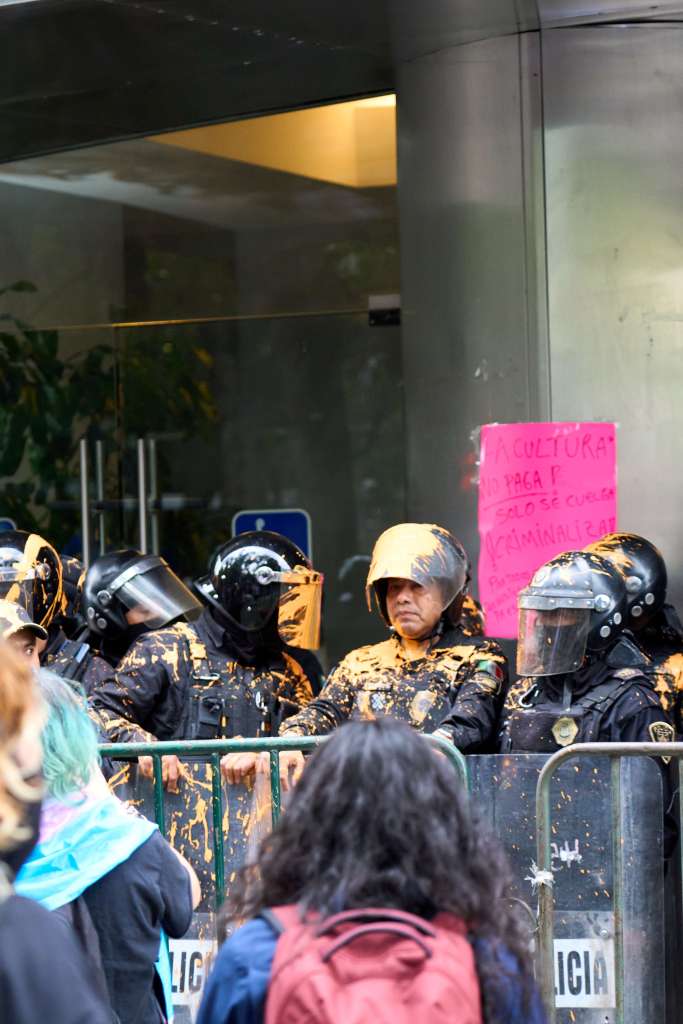
With the assault trial still ongoing, trans activists once again rallied to protest transfemicide at the Mexican judiciary on January 16th, 2025. The protests encapsulated years of rage against government inaction in the face of trans murder, and drew international attention for flashy images of graffiti-covered government buildings and trumped-up reports of violence and damage. Since then, the Mexican government has begun prosecuting Laura Glover for allegedly causing thousands of dollars of property damage. According to reports shared with me, Laura has received consistent death threats over her activism and her involvement with the protests, and has been threatened with major fines and prison time if she doesn’t accept a plea deal. Mariposas Negras have been fundraising to help fight her case, and have requested that I share the link to their GoFundMe with my audience.
I’ve included the GoFundMe link here, and it’ll also be at the bottom of the article:
This article has been delayed in no small part because this is still a developing situation, and an active source of ongoing struggle in Mexico City. Just this week, Mariposas Negras and others rallied to support Glover’s case on August 18th, protesting the charges levied by the government with an attempted sit-in disrupted by the police. The following photos were taken by Mariposas Negras members, shared with TFR in the interest of showing the trans joy and struggle at the heart of the protest in the face of ongoing criminalization and police brutality.
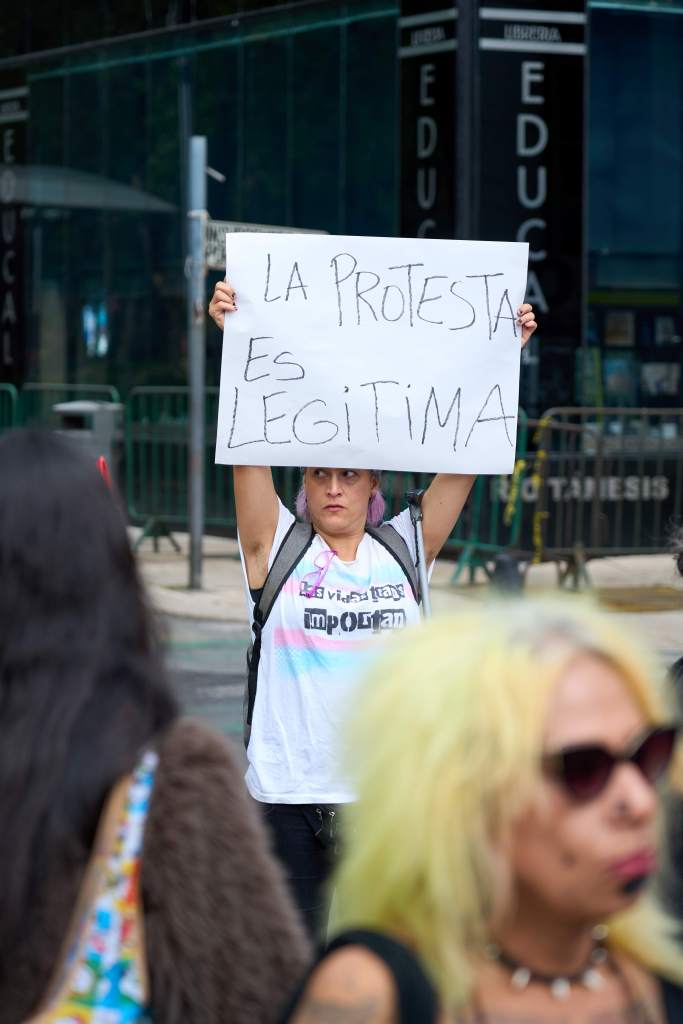


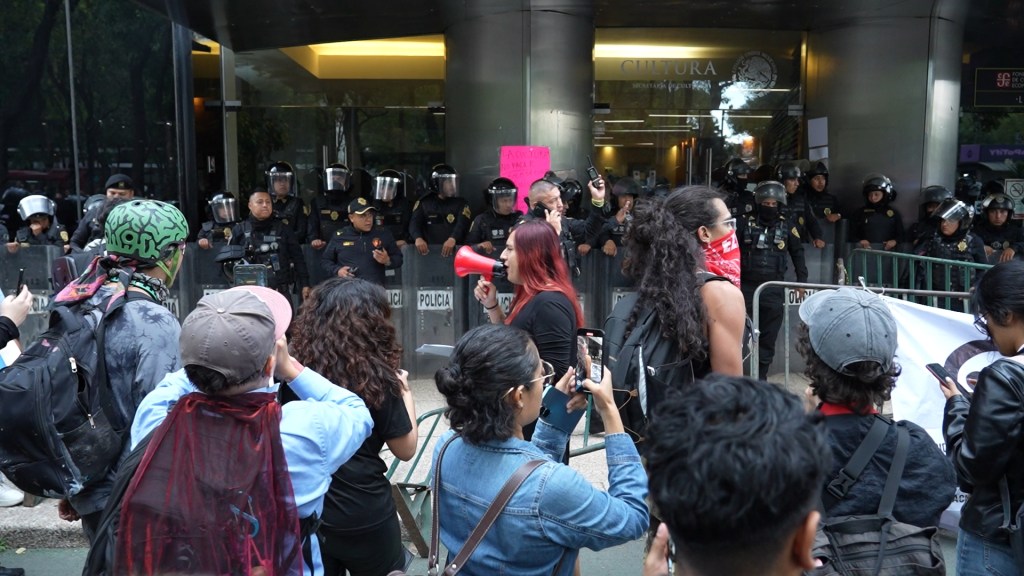
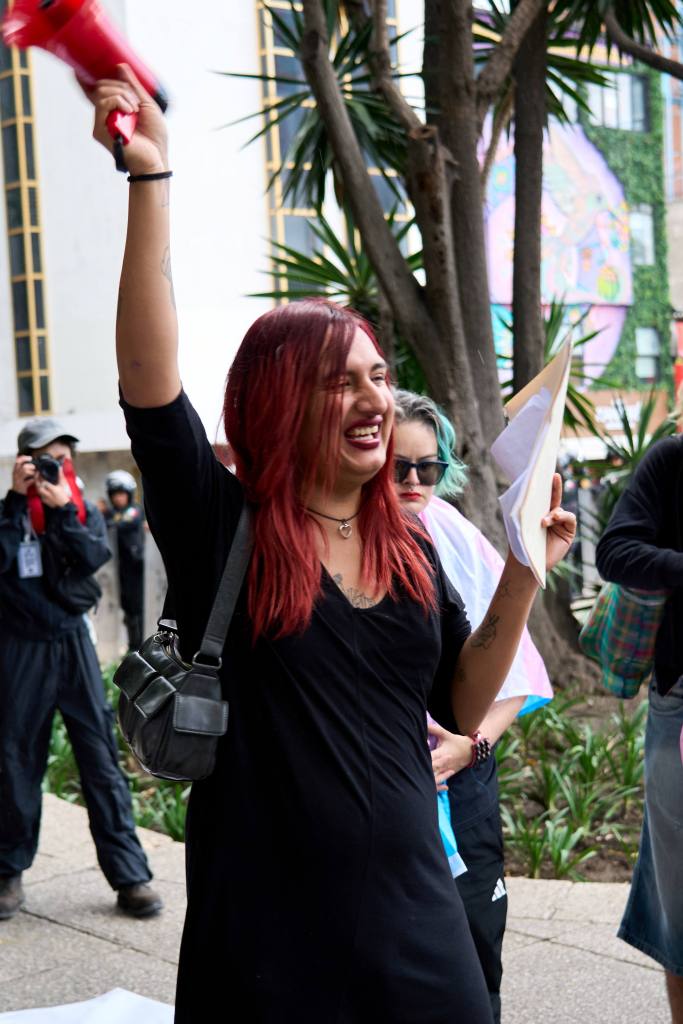
Figs 2-6. – Scenes from the August 18th protest against Laura Glover’s criminal charges. Photo cred. Mariposas Negras.
Now more than ever, it’s critical that we remember the ongoing global struggle for trans liberation, which goes far beyond the narrow confines of Britain and its English-speaking former colonies. Mariposas Negras is performing critical organizing work for Mexican trans women and the Latin trans sphere more broadly, and it’s been a real joy to learn more about their organizing and extend them my platform and community’s support.
The following interview was conducted by journalist Aquetzalli Vallejo with Laura Glover, and the translation has been done by Jamie Berrout. Apart from adding Vallejo and Glover’s names before their quotes, I have made no alterations to Jamie’s original text. Due to the evolving nature of the situation, we had to significantly scale back the original article concept, so I’ve done my best to synthesize recent events to fill in the gaps for my global readers who are likely entirely unfamiliar with the situation for trans rights in Mexico. Ultimately, though, the single best way you can support Mariposas Negras is by listening to their first-hand accounts. If you want to follow their work, you can find Mariposas Negras on Instagram, and I would highly recommend checking their work out!
If you would like to purchase the first Spanish-language issue of Trans y Fugas, you can do so by paying $10 USD at http://paypal.me/clanmariposasnegras with the note ‘Trans y Fugas PDF.’
Members of Mariposas Negras have also expressed interest in building global solidarity with English-language audiences, especially Latina trans women abroad. If that resonates with you, definitely make sure to keep up with their work.
My deepest gratitude to everyone involved with bringing this story to an English-language audience, and as always, a major shoutout to Jamie Berrout for continuing to do the quiet work of building literary bridges in places few others will go. I’ll turn it over to Laura, Aquetzalli, and Jamie now.

Trans y Fugas #1 ed. Laura Glover
Date: 2023
Publisher: Mariposas Negras
Genre: Zine, Periodical
Insta: https://www.instagram.com/clanmariposasnegras/
Purchase: See instructions above or at the end of the article.
Trans y Fugas, “Trans Archive and Trans Memory”
Laura Glover interviewed by Aquetzalli Vallejo; translation by Jamie Berrout
There are people who are rejected by society, people whom the society doesn’t want to see and whom it strives to make disappear, even from its history, as if they never existed, carrying on in an alternate and false reality. There lies the importance of projects like Trans y Fugas, an archive of trans memory labored over by Laura Glover, a compilation of stories that allows us to turn and see the whores that society has rejected, the dark-skinned women, the nuisances, the vulgar ones, the street women, the non-heteronormative. Thus, rescuing them from being forgotten.
Aquetzalli Vallejo: I’m interested in hearing a little about you, about your archive, the stories of these women that you’ve been putting together. How did the idea of creating an archive come about? What’s the objective? What are you looking to rescue/conserve through this archive?
Laura Glover: Let me tell you that I started Trans y Fugas when I was living in a city on the Gulf of Mexico. That’s where I ended up because I was homeless in the summer of 2021, which is something that happens to most trans girls, more than once, due to hatred. I wasn’t just kicked out of the neighborhood where I lived because I was considered immoral, but also the project I founded with Rojo Génesis, the Tianguis Disidente [Dissident Street Market], which at that time was an attempt to organize ourselves among non-heterosexuals from different spheres and statuses. Though, now it [the Market] has turned into an Okupa meme. After that rupture in my life as a trans girl, in which I’ve existed for several years, I understood then as now that actrivizmo [performative activism] desires and brings about the deaths of vulgar, reactive, street trans people, in a broad sense.
I was abandoned to my fate, without any contact, or any way of staying afloat. From then on I started to dedicate myself completely to prostitution in bars, adult theaters, parks, as is the custom in that world. Out of fury, for having been singled out and expelled, as has been the case all my life in fact, I read a lot of critical theory, that which was suggested by Leonor Silvestri. From her [online] classes I took onboard the lesson about “lines of flight,” from the book A Thousand Plateaus, a classic from Deleuze and Guattari. Through which I perform the curation of my archive which revolves around our numerous acts of survival, our crimes, the trans carceral memory. About the trans women that have always been around, those despised by society.
Towards October I started to get to know the girls from over there, we were very few in comparison to Mexico City. In a very different context, where a recalcitrant violence reigns, carried out by the government in collusion with the mass media and of course, the polizia. It was worse still to realize that we were suffering through terrible poverty, which resulted ultimately in making us sick and crazy. Providing “services” and assisting in travesti shows, I heard shocking stories from the mouths of the oldest women, like how in the past they used to throw inebriated clients into lakes full of caimans, about the times that we’d be imprisoned [clandestinely; without due process] for up to a month in the prosecutor’s office, the times we were run over very often and intentionally, when many girls woke up on a street corner wrapped in barbed wire. I uncovered these memories and an infinity of abilities, or “tricks”, as we call them, that we put into practice, because we were all tough bitches in that community, brave and daring, we knew how to work the streets and come out ahead. All this praxis, which was very much from the older trans women, infamous whores, as well as from their memories, was what I wanted to talk about as I began the Trans y Fugas archive, for the benefit of the younger generations of trans girls, who as far as I can see, find themselves very much weakened due to the rise of the political subject known as “the trans woman,” which is bringing forward our collective domestication and neutralization.
In the various moments of enormous risk that I went through as a prostitute, I reinforced my ideas about what we as trans women have: an incapacity to be grasped or assimilated. So it was that theory was nourished by lived experience, having clients who were military, police, bureaucrats, in finance, men from all backgrounds, from whom I obtained an unusual clarity with respect to how this world and its illusions work. Consequently, I couldn’t resist the desire to share these stories, and the political opinions I was developing, inaugurating the Instagram account @transyfugas on the 20th of November of 2021, in accordance with progressive tastes, the day of trans remembrance. I don’t have any other objective but to benefit the girls from my world, when transness becomes every day more polite and aspiring towards citizenship, whiteness, and other such things. I do it also because I can’t help but hate everything that surrounds me, as well as the social punishments imposed upon me, starting with precarization, criminalization, depressions, and dysphorias.
Vallejo: I know you work with other trans women, travestis, etc., can you tell me a little about the real and current panorama of working in the streets and everything that that implies as far as lack of safety, the health care system…
Glover: We work in the streets because every so often we get away with it… After a while, if one is strategic, she can enter into the competition of the erotic ads that are posted online. As long as we’ve “gotten our bodies done.” In my case, I learned that it’s better if a drunk client stumbles through the full price of a complete service during 15 minutes in his car, than to agree to meet with him, wait for him to arrive, and satisfy him for an hour—as well without the opportunity to get through one after the other as fast as possible. Unfortunately, every time one of us earns good money without turning into an alcoholic drug addict, there’s a long list of scumbags that want to take advantage. I think that the ones who have managed to prevail have been, historically, the ones best adapted to heterosexual life. With their formation, inheritances, family, “biological pass”, sexual preference for men, hetero sociability, etc. It seems like something similar happened with the generation of “Los mujercitos” who were the trans women that appeared in the yellow newspaper called Alarma in the 1970s, with a print run of millions of copies. I learned about it through the collective “Deuda histórica”, who are friends of mine. But according to everything I’ve experienced and researched from the streets, the conditions [we face] have worsened. To start, the meth and fentanyl crisis is at the top of the list. That’s how I’ve lost comrades who were an important part of my life. Without a doubt these drugs are worse than before because they’re decimating us; just like the infections that we tend to catch, the arrival of opportunistic diseases like tuberculosis, which runs rampant on the streets, in jail, and other confined spaces. As an example of this sanitary disaster, I have a friend who is about to lose her voice to a rare bacteria. The end result is this, that the new generation of trans girls isn’t engaging in sex work, that gays have taught men to be freeloaders, I mean in the sense of being kept [paid for], that addiction has become entrenched in all the prostitution spots in the city, except for Calzada de Tlalpan, which exposes us even more to becoming thieves, addicts, and broke. This past year alone a gun has been pointed at me three times. At the same time, the straights and gays that provide sexual services, and who charge three times as much as we do from the heights of heteroflexibility, are pushing us out. I’d say, at this time in Mexico City the majority of trans women who are not “producidas” [literally: produced; meaning privileged], that is without a “biological pass”—dark skinned, poor, without surgeries—are profiting more from robbery than from our sexual services, which in the end exposes us to being killed, as has always been the case. The days when any girl could quickly get surged up, make money, and even get famous through prostitution are done…
Of course, no matter how many special prosecutors there are attending to the LGBT population and women, how many segregated wings for trans people there are in the prisons, how many protocols for the provision of justice, I’ve noticed how we can still lose everything when a client accuses us of a crime. If indeed there is some variation to the brutality of the police, the prosecutors offices, and the judges depending on the area of the city—that’s just window dressing. The only option to avoid being processed in a situation like that is clear, to have an intervention on the part of a madam, the cartel, to drop thousands of pesos [hundreds of dollars], or to become a snitch. And so we have to be loud-spoken bitches to get rid of these charges, making the case that the clients were drunk or that it’s hypocrisy. We all need to learn to kill with our words and to heal the blows from this shitty Cis-stem, on our own.
Note: Unfortunately due to a poorly timed bout of COVID and the rapid escalation of the legal situation, the translation remains incomplete for now. I have received permission to print the last few paragraphs in the original Spanish, which can be read below the cut.
Lea la conclusión
Glover, cont.: Sobre el sistema de salud. Los médicos y enfermeros siguen negándose si quiera a tocarnos por qué piensan les vamos a pegar algo, como lo piensa cualquier cliente primerizo. Obvio nos mal generizan todo el tiempo, se ríen entre ellos cuando nos asisten. Nos graban, violan y acosan. Incluso tengo amigas que han querido matar, quitándoles el oxígeno, recetándoles mal o simplemente negándoles la atención. Sucedió hace poco con Paulette Cárdenas y Samantha Fritz, lobas de años.
Vallejo: Cómo tu trabajo en la prostitución te ayuda o te perjudica (sea cual sea la situación) en la creación de este archivo.
Glover: Escribo las vivencias de otras, que voy conociendo en la prostitución y mi labor activista, sí. Pero lo hago mientras tengo, algunas veces, los hechos de frente. Pues de todo sucede en un «punto» de prostitución. Caso contrario el de investigadores hetero cis, gays y feministas, que en este boom de estudios trans, andan por ahí de extractivistas, aunando prestigio y existencia social. En cambio, a chicas como yo, nos llevan las duras condiciones de estar siempre a un pie de la drogadicción, en un estado de salud y psique que desde que soy trans se ha arruinado, el maltrato social de siempre y sus secuelas. Estoy en el momento Aileen Wuornos, me fumé hace rato lo que me quedaba de tolerante… Esta conversión en mujer desalmada, imperdonable por lo que pienso y hago, que es usar todo lo que he aprendido de la calle, el «bufe», la «liosidad», «vale madrismo» etc, es lo que habla y llama la atención en Trans y Fugas. Lamento publicar tan pocas veces siendo que tengo un sin número de historias y conocimientos, míos y de mis amigas, pero no podía ser diferente, cada tanto me roban el celular, me peleo, me pasan cosas, como al grueso de nosotras. O sencillamente no puedo más. Seguro que Alessa, aquella chica fabulosa asesinada en 2016, que tenía programa de radio y canal de Youtube, quiso decir más en cuanto la hipocresía del progresismo, pero de nuevo, las condiciones no nos lo permiten. Nos lleva la censura o el exterminio de mujeres pobres.
Debo decir que el alcohol, la marihuana, el cristal, y otras sustancias me han dado aún mayor lucidez cuándo analizo las historias que me llegan. Sin duda está también esa impronta en el archivo, en cuanto las politizaciones que realizo bajo sus efectos. Los vínculos que hago entre situaciones personales que en realidad son políticas, y nos competen como colectivo. Sobre todo el lenguaje poético. Porque no escribo el archivo de forma expositiva sino medio novelesca, como hacía el Alarma. Con la diferencia de que los ridiculizados son tanto los progres como los fachos.
Vallejo: ¿Qué sigue? ¿Alguna publicación u otro tipo de proyecto consecuente?
Glover: Es probable esté haciendo un rescate de una memoria muy enterrada e indecible por lo que no sé hasta dónde se me permita seguir. Seguramente mis numerosos «haters» me tiren la cuenta, de ahí que quiero hacer una página web y un libro. Tal vez sólo eso por un rato, pues la idea es dejar de doctorado y pasaporte, cuya forma de vida no se puede distinguir de la heterosexualidad. Con el libro me tardaré otros años pues conjuntaré buenos ensayos de más de una escritora incómoda. Trato de pelear mi proyecto «La Tianguis», para que cualquier chica callejera pueda vender allí no sólo las «disidencias sexuales», clases medias. Cualquiera que quiera abonar a mi estabilidad para poder seguir escribiendo en @transyfugas, lo puede hacer vía paypal.me/apoyaenvida
Trans y Fugas entre otras cosas viene también a ser un recordatorio a esta parte de la sociedad que le da la espalda a esas realidades que nos hacen creer que nos son ajenas y quizá sí lo sean en primera instancia, pues nadie mejor que quien vive su historia para conocerla, sin embargo, siendo seres humanos tenemos la capacidad de escuchar, empatizar y dialogar, herramientas importantes para acercarnos a esas realidades, pues como bien dijo alguna vez el escritor Publio Terencio «nada de lo humano me es ajeno”.
Además de la importancia de acercarnos a estas realidades, también podemos permitirnos acompañar y apoyar de diversas maneras, y en el caso de Laura Glover, creadora de Trans y Fugas, la manera ya nos la comparte, haga- mos difusión a su proyecto y de estar en nuestras posibilidades hagamos donativos y recordémosla a ella y a todas las vidas que ella está salvando del olvido.
[Translator’s Note]: Two years ago, after being violently removed from the Cineteca Nacional for daring to use the women’s restroom at that renowned federal film institute, Laura Glover began a campaign of protests to demand justice. When Laura invited me to visit her at the Cineteca in June of 2025, I found that she and other members of Mariposas Negras had organized a new tianguis as a form of resistance—they had occupied a central area of the Cineteca to create a street market that would bring survival funds to trans women and other sexual minorities while also allowing them to reach the public with their demands for reparations and an end to anti-trans discrimination. Instead of listening, the Mexican government has decided to prosecute Laura for her protests. I was among the supporters who accompanied her to a meeting at the prosecutor’s office just last week, past murky hallways filled with cops who stood beside their handcuffed prisoners, at every turn a reminder of the fate that awaits Laura if the government gets its way. Their efforts to silence her do not exist in isolation; they’re part of a larger policy of exterminating undesirables in Mexico. The Cineteca to this day still discriminates against trans women. I myself was harassed by their staff in the restroom during my first visit. I walked out and realized I’ll never get to watch a film there. This, Laura said to me, is the state’s intention: for Mexican trans people to never feel comfortable on their own soil, to never write or make films that could be shown at the nation’s great cinema, to only ever imagine for ourselves a tragic end. Bloody, and out of the way.
This interview was published in the first issue of Trans y Fugas in 2023. You can purchase a Spanish-language PDF by sending $10 USD to paypal.me/clanmariposasnegras and adding “Trans y Fugas PDF” in the note.
A second issue of Trans y Fugas will be published as soon as Laura, its editor, and her contributing writers are free enough from state terror to write. You can support her legal defense and further publications by donating to their GoFundMe: https://www.gofundme.com/f/apoya-en-vida-trans
Laura Glover is a writer, editor, and activist based in Mexico City. She is the editor of Trans y Fugas, an archive of trans memory (@transyfugas on IG). As president of Mariposas Negras she carries out mutual aid and cultural activities as an everyday practice alongside trans women, sex workers, and other marginalized people.
Aquetzalli Vallejo is a journalist and activist. She wrote this interview as a cross-publication for Lagos Post, an independent media site focused on regional social issues.
Jamie Berrout is a translator and the author of Mutual Aid Printing and the Pandemic.

 The Transfeminine Review
Join the discussion! All comments are moderated. No bigotry, no slurs, no links, please be kind to each other.