
It’s been a quiet September on my end – I’ve been hard at work on my latest beginner’s guide to transfeminine literature, plus I’ve just started grad school, which means not a lot of free time for smaller projects! I did want to make sure I published something this month, though, so I’ve decided to share my April 21st review of Emily St. James’ excellent debut novel Woodworking, which is perhaps the best piece of literary-contemporary fiction I’ve read so far from the 2025 crop.
If you enjoyed this or my last two public reviews of Autumnal Conductor or Homunculus Tears, this is your regular reminder that you can access forty-one other reviews if you subscribe to my Patreon! I review every book I read now (part of the reason why the starter guide has taken so long), so if you want to hear me talk about everything from extreme horror to goofy TG/TF smut, definitely go and check out my work over there.
I appreciate your patience and support so much. Thanks all for sticking around.
This article was made possible by our wonderful Sponsors! If you want to contribute to essential transgender journalism like this, then please feel free to go support our work on Patreon – your contributions help us keep Academic Quality Scholarship 100% free and available to the general public.
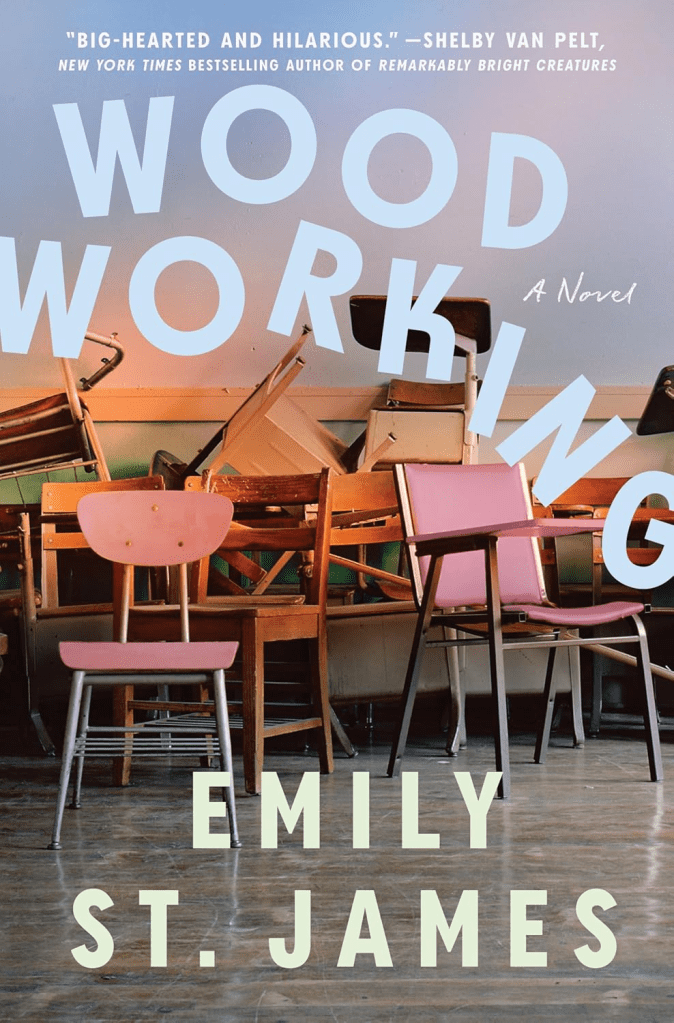
Woodworking by Emily St. James
Date: 3/4/25
Publisher: Crooked Media Reads
Genre: Literary Contemporary
Website: https://episodes.ghost.io/
Bluesky: @emilystjams.bsky.social
Purchase: Bookshop
So this book was technically supposed to be a review copy, but then I procrastinated on sending an email to Emily’s publisher for like, two months, and then I just bought it at Giovanni’s Room. So no disclosure needed >.>
Woodworking is a delight and a wonderful debut effort. Emily St. James comes into her new career chapter as a novelist with nearly two decades of experience in TV journalism and a broad name recognition that few debut trans authors will achieve. You can see it on the page – both her experience and that particular tradpub flavor of literary fiction often acquired by professional resources and industry acclaim. The characters are the highlight of the book, and they’re captured with a loving – and at times painful – realism that’s rare to find in transfeminine fiction.
There was a point at about the 2/3rds mark of the book where I thought the story structure in particular had strayed a bit too far into the bland formula of the MFA style for my taste. And I do still think that at its weakest moments, Woodworking falls into some of the more benign pitfalls of 2020s mass-market literary fiction.
But my God, did that plot twist hit me like a freight train.
I AM ABOUT TO SPOIL THE PRIMARY PLOT TWIST OF THIS BOOK. IF YOU DO NOT WANT TO BE SPOILED, CLICK AWAY NOW.
Woodworking follows three trans women, each of whom have a different relationship to the idea of ‘woodworking,’ i.e. stealthing, or masking transness to pass as cis. We have Erica, who’s still in the closet as a man, and Brooke, who’s post-op and in closet all the same. Then there’s Abigail, a seventeen-year-old trans girl who’s out, and hates it, and spends the whole book grappling with her desire to run away and disappear.
Emily’s prose is masterfully mimetic and deeply grounded in a staunch commitment to realism, even when that reality is awkward or uncomfortable. At times, that approach evoked varying degrees of discomfort and dislike while I was reading; but I think that’s to her credit. Even when Erica is depicted at her most vacant and dissociated, even when Abigail is at her most melodramatic, even when Brooke, and South Dakota more broadly, is at her nastiest, the verisimilitude of these women as people who could have existed in the world in 2016 never falters. And given that, I found even those negative reactions to be well-calculated and intentional, and I appreciate them in retrospect.
The undeniable best part of this book is that knife in a gut – Brooke, that white conservative lady who’s married to the transphobe, is trans herself. Her husband payed to hush up her surgery, and now he’s peddling anti-trans law. And I have… complicated feelings about that.
On one hand, I find the real world idea that ‘transphobes are secretly trans’ to be destructive and false, and I do question this book a little for toying with it. But at the same time, the closet conservative trans woman is a very real phenomenon. I think that what I found so discomforting about that move is that it’s dated, which makes sense – Brooke transitioned in an earlier generation. She’s more Susan’s Place or Virginia Prince than anything. She’s been in the closet post-transition for decades. And it’s tough to grapple with that as a 23-year-old born in the 21st Century, not too dissimilarly from how Abigail struggles with it. Tough to grapple with how rapidly the situation for trans rights has changed, and how quickly those gains can be stripped away.
I will also say that my experience was somewhat colored by St. James’ endnote, where she notes that these characters were based on her experience with people in real life.
At the end of the day, my primary issue with this book still comes down to it feeling formulaic at times, particularly with the emotional beats. The quotidian high school semester novel is a tired litfic trope in 2025, especially in this case when it never quite feels like it has a teenage audience in mind. Abigail is a plucky and likeable character with a lot of heart, but she really does read like more of a foil for the two middle-aged trans women in the book – more James than Maria, to place it in the Nevada archetype. Woodworking struggles on that metric in comparison to other recent transfeminine semester novels, like Victoria Zeller’s YA hit One of the Boys (2025) or the metamodern tour de force of Isabel Pabán Freed’s School (2023).
While the plot twist did a lot to ease that up, there were definitely moments where the plotting felt a bit robotic and rote. Brooke’s big reveal was a relief in no small part because the Abigail and Erica dynamic had begun to feel stale and predictable, and while I really loved what unfolded from there, it does somewhat feel like it was a new story laid on top of the old one, with the old plot still chugging along in the background where we didn’t have to pay as much attention to it.
I got jumpscared when I looked up the publisher and saw that it was on Jon Favreau’s political imprint, of all the improbable places. Zando is a weird company – it’s not owned by the Big Five, but it’s also undeniably a traditional outlet that runs a lot of big name authors. Make of that what you will.
Woodworking has a big heart, and an incredibly important point to make about the oversexualization of everything in our modern culture. We should be able to have cross-generational friendships, trans people especially should be able to form non-traditional kinship structures without getting wrongfully accused of being a predator. Emily’s prose isn’t afraid to unflinchingly show a friendship between a teen and an adult that exists in the face of that conservative culture, with all the struggles and challenges such bonds often face. It’s the most important part of the book, and I’m very glad this novel had a mass-market release to get that message out in the world.
All in all, this is an incredibly solid debut novel, and I’m excited to see what Emily writes next.
⭐ 8/10

 The Transfeminine Review
Join the discussion! All comments are moderated. No bigotry, no slurs, no links, please be kind to each other.