Project 2025 wants to criminalize trans literature. Here’s a game plan for keeping our stories alive.
✨ Call to Action ✨
Hi! I’m so glad that you found this article and cared enough about this issue to click on it. I’m going to warn you right now – this article is 24,000 words long, and if that length is daunting to you, please pick and choose the parts you’re interested in. There is a LOT of advice in here for a lot of different people, including a long historical and legal section, some very depressing insight about fascism, and a step-by-step guide for every relevant interest group about how they can help preserve trans literature. It’s a lot! But don’t panic or click away – we need all the help we can get right now, and I’ve summed it all up in a tidy little list for you here. There’s a table of contents right below this that you can use to navigate.
Here is a quick list of the key points from this article:
- Republicans will likely try to criminalize our ability to discuss and distribute trans literature using the internet, and we don’t have robust networks in place to keep our communities organized or to preserve our access to trans literature if that happens.
- Centralized institutions are more vulnerable to fascist state violence, and you can’t rely on non-profits, social media sites, online stores, or even websites like this one to retain your access to trans literature in a worst-case scenario.
- Almost every point in the action plan found in the second half of the article can be distilled into two key bullet points:
- Create a Microlibrary: Start a personal offline collection of trans literature. Save as many pieces of trans media as you possibly can, including the free stuff. Do not keep it in the Cloud unless you’re using a foreign server and provider. Make copies. Practice secure digital hygeine and encrypt your data. Pool your resources with friends. The more places people keep and hide their books, the more likely it is that at least one copy will survive even a worst case scenario.
- Organize Locally: Find your local community before things get bad. Develop offline strategies to distribute and market trans literature. Make your books available to trans people in your city, county, or neighborhood. Support local authors, or make yourself available to local readers.
- Every person can take these two actions American or not, and the more people who take them, the more effective they will be. Fascism is a global threat. You can start today.
- It’s better to be prepared than sorry. Analog library building and local organizing will be beneficial no matter what a Republican administration does, so you should start now. We don’t have the luxury of time.
WHAT TO DO RIGHT NOW: Before you do anything else, I would highly encourage that you download a PDF of this article so that you will be able to refer back to it if this website is forced to shut down under a Trump Administration. I would also highly recommend that you download a PDF of Essays Against Publishing by Jamie Berrout, which contains more crucial information. Let these be the first two texts in your microlibrary. You can download both by clicking these buttons:
[Disclaimer] None of this is legal advice. Breaking the law is illegal, and doing illegal things is bad – you should definitely not break the law because of anything I have said in this essay, which would be bad because it is illegal.
[Tech Disclaimer] There are a ton of trans girls who know the intricacies of how technology functions, and I am not one of them. Please consult with someone who actually understands tech and digital security, not me.
- ✨ Call to Action ✨
- Introduction
- 😡 What Republicans Want
- 📜 The Legal and Historical Precedent
- 📖 Three D’s of Resisting Censorship: Distribution, Duplication, and Documentation
- ✊ A Practical Guide to Resisting Censorship
- 🏛️ Microlibraries: Your Community’s Lifeline Under a Fascist Regime
- 🇺🇸 Practical Steps for American Trans Readers
- ✍️ Practical Steps for American Trans Authors
- 📰 Practical Steps for American Publishers, Editors, Agents, and Industry Insiders
- 🧑🦳 Practical Steps for American Librarians
- 🎓 Practical Steps for American Academics
- Build a Trans Archive for Your Institution
- Curate Your Professorial Library with Trans Books
- Put Trans Books on Your Syllabus
- Organize to Protect Trans Professors and Students
- Protest for the Immediate Repeal of “Expressive Activity” Policies
- Decrease Gatekeeping in Academic Publishing
- Get Involved in Your Local Community
- Protect Your Job
- 💵 Practical Steps for American Booksellers
- ♀️ Practical Steps for Cisgender Americans ♂️
- 🌍 Practical Steps for Non-Americans
- Know Your History
- Establish Secure Communication with Your American Friends
- Organize Locally
- Help Archive and Document Trans Literature
- Promote Trans Authors to Your Local Market
- Decrease Your Dependence Upon American Platforms
- Don’t Let This Happen at Home
- Help Trans Authors Move Their Digital Footprint Overseas
- Practice Solidarity, Now and Always
- Conclusion
Introduction
This is not the article I wanted to be writing this week.
As many of you know, I was actively engaged in the Democratic campaign this election cycle, working on the ground to turn out the youth vote in Philadelphia. It was a motivating experience, and I really thought we had a chance to win. Well – spoiler alert, we lost.
Bad.
Kamala Harris lost Pennsylvania, obviously. But Pennsylvania also lost Bob Casey, our incumbent Democratic Senator, and two of our incumbent House seats, Susan Wild and Matt Cartwright. Every statewide down-ballot race went for the Republicans (I’m particularly upset that Malcolm Kenyatta lost his race for Auditor General), which means that aside from our Democratic governor, Josh Shapiro, and a narrow State House margin, the Democratic Party in PA completely wiped this election cycle.
While the Democratic humiliation in Pennsylvania may be personal to me, it mirrors a broader result across the United States in the 2024 election. At every level of the ballot, MAGA Republicans barnstormed the polls, setting up a 2025 where Republican legislators control the White House, the Senate, the Supreme Court, and probably also the House. This comes in an election cycle where an astonishing $200 million dollars were spent on anti-trans advertising across the country, and where many Republican legislators have made the criminalization and persecution of trans life in America a core tenet of their campaign and platform. We have been scapegoated, wedged, fearmongered, and caricatured across national television for months, despite significant evidence that this is completely ineffective with the majority of the electorate, and now the American people have overwhelmingly voted to give the Republican Party and Donald Trump’s MAGA movement fiat to do whatever they want with the country for the next two years, at least.
This is a dark week for transgender people in the United States. But we do not have the luxury of despair right now – this is a time for action and organizing, a time for community building and prudence. It now falls upon us to anticipate and mitigate the potentially disastrous outcome of this election upon our community. We may have suffered an egregious defeat, but we won’t take it lying down.
If MAGA wants to come for our rights and liberties, they’re gonna have to pry them from us tooth and claw.
Ergo, this essay is not a pontification upon why or how the Democrats lost the election. I have zero interest in adding to the babble of pundits and talking heads trying to narrativize the results. They don’t matter – don’t waste your time on finger-pointing or what-ifs. What’s done is done.
What I want to present to you now is a survival guide for the next four years, as seen through the lens of trans literature and trans publishing. Publishing is only a small part of the broader apparatus of transphobia furthered by the alt-right leaders of the MAGA movement. In turn, transphobia is only a small fragment of the white Christofascist nationalism that has now gripped this country.
And yet, literary transness finds itself on the front lines of protecting trans rights and trans speech around the country, and if our community buckles without any semblance of resistance, then American transgender people at-large may have a very bleak decade indeed. Even under a trans-friendly Democratic presidency, the last four years have seen an enormous spate of legislation and civil action aimed at censoring and stigmatizing trans publishing. Book bans have become normalized in dozens of states. We’re been under the barrel of the gun for years, and make no mistake, things will get worse before they get better.
But there is still hope. Americans, you have a constitutional right to free speech in this country. A tiny minority of pro-censorship extremists are responsible for 90% of book bans – we outnumber them, and the majority of the country simply does not care about trans issues one way or the other. This is not an unwinnable fight, and we have allies – there is an entire network of queer law professionals, state-level governments, civil rights orgs, and free-speech watchdogs who can and will go to bat for us if we demand it of them. We have market power as consumers of trans literature, and we have publishing power as an extraordinarily talented cadre of authors, novelists, theorists, academics, and community organizers who have the tools to sway the public on this issue.
Do not freely give them your silence. Do not muzzle yourself. Do not comply in advance.
Nevertheless, while I remain optimistic that much of the worst MAGA bark about criminalizing trans speech and expression will crumble on contact with organized social resistance, we cannot and must not rule out the possibility that these efforts will not fail: that trans speech will be criminalized, and that trans literature may be not only suppressed, but actively isolated, censored, expunged, and destroyed. It has happened before, and it can and will happen again.
So – how should we respond to it?
The goal of this article is to lay out an extensive picture of what every level of a hostile assault of trans literary production might look like in the American public sphere, and how everyone (including cis allies) will need to respond and adapt to it should we wish to preserve our culture and ideas for future generations. I will be laying out actionable steps that you will be able to take at every step of this process. While later parts of this article will preemptively cover several varying degrees of nightmare scenarios, the most important section will be about what you can do today, in this lame-duck interregnum between Trump’s election and Biden’s departure from office. We have sixty-eight days until Trump returns back to power, and that’s enough time to execute a tremendous amount of organizing activity, community building, preemptive action, public advocacy, and contingency measures. We have an urgent need to find and mobilize as many allies as we can, and though we should always hold faith that our work will find a way, it would be irresponsible as a community not to prepare for the worst.
This article is divided into several sections. In the first two sections, I will lay out the problem and stakes. The first section will cover what Republicans have been proposing vis-a-vis trans literature so that we all have a common understanding of the stakes and gravity of Project 2025 upon our community. The second section will cover the history of obscenity law in the United States, aiming to fill in the blanks of the parts of the Brief History of Trans Literature series of articles on this blog that I have yet to publish. I will articulate why this is such a dangerous moment for trans literature, and why we need to take immediate action.
Moving to the meat of the essay, I will lay out an action plan for multiple stages of enforced legal discrimination and censorship. While I do not expect them all to be necessary, it’s important to include even the worst case scenario in our planning.
Stage One: National ‘Don’t Say Woke’ Action – This is not a hypothetical – Florida has a DO NOT TRAVEL advisory on most trans risk maps, and dozens of other states have passed extremely restrictive laws and anti-trans book bans over the past few years. Think Floridian law about trans books in schools and libraries on a national scale. In this stage, trans publishing will largely remain the domain of culture warriors and school boards, merely empowered by a friendly federal government and judiciary. Access to trans literature may be severely limited in most Republican-controlled areas. While trans minors and their families will be disproportionately affected, the industry of trans publishing will be largely untouched, and adult trans people will be able to continue to write, publish, and make an income off their writing for the foreseeable future.
Stage Two: Trans Publishing Loses the Internet – Over the past year, bad internet bills like KOSA (Kids Online Safety Act) have shown that they can garner bipartisan support. This is likely to be the first sweeping legal censorship law that may heavily impact trans publishing, and the trans internet more broadly. While this theoretical bill will likely be geared toward protecting minors from harmful content on the internet, the definition of that “harmful content” will almost certainly include trans stories and publications. While it is impossible to know what shape that might take, it is not unlikely that the entire trans internet might be forced to go dark, including news sites, advocacy sites, American author websites, archival sites like Archives of Our Own and Scribblehub, and yes, this includes The Transfeminine Review. Sites with large bodies of trans fiction may purge en-masse any explicit content or in a darker scenario, all trans content altogether. Internet history has shown that these purges can be sweeping and completely unwarned.
Note: My current expectation, if I had to give a personal forecast for what I think will happen over the next few years, is that Republicans will succeed in passing some sort of KOSA-esque bill that will place stringent anti-NSFW restrictions on the trans internet to “protect minors,” but will fall short of a complete purge, placing the United States somewhere in the middle of Stage Two. Anything beyond that point is more extreme than what I personally believe will come to pass.
Stage Three: Project 2025 Becomes National Law – Let’s say that Republican legislators are successful, even if only temporarily, at passing the full scope of what’s laid out in the Heritage Foundation’s plan for Project 2025. This is where things would start to get really dangerous for trans people in publishing. Again, I don’t believe this will happen on the national scale, but we need to acknowledge it: Project 2025 proposes that people who produce or disseminate trans or genderqueer literary materials are “grooming” children, and that they should be treated legally as sex criminals and added to the sex offender registry. Under a total victory for Project 2025, being transgender will be considered “pornographic,” and trans literature will be treated on the whole as porn, no matter its nature or content. If Project 2025 comes into full fruition, trans authors and publishers will not be the only people liable for potential sex crimes. Librarians, academics, critics, and anyone else who handles or distributes the literature could also be held liable. Obviously, a law like this would be wildly unconstitutional, and would also likely be used as a blunt force cudgel against minorities in publishing of all stripes, and likely feminist publishing too. If trans literature goes down, don’t think for a second that other marginalized literatures won’t follow in its wake.
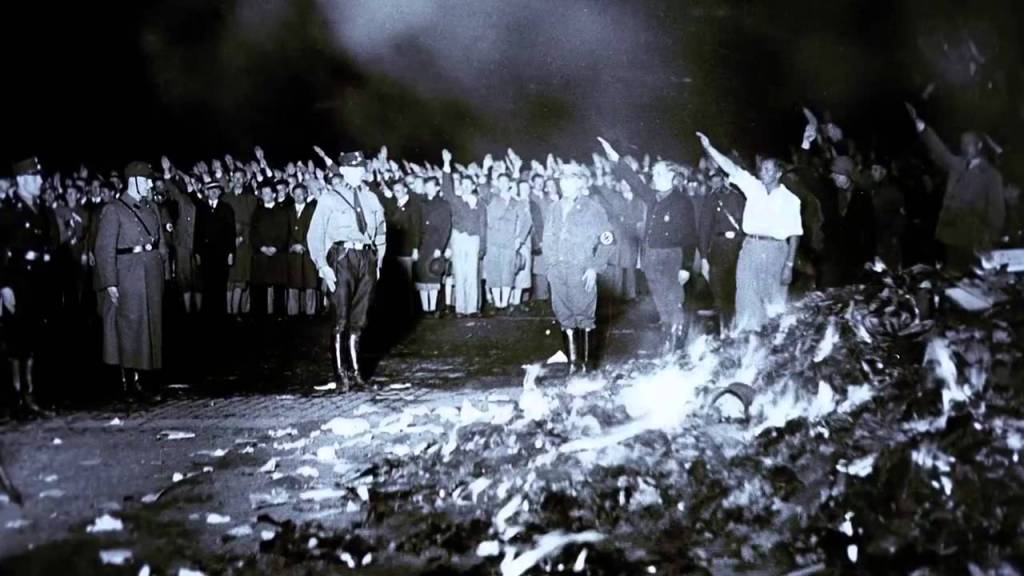
Stage Four: All-Out Nazism – Book burnings. Search, seizure, and destruction of all suspected “pornographic” materials, and the arrest and persecution of their owners. A complete ban and purge on trans themes in publishing. If we get to this point, we have much bigger problems than the destruction of trans fiction.
Yeah.
That’s where we’re at.
All of this is incredibly scary, especially when it’s all laid bare like this. But I don’t think beating around the bush or minimizing the potential scope of the dangers is productive at this stage. We need to know what we’re up against, we need to know what we’re fighting for. To put it extremely bluntly, if Project 2025 gets 100% of its most ambitious goals regarding trans people in the public sphere, it would likely mean the complete collapse of the American trans publishing industry.
This is a crisis moment for trans people in publishing, and failing to respond well could have a severe negative impact on trans rights far beyond our tiny industry. If there’s anything that the last year and a half have taught me, it’s that trans people need trans books. We need to see our stories, we need to hear from our elders, we need roadmaps to survival, we need comfort food, we need safety, we need hope, we need escape. This isn’t just a question of published fiction – eggfic, fanfiction, internet transformation fantasy are all some of the most likely literatures to be lost under a severe criminalization of trans literature. There is so much vulnerable literature out there whose mere existence can be enough to save some suicidal kid’s life. Even in a worst case scenario, books like Nevada that have garnered wide international reputation and success are less likely to become lost literature and survive for future generations. It’s the self-published fiction, the online fiction, the underground fiction that won’t.
At every stage of this action plan, I will be offering you concrete action steps that you can take now to mitigate the risks and harms of the growing threat of fascism in the United States. While American trans authors and readers will be the most urgent audience of this article, I will be advising not just trans Americans but also our allies, both trans people around the globe and cis people at home. Please consider sending this article to as many trans people in the US as possible, along with any cis queers or allies who might be willing and able to aide in this fight. This is a moment for solidarity and collective organizing. We can afford nothing less.
😡 What Republicans Want
Look at America under the ruling and cultural elite today: Inflation is ravaging family budgets, drug overdose deaths continue to escalate, and children suffer the toxic normalization of transgenderism with drag queens and pornography invading their school libraries.1
Under the strictures of Project 2025, trans literature is equated with pornography, and school libraries are used as the fearmongering tactic to paint the entire industry as “marketed toward children,” which is manifestly false. The majority of trans books are neither marketed toward nor read by children. It is adult fiction for adults, and it is severely difficult for minors to access. Nevertheless, this is the straw man used to justify everything else.
Pornography, manifested today in the omnipresent propagation of transgender ideology and sexualization of children, for instance, is not a political Gordian knot inextricably binding up disparate claims about free speech, property rights, sexual liberation, and child welfare. It has no claim to First Amendment protection. Its purveyors are child predators and misogynistic exploiters of women. Their product is as addictive as any illicit drug and as psychologically destructive as any crime. Pornography should be outlawed. The people who produce and distribute it should be imprisoned. Educators and public librarians who purvey it should be classed as registered sex offenders. And telecommunications and technology firms that facilitate its spread should be shuttered.2
It must be emphasized that all of this happens in the first five pages of Project 2025. We cannot afford to cut teeth about what the Heritage Foundation is suggesting in this passage. Under a total victory for Project 2025, everyone involved in the production, distribution, distribution, and discussion of trans literature would be at significant risk of incarceration. This radical gutting of the First Amendment would completely remove any protections for genderqueer speech, essentially creating a “separate but equal” paradigm where the Bill of Rights does not apply to the over 300,000 transgender people living in the United States.
One of the primary battlegrounds which Project 2025 wants to pursue to criminalize trans speech is on the internet. This is why I believe it is a distinct possibility, if not a probable one, that trans publishing in America will lose the internet as a mode of distribution and marketing. The key statute to understand here is Section 230 of the Communications Act of 1934 (enacted in the Telecommunications Act of 1996) which essentially states that your platform won’t be held liable if bad actors post illegal material on it without your knowledge, or if you accidentally see illegal materials on social media or something similar:
No provider or user of an interactive computer service shall be treated as the publisher or speaker of any information provided by another information content provider.3
Republicans want to completely gut this provision, and essentially render large chunks of the American populace legally liable for interacting with or distributing transgender content on the internet:
The FCC should work with Congress on more fundamental Section 230 reforms that go beyond interpreting its current terms. Congress should do so by ensuring that Internet companies no longer have carte blanche to censor protected speech while maintaining their Section 230 protections. As part of those reforms, the FCC should work with Congress to ensure that anti-discrimination provisions are applied to Big Tech—including “back-end” companies that provide hosting services and DDoS protection. Reforms that prohibit discrimination against core political viewpoints are one way to do this and would track the approach taken in a social media law passed in Texas, which was upheld on appeal in late 2022 by the U.S. Court of Appeals for the Fifth Circuit.
In all of this, Congress can make certain points clear. It could focus legislation on dominant, general-use platforms rather than specialized ones. This could include excluding comment sections in online publications, specialized message boards, or communities within larger platforms that self-moderate. Similarly, Congress could legislate in a way that does not require any platform to host illegal content; child pornography; terrorist speech; and indecent, profane, or similar categories of speech that Congress has previously carved out.4
Under this paradigm, “censored” transphobic speech will become the primary mode of protected speech on the internet, and “pornographic” trans publications will be classified as illegal and expunged from all major American platforms in order to protect their parent companies from liability. This could mean, but does not fully encompass, the deletion of all trans content on major American-owned social media platforms, the erasure of all trans forums and subreddits, the complete removal of all trans content from online fiction sites like Archives of our Own, the removal of all accurate information about trans people from Wikipedia and other internet resources, the deletion of a broad swathe of transgender content from the internet, a complete cleansing of all transgender keywords and search terms from Google and other search engine algorithms, and a wide variety of other discriminatory measures.
This affects more than just Americans. The majority of major internet conglomerates are American companies. Consider the ramifications if Google was legally required to wipe trans content from all of its search engines. Consider the ramifications if Amazon was required to purge all transgender content from its Kindle store. Tens if not hundreds of thousands of books could be removed from the platform without warning, many of which are published nowhere else. Major social media platforms are by-and-large American, and we all know that the Republicans have been frothing at the mouth to ban China-based TikTok.
We’ve all seen how Elon Musk has co-opted and destroyed Twitter, turning it from a nexus of trans community to a megaphone for anti-trans organizing. The most likely severe impacts of Project 2025 upon the trans community will come from the Musk approach to dragging social media down the alt-right pipeline getting applied en-masse to the entire internet. If this happens, trans people may be excluded from the public forum entirely.
This is grim. But there is good news here too. Even at his most transphobic, Elon Musk has not succeeded in driving trans people off of Twitter entirely – there is good reason to believe that even if the most extreme version of this policy passes, its implementation will be incompetent and scattershot at best, and that the vast majority of trans people will be able to continue using the internet unimpeded. To police the entire internet, the Republican Party would need to massively expand the scope and powers of federal regulatory agencies, something which their own politics directly oppose. In essence, this policy approach relies on the monopolistic power of big companies and their sycophantic billionaire leaders to do the majority of the work on the government’s behalf. The more that trans publishing can distance and detach itself from an overreliance on corporate platforms like Amazon, Twitter, and Big Five publishers, the more likely it is that our industry will be able to continue business largely as usual, albeit with a reduced scope and marketing potential.
Moreover, as drastic as all of this sounds, it will be significantly harder for Project 2025 to criminalize trans publishing off of the internet than on it. Even now, most “book bans” rely upon the power of state institutions to be the controlling locus for all access to public literature. Governors like Ron Desantis have been able to control public schools, universities, and libraries, but even Florida hasn’t been able to stop private citizens from ordering trans books directly to their homes.
Project 2025’s mandate to censorship relies upon the basic premise that the primary mode of distribution for trans publishing occurs through the state apparatus and its capitalistic satellites, and that by restricting trans access to those state channels, trans speech can be suppressed entirely. Ergo, many of the most severe discriminations proposed by Project 2025 are aimed at the distribution of trans literature, i.e., attempting to keep private citizens from acquiring trans literature, even if they cannot necessarily criminalize them from having it in the present moment. Project 2025 correctly identifies that most trans people in the United States only have access to trans literature through the internet. Therefore, Republican legislators do not need (in concept) to directly criminalize the literature in and of itself in order to destroy trans publishing; if they can regulate Amazon and social media platforms, then remove all public repositories of trans literature that might have the books otherwise, they believe that they can completely suffocate trans publishing in its tracks.
It is extremely unlikely that Republicans could criminalize the possession of trans literature in between now and the midterm elections in 2026. But we may lose the ability to sell, buy, find, or acquire said literature sooner than we think.
Furthermore, I must caution my readers here – they will not come after the readers of trans literature first. They will come after the authors, the publishers, the marketers, the booksellers, the critics, and the distributors. Historical precedent (which we’ll discuss in the next section) has shown that the American government can and will pursue criminal proceedings against trans publishers and authors, and that while we have a distinct chance of winning the battle for our First Amendment rights in the courts, there is also legal justification for the idea that trans speech is not protected under the First Amendment.
Should fascism prevail in the United States over the course of the next decade, however, it is not unreasonable to think that the Conservative agenda for trans literature will shift its view from criminalizing distribution to criminalizing possession. If this happens – and I do not believe it will happen – then we still have meaningful ways to organize and resist against such attempts to erase our work, culture, and ideas. I will discuss those strategies in the latter sections of this article.
📜 The Legal and Historical Precedent
As those who have already been following my work know, I have been engaged in writing a series of articles called A Brief History of Transfeminine Literature aimed at tracing the origins of transfeminine themes and genres, as well as the material oppressions and discriminations which shaped them. Given the current circumstances, it is now my number one priority for this website to finish as much of that series as possible before Trump’s inauguration – right now we need to remember our history, especially when it stands at risk of repeating itself.
If you’re able, I would highly recommend reading my Brief History series before the rest of this article: the first essay is The Moral Origins of Obscenity. If you’ve already read it or don’t have access to it for whatever reason, I’ll give you a brief summary of the most important points here so we’re all working off of the same page once we start talking about solutions.
📵 Anti-Trans Obscenity Law
Obscenity law and Evangelical Christianity have been closely bound together since their inception. The emergence of “obscenity” as a distinct category began in the late 1600s with what was known as the “anti-vice” movement, which sought to remedy the epidemic of “poor morals” in the public sphere through social reform. Many of the early obscenity laws in the 1700s were specifically aimed at suppressing revolt and sedition, namely in the wake of the American, French, and Haitian revolutions and their various aftershocks. The United Kingdom pioneered “obscenity” in response to Yankee and Jacobin rebellious sentiments. One early obscenity law, the Vagrancy Act of 1824, was aimed at controlling and policing vulgarity and sexual impropriety in the wake of the Napoleonic Wars, but these laws were by-and-large left to society to control and police rather than the state. The Vagrancy Act aimed to combat public expressions of sexual impropriety – it was not made illegal to possess obscene prints, but it was made illegal to flaunt them in the street, or to indecently expose them to a lady on the side of the road.
Though the results of the Election of 2024 may be shocking to many trans people, there is a significant historical precedent for it in American electoral politics during the 1820s and 1830s. In 1824, Andrew Jackson won a plurality but not a majority of the votes from the Electoral College in his race against John Quincy Adams, leading to a process in American politics called a “contingent election” where control of the White House is thrown to the House. The House then proceeded to elect Adams instead of Jackson, a decision known as the “Corrupt Bargain” which has haunted American politics ever since. Andrew Jackson would proceed to come roaring back to overwhelmingly win two Presidential terms on his populist platform, and his magnitude would haunt American politics all the way up until the Civil War. The coalition opposing the Jacksonian Democrats would completely crumble in 1832, and it would lead to the creation of the American Whig Party, who would be the primary party opposing the Democrats until the precipice of the Civil War.
Donald Trump is, of course, a notorious Jackson fanboy (Jackson’s portrait hung in the Oval Office for his entire first term), and in many ways, the “stolen election” lies of 2020 manufactured a “corrupt bargain” for the 21st Century in the minds of many Americans, not just MAGA Republicans. If the aftermath of the Election of 1824 has anything to teach us, it’s that the consequences of this mindset can be absolutely catastrophic for the United States, as it literally led the country into civil war the first time around. Over the course of the 1800s, electoral politics would become more and more polarized until the consequences for a political loss were severe enough that half the nation seceded. Don’t think for a second that the Lost Causers have forgotten any of this, even if the Democrats have.
The issue at play here was slavery, not trans rights, but the consequences of the reaction of the Whigs to move rightward was a disaster for them and their allies. The Whigs committed the ultimate error of falling into a cycle of intense appeasement for minor political gains which would quickly be erased in the next election cycle. They completely failed to advocate for abolition, had absolutely zero meaningful political strength on the national level, and collapsed within twenty years of their inception. While this did ultimately lead to the creation of the pro-abolition Republican Party, the damage done by almost 30 years of uncontested Democratic slaveholder control upon this country still hasn’t been undone two centuries later.
To any Democratic officials or thinkers who may be reading this article: this is the moment to close ranks and double down on our commitment to social justice and progressive politics. If you don’t, history shows that the Democratic Party’s future may be numbered in years, not centuries.
It was during the tailing years of the Jackson Administration that the legal groundwork for the criminalization of trans literature began to be laid. In 1835, the American Anti-Slavery Society began to send “inflammatory” pamphlets in the mail advocating for the end of slavery, sparking a moral panic among Jacksonian Democrats and a flurry of legislation criminalizing abolitionist speech across the South. But Democrats were deeply skeptical of passing national censorship laws to restrict the freedom of speech, because they knew that under a Whig administration they could be used against them. Fortunately, the Whigs did all of that work for them! Whig politicians would propose a “Gag Rule,” which forbade the debate or discussion of any abolitionist laws in Congress as a way to appease Southern Evangelical voters (the Whig constituency was predominantly Evangelical). Then, in 1842, the Whig Party would pass the extremely unpopular “Black Tariff” of 1842, which among its many provisions included the first federal obscenity statute in the United States.
Donald Trump ran on a platform of extreme protectionist tariffs, and the Tariff Act of 1842 was one of the most extreme protectionist tariffs in American history. What it also suggests, though, is that tariffs and protectionism can be used as justification for the criminalization of “obscene” literature and prints. The Act forbade “the importation of all indecent and obscene prints, paintings, lithographs, engravings, and transparencies,” and further allowed for “all invoices and packages whereof any such articles shall compose a part, are hereby declared to be liable to be proceeded against, seized, and forfeited, by due course of law, and the said articles shall be forthwith destroyed.”5 In “American Evangelicalism and the Ineptitude of the American Whig Party,” I demonstrated how this law was used as a flimsy excuse to pursue criminal investigations against domestic publishers of erotic and obscene lithography in the United States, and how the “suspected possession” of illegal foreign goods was used as the grounds for the search, seizure, and destruction of transvestic lithographies in the 1800s (even if they were legally produced in the United States).
In the 1840s and 1850s, municipalities across the country began to pass reform bills that condensed their common law into written ordinances, particularly surrounding misdemeanors. Many of these misdemeanor bills were explicitly anti-black, and among their many provisions were frequently both laws that restricted the ability to cross-dress and the publication and distribution of “lewd books.” In analysis that I will be publishing soon, I will demonstrate how many of these cross-dressing laws were copy and pasted from municipality to municipality, and how their development closely mirrored crackdowns on fugitive slavery and abolitionist movements proliferating over the course of the decades leading up to the Civil War. In this sense, American cross-dressing bans can be directly tied to crackdowns on abolitionist speech and fugitive slaves. When we talk about the criminalization of trans literature, it’s absolutely crucial to recognize that these policies are and always have been a direct outgrowth of white supremacist ideologies, and thus a key element of the political programme of a Christofascist regime that might seek to, say, exclude trans people from civil and social life.
Understanding the Tariff Act of 1842 as the protogenesis for anti-trans censorship also helps us to elucidate why anti-trans rhetoric pairs so well with the nativism of MAGAism. Obscene literatures under the Act were treated as no different from items being inspected at immigration customs, no different from a foreigner trying to bring a black currant into the United States. Because obscenity law is rooted in anti-sedition law, the obscene literature is painted as a foreign invader in the American psyche, one which “corrupts” the purity of American literary production. It does not matter if this literature was sourced domestically or abroad – it became alien from the moment it expressed its transness. And much like the black current is an existential thread to many North American ecosystems, trans literature is portrayed as an existential thread to the educational ecosystem of the United States in the white supremacist psyche. It is posed, in short, as an “enemy from within.”
In 1857, the United Kingdom would pass the Obscene Publications Act, sometimes also known as Lord Campbell’s Act, which created the first meaningful state apparatus to police and censure obscene literatures. Under the Obscene Publications Act of 1857, private citizens could bring “illicit” literatures to the attention of the magistrates, who would then hold a public trial to determine whether the book or publication was obscene or not. The bill was unpopular at the time, and only passed on the assurance of Lord Campbell that it would only be used for “proper” moral outcomes, to persecute obscene publications with a clear intention to corrupt the morals of the people. Who became the enforcers of the law? Evangelical Christians, specifically moral reform advocacy groups like the Society for the Suppression of Vice, which had wealthy private funders and interests who often would arbitrarily decide which literatures to prosecute.
The Obscene Publications Act had an immediate effect across the Atlantic, too, where Congress promptly passed a measure strengthening the censorship language from the Tariff Act of 1842.
Probably the biggest fuckup in the history of obscenity law, at least as far as landing us where we are today, was the fact that the Obscene Publications Act of 1857 didn’t define obscenity. Yes – in the Obscene Publications Act, nobody in the British Parliament thought it was a good idea to define what, exactly, obscenity meant. Clarification would not come until a decade later in the form of the 1868 court case Regina vs. Hicklin, where the ordered destruction of anti-Catholic pamphlets was challenged as unlawful in court on the grounds that they were not created with the intention to be obscene or corrupt the morals. Chief Justice Cockburn, however, overruled the judgment of the lower court that the pamphlets were not obscene, and ruled instead that a publication would be considered obscene if it tended to “deprave and corrupt those whose minds are open to such immoral influences,” irrespective of the intention of the work. This standard became known as the “Hicklin Test,” and it is undeniably the blueprint for the legal standard of what Conservatives wish to return to common jurisprudence.
Thanks to the 1868 Regina vs. Hicklin ruling, “obscenity” gained a legal precedent of constituting any work which corrupted the morals of an “innocent” or “gullible” audience regardless of the intention of the work and/or its literary and artistic merit.
It’s really crucial to understand both that the Hicklin Test used to be the basic metric of obscenity in the United States, but more importantly, that it was ruled strictly unconstitutional during the 20th Century, and now has almost seventy years of Supreme Court rulings to support that precedent. While this is no guarantee that this Court will uphold its unconstitutionality – they did overturn Roe vs. Wade, after all – it means that any Republican law that attempts to base itself upon a Hicklin Test standard of obscenity will have a strong counter-argument in the courts, and will likely be able to be stalled for several years at the bare minimum. I’ll walk you through the specifics of this, but I wanted to establish that before we proceed deeper into the history, because there’s some other important stuff that happens in the middle and I don’t want you to lose the thread of the argument.
I explain the importance of this in way more detail in my Brief History series, but to put it shortly, a lot of the differences between British transphobia and American transphobia are at least partially explained by the fact that in the United Kingdom, cross-dressing was criminalized after obscenity, whereas in the United States, cross-dressing was criminalized in tandem with obscenity. Moreover, while American criminalization of cross-dressing was a distinctly racialized phenomenon, the British criminalization was far less so, and was indeed sparked by an episode in 1870 where two young white British transfemmes, Stella Boulton and Fanny Park, were arrested on suspicion of sodomy and subjected to an extremely public trial. There was a long history in the UK, far less prevalent in the US, of actors cross-dressing for roles as women; Fanny and Stella both acted in the same troupe, and their conviction set off a furor in British society that would eventually lead to the criminalization of cross-dressing in the 1885 Criminal Law Amendment Act.
In the United States, although the Tariff Act of 1842 did proceed the first cross-dressing ban in the country by a year, their impacts were rather far removed from each other (New York vs Missouri), and my research indicates that they were largely unrelated, or rather two disparate reactions to a similar historical phenomenon. Many of the individuals criminalized under the Tariff Act were New Yorkers or other East Coast dwellers, predominantly cosmopolitan Whigs, and it’s important to realize that there are actually two distinct origins for cross-dressing law in this country. There’s a lot of scholarship that erroneously lumps all early cross-dressing bans under the label of “masquerade laws,” after the original New York ban passed in 1845 in the wake of the Anti-Rent War to police seditious activities carried out in disguise. The other major masquerade law was passed, predictably, in California, and I believe that painting the whole legislative slate under this banner betrays a certain blindness for how anti-trans sentiments in the United States very much originated in the Midwest.
No, when Project 2025 wants to criminalize all expressions of trans existence, that is not a sentiment that originated or legally bases itself upon New York masquerade laws. The actual blueprint for the criminalization of both transness and obscenity in the United States arose from the same misdemeanors code in St. Louis in 1843. Some context: in 1835, St. Louis passed a law that required any Black person in the city to carry around a “freedom license” to prove their freedman status (porting over a law from Ohio from the beginning of the century). This was not, however, enough to full quell the city’s anxiety about the Underground Railroad, which led the city of St. Louis to pass an even more restrictive law in 1843 entitled “An Act more effectually to prevent free persons of color from entering into the State, and for other purposes.” One of the many heinous things that this act did was to allow for the deportation and/or detainment of any Black person who failed to present a freedom license from the State of Missouri (this should sound real familiar to anyone who’s been listening to the rhetoric about deporting naturalized citizens). While this act was ostensibly to control the flow of free Black people moving up and down the Mississippi River, its implications for the Black communities of St. Louis ranged far beyond that, as it massively expanded the city’s mandate to surveil, arrest, and transport Black bodies. The misdemeanors bill of that year, therefore, gave the city an expansive slate of reasons to take in a “vagrant” Black person for questioning and deportation, either back to their Southern owners or out of a racially pure Missouri. And in this version of the city code, both anti-crossdressing and anti-obscenity ordinances were introduced for the same time:
§ 7. Every person who shall appear in any street, alley, avenue, market place or public square or in any other place within the city, when naked, or in a dress not belonging to their sex, or in an indecent or lewd dress, or shall be guilty of any indecent or lewd act or behavior, or shall exhibit any indecent or lewd book, picture, statue, or other thing, or who shall exhibit or perform any immoral or lewd play or other representation, shall be deemed guilty of a misdemeanor.6
The first anti-trans bill in American history was literally part of the same ordinance as a criminalization of “indecent and lewd book[s].” It wasn’t until later misdemeanor bills, like the 1848 city ordinances of Columbus, Ohio, that the two would be separated into their own individual statutes.
One of the many effects of the Tariff Act of 1842 upon the American erotica industry was that the primary method of distribution shifted from in-person salesmanship to mail-order subscriptions, which were significantly easier to circumvent the search-and-seizure provision against foreign erotica now made national law. This, combined with the fact that many of these early anti-trans bills prohibited the exhibition of erotic literature, created a culture of secrecy around the production of (trans) erotic literature that has continued to this present day. Though the Tariff Act had a brief suppressive effect on the pornography trade, it came roaring back in force during the 1850s, and by the end of the Civil War, had become far more expansive and common among Union soldiers, leading the world’s biggest prude, one Anthony Comstock, to petition Congress to pass one of the absolute worst bills in American history to support his role as Postmaster General, the Comstock Act of 1873.
The Comstock Act of 1873 should already be infamous among the modern American left as the archaic bill that the Republicans intend to use to criminalize sending birth control or abortion pills through the mail. Well, I have terrible news for you – this bill also has a long history of being used to criminalize trans literature! To say that Comstock revolutionized the criminalization of obscenity in American history is an understatement. The Comstock Act played a pivotal role in shaping 20th Century trans history – in 1960, Virginia Prince was prosecuted under the Comstock Act for sending letters with cross-dressing sentiments in the mail, and her ensuing probation was a primary cause for much of the virulent conservatism and prudishness that has suffused trans spaces like Susan’s Place ever since. If you’ve ever encountered the stereotype of the “Boomer white trans lady,” you can thank Anthony Comstock and the strictures of his obscenity law for creating that.
In 1879, the Hicklin Test was used as justification by Justice Samuel Blatchford to uphold an obscenity conviction under the Comstock Act, establishing it within American law. It was further codified in the 1896 Supreme Court case Rosen vs. United States, which decreed that the test would be the appropriate metric for determining whether something was “obscene” in America moving forward.
This standard for federal obscenity convictions – using the Comstock Act as the statute and the Hicklin Test as the cause- would not be challenged until 1933, when the famous case United States vs. One Book Called Ulysses determined that James Joyce’s masterwork was not obscene, and that the standard for obscenity could not be the most susceptible person (i.e., the straw man of the innocent child being corrupted by the perverse, if that sounds familiar), but rather the average person, and further that a book had to be considered as a whole, rather than taking individual passages out of context. Finally, in the 1957 Supreme Court ruling in Roth vs. United States, the Hicklin Test was ruled unconstitutional altogether, and was replaced instead for the new “Roth Test,” which weighed a work for “whether to the average person, applying contemporary community standards, the dominant theme of the material taken as a whole appeals to prurient interest.”
This was further expanded upon in the 1964 Supreme Court case Jacobellis vs. Ohio, which ruled that a work could only be considered obscene if it was “utterly without redeeming social importance,” and that obscenity was “constitutionally limited to hard core pornography.” Finally, our current jurisprudence holds to the Miller Test established by the 1973 Supreme Court case Miller vs. California, where the Supreme Court ruled that a work could only be obscene if it does not “appeal to the prurient interest,” depicts sexual conduct “in a patently offensive way,” and finally that “whether the work, taken as a whole, lacks serious literary, artistic, political, or scientific value.”
In a worst-case scenario for American obscenity law, the Conservative majority on the Supreme Court may seek to challenge the long precedent of Roth, Jacobellis, and Miller, seeking to return the country to the 1860s jurisprudence of the Hicklin Test. This would be wildly unethical, and would also likely challenge a large percentage of “Western Canon” novels like Ulysses, whose acquittal would up for debate for the first time in a century. The Hicklin Test wasn’t just an over-extension of federal authority – it also was completely infantilizing and had a suppressive effect on Anglophone literature for decades. This would be an extremely uphill battle for Conservative lawyers – but, of course, none of this rules out the possibility of a Congressional act which could redefine obscenity around the courts altogether, nor the possibility that the Supreme Court might uphold that new anti-trans obscenity law as just.
Another key act that the Republicans will likely attempt to reinstate in some form is the Communications Decency Act of 1996, which attempted to protect minors on the internet by criminalizing porn as public indecency. All of the indecency statutes of the act were unanimously struck down by the Supreme Court in 1997 as a violation of the First Amendment. Importantly, what was not struck down was that obscenity aspects of this bill – specifically, the provisions that forbid people from sending pornography or other obscene materials to minors on the internet, a piece of the law that was unanimously upheld by the Supreme Court. The distinction matters a lot, because it draws a clear line between the act of obscenity – actively soliciting minors or other disgusting evil behaviors – and the act of indecency – i.e., presenting oneself in the nude, talking about sex, existing (and this should not even be on this list) as a queer person in the public forum.
It is a distinction that Project 2025 almost certainly wishes to efface.
🚷 Fascism and Trans Literature
All of this is the down-and-dirty of what Project 2025 is working with from within the frameworks and jurisprudence of the American legal system. There is, however, another critical perspective we need to look at to fully comprehend the magnitude of the danger here, and that’s the history of National Socialism as it pertained to trans literature.
This is a much simpler and darker story than the last. American obscenity law has an extremely convoluted and murky history when it comes to its interconnections with transliterary history.
Nazism does not.
It’s well-known that the Weimar Republic was one of the most queer-friendly places in the world during its brief time in the sun. Between its vibrant nightlife, a young but growing queer activism movement, and a strong cadre of academics and scientists pushing the envelope on trans healthcare and psychology, it was objectively a good place to be queer (aside from the fact that they would all be murdered during the Holocaust within two decades).
The charismatic figurehead and lead advocate for the situation of the German transvestite was a sexologist named Magnus Hirschfeld, who the majority of my trans readership probably already knows. Hirschfeld ran the Institut für Sexualwissenschaft (Institute of Sexology) in Berlin, where he was actively engaged in organizing the entire global discipline, collecting an invaluable library of texts and first-hand accounts about transvestism, and providing a community space and nexus for the entire queer community of Berlin. The Institute of Sexology was the center of German queer life in the early 1930s, so of course it was the literal first place that the Nazis decided to begin their purge of impure literatures:
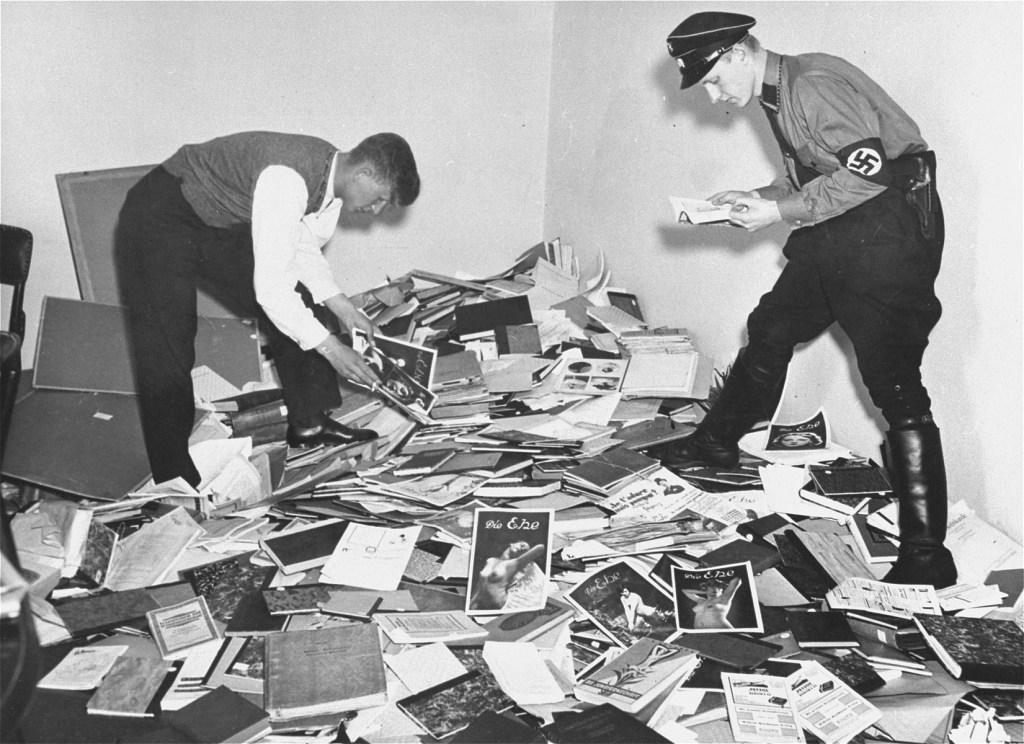
They burned it. All of it.
This is not a happy anecdote of how “we have always been here” or whatever other bullshit gets flung around during Pride Month. This is a cautionary tale. No, worse: this is a warning, an active red flag for what might be to come if we don’t prepare ourselves to fight back. Burning the Institute of Sexology was not an accident or a coincidence. It was very intentional that this was one of the first institutions targeted by the Nazi Party in their crackdown upon Weimar liberalism. The Institute of Sexology was a manifest representation of everything German fascists saw as wrong with their country; it was about a hatred for the queers, yes, but also a hatred for Jews, a hatred for foreigners, a hatred of the impure. By the time the Nazis escalated to book burnings, they had already banned homophile clubs, gay lib organizations, and pornography. Affiliates of the Institute were forced to flee Germany. Those who got caught were sent to concentration camps, where many of them were murdered.
I need you to understand that this was not the end of the fascist dismemberment of homosexual and transvestic life in Germany.
No – this was in 1933, twelve years before the Nazis lost World War Two.
The Holocaust soon followed.
We discussed the last section in depth because it’s important that you know the legal status of Republican attempts to criminalize trans literature as obscene or pornographic. I bring up this section, however, because there are several key points you need to take away about what fascism is and how it works:
Lesson One: Centralized institutions are more vulnerable to fascist state violence.
In the 1930s, the sexological movement had one clear figurehead – Magnus Hirschfeld – and one clear central institution – the Institute of Sexology. By destroying the Institute of Sexology in an act of state-sanctioned mob violence, the Nazis were able to effectively cripple the entire German queer community; they cut the head off the snake, and the body went limp and pliable.
Fascists love to have an individual leader they can make an example of. When Magnus Hirschfeld went to speak in deep Conservative country in Munich in 1920, he was assaulted and nearly killed by a group of soon-to-be Nazis, shattering his illusion that Germany would be a safe place for homosexuals or transvestites. By the time that Hirschfeld went on his world tour in 1930, he had essentially given up on the possibility of homosexual rights in Germany, and had realized that he would need to flee the country if he wanted to survive. The Institute burned, Hirschfeld died in exile, and the dream of a queer Berlin died alongside him.
A centralized or incorporated movement will not be able to effectively combat anti-trans fascism in the United States. The Transfeminine Review certainly wouldn’t be able to. If Project 2025 truly whets its teeth on Nazi aspirations as much as we all fear it might – and that’s a big if – then the first thing they will come after are the non-profits, the small presses, the journals, the websites. Anywhere that “trans literature” is represented in a business or company, they will destroy it. And if that’s the only place that we can conceptualize trans literature, then they’ll succeed. Fascism, especially American fascism, cannot articulate itself beyond the language of capital. It cannot fathom an “industry” that exists beyond the confines of an institution like the Institute for Sexology.
In a worst case scenario, you cannot rely on any queer business or institution to protect either you or the literature you care about. And this is the core principle of this thing that I am calling the Trans Literature Preservation Project – it is not business, not an organization, not charity, not an academy, it does not ‘exist’ in any organized or vigorous fashion. The Trans Literature Preservation Project (TLPP) only exists insofar as it is a philosophy and a communal mode of understanding and survival. There will never be a TLPP organization you can donate money too. Save your cash for mutual aid.
Lesson Two: Gatekept literatures are more vulnerable to fascist state violence.
Magnus Hisrchfeld was a real magpie when it came to collecting books and firsthand accounts. The Institute of Sexology wasn’t just a library for research and queer literature – it was a stockpile, it was a vault, it was full of invaluable and unique texts that were found literally nowhere else, and that nobody in Hirschfeld’s inner circle ever made a meaningful attempt to distribute or circulate.
We don’t know what was in Hirschfeld’s library. A select few texts survived, but the vast majority are completely lost to history. We do not even have a record of what might have been in there – there was no catalog of the library, there was no external documentation of its contents, it was literally the private collection of a single white man who had an inordinate amount of power and authority over the community who he had dedicated his life to. And when his life’s work went up in flames, so did the communal knowledge and wisdom of an entire generation of German queer people.
Don’t be like Magnus Hirschfeld. If you decide to gatekeep whatever literature you have access to, and then the fascists either kill you or destroy your records, everyone will lose that piece of literature, not just you. It’s far more easy for a book to become lost when only a single person has access to it, especially if that access is widely known.
Lesson Three: Literature is useless if the people who need it most can’t read it.
The Trans Literature Preservation Project aims to preserve and maintain the cultural production of trans writers even under a strict fascist regime, but before we even begin to discuss what that looks like, we all need to ask a hard question: if trans people aren’t able to read those books, then what’s the point? It’s all hunky-dory for future generations if the cumulative output of Topside Press sits in a university vault for a century, only to be rediscovered from the archives by some bright-eyed trans researcher in 2147 CE, but that does absolutely nothing to help marginalized people in the present obtain the tools, resources, and comfort they need to resist state violence. No – the plan of action that I will lay out over the rest of this essay is fundamentally premised upon the understanding that the literature can and must remain in the hands of the people and their communities. My fundamental thesis in this essay is that retaining access to such literature gives us far more ability to operate and organize under even the most totalitarian nightmare scenario, and that the best prognosis for the survival of trans literature under authoritarianism can only come when we have so thoroughly diffused and embedded it into grassroots networks of community and care that they would literally have to kill all of us to fully stamp it out.
📖 Three D’s of Resisting Censorship: Distribution, Duplication, and Documentation
So, what is the Trans Literature Preservation Project? It is a practical strategy that each individual person or group of people can execute in order to mitigate, circumvent, and overcome the violent pressure of fascist state censorship. While the implementation of these core philosophical tenets may vary at different stages of fascist control, the underlying principle remains constant. In fact, I would argue that following these rules is good practice (and good praxis) even under the most progressive regimes.
Let’s diagnose the problem. When fascists (or modern surveillance states like China) enact censorship policies, it can often lead to books, sometimes even entire genres or fields of study, getting completely erased from memory. Human knowledge is not eternal, it is not immutable. If we do not take active steps to preserve it, and a sufficiently violent force attempts to stamp it out, then it will disappear. Moreover, as we have already discussed, we cannot use the internet as a crutch in this situation, because internet access for trans publishing is quite likely to be one of the first contested battlegrounds of a fascist censorship programme. If the Republicans succeed in their wildest aspirations – rolling back Roth, recreating the CDA, creating an equivalent of the Comstock Act for the internet, purging all trans content from major corporate-owned websites, shuttering all major transliterary American institutions, etc. – then any internet trans literature that has not been stored either on a hard drive or in print can and will be lost.
We’ll fight our asses off to keep our internet access and maintain the internet as a primary locus for trans literature, but we also need to be prepared for the possibility that we could lose the American internet completely. Amercian internet access is the very definition of the “centralized institution” I motioned toward in the last section; it will be one of the primary goals of Project 2025’s criminalization of trans life. International servers can help preserve literature, of course, but at a certain point, there’s only so much that a VPN can do for people trying to survive a fascism on-the-ground. Moreover, if the internet truly does become dangerous for American trans people, then any attempts to store or distribute trans literature digitally could become a liability for our communities. Ergo, I will be extensively laying out (especially for my fellow Gen-Z readers who’ve literally never lived without the internet) how the entire trans publishing industry can decrease their overreliance upon the internet, as it may become a matter of both practicality and survival should the Trump administration get their uncontested way.
Additionally, remember: we are always both fighting and hoping for the best case scenario. Do not give an inch. It is my earnest hope that the vast majority of the information and action suggested in this document will never be necessary, and that in a decade, I’ll look back on this piece as a delightfully alarmist overreaction to what was, all things told, a relatively normal Republican administration. Do not jump straight to Stage Four. If we are in Stage One, then you should act like we are in Stage One.
What does it mean for a piece of literature to ‘survive’ a fascist government? It’s simple, really – as long as ONE copy survives past the fall of the government, then that work of literature has ‘survived’ the period of censorship. One copy. That’s all it takes for a book to make it through a dictatorship, and it’s a much, much harder objective than you might think or expect.
Fun fact: most books have only a handful of copies. The older a book gets, the fewer copies it will have (unless it’s a classic, but that’s its own story). Here’s an interesting question – what counts as a ‘copy’ of a book? For print books, obviously one book is one copy. But it’s not so clear-cut for e-books.
Obviously an e-book has the potential to have an infinite number of copies. HOWEVER. It is absolutely crucial to understand that a “copy” of an e-book is not access to an e-book, but the physical file which contains the e-book’s data.
Let’s take an example. Sally’s popular new book just sold 10,000 copies as a Kindle Exclusive, which means that more people have read Sally’s book than went to my elementary school, middle school, high school, and college combined. How many copies of Sally’s book are there?
One – and it’s owned by Amazon (or at least the DRM part of the file is).
Maybe two or three if Sally or her editor have kept personal copies for themselves.
You do not own the rights to e-books purchased through Amazon or other large conglomerates (though the DRM-protected file is often downloaded to a device). You own a license to read that book, you have the right to consume the media through the appropriate channels – assuming that neither Amazon nor the author decides to remove that e-book from the platform. What this means is that even though exponentially more people are able to read Sally’s Kindle Exclusive than, say, Sarah’s limited run indie book that only printed five hundred copies, Sally’s book is actually at a much higher risk of being censored by the state, because 99.9% of her readership and distribution rights are controlled by a single centralized corporate entity that can be regulated and policed. Popularity and traditional legitimacy are not always beneficial when trying to combat censorship. In fact, the presence of an overt corporatism or centralizing economic force within a corpus of texts can actually do more to co-opt a fight against censorship than it will to resist or subvert it.
The communal economies of resistance necessary to effectively combat fascism are directly hampered by the adherence of the publishing industry to traditional modes of capitalistic production. Capital suppresses and monetizes distribution, criminalizes duplication, and itemizes documentation. When books are held as commodities first, repositories of knowledge second, then the economic value of the page will trump even an existential threat to its survival. But by the same token, we cannot approach the issue of literary preservation under fascism without the recognition that there are thousands of working trans authors who rely on their work for either primary or supplementary income. What I am suggesting here is not that trans readers start openly pirating or stealing the works of trans authors. Quite the opposite. If anything, one of the core theses here is that we need to increase the market power of the trans author. Now more than ever is the time to buy, share, review, critique, and advocate for trans authors, to turn out and show the power of our community to support and fund our own literature without relying upon the benefaction of the state.
I will briefly go over each of these tenets, but you should expect to see them mix and mingle in the practical advice section that follows this.
📨 Distribution
The principle here is self-evident: the more people who own a copy of a book, the harder it is for the fascist state to destroy it. And I do mean own. Not rent, not borrow, own.
There is an immediate problem of class here – what happens when people can’t afford books? Already we have arrived at the first – and the most urgent – organizing action which trans publishing now faces. Our goals must be as follows:
- Ensure that the maximum number of trans books have at least one method of acquisition that gives readers the ability to own their own copy (either paperback or a PDF/EPUB without DRM) for purchase. This can be accomplished on existing platforms like itch.io.
- Develop strategies and mutual aid tactics for distributing trans books to low-income trans people who do not have the means to acquire them otherwise.
- Coordinate with as many institutions as possible (libraries, universities, non-profits, bookstores) to create as many backup copies in hard-to-move places as we can.
- Download digital-exclusive serialized trans fictions (fanfictions, web novels, etc.) in case of a total shutdown of modes of internet trans publishing.
- For those with the resources and ability, begin immediately curating a microlibrary of trans books you want both yourself and your local community to have access to should the internet become an unsafe method of distribution.
- Make yourself aware of all online free trans books, and download any you care about for your personal record.
- Repeat this process for ANY trans media that you want to continue to have access to after Trump takes office. Articles, journals, photographs, research, medical notes – anything. Download it all.
This is an immense project, and likely an expensive one as well. There’s going to be a lot of people who can’t afford to do some of these steps, so here’s my advice: do what you can. Prioritize the books that are most important to you. Buy paperbacks of your favorite e-books. Help others in your community if you’re able. Buy your trans friends some great books for the holiday season. Even better: pool your resources. Find your local trans friends and have a meeting about it- if any one of you has a book, then you’ve all got a book. It’s way easier for ten people to put together a really interesting collection than one person alone.
And remember: there’s a lot of free trans media out there that’ll need preserving too. Never assume that something you care about will be saved from a censorship purge. It doesn’t matter how silly, how cringe, how niche it is. Download it. Save it. You’ll never know what you’ll be grateful to have later.
📚 Duplication
If distribution is breadth, then duplication is depth – create as many redundancies as possible. The more places you hide your books, the less likely they are to find them all.
Let’s be clear of the bat – duplication does not mean pirating books before the onset of a severe censorship. Duplication should not even enter consideration until there is a reasonable suspicion that your books may be at risk of search, seizure, and destruction. This is a survival tactic for a marginalized literature under conditions of extreme authoritarian rule, NOT an excuse to stop paying indie authors for their blood, sweat, and tears. Writing and publishing are labor, and if you’re exploiting working-class trans writers in the name of “fighting censorship,” then you are the problem.
Capiche?
Duplication is not a tool for distribution. Rather, the goal of duplication is to ensure that if you have access to a work of trans literature, you minimize the risk of losing that work as a consequence of state violence to the greatest extent possible. Duplication is a question of making backups and copies, yes, but it’s also a question of duplicity: learning best practices for concealing your literature, minimizing the risk of discovery, protecting yourself from the potential consequences of having illegal literary materials in your home or belongings. The goals of this tenet:
- DO NOT STORE YOUR LITERATURE IN THE CLOUD. Keep your collection on USB drives or microSD cards – hard drives or SSDs if you can afford them. Encrypt the data and put a password on them.
- If you have no choice but the Cloud, use an encrypted overseas storage provider like Proton, access with a VPN at all times, and emotionally prepare yourself for the possibility that you may completely lose access.
- If you have a digital repository of trans literature, make backup copies on different drives, cards, or disks. Give the spares to trusted friends and family. Hide them, and hide them well.
- If you have physical copies of a book, make a backup plan for how you will secure it in case of a severe crackdown on the possession of illegal literature. Coordinate with your relatives and friends. Ideally, spread your collection out across multiple homes. Choose the cis-est, straightest allies you have and make them your guardians.
- Redundancy is the name of the game. The more ways you can secure your books, the more likely they are to survive under conditions of severe censorship.
But above all else: YOU MUST SURVIVE. No book is worth more than your life or liberty. If you need to jettison your books in order to stay alive, then that is a compromise you should make without hesitation. Trust that others will have preserved the books too, and that your communities have held true to the principle of distribution.
📸 Documentation
This one is tough, because it’s not really for you or your people – it’s for that nebulous ‘after’ that might never come. Some day, people will need to know the scope of what they still have (and what they’ve lost).
You are the institutional memory for a culture and a generation. We don’t know what was in Magnus Hirschfeld’s library – but that doesn’t mean that our descendants shouldn’t know what was in ours.
- Collect whatever data you can about trans literature, then store it in a completely different place than everything else. Preferably, you should give it to someone else for safe-keeping.
- Document oppression and fascism in real time as it happens. Keep a record, if you can. Be discrete and safe, but don’t let it become background noise.
- DON’T STOP WRITING. Write for your immediate community. Write for your family. Write for yourself. Write on a whiteboard then erase it. Write on paper then shred it. Destroy what you need to – but your words are your weapon, and you need to keep them sharp.
Documentation isn’t a survival strategy. It’s a liberation tactic.
Never let the light go out.
✊ A Practical Guide to Resisting Censorship
And here we arrive at our detailed action plan.
It’s important to recognize that there is a very real possibility, perhaps even a likelihood, that we will never experience true fascism on the magnitude I am suggesting and that all of our preparations will be redundant. Good. Not only is it objectively useful in the longterm to insulate the global trans community against authoritarianism and fascism, but we also should never ascribe an inevitability or preemptive victory to the opposition. This, too, is a form of obeying in advance. Until the day it is no longer legal, you should be continuing to act as though we remain in Stage One, organizing, distributing, fighting back.
To my international readers, to my cishet readers: you are our firewall. Not only is all of this useful should the worst come to pass in your own country or community, but your action can have an outsized positive impact on our ability to retain knowledge and community past a period of severe authoritarianism. Allyship matters more right now than ever.
So without further ado…
🏛️ Microlibraries: Your Community’s Lifeline Under a Fascist Regime
Let’s play out a nightmare scenario. Any and all representations of transness have been completely purged from the American internet, and it’s illegal to engage in transgender activities on the web. Hell, it’s illegal to search the word “transgender,” or at the least it’ll get you put on a watchlist. Think Great Firewall of China levels of censorship and criminalization. Moreover, trans books have been removed from libraries and bookstores. Gender studies departments are gone, and Trans Studies as a field is effectively dead in the United States. Let us assume, for the sake of the argument, that you have absolutely no way of acquiring new trans books in a safe manner. Your access to trans literature has been completely revoked, and with it, much of your ability to articulate transphobia or escape into a friendlier world – that is, unless you and your community already have a collection at your disposal.
Here’s the fundamental principle of a microlibrary – build your collection on the assumption that it is the only access to trans books that you and your community will have.
This does not, and should not, be an individualistic pursuit. Pool your resources. Collaborate with your friends. Work together.
Think about it this way: if the trans internet goes completely dark, we’ll be forced to take our networking and opposition to a hyperlocal level. You may be limited to the resources and abilities of whoever lives close to you. Skill-sharing is a super important tool, and you should think of your library as a skill you’re bringing to the table. Obviously, it’s so important to preserve the tools of our liberation. Transfeminist texts like Whipping Girl; theory texts like The Transgender Studies Reader; historical texts like Stone Butch Blues. All of that matters a lot.
But that’s also not going to help you live under a fascist regime. Those books might help you, but they may not let you escape if you need an outlet from dysphoria or find solace if you’re struggling with dark thoughts. If we only preserve literatures relevant to life under fascism, then we stand to lose so much of our culture and creative output. Here’s a better way to think about it. Trans literature as a whole is a corpus, a collective body. Our job right now is to preserve as much of that body as possible for future generations, which means that no matter how silly, irrelevant, bad, stupid, or wrong a book is, there is still value in preserving it and passing it around. In fact, I would argue that collecting your favorite comfort food is such a powerful act of resistance! Please put eggfic and trans joy in your microlibrary!
In the coming weeks, I’m going to be adding a Censorship Index to my spreadsheet indicating how likely every book on it is to be lost under a fascist programme of censorship. When that goes live, I would urge you to peruse it and pick a few high-risk lesser known books to try and preserve alongside your copies of Nevada and Conundrum. It doesn’t matter if 5000 people make a microlibrary – if 4998 of them only have a pool of the same hundred books, then we’ve failed as a community to preserve trans literature as a whole. The weirder and more unique/personalized you can make your microlibrary, the more likely it is to make a significant contribution to the preservation of trans literature as a body and a whole.
Moreover, the more isolated you are from broader networks of trans organizing, the more important your microlibrary will be. For example, a microlibrary in Portland will probably have less immediate impact than a microlibrary in Tulsa. That’s not to say that both aren’t important – they simply serve different purposes. A microlibrary in a sanctuary state or city is far more likely to make a significant impact on the preservation aspect of the TLPP – but a microlibrary in a deep red state, county, or town could be the difference between life and death for a closeted trans kid with nothing.
Again, you cannot rely on the library of a single private citizen like me to preserve trans literature for you. Do I, Bethany Karsten, have one of the most expansive trans fiction libraries in the entire world? Yes. But when fascists are looking for easy targets, they will come after me and my books first.
Don’t advertise your microlibrary. If you need to talk about it, only do so in person or through encrypted channels. Do not keep a record of your library in the cloud or on social media. Knowledge has power, but hidden knowledge has strength. Deploy both.
But just because you’re keeping a private library doesn’t mean you’re keeping a personal library. As I suggested earlier, preserving trans literature is a pointless endeavor if it cannot be read by the people and communities who need it most. In a worst-case scenario, those books might be tantamount to sacred. Make sure your whole community can read them. Scribble down notes in the margins like a family bible. Keep the sacred flame alight.
You do not need permission or public approval to do this. You are already at a disadvantage by the fact that this has become a necessary conversation at all. Start now. Start today.
Remember, redundancy and accessibility are the name of the game. A copy of Invisible Lives in California is not useful to people in Michigan if the trans internet collapses.
Like I mentioned earlier, novels and theory texts aren’t the only piece of literature that matter. We need people to save fanfiction, web serials, erotica, TG/TF, articles, studies, forums, music, video games – everything. Make your library mixed-media. Get creative. Everything counts.
Even if a Trump Presidency turns out to just be business as normal, what’s the downside? Now you’ve got a cool library of trans books at your disposal! Preparation is never a waste of time.
🇺🇸 Practical Steps for American Trans Readers
Support Working-Class Trans Authors
Fun fact: trans authors still need to pay the bills while living in a fascist regime!
Building your microlibrary should be a primary reason to increase your support for trans authors, NOT an excuse to try and circumvent them. Buy your favorite author’s books. Buy multiple copies, if you can. Subscribe to their Patreons. Look up their other creative pursuits, and support them there too. Prepare to give mutual aid to the trans authors most disproportionately affected by a hostile government or censorship.
Signal boost. Repost. Share with your friends. Convince your cis family and relatives and friends to read trans books too. This is one of the most important action steps on this list, and it will remain relevant no matter how bad things get. Authors may also need more direct forms of mutual aid, so be prepared for that too.
Start Building Your Microlibrary
Think about this like a fun hobby! Your library is a great opportunity to express yourself and what you value both in literature and in life. Get weird with it. Find obscure books. Collect that one short story series from 2012 that nobody else remembers. Print 500k word fanfictions. Invest joy in your books, and it will be waiting for you when you need it the most.
Vote with Your Wallet (If You Can)
Wanna know why rainbow capitalism exists? Because major corporations realized that it is objectively more profitable to market to LGBT people and their allies than it is to exclude them from the public sphere. Regardless of your feelings on rainbow capitalism as a phenomenon, I would objectively prefer to continue living under that paradigm than to return to the economic censorship and exclusion of the last century. So buy traditionally-published trans books. Buy them now, and buy them a lot. Most of their authors need the money too.
There are other ways to make sure that publishers know that trans books matter. Lobby the Big Five publishers. Tell every editor that’s ever published a trans author that you want to see more. Figure out which publishers have been historically more (Penguin, Random House, Tor) and less (Hachette, etc.) friendly to trans authors, and make sure they know that trans books will still sell even under a fascist regime. We need publishers to help be our bulwark. Pressure them not to comply in advance.
Find Your Local Literary Community
Go get a library card and introduce yourself to your librarians. Go to your local bookstores and talk to the employees and owners, sign up for their mailing lists. This goes double for queer bookstores. Look into local queer book groups and join one if you can. Research indie presses in your city and reach out to their editors and staff. Get in touch with your local newspapers and literary journals, especially if they’re queer.
This networking should go beyond explicitly literary spaces, too. Go to queer support groups and gay bars. Find LGBT-friendly cafes and third-spaces. Just cause they aren’t directly involved with the publishing industry doesn’t mean that there aren’t dozens of other queer readers in your area who can and will support you in your preservation and resistance efforts.
Use social media to organize locally while you still can. Build networks of other trans readers you know you can trust and can vouch for – you may need them. Do some research. Take as much advantage of the internet as possible while we still have full access.
Invest in Digital Safety (Reader Edition)
This is the moment to decrease your over-reliance on tech conglomerates as much as you possibly can. They are not our allies, and they can and will use your data against you in case of fascism.
We can break this up into a few categories:
Step One: Platform Hygiene. If you haven’t already, delete Twitter/X now. There’s a strong transliterary community growing on Bluesky right now, and I would urge you to migrate there instead. Stop using Google Chrome or Safari and switch over to a browser that respects your privacy. Firefox and DuckDuckGo are good options, but Tor is obviously the best if you have any intention of continuing to organize trans literature over the web even after it may be potentially criminalized. If you can, it’s worth considering switching your OS from Windows or AppleOS entirely. Linux may be a good option.
Do not store your microlibrary in American servers of the Cloud – and ideally not in the Cloud at all. You should be prepared for the possibility of only accessing your digital trans literature only when disconnected from the internet.
Step Two: Protect Your Communication. Invest in a VPN immediately. Prepare secure and encrypted communication methods like Proton or Signal in case they become necessary for the discussion of trans literature. Delete old accounts that you’re no longer using. Change your passwords, and for god’s sake, don’t put them on your Notes app. Get a password manager or write them down on paper in a secure location. Enable two-factor authentication on as many devices as possible.
TURN OFF ALL AI FEATURES IMMEDIATELY. Artificial intelligence programs actively scrape your data – even private emails and messages – off of many Big Tech platforms, and if they get weaponized under a man like Musk, you could be incriminated just by using the platform to store a trans book or write trans fiction. In fact, I would strongly advise that you try to only use non-AI devices if you’re able.
You should thoroughly scrub your computer for malware and shovelware – you don’t know what’s in your files, and it’s better to be safe than sorry. Be careful about what websites you visit – the majority of them will be trying to sell your data.
I would recommend creating both at least a free Proton Mail account and downloading the Signal messaging app. Security experts, feel free to leave additional insight in the comments.
Step Three: Prepare Your Tech. Here’s one of my more surprising pieces of advice – get your hands on an old laptop and designate it as your “offline” laptop. If you have a large digital stockpile of trans literature, this will be the device you use to read it on if we lose the internet. DO NOT KEEP THE FILES ON SAID LAPTOP. Keep them on thumbdrives and MicroSD cards – they’re easier to hide, though if things go bad, even having it on your person or in your house could be a serious safety risk. This laptop is just for plugging in an external drive and accessing PDFs. The dumber, the better. Almost everyone these days has an old computer lying around, so you should likely be able to accomplish this for free. Keep it in airplane mode. When you aren’t using it, toss it in with the rest of your old tech junk.
Invest in USB drives and MicroSD cards now. External drives are also good but tend to be bulkier – it’s unlikely that you’ll ever be exceeding the 128 or 256 GB storage capacities that many flashdrives have these days. Not only will these likely be more expensive under Trump’s tariff plans, but it’s also possible that under severe fascism, their access and sale may be monitored.
If you have a large collection of Kindle E-Books, BUY A DUMB E-READER. Not a Kindle Fire – buy the simplest E-Reader you can find on the market. You can probably find a used Paperwhite for cheap. Download every E-Book you have ever purchased, and prepare to permanently disconnect it from the internet. Amazon has the power to remove e-books from the store – if there’s a large-scale purge of trans literature from the Amazon store, it’s possible that Amazon will delete your trans books en-masse without telling you.
Many e-book retailers (especially Amazon) include what’s called a Digital Rights Management (DRM) component that prevents you from using the e-book outside of their proprietary software. While having an offline Kindle is a good way to preserve the Amazon e-books you already have, it is not a good place to continue buying e-books. Invest wisely into e-book options that put the ownership of the literature into your hands. We own our physical paper books – there’s no reason we shouldn’t own our e-books too.
Request Books at Your Library
Most libraries in the United States will buy you books if you ask them! Request as many trans books as you can for your local library system. While it’s very likely that libraries around the country will be some of the first targets of Project 2025, the more trans books there are in circulation, the harder it’ll be for the Republicans to purge all of them.
Call Your Representatives
Right now is the moment to get involved with government at every level of the process. Annoy your congresspeople. Talk to your mayor, your city council, your school board. Tell them that they need to respect your First Amendment rights, tell them you’re calling because you’re concerned about censorship in America. Make your voice heard, and make it loud. The more local you engage in this work, the louder your voice will be.
Make a Backup Plan
This obviously goes beyond trans literature, but I specifically mean that you should be making a backup plan for what you’re going to do with your microlibrary in an emergency. Do you have a safe friend or relative who can stash your books without arousing suspicion? Is there anywhere you can hide them that the police won’t look? If keeping a large collection becomes too dangerous, do you have a plan for spreading it out to minimize the risk of discovery? You should think through all of this now so that if it becomes necessary, you know your options and what you should do next.
✍️ Practical Steps for American Trans Authors
Do Not Censor Yourself
Again, rule one: never comply in advance. But this is a more existential problem, one that both needs and deserves its own bullet point.
Let’s not mince words – all of this is absolutely terrifying. You’re a public figure on the front lines of what has the potential to be a serious authoritarian crackdown, and your safety and liberty may be at risk. That’s an unfortunate fact of where we’re at, and lying about it or handwringing won’t do us any good.
The fascists will be looking for any excuse to shut us up and destroy our work. DO NOT COOPERATE OR COLLABORATE WITH THEM. We need your voice and your platform to be loudly and openly sounding the alarm about what might be to come, at least for as long as such an action is legal and safe. Your words have the power to shape the public opinion, and right now you have a narrow window to use them to alter the potential course of what might come next.
Do not remove your books from circulation unless you are forced to. Do not stop advertising and marketing your books unless you are forced to. Do not stop writing, editing, and publishing your forthcoming titles unless you are forced to. Do not stop querying agents and editors unless you are forced to. Do not alter the content of your manuscripts to be more conservative or less overtly queer unless you are forced to. Do not give up on your most ambitious ideas for your dream books unless you are forced to.
Trans publishing can and will continue even under conditions of extreme fascism. It only ceases to exist if we stop fighting for it.
Make Your Books As Accessible As Possible
I completely understand why an author may be wary, even downright hostile, to the three D’s of distribution, duplication, and documentation that I laid out in Section Five. Capitalism teaches us to safeguard our intellectual property like a dragon’s horde, and much of the economic value of a novel in a capitalistic society comes from its enforced scarcity. HOWEVER. If there is a significant crackdown on trans literature in this country, and you only distribute a few copies of your book because you want to make more money, then your work will be at a significantly higher risk of being lost.
This very much is also the case for any authors who use traditional publishers or Kindle Unlimited, two modes of distribution that heavily restrict when and where an author is allowed to distribute their books. If you’re contractually bound to only distribute your work through certain channels, then I understand, and you should feel free to skip this section. However, to everyone else, facilitating the distribution of your work to the maximum number of trans readers possible is perhaps your single most powerful tool to insure your hard work against state censorship.
If you have the right to do so, I would strongly recommend that you put an EPUB or PDF of your book for sale on the platform itch.io. Rien Gray has a guide on how to do this. itch is a grassroots market for underground literature and video games that have a number of important features for distribution, especially to trans readers who may not be able to afford a $20 book. Obviously you can put the book up at full price there, but there’s also comprehensive tools for a “name your price” program, which lets marginalized trans readers pay what they can, or potentially even read a book for free if they truly cannot afford it. itch is the preferable platform for both the distribution and the duplication of trans e-books because it both gives the reader full access to the physical file and gives options for poor trans readers to still be able to build their own microlibraries, even at a greatest remove from wealth. It also has the advantage of rarely showing up in Google searches, being extremely difficult to navigate without prior knowledge, and generally resisting more algorithmic attempts to scrape or surveil its content.
Invest in Digital Safety (Author Edition)
Step One: Do literally everything that I suggested in the Reader section. Once you’ve done that, there’s a lot of additional steps that you should be taking as an author to protect your work and craft.
Step Two: Disconnect from the Cloud. If your primary method of keeping and producing your writing is on a digital platform like Google Docs, I would highly recommend that you look into an offline word processor or similar program and start relocating your writing process there. I know that programs like Google Drive and Microsoft OneDrive and Dropbox are all massively convenient and accessible, but if your entire writing craft hinges upon those platforms, you may be in serious trouble if a true wave of anti-trans censorship hits this country.
When you are picking a word processor, make sure that it is free and open source. Microsoft Word is not better than Google Drive. An excellent free alternative word processor that will never access or sell your data is LibreOffice, which can do 95% of what Microsoft Word does without licensing or AI. A free open-source word processor can be downloaded on multiple devices, run almost any file type, and crucially is safe, secure, and non-corporatized, which may be the difference in your ability to continue writing under a fascist regime. There are lots of other alternatives, so ask around – you’ll probably get multiple answers that might better suit your needs.
Pen and paper is still a valid way to write!
Similarly, start looking into more secure methods for advertising and marketing your work. Obviously social media and the internet are such critical tools for independent trans authors, and the idea of losing those is absolutely terrifying. For all our sakes, I really hope that we won’t – but you need to be prepared for the possibility.
I would recommend investing in secure communications channels (encrypted messaging apps like Signal are good) with your agents, editors, beta readers, publicists, and any other allies who might want to work with you in a worst-case scenario. When possible, try to start building less visible channels of communication with your readers. You can organize mailing lists, either with email or with physical addresses. Newsletters may be a powerful tool if websites and platforms are forced to shut down.
Send documents through encrypted channels. It’s possible that Republicans could criminalize publishers who buy trans manuscripts, but until that happens, don’t stop querying – just do it safely. Query directly or in person if you can. Ask your agent to be careful.
Grow your international audience. Pursue markets in Europe, Oceania, and around the globe where you might be able to continue to gain revenue no matter what happens domestically. Cultivate a team of supporters and friends in other countries who can champion and support your work even if you can’t do it yourself anymore. Global networks are one of the most powerful tools that authors have to resist censorship, and you should start prioritizing yours now.
Step Three: Make Preparations to Publish Analog and Locally. If the US government completely censors all trans literary material from the American internet, it’s possible that we may lose digital distribution entirely. If this comes to pass, do not stop writing. Your words and ideas will be more important than ever, and it’s on us to find ways to make sure that we’re still getting our work out to the readers and communities who need it.
I would strongly recommend that you invest in a black-and-white laser printer now. Toner is easier to acquire than printer ink and lasts longer, and laser printers tend to require less shitty software or scummy ink-buying practices. You can buy a relatively cheap laser printer for about $100-$200 dollars – this one is a good example. It’s an investment, but likely a worthwhile one. I would also recommend buying several year’s worth of toner now if you can. Get the most generic brands of toner and paper possible – it’s a lot easier to track that sort of thing than you think. But don’t skimp – cheap toner can both be hazardous and damage your printer, and you need that thing to work for years if not decades.
If possible, avoid OEM (Original Equipment Manufacturer) toners. Most printers can use a generic brand, but don’t want to tell you cause the toner is how they turn a profit. Xerox sells a generic line of toner that works with most laser printers.
Don’t waste your money on a color printer or colored toner. Anything you’ll be wanting to print under fascism should be printable in black and white.
Do not connect your printer to the internet. If your printer of choice requires an app, ignore it or choose a different app. Any of this can be used to surveil what you print. Even now, most printers can still use wired USB connections to print documents. Make friends with your USB cable. Only print from an offline computer.
You should also be aware that most printers keep a local memory record of everything they’ve printed, which can be accessed by anyone who can get into the printer’s files. Additionally, you should be aware that many printers have a “signature” where they print a couple dots across the sheet that can be tracked back to the unit serial number. Color printers typically do this will yellow ink, making them easier to trace, hence why I’m strongly recommending that you get a black and white printer.
Don’t forget to stock up on the little things, too. Paper, staples, notebooks, envelopes, stamps, etc.
Your offline computer and your flashdrives will be even more important than they are for a reader, so invest well in them. Be prepared to only write while not connected to the internet in a worst-case scenario. Spyware is incredibly pervasive in the modern digital economy, and you could be putting yourself at risk.
Back Up Your Work
This is basic good practice for any writer obviously, but it’s more important now than ever.
Your best tool for protecting your published work is distribution, but you almost certainly will have a private collection of manuscripts, drafts, and other literary materials that aren’t ready for publication yet. If you’re like me, you probably primarily back this up in this cloud. While this is a good solution for now, and quite probably will remain viable for years, it is not secure under a fascist government and you should assume that doing so may compromise both you and your work.
Back up your digital files onto all of your harddrives and SD cards. Give them to family and friends. I would also highly recommend printing at least one copy of everything important that you’ve ever written. You can also give that to a friend or family member to stick in the back of a closet if you don’t want to keep it in your own home. The less publicly associated you are with that person, the better. If they live in a different country, even better.
Help Create Your Local Literary Community
It’s awesome that you’re organizing on social media or mobilizing your thousands of Bluesky followers, but we need to be prepared for the real possibility that we might lose access to those channels. The “trans author” is a very cosmopolitan figure – she exists at parties and in spirit, she is everywhere and nowhere, New York and San Francisco are closer together than your house and your local library. Ask yourself: if you completely lost access to the internet today, how many trans people would you know? How many queer communities would you be a part of? If the answer is “zero” or “my immediate friend group,” then I would urge you to consider branching out and involving yourself more directly in local organizing efforts.
Having an author around is awesome! You have a lot of power to bring people together and organize them around you. In times of struggle, those queer communities may need your knowledge, your wisdom, and your craft. But they won’t have access to it unless you integrate yourself with the local communities where it’s needed. Your readers will need you in the coming years as much as you need them, and that doesn’t stop on the local level.
Put Your Affairs in Order
This is a dark one, but it’s important. You should have a plan for what will happen to your work and estate under two different scenarios: A) if you die and B) if you are incarcerated. Know your rights, and plan your will accordingly. Consider entrusting a friend abroad with the publishing rights in case you pass away. Don’t let your work die with you.
Survey Your Legal Options
Be aware of who can provide you with pro-bono legal service. Find your local experts in LGBT law. Research nonprofits and organizations dedicated to providing legal assistance in civil liberties cases and consider preemptively reaching out to them about transliterary censorship and how they’re planning on combating it. Make sure that your family knows about those options too. Give them the knowledge they need if you happen to get arrested or arraigned. And for God’s sake, don’t talk to the cops.
Have a Financial Plan
Nobody wants to return to a day job after they’ve found a successful career in the publishing industry. But the reality right now is that the Republicans will likely do their darndest to make working as a full-time trans author difficult, if not impossible. If you need to go back to a day job, if you need to prioritize your finances to survive, then you are valid for that. It’s their fault, not yours. Prepare yourself both physically and emotionally for the possibility that you may need to pursue other forms of work to survive the next few years.
📰 Practical Steps for American Publishers, Editors, Agents, and Industry Insiders
Don’t Become the Problem
Listen to me well – if you start pre-emptively censoring and discriminating against trans authors and trans books out of either fear of Trump or a cynical economic pragmatism, then that’s not the Republican Party who’s participating in fascism. That’s YOUR COMPANY participating in fascism, which will only accelerate the process.
Trans authors need you and your institutional support now more than ever. We need you to go to bat for us and our work. You have the power to advocate for trans authorial communities and provide a crucial bulwark against unmitigated fascism in the United States, and there are millions of marginalized people around the country who are relying on you to hold the line.
If you publish or distribute the work of a trans author, continue to do so until the day it becomes illegal. If you represent or work with a trans author, check in on them. Give them support. Be their advocates. Reviewers and critics, it’s time to send a clear message to the rest of the world that trans literature is culture, not pornography. Now is the moment to close ranks and use the political power of the publishing industry to protect not just trans authors, but also the transgender community at large.
Increase the Scope and Accessibility of Your Distribution
As much as I sincerely doubt that most publishing companies will be willing to do this, I still think it bears mentioning: publishers, one of the best ways you can protect your client’s books from state-level censorship is by making an EPUB edition available for sale. By placing ownership of your titles directly into the hands of readers, you will not only protect your trans authors and readership from state censorship, but also increase the likelihood that you will be able to continue receiving business from queer Americans under a fascist regime.
Similarly, consider pursuing an accessibility program so that low-income trans readers can access trans books at a discounted or subsidized cost. Now is an excellent time to put your entire catalog of trans literature on sale. Obviously a mutual aid programme to disseminate books directly to the poorest trans readers would be ideal, but I also understand how that is an impossibility for most presses.
Make an Active Plan with Your Trans Authors
The worst thing you can do right now is make unilateral decisions about your trans clients without notifying them beforehand. This is an extremely vulnerable moment for trans authors, and we need you to work with us, not around us. Talk your clients through the options and your worries about the coming years. Help trans authors understand the economics of what Project 2025 means for the publishing industry, and work together to prepare for all possible outcomes.
If you need to drop a trans author for legal reasons, please consider signing a termination contract with that author that gives them back the rights to publish their work as an e-book. If you have to nuke your trans catalog because of fascist censorship, please give your authors the rights to disseminate their own work in your absence. Give them the rights to self-publish an EPUB edition, hell, give them full printing rights altogether. Refusing to publish the work of trans authors AND refusing to return their intellectual property rights to them so they can continue to make a living is, essentially, the least moral business decision you could make in the coming years, and stands the risk of royally fucking over trans authors who will desperately need income and social support. There’s a special level of hell for companies that trap artists in dead-end contracts. Don’t be that company.
Organize with Other Publishers to Oppose Censorship
It’s far easier to go after a lone voice of resistance than it is an entire industry. The more companies you can collaborate with, the more imprints you can engage trans literature with, the better the chance we stand of being ungovernable by the fascists. That means that if you’re an ally in the publishing industry, find community with other allies. Make connections. Get in the mud of acquisitions and corporate decision making. The executives, especially at a Big Five publisher, are likely to try and capitulate to Republican demands, and you have the power to throw rocks into those gears. Make trouble, fight like hell for your books, do whatever you possibly can to keep the company from acceding to censorship and fascist mandate.
Publish More Trans Books
You know what’s a great way to fight fascism? Market the hell out of your banned books! Or better yet, make a plan to publish literature that Republicans hate. Civil disobedience can be an incredibly powerful force for good, and the idea that trans authors are “inherently pornographic” is discrimination on so many levels. It is a fundamental absurdity, and they know it. Don’t give them a damn inch until they demand it of you.
🧑🦳 Practical Steps for American Librarians
Order Trans Literature for Your System
Microlibraries are great and all, but an actual library will always reach more people. Now is the moment to order as many trans books for your system as possible.
It’s important to recognize how typical book bans in libraries have been playing out over the last year. In general, Republicans come armed with a list of books they’ve identified as “woke propaganda,” which they then proceed to methodically go down and submit ban requests for in the system. While we can’t rule out the possibility that a future book banning program will develop a more comprehensive list, it remains likely that the less popular or well-known a book is, the more likely it is to avoid censorship. That means that libraries could have an invaluable role to play in the preservation of rarer or more obscure trans literatures.
Prioritize books that aren’t obviously or visibly trans. It’s rather likely that book ban junkies won’t bother to read anything more than the dust jacket.
Organize with Your Local Trans Community
That being said, it’s general practice that libraries only request books that their cardholders have asked for. Here’s a fact: most trans people have no idea that their local library can be an invaluable resource to them, and will never think to seek it out. While I’ve advised trans readers elsewhere in this article to request books at their local library, it’s probable that nobody in your immediate district will do so.
You can be proactive about this. If you have any trans regulars at your library, tell them about the book request program. Consider attending your local trans support group or going to a trans-led workshop and offhandedly talking about how great it would be to stock more trans books. If they won’t go to you, you can go to them.
This is doubly important because you probably should not be advertising to the general public that you’ve been curating a large collection of obscure trans books. In fact, it probably should remain a discrete exercise – so going directly to your local trans community and making sure they know about the resource is likely the best (and potentially only) feasible mode of distribution here.
Don’t Flag the Books As Trans
If you live in an area that is actively working to ban trans books, don’t put them out in a Pride display and expect them to remain in the system. Malicious compliance is the name of the game here. Quietly move as many of your trans books as possible into the general fiction stacks if they aren’t there already – I promise that MAGA freaks will have a harder time finding them. Nonfiction is obviously harder because of the Dewey decimal system, but some slight mislabeling or misshelving could be the difference between destruction and preservation.
If your system has a method of labeling queer or trans books, consider advocating to quietly remove the category (in places where book bans have begun). Don’t remove the books – obfuscate what they are. If you buy new trans books, don’t add the labels.
Yes, this will make it harder for trans people to find the books. But that’s precisely why taking proactive steps to connect with your local trans communities matters so much. Remember that we need to go analog here – the best way you can get trans books to trans people is by finding the people directly and making sure they know what they have at their disposal.
Preserve Trans Books if You Remove Them
If you are forced to remove a banned book from circulation, the worst thing that you could do would be to simply throw it out. I also would strongly recommend not putting them out on a library sales cart (much as I love a good library sales cart). Here are two alternative options:
Option One: Donate the banned books directly to your local trans community. Don’t advertise about it on the internet – find your community directly and give them the books in person. Once again, this step requires some level of community organizing, which I hope underscores how critical that step is.
Option Two: Use the banned books to create your own personal microlibrary of trans literature, as I’ve laid out above. It may be a private collection, but you’ll still be doing your job! Lend and distribute them among your community as you please.
Protect Your Job
Having a public safe space for trans people is infinitely more valuable under conditions of fascism than a limited and obscure access to a couple trans books. Do what you need to in order to remain in the system. Be a safe person, and prepare yourself to fight from inside.
🎓 Practical Steps for American Academics
Note: College and graduate students can also participate in a lot of these tasks! Take advantage of your institutional access, don’t wait for a professor to give you permission.
Build a Trans Archive for Your Institution
The academy is one of the most important firewalls against the onset of fascism. A strong academic resistance can make an enormous impact upon the preservation and survival of marginalized knowledge. If you’re a trans professor, a Gender and Sexuality Studies professor, an English professor, or if you are aware of any trans books in your field, start working now to collect as many of them as possible in your university libraries. The more universities that have a book, the better. This is crucial especially in deep blue sanctuary states like California and Massachusetts where Project 2025 will have substantially less influence upon the curriculum and library.
If your institution has a digital archive of trans books – most do – then you should start downloading as many of those PDFs and E-Books as you can now. If you are in any way interested in researching trans issues or hearing the perspectives of trans academics in the United States, then you need to get those resources off of the internet and onto local hard drives or into print. This is especially crucial because the average person won’t have access to big academic journals or sites like JSTOR. Fascist censorship can and will target the academy, and non-academics can’t help you do this work – we’re relying on you to preserve the trans academy for future generations.
Curate Your Professorial Library with Trans Books
If you’ve got an office on campus, chances are that it’s filled to the brim with books. Take a moment to ask yourself – how many of those books are by trans authors? A professor’s library is even better than your standard microlibrary because one of the biggest signs of a good professor is their ability to recommend further reading to their students. You have the ability to mobilize and educate a generation of young intellectuals on trans issues and censorship – but your ability to do so is only as good as the books you have access to. Even if your university decides to censor or purge trans literature from its library, having those books in your office can give you the ability to continue working them into the curriculum regardless.
On a similar note, I would strongly recommend finding more ways to increase your accessibility to students. Having open and frequent office hours, or better yet, an open doors policy, is the best way to do this. In a severe censorship scenario, it may not be safe or permissible to openly teach your class about trans subject material, and students may not know that you’re a resource or a safe space. It’s up to you to make sure that your students know that you’re here for them. Having resources stockpiled for your trans students is great, but you can’t help them if they never show up at your door.
I would generally advocate for accessibility measures like flexible grading policies and multiple modes of delivery and presentation, but that’s its own conversation.
Put Trans Books on Your Syllabus
You know what’s even better than having one copy of a trans book in your professional or institutional library? Distributing 10-30 paper copies of a book to university students! Not only does this help to support trans authors and spread awareness of trans issues, but it also puts trans books in the hands of people who likely would never get them otherwise. University textbooks will frequently end up forgotten on shelves or recirculated through the used book ecosystem, and our primary goal right now is to increase the number of copies in circulation to the greatest extent possible. While this strategy is obviously going to be largely restricted to books with enough cultural impact to be relevant – Nevada by Binnie, Detransition, Baby by Peters, Whipping Girl by Serano, etc. – I would also advocate especially for the use of trans nonfiction texts to teach subjects like history, sociology, anthropology, feminist studies, philosophy, etc. That kind of theory can have a massively powerful impact on people, and the more who have access to it, the better.
A list of books I think you should teach in your classes (most of which are transfemme cause that’s my expertise but you should 100% teach transmasc books and nonbinary books too):
Nonfiction
- Invisible Lives: The Erasure of Transsexual and Transgendered People by Viviane Namaste
- Whipping Girl: A Transsexual Woman on Sexism and the Scapegoating of Femininity by Julia Serano
- Transgender History by Susan Stryker
- Black on Both Sides: A Racial History of Trans Identity by C. Riley Snorton
- Testo Junkie: Sex, Drugs, and Biopolitics in the Pharmacopornographic Era by Paul Presciado
- The Transgender Issue: Trans Justice Is Justice for All by Shon Faye
- Redefining Realness: My Path to Womanhood, Identity, Love & So Much More by Janet Mock
- Miss Major Speaks: Conversations with a Black Trans Revolutionary by Miss Major and Toshio Meronek
- Street Transvestite Action Revolutionaries (STAR): Survival, Revolt, and Queer Antagonist Struggle by Sylvia Rivera and Martha P. Johnson
- Essays Against Publishing by Jamie Berrout
- A Brief History of Transmisogyny by Jules Gil Peterson
- Gender Outlaw: On Men, Women, and the Rest of Us by Kate Bornstein
Fiction
- Last Letters from Hav by Jan Morris
- Nevada by Imogen Binnie
- Detransition, Baby by Torrey Peters
- Yemaya’s Daughters by Dane Figueroa Edidi
- Wrath Goddess Sing by Maya Deane
- Tell Me I’m Worthless by Alison Rumfitt
- Las malas (Bad Girls) by Camila Sosa Villada
- Sasha by Roberta Angela Dee
- Fated for Femininity by Virginia Prince
- Light from Uncommon Stars by Ryka Aoki
- I’ve Got a Time Bomb by Sybil Lamb
- A Safe Girl to Love by Casey Plett
- Fierce Femmes and Notorious Liars by Kai Cheng Thom
There are loads more books have a lot of meat to tackle in an academic setting, but these are the ones that I could personally envision myself structuring a curriculum around. Pick and choose as you would.
Organize to Protect Trans Professors and Students
Obviously this includes members of the trans community, but I would also encourage cis profs and students to get involved in this work. Meet with your departments, find allies across departments and in the administration. Make sure you know ahead of time who will protect trans people and who won’t, and warn your students of those dangers. Organize teach-ins and guest speakers on the issue of censorship. BE LOUD. Protest and civil disobedience are time-honored university traditions, and now is as pressing a moment to uphold them as ever.
If you know your students are participating in protest efforts to protect trans students or books, do as much as you can to keep it from affecting their academics. Hell, go out to the protest with them. Faculty support for student protests can make a huge difference. If the school starts expecting you to report instances of students breaking censorship laws, learn the fine art of looking the other way.
Protest for the Immediate Repeal of “Expressive Activity” Policies
This is an extremely urgent issue that not enough people are aware of. This summer, a ton of American colleges and universities passed restrictive new measures governing acceptable methods of “expressive activity” on college campus, which effectively ban many prominent types of campus protest and throw the Chicago Principles for academic freedom out the window. This was done in response to the ongoing protests over the genocide in Palestine to combat perceived anti-semitism (if that’s what gets you up in arms about this article, fuck off; I’m Jewish) surrounding said protests, but can and will be used by colleges and universities around the country to police and criminalize student speech under a fascist administration. Here’s an article with more details.
Campuses around the country should be mobilizing now to repeal “expressive activity” policies. Protesting against the onset of fascism in academia will be far more dangerous if we don’t.
Decrease Gatekeeping in Academic Publishing
Yeah, journal articles can give you and your scholarship a lot of institutional legitimacy and guild certification to pursue your work and ideas. But they’re also notoriously inaccessible for the vast majority of the population, especially a trans population that is disproportionately barred from traditional avenues of institutional knowledge.
Consider cross-publishing your work on an accessible platform like Academia.edu, PhilArchive, or SocArXiv. Put a PDF on your website, if you can. I would advise that you take many of the steps I outlined in the author section to make sure your academic research on trans issues isn’t lost. If you’ve published a book, talk to your publisher and see if they’d be willing to put it on sale and/or pursue a mutual aid program for low-income trans readers who might need or want to access it.
Get Involved in Your Local Community
Get outside of the academic bubble. Find trans people in your neighborhood. There’s a whole world out there beyond the pearly gates. This is a question of economic justice and communal knowledge – the more people you can arm with historical facts and rigorous analysis, the better we can organize our way out of this mess.
Protect Your Job
You can’t educate or protect students if you don’t have students anymore. Do what you need to do to protect yourself and your students.
💵 Practical Steps for American Booksellers
Keep Selling Trans Books
Unlike libraries in conservative areas, who may be at risk of losing public funding if their trans books are discovered, bookstores have the opposite problem – we need you to sell as many copies of trans books as you possibly can. Don’t hide your trans books until you have to (in deep Red states, this threshold may have already passed). Put up Pride displays. Make a trans table like my local queer bookstore has. Distribute, distribute, distribute – right now is the moment to sell the fuck out of these books, and doing so will both benefit your business and the authors who need it most.
I’ve got loads of ideas for how you can sell more trans books! Identifying them is a big first step, obviously, but there are other ways to move more units to a broader audience. One of my favorite fun book-buying gimmicks is when a store wraps ‘mystery books’ that the reader can blindly pick at random – you could fill all these packages with trans books, or just explicitly market it as a “random trans book” event. Another option: give people the opportunity to buy a trans book for a low-income trans person! Or any other type of mutual aid program lol. Books can be so expensive, and a lot of people can’t afford to build a microlibrary right now – but you can give your customers the opportunity to help them out. Discounts are also always a plus.
Host Trans-Oriented Readings, Panels, and Events
If you’ve read this entire article, you’ve probably figured out by now that I’m pushing local community organizing pretty hard right now. Bookstores, especially queer bookstores, can be an invaluable third space for trans folks seeking both knowledge and refuge. I’m sure that many queer bookstores are already aware of this and have been doing it for years, but it still bears mention – if your store isn’t actively engaged in community building yet, now is the moment to start.
Ask trans authors to come and do readings. Publically put out a call for trans authors interested in events or panels, especially if they’re local. Make a queer book club! Create a queer books mailing list! There’s so much fun stuff you can do to help fund your business through the uncertainty of what’s to come, and it’s way easier to start now than in six months.
Learn the History of Literary Resistance Movements
What about the role publishing played in the abolition of American chattel slavery?
Now may be a good moment to start doing your homework.
Make a Pivot Plan
Have you read all of those articles and looked into the movements that surrounded them? Good. Now let’s talk.
We have to face the brutal facts of the matter – if Project 2025 gets everything that it wants, being a queer bookseller in the United States may become not just economically unviable, but also legally and/or physically dangerous. Moreover, even if you do somehow manage to stay in business, you will almost certainly get labeled as a collaborator with the regime who sold out its queer community for economic value. It’ll be extremely tempting to either go down with the ship or to close your doors altogether.
Here’s why I think you should do whatever you need to do to stay open instead.
As a queer bookstore, your aim is to sell books, yes, but you’re also a community space and a repository of literary knowledge. As I’ve laid out in this article, there is an expansive network of people who are ready to do what it takes to preserve the actual literature. What’s far harder to recreate are the institutions and the people who have the knowledge to run them.
Pivoting away from marketing your business as a queer bookstore to avoid sending you and all of your staff to prison does NOT mean you have to stop selling queer books. Firstly, there are tons of books by queer authors that are not obviously queer. It would be entirely possible to fill a bookstore with books by queer authors that are not immediately evident as queer without a shitload of research – which would be, y’know, illegal! Load the rest of those shelves up with Classic White Dude Books like Moby-Dick and Plato’s Symposium, toss out some buzzy Conservative memoirs for camouflage, and, well- You and your staff know queer books a hell of a lot better than your enemies, and a lot of them are hostile to the notion of reading, frankly. They can be openly deceived. Alternatively, you could go full cis-conventional with your choices and perhaps pursue a side-hustle in your spare time like those wonderful historical examples I cited above. What literati doesn’t love a speakeasy?
Look. This sucks. It’s a threat to your business, it’s a threat to all of us. But don’t give up and don’t back down. Workshop solutions with your employees and your community. Pick your allies well.
Get in the Habit of Stocking Local Trans Zines
It’s a booming industry with a lot of growth potential – just saying.
♀️ Practical Steps for Cisgender Americans ♂️
Be Our Firewall
Let’s be very blunt here: in a worst-case scenario, the possessions and homes of your trans friends, family, and loved ones may become subject to search and seizure, and those trans acquaintances could be arrested, prosecuted, or outright murdered. If America fully falls into fascism, then we are going to need you, our cis allies, to help us preserve both our literatures and our freedom.
Join our communities and our movement. Help us to secure our books. Stand with us in solidarity when we go to protest. Make a plan to help protect your loved ones in a crisis or emergency. Stand up for us in your workplace or institution or social sphere. One of the most crucial things you can do is to participate in mutual aid efforts – help lower-class trans women gain access to literature, help writers cut off from their income pay their bills.
The more unlikely a supporter of trans rights you are, the greater potential you have to evade censorship and make a really crucial difference in the preservation of efforts of the TLPP. If you’re a gun-loving white dude farmer from rural Nebraska who never talks about politics and doesn’t know a single trans person, making a trans microlibrary is exponentially more likely to lead to those books surviving a fascist censorship regime than if a trans woman of color in Portland does the same. Now is a real moment to use your privilege for good, and you should consider this article an open invitation to do as much as you possibly can.
Keep Your Microlibrary Secret
Cis people – the most powerful way that you can protest anti-trans censorship right now is to join us in building a microlibrary of your own. Trans books rock, and you can help us preserve them.
Don’t talk about your microlibrary on social media. Don’t tell your friends or coworkers about your preservation efforts. The greatest value you bring to anti-censorship efforts is that they won’t expect it from you. They won’t look in your house, they won’t closely surveil your browsing, they won’t try to monitor your communications. So don’t give them a reason to. Silent allyship and learned duplicity can be extremely powerful tools for resisting authoritarian rule, and you should start working on cultivating them now.
Malicious Compliance is Your Best Friend
Fascists love rules, and their rules are often fundamentally stupid and contradictory. It’s your job to exploit them in as many ways as possible to make their lives a living hell. Leave bugs in their code that’ll take months to untangle. Cultivate your incompetency. Misdirect. Lie. Fail on purpose. Never comply in advance.
Get Politically Involved
We need loud vocal allies who will fight for trans people and our future within the Democratic Party (or whatever comes next). Call your congresspeople and loudly express your support for trans rights. Run for local office. But this goes beyond electoral politics too. Start grassroots organizing, especially in deep red country where there isn’t a voice of progressive politics around. Go to your school board meetings. Find your local mutual aid and queer advocacy groups, and help them too.
Use Your Privilege For Good
Nobody should have to go through the kind of discrimination and hatred that trans Americans currently face at the hands of the MAGA movement. Nobody. It’s cruel, it’s vile, and it’s oh-so-easy for someone not directly involved with trans liberation to fall down the rabbit hole. Better them than us, right?
The erosion of free speech in American and our First Amendment rights affects everyone, not just trans people. Sure, they’re coming for trans people today, but tomorrow it’ll be the leftists and Black people, on Tuesday it’ll be the Jews. Once a precedent has been set for censorship, it becomes so much easier for an authoritarian regime to extrapolate it light years beyond its original intention. It might not affect you now – but if the whole society thinks like that, it’ll affect everyone in short measure.
Your power to help the trans community comes from the fact that you can articulate how anti-trans censorship law affects you, not just us. Pull down the facade – this was never about trans people.
It was always about power and control.
We’re not going to shut up and take it, and you shouldn’t either. This issue affects your rights and your freedoms, and if they come after our homes and freedoms today, they will come after your homes and freedoms tomorrow. I’m always reluctant to use the argument, but censorship really is something of a slippery slope. It normalizes itself, it rewrites social norms. Few social forces hold quite the same sway as the abjection of a taboo.
Put yourself in our shoes, or in the shoes of undocumented immigrants, or Haitians, or Palestinian children, or a woman forced to carry to term, or any of the other heavily stigmatized groups that have been dragged through the streets. That’s how we build solidarity – empathy. My struggle is your struggle, we cannot come unbound.
So fight with us. Fight for us. We need you right now, more than ever before.
🌍 Practical Steps for Non-Americans
Know Your History
If you’re from a country that hasn’t just overwhelmingly elected an openly anti-democratic felon to the most powerful office in the land, there are a lot of ways this can affect you.
First off, platforms: Amazon, Google, Microsoft, Apple, Meta, and X are all American companies, as are many of the smaller companies who constitute the social media ecosystem. If they are ordered by the federal government to wipe all trans content from their platforms, that will likely affect the entire globe. And again, many online trans literature sites are also based in the United States, and could potentially be purged of all trans content or even outright deleted. There’s a million other ways that fascism in the US could be a death sentence for trans folks around the globe, but the primary story I want to tell you here is one of hope and resilience, not doom.
So after the Holocaust, the German queer community was basically gone and much of their work had been entirely erased. And the unfortunate truth of the matter is that they didn’t really bounce back for generations. The Iron Curtain came down hard on the country, Berlin was a tiny island in a sea of the Soviet Union. The Nazis might not have won their World War, but their genocide had largely succeeded.
But Magnus Hirschfeld hadn’t just been organizing in Germany. He had an immense web of contacts all around the globe – in Japan, in America, in other part of Europe. He had spent most of the last few years leading up to the destruction of the Institute of Sexology frantically networking and spreading his message beyond the reach of the Nazis, and you know what? He succeeded.
Some of Hirschfeld’s disciples became prominent sexologists in the United States. In the 1940s, they would come into contact with Louise Lawrence, a trans woman who had every bit of Hirschfeld’s appetite for networking and contact building. Using her association with Hirschfeld’s students and their psychiatric work, Louise Lawrence was able to build an expansive list of trans contacts around the country, and it was out of that network that the queer liberation movement was able to organize and explode in the 1960s.
Magnus Hirschfeld knew by the 1930s that it was too late to save queer communities in Berlin. But because of the work he did, because he tirelessly organized across national borders and oceans and continents, he left trans people with the tools, resources, and connections they needed in America to get trans rights to where they are today.
Think about that. The doomed struggle of a trans liberation movement in Nazi Germany laid the groundwork for the cultural acceptance and visibility of trans people around the Western world today.
My point is that no matter what happens in the United States over the next few years, it would be a grave mistake to not preserve as much of our trans community’s cultural output as you possibly can. Not only is the outcome of this battle far from determined, but our struggles today could lay the groundwork for your liberation tomorrow. History has shown this to be the case.
Establish Secure Communication with Your American Friends
Signal and Proton are good options.
Organize Locally
Just because the American trans community is in a crisis period and the French trans community is not does NOT mean that all of the best practices I’ve outlined above aren’t relevant. Everything in this plan is designed to increase both the resiliency and the safety nets of the transliterary community; many of the things would have unfolded organically over the coming years anyway. Our vulnerability very much comes from our lack of establishment. Trans literature is young – Republicans know that, and they’re attacking us like a wolf would a fawn. They think we’re defenseless. They think we can’t come back.
Your organizing is not to combat an immediate authoritarian threat – though for some it may be – but to significantly reduce the likelihood that your own trans community will be caught with its pants down should a similar anti-trans populist uprising occur in your nation. Everyone can benefit from these strategies, and I would urge you to start your work at home.
Help Archive and Document Trans Literature
Whether it’s in the university, the bookstore, the library, your own personal collection – everything I listed in the sections prior can be accomplished from abroad, and if anything is universal, it’s human storytelling. Join our struggle. Help us with this monumental task – this is normally the work of decades, and we have potentially months or years now. You can refer to prior sections if you want more specifics about what that might look like. I have a plethora of resources on this website to help your effort.
Promote Trans Authors to Your Local Market
If Republicans get their way, it may become prohibitively difficult for many Americans to market their books on the internet, which could easily lead to the ends of careers, or worse. If you’re friends with an American author, you can help them find ways to market their work to a foreign audience! If a book finds a way to do well abroad, that could provide an American author with a critical revenue stream during this challenging time.
Research your local distribution laws and help American authors find alternative platforms from Amazon. Advertise American trans books to your contacts in other countries, and help them purchase and acquire their work. If you live in a country that predominantly speaks a language other than English, consider translating a trans book! (And of course, you should support the entire global trans authorial community while you’re at it).
Decrease Your Dependence Upon American Platforms
Remember, centralized institutions are far more vulnerable to fascism. One of the reasons that the Global Right is ascendant right now is because social media has a global monopoly and stranglehold on our work and attentions. We need to find ways to break past those monopolies, and right now those solutions probably need to come from abroad.
We need solutions that don’t rely upon big tech conglomerates, and frankly right now I don’t have an answer (and the fact that I have as many answers as I do after less than a week is some small miracle). Part of this is a symptom of late-stage capitalism – our complete inability to conceptualize the internet in a way unrestricted by capital and greed. This is work that will take years and a sustained collected effort from a lot of really smart people.
So let’s get to it, yeah?
Don’t Let This Happen at Home
Please let this American election light a fire under your ass, my trans friends abroad. Don’t be complacent, don’t write this off as an American problem. With social media unrestrained around the globe, this is an EVERYONE problem. Organize, mobilize, get off your ass and into your local community. Fight like hell to get actual legal protections for transgender people on the books in your home country.
Help Trans Authors Move Their Digital Footprint Overseas
If you can, consider helping your American author friends explore alternative hosting and server locations for their websites. Help them learn about international social media alternatives and get set up on those platforms. We may need to urgently evacuate from American platforms and we need people to be prepared to help us get resettled.
Practice Solidarity, Now and Always
Global conflict never happens in a vacuum. Trans rights is a global struggle, yes, but our communities interact and intersect with so many other ongoing issues around the world. Be mindful, be kind, and get ready to dig your heels in and push back against this rising authoritarian tide.
Conclusion
I know it’s always ironic at the end of a 24,000 word article to say that I’ve barely scratched the surface, but there really is a lot that I wanted to include here but ultimately had to end up cutting. I’ll be doing my best to publish more on this topic over the next month or two. Here’s some of the topics I didn’t get to cover here that I’m probably gonna make articles about soon:
- What to prioritize when building your microlibrary
- A long list of free texts that you should add to your microlibrary
- What the censorship index is and how it works
- How Jamie Berrout’s anti-press could offer us a possible picture for what a trans publishing industry might look like under fascism
Speaking of Jamie Berrout.
Everyone who reads this article should read and download a copy of her work Essays Against Publishing. Here’s a free link on archive.org. Here’s a link to the copy I use. You can also read it right here and download it from the button below.
I am also going to recommend that every person download a copy of this article that you just read (“The Trans Literature Preservation Project: A Practical Guide to Resisting Censorship” by Bethany Karsten) so that they have a physical file copy of it. If you would like to do so, you can press the button below:
Finally, I want to end this essay on a hopeful note: I fundamentally do not believe that the Republicans will be able to pull half of the shit that I’ve outlined here. It’s blatantly discriminatory, they want to overturn dozens and dozens of legal precedents, and ultimately transphobia is just not as popular in the United States as the Right wants to portray or believe. Don’t get me wrong – there’s real danger here, and that’s not even getting into the fact that we may have all just signed our death warrant to the climate catastrophe. But there is hope, and we have a lot of ground left to fight on.
So let’s fight like hell, and kick these transphobic bastards to the curb.
If you have anything whatsoever you want to add, please stick it down in the comments. Send this to your friends, family, allies, teachers, anyone who you think might take an active interest in these preservation efforts. We’re gonna need as much support as we can possibly get.
Yours in solidarity,
Beth
- Dans, Paul; Groves, Steven, eds. Mandate for Leadership: The Conservative Promise (PDF). Washington, D.C.: The Heritage Foundation, 2023. 1. https://static.project2025.org/2025_MandateForLeadership_FULL.pdf ↩︎
- Ibid, 5. ↩︎
- 47 U.S. Code § 230. https://www.law.cornell.edu/uscode/text/47/230 ↩︎
- Dans and Groves, Mandate for Leadership, 849. ↩︎
- The Tariff Act of 1842, https://fraser.stlouisfed.org/title/tariff-1842-5890/fulltext ↩︎
- The revised ordinances of the city of Saint Louis, 1835-36, 1843, 1846, 1850, 1860-61, p. 303. https://archive.org/details/revisedordinanc01mogoog/page/302/mode/2up ↩︎

 The Transfeminine Review
Leave a reply to New website for the Trans Pregnancy Project – Trans Pregnancy Project Cancel reply