As promised a few weeks ago on Bluesky, here’s my recent review of Freed’s second novel! Not only was this one of the standout titles of 2025, but I also think it contains some of my absolute best review work to date. Really proud of this one. Isabel also reached out to me asking for a copy, so I figured I’d cut the middleman and push it out to the main site ❤
I’m deep in the weeds of my extensive research project on Roberta Angela Dee, which is currently sitting at around 150 citations and 40,000 words, with a primary source dump of over 100 pieces of Dee’s writing formerly lost to the depths of the internet. I know it’s been a slow year from me, but I’m really hoping that the quality and rigor of this project speaks for itself. It should be out hopefully in the next two or three weeks.
Did you enjoy It’s the Characters!? Let me know in the comments!
This article was made possible by our wonderful Sponsors! If you want to contribute to essential transgender journalism like this, then please feel free to go support our work on Patreon – your contributions help us keep Academic Quality Scholarship 100% free and available to the general public.
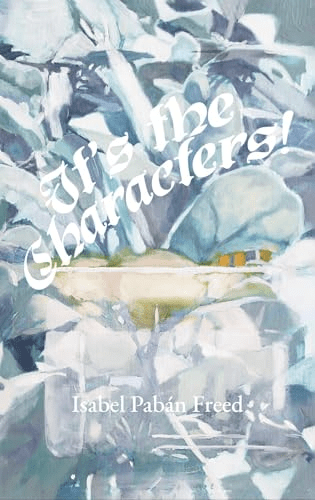
It’s The Characters! by Isabel Pabán Freed
Date: October 20th, 2025
Publisher: Self
Genre: Metamodern, Literary Contemporary, Science Fiction, Psychadelic
Website: https://www.isabelpabanfreed.com/
Substack: Isabel1000
Purchase: Website
THIS IS A FULL SPOILER REVIEW. YOU HAVE BEEN WARNED.
If you want to read the most challenging novel of 2025, look no further. Freed is back in force with her second novel, and my god it’s a doozy.
It’s the Characters! is a far less accessible title than Freed’s debut novel School, which I gave a perfect 10/10 rating. Obviously that’s an impossible standard to live up to, and I did like this novel slightly less than School. But while the actual reading experience of It’s the Characters may not have the magical quality of Freed’s debut novel that so captivated me, it makes up for it in technical rigor and an ambitious metamodern story structure that demanded a full reread before I felt even remotely comfortable stepping up to write this review.
Both the most frustrating and the most brilliant choice in this book: the complete and utter lack of dialogue tags. You have to respect the commitment of an author who never tells you who is talking, and who entirely demands that the reader pay actual, close attention to the story in order to follow along. It’s the Characters! is not shy about demanding your attention, and if you try to sleepwalk through the novel, you’re going to be deeply lost. In general, dialogue can get away without tags because of context clues in the prose; but Freed’s sparse style works almost like a sensory deprivation, drip-feeding you the slightest bits of detail, just enough to piece it all together, but never enough to allow for a comfortable read.
Don’t let the short page count or the sparse prose fool you. This is not a casual read. But if you’re willing to buckle down and immerse yourself in this book’s world, it will reward you threefold for your efforts.
I won’t lie – I do think that the difficulty in following basic aspects of dialogue is what holds this book back from meeting School‘s bar. I’ve read this cover-to-cover twice, with two separate live threads and a fair amount of backtracking and close reading, and there are still passages where I genuinely have no idea who is saying what. If the writing were any less good, it would be a major problem for me. At the same time, Freed’s precise usage of nuance and ambiguity are also what make this a great novel, not just a good one. While it’s not on the same level for me as the best reading experiences of last year, It’s the Characters is an enormously valuable work, and demands literary analysis in a way that no other book I read does.
On my second reread, I had a major question that I posed to myself: what does this frustration of dialogue accomplish for the novel? It’s far too deliberate to be unintentional. To really get across why I think this book is excellent, I’m going to do my best to answer that in this review, in the hopes of convincing you that you should read this book, even if it’ll push you past your literary limits.
At its core, I believe that It’s the Characters! uses its dialogue style to capture alienation to fantastic effect. Our narrator is deeply dissociated and sleepwalking through her own life, and Freed sets out to capture that not just in the events and descriptions of the novel, but in the structure of the prose itself. This is a first person narrator, but the “I” we follow is fleeting, rarely descriptive, and to the point. She doesn’t mince words. And the lack of dialogue tags is one of the strongest expressions of character in a book with “character” in the title – there’s not an ‘I said’ or ‘I thought’ in the book. The ‘I’ comes out most strongly in brief action beats – leaving, coming, going – or in the vivid moments of unreality that make up the bulwark of the book’s prose: drug trips, nightmares, daydreams, and the irrealis spaces between.
This had a fascinating effect on my reading experience, one that notably shifted upon reread. Because I was struggling so severely to follow basic plot and character elements in my first reading, I hyperfixated on the narrator as the fulcrum of the plot. She was, in a word, the only part of the novel I could grapple onto. So I did. I was eagle-eyed for those brief moments of narrative selfhood, the little glimmerings of articulation that emerged through the sea of unattributed speech. Perspective was the only continuity across the confusing scenes. I didn’t have the focus to spare for the side characters, for the details. My whole attention was fixed on getting through to the end of the book.
But that’s such a brilliant encapsulation of who our main character is, and the struggles she’s going through. The main protagonist of It’s the Characters is an addict struggling with OCD and a life that’s collapsing at the scenes. She’s deeply dissociated, she’s isolating herself from her friends and social network, and her own mind is leading her along down the merry road to self-destruction. Freed’s narration does a brilliant job of capturing the actual lived experience of her psyche. The scenes of irrealis are so vivid because the narrator only feels whole and present when she’s tripping off her ass. The dialogue is so sparse and difficult to follow because she’s completely checked out of her own life. The protagonist can’t follow her own social relations, and so the reader can’t either. And through a series of deft slight-of-hands, Isabel Pabán Freed succeeds not just at depicting the struggle, but at forcing the reader into the headspace of the narrator. Unless one reads this book with a disciplined eye for critical analysis, the narrator will drag you down into her extremely biased headspace alongside her. It’s the Characters! is an absolute masterpiece of unreliable narration.
Here’s what I saw when I read It’s the Characters! for a second time. I saw an incredibly well-realized portrait of a life, hovering in bilious outlines just beyond the hostile membrane of our narrator’s ailing perception. I saw a sympathetic portrait of a woman losing her grasp on all the things that make her a person, in a word. I saw a portrait of side characters trying and failing to make contact, to break through the veil and connect, not just with the narrator but with the readers – and I, like our narrator, wasn’t able to make those connections on my first read-through. But the main character doesn’t get a second read-through. I saw an absolutely devastating portrait of the ways that addiction and mental illness can rot your life from the inside out and leave you a hollow shell of yourself. There is a portrait of a woman to be drawn from this novel, but it’s shown to you in negative: in traces, in memories, in absences. You’re handed film negatives and asked to develop the photography yourself.
Here’s where the meta in metamodern comes in. In this character study of a novel, the main plot centers around a study of a ‘substance’ called CHARACTER, which serves as the primary addiction correlate in the story. CHARACTER is a black orb that induces hallucinations when the narrator touches it. It starts out as a ‘drug’ trial, but before long, the protagonist’s trips to the lab have turned into a little black ring that never leaves her finger, and she’s not limited her ‘experiments’ to controlled tests. It is a very open question what any of this means or represents. I believe that It’s the Characters! takes place in the same broad universe as School, which has a similarly shadowy tech organization and extremely high concept ending, something akin to Roko’s Basilisk, though not so brute. The fundamental ambiguity, or genius, of this is simple: in a novel that constantly bends reality of perception, is it the characters? Or is it the CHARACTERS? It’s an even more delightful question because of the joyful exclamation of the title – It’s the Characters! The ‘characters’ that the narrator meets through her drug hallucinations feel far, far more real on the page than the actual people in the narrator’s life. And then toward the end of the novel, Freed goes even more high-concept with this fascinating muddle of unexplained symbology and theme by introducing a new drug trial called FICTION, and, well. I’ll let you spool that one out for yourself.
There’s a quote from Alyson Rumfitt that’s always stuck with me about how a great haunted house in horror fiction is never just a metaphor; it has to be real too. For me, that’s what the technology in Freed’s work represents. It’s an idea and a metaphor, but never just an idea. To that end, one also always has to remember that Freed’s biggest influence is David Foster Wallace, and all of the conceptual heavy lifting that goes into a book like Infinite Jest. Novels plotted in fractal form. Science fiction about tennis. The works.
It’s the Characters! isn’t just a novel that demands literary analysis. It requires it. Its meaning must be argued and constructed before it can be understood. My interpretation in this review is only one of many possible readings of this novel, and I’d argue that that’s what gives it such literary credence as a statement text. That’s also why I feel comfortable writing this as a full spoiler review. I genuinely think I could give you my best full summary of the events of this novel, and I would barely capture the outline of it.
The ending is a great example of how this book doesn’t unfold until you begin to interpret it. On my first readthrough, I thought it was confusing and abrupt. There’s a bombing, the narrator goes to visit an injured friend – which friend? I think the rabbi? Who knows – in the hospital, an eldritch abomination approaches, cut to black. It did mirror the end of the first book, so I just assumed that it was a high concept tie-in I didn’t understand because it’s been over a year and a half since I read School. And who knows, maybe it is! But on my second reading, I spent the whole book trying to figure out what the hell the ending means, and it has depth.
The ambiguity lends itself to a whole host of possible readings. You can make a literal reading about the creature as a vision, a hallucination, CHARACTER itself. You can make a tie-in reading that connects the novel back into the Bartelby Initiative that ties the series together and connects this novel to School, which itself reads as a high concept reference to Melville’s Bartelby the Scrivener. For me, the most compelling reading of this final scene is an overdose; the main character’s addition has spiraled, and they’ve finally pushed their body and mind too far. But it’s entirely ambiguous whether the narrator lives or dies at the end of the story. But an equally compelling reading could hold that it’s a representation of the narrator’s bedridden friend passing on.
None of these are correct or even textual interpretations. But it’s the overdetermination that folds and unfolds and refolds the semiotics of Freed’s prose that make it brilliant. None of it needs to be read, all of it can be read. And what emerges is a fascinating discourse on the semantic work of fiction itself, and if that’s not the beating heart of metamodernism as a literary movement, I don’t know what is.
I’ve gotten all this way into the review without even starting to talk about the “noir” element of the story, which is a series of serial killings that seems to exclusively target the narrator’s friends and queer writers. Let me tell you – if this novel is a murder mystery, I haven’t even begun to solve it. I genuinely have no idea who the killer is or what any of it means, but I do think there is a meaning here, even if I can’t begin to parse it. How all of this fits into a 160 page ebook is beyond me. Freed also motions that there are formatting things lost in the digital format, so it’s entirely possible I’m missing structural context.
I have, and I mean this so genuinely, so many unanswered questions that I’m tempted to pick the book up and read it for a third time. What’s the deal with the murders? What is “The Movement” with the tagline “Is Humanity Worth Saving?” and why does Freed show us the sticker twice? Why is there a repeated advertisement for an unnamed omni-app that does everything? Why is there a wetsuit hanging on the table in an early chapter? Who the hell is the other man with the ring? What does the name change for the weed company mean? What am I supposed to make of all the deeply philosophical conversations that happen in the hallucinatory irrealis of high sci-fi space? Why is the first time the absurdly named sci-fi pastiche drug “nlorp” gets smoked the only font change in the book? This is going to be a several-thousand word review, and I’m barely scratching the surface of the knot that Freed has created here.
None of the ambiguity, however, can take away from the quiet tragedy of what is on the textual page, and that’s a brutal story about addiction slowly ruining a life. CHARACTER’s hallucinations may not have a set meaning, but the way they’re portrayed tell a clear story – from the slow shift from experiment to routine, the secret keeping, the futile attempts to quit, the alienation from loved ones, the desperation of a hit that’s losing its potency, and the ultimate escalation in substance usage to a potential overdose. The way that the ring symbolizes how addiction becomes a literal part of one’s body was powerfully done – it’s got major Lord of the Ring influences, the way that twisting the ring becomes an escape from reality, Bilbo’s invisibility, the narrator’s visions. But It’s the Characters! does not have a eucatastrophe at the end of the story. There is no Mount Doom to destroy the ring. Nobody in this novel has the slightest conception of the absolute good. There is only the slow, pallid creep of death, whether real or metaphorical; what dies first is reality itself. A classic piece of symbolism encapsulates this shift, the slow bleaching of the ring from black to white, a mystery to a shroud.
The powerful device Freed uses to accomplish this is perhaps the most distinctive stylistic choice in this book: the prolific usage of subheadings to divide the narrative. Rather than using chapters, It’s the Characters! is broken into hundreds of little sections, almost vignette-like in their structure, that frame the story. This is often used to quirky or humorous effect, with lots of charming one-liners that help punctuate the confusing stretches of dialogue and keep the reader grounded in the narrative. Counting is used both to bracket the usage of the CHARACTER substance and the serial killings throughout the book, and it’s emblematized in these subheadings.
The darkness of the addiction commentary – at a certain point, the narrator stops counting how many times she’s used the substance. You don’t realize how routine it’s become until you see her twisting the ring without telling you in the subtitle. By the end of the book, it’s impossible to know what’s real and what’s a CHARACTER hallucination – perhaps fitting that this is when FICTION comes into play.
Have I mentioned that this novel is genius yet?
Though I still would need another read – and possible a physical copy to annotate – before I could make a confident reading, this counting motif seems to me a core linkage between the addiction/experimentation plot and the serial killer plot, as both slowly count up over the course of the story. There’s a potential drug epidemic reading, a mass death that moves in unitary silence through the queer community. That has echoes of AIDS too. I also could see an interpretation, though it may be a stretch, that the CHARACTER company is responsible for the murders, or perhaps the narrator is somehow involved during her moments of irrealis. But I can’t say for certain, so I’ll leave the question open.
While it’s not as riotously funny as School, this novel still has its moments of breathless weird humor, like a local poetry slam that rhymes about pussy with the most inane repetitive verse you can conceive. Freed’s penchant for these emergent strange moments carry throughout the story – the vignette structure lends itself well to her favored dramatic tangents, which can spiral wildly in unexpected directions, but only for a few paragraphs. Then it’s always back to the methodical, unrelentingly hostile dialogue. You never quite know what’s going to be on the next page.
I have many mental health diagnoses, none of which are OCD, so I can’t personally comment on the narrator as OCD representation. But given how good the rest of the novel is, I’d easily venture that there’s plenty to unpack there too. This is certainly far less cliche than most of the OCD fiction I’ve ever read.
I’ve nearly talked myself into another 10/10 here, but at the end of the day, It’s the Characters! works way better for me as a literary object than a reading experience. It’s doing brilliant things, but it just didn’t grasp me. When I put the book down, I didn’t have that same sense of catharsis and awe as I did with School. I was genuinely perplexed about whether it was good or not, or what I had even read in the first place. And while this review should make it clear that I’ve come firmly down on the side of excellence, I’ve still got that lingering sense of detachment, that beautiful cultivation of alienation from the text. I can babble on about this book as a literary scholar for thousands of words, but at the end of the day, I thought this book. I didn’t feel it. And for me, that’s the difference between a 9/10 and a 10/10. If it’s not capturing my emotions, if it’s not wrapping me up in the experience, it’s missing out on that elusive quality that makes great literature so special and endurant. And it just doesn’t stand up to A/S/L or especially Autumnal Conductor as a personal favorite when I look at the release slate from last year.
And the dialogue is so frustrating. Goddamnit, I’ve read the whole book cover-to-cover twice, I shouldn’t still have scenes where I don’t know who’s talking. I shouldn’t be uncertain who’s in the hospital bed at the end of the book.
I’ve already given Freed a 10/10. I think that a 9/10 is a perfectly respectable second showing. If this feels like a snub, then that’s only a testament to how Isabel is one of the greatest transfeminine writers in the industry today.
⭐⭐ 9/10


Join the discussion! All comments are moderated. No bigotry, no slurs, no links, please be kind to each other.