
[TRIGGER WARNING] This article will be discussing DID and all of its various causes, symptoms, and impacts, including but not limited to abuse, childhood sexual assault, rape, incest, suicide, homelessness, and other forms of state and cultural violence against transfeminine and plural individuals. Please read with care, and take breaks if needed.
[DISCLAIMER] I’m not a doctor and none of this is medical advice. If you’re struggling with dissociative symptoms, please consult with a psychologist or a licensed medical professional for guidance, not me. This is media criticism and feminist theory, not psychological guidance.
[AUTHOR’S NOTE #1] As will be elaborated upon later in the article, there’s a very significant divide in the plural community between people who identify more with the “Dissociative Identity Disorder” diagnosis versus the demedicalized “Plural” label. I am writing this article from the personal perspective of identifying with both, and I will also be both discussing and critiquing both at various points. If I am using the words “DID” and “plural” somewhat interchangably, it’s because it A) reflects my personal experiences and B) is the most effective way to communicate the issue to a non-plural audience.
[AUTHOR’S NOTE #2] “Syscourse” between the endogenic and traumagenic plural communities is a discourse constructed around an ongoing debate about the causes and origins of plurality. For reasons that I will discuss extensively later in the article, I believe that this deontological (regarding the causes of being) framework is a fundamentally unproductive paradigm, and that activists are better served focusing on the social and material nature of pluralphobia in its various manifestations. The “DID” or “plurality” I discuss in this article will resemble the conventional understandings of the terms and issues as they manifest in common parlance. I do not care about the deontology of alterhood, and while I respect deontology’s importance to the endogenic and traumagenic communities, I have exactly zero interest in engaging on the topic.
- What is Dissociative Identity Disorder?
- Systemhood and Transfemininity
- The Transmisogyny of Popular Pluralphobia
- “It could be Multiple Personality Disorder”
- CORE_FAILURE
- Endogeneity, Syscourse, and the Plural Community
- System Accountability
- Conclusion
What is Dissociative Identity Disorder?
Transgender women (hereafter “trans women”) are estimated to comprise approximately 0.1%–0.5% of the overall U.S. population; however, trans women are at a far greater risk for experiencing physical or sexual abuse, and/or psychological distress when compared with other adult populations. Over the past decade, survey-based research with trans women has found reported rates of physical abuse ranging from 39% to 47%, and sexual abuse rates ranging from 50% to 59%.
-Kussin-Shoptaw, Fletcher, and Reback, LGBT Health, 20171
Transfemmes are no stranger to trauma, dissociation, and trauma disorders. As a population, transgender women and transfeminine nonbinary people (especially those of color and with other intersecting marginalities) are disproportionately more likely to experience sexual, physical, familial, and societal abuse, homelessness, incarceration, violence, suicidality, and a wide range of other risk factors and forces of violence. As a result, transfeminine people are at a disproportionate risk of developing Post-Traumatic Stress Disorder (PTSD), a disorder caused by exposure to traumatic events classified under the broader umbrella of dissociative disorders, AKA “mental health conditions that involve experiencing a loss of connection between thoughts, memories, feelings, surroundings, behavior and identity.”2 As the Mayo Clinic writes, “Dissociative disorders usually arise as a reaction to shocking, distressing or painful events and help push away difficult memories.”3 According to a 2017 study by Reisner et al. (which inexplicably specified FTM cases but not MTF), an astonishing 76.9% of individuals living full-time post-transition exhibited symptoms for a clinical PTSD diagnosis.4 What this indicates is that not only are dissociative symptoms of Post-Traumatic Stress prevalent in transfeminine population, but also that a majority of individuals under the broader transfeminine umbrella may be suffering from a dissociative disorder to some intensity or degree.
Dissociation is a term that gets cited often, and just as frequently remains poorly understood, even among those who experience it. WebMD describes dissociation as “an involuntary experience that occurs when you feel disconnected from yourself or your environment,”5 and you don’t need to have a full-blown dissociative disorder to have experienced it. Have you ever spaced out during news coverage of a major political event (think 9/11 or a major election) or a particularly stressful conversation with your family or your boss? Have you ever gotten distracted and lost track of time for a while? Any of that could be a dissociative experience. Dissociation is more than anything else a feeling – like staring at a blank wall or having trouble getting yourself to move. You feel distant, unfocused, dilute. Your head gets fuzzy or tight. Sometimes, it feels like you aren’t really living your own life, or like somebody else is moving or talking for you. In colloquial speech, people sometimes call this “being on autopilot.” It happens far more often than most people acknowledge.
Think about it this way. Your brain may work like a fancy biological computer, yes, but as with any computer, there’s hardware that makes the system run at all in the first place. Lots of miseducated critics and bad actors like to suggest that dissociation is a “choice” or a form of “laziness,” a piece of software that your brain has made an active effort to download and execute, and that dissociative symptoms originate within the mind, not the brain. This is not reflected by science or the clinical literature. Dissociation is better understood as a hardware issue, a physical rupture within one’s neurological circuitry between traumatic memories or experiences and their associated emotional responses. Recent research has shown that feeling dissociated may not just involve a disconnect within the brain, but also a synchronous mirroring of stimulus in the posteromedial cortex which can be repeated without its corollary mirrored stimulus (Vesuna et al. 20206). In layman’s terms, this essentially means that the feeling of dissociation, of removal from one’s body, can arise because the feeling actually occurs in two different parts of the brain, a literal removal, and further that in dissociative disorders, the “dissociated” response can then be repeated without the initial stimulus or action that caused it. Dissociative disorders arise when the individual experiences primarily this desynchronized form of dissociation as a recurring and impairing condition which can continue to resurface weeks, months, years, or even decades after that physical trauma response has stopped.
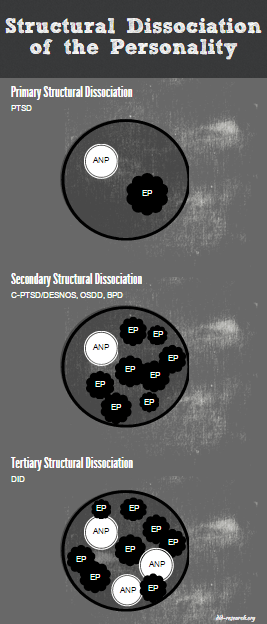
Most people will be aware of PTSD – shellshock, survivor’s guilt, the classic soldier’s burden. However, PTSD is only one disorder along a broader spectrum of dissociative disorders, which can be both less severe (Depersonalization/Derealization, Maladaptive Daydreaming) or more severe (Complex PTSD, OSDD, DID) depending on the individual circumstances. What underlies our contemporary understanding of all of these disorders, however, is what’s known as structural dissociation, a theory outlined by van der Hart, Nijenhuis, and Steele in their 2006 book “The Haunted Self: Structural Dissociation and the Treatment of Chronic Traumatization.”8 Research on structural dissociation has shown that contrary to many classical beliefs, the human mind begins not as a cohesive whole, but rather in a nebulous and fragmentary state – in essence, to be a young child is to be dissociated. Around the age of nine, the average human brain will fully cohere into a single unified whole. However, when someone experiences extreme trauma, this unity can be disrupted and dissociation will be caused as a result. With an individual with PTSD, a dissociated brainstate can emerge that sections off the emotions and sensations of a traumatic memory from the rest of the brain. This is the cause of a flashback. When an individual with PTSD experiences a flashback, their dissociated emotions assume temporary control of the mind, overwhelming all other stimuli.
However, the most extreme disorder on the dissociative spectrum is somewhat different from most of its lesser incarnations. Dissociative Identity Disorder (DID, formerly Multiple Personality Disorder) is primarily characterized by the emergence of unique and distinct “personalities,” clinically referred to as “alters,” colloquially often referred to as “headmates.” The way I will be discussing them, however, is as individuals. There is an onto-mythology in the DID clinical sphere of an “original” or “core” alter who is the “real” person, and their “system” whose only purpose is to shield them from trauma. This is reductive and hearkens back to an era of clinical psychology that predates the structural model. In the past, the only viable treatment option for people with DID was a motion toward “integration.” This involved the “host” alter, AKA the “actual person,” attemping to reabsorb all of their “parts” and return to a “normal” brainstate, meaning only having a singular identity or personality occupying their brain. This can only be accomplished through extensive talk therapy, which has a typical prognosis of a decade, requires extremely specialized therapeutic care to be done properly, and ultimately occurs with the goal to “cure” the patient of their dissociative disorder.
Over the last twenty years, the theory of structural dissociation has challenged and unsettled the psychiatric common sense of the 20th Century. Under the current best theory, Dissociative Identity Disorder can only occur when a child is exposed to severe trauma before their mind has fully cohered into a single articulate identity, i.e. before the age of nine or thereabouts. Rather than having “shattered” the coherent mind into pieces, which thus must be healed like a broken bone, structural dissociation proposes that “alters” in DID “systems” (the collective noun often used to refer to all the identities in one body) were in fact never the same person. Rather, the core alters in a system, failing to come together into a single identity due to severe trauma causing dissociation in the young mind, each develop on their own as individual “identities,” “personalities,” or just “people,” depending on your preferred verbiage.
This can be extremely hard to conceptualize if you’re a “singlet,” or an individual whose brain cohered into a unified self. You feel like yourself! It’s one of the fundamental human truths – you don’t have the option to be anyone other than yourself. There’s a popular misconception of Dissociative Identity Disorder, then, that individuals with DID simply “choose” to become another person to escape from their traumatic histories. While this may be accurate in less severe cases, it’s not the whole story. What makes DID so fascinating and challenging from, like, a fundamental metaphysical lens is that each alter in a system has their own sense of selfhood. Katy feels like Katy when she’s out – so Katy must be the core personality, right? But when John’s out, he feels like John. Hell, he might not even know that Katy exists!
The point I’m trying to make here is that there’s real value in understanding alters in dissociative systems not as “personalities,” not as “trauma responses,” but as people who happen to live the odd experience of existing in the same body as other people as part of the same fragmentary consciousness. While this may be difficult for singlets to understand, it’s something that resonates deeply for many people living with Dissociative Identity Disorder and its various manifestations. Relationships with other headmates are often deeply personal (as one might imagine while sharing a body) and inter-personal, social by nature. Headmates are family, friends, colleagues, bitter enemies. It’s for this reason that many dislike the clinical language, and prefer the term “plural” to described their lived experiences as a person sharing brainspace with other people. Throughout this article I’ll be discussing alters in dissociative systems who have developed their own communities, cultures, and networks of care out of necessity and survival. Alters can have their own individual beliefs about their selfhood, origins, and ontological nature. In my experience, it’s rather rare to find a system where everyone in it does agree about those philosophical questions.
Systemhood and Transfemininity
Before we go any further, I want to be very clear: I am both plural and a trans woman. “Bethany Karsten” is an endonym – there are four of us who have been actively working to make this website a reality, each with our own strengths, weaknesses, and personal views on both transfeminine literature and the world. I’m writing this from the #ownvoices perspective as a plural trans reader who’s always searching for better plural trans rep in fiction, and it’s my hope that writing this article will help to elucidate our community, and how silent yet common we are in the broader trans community as a whole.
From personal experience, I’ve known dozens of trans women who are also plural. It’s important to understand that most alters have a unique inner presentation, not dissimilar from a physical body, represented within the mind. Alters can take on a wide variety of appearance traits, among which variant sex and gender are very much included. People squabble about this, but there’s a concept in transfeminism that’s very useful for understanding this paradigm, found through the work of Julia Serano in Whipping Girl:
Throughout this book, I will use the word trans to refer to people who (to varying degrees) struggle with a subconscious understanding or intuition that there is something “wrong” with the sex they were assigned at birth and/or who feel that they should have been born as or wish they could be the other sex. […] For many trans people, the fact that their appearance or behavior may fall outside of societal gender norms is a very real issue, but one that is often seen as secondary to the cognitive dissonance that arises from the fact their their subconscious sex does not match their physical sex. This gender dissonance is usually experienced as a kind of emotional pain or sadness that grows more intense over time, sometimes reaching a point where it can become debilitating.9
Alters much like singlets have subconscious sex. What differentiates them from a singlet, however, is that multiple alters in the same body may have different subconscious sexes, i.e., in a system with seven members, one could have two alters who identify as men, three alters who identify as women, and three alters who identify as non-binary. Alters may also transition internally – one of the unique privileges and blessings of a “headspace,” i.e. the mind palace many systems develop as an imagined space for alters to cohabitate, is that the materia of the physical body is often more malleable than in meat-world (though less so than one might think or expect). It’s much easier to be gender-fluid as an alter in headspace than a physical person.
This can get confusing.
In this section, I’m going to be treating the intersection between plurality and transfemininity in two broad categories. Firstly, I’m going to discuss transfeminine people who happen to have Dissociative Identity Disorder. Secondly, I’m going to discuss the situation of femme-presenting alters who inhabit bodies that have been assigned male at birth. Ergo, first body-to-mind, then secondly mind-to-body. While there are a lot of similarities between transfemmes and femme-presenting alters in AMAB bodies, it’s important to recognize that many femme-presenting alters do not identify as trans. While a strict adherence to Julia Serano’s definition of “trans” would certainly include them as individuals who experience a dissonant subconscious sex, femme-presenting alters are not a gotcha tell-tale sign that the AMAB system as a whole is an egg or a trans woman in denial. There are men with DID who simply have femme-presenting alters while remaining satisfied as a collective with their assigned sex at birth.
One might be tempted to cite the fact that DID is more prevalent in women than men as “evidence” that men with femme alters are trans women in denial. This is bioessentialist bullshit, and it has way, way more to do with the fact that young girls are at a severely higher risk to experience childhood sexual abuse than young boys.
It is crucial to my argument that you understand that alters are people just as much as singlets are people – or, more accurately, that even if the system as a whole is only one “person,” no one alter has a stronger ontological claim to being that “person” than any other alter. Many systems live with the ongoing dissonance of having both a “collective” identity and a “personal” identity. What this means is that it’s possible for an alter to both be A) a trans woman with DID and B) a femme alter in an AMAB body. The two are not exclusive, often overlap, and each provide their own unique challenges. Basically it’s a Venn diagram. Let me visualize this for you:
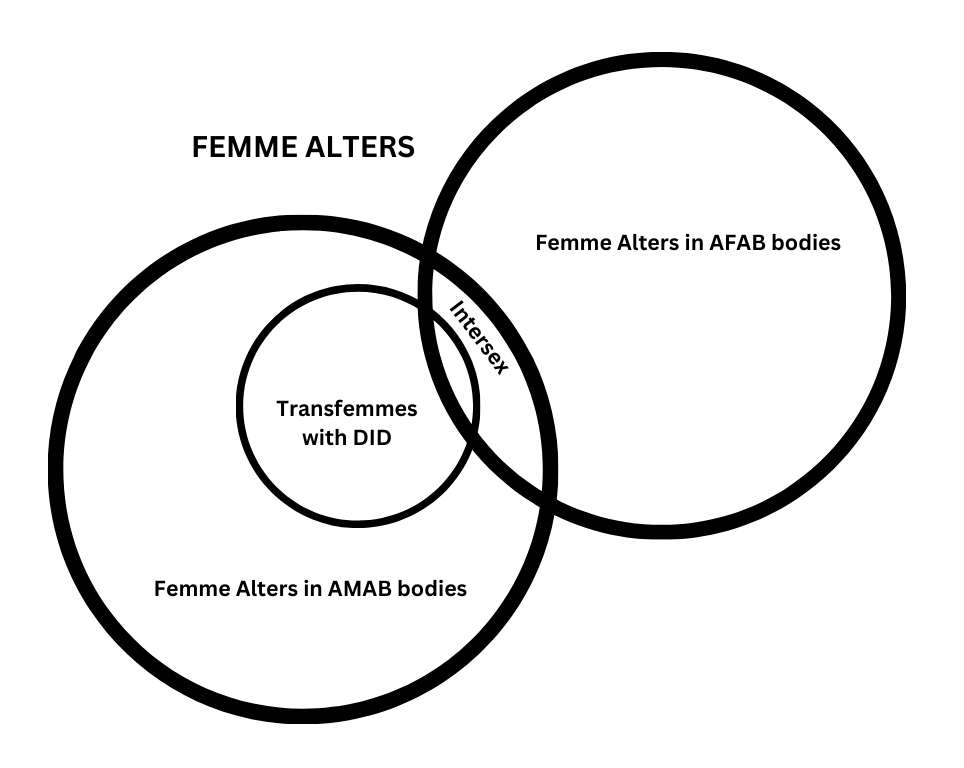
So basically, all transfemmes with DID have femme alters in AMAB bodies, but not all femme alters in AMAB bodies identify or want to identify as transfemmes with DID. (It should be noted that you could make a near-identical graph for masc alters and the same would hold true).
There are so many commonalities between trans identity and dissociative identity. One of them is a vast statistical underrepresentation arising from a severe and systemic discrimination – both the trans and plural communities are hard to accurately survey because of the secrecy that has often been necessary for survival. We don’t have accurate demographic data, and thus it is neither useful nor important to speculate on their statistical correlations until better research can be performed.
From our first perspective – trans women with DID – it’s clear that much of the “comorbidity” can be attributed to how severely trans children are at risk of significant childhood trauma. Awareness of gender arises young; a common age people cite for when they “knew” they were trans is around four or five, and that awareness of trans identity comes with a childish innocence. How should the trans child know that her father might abuse her for wanting a dress? Even without the slightest bit of psychological knowledge, it should be pretty obvious how easy it is for a trans kid to develop a serious issue with dissociation – they want something gendered, their parents scold them, the desire doesn’t go away, so they keep it to themself. Hide it from themself. Hide it well – really well. Hide it until “they” aren’t the one who’s hiding it at all.
So being trans alone can be sufficient trauma to plant the seeds of a dissociative disorder. That’s a risk factor, but generally not considered an ACE (Adverse Childhood Experience, the metric for severe childhood trauma used by clinical professionals). What it risks are all of the other systemic violences faced by trans women. Sexual abuse and harrassment. Physical violence, both within and without the home. Verbal, emotional, and physical abuse. Physical neglect – and yes, I would argue that allowing your child to wither from dysphoria is a form of neglect. In severe cases, unhousing and homelessness at a young age. Conversion camp. Ritualistic abuse. Abandonment. So on and so forth. Any one of these experiences can cause Dissociative Identity Disorder – even something as simple as bullying can cause DID – and trans women are often subject to a lot of them.
It is extremely common in transfeminine systems for there to be a male alter who develops in order to present the facade of a functional boyhood and keep the collective in denial. What this means is that it is very, very common in transfeminine systems for a power dynamic to form in which femme-presenting alters face violence from male alters in order to preserve the state of denial and keep the egg sealed. But this physical, mental, and sexual omnipresence of violence in the life of the femme-presenting alter goes beyond just trans women – it is a shared experience in the lives of many femme-presenting alters in AMAB bodies, especially when the system formed as a response to sexual abuse.
Whether that violence comes at the hands of a male alter or a masc-presenting transfemme in denial is completely irrelevant – internalized patriarchy is the operative principle of this form of abuse either way.
Nobody talks about intra-system sexual violence. Or if they do, it’s always framed as “oh well they’re just reliving past experiences, if they just heal from that trauma, they won’t have to imagine sexual abuse anymore.” This strips away any semblance of agency from alters who experience intra-system sexual abuse, and completely effaces the possibility of their personhood. In this sense, sexual violence is one of the fundamental forces which undermines the potential personhood of an alter. The abusing alter is not committing sexual trespass – he is a personality, he is a trauma response, he’s just programmed to be that way. And the femme-presenting alter is programmed to lay back and take it.
It’s a misogynistic construction, pure and simple. And the presence of intra-system sexual violence is even more normalized in AMAB systems, where excusing such violences as a “coping mechanism” is almost standard therapeutic practice.
Boys being boys – literally.
Don’t think that society doesn’t recognize this. There is very much an implicit understanding of the shocking and gruesome frequency of intra-system sexual violence in the public imagination of Dissociative Identity Disorder. Does that mean that society has a feminist praxis regarding the autonomy, personhood, and therapeutic protection of femme-presenting alters?
No. Nope. Not at all.
Basically it just means that all plural bodies get treated like (transfeminized) serial killer rapists.
The Transmisogyny of Popular Pluralphobia
Oh, Alfred Hitchcock. We were going to have to talk about you eventually.
Meet Norman Bates.

Norman Bates is an evil psychopathic murderer. He also clearly has some form of either schizoaffective or dissociative disorder which has caused him to converse with his “mother,” who also happens to be a serial killer. Norman Bates is a sexual predator who “becomes” the alternate personality of his mother (who he murdered) whenever he is attracted to a woman, who then proceeds to kill said woman out of “jealousy” because his “mother” wants Norman all to herself. Implicit here is the Freudian Oedipal Complex – Norman wants to fuck his mother, he killed his mother, he is his mother. All of the nastiness. Effective horror, right? Norman Bates isn’t just an icon – he is the archetypal psycho, the main character in the film that bears that name.
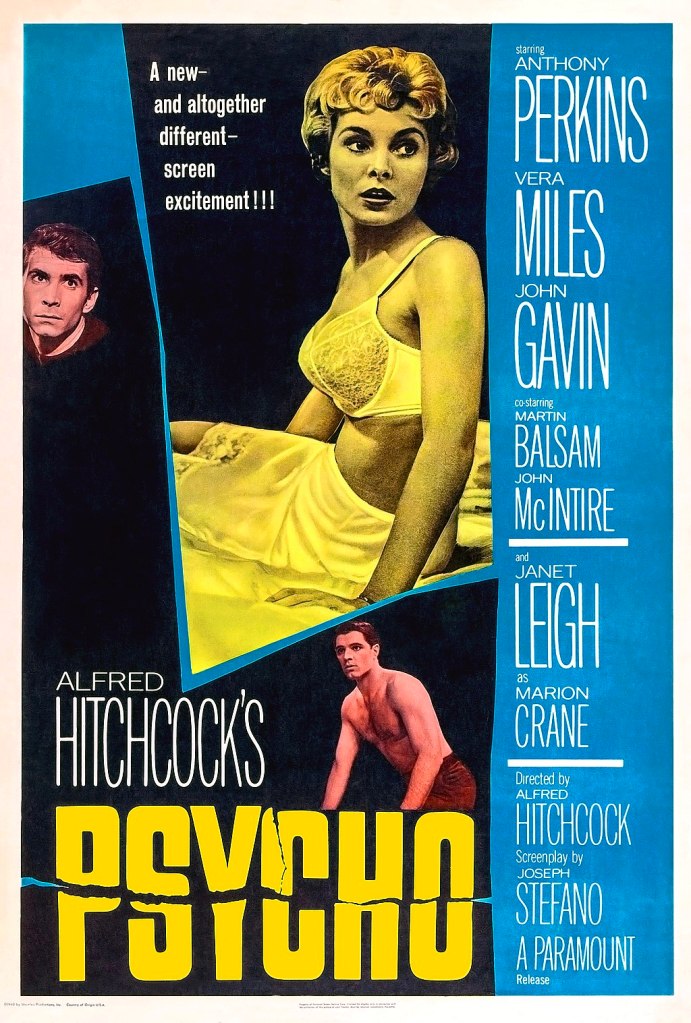
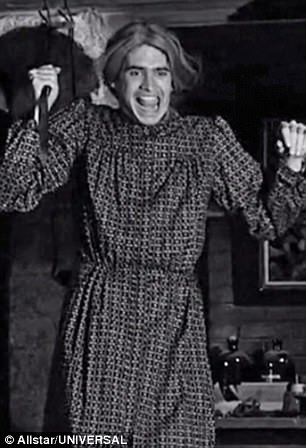
The poster for Hitchcock’s classic 1960 film Psycho advertises it from the cover – an innocent white lady stripped down to her underclothes with the ominous figure of a male predator lurking in the shadows. Lots of trans readings have been made of this movie, but almost none of them have been plural-sensitive. What I mean is that while Norman’s “mother” is often written as a reflection of Norman’s predatory desire for young woman in the external world, there is a corollary reading wherein Norman’s predatory serial killer behaviors against young woman are a reflection of his inner tendencies toward the rape and murder of the imagined figure of his mother. The two are symbiotic, and while transfeminine activists and writers have been largely successful at unthinking the idea that transitioning to be a woman somehow represents a predatory sentiment toward other women, there has been a broad failure to grapple with the fact that an external mythos of the plural person as a sexual predator completely overwrites the actual reality of post-traumatic sexual violence faced by many femme-presenting alters. This is A) a violence that affects nobody outside of the system, B) is almost always invisible, and C) often emerges due to molestation and childhood sexual assault against young boys, which is a notorious source of shame, secrecy, and violent suppression. It’s victim-blaming pure and simple on multiple levels – both victim-blaming against young male victims of sexual violence, and victim-blaming against the femme-presenting alters who have the misfortune of growing up within those crucibles of violence and repression.
But no, of course Norman Bates only kills his female victims while wearing a dress.
What this produces is a certain collapse of the feminine alter into her male sexual abuser – another clear symptom of society’s inability to conceptualize alterhood – out of which emerges a particularly unholy abomination of the popular conscience: the “killer alter” trope, or the omnipresent image of the plural serial killer.
This is – extremely unfortunately – a trope that gained traction due to a real-life manifestation. In 1977, the serial killer Billy Milligan, better known as the The Campus Rapist, went on extremely public trial for his horrific crimes. Milligan had DID and attributed many of his crimes to his alters, and in doing so, would leave a stain on the entire plural community that still lingers to this day.
One of Milligan’s alters was named Adalana. Adalana was a femme-presenting lesbian in an AMAB body. She was a caretaker alter who took care of the system.
She was also allegedly responsible for all of Milligan’s rapes.
So the woman – more importantly, the lesbian in a male body – is the rapist, and the man is merely the accessory to her crimes, the murderer silencing the victims in her wake. We cannot overstate how prolific this image of plurality became. This is hardly the only reason why Milligan’s story is so destructive to the plural community, though. Billy Milligan’s other claim to notoriety was the fact that because of his DID, he escaped a death sentence and was institutionalized on an insanity defense instead. In essence, Milligan was able to use his DID as a way to avoid accountability for his crimes, which has created the pervasive lie that not only are people with DID dangerous serial murderers and rapists, but also that their DID is a convenient tool to literally get away with murder. This is manifestly false, and we’ll discuss the concept of “system accountability” in the final section of this essay and why it’s so important for authors to portray in plural-informed fiction, but for now I want to keep tugging on this thread of the femme alter in the mythos of the plural serial killer.
Billy Milligan has been immortalized in film and true crime documentaries many times now. One of the more notorious recent depictions of DID was based off of Milligan – M. Night Shaymalan’s 2016 movie Split, where the “caretaker” alter Patricia runs a tyrannical cult in her AMAB body that oppresses her innocent male alters and harnesses the power of “The Beast” to kidnap, murder, and eat teenage girls.
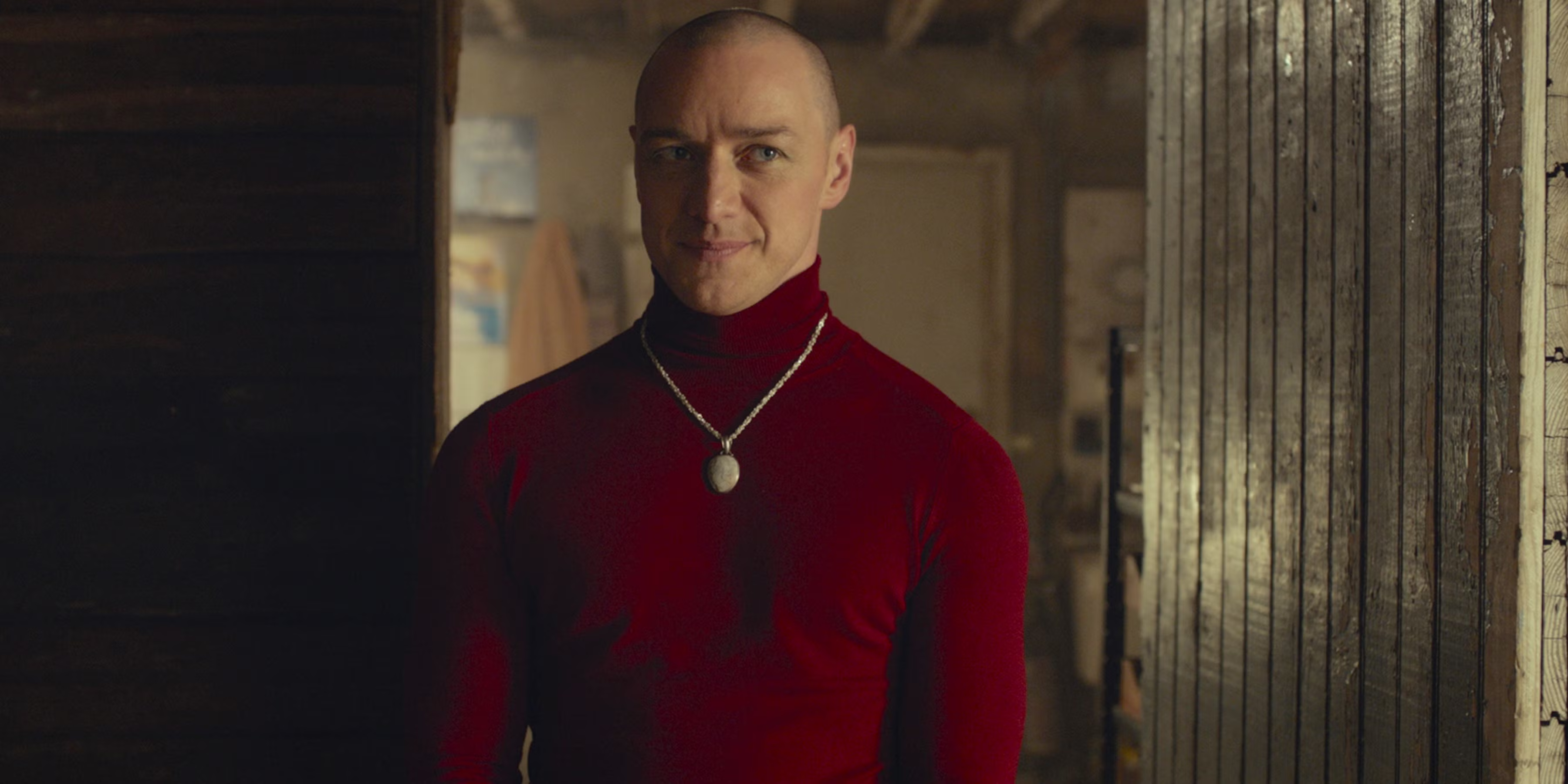
Let’s not cut teeth – Billy Milligan was one of the worst human beings to ever walk the face of this Earth, and anyone who says otherwise or tries to defend his alters needs a hard reality check. He was in no way, however, representative in any way of Dissociative Identity Disorder as a condition, and anyone who tries to claim so is a bigot. What Psycho, Milligan, and Split all obscure is the way that intra-system violence affects alters – how the actual victims are disproportionately not other humans in the physical world, but marginalized alters within closed systems of power that have little to no means of seeking external aid or support. Depictions like this are to the detriment of everyone in a dissociative system – by blaming the femme-presenting alter for the state of sexual violence in headspace, popular media both silences the victim and stigmatizes the perpetrator, driving the system further into denial and rendering ever-more-distant the possibility of healing, restorative justice, and community care.
The clearest illustration of the fact that the general populace has a underlying intuition of intra-system violence comes from the 2003 horror film Identity. This film gets rightfully critiqued for perpetuating the “killer alter” trope, but to this day, it is probably the only piece of popular media to ever take a hard look at intra-system violence, and in a plural-informed audience, becomes an indispensable metric for unthinking system power dynamics. So let’s talk about it.


Paris Nevada is a sex worker who’s pulling a reverse Maria Griffiths and driving to Florida to start an orange orchard, and she is one of the most badass trans characters in cinema who gets absolutely no recognition whatsoever. Ed Dakota is a retired ex-cop who finds himself in the midst of a string of inexplicable murders at a motel (which is definitely not just the Bates motel reskinned with Aughties graphics), and the two of them attempt to get to the bottom of the mystery. Paris and Ed also both have the grave misfortune of being alters in the body of serial killer Malcolm Rivers, who is currently sitting on death row getting tested for insanity.
What really makes Identity stand out from movies like Psycho and Split is that is has a staunch commitment to depicting the interiority of life with DID, albeit through the chokingly pluralphobic lens of the mind of a serial killer. Even though the watcher knows from early on that Malcolm has DID, the alters don’t know that, and are stuck in a pantomime of a murder mystery, trying to understand why their world is coming unraveled at the seams. Paris and Ed don’t understand that they’re alters – they’re people, people who are trapped in a horrible violent situation, and they need to find a way out. In plural circles, Identity is rather notorious for perpetuating the idea that one alter can “kill” another – which is complete bogus, for the record – but a far more meaningful way to read this is not as a literal murder but rather as a metaphor for the inescapable dread of intra-system (sexual) violence which so many alters face, especially an alter like Paris Nevada, a sexual protector in an AMAB body that has other alters who have committed unspeakable acts of violence in the real world before.
The point isn’t that people with DID are serial killers who murder even their own alters in their sick, twisted mind. The point is that when the individuals in headspace have spent the entire movie desperately searching for a way out of their situation, the entire emotional crux of the film comes in like a fucking wrecking ball.
They’re alters.
They’ll never be able to escape their body, because they literally inhabit it. They’ll never be able to escape the serial killer – the thread of (sexual) violence – in their own mind.
They’re trapped.
Identity‘s twist isn’t even a surprise for the viewers, but it works – not because it’s shocking that Paris and Ed are both alters of this serial killer, but because the viewer suddenly has to grapple with the sheer dread of realizing that this beautiful plucky badass of a young woman is trapped inside the mind of a vicious male serial killer, forever, and that she is completely at his mercy and there is nothing anyone can do about it. You cannot save her. She cannot save herself. The only person who can offer her mercy is Malcolm, and well- It’s pretty obvious there’s no chance of that. As a film overall, the conceptuality of Identity is voyeuristic and gross. But as a femme alter, I can’t help but find Paris to be deeply relatable. Far more so than recent progressive portrayals of DID in film like Marvel’s Moon Knight (2022), I see myself in her, her struggle, her terror, the inevitability of her fate.
“It could be Multiple Personality Disorder”
I want to take a moment to shout out what is, as far as I can tell, the only other extended scholarly account by a trans plural person that’s ever been written on this topic. Small Cedar Forest’s 2014 article “On Transgender and Plural Experience” was enormously helpful for me while I was figuring out my plurality, and it provided a really crucial groundwork for the plural-informed transfeminism I’ve laid out in this essay. One of the major focuses of Cedar’s article was tracing the similarities between the clinical treatments of DID and gender dysphoria. Cedar wrote:
As with many trans people, those that do not have the “right” way of experiencing their plural identities are treated as suspect. While our own experiences with plurality have not always been positive, we have also found switching to be very positive and healthy for us. People should trust, at the very least, what others report as their subjective experience. Plurality should be defined by the subjective experience of having multiple selves, rather than requiring a specific narrative and formal diagnosis under a pathologizing framework. […] Having your experiences invalidated and pathologized, and being told that your experiences aren’t real (or are less legitimate) if they don’t follow a prescribed narrative, comes with significant personal consequences. All of this gets internalized and can lead us to seeking external validation rather than trusting in our own experiences. This was very much the case for us with respect to being both trans and plural. As we came to understand ourselves as trans, we went through an intense period of obsessively comparing our own experiences of being trans against those of other trans folks, and against mainstream understandings of trans experience. When things deviated from these narratives, we became very worried that our experiences were not legitimate, and that we were making things up to get attention or distract ourselves from other difficult aspects of our life. As we came to understand ourselves as plural, we had a very similar experience with obsessively comparing our narrative against that of others. […] This left us feeling really lost; knowing that we were experiencing aspects of plural selves that we couldn’t deny, but not feeling that we were “really plural”. I’ve heard attitudes towards non-binary gender folks as being as if you can pick the “male box”, “female box”, or “crazy box”. I felt like all I had left with my experiences of plurality were the “crazy box”, not being really plural, but definitely being different from a singlet. However, the more I chatted with plural folks, the more I recognized an incredible diversity of experience and that our experiences were actually more typical than not. It has taken us a long time to trust our own experiences as legitimate in themselves, and not need a great deal of external validation to feel okay.13
Cedar does a great job at observing the links between the clinical literature on DID and dysphoria, but the rabbit hole goes deeper than what they observed. From the early sexological days, male doctors who took an interest in the transsexual phenomenon were aware of the possibility of co-ed dissociative systems with both male and female alters. It would thus become an important part of the screening process for trans people, especially trans women seeking bottom surgery, to ensure that they did not have Multiple Personality Disorder. If a person did have MPD, then if they had even a single male alter, then it was assumed that they “weren’t really” a woman, and their gender affirming care was summarily denied.
This was in no small part due to the Harry Benjamin Standards of Care, the organizing document which provided the rules for all gender affirming healthcare in the later years of the 20th Century, which in turn cited the DSM-III, the then-current version of the core text of clinical psychotherapy which provides the official definition for every mental health condition. The DSM-III had a clinical diagnosis of “transsexualism,” which had the following conditions:
A. Sense of discomfort and inappropriateness about one’s anatomic sex.
B. Wish to be rid of one’s own genitals and to live as a member of the other sex.
C. The disturbance has been continuous (not limited to periods of stress) for at least two years,
D. Absence of physical intersex or genetic abnormality.
E. Not due to another mental disorder, such as schizophrenia.14
Obviously Clause E of this definition would have automatically precluded anyone showing visible signs of plurality from receiving SRS and other gender-affirming care. But there’s a double-embargo against the existence of plural trans folks here, and that’s the requirement of a continuous dysphoria. A male alter fronts twenty-two months into your two-year stretch and decides to be a little shit on main? You can kiss your hormones goodbye.
Plural trans folks in the 20th Century were uniquely positioned to not be able to receive healthcare; if you were openly plural and trans, you were far more likely to get institutionalized than you were to receive hormones. Even as awareness of trans bodies and identities steadily grew in the late 80s and 90s, MPD remained a stubborn sticking point for many gatekeepers of trans healthcare. I find the 1988 case study “A case of concurrent multiple personality disorder and transsexualism” by P. G. Schwartz to be particularly illustrative in this regard. This is a long quote, but I think it’s important to give a thorough picture of the way that MPD and transsexuality orbited each other in the psychological establishment:
It is difficult to accord primacy to either the MPD or the transsexual diagnosis in this case. The history indicates that the development of the two conditions was intertwined from the beginning, and appears to originate in the insistence by mother that her son be treated as a girl, and in the pervasive sexual abuse that has permeated the patient’s life from childhood until the present. The patient appears to have developed a gender identity disorder of childhood that progressed into a fixed transsexual adaptation, and to have developed a childhood form of MPD that became a rather classic and florid adult MPD condition. It would appear that mother’s efforts to give the patient a female name and dress him as a girl prevented the patient’s separating from the mother at an age-appropriate time, with the result that his preferred role model did not undergo the usual male transitional patterns of changing from mother to father (Stoller, 1968, 1985). Sexual reassignment surgery is irreversible. The choice to undertake it or not should be made in an atmosphere of free choice and informed consent, with full awareness of the possible consequences. It is doubtful that most MPD patients can make such a decision in an unencumbered manner. Furthermore, because the alters of an MPD patient may seize control and succeed in representing themselves in a transsexual pattern, and seek sexual reassignment surgery to solidity their claim to be truly and irrevocably in power, it is crucial to rule out MPD in potential candidates for this rather drastic form of intervention. Based upon his experience consulting in situations that involve transsexuals, Kluft (personal communication, September, 1986) concludes that the definitive treatment of the MPD should precede the serious consideration of sexual reassignment surgery. In this situation, it is fortunate that the male alters in this patient concurred with the decision to be female. One possibility that this suggests is that both a true transsexual and a true MPD condition coexisted, and that the same patient would have made the same choice even if there were no question of MPD. However, it remains within the realm of possibility that this preference is the patient’s least narcissistically damaging response to an unwelcome and overwhelming fait accompli. In conclusion, it is evident that a thorough evaluation is essential prior to a patient’s being accepted for sexual reassign- ment surgery. This evaluation should be particularly sensitive to the possibility of concurrent MPD, or to MPD misdiagnosed as transsexualism. Working with dissociative defenses and the consequences of sexual abuse issues must not be overlooked in the required treatment preparatory to undertaking the surgical reassignment.15
I would posit that this historical attitude within the field of psychology (specifically psychoanalysis) elucidates both why so few trans theorists have taken the time to sit down and consider dissociation and femme alters, and why so many femme-presenting alters in AMAB systems are reluctant to claim the “trans” label as a self-descriptor. For the former, disavowing plurality was a matter not just of political convenience but of survival – it didn’t matter how often you blacked out for a few hours, if you let your doctor or therapist know you’d be off hormones faster than you could say “Susan,” and for some folks that was a matter of life and death. The latter group feels reverberations of the DSM-III and the Standards of Care too – definitionally, if you were an alter in an MPD system, you were psychologically incapable of also being a transsexual, and trans women on the internet would be the first people to tell you so. The diagnoses may have changed over the decades, but those sorts of social intuitions tend to linger long after their truth has passed.
It’s at this point in the article that we finally get to shift gears and talk about depictions of plural identity in transfeminine literature! There are four books I want to talk to you about today, but I want to save the three novels for last. First though, we need to talk about one of the best trans memoirs, Emma Grove’s Lambda award-winning The Third Person, a graphic novel from 2022.
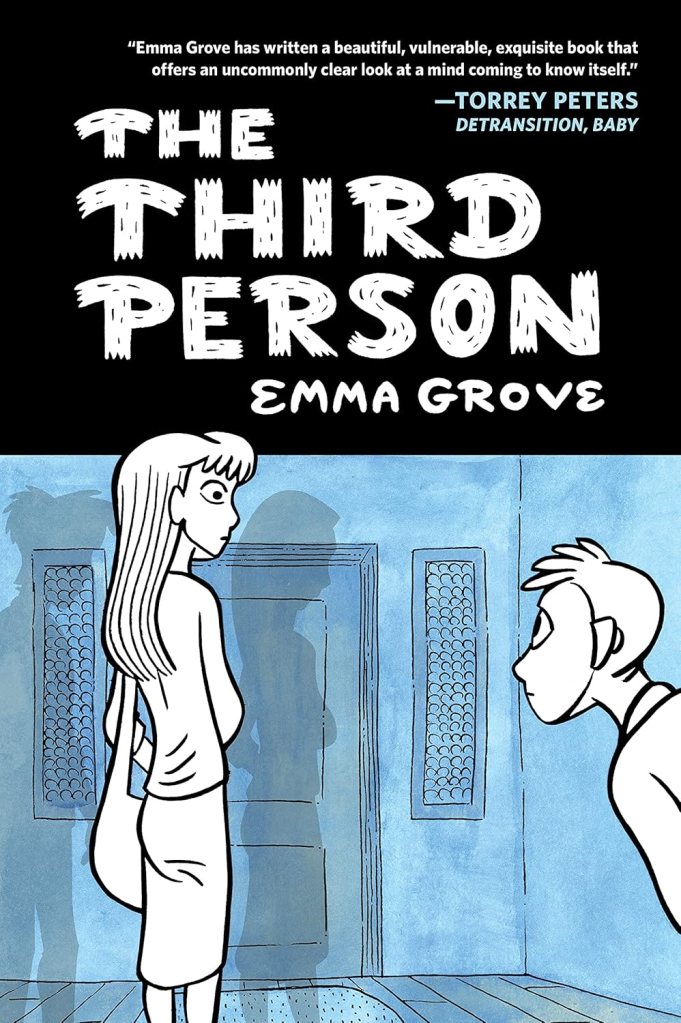
One of the reasons this book is excellent is that it offers a counterpoint to the narrative of plurality I’ve offered you above, and perfectly illustrates the fact that no two systems are alike, and no two healing journeys will run the same course. Emma’s therapy involved a final integration of all her alters, and The Third Person explores in depth what that process looks like, and what a powerful difference it can make in somebody’s life. Emma’s system had three alters – mine has twelve, some systems have dozens. One of the most important takeaways from this article should be that there is no correct way to be trans and plural. There are no litmus tests, no gatekeepers, no rules, no boundaries. Integration, functional multiplicity, something else entirely – at the end of the day, all that matters is your healing, your system, and how you experience your own gender, either collective or personal.
The vast majority of The Third Person follows Emma’s experience with her terrible gender therapist Toby, who is antagonistic, brutally skeptical, and ever so counter-productive to her healing journey. Toby yells, provokes switches, casts constant aspersions on her attempts to self-actualize, and, of course, casts Emma’s identity as a trans woman into doubt – a relationship which only begins in earnest when the therapist “discovers” her male alter Ed for the first time. The year in 2004. The DSM-IV may have been the ruling law of psychology for a decade, and Gender Identity Disorder may have replaced the old dogma of “transsexualism,” but the stains of doubt and ableism still linger upon the diagnosis. Emma is trying to receive gender-affirming healthcare through therapy, but her inability to recall any details from her childhood led her to a quick wall with her first therapist. Downtrodden, Ed tries again, but he’s doubtful that he’ll have any more luck the second time.
Emma’s system has a flawless solution to this problem:
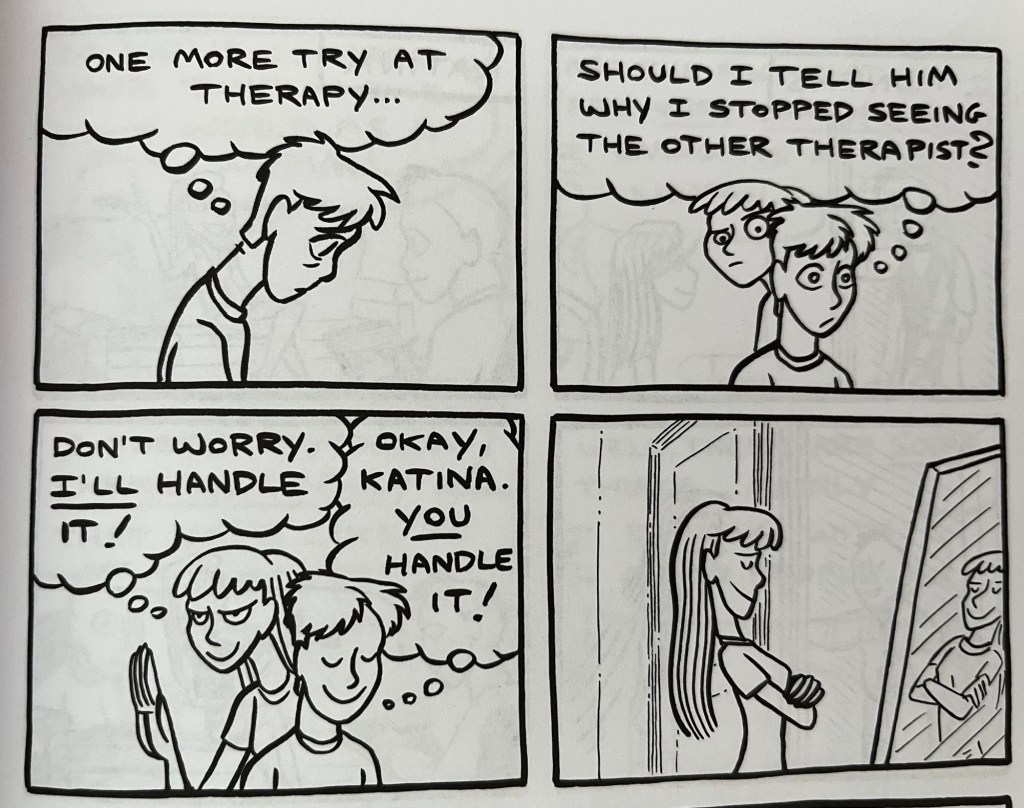
Katina sees Toby alone for two months, but it’s all glossed over – something isn’t right. Toby has been waiting for a “Gotcha!” moment, and, well, he gets it:
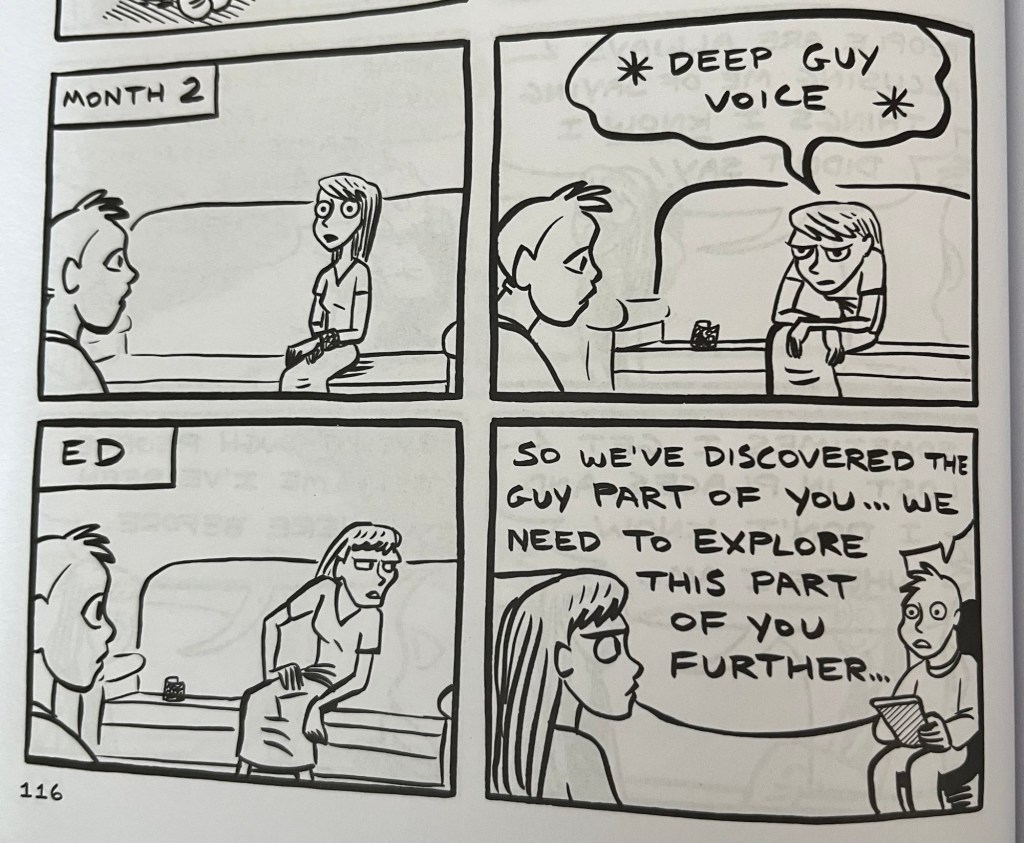
Here we get a very, very clear picture of how the rupture from transness happens for femme-presenting alters in AMAB bodies, even for alters who are part of a trans system. It does not always occur because of a lack of self-identification – just as often (sometimes implicitly so), it is a direct response to systemic forces of transmisogyny and disbelief on the part of the various gatekeepers who control trans plural life which leads to femme alters disassociating (and dissociating) themselves from overt declarations of trans identity, only reinforcing an overarching society belief that transfemininity is a fundamentally undesirable or dangerous condition. This odious sense of transfemininity as a stain or taboo lends itself to the production of a social contagion-esque derationalization of transfeminine alters – if even one alter makes the body look trans, the AMAB system rationalizes, then the whole system could appear like a tranny fag by association.
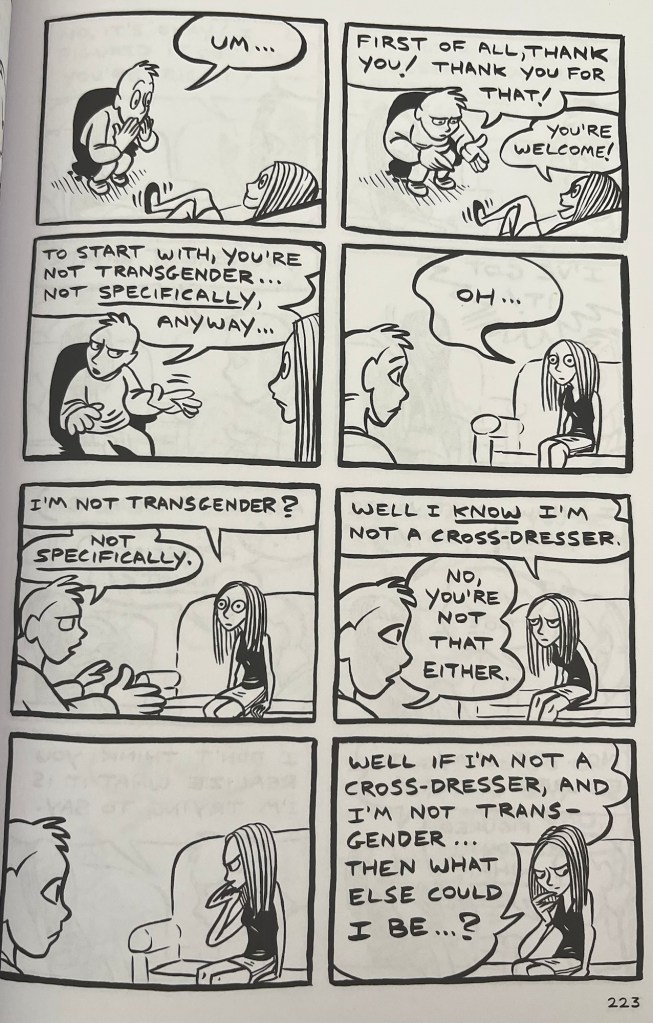
And then, because plural trans women are better than just about anyone else on the planet at rationalizing away all of their problems (the problem in this case being that Toby takes the lone male alter as a sign that they can’t be a trans woman):
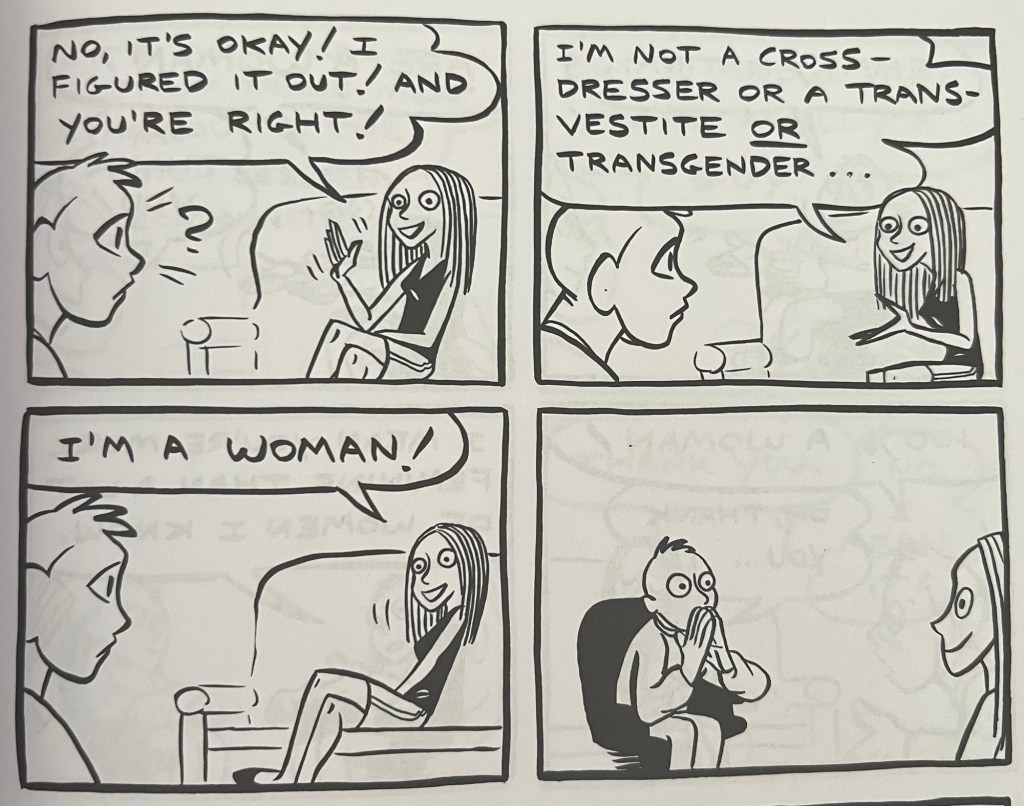
The next session, Toby lays this out for her in no uncertain terms:
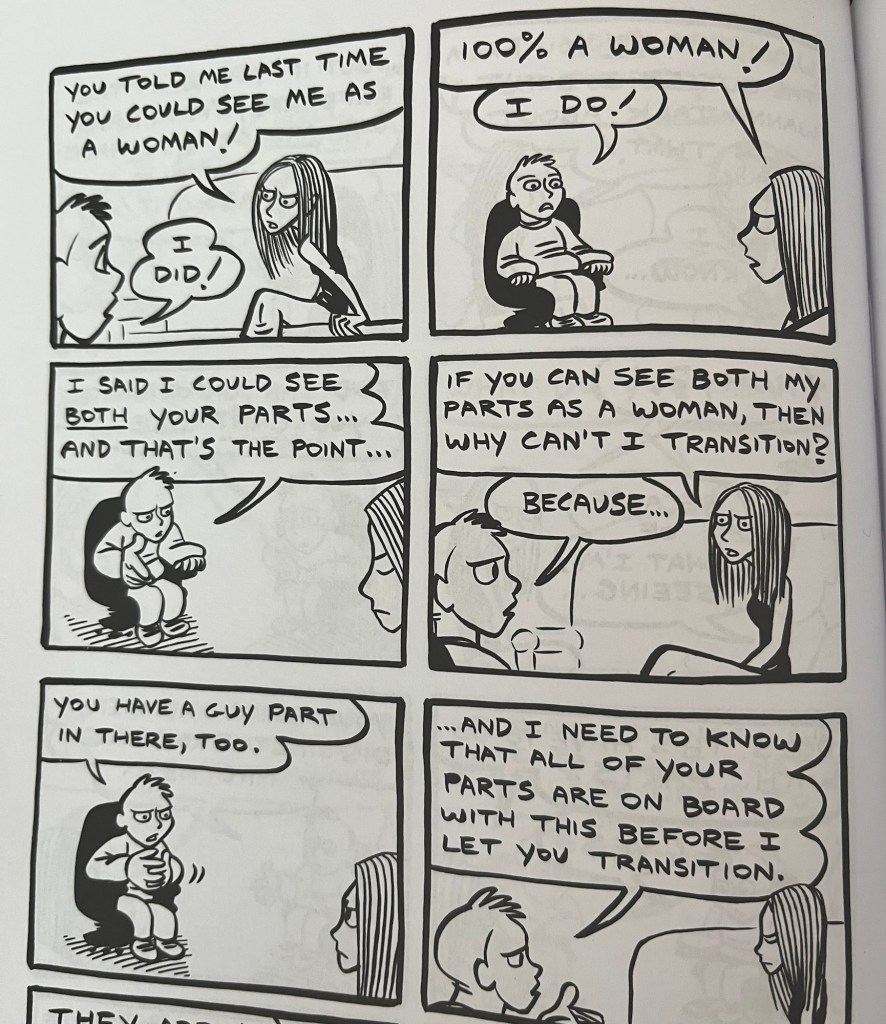
The implicit ungendering of the fact that Emma’s system A) isn’t trans, B) isn’t a woman, and C) isn’t a man who can say otherwise, even though D) the only reason that A and B have been held is a premising of her ontological manhood, is transmisogyny at its absolute worst. The plural system isn’t any gender. They collapse into themselves. The psychic man and the psychic woman cannot coexist – their only recourse for their sheer implicit impossibility (and the agony presumed) is to kill someone else, or rape each other. Either way, inevitably, they self-destruct.
Hence why The Third Person is a harrowing 900-page odyssey instead of a 20-page feel good comic about a plural transfemme finding herself.
There’s a lot more to be said about Toby’s role in The Third Person, but, well…
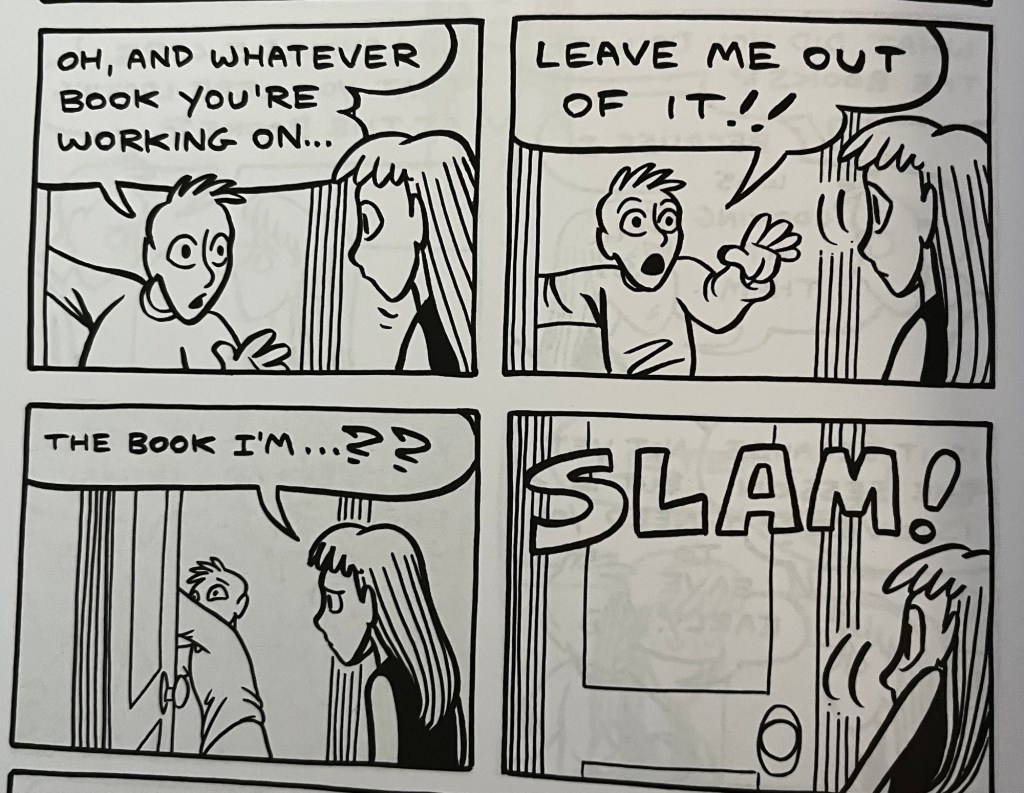
The few sections of the book focus on Emma’s integration journey after getting away from Toby’s poor therapeutic practices, and I’ll be the first to confess that it absolutely made me sob when I read it for the first time. It’s done so beautifully well and I won’t spoil it by showing the panels, cause I think that all of you should go read this book, but after almost nine hundred pages of black-and-white illustrations, the final moment of catharsis explodes into vivid color, and it’s a downright spiritual experience.
No, instead, the final image I want to show you from The Third Person illustrates how this memoir tells what we might call a “Classic DID” story, i.e. one that, while progressive in its interpretations, still hews to a conventional Post-20th Century wisdom about the prognosis, treatment, and desirable outcomes for patients suffering from Dissociative Identity Disorder. It starts with a life full of confusion and amnesia, continues with a grueling journey in therapy, and concludes with a happy, healthy, newly integrated protagonist who’s finally ready to face the rest of her life like any other singlet would. And we love that for Emma! For a lot of people living with dissociative disorders, integration is the correct goal for their needs and life desires. But before we talk about the diversities of other depictions of plurality in transfeminine media, I want to give Emma the final word about integration, core alters, and whatnot, cause Lord knows she’s a way better resource for the plural transfemme than any of the psychologists I cited in the first half of the essay:
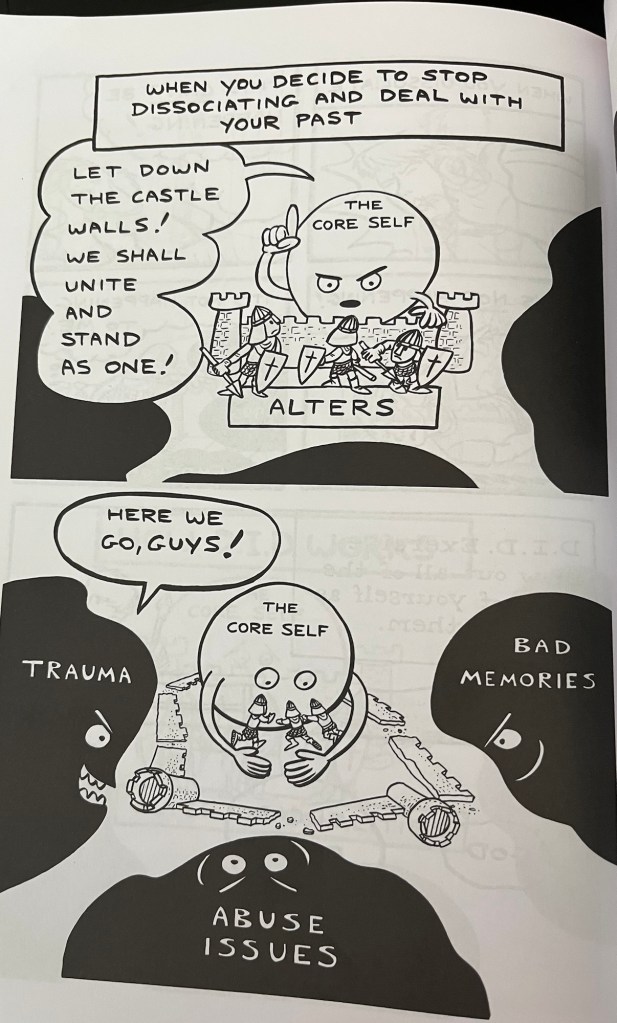
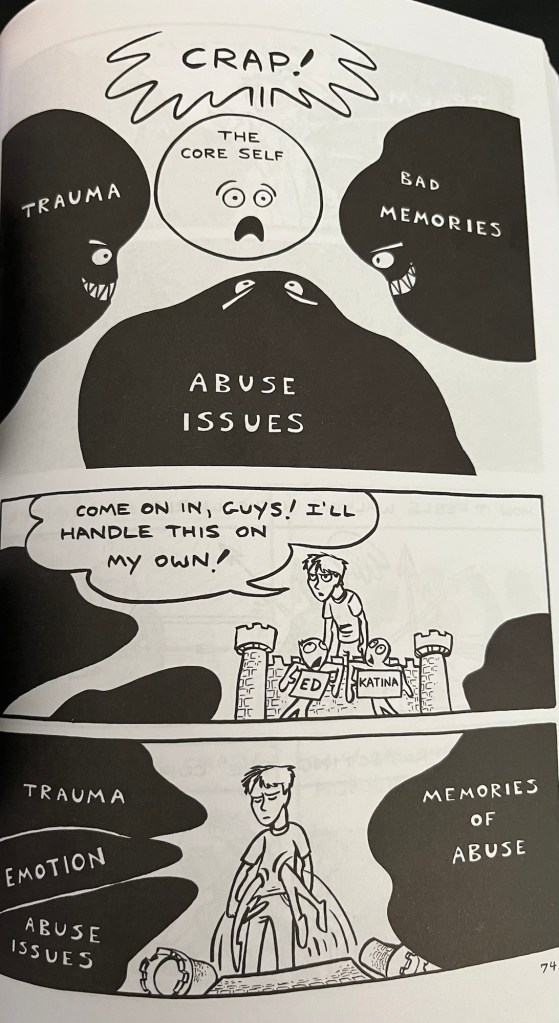
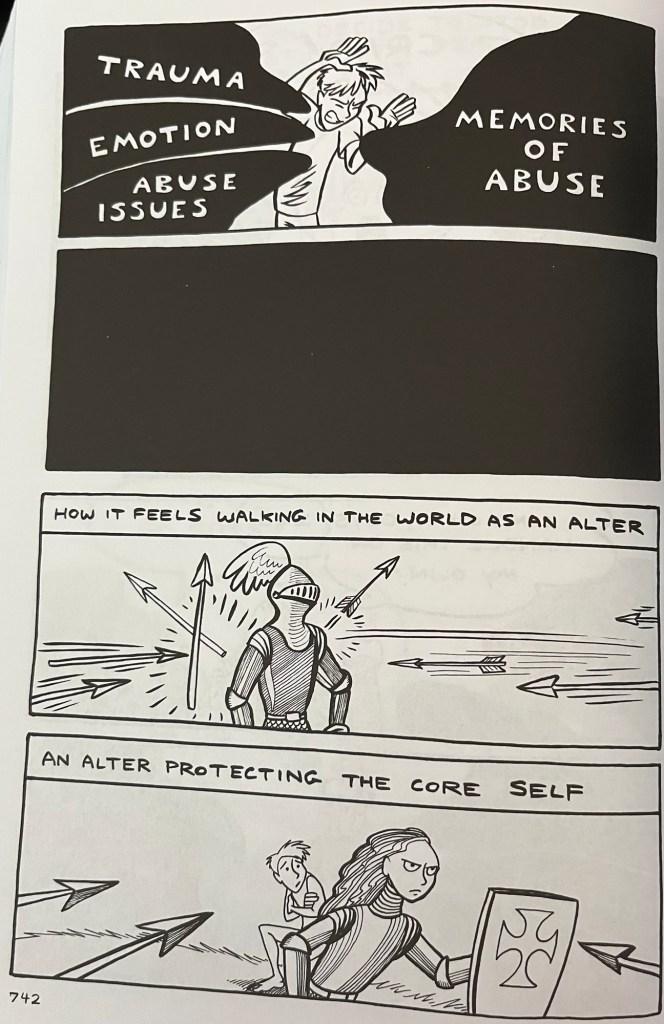
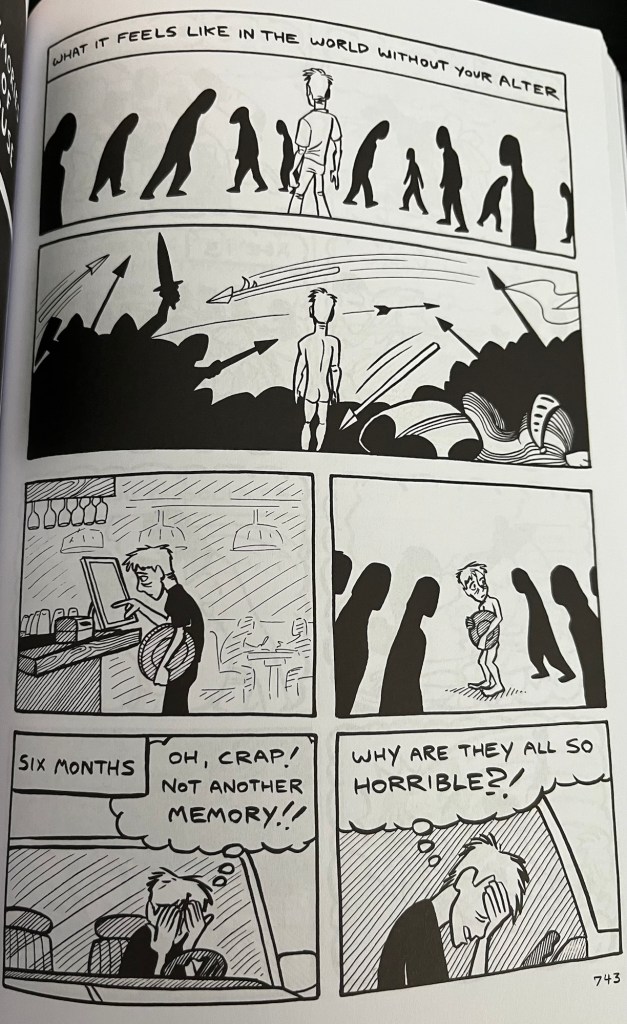
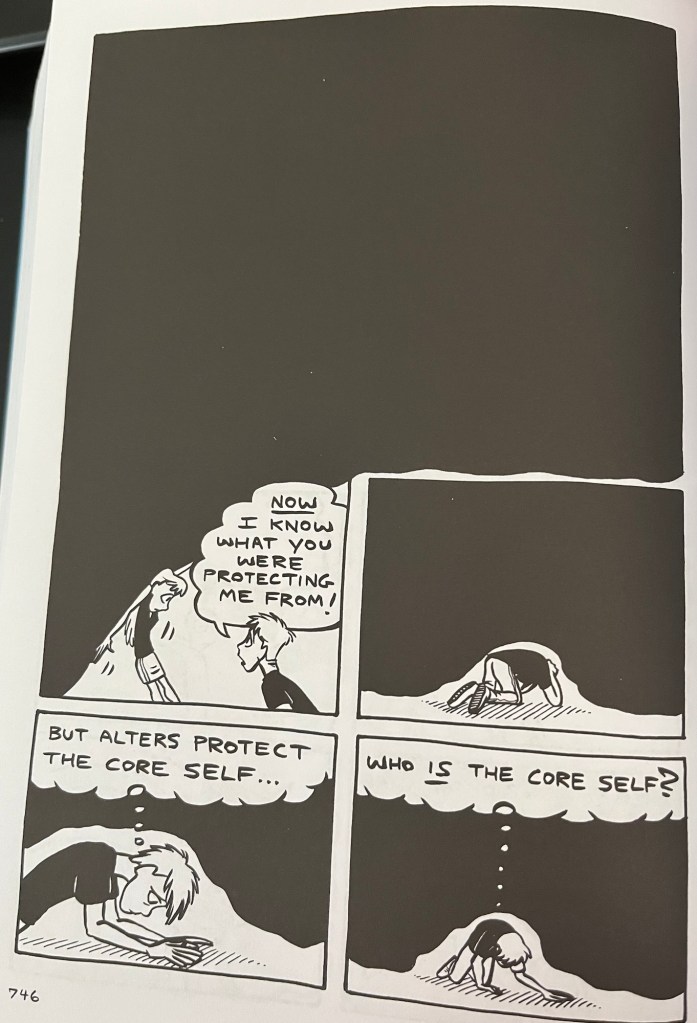
Who indeed?
CORE_FAILURE
“I want to get back to something you said, Scratch,” says Winc around a mouthful of waffles. “Something you were saying about sensory overload.”
Scratch, who I swear looks one minute like everyone’s mother, and the next like some guy in drag, and the very next minute, well, strong and proud, gets all quiet and nods, so Winc keeps talking.“It ties in with something I was saying, about the courage you’ve given me – online. See, I did want to be a woman, Scratch. I really, really thought that was the answer for me. But when I finally did it, it felt like I was still acting.”
It was weird hearing all this come from a doode with a mustache.
“All my life, I played at being a boy, and when I finally became a woman – and that’s what I did, Scratch, I became a woman – I found I was playing at that too. It was too tight. Too many rules on both sides of that gender fence, and I just don’t get along well with rules.”
Scratch looked a little more like what I think ze really looks like then. “So online,” ze says, “you got to escape?” Winc nodded, and then Winc took a deep breath.
“I fell in love with you a lot of ways, Scratch. I loved being boy to your riot grrl. I loved being nasty gay man to your nasty gay man. I even loved when you were a vampire and I was… um… food. I fell so deep and hard when we were Frankie and Johnny. And then Razorfun and Gyrl…”
I felt embarrassed but thought that what ze was saying would maybe save this whole thing.
Hir voice trailed off, and Scratch’s eyes got a little wet and ze just nodded some more. Winc went on. “What I’m realizing now,” ze said, “is that I was falling with a safety net.”
Winc was getting sadder and sadder, but ze kept talking. “I was finding a way to be all the different me’s I could be, with you. But it wasn’t with all of you, not really. A lot of it was in my head. It wasn’t really you. It was the you I wanted you to be.”
Ze just stopped and looked down, and took another bite of hir waffle, but I don’t think ze was hungry. Scratch took up the slack.
“So you were becoming who I wanted you to be?”
“Sort of.”
Scratch looked disgusted with hirself.
“It was always someone I wanted to be too,” Winc went on. “I loved that no matter who we became, you were right there with me. We both had the safety net. I… I didn’t have to worry about looking like a freak to other folks. You didn’t know you’d be with a freak.”
Right then, the waitress comes back and asks Winc if “the table” wants more coffee. So Winc says, in this girly voice ze usually uses, “Thanks, hon, yes please,” and the waitress just stares at hir, pours the coffee quick and gets outta there.
“You’re a freak?” Scratch said when she was gone. “You think you’re the only one? Don’t you know I’m one, too? Why do you think there’s so many of us online. Not just queers either, but lots of people are freaks out there.”
Ze looked around the diner. “I mean, out here.”
Winc looked kind of surprised, but didn’t say anything. Ze had a kind of “tell me more” look in hir eyes.
“You were trying to make me complete some kind of fantasy, right?” Scratch added. “Something to make you look more normal?”
Winc nodded, tears spilling out of hir right onto the waffle.
“You sort of used me, Winc,” says Scratch, real quiet. Winc was crying now; ze just nodded and said ze was sorry.23
Nearly Roadkill by Kate Bornstein and Caitlin Sullivan occupies an odd position in the broader transliterary sphere. Published in 1996, the novel is long out of print. Most transfemmes have probably at least tangentially heard of Bornstein’s work, yet basically nobody knows that they wrote one of the first real tradpub novels to get into the nitty-gritty of an actually progressive look at gender identity and trans issues. Similarly, basically none of the other scholars of trans literature have been able to make heads or tails of it, and tend to get relegated to the requisite “Oh, and here’s all the other books from before Topside that I want to mention but don’t know how to discuss” paragraph. As a work of fiction, Nearly Roadkill manages to be simultaneously dated to the point of unreadability and still ahead of even our present moment almost thirty years later. I’m not going to attempt to explain how this book works, or why there’s so many awful cyber sex scenes, or how you should read or even acquire it. It’s a proper Experience, and I don’t really think I’ll be able to do it justice. Rather, what I want to talk about is Bornstein’s radical depiction of plurality and how astonishing it is for a book written in 1996.
Textually, Winc is not plural, or at least it’s insinuated that ze aren’t, not in the formal sense of Multiple Personality Disorder. That being said, I would argue that Winc’s relationship with Scratch gives us a really interesting look at the other side of the transmisogyny/pluralphobia dynamic. In Emma’s case, the discovery of plurality delegitimizes Emma’s desire to receive gender-affirming healthcare. In Winc’s case, however, it’s the discovery of transfemininity that delegitimizes both Winc and Scratch’s belief that Winc’s polymorphism and identity-play could ever have been an act of true freedom or radical unsettlement in the first place, suddenly turning Winc’s identity-play from an act of rebellion to a statement upon hir character (or lack thereof).
Let’s rewind to a bit before the long quote above. Winc and Scratch are notorious cybercriminals, the terrors of the early internet. They descend upon random chatrooms and have extremely long, elaborate, and public cybersex roleplay scenes. Most of the time they don’t know who the other person is until halfway through – they’re essentially digital soulmates. Doesn’t matter what name they’re using or what role they’re playing, they’re gonna end up fucking each other in public (and yes, the premise is exactly as ridiculous as it sounds).
What keeps Nearly Roadkill from being a bizarre relic of 90s erotica comes in the middle of the book, when Winc and Scratch, now on the run from the law, meet each other in person for the first time. Suddenly they are not disembodied spirits, ever shifting in the void; suddenly they are here, present, physical; suddenly, their bodies matter. And, well…
“Okay, okay,” says Scratch. “Here’s what I am.”24
Once again, the ontological imperative is announced by the arrival of the flesh. Here are two characters who have been everyone and anyone for the last two hundred pages – for all we know, they don’t even have bodies! When I read Nearly Roadkill for the first time, I had absolutely no mental image of either Scratch or Winc until this scene. Each of their incarnations seemed a person(ality) unto themselves. But the first thing – the first thing – that Scratch does when the two of them finally have a moment to speak in person is to declare hir biological allegiances:
“Okay,” ze finally said, all the breath pushing out of hir in a whoosh. “I’m a girl, woman, crone, maiden, chick, bitch, cow, dyke, babe, sweet-pea, female person. This week I wanna look like Johnny Depp and last week it was Garbo. I wish I were black because I hate my skin and probably next week being a wolf would be even better.
Ze kept looking down, but the words kept pouring out.
“I’m not afraid to walk down the street alone because I am all those things inside without thinking about it; then somebody calls my name or rather, my sex, and I feel like I’m in a borrowed body, the body I was born into, easily recognizable, to other people, not to me. They want to sculpt it and dress it and reduce it and extend it but it’s worked against me a lot or has had itself worked against.”
“I’m a female,” ze finished in a lower voice that trailed off. “And now my freedom’s over.” […]
“Pushing forty, I started dressing and acting how I felt and realized it’s my life and I’d been wasting a whole lot of time acting like it’s someone else’s.”
Ze paused. “Do you know what happened when I started doing that?” But ze wasn’t really waiting for our answer. “Nothing. Except,” and Scratch started blushing, “I got a whole lot more dates from women.”
For some reason I blushed, too.
“I feel I’m finally in my body,” Scratch went on. “Which is funny because the second I went online I started being in a whole lot of other bodies, too.”
“And how!” Winc said very quietly to hirself, but Scratch heard it and kind of shifted like ze was uncomfortable.25
There’s an interesting thread to draw upon here about the gender-as-performance argument as seen through the lens of plurality. Judith Butler (the feminist theorist responsible for pioneering the performance theory to the mainstream) writes in Gender Trouble a few years after the publication of Nearly Roadkill:
What can be meant by “identity,” then, and what grounds the presumption that identities are self-identical, persisting through time as the same, unified and internally coherent? More importantly, how do these assumptions inform the discourses on “gender identity”? It would be wrong to think that the discussion of “identity” ought to proceed prior to a discussion of gender identity for the simple reason that “persons” only become intelligible through becoming gendered in conformity with recognizable standards of gender intelligibility.26
Butler’s writing style is notoriously unreadable; there are two things in this passage you should note. Firstly, Butler’s problematization of the notion of “identity” presumes the continuity of that identity, i.e. that conventional wisdom assumes that your “identity” will always be the same. Butler then suggests that gender dynamics pose a challenge to notions of stable identity, fracturing the illusion of continuity. This is very much in line with our discussion about how the presence of femme alters in AMAB systems can challenge the notion that the system “has” a stable identity in the first place. But the second issue is perhaps more important: part of the complexity of this issue is that in 1996, neither transness nor plurality constituted “recognizable standards of gender intelligibility” (and plurality still doesn’t). Butler continues by noting that the internal coherence of gender identity in the popular conscience is framed around the heterosexual desire as its congealing force:
Gender can denote a unity of experience, of sex, gender, and desire, only when sex can be understood in some sense to necessitate gender—where gender is a psychic and/or cultural designation of the self—and desire—where desire is heterosexual and therefore differentiates itself through an oppositional relation to that other gender it desires. The internal coherence or unity of either gender, man or woman, thereby requires both a stable and oppositional heterosexuality. That institutional heterosexuality both requires and produces the univocity of each of the gendered terms that constitute the limit of gendered possibilities within an oppositional, binary gender system. This conception of gender presupposes not only a causal relation among sex, gender, and desire, but suggests as well that desire reflects or expresses gender and that gender reflects or expresses desire. The metaphysical unity of the three is assumed to be truly known and expressed in a differentiating desire for an oppositional gender—that is, in a form of oppositional heterosexuality. Whether as a naturalistic paradigm which establishes a causal continuity among sex, gender, and desire, or as an authentic-expressive paradigm in which some true self is said to be revealed simultaneously or successively in sex, gender, and desire, here “the old dream of symmetry,” as Irigaray has called it, is presupposed, reified, and rationalized.27
Butler’s account of gender tends to focus on sexuality instead of transgender experience. I am hardly the first trans theorist to attempt to commentate on the shortcomings of Butler when it comes to conceptualizing the trans self, and honestly, I’m not really interested in wading into that discourse. Some people see themselves in Butler’s work, and others don’t, and I’ve always found it to be somewhat of an immature theoretical stake to attempt to claim that one side is more philosophically or metaphysically “right” than the other. These passages are of primary interest to us because of the way Butler has framed “identity” and “personhood” as a phenomenon which arises only after the subject has gained visible gender in society, a process that begins before birth (think gender reveal parties). What Butler describes here about gender ontology as a matrix of heterosexual desire in the social conscience mirrors really well onto the way that Scratch describes hir former sense of self (where ze tried to escape being female at any cost), and I find that where Butler further takes this argument maps well onto Scratch’s new declaration that each act of gendered non-conformity only makes hir more secure in hir embodied position as a unitary actor.
In this sense, gender is not a noun, but neither is it a set of free-floating attributes, for we have seen that the substantive effect of gender is performatively produced and compelled by the regulatory practices of gender coherence. Hence, within the inherited discourse of the metaphysics of substance, gender proves to be performative— that is, constituting the identity it is purported to be. In this sense, gender is always a doing, though not a doing by a subject who might be said to preexist the deed. The challenge for rethinking gender categories outside of the metaphysics of substance will have to consider the relevance of Nietzsche’s claim in On the Genealogy of Morals that “there is no ‘being’ behind doing, effecting, becoming; ‘the doer’ is merely a fiction added to the deed—the deed is everything.” In an application that Nietzsche himself would not have anticipated or condoned, we might state as a corollary: There is no gender identity behind the expressions of gender; that identity is performatively constituted by the very “expressions” that are said to be its results.28
From a plural lens, there are a lot of problems with this argument. What goes unstated and implicit in this argument is that irrespective of the deed/doer rhetoric as a frame device, the “doer” being discussed here is not a physical doer, i.e. a body, but a metaphysical doer, i.e. a brainstate, a person, a mind. Gender as performativity frames, in a sense, the body as stage; the body is the instrument of performance, the canvas; it underlies, it is the mode of articulation. All that matters is how action manifests upon the body and creates the illusion of an identity underneath.
So when a body’s performance sharply differs after a “switch,” when two alters change who controls the body, gender as performativity does posit that neither action indicates a core identity more than the other! That’s undeniably a step up from the “core self” argument of the 20th Century psychologist. But it leaves a gaping void in its wake. The manifestation of multiple personalities in the world is just that, an “expression” of personality rather than any sort of indication of selfhood. Switching alters is no different from changing your clothes or playing a role in a school play. It’s hard not to see that the one thing which stays “consistent” in this sense is not the doer, not the deed, but the stage of action, the platform, which is nothing more than the body itself. One stage, one continuity of deed – one can only presuppose one actor, or an actor-by-absence, the singular shadow that remains when one possesses no actor at all.
This line of argument becomes explicitly destructive when applied to plural audiences. When alterhood is conceptualized as nothing more than a “performance,” “expression,” or “act,” it puts the onus of deciding whether a person is experiencing DID not upon the person actually experiencing the disorder, but upon the “audience,” whose job thus becomes determining whether the system is a “real” plural system or just “faking” it, an action known in the plural community as “fakeclaiming.” This inspires a truly cataclysmic level of anxiety and self-doubt in the system, which only serves to reinforce their denial and resistance to care. I’ve witnessed the impacts of this mindset firsthand, and let me tell you, it can fuck people up.
The worst part about this is that Butler has a point! So much of how we understand “identity” hinges upon having a stable gender, a legal gender, one given by the state. Those who attempt to exist outside of the framework of socially acceptable gender (like alters) face harsh censure from their peers; it’s not that they don’t have a gender, it’s that society treats them as though they don’t, or as a different gender altogether. The problem arises from the fact that taking an uncritical version of the performativity picture of gender would also demand us to take a fundamentally asocial, even anti-social, definition of how plurality and DID work. Much as gender is an ordering principle beyond systems, it’s also an ordering principle within systems, and can be one of the most critical pieces in the implicit social norms and strictures of headspace. Butler’s analysis is important for unthinking that. But by arguing about the complete ontological lack of an actor, the onus of action itself is subtly shifted from the person to the body, which then becomes held as prior, if not primary, to any sense or articulation of personhood. A Butlerian view is only useful to the plural commentator insofar as alterhood can be articulated from the lens of an internal body, necessarily a mental body, which is definitionally impossible from the same view. This complete erasure of the possibility of intra-system relationships suggests not only that the subject with DID is suffering from “episodes” of “personality shifts,” but also poses that the idea of multiple alters communicating with each other, a basic tenant of plural life, is an act verging on narcissism or schizophrenia. A plural-informed performativity argument could totally argue that gendered performance in headspace should be a critical piece of rethinking system dynamics, but that’s completely impossible in the anti-metaphysical picture of performance forwarded by the Post-Modernist singlet mainstream.
A particularly noxious 1998 article from Anthony Kubiak drives home how easily the Butlerian argument of performativity can be weaponized into pluralphobia:
Soon an ensemble of voices and clashing personalities emerges, a theatre of therapeutike, which replays the events of the trauma. The individual, in other words, now disindividuated, now more collective than unitary, acts in a microtheatre of cruelty within which she both reenacts and prevents the enacting of the trauma that gave her theatre its birth. Taken together, this is what is popularly known as multiple personality syndrome, or multiple personality disorder, now called DID-dissociative identity disorder, the name change ironically recapitulating the shifting, dissociative thing itself. This disorder has a rather short history, and one that is worth recounting briefly here, if for no other reason than to point out that multiplicity, too, has its history (Hacking 1995).29
The “microtheater of cruelty,” as Kubiak so callously puts it, is precisely what I have been trying to isolate and interrogate over the course of this article (and don’t think I’m overlooking the way he assigns “her” as female). He’s right, it is a common problem for people with dissociative issues, but it is hardly a problem without recourse. There’s absolutely no reason that systems need to mirror toxic dynamics of sexism, abuse, violence, and all of the other issues I have here brought to light, but the way that we unthink that is by talking about it, processing, coming up with new tactics and methods for systems to reach healthier equilibriums. But Anthony Kubiak has absolutely no interest or investment in healing those cruelties.
Rather, his “solution” is to question – fakeclaim – whether DID is even a “real” phenomenon in the first place.
Once memories can be recovered through the narratives and words of the various alters, the patients can be reintegrated. Therein lies the second of the great controversies of DID and recovered memory: How does one know, barring outside confirmation, that one’s memories are in fact “true”? Does the import of one’s memories depend on their external confirmation by others, or on the subjective impact they have in forming identity? Further, doesn’t conflating memory and identity in this way obscure the deeper and more difficult problem of subjectivity? And isn’t the multiplication of identities, and the ability to switch identities merely a multiplication and obfuscation of the original problem? If identity-gendered, racial, classed-is decentered and unstable, how does mere multiplication or the ability to switch identity/race/gender change the fundamental problem of identity and subjectivity? How, precisely, is this-as many what I call “new Column” DID sufferers claim-liberatory, or even evolutionarily superior? And finally, even though the pathologies of DID are clearly not what gender theorists have in mind when they question cultural assumptions about the stability of identity, what does DID itself suggest about such assumptions? Might the positing of some hegemonic idea of identity-stability be a straw-man argument? The prevalence of DID might suggest so, as might the currency of multiplicity in movies and TV.30
Ah yes, because obviously the number one reason people are plural is because they want to be “evolutionarily superior.” Kubiak’s distaste for plural people becomes even more evident in subsequent paragraphs:
What, in fact, makes DID unbelievable, or at least arguable, to many observers is its failure, like Finley’s performance, as theatre. While on the one hand many object to the substantive claims of DID because it seems like so much bad acting, many suspicions seem to center on DID’s very insistence on its own nontheatricality, on its “reality.” Thus while the poststructural world continues to present us with theories of the insubstantiality of self, DID is trying, like some gender theory itself, to convince us of the self’s (multiple) reality. Indeed, outside gender theory, experts in consciousness and identity such as Daniel Dennet see multiplicity-as-identity as inevitable, a healthy and predictable response to modern fragmentation. But modern fragmentation and the painful decenteredness of identity has little to do with the indeterminacy of genders or races-it has to do with the suspicion that I might be no-one at all. We are not talking about the “humanist” fear of shifting identity, ultimately, but the fear of non-being, of death.
Corollary to this, what are we to make of the resistance among many in the DID community to reintegration? Many refuse to see themselves as anything other than normal but still wish to insist on the mutual nonresponsibility among alters for any one alter’s actions-if my alter “Bill,” for example, exposes himself to a woman in a hotel room, should my other alters be held responsible for it? It depends, of course, on who is asking the question, one’s therapist or the state prosecutor.’31
The notion that some plural people don’t want to pursue integration because they want to be able to get away with rape is a wild leap – and I can’t help but feel like the author calls himself out by suggesting that his own “alter” would be the rapist. What would be his alter’s full name, Bill Mills? Similarly, this notion of a “failure to theater,” i.e. the idea that it’s the system’s job to convince singlets of their personhood, and that a failure to do so is sufficient grounds to take DID as an “unbelievable” disorder, reads in so many shades of the Real Life Test for trans women. If you can’t jump right into the deep-end of full-time girlmoding, if you can’t pass as a cis woman before you even begin to transition medically, then are you even a woman? And this idea that systemhood is a manifestation of a nihilist fear of oblivion – that’s just not comprehensible to me. Most systems struggle with having too much selfhood going on in their brain, not a void thereof. The verbiage of “theater” or the “therapeutike” used in this article are, I think, just hollow shades of the rhetoric of the trial, just as Kubiak’s imagined plural subject is quite clearly a failing wannabe of Billy Milligan (literally) and the position of the singlet theorist stands as judge, jurist, and executioner supreme.
Let’s bring our argument back around to Scratch and Winc. What’s so striking about this scene is that these two characters, who have appeared so very similar for the whole book, suddenly show up as wildly different people the moment they come together in person. Scratch is in many ways the ideal provocateur of a Butlerian gender trouble – through performance, through a rejection of ontological womanhood, everything ze does on the internet only increases hir comfort with using hir body as a stage. By contrast, Winc represents a certain failure to see gender through a performative lens. Winc has spent the entire first half of the book investing a certain level of selfhood into not just hir own characters, but Scratch’s characters too. It’s not just who hir wants to be or chooses to perform, it manifests in some crucial way who ze is. And this brings up one of the key flaws with this paradigm – on some level, gender-as-performativity is framed as an ethical paradigm, not just a metaphysical one.

If the body is the stage for the disembodied performance of gender, the medium, the paintbrush, then Winc’s attempts to use hir chatlogging and criminal cybersexing to escape that (dyphoric, transfeminized) body becomes not just a failure to actually perform gender, presupposedly the thing that ze’s best at, but an actual ethical shortcoming, a social deficit that Winc must now apologize to Scratch for. It was all a masquerade for Scratch – but not for Winc.
Never for Winc.
Normally in transfeminine fiction, one of my least favorite tropes is when the author interrupts the flow of the novel to infodump about medical or social transition for several pages, but I think it works in Nearly Roadkill because it nails home how Winc suddenly has to extensively prove and explain hirself – hir real-world self – to Scratch to maintain their relationship. Scratch opens hir email to Winc with “I love you, I want to be with you somehow, but the words are still fucked up, I have questions that are stupid but I have to ask them of *somebody.*”32 What ensues: Winc explains to Scratch what it’s like to be a non-binary transfemme, Scratch explains to Winc what it’s like to be a dyke, they’ve talked their shit out, they’re on a level-playing field again.
This conflict may have played out through the late-90s lens of performativity, but this rupture hints at a more fundamental truth about human subjectivity and our inability to conceptualize plurality or transfemininity on the societal level. Butler’s philosophy is so persuasive because it is hard for us to conceptualize or perceive the interiority of other human beings. It’s tempting, almost sexy, to think that we as people could be nothing more than how we display ourselves. There’s a post-modernist panache to the concept. But I don’t think that performativity changes the presumption of a subjective representation of personhood, just dislocates it into the eyes of the audience. Both Scratch and Winc expected the other to perceive them in the same way as they perceived themselves, and when there was a mutual failure for that to happen, it caused a serious rupture in their relationship, and societal power dynamics immediately took over.
In the performativity model of gender expression, theatrical expressions of gendered selfhood are privileged, and private notions of gendered ontology are called into question, challenging the idea of a heterosexist gender conformity as the primary metric for establishing a gendered identity. But when selfhood is hidden/withheld by necessity (transness) or by design (plurality), the silent trans plural subject is erased by their failure to show up as “trans” or “feminine” or to exhibit “multiple personalities” before the masses. This is further exacerbated through the creation of systems (read: DSM-III) which directly punish overt expressions of plural transfemininity or genderqueer alterhood. The lack of action or paralysis this produces can then be read as “proof” that the trans plural subject was “faking it” all along, and used to write off their subjectivity (that classic tactic of domination) in the process. This overt erasure of the bodily potential of the alter in headspace – i.e., the impossibility of gender identity for the subject dissociated from their body – is a bioessentialist paradigm, a product of the supposition of flesh, either gendered or not. There’s a reason that plural folks sometimes call singlets “meat people” – the condition of existing within a system of multiples has an alienating effect upon one’s ability to claim embodiment on several levels, both within and without. Even the trans woman singlet, even the enby can on some level describe their gendered self through a relationship to embodiment. But when the alter has been rendered disembodied and fragmentary, she loses the verbiage to describe the ways that her social condition still reflects embodied hierarchies of domination and subordination within the confines of her ephemeral mind. Even when you’re fronting, even when you have access to a physical body, that alienation still lingers with a vengeance.
Now is an important moment to recall that the cause of Dissociative Identity Disorder is severe abuse of a physical, sexual, emotional, verbal, or neglectful nature experienced from a very young age. That is an active violence which produces this condition within the child, an active force of malice that provides the conditions for this alienation. Alters aren’t just affected by these hierarchies of subordination and domination – they’re often their worst victims.
And we wonder why people who fall under the transfeminine umbrella struggle so chronically with dissociative issues.
I’m reminded of this passage from Eduardo Nicol about the problematic of consciousness:
He has to transcend his own self and to acquire other evidence of other beings beyond his own ego cogitans. Otherwise, the matter of his cogitationes would be only himself. That is quite clear. But the ego finds himself alone, reduced by himself to an unsurmountable solitude by that previous, irreversible, operation of suspension of reality (which Descartes called “methodical doubt”, and which Husserl will call E’ox’). However rational his thinking may be, the solitary subject will never be quite sure that the objects of this world are not merely a coherent dream of his own mind. Why? Because he cannot communicate directly with any other ego. He cannot pierce the double ontological barrier constituted by the res extensa of his own body and the body of the alter ego. Thus the body, which we naively regard as the means of our expression, becomes a problem when philosophy (idealism) presents it as a metaphysical impediment to expression. Solipsism is the inevitable result of this kind of ontological foundation of science. This is made definitely clear in the philosophy of Husserl. The fifth of his Cartesian Meditations is really the last stage of the idealistic tradition, the testimony of its failure.33
There is a dark irony to the fact that alters are all-too-often inescapably aware of the mind-body of the alter, her ego, her self. Even the mere framing of the term – the alter ego, the Other-self – invokes plurality. Kubiak suggests earlier that people with DID are afraid of death, deathliness, nonbeing, but I would suggest instead that the fundamental root of pluralphobia arises from the fear – especially in a culture of individuation so strong as the United States – that the Other does have a mind, does have a body, does have wants and desires and a subjectivity with a drive of its own. How very painful for our atomized elite, to imagine any mindedness other than their own desires and income. And so of course anyone who does must engage in solipsism, of course they must be narcissists, because how could they not be? Is it not the fundamental human condition to bathe oneself in the luxuriant waters of their own individualistic desire?
But it becomes nothing – all nothing but a dream of the Other within the hollow panopticon of the self. Que sais-je?
In what is perhaps the most exceptional epistolary exchange of the book, Bornstein and Sullivan beautifully capture the alienation and imposed ego-annihilation faced by the plural subject who exists within this philosophical doctrine:
To Scratch@FarmReports.com, From TheStLouis7, Subject: We are… are you?
We are M.P.D Multiple Personality Disorder. Only one of us likes the “Disorder” word, but that one is Boo who is down on everything about himself anyway. We want to know: Are you a gang like us? Is Winc? Is that why “you” are so many people online?
We look hard for others like us. We have certain signs we look for. The actual individual actions of each personality is probably the surest way to tell. And of course, sometimes there’s time loss when one of us is being so much stronger than the rest. We’ve found among ourselves and other multiples is a fear of mirrors on the part of the host. She avoids looking in mirrors because she never sees the same face. Is it like that for you? Is that why you “change?” She also doesn’t like clocks, they scare her. None of us like them. Time is an enemy, because time always disappears.
Do you have some time to write us? -StLouis7<<
To Toobe, From Scratch, Subject: Don’t laugh…
I’m intrigued with these Multiple folks. They don’t sound like kooks, you know, they sound cool, if you try to forget the fact that “they” is one person. Or “one person” as “we” know “one person.”
How different from them am I? Maybe it *is* weird to insist on multiple genders. Or maybe it’s not so weird to insist on retaining multiple personalities? They don’t sound eager to “integrate” them all, or whatever shrinks say they’re supposed to do. Seems a sane response to the world.
Should I answer it? -S.<<
To Scratch, From Toobe, Subject: Multiples
I had a long talk once with somebody who was diagnosed as MPD. Only ze called it Dissociative, I guess the newer term. I found hir to be totally together. (I didn’t mean a pun there.) -T.<<
To TheStLouis7, From Scratch@ (emailaddressscrambled), Subject: Am I?
>>Thanks for your note. I’m not a Multiple personality, but I really liked getting your letter. I related to a lot of it.
You should know that Winc and I never wanted to make any kind of statement, or that we know any answers to anything. We just kind of did our thing and somehow a mirror was held up so all kinds of people are seeing different things, in us. I guess that’s good, I just wish the Law wasn’t one of them.34
Pluralphobia, much like transmisogyny and bigotry more generally, is a social force that attempts to hold up a mirror to the marginalized and caricature them at their most grotesque, at their lowest, at their worst. There is no subjectivity, only a reflection of what they “perform,” the selves that other people interpret them to be. And perhaps there is liberation to be found in leaning into that performance, perhaps there is liberation in the facade. But most plural folks – especially plural trans folks – have neither the luxury, the desire, nor the ability to create that kind of public performance. It can be extremely dangerous to be open about your alters. And so in the face of these social normativities, it’s a common response for plural trans people to buck in the opposite direction. Hard.
Endogeneity, Syscourse, and the Plural Community
Now, if you aren’t deeply embedded into online plural communities, you’ll probably have never heard of the word “endogenic” or understand its significance. It’s helpful to understand the root word, “endogenous,” which means ‘coming from within’ and is the antonym of “exogenous,” meaning coming from without.
The fact that a large chunk of the plural community has developed “endogenic” as a social identifier and political alignment is fascinating on multiple axes, and I want to treat with the anthropologic aspect first. In anthropolopy, an endogenous kinship structure is a structure of cultural and familial relationality wherein marriages and family affairs primarily exist within a closed system, typically a clan or a village. Endogenous kinship is defined by a hostility to intermarriage with out-groups, closely-kept familial traditions, and an insular outlook on culture and society that privileges the authority of the clan above all else.
You’ve almost certainly been exposed to an endogenous kinship structure at some point in your life. Many religious groups practice endogamy and demand that their followers only marry inside of the church. There are thousands of cultural examples around the globe. Wikipedia has some if you’re curious.
I find that the concept of exploring systemhood through a framework of endogenous kinship completely unsettles much of our conventional wisdom about what it means to be plural. While the sample populations are typically smaller than the average anthropological group of study, systems are often endogenous by necessity. In headspace, nobody but your other alters can give you social support. Nobody but your other alters can touch you, or fuck you, or hold you when you cry. Sure, you can always try to front, but for the majority of alters in most systems, fronting is a privilege or a rare luxury, not a given that can be taken on demand. Many systems have “gatekeeper” alters that police which alters get to front, and which don’t. “Host” alters, i.e. the ones who’re out the most, are also notorious control freaks (I’ll admit that I’m guilty on this count). It takes an extremely active effort to even attempt to develop an exogenous relationship if you aren’t a host alter, which means that you’re often limited to an extremely select pool of close friends and family members (if you have any, which many systems don’t), who often will fall under the umbrella of endogeneity for your external self anyway.
There’s real value to be gained about approaching a plural system from an anthropological lens, or as you might a friend who’s from another state or province or nation. Many systems have a deeply elaborate internal normativity that I’ll be willing to bet they almost never get a chance to talk about, and learning more about how their inner world works can be super rewarding for both you and them.
In this sense, I like the construction of the “endogenic” label a lot.
The other sense of the word “endogenic,” however, carries an deontological implication, and I like it severely less, especially once you extrapolate it from a descriptor to a label to a wholesale identity category.
Let’s frame the idea of an ontological endogeneity in terms of the argument we’ve outlined over the last few sections. At face value or in a vacuum, I honestly don’t disagree with it! Basically, claiming that you’re “endogenic” means claiming that your alters/headmates originated from within your system, i.e. as a consequence of your unique selfhood and being. If there was a corrolary idea of an “exogenous” alter or an “exogenic” system, then you could easily frame this against the performativity argument and use it as a way to say, hey, no, we are people, we do have our own senses of selves and that can’t be reduced to the way we act and perform multiplicity around other people. In this verbiage, one could differentiate between “endogenous” alters who either emerged out of that original disunitary state of infantile consciousness or subsequent splits, and the rarer “exogenous” alter who emerged in the system due to some external force like brainwashing or hypnosis (which is clinically distinct from DID). If this was what “endogenic” meant, then every alter who was not part of an OSDD-2 system would be an endogenic alter.
This is not terminology that exists.
Instead, the antonym for “endogenic” in online plural spheres is “traumagenic.” It’s a deontological argument rather than an ontological argument. What does that mean?
For those who don’t have much experience with philosophy, deontology is basically the study of causes, origins, and causalities of substance or form, as opposed to ontology, which is the study of the fundamental nature of that substance and form. Essentially, ontology asks “what,” and deontology asks “how.” If the colloquial use of “endogenic” mapped better onto the ontological discourses around personality, selfhood, and being that I outlined in the last section, the “endogenic” position would essentially affirm that alters have some degree of personhood and selfhood even when not fronting, and that they can be discussed with some degree of individual consideration as such. As you may have gleaned from my argument thus far, I find arguments that hold an endogenic ontology to be compelling, and deserving of serious theoretical consideration at the very least.
In system circles, however, this premise is largely taken as a given, and thus “endogenic” and “traumagenic” communities are far more concerned with how that endogenous selfhood comes into being, when the very premise of the endogenous selfhood of the alterhood is barely even an accepted possibility beyond plural communities.
“Endogenics” hold that not all systems are created by severe trauma (in direct opposition to most clinical literature), and tend to claim that their systems in particular were not created due to dissociative symptoms, but rather Something Else. That “something else” usually ranges from a variety of religious or New Age beliefs, an obscure Buddhist spiritual practice known as “tulpamancy” wherein the individual produces a “thought-construct” which takes on self-awareness, a profound fandom or preference for a fictionalized character leading to that character (‘fictive’) suddenly talking back in their head, kinship with various animals or other natural entities, or simply just that they were always plural, and that there was nothing that “created” the system at all. The majority of people in these community spaces are Westerners, many white, but it’s also a community sometimes tangentially connected to non-Western manifestations of plurality, such as some Two-Spirit faiths or ọgbanje (both of which have their own cultural heritages and fall very much beyond the scope of this article, but they do at least bear mention).
“Traumagenics,” on the other hand, essentially kowtow to the conventional psychiatric picture of the disorder, framing their alters as trauma responses and using clinical language to describe their systems in a mental health context. Every aspect of their DID can be explained through their Adverse Childhood Experiences, and any attempt to frame it in any other light is tantamount to retraumatizing the system by interfering with their ability to heal. Unlike in endogenic spheres, where “int*gration” is often seen in such a negative light that people will censor it like a slur, “traumagenic” commuinities are often extremely focused on therapy journeys, integration, and healing almost as a social mandate.
To say that the “endogenic” and “traumagenic” communities loathe each other is perhaps an understatement. If you’re a Tumblr native, you’ve probably seen “endos dni” on a profile at some point, and endogenic advocates will bandy about the word “sysmed” with the same level of vitriol as trans communities will “truscum.” As someone who’s hated the concept of deontological ethics since middle school, this entire paradigm is an absolute clusterfuck. I would point out how much “endogenic” and “traumagenic” arguments resemble the shitty brainworms that you find so often in certain terminally online transfeminine communities. If you know what “transmedicalism,” “baeddelism,” “/tttt/,” or any of the rhetoric you find in a lot of extremely conservative or anti-transition trans communities is like, then you know what I’m talking about. If you don’t, then good. Don’t Google it.
I’m not really interested in exploring the critiques against either group – I didn’t bring this up to wade into the waters of “syscourse,” as it’s often called. Rather, I want to argue that just as many conservative and reactionary trans ideologies arose as a direct response to material discrimination and oppression against trans communities, contemporary syscourse similarly took on its present form due to the shape and material circumstances of historical pluralphobia. I would also posit that by framing itself as a deontological discourse, syscourse as a whole is largely unproductive (if not counterproductive) at actually unthinking popular pluralphobia, and that it has completely failed to address or respond to the ontological debate that rages on in popular culture about whether an “alter” has any selfhood or individuality at all. I really do believe that both the endogenic and traumagenic deontological communities are fundamentally arguing for the same endogenous ontological framework, and it’s my hope that this article has shined some light on what that looks like and means.
All of that being said, I do find the endogenic impulse interesting. The fantasy of deontological endogeneity takes alterhood to its logical extreme, and asks, “What if people could just be plural without the baggage of severe childhood trauma attached?” While this may not be a particularly productive mindset in therapy, it does lead to some really interesting fiction, especially speculative fiction that plays with plural selves in worlds with alternative explanations to the Western medical model. Systems in fantasy worlds can be magical! Superheroes! Shapeshifters! Symbiotes! Reincarnations! Anything goes, and that’s always the most fruitful ground for some fun worldbuilding.
One such book that takes on speculative plural fantasy is Through Verdant Mirrors by Ela Bambust. The best way that I can describe this book is “trans plural power fantasy” – after saving the fabulous himbo Prince Clarus from a terrible curse, Vera is possessed by wood nymph Aesling who immediately knows she’s trans, magically turns her into a girl, and also happens to already be in love with said prince. Vera essentially inherits Aesling’s relationship with Clarus – Vera, Aesling, and Clarus fall into a healthy and supportive polyfidelitous relationship that eventually leads to the ancient evil being sealed away (for now) and Vera getting coronated as the Queen. It’s a quick-paced, feel-good adventure full of eggfic fluff, a found family unit that slowly comes around to being supportive, and some delightfully snappy prose.
What I love about this type of plural fiction is that in removing the baggage of writing trauma entirely, books like Through Verdant Mirrors get to really take the time to explore many of the other aspects of alterhood which so often go neglected beneath the sheer weight of tactfully depicting the aftermath of childhood sexual assault or severe child abuse. In doing so, Bambust offers us some interesting commentary on the issues we’ve drawn out from trauma-informed plural media.
Prince Clarus gasped. Cassion fainted. The King leapt forward, raising his son by the shoulders. Cinero looked around the room, at everyone intently staring at the scene in front of them, at the men who had no idea what the proper decorum was for a situation like this. The Prince stirred again. Then Cinero heard something. Something that seemed to come not from in front of him, or to his sides, or above or behind him. He heard a voice inside his head.
“Hello?”
His jaw tightened so strongly he thought his teeth would shatter. A feminine voice rang through his head, making it sing like a bell.
“Thank goodness, I thought there’d be only men in this room. Clarus is a wonderful man, but since he doesn’t seem to be waking up, I was wondering if I could be in your head for a spell.” There were so many things he had no idea what to respond to first, and so he went with the most obvious question first.
“What?” Cinero whispered. Flaveo frowned and looked at him. Cinero quickly shook his head, pretending that hadn’t been him. So apparently he was hearing voices now.35
From the moment Vera starts hearing voices in her head, Bambust raises a really interesting question about alterhood and subconscious sex. While the method of this self-discovery is fantastic, this sort of scene will be anything but unfamiliar to many transfeminine plural folk – our alters are often aware of our transness before we are, and thus there is a delight, a truly cathartic pleasure, in the idea that should a stranger enter your mind, they would be able to recognize you at a glance. The real you, who you really are. Endogenic fantasy says: you always had an inner body. The world was only ever waiting to see it.
What I want to pose here: is Vera an alter? For all intents and purposes, Vera has been a singlet for her entire life. We have no reason or indication to think that she has DID; it’s only after Aesling begins to cohabitate her body that she begins to exhibit signs of it, and even then much of her dissociation seems to come from other places. And yet Vera and Aesling have an undeniable system dynamic. They split time, they each have individual relationships with their princely boyfriend, each has her own wants, needs, hopes, desire. Even more interesting – Cinero is a singlet, whereas Vera has only ever been openly herself when Aesling is in her head. Even her body is different. There’s a non-negligible way in which plurality and multiplicity become the primary medium of Vera’s gendered self-actualization in this story, wherein singlethood is framed not as a desirable condition, but rather as a state of psychic isolation that kept Cinero befuddled and silently miserable for the majority of his life. Plurality and transfemininity arrive in tandem, neither extricable from the other.
To be certain, there’s an argument to be made that Vera’s not an alter, even with Aesling in her head. Vera is still the same singular person she’s been her entire life. There’s been no split, no fracture, no trauma – Aesling is not her soul, she’s another person entirely. It’s possession, right? Distinct, diffract.
If you want to take a strict definition of “alter” as a dissociated part of a unified consciousness that arises due to childhood trauma, then I totally get it. There’s power in that, power in the diagnosis, power in the assignation. But endogeneity too seems to blur the lines between where alterhood ends and personhood begins. Vera hasn’t changed from when she was a singlet. If anything, she’s more herself than she’s ever been. So often, the framing of this question poses the unified self as prior, and the dissociation as a later innovation – but as we’ve discussed, the theory of structural dissociation has been problematizing this originality of the singlet for years. So the question must be asked: what makes a singlet different from an alter who merely happens to be the lone member of their system?
This is easier for trans people to conceptualize than cis people, precisely because of the subconscious sex argument that we’ve already discussed. Being trans necessitates a certain remove between body and mind, a dislodgment. It challenges the very unitary nature of our physical forms. What I want to say is that there is no difference between the subconscious body of a trans woman and the subconscious body of an alter – nor the subconscious body of anyone else. It’s the same neurological circuitry, the same sensibility. Furthermore, trans scholarship has elsewhere posited that everyone has this experience of a mental map of their physicality; there is an entire discourse about how trans dysphoria and euphoria could be experienced by anyone with a body, and how those gendered phenomenologies merely become apparent to trans folks because they experience a greater extreme of discontent. If a feminist picture of trans plurality demands that we consider the body of the alter, their gendered relations, the dynamics of biopower and embodied violence they face, then that picture would radically destabilize the notion that there is any difference between “alterhood” and “personhood” in terms of a praxis of the self. It’s crucial to recognize that I am not using “personhood” as a synonym for “individual” in this context. If anything, understanding personhood and alterhood as synonymous, or at the very least symmetrical, gives us the grounds to challenge the very notion of the individual as the core metric for the “person” in the first place! To be plural, to be an alter, is to exist as a fundamentally social creature, and, well, Marx put it more eloquently than I ever will:
Where there exists a relationship, it exists for me: the animal does not “relate” itself to anything, it does not “relate” itself at all. For the animal its relation to others does not exist as a relation. Consciousness is, therefore, from the very beginning a social product, and remains so as long as men exist at all.36
By posing plurality as an asocial construction, the pluralphobe positions the system in the guise of an animal, a monster ruled by their baser desires. As M. Night Shaymalan puts it, the system is, at its core, nothing more than “the Beast.”
“My name is Aesling. You can call me Ash, if you like.”
“Why are you in my head?” It was hard not to entertain the thought of this voice being real, that this wasn’t a stray thought gone too far.
“I am not in your head. I am in the Prince’s head. I would like to not be. Would you like green eyes? I could give you those.”
Cinero thought for a moment. The thought of being beautiful, what that meant to him… Could she really change him, pull him away from the brink of what adult manhood meant? Even if she couldn’t, if she was really just a figment of his imagination, would it really matter if it made him happier?
“Okay,” he said.
Then, too many things happened. He experienced a fullness in his head, like he was a cup now overflowing, a thousand thoughts and memories that weren’t his crashing around in his brain.37
I’ve always thought of Soulmate AUs as a fantasy of sociality in an atomized society. You are an island unto yourself, but if one person – just one person – could see who you really were on the inside, wouldn’t you be so fulfilled? Something that conventional media never acknowledges: when you’ve worked through some of your trauma and aren’t having daily panic attack flashbacks, being plural can feel really good! It’s incredibly satisfying to be able to communicate your thoughts and feelings directly to the Other – hard to do right, of course, but what in life isn’t? Through the pathologizing framework of DID, the base condition is framed as a disease, a state of sub-humanity preventing the patient from self-actualizing as an individual. But that presumes the individual; that presumes there is not fulfillment to be found in collectivity, it presumes that psychic isolation is the only recourse for the troubled soul.
Through Verdant Mirrors is a powerful piece of plural-informed fiction because it depicts not only the relationships between alters, but also how each alter has their own relationship with others and the world. Both Vera and Aesling have their own relationships with Prince Clarus, and Bambust spends much of the novel developing an excellent picture of what a plural polyamory often looks like.
“Do he and I need to have a conversation?” Aesling asked out of nowhere. Vera nearly choked on her own tongue. She waved Prince Clarus away as he tried to help her with her coughing. At least it gave her a reason for her head to be as red as it was.
“What about?” she asked when she’d caught her breath.
“About you and him, child.” When Vera didn’t respond, Aesling pushed on. “You seem quite taken with him, and he certainly has a soft spot for you. Do he and I need to talk?”
“No,” Vera mumbled as they broke up camp and saddled their houses. “There’s no need, Aesling. I promise I won’t get between the two of you.” The thought of that conversation was drawing a dark cloud over her thoughts quickly. “I won’t be a pr—”
“Girl,” Aesling interrupted, “no. That’s not what this is. If you and I are going to be coexisting like… well, this, then Clarus and I will likely share some intimacy, and unless we acknowledge the fact that your feelings for him and his beautiful, stupid face are getting strong enough for me to touch, that’ll only cause hurt in the future.”38
Anyone who’s ever been in a relationship either as or with a plural person can tell you that it’s not like dating a singlet. While it’s true that there are systems where the whole system considers themselves to be in a romantic relationship with their significant other, this is most common when the relationship predated the knowledge of the system. Far more common: some alters consider themselves to be dating their partner, while others don’t. And often multiple alters will be dating at the same time. Even when the relationship isn’t polyamourous, it’s usually poly-informed by necessity. What do you do if one of your other alters has a crush on someone else? What happens if your partner dates one of your alters, but another one also expresses interest?
This is another dimension to the blowup between Scratch and Winc I discussed in Nearly Roadkill, and one that both plural and trans people often have to grapple with. Coming out as trans or plural can force your loved ones to completely shift their perceptions of you. As we’ve discussed, people form their own ideas of who someone is, and when they’re deeply invested in your personhood, telling them that you’re not the person, the alter they thought you were, can be an extremely difficult thing to process, especially if you’ve been masking around them for years. While it may not have been explicitly plural, the anger that Winc faced from Scratch at the idea that their “characters” may not have been so pretend is extremely familiar to anyone who’s ever tried to tell their family about their dissociation.
Functional multiplicity and kitchen-table polyamory have a lot in common with each other. Both require excellent communication skills, a willingness to compromise, and a vulnerability to sit before the Other and tell them about your most embarrassing desires and worst biases. Bambust does a great job at exploring these similarities in the relationship between Vera, Aesling, and Clarus.
Another key piece of this puzzle is the issue of consent. As we’ve been discussing, sexual consent is a huge issue in many systems. This goes both for relationships between alters, where rape and reenactments of sexual trauma can be chronic issues, and for relationships in the external world. It may be your body, but it’s their body too. Having sex as a system, then, is not just about receiving consent from your partner, but also from your other alters, who may be aware and uncomfortable with the way the body is engaging with its partners. But the intersection between consent issues and plurality goes a lot deeper than that. Violations of consent between alters goes way deeper than just rape. Getting forcibly ripped away from the front can be an enormous violation of bodily autonomy. It’s hard to describe just how hopeless it can feel to lose complete control over your actions on the flip of a dime – while sexual assault between alters can be more destructive, but violent or hostile switching practices are a lot more common, and can be just as devastating for the alter who loses control. I have complicated feelings about the term “mind rape,” but there are definitely circumstances where it is the best descriptor for the way that an alter acting in bad faith can invade your very sense of being and wreak havoc on your emotions or self-worth.
Bambust does a great job at handling consent too:
“Vera,” Aesling said internally, “I’m going to kiss some sense into this fool, with your permission.” Her politeness made Vera almost accept automatically, but she hesitated for a moment. She wasn’t sure how she’d handle kissing him again. The first time had been in shock, she’d barely been aware of the experience, but now she was ready for it, and she worried it might overwhelm her. “If you must, you can close yourself off from outside experiences within my grove. Would that help?”
“Yes,” Vera said. Strangely, the thought of Aesling ‘using’ her body for this didn’t bother her. Sure, it was Vera’s body, her mouth, all that, but this was Aesling’s too, now. “If I asked you not to,” she asked quietly, “would you not?”
“No,” Aesling reassured her. “I’ll do nothing with, or to, your body without your permission, Vera. I’m here because you’ve allowed me here. My memory is long, and my gratitude quite boundless.”
“Thank you,” Vera said. “Uh, you can kiss him now, if you want.”
“You’re not… retreating to the grove?” Aesling asked. Vera knew she’d be blushing if she was fronting at that moment.
“Do — do you want me to?” she asked. It wasn’t that she wanted to watch Aesling or anything like that, but, well, she’d never had a proper kiss before, and the first time didn’t really count because she hadn’t been ready for it and it hadn’t been meant for her, and sure, this one wasn’t really meant for her either, but maybe it would be good practice, and, well, it had felt pretty nice the first time and she was okay just kinda being there again this time and—
“Oh, you don’t have to. I just don’t wish to make you uncomfortable…”
“I’ll be fine,” Vera squeaked. Aesling gave her a look, which was a strange feeling when neither of you had a body inside your own head, but a look was given and a look was received nonetheless.39
And so we return once again to the issue of intra-system violence.
Part of the problem is that rape, and criminality more broadly, is more-or-less equated to original sin in the modern Western conscience (if you want to learn more about why this genre of thought really fucking racist, I’d suggest checking out my A Brief History of Trans Literature series). Adam and Eve have committed sexual trespass; they are aware of their nakedness, they must be exiled from the Garden of Eden, and each of their descendents must be baptized to cleanse them of their sexual sin. This produces not just an analytic of the stain, but that of a stain-by-association – whether it be association with the rapist for the left, or the victim with the right. Part of the reason there is such a prevalent intra-system rape culture in many systems is precisely because the mere acknowledgment of poor sexual behavior on the part of one alter against the other can stigmatize the whole system as a sexual predator, even when there’s absolutely zero external evidence or behavior to suggest such. There’s a very Protestant equivocation of “bad thought” with “bad action,” and the fact that one alter acts against another is taken as evidence that the whole system would act against a physical stranger in the real world, which is manifestly a false and cruel equivalency.
Underlying all of this pluralphobia is the core idea that not only will systems use their plurality as an excuse to get away with murder, but that they are in fact incapable of controlling their own actions, and their plurality renders them essentially unable to consent or seek consent. As a result, it is only appropriate for the state to exercise violence against the plural body, because that form of discipline is the only way to prevent the plural body from committing senseless violence against the innocent Other. Books like Through Verdant Mirrors are therefore critical in that they show the fundamental importance of consent in the life of an alter, and how desperately needed a rigorous analytic of consent is for the broader plural community at large. I do not say this to suggest that plural systems need to learn how consent works; I mean that plural systems need to place the practices of care, consent, and accountability that already exist within many systems front and center as the productive grounds for the first seeds of a plural transfeminism.
Functional multiplicity (where alters learn to healthily cooperate and share their lives) and integration (where alters resolve their trauma and meld) are both distant possibilities when headmates cannot acknowledge that their actions affect both their headmates and their body. This isn’t a medicalized paradigm, it’s a basic question of respect and regard. We could call it the Golden Rule for systems: treat yourself and your alters as you want to treat others. Self-flaggelation, intra-system sexual violence – it’s all an internalization of the stain of childhood trauma, it’s all self-punishment and self-censure for having “failed” to not become severely traumatized as a young child. When you have DID, you’re already stained. You’re dirty. Having a “persecutor” alter who engages in intra-system violence or sexual trespass only serves to reinforce the inescapability of your victimhood and moral wrongdoing, the totality of your sin.
But we don’t have to conceptualize our lives and our alterhoods through such a reductive lens.
System Accountability
As much as I would like to end this article with a positive depiction of plurality, we unfortunately need to talk about the DID serial killer trope one more time, now through the lens of a trans-authored novel.
I really wanted to like Bang Bang Bodhisattva. It was one of my most anticipated books of 2023 – I preordered it, when it finally arrived I sat down and read the entire thing in a single setting. And, well- It’s not a terrible book. Like, I had a lot of trouble with some of the dialogue, and I found it to be a little bit of a Baudrillard-esque pastiche that leaned a little too heavily on neo-Donna Haraway cyberpunk tropes, but I didn’t mind it. There was some fun action-adventure, the trans polycule was compelling enough. My reading group and I had a number of quibbles about the pop Buddhism, but it was nothing dealbreaking. Wood’s prose is workmanlike. None of this is reason for me to actively dislike a book.
Having your twist villain be a plural serial killer, however, very much is:

“So, who are you, really? Bradley Carson, right?”
“I’m Nile.” Nile’s voice choked a little. “I’m just Nile.”
“But you’re really Bradley. And the guy in the track suit, and that old Asian lady with the paintings. All of them were really you. So, which one is, like, you you? Bradley Carson, right?”
Nile exhaled. “Bradley passed over years ago. Why are you talking about him?”
Okay. She’s talking to me. Good. “What does that mean? You mean, like Bradley’s your deadname?”
“No, Bradley’s deadname was Dakota. But Bradley was…” Nile squeezed the steering wheel and took a breath heavy with exasperation. “People always get confused about this.”
“Then explain it to me.”
“For a while… this was…” Nile waved their hand around their face, their chest, reminding Kiera of Roxy Coxxy – I bought this. “Bradley Carson. But there’s no… I. There’s no ego, we’re not the same person. There’s none of him left.”
Kiera considered this. “So you’re, what, his reincarnation?”
“Yes,” said Nile, looking purposefully at Kiera. “Yes, babe. Exactly.”
“Don’t you have to die to reincarnate?”
“I never did know how to explain this part. In a way, Bradley did die. But you’re only thinking of body death, of brain and heart death. Bradley was wiped from this brain, his karma cleansed, and reconstituted into the next consciousness.”
Kiera swallowed and breathed out. “Nile, you know how this sounds, right? You sound ridiculous. Like, crystal healing and quantum magic and shit.”
[…]
Nile covered their mouth, blinking back tears.
“Bradley got into a fight with his girlfriend,” they said. “They put hands on each other. He was choking her, and she was choking him, and-” They sniffed. “And she hit her head. Bad. On a corner. It was an accident.”
“Okay. What else?”
“Of course, nothing happened to him, his father took care of it, but Bradley just got, like, obsessed with the guilt. With the idea that he had just ended someone’s existence, snuffed them out. He couldn’t handle death. He was in and out of psych offices, on and off pills for a year. Then he found the Dharma. And for a while that gave him direction.”
A picture was forming quickly for Kiera, a collage pulling together the scraps she already had, and now the ones Nile was sharing with her. A picture of Bradley Carson and Nile, sharing the same face – this smooth, robotic one sitting across from her.40
This is almost every trope of pluralphobia that we’ve been talking about for this entire essay, wrapped up into a single scene. Nile is a domestic abuser and a serial killer who simply couldn’t handle it when they murdered their girlfriend (as a transmasc, mind) and devolved into madness. The whole “cycles of reincarnation” angle is just a dressed-up version of the “killer alter” trope; the murdering alter is dead, there’s a new innocent alter in their place, and it’s not their fault that the system keeps murdering people. Nile is completely ungendered – they’re a robot, they have no gender, they have had too many genders to achieve any metric of gendered intelligibility. Furthermore, the contrast with Kiera and her polycule, who are our plucky cyberpunk transfeminine heroes for the novel, sets up a contrast between the transfeminine cyborg who constructs her own gender, and the plural cyborg who wears masks to hide the hollow void of her non-ontology. Nile isn’t performing gender, they’re performing their murderousness. The cherry on top of this whole mess is, of course, the fact that Nile’s endogenic beliefs about the nature and tenor of their plurality are stigmatized to hell and back, especially given that they’re based on real life Buddhism, a religion that explicitly disavows this form of violence. The endogeneity of their alterhood is framed as a product of their desire to get away with heinous crimes without accountability.
The worst part about all of this is that it’s all just setup so that our transfeminine protagonist can have a big gotcha moment and declare that Nile was only ever a fake, a liar, a murderer, a sexual predator, and a psychopath in the first place:
Kiera shifted; her ass was getting numb. She bit her bottom lip and thought about everything Nile had told her. “So… here we are now. Getting away from Carson obviously didn’t change anything. This shit just… what, goes on forever? You kill someone, you say your prayers and get a new face and feel better for a little while?” She found her voice rising. “Life isn’t Tyrna, dude, you can’t just roll a new character and disappear and ignore all the shit you did.”
“That’s not-“
“And wait, hang on. You became Nile months ago, I figured that out from your internet posts. But you turned back into Kolyat, just to kill Malcolm Hobbes? Because you wanted to stay Nile, right?”
Nile didn’t answer, just giving Kiera an anxious glance.
“After you killed Mr. Hobbes, you switched back to being Nile, and met me that night at MisterMine’s party.” Kiera leaned closer to Nile. “And then you were Kolyat again when you talked to me and Angel that day at the Heights. And now you’re Nile again! You chose that.” Now Kiera was yelling. “And you still remember being Bradley, and Kolyat, and the painter and whoever else. Because it’s all just you.”
Sterile tears crept down Nile’s silver cheek. “There’s just no way to explain.”
“This is so fucked. You’re breaking your own stupid rules because it got difficult, that’s all it is!”
Nile slammed their hand on the wheel. The horn honked. “You try living in my head for a week and see how well you deal with it!”
“Fuck you, you know what’s hard to explain? What it’s like to catch feelings for someone and then find out they were just made up!”
The tires squealed. The car ground to a stop so suddenly that Kiera bounced off the glove compartment. Another nearby car beeped at them and passed on the left side. Nile got a fistful of Kiera’s jumpsuit collar. Without skin, the polycarbon face was difficult to read. Kiera put it together from the shake of the voice, the part of the lips, the tight grip of the prosthetic fist on her collar. Kiera bit down on her tongue, and her breaths became shallow.41
This whole scene is so unbelievably gross as a plural reader. Kiera essentially accuses Nile of A) making their plurality up, B) using it as an excuse to get away with murder, and C) taking sexual advantage of her by “deceiving her” into thinking they’re someone they aren’t. We don’t even need to talk about how getting “tricked” or “trapped” by a trans woman with a dick is a classic trope of transmisogyny. But this scene actually gets worse from here, because it turns out that all of Kiera’s worst thoughts about Nile are completely true:
A few minutes passed before either of them felt comfortable enough to speak again. Finally, gently, Kiera asked, “So, what happened to your hand? The night I found it.”
“I cut it off.”
Kiera blinked. It took her a moment to figure out how to answer that.
“You… cut it off,” was all she could manage.
Nile nodded.
“Why did you do that?”
“I have a, um, a problem with self-harm. I thought you knew.”
“I heard. That’s a little extreme, though. Maybe a lot extreme?”
Nile tightened their grip on the wheel. “You were on your way over, and I was… I was planning on killing you. Well, planning isn’t the right word. I was craving killing you. And I didn’t want to, babe. I swear to god I didn’t want to. I was fucked up on crash so I could hardly feel anything, and I cut my hand off” – Nile chuckled, maybe realizing it was so ridiculous when they said it out loud – “because I was so mad I couldn’t stop killing everyone I loved. Because I wanted nothing more in the world than to just stay Nile, and keep being with you, because I’m so fucking in love with you.”
Kiera shook her head. “Nile, do you understand how fucked all of what you just said is? We knew each other, like, a week at this point.”
“But you felt it, too, sweet girl. Right?”
“I had some wicked feelings for you, Nile, but Jesus Christ. You cut your hand off because you were in love with me? You were going to kill me! Doesn’t hearing that come out of your mouth make you realize how unhinged it is?”
Nile took their eyes off the road. “Had feelings?”
Kiera balked. “Nile, I don’t even know who you are anymore!”
Nile’s face screwed up, fighting back more saline tears.
Kiera sighed. “I think you need a lot of help, dude. But I don’t know what to do. I can’t just tell you to turn around and take us to the police. They’re not gonna fucking get you help.”
“…if you don’t…love me anymore, at least don’t hate me. Please. Please just don’t hate me, babe.”
Nile broke into shaking sobs that threatened their steering. Kiera put her hand on the crook of Nile’s elbow.
“Goddamnit, Nile… Bradley. Whoever you are.”42
Everything about this scene is awful. It’s the relentlessly vile stereotype of the plural serial killer, it’s the fact that Kiera approaches this whole scene with a holier-than-thou mindset like she’s casting down a moral verdict upon the non-believers, it’s the fact that Nile devolves immediately into this insipid sniveling worm of a character, it’s the fact that Kiera actively misgenders and deadnames Nile multiple times over the course of this conversation, like Jesus Christ, this is supposed to be a trans-positive book! But Nile isn’t trans, they’re plural. They aren’t trans, they’re a serial killer and a rapist. A beast. A monster. They can’t have a gender by definition. It’s not a character moment, it’s a setup so that Kiera can be vindicated in her sudden abhorrence for Nile. Plurality in Bang Bang Bodhisattva is a cheap and voyeuristic plot device – its whole purpose in the story is to graphically depict and caricature Nile’s motives and suffering in the least sympathetic light possible.
There’s something of a mythology in transliterary circles that the mere act of publishing while trans is a radical or progressive act, and it’s simply not true. My goal with highlighting this scene is not to pile on, or punch down, but rather to point out that even in a story about a trans girl polycule fighting the cops in the cyberpunk future, it’s entirely possible to still include thoughtless bigotry like this. Moments like this in fiction can be actively harmful to the readers who identify with the groups stereotyped and caricatured, and that’s something that we’ve all got to be mindful of. It takes an active commitment to unthinking systems of oppression and a willingness to recognize faulty depictions, learn, and grow to avoid this sort of thing, and that’s challenging if not impossible to do without a critical framework for identifying these issues in the first place.
Intersectionality matters a lot. Transmisogyny and pluralphobia are inextricably wound together in a lot of crucial ways, and an inability to grapple with that, an inability to think our transfeminisms through the lens of race, ability (like this), nation, etc., will inevitably lead us to reproducing and upholding the very forces of systemic discrimination we are trying to undo. Even in a book that’s informed by transfeminism, the presence of a virulent pluralphobia has the adverse effect of reinjecting transmisogyny too!
What are we to make of all of this? Plural transfeminism can only begin when we recognize the real harm that can be caused by intra-system violence and stop projecting those inner issues into caricaturized portrayals of stereotypical violence and rape. By fictionalizing and sensationalizing the system as a pervert and a murderer, pluralphobia stymies the ability of the system to heal, preventing a recognition of actual harm and persecuting the mere possibility of restoration and care. The fact of the matter is that even when intra-system violence does occur, it’s almost always as a post-traumatic reaction to extreme abuses faced in childhood, which can fester and propagate in the mind of the victim. A lot of plural systems are extremely toxic because they don’t have any healthy experiences with familial systems in their life. How many people with Dissociative Identity Disorder were raised in extremely abusive households? How many faced the same violence without that their systems later replicate within – as punishment, as self-harm, as a motion toward a societally enforced oblivion?
The solution to all of this is system accountability.
System accountability is the fundamental idea that all members of a plural system are equally responsible for actions taken by the body in the external world. Obviously that includes heinous crimes – if an alter commits an unspeakable act of violence, then it’s the entire system’s responsibility to accept the punishment for their wrongdoing. That’s where it begins. But system accountability is about a lot more than just batting away stupid anti-plural bigotry. If you have a job, it’s your whole system’s responsibility to hold down the job. If you have a significant other, it’s your whole system’s responsibility to treat them with love, kindness, and respect. And this isn’t an accountability motivated by “guilt” or “pennance,” but an accountability that arises out of the fundamentally social nature of systemhood, the fact that what it means to be a person is to exist in social relationship to others, and that upholding those relationships is one of the basic metrics of what it means to be human in this fucked-up world.
There’s a lot of discussion about system accountability in the outer world: the responsibility of all members to maintain their mortal vessel in all of its accoutrements. But framing plurality through the lens of an ontological endogeneity demands a further recognition – “system accountability” to singlets out in the real world is no different than the basic respect and dignity that alters owe to each other as well. If the lines between personhood and alterhood blur to the point of non-distinction, then you, as an alter, have just as much of a responsibility to the other people who cohabitated your body as you do to your girlfriend or teacher or second cousin. Any framing of system accountability that says “It’s your responsibility as a plural person to be a normal functional person, even if you are multiple people” is pluralphobic and reductive.
Derealization and depersonalization are two of the most insidious and least discussed symptoms of dissociative disorders, and they need to be highlighted here. Derealization is to say “this isn’t real, I’m not real, I don’t exist, none of this is happening.” On the other hand, depersonalization is to dehumanize oneself; it’s to say, “Oh I’m not a real person/girl/alter, I don’t have thoughts or feelings, I’m just a trauma response.” Pluralphobia demonizes and caricatures the alter in a way designed to trigger both. I do believe that a failure to recognize or accept alterhood can be one of the primary prolonging causes of severe dissociation, and that it takes on some level a willingness to finally recognize and radically accept the personhood of the Other to begin to find solace in one’s self.
If your alters are just people, after all, then you must be too.
The same person. Your own person.
Either or.
Conclusion
We’ve covered an enormous amount of ground, and I’m not going to pretend that everything in this essay is cohesive or watertight. There’s a lot of opposing viewpoints at play here, and even though I’ve made a real effort to talk about as many aspects of plural trans identity as possible, I have no doubt whatsoever that there are things that I’ve forgotten.
I also want to acknowledge that this is very contentious theoretical terrain. I’ve almost certainly said something in this essay that will either offend or trigger someone, and I apologize for that. It’s tough to talk about a trauma disorder because, well, all of the people who have it have pretty severe trauma and a disorder that can latch onto misinformation and bad faith critique like a barnacle. I come to this subject matter with an earnest desire to learn and grow, so if there’s something in here that you disagree with or that you think I misrepresented, feel free to let me know in the comments.
Though I didn’t come into full awareness of my system until 2021, I’ve been thinking about these issues since I was a child, and my personal experiences and those of my alters have informed a lot of my argumentation here. Every system, however, is unique, and no two bodies will experience trauma in the same way. If your experience does not relate or vibe with what I’ve said here, you are valid. There is no “correct” way to be plural, and it’s really important that we recognize and uphold that.
That being said, if what I’ve said today is familiar to you – if you or your alters have ever had to deal with intra-system violence, if you’ve ever felt stigmatized or isolated by popular pluralphobia, if your transness and your plurality have been put into conflict in ways that have harmed your well-being, then I’m here to tell you that we have a way forward. Our interactions with our headmates don’t have to be like this, our interactions with the world don’t have to be like this. It’s not easy. It never is. Almost all of us have gotten to where we are because we’ve faced trauma and hardship, because the world has been cruel to us in ways that we have never deserved.
But there is healing. There is a path to a better future, whether that looks like integration or functional multiplicity or anything else.
It begins when we’re willing to sit down and talk about it.
- Kussin-Shoptaw AL, Fletcher JB, Reback CJ. Physical and/or Sexual Abuse Is Associated with Increased Psychological and Emotional Distress Among Transgender Women. LGBT Health. 2017 Aug;4(4):268-274. doi: 10.1089/lgbt.2016.0186. Epub 2017 May 12. PMID: 28498023; PMCID: PMC5564039. ↩︎
- “Dissociative Disorders.” Mayo Clinic, Accessed October 23rd, 2017. https://www.mayoclinic.org/diseases-conditions/dissociative-disorders/symptoms-causes/syc-20355215 ↩︎
- Ibid. ↩︎
- Reisner SL, White Hughto JM, Gamarel KE, Keuroghlian AS, Mizock L, Pachankis JE. Discriminatory experiences associated with posttraumatic stress disorder symptoms among transgender adults. J Couns Psychol. 2016 Oct;63(5):509-519. doi: 10.1037/cou0000143. Epub 2016 Feb 11. PMID: 26866637; PMCID: PMC4981566. ↩︎
- Wiginton, Keri, Mitchell, Kristen, and Amandolare, Sarah. “What is Dissociation?” WebMD, July 14th, 2014. https://www.webmd.com/mental-health/dissociation-overview ↩︎
- Vesuna, S., Kauvar, I.V., Richman, E. et al. Deep posteromedial cortical rhythm in dissociation. Nature 586, 87–94 (2020). https://doi.org/10.1038/s41586-020-2731-9 ↩︎
- Reuben, Katherine. “Structural Dissociation.” did-research.org. April 18th, 2015. https://did-research.org/origin/structural_dissociation/ Creative Commons license. ↩︎
- van der Hart, Onno, Nijenhuis, Ellert R.S., Steele, Kathy. The Haunted Self: Structural Dissociation and the Treatment of Chronic Traumatization. New York: W.W.Norton & Company, 2006. ↩︎
- Serano, Julia. Whipping Girl: A Transsexual Woman on Sexism and the Scapegoating of Femininity. New York: Seal Press, 2007. ↩︎
- Chicago Universal Pictures. Alfred Hitchcock’s Psycho. Universal City, CA :Universal Home Video, 1998. ↩︎
- Night Shyamalan, M. 2016. Split. United States: Universal Pictures. ↩︎
- Mangold, James. 2003. Identity. United States: Columbia Pictures. ↩︎
- Small Cedar Forest. “On Transgender and Plural Experience.” smallcedarforest.org, September 22nd, 2014. https://smallcedarforest.org/on-transgender-and-plural-experience/ ↩︎
- Walker et. al. “Standards of Care: The Hormonal and Surgical Sex Reassignment of Gender Dysphoric Persons.” Archives of Sexual Behavior 14, 1 (1985): 85. https://transreads.org/wp-content/uploads/2023/06/2023-06-05_647e17bc15e2a_StandardsofCareTheHormonalandSurgicalSexReassignment.pdf ↩︎
- Schwartz, P. G. (1988). A case of concurrent multiple personality disorder and transsexualism. Dissociation: Progress in the Dissociative Disorders, 1(2), 48–51. https://scholarsbank.uoregon.edu/server/api/core/bitstreams/3576655d-280b-4262-94d5-ffba4ebd2328/content ↩︎
- Grove, Emma. The Third Person. New York: Drawn and Quarterly, 2022. 113. ↩︎
- Ibid, 116. ↩︎
- 223. ↩︎
- 225. ↩︎
- 240. ↩︎
- 812. ↩︎
- 740-3, 746. ↩︎
- Bornstein, Kate and Sullivan, Caitlin. Nearly Roadkill: An Infobahn Erotic Adventure. New York: High Risk Books, 1996. 205-206. ↩︎
- Ibid, 195. ↩︎
- 195-196. ↩︎
- Butler, Judith. Gender Trouble: Feminism and the Subversion of Identity. New York: Routledge, 1999. 22. https://selforganizedseminar.wordpress.com/wp-content/uploads/2011/07/butler-gender_trouble.pdf ↩︎
- Ibid, 30. ↩︎
- 33. ↩︎
- Anthony Kubiak; Splitting the Difference: Performance and Its Double in American Culture. TDR/The Drama Review 1998; 42: 4 (160), 99. doi: https://doi.org/10.1162/105420498760308373 ↩︎
- Ibid, 101. ↩︎
- 102. ↩︎
- Bornstein and Sullivan, Nearly Roadkill, 250. ↩︎
- Nicol, E. “Some Indications About the Metaphysics of Expression.” Philosophy and Phenomenological Research 25, no. 4 (1965): 584-5. https://doi.org/10.2307/2105445. ↩︎
- Bornstein and Sullivan, Nearly Roadkill, 269-270. ↩︎
- Bambust, Ela. Through Verdant Mirrors. Self-Published, 2023. 39-40. ↩︎
- Marx, K., & Engels, F. 1846. Marx and Engels 1845-47 (Vol. 5, Ser. Marx and Engels: Collected Works). Lawrence & Weishart. 44. ↩︎
- Bambust, Through Verdant Mirrors, 41. ↩︎
- Ibid, 115. ↩︎
- 73-74. ↩︎
- Wood, Aubrey. Bang Bang Bodhisattva. Oxford: Solaris, 2023. 346-7. ↩︎
- Ibid, 350. ↩︎
- 351-2. ↩︎

 The Transfeminine Review
Leave a reply to Obscura Cancel reply