
What’s this? A review cross-posted on publishing day to both Patreon and the main site? Inconceivable!
This review is the rare confluence of two factors – reading a new release in the week it released, and having criticism about a book that goes beyond like or dislike. Given that I’ve dipped into a more critical mode, I thought that making this review public would be an interesting addition to the review cycle for Estro Junkies. You should read this book! It’s going to be one of the biggest releases of the year, and if you want to stay hip to current trends in transfeminine publishing, this is absolutely mandatory reading.
If you enjoy my book reviews, then here’s your regular reminder that I have over 100 reviews on my Patreon, which you can read for as little as $4/mo.
Without further ado, here are my thoughts on the hottest book on the market!
This article was made possible by our wonderful Sponsors! If you want to contribute to essential transgender journalism like this, then please feel free to go support our work on Patreon – your contributions help us keep Academic Quality Scholarship 100% free and available to the general public.
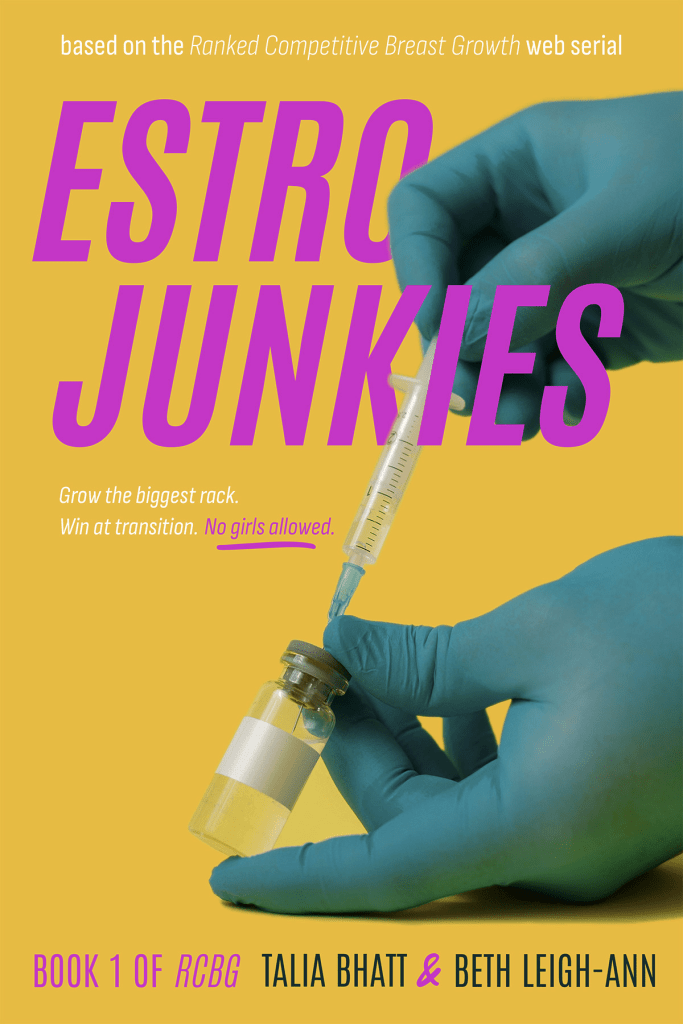
Estro Junkies by Talia Bhatt & Beth Leigh-Ann
Date: May 24th, 2026
Publisher: Self
Genre: Satire, Literary Contemporary
Website: https://taliabhatt.com/
Bluesky: https://bsky.app/profile/tpwrtrmnky.bsky.social
Purchase: itch.io
[DISCLAIMER] I received a review copy of this novel from the authors. Thank you so much to Talia and Beth for hooking me up, and for Talia’s ever-colorful commentary on my reading thread.
And the Eggerton Window shifts once again.
When I heard that acclaimed cogitohazard – I mean serial – Ranked Competitive Breast Growth, currently sitting at an eye-popping 668,000 views on Scribblehub, would be getting a ‘novelization’ rather than a simple published edition, I was skeptical. There’s a wide range of former Scribbehub serials that now have published book editions, ranging from direct copypasta jobs to modest rewrites, typically no more than some structural shifts or a few added chapters. Even the best of the Scribblehub crop, books like Welcome to Dorley Hall, are little changed from their digital precursors.
Estro Junkies bucks that trend to the extreme. Bhatt and Leigh-Ann were absolutely correct not to market this as a ‘published edition’ – Estro Junkies resembles Ranked Competitive Breast Growth in the same way that the Percy Jackson books resemble the Disney+ TV show. Reading both in comparison lays bare the true differences between the two mediums. Toward the beginning of the book, I had the initial reaction that Estro Junkies was a far superior rendition, almost to the point of rendering the original redundant. That was a wrong first instinct. I would instead argue that, while nominally telling the same story, the stakes, themes, and emotional gravitas of the two versions are different enough to merit a completely separate evaluation. Estro Junkies cannot rightfully be called ‘better’ than RCBG, though it certainly could not be called worse. Merely different.
Ranked Competitive Breast Growth is a shitposter’s shitpost, an elaborate pissing contest between two of the online trans community’s most prolific feminist posters to cause as much psychic damage to the trans leftist psyche as can fit within a digital text document. While RCBG contains foreshadows of the emotional stakes of Estro Junkies, they appear in the text almost as an accident, the byproduct of two writers who can’t quite bring themselves to forget the basic principles of good storytelling. It’s no accident that Talia Bhatt swore off fiction mere months before publishing RCBG. The serial, put simply, did not want to be good fiction; but it was, oh god was it.
Two TFR Awards and near-universal praise can attest to that. When I saw that Sarah Z was reading RCBG, that was when I knew this story had legs.
This is not, however, a review of Ranked Competitive Breast Growth, however inescapable its shadow may be. It is a review of Estro Junkies, the fiction project that emerged once the delusions of satire coalesced into the accidental diamond of literary acclaim. In order to make Estro Junkies even remotely possible, the structure and tone of RCBG had to be gutted so thoroughly that the final product is an entirely separate book in places. Characters have been radically rearranged. Entire plot arcs have been added. Vast stretches of irony-poisoned riffing have been removed. Not entirely – the satire in the original serial was load-bearing. But an admirable attempt has been made to conceal Estro Junkies’ most terminally online structural supports.
At the root of Estro Junkies’ storytelling is a certain degree of what can only be described as transfeminine sadism. As the current crowning triumph of the eggfic genre – typified by an arms race towards an ever-denser transfemme protagonist, trapped in elaborate denials of her womanhood – Bhatt and Leigh-Ann take a true glee in finding new and creative ways to torment their eggy protagonists. Every brainworm gets its wormy home. Every rhetorical fallacy and cognitive hazard is laid out on full display. In many ways, RCBG – not Estro Junkies – is the platonic ideal of the eggfic genre, the perfect actualization of an arms race that began around 2020, and only now has reached terminal levels of denial and self-destruction, verging upon a spectacle of self-harm.
Estro Junkies has a problem, then. At some point in the last year, these miserable, pathetic characters stopped being ridiculous caricatures of trans women in denial, and began to have real emotional stakes behind them. Messy, emotional, baby trans girl stakes. I could pinpoint during my reading of the serial the exact moment when Katherine stopped being absurdist hyperbole and started becoming the emotional center of a torment nexus engineered without escape. Dearest Katherine, Boymoder Sephiroth, undeniable winner of the 2025 TFR Award for Best Character. When that moment comes in RCBG, it’s almost manipulative, however innocently intentioned. The gut punch – and subsequent tears, at least for me – only worked because Bhatt and Leigh-Ann seemed just as shocked by Katherine’s sudden emotional depth as the reader. It’s kinda like that scene from Arcane where the writers gleefully destroy the childhoods of Vi and Powder, only for Silco to come and scrape up Jinx from the wreckage. That is, if Arcane’s writing was intended to weaponize cringe to the point of self-implosion, and Powder’s explosion took the form of online debate on a Discord server for closeted t-girl incels.
Reconstructing the sheer emotional gutpunch of that moment with Katherine was impossible, and you shouldn’t expect to find that here. If anything in RCBG was lightning in a bottle, it was that one character beat.
Estro Junkies isn’t trying to replicate RCBG, and frankly that’s the best thing about it. This isn’t a repackaged serial, this is a novel. That’s an thought I had around the 1/3rd mark. This is a book that understands the novel, that wants to be a novel, that intentionally and deliberately seeks out a higher mark than its source material. I respect the project immensely on those terms.
Does it succeed at its stated goals? Maybe.
On the level of pure prose craftsmanship, this is by far the best writing that Bhatt has ever produced. My biggest criticism of Dulhaniyaa was that its prose was weak and unpolished. I’m very pleased to say that those issues are 100% gone here, and while I’m not as familiar with Leigh-Ann’s broader corpus, it’s a great first impression of her work. Estro Junkies is a polished, modern, sleek entry, with prose that far excels its serialized cousin. It’s a little bit like walking around in a Frank Lloyd Wright house – the architecture is funky, but there’s clear love and care gone into maintaining it, and the current owners have made the most of the space. No – most of my critiques of this novel are of its substance, not its construction.
When you attempt to workshop an absurd maximalist shitpost down into a serious (in the professional sense) work of literary satire, there are intrinsic limitations baked into the endeavor. As I’ve already mentioned, aspects of the original farce were load-bearing. While some of the more out-there aspects of RCBG may have been nonsensical and underbaked, they still served a critical role in situating the premise, selling the fantasy of a transition contest for men, a gift basket of HRT delivered straight to a college student’s dorm. The more planks you replace in Theseus’ ship, the more bits you replace with straight-faced examinations of the toxic egg psyche, the more stress you place upon those original absurdist bits to maintain their own self-justification.
Estro Junkies is a novel that can only exist in a post-Dorley world. It takes its formula from Greaves’ miraculous serial-shitpost turned literary fiction, and in rewriting itself for the publishing lens, it seems to hope for its literary proficiencies as well. But even from the first chapter, The Sisters of Dorley took itself seriously in a way that RCBG did not. While this overhaul succeeds at creating literary valence, Estro Junkies fails to replicate the timelessness and universality of early Dorley‘s storytelling, the crystal clarity of its messaging and prose.
But Estro Junkies‘ identity crisis goes beyond a mere tension between absurdist satire and literary heft. While the early chapters hew closer to Bhatt and Leigh-Ann’s vision, deepening the world by exploring social networks and adding new seamless character scenes that enhance the satirical lens, the later chapters begin to stray into other pursuits to close the gaps. While RCBG always had Bhatt’s signature feminist critique woven onto the page, there were moments in Estro Junkies where I felt like I was reading outtakes from Trans/Rad/Fem concealed as witty rapport. I know that Katherine’s proficiency in gender theory was part of the bit, but when she spends several pages explaining third sexing in paragraph-length detail, it’s hard not to see the authorial voice creeping in. Further, as Talia agreed on Bluesky, Estro Junkies felt like a backdoor sequel to Dulhaniyaa in a way that RCBG never did. While Rupali and Rashmi’s character arc was an undeniable highlight, it reads like a quiet shift in the character landscape, as though Estro Junkies wants to bring them closer to the center of the narrative, but was unable to break away from the ensemble cast that made RCBG so popular in the first place.
By far the biggest problem, however, comes in a fundamental ambivalence about the narratorial mode. To draw on Northrop Frye here, Estro Junkies is a shift away from the ironic mode, which concerns pathetic or inferior characters, to the low mimetic mode, which concerns characters which resemble everyday life, however down on their luck. Further, its primary valence begins to shift away from comedy to tragedy. Frye identifies the mode of the ironic comedy as sadism, as motioned above, and the mode of the low mimetic tragedy as pathos, or the emotional attachment to the plight of its characters.
However unintentioned, the brilliance of RCBG comes from the pivot between the two modes, the sudden revelation of a tragic emotionality beneath the comedic sadism of a breast-growing contest. But Estro Junkies’ rewrite takes the entire story and reframes it within the low mimetic mode – a shift which breaks the fundamental turn that defines the story structure of the original serial, and demands a complete reimagination of the story’s emotional landscape.
There are two fourth-wall breaks that underwrite this collapse of the ironic mode – both lampshaded in the original serial, but neither explored in their full implications. Firstly, in the original serial, it’s not nearly as explicit that the Ranked Competitive Breast Growth Discord server was created with malicious intent – or as a “tranny torture chamber,” as Bobbie puts it. The implication is always there, but a certain remove from the in-universe sadism of RCBG is necessary to give the literary sadism of the serial its raw comedic edge. For me, this was the moment that Estro Junkies stopped being funny. Secondly, in the serial, part of the quiet absurdity comes from the quiet realization that the RCBG competitors aren’t scattered around the world; they’re scattered around the campus of a single college. It’s an incredibly effective piece of subversion, making a contest that seems so grandiose amusingly small in scale. Estro Junkies, on the other hand, grounds the events of the plot in the university to the point of feeling like a campus novel, and that comes with troubling implications that the narrative isn’t really equipped to explore.
It should not be lost on the reader that both of these shifts make the world of Estro Junkies more akin to Dorley – the predatory conspiracy of Grandmother’s clientele network, the university setting. But what Dorley has that Estro Junkies lacks is a certain optimism about trans care networks and relationships, a fundamental belief in sisterhood and compassion that the sadism of RCBG precludes. Dorley works as a campus novel because it isn’t afraid to show its characters as college students, as kids. Getting sent to the basement is a second childhood of sorts. It’s a second chance for trans women who have already written themselves off as irredeemable, and I don’t think we talk often enough about how remarkable it is that the narrative never mocks its characters for it.
The world of Ranked Competitive Breast Growth is not capable of reserving that mockery, much less offering care to its characters. While Estro Junkies recognizes its limitations, it remains incapable of changing its approach, fundamentally constrained by the lode-bearing bones of its ironic story structure. I’m not going to sit here and moralize, or tell you that’s a bad thing. But I don’t like it, unfortunately. I simply do not enjoy reading about miserable people saying and doing miserable things to each other, especially once the facade of riotous, glorious humor falls away from the ordeal. And it did fall, for me. In the first half of the book, I was still cackling along – but by the end, the weaponized cringe and dismal social outcomes had me stony-faced in my room.
Of all the characters in the novel, Katherine is by far the most impacted by this shift from ironic to low mimetic storytelling. While Boymoder Sephiroth is an exceptional protagonist for a sadistic comedy draped in irony poisoning, a little sniveling girl-failure with the emotional affect of a bedraggled kitten who gets hauled in out of the rain to lap at a saucer of warm milk, she’s not nearly as compelling as the main character of a dark semi-realistic campus novel about a underground HRT ring weaponized against baby trans girls for sexual exploitation and gratification. When one of the server mods gleefully crows that watching their romantic drama is “better than Love Island,” it doesn’t come across as a glorious knife twist – it’s just painful. It turns out that when the laughter stops and the subtext becomes text, reading a full novel’s worth of young trans women shriveling under the violence of gleeful sexual harassment isn’t very funny. Without the irony, the sadism doesn’t work.
While I understand what Bhatt and Leigh-Ann were going for by giving Katherine an accountability arc, having her acknowledge her own faults and resolve to work on herself, it doesn’t work for me because the reader gets zero payoff for it. Katherine is never rewarded or treated kindly for her character breakthroughs. If anything, she’s treated worse for it. It’s like she decides she’s made mistakes, and then all the characters go, ‘You’re right!,’ blame her for everything, and then move on without any resolution. This is not an uncommon pattern in the book. There’s character development here, but there’s no catharsis. The closest we get is Nicole’s negative character arc, but there’s never any contrast to break up the nausea of her inescapable misery. That’s really what this book lacks – contrast. There’s no Puck, no chorus, no real voice of reason, no outsider perspective. There are no moments where the antagonists find hope, or where the protagonists sits with the doubt of their own actions. Genuinely, all I wanted was for someone to give Katherine a hug, and actually mean it.
I’ll give it one thing – these characters feel like college students. They embody all of the worst aspects of petty university mean girl shit. The absolutist thinking, the immediate instinct to ostracize and burn bridges, the full-body overinvestment in every little drama and rivalry, the unwillingness to compromise and change. Every single character in this novel is immature. And like, as a satire of trans community, I get it. I had these messy social circles and dramas in college. I see people act like this every day on social media. Transfeminine social circles are full of people who never got to be middle school girls, so now they act like middle school girls in their thirties.
But there’s no perspective. There’s not a single character in this book who feels like another possibility for how transfeminine relationships could be. Instead, we’re trapped in an inescapable torment nexus of terrible decisions, petty bitchery, and exploitative social systems that exchange basic healthcare for topless selfies. It’s not that it’s unrealistic. It’s that this world feels small, and it feels bleak. And maybe that’s life for British trans women in 2026, but I refuse the notion that it’s the only way, much less that it achieves the mimesis that this formalizing rewrite seems to desire
There are glimmers of a different story woven into Estro Junkies. As I mentioned, Rupali and Rashmi’s relationship would have been a much more functional central duo to follow than the miserable dysfunction of Katherine and Nicole. If Bhatt and Leigh-Ann had done an even more drastic rewrite, Estro Junkies could have been a really compelling satirical romance novel about two people stuck in abusive social systems, working to find each other. Rupali’s friend group is really well-developed, and with Jeff toned down significantly from the serial, I could actually read his scenes without wanting to chuck my phone off my balcony. Katherine and Nicole would have worked much better as comic relief side characters, rather than trying to use their foil to carry the narrative. But as it stands, the ensemble storytelling really worked against that tantalizing Dulhaniyaa sequel buried within this novelization. By the end of the book, Rupali and Rashmi felt almost like Talia and Beth were trying to find an escape from the torment nexus, a way out from the Gordonian knot they had created. But it was always a structural issue, not a character issue, that kept their vision locked in place.
Given my criticism here, you may be surprised that I have a pretty high opinion of Estro Junkies as an overall product. No matter how I feel about what it has to say, this is a good book. It’s well-presented, well-edited, well-crafted, and ambitious in the ways I admire the most. This is already one of the biggest hits of the year, and it’s going to resonate with people, just like the serial did. At the end of the day, if I had to choose, I do think I still prefer Ranked Competitive Breast Growth, if only for the pure comedy of its prose. But even then, this is a style of storytelling that just doesn’t resonate with me. It might be a funny world, but it’s not a very kind one.
7/10


Join the discussion! All comments are moderated. No bigotry, no slurs, no links, please be kind to each other.