This article was made possible by our wonderful Sponsors! If you want to contribute to essential transgender journalism like this, then please feel free to go support our work on Patreon – your contributions help us keep Academic Quality Scholarship 100% free and available to the general public.
Introduction
My journey with Roberta Angela Dee began in the early summer of 2023, when I first began to read through Monica Roberts’ classic blog TransGriot. Back then, I had just finished my junior year of college, and The Transfeminine Review was only a flicker in my imagination. But I knew, even then, that if I were ever to make a blog about transfeminine literature, I would want it to look something like the platform Monica Roberts built.
I had come across TransGriot many years prior, during my early transition in 2017, and was familiar with the site by the time I got really into trans literature. But 2023 was when I discovered that Monica Roberts had gifted us with a wealth of information about early black trans authors, which was a subject I had already become interested in. I noticed very early into my trans lit research that there was no information on the web about TWOC fiction, and especially about black trans fiction. Every source seemed to point to the same five or six authors over and over again. The only black transfemme novelist who seemed readily available was Dane Figueroa Edidi.
But the information was out there. Through Jamie Berrout’s work and the Trans Women Writer’s Collective, I found out about writers in the 2010s. Through diligent research on social media and in news articles, I found out about contemporary authors. And through Monica Roberts, I learned about black trans writers from the aughts, and one sole writer from the nineties, one Roberta Angela Dee.
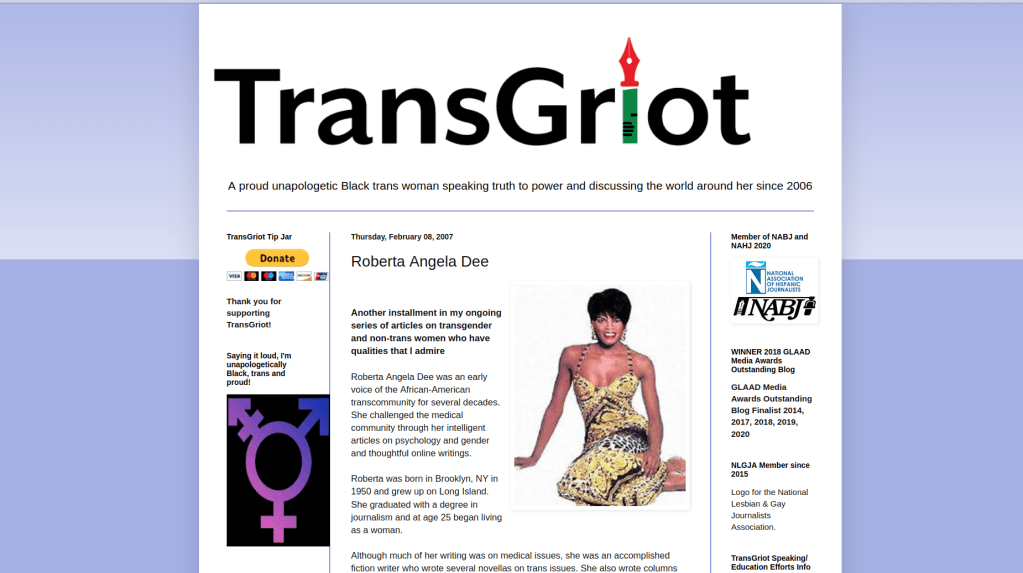
Across two short articles, Monica Roberts wrote about Dee, who had been a close personal friend of hers and a primary influence upon her own advocacy and life’s work. In a 2013 article published on Dee’s death anniversary, confusingly titled ‘Happy Birthday,’ she wrote these powerful words about Dee’s influence on her life and legacy:
While we had more than a few chat conversations, sadly I never got to meet her in person before she passed away. But there is no doubt that I’m not only following in Roberta Angela Dee’s footsteps, I’m done my part to expand what she started doing to a wider audience inside and outside the trans community with my own emphasis on unearthing those nuggets of Black trans history and discussing them here or at a conference or college campus near you.
I’m doing my part to live up to and exceed the legacy she left behind with her untimely 2003 death. I hope that as I run with the torch she handed off to me, I continue to make my community proud and keep exceeding the lofty standards I expect from myself and the community expects of me until the day comes that I have to pass that torch to my successor.2
Monica Roberts passed away in 2020, long before anyone in the broader trans community had any recognition or appreciation for the legacy Roberta Angela Dee left behind. With her passing, we lost our strongest link back to Dee’s life work. And I will confess myself that while I registered Dee’s importance to Roberts in 2023, I didn’t ultimately give these articles the gravity they deserved. I made a small note of Dee’s name on my long masterlist of transfeminine authors to research in the future, and moved on with my life.
Jump forward to October of 2024. From the moment I went live with The Transfeminine Review, I knew that one of the first resources I wanted to create was a reading guide to black transfeminine literature. True to my word, the eleventh post I made on this website was entitled Fifteen Black Transfeminine Novelists You Should Read, ordered chronologically by earliest publication. Roberta Angela Dee was the first author on that list.3
Looking back on what I wrote about Dee in 2024 (there’s more in the article), I did a pretty good job at capturing the broad strokes of her career and importance. There are a couple errors I made – her erotica, for example, is not lost, as I have now found it – but in general I’m satisfied with my research back then. What I didn’t capture in that 2024 article, though, was the sheer breadth and depth of her career, largely because I had not yet truly dived into her writing at the time.
In preparation for that article, I read Dee’s 19974 novella Sasha, live-posting my reactions on both Bluesky and Tumblr. It is entirely possible that it was the first time anyone had read Sasha in a decade, maybe two decades. The fact that I could access the novella at all is a testament to the longevity of influential 90s TG/TF publisher Reluctant Press, whose full catalogue is still available on the website magsinc.com. And, well, it knocked my socks off, and was by far the best piece of black trans fiction I read during that research.
My reading of Sasha made a fairly notable public splash, especially for a novella so obscure that it still doesn’t have a Goodreads page. The article was, at the time, the biggest I had ever written, with over 2000 notes on Tumblr and 3000 lifetime website hits, and Sasha was the book that I talked up the most. It ended up being read by several of the most die-hard fans of transfeminine literature. Steve Hugh Westenra described it as “absolutely compulsive” and a novel that “absolutely deserves to be read academically” in a 2026 review, and made it the April 2025 pick for his Trans Reading Group book club.5 In my own one-sentence 2024 review on my Masterlist spreadsheet, which is how I used to keep track of my ratings before Patreon, I wrote, “One of the most powerful works of feminist literature I’ve ever read. A stunning triumph of the epistolary genre,”6 and gave it a two-star 9/10 rating.
Still, my brief profile didn’t exactly bring Dee back into the public consciousness more than twenty years after her death. My platform was still small in 2024, and I had endless other topics to turn my attention to. I published the article and, once again, moved on.
By February of 2025, during Black History Month, I had grown to feel that my first article on black transfeminine literature was incomplete, and published a longer essay on the topic, entitled “Black Transfemme Literary Springtime.” Heavily inspired by Snorton and Haritaworn’s “Trans Necropolitics” and Jamie Berrout’s Incomplete Short Stories and Essays, I wanted to understand why there was so little scholarship on black transfeminine literature, and why black trans authors seem to slip so easily into obscurity. I began that piece:
Here’s a fact – 2025 is the best year for Black transfeminine literature, ever. Right now, there are more Black transfeminine novelists writing, publishing, and succeeding than at any point in history – but their presence is diffracted, diffused within the normative lenses of white supremacist publishing. There are no critics to give it narrative, no springtime, no fall. It is a history only written upon death.7
But that’s not quite right, is it? Looking back on this piece in retrospect, I may have had it backward – the problem is that black trans literature has only been observed in life. Roberta Angela Dee faded into obscurity almost from the moment she died. There is no substantive posthumous reading of her work. Apart from Monica Roberts, I have only found three secondary posthumous sources that document her life on the entire internet, and none of them engage with her writing. As important as Roberts’ memorial is, neither did she. When I combed through academic databases, I only found one singular mention of her in any scholarly source – and it was a Reluctant Press advertisement that just happened to have been scanned into a Queer Studies database. There have always been contemporaries of black trans authors who promoted and critiqued their work.
It’s after they’re gone that the silence comes.
I still feel that “Black Transfemme Literary Springtime” is my most under-read article. Of everything I’ve ever written for this blog, it was that piece I hoped would garner a response, either critical or positive. But it released largely to silence and faint praise. Some of that can be tacked up to the fact that it was published in the spring of 2025, aka high American fascism hours. But not entirely. The thesis of that piece, I think, is of particular interest to this article:
Let’s take a different tack. Black transfeminine publishing has always existed as a supplement to White transfeminine publishing, a neglected undercurrent to be extracted and discarded, forgotten. Even now, at the nadir of the contemporary trans publishing movement, it remains a counterweight and a benchmark upon which White trans publishing may be weighed. It is no less fragmentary now than it was in the 1990s, when Roberta Angela Dee was silently toiling at powerful literary fiction while Reluctant Press churned out white erotica slop around her, or when Yemaya’s Daughters was also self-published in 2013 and received little of the attention or acclaim of its White transliterary cousin Nevada. Even now – what books are favored for literary preservation? How many of the participants of the Trans Literature Preservation Project have more than one or two Black transfemme-authored novels in their library?
This isn’t just a question of positing that Black transfemme lit isn’t in all that different of a place as it was thirty years ago – it’s a question of positing that White transfemme lit isn’t in all that different of a place as it was thirty years ago either. The economics, tropes, genres, and volume have all shifted, but the primary modes of conceptualization and reproduction have not. Crucially, my thesis here is that the relationship between White and Black transfeminine literature has barely shifted during that time, if at all. There’s more of both, but that hasn’t changed much structurally of what it means to be a White transfeminine author or a Black transfeminine author.
The ‘Transgender Tipping Point’ was always a myth, one which excused the White desire to posit the gains of the Trans Liberation movement as equally distributed across demographics. And thus White supremacist publishing legitimates itself through a new lens, and the cycle begins again.8
I originally wrote that article as a critique of my own prior piece, “15 Black Transfeminine Novelists.” Similarly, this article on Roberta Angela Dee has arisen in part as a critique of “Black Transfemme Literary Springtime.” While this thesis was broadly on the right track, I made the critical error of forgetting that people didn’t have a conception of what the relationship between white and black transfeminine literature looked like in the 90s. In fact, they had no conception of a “history” of black trans women in publishing at all.
Once again, I had left myself an open question. This article is my attempt to solve it – my attempt, in effect, to give an actual history of black transfeminine literature, with full research, historical sourcing, and concrete, undeniable evidence of the historical importance of a black trans author who helped to shape the trans community as we know it today. Not a listicle. Not a polemical essay. A history in its own right.
I will also note that my ability to do this research is a continuation of the work I’ve been doing in my Brief History of Transfeminine Literature series over the past few years, which is itself inextricable from the histories of enslaved Africans across Britain and the United States. “Trans history” is Black history. It is a history of flesh and race and carcerality and fugitivity. It is a history shaped by black trans actors from the beginning. I would urge you to go and read those articles, especially “The Birth of American Anti-Trans Law,” if you’re curious to learn more.
Around this January, I started thinking about what I wanted to do for Black History Month this year. Those plans were unfortunately derailed by the one-two punch of poor mental health and a runaway novel draft that took me by storm. Given that I did not publish anything in February, it’s evident that I didn’t manage to follow through on those ideas. However, I knew that I wanted to go further in depth on the black trans fiction I covered in my first overview, and the first spark was lit in my mind.
The kindling: As many of you know, I’m currently in the middle of getting a Master’s degree in Feminist and Gender Studies. This semester, I’ve had the absolute pleasure of taking a class that’s focused on Black death, grief, and resistance. It’s easily one of the coolest courses I’ve ever taken, and one that I immediately realized could be enormously valuable to bring into my own work and share with the broader community. It ties directly into my own prior scholarship, as we read “Trans Necropolics,” and covered a lot of Black feminist theory on death and remembrance I hadn’t yet encountered. The whole course was built around Christina Sharpe and her foundational theory of the wake, looking at history as following in the wake of African chattel slavery, the literal wake of the slave ship. We also read Saidiyah Hartman, Mari N. Crabtree, Dagmawi Woubshet, among others.
The final project for that class is to write a eulogy, and from the moment I saw that on the syllabus, I knew I wanted to write about one of the black trans authors whose legacies have been largely forgotten. Though I was torn between Roberta Angela Dee and Pamela Hayes, I ultimately settled on Dee, and I’m very glad I did.
When I decided I was going to write a eulogy for Roberta Angela Dee, I thought at first that it was just going to be a class project, a final essay for the grind. But I realized almost immediately once I began researching the gravity and immensity of the task. Because there is nothing written about Dee’s life. Not in the standard of detail I usually hold myself to. It wasn’t just that I would be remembering her life. If I only made my project a graded assignment, something to be turned in to pass a class, I would also be the only person remembering her life. And that was untenable for me. Roberta Angela Dee and her full, vibrant life deserved so much better than that. The scope grew. I committed fully to turning this into a main site project.
You hold the sum of that research in your hands now.
So this article is a eulogy, or at least a eulogy as I understand it. eulogia – good words. I am setting out here to remember a woman who has been largely forgotten, but I am also engaged in the same act of deliberate passing-down, taking-up, as Monica Roberts did. I am letting Dee’s work inspire my own words.
Roberta Angela Dee’s life work is of importance to me because I do see myself as writing in the direct lineage of her influence. As I’ve already mentioned, Monica Roberts’ blog TransGriot was inspired by Dee’s work, and in turn was a direct influence on the construction and presentation of The Transfeminine Review. Furthermore, my biggest influence is Jamie Berrout, and both her scholarship and the Trans Women Writer’s Collective wouldn’t have been possible without the foundations that Monica Roberts helped to lay down. So there’s a two-fold sense in which I would place my work there. I am not a trans woman of color, but I have taken up the flame that Monica Roberts, and Roberta Angela Dee in turn, left behind for us, even if I only carry a very small part of it. And it’s a legacy I hope to honor here, one I hope I can share and pass on to the many trans women of color who do read my work.
Furthermore, over the course of reading her life’s work, I’ve come to develop a great appreciation for Dee as both a writer and a woman. While she undeniably had her flaws, the Roberta Angela Dee that I have uncovered in my research was a fierce and enormously compassionate pillar of her community, deeply dedicated to her principles and the journalistic ideal of bettering the lives of the people around her. On a personal level, I’ve also seen how Roberta spent her whole life advocating for pieces of my own transness and sense of self that I have always taken for granted. While I’m certainly no lipstick femme like she was, I do fit into that same sense of self that Dee would have called ‘transgendered:’ a trans woman with no interest in surgery who identifies as a woman first-and-foremost. That was a contentious thing in the 20th century, and Dee spent most of her life embroiled in community discourse. I live it every day without second thought. And though her conclusions are very much of her time, and I strongly disagree with some of her positions on gender and sexuality, as well as the abrasive way she defended them, it’s been very powerful to read back her work and see myself in it, even several generations removed.
What is the goal of this article, then? On a certain level, this is just that: a eulogy. I have come by a memory that is bigger than any one person should hold, and I hope to share it with all of you. Roberta Angela Dee deserves to be remembered. I also firmly believe that she deserves to be read, and that her life work needs to be slotted into the rest of the ‘trans canon’ of the 1990s.
I have also presented this in the hopes of expanding our historical record. Apart from Roberta herself, who is obviously the central topic, I also cover a wide range of lesser-known figures in trans history to our current day, such as JoAnn Roberts. The history of Roberta Angela Dee’s life runs parallel to the sort of trans history you’ll find in a book like Susan Stryker’s Transgender History, and it stands both in tension and conversation with those dominant narratives. My hope is that this article can begin a larger conversation about trans history in the 1990s, and that my work will be expanded upon by future scholarship.
To this end, at the end of the article, I have included a massive primary source dump with hundreds of texts from Dee’s long publishing career, ranging from articles to erotica to old forum posts to advertisements for her fiction. By making so much of her life’s work easily and publicly accessible, it is my general aim to allow anyone to continue this research, no matter their background or education. Roberta was a firm opponent of intellectual gatekeeping and snobbery. We share a common conviction that all people should have equal access to good, rigorous information and resources. It is my belief that sharing her work this way honors that legacy. I will also note that almost all of this was publicly accessible on the internet – merely very difficult to find. I have found it, and now it is easy to find. That alone is reason enough to publish this article.
While this is the most expansive and authoritative piece on Roberta Angela Dee ever published, I would not have been able to do this work without all the trans researchers and archivists who laid the groundwork for it. Obviously the biggest thanks needs to go to Monica Roberts, who continues to shape our community after her death. But I also relied upon a variety of resources from Lori Wynn, Cara Esten, Andrea James, Cassius Adair, Avery Dame-Griff, Michelle K. Smith, JC Badger, @james.claims, @rye.onl, and @soroke.bsky.social on Bluesky, the Transgender Oral History Project, the William Way LGBT+ Community Center, and basically every single person who’s ever left the breadcrumbs of Dee’s life scattered across the internet. Big groundbreaking projects like this are never sui generis; this is a knowledge that has remained buried beneath the surface of trans history for nearly thirty years. It only needed the right conditions to emerge.
Of course, none of this would be possible without Roberta Angela Dee herself – a woman who wrote tirelessly for decades, who was in constant correspondence with many of the major trans figures of her day, who was so prolific that even after twenty-three years of digital decay, her presence could still be felt in nearly every trans archive I looked. Dee’s life work is massive and absolutely indomitable, and I will only be able to capture a small portion of it here. The earliest text I can reference in this article came from 1990, and Dee claims to have been writing and publishing in queer circles since the 1970s. Entire decades of her work and thought are absent from this examination.
Despite the many remaining gaps and questions, I have done my best to present you with a cohesive and cumulative portrait of Dee’s lifework. There is a section on my methodology and future research questions at the end of the piece.
Without further ado, let me tell you a story about Roberta Angela Dee, the black trans literary pioneer you’ve probably never read.
- Introduction
- New York in 1969… On Long Island
- A Lifetime of Writing on Gender
- Erotics, Kinky Bisexuality, and Dee’s Lesbian Transsexual
- A Legacy in Black Transfeminine Publishing
- Conclusion
New York in 1969… On Long Island
Early Childhood
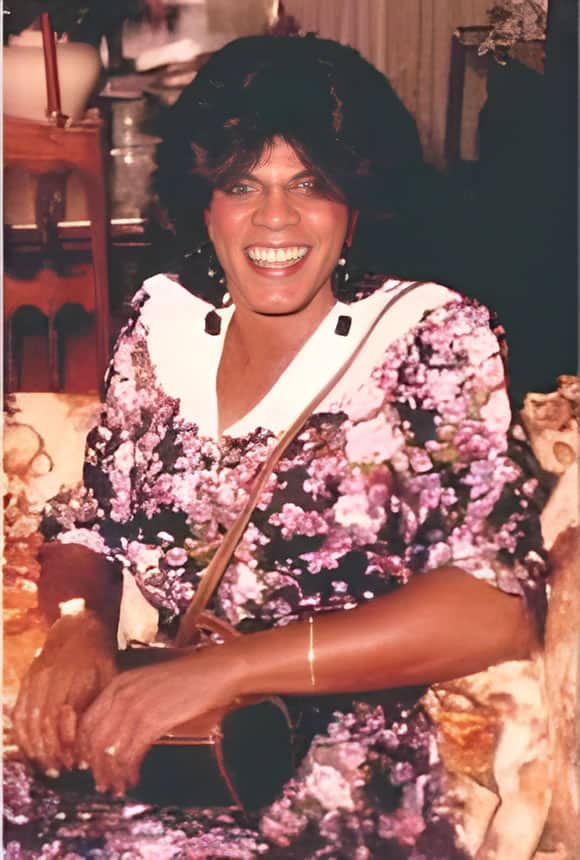
Before we begin to talk about Dee’s life, the first thing you need to know is that Roberta’s primary genre of writing was autofiction. Of her five novellas, all of them feature a main character named Roberta, none of whom are exactly the same. Roberta Angela Dee was first and foremost a lifestyle writer, and she used herself as the main character across much of her writing to explore the big questions of race, gender, and life. While many of her pieces are billed as memoiristic or otherwise factual stories, Dee was also a tabloid writer at heart, and got up to some truly raunchy escapades if all of her writing is to be taken literally. While it is entirely possible that these stories are true, it is also important to remember that we have minimal secondary sources to confirm or deny any of it.
What does that mean for this article? I am going to be drawing personal information and anecdotes from Roberta’s life from a wide range of her writings. However, please keep in mind that Dee’s writing often blurred the line between fact and fiction. While Dee remains the strongest authority on her own life, her oeuvre can be contradictory, and at times flatly incorrect. This is a working understanding of Roberta Angela Dee’s life, and it may evolve or be disproven in places over time as more of her work gets uncovered and documented.
I have done my utmost to cross-reference as much information as I can, but there are places where things will get shaky. With that out of the way, let’s talk about Dee’s early life.
The most reliable information about Roberta Angela Dee’s childhood comes from a regular monthly column Dee wrote for Transgender Form entitled Memoirs of a Transgendered Lady, which ran from late 1997/early 1998 (unclear) until at least 1999, and likely later. My access to these articles was indebted to an archival project by Cara Esten, which digitized and made public a specific CD-ROM archive of the forum compiled through December of 1998.10 What this means is that this critical compilation of Memoirs of a Transgendered Lady is almost certainly incomplete, and I have been completely unable to find any archived articles in the series published in 1999 or later.
Due to its central importance to this article, I have done slightly more editorializing on the Memoirs pieces, compiling them into a single document organized in rough chronological order and separated into sections based on where Dee lived at the time. You can find the full collection of the Memoirs column in the primary source files at the end of the article.
Cara Esten’s archival work on Transgender Forum made queer news in 2023, and I think it’s worth lingering on the preservation question for a moment. I’m specifically interested in the article that Samantha Riedel wrote on the archives, where she had this to say about the text-based library:
Unfortunately, while all these photos and images are freely available through this CD, they would have been inaccessible at the time to anyone who wasn’t subscribed to TGForum for $25 per year — roughly $50 today, adjusted for inflation. Non-subscribers were mainly limited to the text portions of the site. Still, the information there was no less valuable: fresh news items, opinion and advice columns, tips on fashion and “passing,” and links to various resources from clothing stores to doctors and therapists. Again, the utility of this information being widely available outside of whisper networks was completely unprecedented.11
As I mentioned earlier, Dee was a major proponent of open access to information across class and income barriers. It’s notable that these key articles on Transgender Forum, along with a host of lifestyle pieces and other writings, would all have been completely free at the time. This means that all visitors to the site, even those not subscribed, could read Roberta’s columns. Given that key detail, I do think that Riedel missed a major opportunity when she wrote this:
It’s impossible to summarize all the print content on the TGForum archival disc, especially as every reader will latch onto a different piece as their “best part of the whole thing.” For me, that spot is occupied by Gardner’s undated interview — either from 1998 or 1999 — with Jordana “1.8.7” LeSesne, the Black trans woman who played a major role in popularizing drum ‘n’ bass music in the U.S. […]
Unfortunately, Gardner’s LeSesne interview also lampshades a major diversity problem that bubbled below TGForum’s surface. Despite its zeal for broad community building, the site was near-universally populated by white, middle-class, Boomer trans women (a trend which was reflected in many of its humor articles and cartoons). Though a few non-white trans women like writer Karina Isato featured in some columns and pictorials, the overwhelming majority, including the site’s founders, were white.12
Roberta was right there! But I think that this oversight is the perfect encapsulation of a running theme I found while trying to find secondary sources for this article. The literature is full of little moments like this, where a piece could have mentioned Dee, but overlooked her. To be 100% clear, this is not a dig at Riedel, whose piece is excellent. I think it says more about the subtle ways that trans women of color, and especially black trans women, moved through these deeply white spaces on the early internet. Unlike in our current day, when BLACK TRANS WOMAN is more-or-less an expected part of the marketing process (see the title of this article), Roberta Angela Dee never advertised herself as Black. But she didn’t hide it, either, and it wasn’t a secret. It was very much common knowledge in these circles that Dee was African-American. She was not marked apart from her peers; her work was integrated into the core fabric of the product TG Forum delivered. Dee began writing with TG Forum in either 1996 or 199513, and her association with site owner JoAnn Roberts predates the existence of the Forum by at least five years. Among the consumers of the TV/TG periodical trade in the 80s and 90s, Roberta Angela Dee was a known quantity.
Dee’s contributions to Transgender Forum cannot be reduced to “a few non-white trans women” or “some columns and pictorials.” Dee was a friend of the site owner, and ran two regular columns, Memoirs of a Transgendered Lady and Roberta’s Beauty Tips. Her presence in discussion groups was about as chronically online as your classic poster’s disease Bluesky girlie today. She was a much bigger piece of this puzzle than that.
According to Monica Roberts, Roberta Angela Dee was born on Halloween, 1950 in Brooklyn, New York.14 But this was likely incorrect. Dee states that she was seven years old in 1956,15 ten years old in the summer of 195916, and twenty years old in 1969.17 Since she was born near the end of the year, it would seem that an accurate birthdate is October 31st, 1948. But it’s also possible that she was born in 1949. I will be using the 1948 date. Her family then moved out to Long Island, which Roberta would call home for the first half of her life. As someone born the day before Halloween, I absolutely love that Roberta is a Halloween baby; and clearly she did to, as we might gleam from a fascinating December 1990 edition of her regular column in En Femme magazine entitled “The Crossdressed Spirit of Hallowe’en.” This will also give us a early example of her autofictional tendencies to serve as guide through our attempts to piece together her childhood.
I share this story only with those special ladies who must also live as men, or at least occasionally dress as men. It is not to be read or told to any man. It is a lady’s tale, because a man would never understand the cross-dressed spirit of Halloween. […]
Michael Porter was born in 1949, at 10:35 p.m. on Halloween. It rained that night and the Atlantic Ocean threw the tide of a full moon against the rocky beach of long island.18
The conversational, almost conspiratorial tone is a signature of Dee’s writing. Her columns were so successful because of her skill at giving a personable touch to her life advice, a private conversation between herself and the reader. But what I want you to note here is how Dee ittakes details from her own life and shifts them ever-so-slightly to create a compelling fiction. In her writing, Roberta’s deadname is almost always Robert; Michael’s en femme name is Michelle. Roberta was born in 1948; Michelle was born in 1949. Roberta was born in Brooklyn, but moved to Long Island at a young age; Michelle was born on Long Island. Both were born on Halloween. These are the kinds of little embellishments and shifts that make it extremely challenging to definitively say what in Dee’s columns are actual facts about her life, and what are pleasant obfuscations.
I also find this story notable because of how its ending dramatically shifts the valence of a story that spends most of its middle depicting how Michael started going out as Michelle and fell in love with a neighborhood lesbian named Elizabeth.
It was the morning of her fourteenth birthday that Andrew decided to take Michael out on a long excursion onto the ocean. […]
At about 10:35 p.m. Andrew noticed that Michael had disappeared. He ran to the cabins below to look for him but he was not there.
The next morning after the storm had quieted and the sun emerged to make day, he discovered Michael’s body floating alongside the ship. He had been washed overboard and had drowned. […]
People who’ve lived in Freeport for many years and who knew Michael will swear that on some nights they can see what appears to be a spirit. It is the spirit of a young woman who bears a striking resemblance to the boy who was washed overboard on that October night during the early sixties.19
Roberta never shared her birthday with the audience of En Femme. To the uninformed reader, this is a very chaste story about a cross-dressing transgendered girl who meets a spooky fate at the end. But a basic autobiographical knowledge about Dee’s life adds a darker autofictional current to the story, one that seems archetypal of TV/TG fiction in the nineties. A modern reader will often comment on the prudish or conservative nature of classical TG/TF fiction – but even when writing for a true crossdresser’s magazine, Roberta Angela Dee’s prose has an edge that many of her contemporaries lacked.
I mentioned Christina Sharpe’s theory of the wake20 in the introduction, and I can’t help but feel the metaphor here, even knowing that Sharpe’s primary work came a quarter-century later. The image of a boy’s body getting swept overboard off a boat during a great storm, only for a girl’s spirit to rise in the storm’s wake, is deeply evocative of themes that echo across Dee’s multi-decade oeuvre. In a Memoirs of a Transgendered Lady column entitled “Women are Like Rivers,” one of Roberta’s paramours, Rebecca, says the following:
“When a man mimics a woman, when he cross dresses or whatever, he mimics the waves of a river. He mimics the flow, the way it moves. A river, however, has more elements than just its waves. Where the river is narrow, it flows faster. Where it is broader, it flows more slowly. Some areas of the river may be very shallow and other areas may be very deep. So a single river will have many different characteristics. Just like a woman. One woman — but what gives her depth is the variety within her soul, the textures within her being, the many different currents to the ways she lives her life. She like a river can have many currents, so can a woman, Currents within currents. Currents above and below currents.”
It was clear to me. As I had aged the depth of my womanhood had grown and had aged too. I was no longer just a river that mimiced other rivers. I too possessed the many currents and patterns that are all a part of being a woman. And it felt good. It felt good to be a woman — a real woman!
“I understand you, Rebecca,” I told her, as we walked back to the apartment. “I understand every word that you’ve said. I understand you perfectly.
“Ah, yes,” she answered, happily. “You are a woman. You understand.”21
Roberta Angela Dee was “a deeply religious and moral woman,”22 held a deep conviction in gender as a spiritual sense of self. For her, what distinguished a trans woman from a crossdresser was the spirit of womanhood within them, a spirit that transcended sex, and was indeed separate from sex. She considered sex and gender as separate, and strongly condemned anyone who conflated the two (we’ll get into this in more depth later). While the broad strokes of this seem common sense to us now, living the aftermath of Julia Serano’s subconscious sex argument, it very much was not common sense in 1990. The imagery of water, both as a source of bodily death and spiritual rebirth, echoes these central belief about trans embodiment.
I believe Christina Sharpe is a useful interlocutor for reading Roberta Angela Dee because toward the end of her life, Dee began to extend her arguments about the spiritual nature of gender and its separation from bodily sex into an argument about race and Blackness. On her website Women on the Net, an early internet resource for Black women that included info on trans identity, Dee published the article “Spiritual Feminism,” which follows an anecdote about Soujouner Truth:
“Look at me!” demanded Sojourner Truth, speaking as both abolitionist and feminist. The audience at the Women’s Rights Convention in Akron, Ohio, were stunned at this tall and imposing image, this woman of African descent, standing before mostly insensitive and hostile whites. “Look at my arm,” she continued, “it’s plowed and planted and gathered into barns and no man could head me! And ain’t I a woman?” […]
Her slave name had been Isabell Hardenburgh. She discarded it when she acquired liberty. The former Isabell choose Sojourner because sojourn meant “to dwell temporarily,” which she believed to be an appropriate description of one’s condition in this life. She choose Truth as the message she would carry to the world.23
There are very clear parallels to be drawn here between Soujourner Truth’s experience with slavery and race and the way Dee understood her experience with transness. Just as Roberta saw herself as discarding the power of her male body for her womanly spirit, Soujourner Truth discarded her slave name to draw out her own womanhood in the eyes of her opponents. Abolitionist and feminist, intertwined. What makes this essay really interesting is how Dee sees this move as foundational to a political project toward the feminist ideal:
However, as important as it is to understand why and how African American feminism developed through women like Sojourner Truth, there also needs to be an appreciation of the power and strength gained by numbers. Understandably, if the feminist movement among women of color is to move forward, the struggle will need to unite — collecting all disadvantaged women. There must be a unification of the needs specific to every poor woman, and every woman adversely affected because of the color of her skin or the nation of her origin. Essentially, feminism must move beyond its second wave of status quo limitations and become spiritual.
The idea of spiritual feminism has enormous appeal. First, because it excludes no woman. Second, because it can be distinguished from the views of status quo feminists. The word ‘spiritual’ itself has powerful connotations within many communities, including the community of scholars. […]
Yet, in spite of the diverse meanings one can derive from the word, it remains a powerful idea that lends itself to a feminist philosophy that is more inclusive. Spiritual feminism could provide a means for physically challenged women to bond with women of color, and for women of color to bond with poor women of all races. The unity, and the power of this unity, might well be the key to unlocking the resources that status quo feminists have essentially held only for themselves. It is a force, a power, that women of color must take back.24
This is the motivating philosophy that would lead Monica Roberts to create TransGriot. It is the reason that Women on the Net gets cited as “an early transgender resource for women of color,”25 despite only having extremely superficial and limited resources that actual mention transness. The ‘transgender’ element is not a recitation of the mechanics of trans identity; it is a transness baked into the fundamental philosophy and conception of the site. It is entirely inextricable from the political prerogatives it seeks to forward, and the coalition it seeks to build.
Our knowledge about Roberta Angela Dee’s early life is patchwork at best. For example, the prior article gives us the random knowledge that her mother was born on April 9th26, the sort of breadcrumb that becomes tantalizing when we have no official records of her birth, death, or family tree. The first two chronological articles in her Memoirs column give us a clear image of her favorite dress in her mother’s closet and a 1958 trip to Woolsworth’s, but not much else. Call it writing for the transvestite’s gaze. We know from a 2002 Usenet post that one side of her family was “West Indian,”27 placing at least one grandparent somewhere in the Caribbean. But our first really substantive glimpse at Dee’s childhood, likely on the other side of the family, comes in the article “Two Wells,” which recounts a visit to her grandparents’ farm outside of La Plata in Charles County, Maryland in the summer of 1959, a piece that gives us an enormous amount of insight into Dee’s relationship to the Civil Rights Movement, which lasted the whole of her adolescence.
America was beginning an unprecedented economic boom. As a result, life was good for most Americans and most Americans can cherish fond memories of this era in American history. Regrettably, the experience was very different for African Americans. Nineteen hundred and fifty-nine was four years before the celebrated March on Washington, and for many who would participate in the march, their memories consist of racial tension, segregation, oppression, unemployment, and police brutality.
Perhaps, the greatest threat to democracy lies in the different experiences of its people, our different memories and perception of what is the truth.
I was only 10 years old in the 1959, and only just beginning to understand the difference between being homosexual and being transsexual. The word ‘transsexual’ was new to me. I had only heard it during a news report about Christine Jorgensen. The word could not even be found in my father’s dictionary, and this occurred many years before there was a common appreciation for what’s come to be called the information superhighway.
Whereas, for most people, Christine Jorgensen with little more than a news item, and most assuredly a sexual oddity, for me she was like Joan of Arc or Sojourner Truth. She was a savior — a heroine who had arrived to lead me away from my confusion and personal hell.28
This was written after “Spiritual Feminism,” and the comparison between Sojourner Truth and Christine Jorgensen is about the strongest proof you can get that Dee saw transness and race entangled as you can get without laying it out explicitly. The term ‘transmisogynoir’ wouldn’t be coined until 2014, and the Third Wave understanding of intersectionality hadn’t hit the mainstream yet.
While Dee was both aware and influenced by the Civil Rights Movement, her upbringing on Long Island seems to have left her broadly sheltered from the actual events of it. The next paragraph is a good example of this:
That Summer — the summer of 1959, I and my sisters were driven by my parents to my grandparents farm in La Plata, Maryland. They owned most of what is Charles County today. I do not know how they came to lose so much property. However, it was not long after they passed that all of the land was confiscated by the State of Maryland.29
While I seriously doubt that Dee’s family owned “most” of Charles County, and I couldn’t turn up land records to answer the specifics of what lost the property, it doesn’t take a giant stretch to place the loss of family farmland within the broader dispossession of Black-owned agricultural land across the United States over the first half of the 20th Century. Charles County, MD is very much the American South as far as this history was concerned – until 1895, the county seat was Port Tobacco, and the name wasn’t a metaphor, that’s for certain. An analysis from Francis, Hamilton, et al. (2022) lays out a pretty clear picture of how Dee’s family may have lost the farm.
Black farmers had acquired this land against a backdrop of extreme racial violence, sometimes directed at landowners. Planters conspired together to restrict land sales to African Americans (Grim 1998). Because many banks refused to lend to African Americans, they had limited credit resources when the Great Depression hit.
Even though the federal government enacted massive spending programs to halt the farm crisis of the Great Depression era, the insistence by Southern Democrats that these programs be administered at the local level effectively blocked Black farmers from receiving relief (Daniel 2013).
In addition to controlling government benefits, White Southern elites found other ways to take Black farmers’ land. In one instance, a bank, a crop duster company, and federal officials conspired to force a reverend into debt and out of his land. Another common tactic was for a federal agent to delay a loan in order to cause a farmer to plant late, reap a smaller harvest, and end up in debt. All available evidence suggests schemes like these were widespread (Daniel 2013).
Black farmers made a direct attack on this system in the 1960s, when they worked with civil rights organizers to run election campaigns to integrate USDA county committees. White elites, however, used threats of job loss to repel voters and even resorted to blatant fraud, with no consequences (Daniel 2013).30
Furthermore, the fact that Roberta Angela Dee’s grandparents ran a farm in rural Southern Maryland, in the square heart of Maryland’s former slave country, and her parents lived in New York City until shortly after her birth around 1948, place Dee’s family squarely within the general patterns of the Great Migration. The Great Migration was a large-scale Black migration away from the violence and economic discrimination of the Jim Crow rural South towards new opportunities in the urban centers of the North. Given everything we know about Dee’s life, it seems likely that Dee grew up in a working class family, maybe middle class – well-off enough to move out to the Long Island suburbs and send Dee to community college, but not enough to pay off the farm. Dee spent her life primarily in white-collar jobs. While we don’t know how her parents were employed, it’s not out of the imagination that they may also have done white-collar labor.
“Two Wells” paints a vivid portrait of the severe rural poverty that Dee’s parents left behind in the South. The farmhouse had neither plumbing nor electricity, and Dee describes her grandparent’s lifestyle as living “in a different century.” The title comes from the fact that the first well had been contaminated by sewage from the nearby outhouse, forcing Dee’s family to dig a second well further away from the farmhouse. In the column, Dee describes how she had tried to drink once from the first well as a child, and came down with a scarlet fever that landed her in the hospital. I find the way she concludes this anecdote to be extremely telling:
Now, some of you might want to know what all this has to do with cross dressing, with being transgendered or with being transsexual. “What is the moral of the story?” some might ask. I can’t, however, answer that question. I’m a writer. My job is to write. I prefer that the Reader make his or her own interpretation.
However, if I were a Reader, I might think the story meant that one is best not to judge a book by its cover, nor to believe that everything that looks female and demure is actually female — even if anatomically correct.31
Firstly, I think this sentiment really captures the literary work I’ve set out to do in this article. Roberta ended most of her articles with requests for comments and feedback, and by all accounts loved receiving reader interpretations in the mail. For a writer so rich in subtleties and implications, her work has long lacked the attention and rigor it deserves, and I hope to deliver that at least in part in this lengthy piece.
Secondly, this is once again a piece where a broader context of Dee’s oeuvre adds new depth to her writing. The water metaphor here keys us into Dee’s understanding of womanhood, but it also, through the Soujourner Truth parable, keys us into a deeper story about the aftermath of slavery and the nature of systemic discrimination. I find it deeply fascinating how Dee’s stated ‘moral’ for this story about racism in Jim Crow South is about gender and gendered relations. When I first read this, I thought that maybe this was just a move to appease the Transgender Forum community – but now I think it’s deeper than that. Remember that Dee understands sex and gender as fundamentally distinct and separable categories. It’s a commentary on the difference between transvestites and transgendered people, yes, but it also evokes her ideas about the embodiment of slavery and the spiritual transness of liberation. The purified water moves away from the old farmhouse, into the shade of “the base of an old oak tree,” which provided water that was “cold as ice.” The second well is surrounded by wildlife: “incredibly huge insects,” “a snake that slithered away as we approached,” and “a tiny frog that swam in the pool of water.” A textural landscape of life that the first well lacked.
“Even at ten years of age,” Roberta wrote of her time in the hospital, “I understood precisely what the doctor meant.”
Coming of Age in the Civil Rights Era
As a child of Post-War suburbia, Dee’s early relationship to trans identity was defined by two chance television viewings: a news report about Christine Jorgensen at a young age, and a later talk show episode featuring Virginia Prince, which we’ll talk about in the next section. Roberta idolized both figures, and repeatedly talks about both of these moments throughout her writings. By the time she was a teenager in the mid-1960s, Dee had already begun to regularly go out dressed as a woman. Of this time in her life, she wrote:
There was a period in my life when one could describe me as a cross-dresser. My aspiration had always been to live and to work as a woman. However, before I summoned enough courage to make such a commitment, I would still go out dressed in the most feminine attire with the hope that I would be accepted as a woman and return home without the embarrassment of a police record.32
I think it’s absolutely crucial to recognize that Roberta Angela Dee, while in possession of a good deal of class consciousness, did not come from the same background as her black trans contemporaries in the New York ballroom scene and adjacent. She was never homeless, and while we don’t know much about her parents’ acceptance of her transness, the fact that she lived on Long Island for decades after going full-time as a woman suggests that they were at least tolerant. While I don’t believe she was ever wealthy, her life paints a consistent story of upwards class mobility, especially when compared against her grandparents’ generation. I have not found a single mention of Sylvia Rivera or Martha P. Johnson in her writing. It’s unclear if she ever became aware of the Stonewall riots, and her caution with the police and wariness of arrest suggests that even with awareness, she would not have involved herself with any of the street protests of the early Gay Liberation movement.
Across her oeuvre, Roberta claims that she began writing about gender at the age of ten. I suspect that this is about the same level of “writing” that I did in elementary school, but nevertheless her passion for writing began at a young age. While it is a less authoritative source than her memoiristic writings, Dee’s 1999 autofictional novella Roberta & Ren seems to carry some tantalizing breadcrumbs that might give us clues towards this early period in her writing.
Even at the age of 10 years, Robert recognized that society’s logic was somehow inconsistent: If wearing a dress did not make a woman less a person, or less a human being, how could it make a man any less a person or a human being? And, if it made him less masculine, then was being less masculine a crime? Was it a terrible sin to be “less masculine”? Perhaps, no one had bothered to examine the possibility that the world might be a better place to live in, if men were less masculine and were more nurturing, passive and, yes, feminine.
Robert’s first published essay was titled “How Do We Measure a Woman?” He submitted it to a lesbian organization based in West Hempstead, Long Island, New York. The editor, a woman named Becky, liked it and published it.
The essay represented Robert’s first attempt to intellectually grasp the idea of being transsexual. “How do we measure a woman?” he asked. Do we measure her by the size and shape of her breasts? If so, is a woman with large breasts more “womanly” than a woman with smaller breasts? Or do we measure her womanliness by her ability to bear children? If so, then is the woman who bears five children more a woman than the woman who is unable to conceive a child? If none of these attributes or capabilities matter, then do we somehow measure her womanliness through her vagina? After all, is this not the way that we distinguish little girls from little boys? Is it really, however, that simple? Can we truly and accurately determine the gender of an individual solely through which genitalia he or she possesses?
Robert concluded that gender could not be determined solely through genitalia; there had to be some other measure. He concluded that the only way to truly assess an individual’s gender is to assess the content of that individual’s heart, mind, and soul. In other words, it was necessary to assess the individual through an assessment of their emotions, personality, and character.
Robert already understood that in heart, mind, and soul he was a woman. The attributes of being feminine and womanly defined his gender, not what was between his legs.33
Again, given that this is a work of fiction, it’s impossible to know what here may be factual vs. fiction. However, given that the story Dee paints about researching transsexuality after seeing Christine Jorgensen on the news at age ten and coming to an interest about writing on topics of transness and gender lines up consistently across her work, I find this an instructive look at her early motivation towards her central beliefs. Additionally, given the prominence of Long Island across both her life and work, and the fact that Roberta was a well-known member of the Long Island queer community, especially in BDSM circles, for decades, the tidbits about Long Island queer culture are too important not to follow up on, and at least consider as potentially grounded in autobiographical fact.

While I was not able to confirm whether there was a lesbian publication on Long Island in the 1970s (though it seems likely there was), I have found the fragments of a surprisingly robust local queer community around the period. For example, West Hempstead, Long Island had its own lesbian bar from 1976 into the 80s called TC & Company.35 Roberta claims to have had partners over the course of her youth, but never felt the need to move into the city; it does very much seem like the local community was rich in queer culture, however DL. If the referenced essay is real, this passage may give us one of the only concrete links to finding Dee’s legal name, which could unlock an enormous amount of archival material for future scholarship.
And so we come to 1969. In the year that so many people consider the ‘beginning’ of queer history, despite her superficial proximity to Stonewall, Roberta Angela Dee was not living in the Village when the bricks started flying. She was attending a local community college to receive her degree in journalism, which would serve her well for the rest of her life. There are only two community colleges on Long Island, Nassau Community College and Suffolk Community College.
A 1998 short story suggests that Dee may have finished her community college program and transferred to SUNY Stony Brook for the second half of a four-year program, though her stated age of 22 does not line up with the timeframe for her community college degree. I would not take erotica from Nifty as the strongest biographical source, so take this with a grain of salt:
We met one Summer at the State University of New York — Stony Brook. She was a junior. I had transferred there from a two year college and was also entering my third year. We were both 22 years old and both very bisexual. Ironically, we were placed in the same room together.36
While she was not directly involved in it, Dee was very aware of the Civil Rights Movement unfolding around her at the time. What I find really interesting is how Dee opens her essay about 1969, “‘It Ain’t Necessarily So,’” by musing on the legacy of composer George Gershwin:
George and Ira Gershwin had engaged in a bold experiment: borrowing from the music, language and experiences of African Americans. It was an attempt to capture the essence of the lives of an oppressed race, and present it to an aristocratic audience.
The song “It Ain’t Necessarily So” suggests that the human experience is universal and that Fate can curse anyone regardless of race or ethnicity. The character Porgy might represent anyone unfortunate enough to be born different from the majority of the population.37
I find this fascinating not in the least because it seems to show in some part how Dee conceptualized her own work and audience. Many of the people in Dee’s audience were cross-dressing white men from an upper class background, or white trans women unable to come out for fear of losing everything. It also says a lot about Dee’s politics, because the opera Porgy and Bess was extremely controversial at the time. While the opera was responsible for launching a number of Black opera careers in the segregationist South, it was maligned even in the 1930s for minstrelsy and racist stereotypes, with outspoken opposition from Black intellectuals that grew into a pan-cultural roar by the time of the Civil Rights Movement. You know the show has to be pretty racist if it was canceled in the late 1930s.38 Its white-authored script used the N-word prolifically. There have been entire books written on the complexity of the topic, which I will reference here for those curious.39 This article on the specific legacy for Black women is also a great read.40
In 1967, taking up Black playwright Lorraine Hansberry’s open disdain for the opera still captured in the 1959 Variety article “Lorraine Hansberry Deplores Porgy,”41 academic Harold Cruise critiqued both Porgy & Bess and Hansberry as part of his argument in The Crisis of the Negro Intellectual:
The real cultural issues surrounding Porgy and Bess. as it relates to the American Negro presence, have never been confronted by the Negro intelligentsia-inside or outside the theater. The two most obvious points a Negro critic should make are: 1.) that a folk-opera of this genre should have been written by Negroes themselves and has not; 2.) that such a folk-opera, even if it had been written by Negroes, would never have been supported, glorified and acclaimed, as Porgy has, by the white cultural elite of America.
Lorraine Hansberry, taking to the television rostrum on art and culture à la Negre, was like a solitary defender, armed with a dull sword, rushing out on a charger to meet a regiment. But once having met an opposing general she immediately capitulates-“My intentions are not really hostile but you all have wounded us.” For Miss Hansberry to have criticized Porgy merely on content was, of course, her unmitigated privilege; but on this basis, her own play was wide open for some criticism on art and the image of the American Negro, which it never got. To criticize any play today involving Negroes, purely on content, is not enough. Most Negro criticism of Porgy has been of middle-class origin, although the Negro middle class has never been at all sympathetic to the realities of southern Negro folk characteristics in any way, shape or form. Hence, a generically class-oriented non-identification was inherent in Miss Hansberry’s views. […]
To attack it, one must see it in terms of something more than mere content. It must be criticized from the Negro point of view as the most perfect symbol of the Negro creative artist’s cultural denial, degradation, exclusion, exploitation and acceptance of white paternalism. Porgy and Bess exemplifies this peculiarly American cultural pathology, most vividly, most historically, and most completely. It combines the problems of Negro theater, music, acting, writing, and even dancing, all in one artistic package, for the Negro has expressed whatever creative originality he can lay claim to, in each of these aspects of art. However, Negroes had no part in writing, directing, producing, or staging this folk-opera about Negroes (unless it was in a strictly subordinate role).42
Cruse’s legacy as a scholar is broadly considered controversial among Black academics. He was the rare scholar throwing fire blankets at the peak height of the Civil Rights Moment, and was widely ignored and put aside by liberals at the time. The book also has issues with its handling of racial solidarity, and some questionable ideas about the Jews. But I want to bring in Cruse’s critique because it takes on an interesting second life in the work of Black feminist Hortense Spillers, who muses on the book’s impact in 1994:
The truth, more nearly, is that writers, in particular, and certainly the critics/theorists, have been as compelled as any other subject of economy to follow whatever fortunes, in this case, of the “prose arts,” into the contemplative sanctums, in an age dominated by communications technologies. The younger members of Cruse’s initial audience, then, either leaving undergraduate schools or entering graduate programs, at the time that The Crisis was published, were never wholly destined, by very virtue of the aims of the Civil Rights movement itself, for the singularity of motive, of address, that Cruse’s passionate invocation conjured up. Many of those persons, like Cruse himself at the University of Michigan, would be exactly positioned, in their future, between a putative community on the one hand and the politics and discursivities of the predominantly white academy on the other. We could say with a great deal of justification that the black creative intellectual has been more hesitant than not to acknowledge precisely where and how he or she “is coming from” and in what ways location marks in fact a chunk of the historical material. […]
The short answer is that the black creative intellectual must get busy where he/she is. There is no other work, if he/she has defined an essential aspect of his/her personhood as the commitment to reading, writing, and teaching.43
I love this idea of “getting busy” because it really seems to capture how Roberta approached her own work. For her, writing and journalism were deeply embedded pieces of her selfhood. And she got busy, certainly, and did so in a very distinct locale, the TV/TG magazine ecosystem, and later online trans forums. I think it’s notable that Roberta’s choice of medium carries traits identified by both Cruse and Spillers. While Transgender Forum obviously is not a fully comparable space to the Academy, it still mirrors the tension between Dee’s putative audience – transgendered people, and later trans women of color – and the white transvestite communities she embedded herself within.
Further, I think that Cruse’s work identifies an important class tension that exists throughout Dee’s corpus: her poverty and slavery-marred Southern ancestry that we see in “Two Wells,” and the middle-class American promise that her parents gave her on Long Island. The promise of Transgender Forum, as with many cross-dressing circles, was to a certain degree a dream of assimilation, of passing, of a well-to-do white trans middle class that could return to a ‘real’ life in cis society. It was a dream that Roberta Angela Dee largely had accomplished by the end of her life, one of the rare Black trans women of her era to do so. The truth of the matter is that Dee was sympathetic to the “realities of Southern Negro folk characteristics.” She would eventually return to the American South, first a brief stint in Louisiana in the 80s before settling down in Augusta, Georgia for the rest of her life. And it seems that Dee appreciated Porgy and Bess for the exact reasons that Cruse hated it – its honest, earnest attempt to capture the deeply fucked racist reality of poor Southern Black folks living under Jim Crow in an artform medium that was and continues to be lily-white. As absurd as the comparison may seem, there’s a real contrast to be drawn between the racial dynamics of opera and traditional TG/TF literature, which has its own storied history of racism and exclusion. In a way, her own work was attempting to perform that same “borrowing,” a merging of the essences of her Black and transgendered experiences, a theme that emerges most strongly in 1999’s Roberta & Ren.
Dee writes:
Since 1969, I don’t know how many men I’ve met who were actually women. They appeared to be men, but like the song suggests: “It Ain’t Necessarily So.”
As an African American who lives in America as a woman, I am more than aware that America is a racist and a sexist country filled will enormous prejudices. I can’t be real, nor true to
myself and believe otherwise. As a sane individual, I must confront reality. Many people prefer not to believe that this reality exists. I have nothing to say to such people. They live in a world of
fantasy and my situation doesn’t afford me their luxury.So, to all the male-to-female and female-to male transsexuals in the world, and to all the cross dressers — drag queens and drag kings alike, I say, be true to yourself. Be proud of who you are and what you do. Define yourself according to your own terms and your own standards. Don’t let anyone else define you simply because they’ve written some book or hold a degree from Harvard, Princeton or Yale. It’s you who matters, not them.44
Make what critiques of her politics you want, but Dee was at the end of the day a hardened realist. She presented herself in a manner legible to the normative power structures around her, and the majority of her more radical work occurred in nuances cultivated across decades beneath the outwardly palatable nature of her writing. And we can look back on those choices thirty years later, and say, “That wasn’t good enough.” But there’s a reason Roberta Angela Dee had a prolific career in these spaces, while other trans women of color did not. She had an incredibly fine needle to thread, and she didn’t always have the luxury of stating her more radical opinions outright.
Spillers would call that hesitation. Cruse would call that capitulation. Maybe they’re both right, but if I had to give it a title, I would call it survival.
I also think that Dee’s citation of Porgy and Bess echoes the extremely limited cultural resources that Dee had as a child, especially pertaining to matters of race and gender. As she repeatedly notes, Christine Jorgensen was her only exposure to transsexuality for many years. I would wager a reasonable guess that Porgy and Bess may have been one of the only pieces of Black media that Dee was exposed to growing up. Long Island is one of the most segregated places in the United States to this day, with Nassau County ranked as the most segregated in the entire nation in 2010.45 If it’s still this bad over 75 years later, it’s almost unfathomable to think of when Dee’s family moved to Long Island in the early years of the 1950s. While college educated, a community college journalism degree was almost certainly skill-based, not liberal arts based, and Dee likely wouldn’t have been exposed to the work of Black academics during her time there. In a pre-internet era, Roberta would have had no choice but to work with the information available to her.
At the same time, Dee’s 1997 website Women on the Net demonstrates a broad grasp on Black resources and culture on the early internet. Aside from being extremely well-read by her late forties, Dee cites an incredibly wide range of organizations and coalitions, with topics ranging from Black history to politics to culture and everything in between. “‘It Ain’t Necessarily So,’” likely written in 1998, post-dates all of this, which means that Dee’s choice to hold up Porgy and Bess as exemplar is a well-considered and intentional detail. It lends itself just as easily to a critique of Dee’s liberal (at times reactionary) politics as it does to an understanding that Porgy and Bess represents in a very real sense where Dee was during her life and career.
Reading Black Feminism into Dee’s Life
Lastly, before we get into Roberta Angela Dee’s thorny position on gender, trans identity, and embodiment, I want to take a moment to linger on Spillers, who I believe may be the strongest Black feminist theorist for attempting to untangle Dee’s trans theory. In her classic text “Mama’s Baby, Papa’s Maybe,” she write about the fracturing of the gender binary:
In other words, in the historic outline of dominance, the respective subject-positions of “female” and “male” adhere to no symbolic integrity. At a time when current critical discourses appear to compel us more and more decidedly toward gender “undecidability,” it would appear reactionary, if not dumb, to insist on the integrity of female/male gender. But undressing these conflations of meaning, as they appear under the rule of dominance, would restore, as figurative possibility, not only Power to the Female (for Maternity), but also Power to the Male (for Paternity). We would gain, in short, the potential for gender differentiation as it might express itself along a range of stress points, including human biology in its intersection with the project of culture.46
There are times where Dee’s thought clearly veers into exclusionary rhetoric, enbyphobia, and other forms of inter-community violence that we today would recognize as unacceptable. To be clear, I have no intention of defending those positions of hers. I do think that Spillers’ caution is critical here, though. While Dee’s individual arguments and positions are absolutely reactionary in a vacuum, I would argue that taking the cumulative heft of her work reveals an immensely valuable examination and critique of the stress points of gender differentiation. Such stress points were not well-documented, and as a national transgender politics began to coalesce around a communal understanding of what it meant to be ‘trans,’ there were few trans writers willing to linger in the muddy spaces between the groups. While Dee’s positions were often harsh, binaristic, biased toward what she understood as ‘transgendered’ people, and at times unacceptable cruel towards people in vulnerable states, I do not believe that she was a bigot. Her social network spanned across all three of the major trans categories at the time.
I will also link Spillers’ discussion of ‘Power to the Female’ back to Dee’s philosophy of spiritual trans identity and becoming. I believe that Spillers is a useful interlocutor here precisely because one can make a reading that she articulates the reconstitution of gender as a spiritual sense of self, one that emerges in both culture and biology to varying effects.
I want to further draw your attention to this passage, which evokes many of the things we have already discussed:
These scaled inequalities complement the commanding terms of the dehumanizing, ungendering, and defacing project of African persons that De Azurara’s narrator might have recognized. It has been pointed out to me that these measurements do reveal the application of the gender rule to the material conditions of passage, but I would suggest that “gendering” takes place within the confines of the domestic, an essential metaphor that then spreads its tentacles for male and female subject over a wider ground of human and social purposes. Domesticity appears to gain its power by way of a common origin of cultural fictions that are grounded in the specificity of proper names, more exactly, a patronymic, which, in turn, situates those persons it “covers” in a particular place. Contrarily, the cargo of a ship might not be regarded as elements of the domestic, even though the vessel that carries it is sometimes romantically (ironically?) personified as “she.” The human cargo of a slave vessel – in the fundamental effacement and remission of African family and proper names – offers a counter-narrative to notions of the domestic.
Those African persons in “Middle Passage” were literally suspended in the “oceanic,” if we think of the latter in its Freudian orientation as an analogy for undifferentiated identity: removed from the indigenous land and culture, and not-yet “American” either, these captive persons, without names that their captors would recognize, were in movement across the Atlantic, but they were also nowhere at all. Inasmuch as, on any given day, we might imagine, the captive personality did not know where s/he was, we could say that they were the culturally “unmade,” thrown in the midst of a figurative darkness that “exposed” their destinies to an unknown course. […]
The loss of the indigenous name/land provides a metaphor of displacement for other human and cultural features and relations, including the displacement of the genitalia, the female’s and the male’s desire that engenders future. The fact that the enslaved person’s access to the issue of his/her own body is not entirely clear in this historic period throws in crisis all aspects of the blood relations, as captors apparently felt no obligation to acknowledge them. Actually trying to understand how the confusions of consanguinity worked becomes the project, because the outcome goes far to explain the rule of gender and its application to the African female in captivity.47
There is a broad misconception in the trans community that the term ‘ungendering’ originated with Julia Serano, likely because Spillers or her black feminist contemporaries are not cited in Whipping Girl. I find Spillers’ construction of the term to be more useful, especially when held in conjunction with black trans writing and black feminist thought. We can link back her idea of the captive Africans in the slave ship being ‘nowhere’ to her piece about the importance of the black intellectual grounding herself in a sense of place. I also want to draw a connection to Dee’s arguments about naming, specifically the idea of a slave name coming to fill in the gaps of the namelessness of the Middle Passage. Further connections can be drawn between Dee’s persistent water imagery and Spillers’ consideration of the oceanic, the difference between moving-across and currents within. I am further interested in the idea of gendering as a domestic process and its connections to the presupposed domestic space of the white transvestite-crossdresser fantasia, and the ways that Dee navigated that over the course of her career. What underscores all of this is the question of how blackness and transness interlock; what trans identity might look like, a full decade before Whipping Girl was published.
I don’t believe that Dee and Spillers would agree here, and I’m sure that Spillers would have major critiques of Dee’s approach to gender. But the framework laid out by Spillers helps us to articulate what exactly Dee is doing, and the resemblance it forges to Whipping Girl and more contemporary trans philosophies through the situation of ‘ungendering’ is a useful device for making Dee’s work legible to a contemporary audience.
Finally, before we move on, I want to locate transness within Christina Sharpe’s work on the wake, as well as to briefly define the general contours of Sharpe’s thought. In the second chapter of In the Wake, subtitled “The Trans*Atlantic,” she writes:
What I am therefore calling the TransAtlantic is that s/place, condition, or process that appears alongside and in relation to the Black Atlantic but also in excess of its cur- rents. I want to think Trans in a variety of ways that try to get at something about or toward the range of transformations enacted on and by Black bodies. The asterisk after a word functions as the wildcard, and I am thinking the trans in that way; as a means to mark the ways the slave and the Black occupy what Saidiya Hartman calls the “position of the unthought” (Hartman and Wilderson 2003). The asterisk after the prefix “trans” holds the place open for thinking (from and into that position). It speaks, as well, to a range of embodied experiences called gender and to Euro-Western gender’s dismantling, its inability to hold in/on Black flesh. […]
With the Trans* I am not interested in genealogy; it is not my intention to recover transgender bodies in the archive. But when Omise’eke Tinsley writes in “Black Atlantic, Queer Atlantic: Queer Imaginings of the Middle Passage” that “the Black Atlantic has always been the queer Atlantic” (Tinsley 2008, 191), we might add that the Black and queer Atlantic have always been the Trans*Atlantic. Black has always been that excess. Indeed, blackness throws into crisis, whether in these places one can ever really think together, Black and (hetero)normative. That is, Black life in and out of the “New World” is always queered and more. We might say that slavery trans* all desire as it made some people into things, some into buyers, sellers, owners, fuckers, and breeders of that Black flesh. That excess is here writ large on Black bodies—as it is with the process of subjection. And it is that point, post the “rupture in the world,” at which, Dionne Brand tells us, we, whether we made that passage or not, are “transform[ed] into being. That one door [the door of no return] transformed us into bodies emptied of being, bodies emptied of self-interpretation, into which new interpretations could be placed” (Brand 2001, 25).48
As a cis scholar, Sharpe poses a transness that vacates, that empties the body of its spirit, that makes hollow in the pursuit of middle passage, into which a ‘new interpretation’ can be placed. If you take away anything about Roberta Angela Dee, I want it to be this: she spent her whole life fighting for that lost spirit and teaching the people around her the ways it could be renewed, ways that those forced interpretations could be overthrown. There was nothing Dee hated more than a construction of trans identity that ignored that fundamental need for a spiritual gender, whether it was transsexual thinkers who staked the entirety of trans being on embodiment and surgery, or transvestite thinkers who insisted that no matter their aesthetics, their inner selves were vacant of true expression. Dee understood through Soujourner Truth that old names could be shed, and that gender, thus spirit itself, was the central truth of one’s being. She was a woman of immense conviction, and it comes across even with the limited vocabulary she had to articulate it.
What is wake work in a black trans context? While as a white scholar, it’s not a question I would ever presume to fully answer, I do think that Sharpe’s central cri-du-coeur is a north star when trying to make sense of Dee’s life work:
Despite knowing otherwise, we are often disciplined into thinking through and along lines that reinscribe our own annihilation, reinforcing and reproducing what Sylvia Wynter (1994, 70) has called our “narratively condemned status.” We must become undisciplined. The work we do requires new modes and methods of research and teaching; new ways of entering and leaving the archives of slavery, of undoing the “racial calculus and . . . political arithmetic that were entrenched centuries ago” (Hartman 2008, 6) and that live into the present. I think this is what Brand describes in A Map to the Door of No Return as a kind of blackened knowledge, an unscientific method, that comes from observing that where one stands is relative to the door of no return and that moment of historical and ongoing rupture. With this as the ground, I’ve been trying to articulate a method of encountering a past that is not past. A method along the lines of a sitting with, a gathering, and a tracking of phenomena that disproportionately and devastatingly affect Black peoples any and everywhere we are. I’ve been thinking of this gathering, this collecting and reading toward a new analytic, as the wake and wake work, and I am interested in plotting, mapping, and collecting the archives of the everyday of Black immanent and imminent death, and in tracking the ways we resist, rupture, and disrupt that immanence and imminence aesthetically and materially.
I am interested in how we imagine ways of knowing that past, in excess of the fictions of the archive, but not only that. I am interested, too, in the ways we recognize the many manifestations of that fiction and that excess, that past not yet past, in the present.49
Roberta Angela Dee was a prolific writer of autofiction. Even in life, the archives of herself that she presented to her readers were a flickering thing, folding and ephemeral. Long after her death, we are presented with an image of a woman who, despite spending her whole life writing about herself, never truly allowed herself to become known. But Christina Sharpe gives us the tools to understand the archive of Dee’s life not just as a historical object, but as a living rupture that still affects us in our present day. It is an immense gift that we can reconstruct so much of Roberta’s life, but ultimately the story I want to tell you is one about who we are now, and how we move forward in a world no less hostile to Black and trans people than it was thirty years ago.
With that said, let’s talk about the most contentious part of Roberta Angela Dee’s legacy: her liaison with Virginia Prince and her evolution of the Princean conception of ‘transgendered,’ in all that came with it.
A Lifetime of Writing on Gender
Understanding Princean Gender Theory

The most important moment in Roberta Angela Dee’s intellectual development came in 1968, when the Alan Burke Show aired an episode featuring Virginia Prince (at the time introduced as Charles Prince, transvestite) promoting her book The Transvestite and His Wife (1967). At the time, Alan Burke’s show had developed a reputation that television historian Tim Brooks described as “the ‘crackpot’ school of talk shows,” with “bizarre or sensational” guests and a “caustic” leading man.51 Given Roberta’s lifelong participation in the tabloid sphere, it’s not hard to imagine why she might have enjoyed the show. She would have been nineteen at the time, and likely already studying for her journalism degree.
In many ways, the Alan Burke Show was a very early prototype for the talk shows that would become a staple in trans communities by the nineties. While the Christine Jorgensen story was told largely in newscasts and tabloid headlines, the Virginia Prince episode would have been far more personal, and likely rather explicit about the mechanisms of cross-dressing and transvestite relationships. There is absolutely zero information about this episode on the internet. What we do know, however, is that by 1968, Virginia Prince had just begun to live full-time as a woman, and was starting to become famous as a full-time activist for the trans community. It was not Prince’s first television role, as she had appeared on Irv Kupcinet’s “Kup’s Show” a year earlier on a panel about transvestism.52 Zagria Cowan’s biography of Prince does not mention the episode, focusing instead on other appearances in 1968 that were assuredly more substantial and less lurid.
The fact that Roberta watched this episode of the Alan Burke Show was, to put it simply, a complete historical accident. But then so was her seeing Christine Jorgensen on the news. This one moment, not even a footnote in Virginia Prince’s storied life, was the spark that would eventually lead Dee to become a prolific writer in the trans community. Ironically, this is a fantastic example of the historical impact made by Jorgensen and Prince. Even when they weren’t advocating for trans rights, their mere existence in those early days before the Gay Liberation Movement was enough to change the trajectory of trans lives across the world.
Here is what Dee had to say about her memory of the show:
I watched Virginia Prince on the Alan Burke talk show — one of the first to be nationally syndicated. These were the early days of television when television producers exercised good taste and moral restraints. So to see a man with breasts and obvious cleavage was an astounding event.
Mr. Burke puffed on his huge cigar and asked Virginia if she was a woman. He asked if she had had a sex change operation. Virginia insisted that she was a man but that he had chosen to live as a woman. He was the first to use the word transgendered as a means of distinguishing himself from someone who would be called a transsexual. Today, transgendered is used in several different ways — some more correct than others.
Virginia and I continue to be friends. We corresponded for several years. He mailed a photograph of himself to my post office box in Augusta. Even at 70 plus years of age, he makes for a striking woman.53
Yes, the pronouns in this passage are a confusing mess. In fact, that entire article, “The Secret Garden,” is a confusing mess. I don’t know what was happening but it’s not up to the quality of her other work.
Now, here is where the real issues with the archive begin. Up to this point, I’ve been relying entirely on sources from later in Dee’s life, which look back at her childhood. However, around this time is when Dee would have probably begun publishing her work, if she is at all to be believed. That means that there is a whole host of primary source documents absent from our picture of this period, and really Dee’s entire career through the 70s and 80s, which will severely limit our ability to trace the development of her thought on gender. Further, while Virginia Prince’s archive is fairly well preserved, it is scattered across a number of different institutions, many thousands of miles apart from each other, and Roberta’s letters to Prince could be scattered in any number of those boxes. We do not know when Dee mailed Prince for the first time, and we do not know what they said to each other or the precise nature of their relationship.
Let me emphasize: this information could be accessible. But I have not, and likely will not, had the ability to search those archive to find it for myself.
Because this period of Dee’s life is such a question mark, especially during the 1970s, I’m going to primarily focus this section on her later writings on gender, which give a clear picture of how Dee saw her relationship to Prince and her ideas by the end of her life. While there is a full twenty-year gap in which Dee could have begun corresponding with Virginia Prince, we do have a decent idea of the broad outlines of her life during that time. Before we dive into the gender theory, let me share those breadcrumbs with you, as sparse as they are. In 1974, at the age of 25, Roberta began to live full-time as a woman.54 Our next record at the present moment regards a job she claims to have held in 1979, where we get these two paragraphs:
By 1979, at the age of 30, I had taken a position as a writer for a small publishing company on Long Island. The company maintained offices in the newly constructed mirrored towers on Hempstead Turnpike. At the time, they were the most impressive examples of modern architecture that Long Island had to offer, and provided a clear indication that Long Island was well on its way to becoming a major metropolis.
The twin buildings were not only taller than anything else on Long Island at that time, but their reflective windows gave the illusion that the building was constructed solely of glass – an impressive and equally impossible accomplishment. Both the employers and employees who worked there had a sense of working in the future, or at least of working in some futuristic setting that somehow made them superior to those who worked in less impressive structures.55
I say “claims” because I figured out the exact building she refers to, the EAB Plaza at 405 RxR Plaza, Uniondale, NY, 11556, which was not constructed until 1983, a full four years after the claimed date. There is another tower that was built slightly earlier, 666 Old Country Road, known for its mirror-like windows, but that was on a smaller street, a single tower, and only finished construction in late 1980. And the rest of the article is quite useless for further details, as it quickly shifts gears to illicit office romance erotica.

This is what I mean when I say that nothing in Roberta’s Memoirs of a Transgendered Lady column can be taken as strict or assumed truth. Dee was an absolute master at turning anecdotes that likely have a good deal of truth in them, and falsifying them just enough to keep her personal history secret. Which is excellent when you’re a Black trans woman trying not to dox yourself on the 90s internet, and absolutely maddening for a historian in 2026 trying to piece together the life story of a woman who died 23 years ago.
Here’s another example of Dee’s unreliability as a memoirist. In a 1993 issue of The Transvestian where Dee was the cover feature, a full two-page photography spread included a number of little anecdotes about her life. One of these anecdotes stated the following:
After five years, I began changing my credentials and obtaining credit cards and other documents under the name Roberta Angela Dee.57
This is, unfortunately, likely not true. After an extensive obituary search that turned up absolutely nothing, I called the Vital Records Department that serves the city of Augusta, Georgia to do a search for a Roberta Angela Dee in their March, 2003 death records. There were no results. We also tried Roberta Dee and Robert Dee, and the clerk checked both the digital and paper records, to no avail. While it is possible that Roberta did change her legal name, it appears highly unlikely that the aforementioned legal name upon death was “Roberta Angela Dee.” Since Roberta’s Post Office box was in Augusta, I have no doubt that she did live there. We don’t have confirmation that she died there, but given that it was her permanent residence, there still should have been records. Unfortunately, despite weeks of intensive research, we still have no meaningful leads on Dee’s government name. Maybe someone who is a better sleuth than I am can figure it out, but I have failed at every attempt I have made.
There is another anecdote in this article that further falsifies the 1979 publishing job story:
After five years, I started taking female hormones and obtained my first job as a woman. It was at a boutique, and they were my most cherished years.58
It’s possible that Dee was simply bad with dates, given that her close friend Monica Roberts believed she was born in 1950. More likely, however, is the simplest explanation, which is that Roberta loved to make up stories about her own life. Take this 1990 column in En Femme entitled “My First Job as a Woman,” which contradicts Roberta’s ‘first job as a woman’ claim that she made not three years later:
My first job as a woman was for a golf cart company on Long Island, which has since gone out of business. I was about 28 years old at the time and had no employment history as a woman. So the job with this company was a very important step. It became the basis for all of my future employment.
My resume reflected a high school diploma. It showed that I had held a clerical position at a small retail store. It also showed that I had held the position of Administrative Assistant for a small out of state company. When I interviewed I explained that I needed a job right away. I had just moved to town and was staying with a friend.59
When one sorts through all the lies and obfuscations, a potentially coherent picture of Dee through the 1970s and early 80s could emerge. It goes something like this: she goes full-time as a woman in 1974, gets her first job en femme at a golf cart factory in 1977, starts working at a boutique she loved in 1979, and finally landed herself an obscure publishing job in 1983, shortly after EAB Plaza’s opening. Or, every single thing I just told you could be complete bullshit, and all of the source material I’ve cited here could be fictional, pure and simple.
We simply do not have enough sources to know for certain. And are you beginning to understand why this research is difficult?
Given both these complexities and our lack of concrete biographical source material to fact-check her columns against, I have come to the unfortunate conclusion that at this stage, the entirety of Roberta’s life between 1970 and 1990 needs to be treated as more or less unknown. I’m pretty sure that Dee really did see Virginia Prince on the Alan Burke show in 1968, as it’s so obscure that I have no idea how she would have learned about it otherwise, and there’s a lot of evidence to support that she did receive a journalism degree from community college. But we simply do not have a single verifiable detail about her life until her column for the Transvestian begins in the late 1980s, and even then, the earliest Transvestian column I was able to turn up from her was published in 1993.
In the absence of knowledge, therefore, let’s talk about her intellectual relationship with Virginia Prince, which will be sourced entirely from her writings between 1990 and 2003. It should not and can not be taken as representative of any relationship she may have had with Prince before that time.
Oh, Virginia Prince. It always comes back to Virginia Prince, doesn’t it?
In 2026, the prevailing consensus among the trans community is that Virginia Price, while an early activist for her version of trans liberation, was a bigoted, mean, and close minded woman whose ideas broadly did more harm than good. Let me give you a representative sample of what we’re working from here. On Transgender Forum, Dallas Denny wrote:
Virginia was a quarrelsome person, and a bigoted one. She objectified women, aggressively excluded transsexuals and gay men from Tri-Ess and her other organizations, and in general forced her opinions on everyone; in earlier decades those who refused to agree were cast from her fold. Case in point: after she decided surgery wasn’t for her she thought no one should have it. She wrote and said objectionable and sometimes horrible things about transsexuals, right into the last years of the twentieth century. Consequently, even after her death, many transsexuals loathe her.
I despised Virginia for her sexism and homophobia and transphobia and tried many times to convince her to open the membership of Tri-Ess to anyone who supported its goal of supporting heterosexual crossdressers. So did any number of other people. Being Virginia, of course, she never budged. Over the decades of her dominance of the crossdressing community, many people who were looking for support were turned or driven away because of her prejudices. History will not remember kindly for this — nor should it.60
The landmark history of transsexuality by Joanne Meyerowitz, How Sex Changed: A History of Transsexuality in the United States, doesn’t seem to place much emphasis on Prince’s broad impact, and writes:
Others worked to create a transvestite identity that explicitly excluded both homosexuals and transsexuals. Virginia Prince emerged as the chief spokesperson for this position. […] From the start, Prince used the pages of Transvestia to delineate differences among transvestism, homosexuality, and transsexualism. The very first issue hinted that she hoped to rid transvestism of its public association with homosexuality. “Educating society to look for the differences that set groups apart,” she wrote, “would reduce the number of incidents where individuals are . . . made to bear stigma that they do not deserve.”’ For Prince, transvestism was “gender expression,” not “sexual deviation,” and transsexual surgery was a “tragic mistake” for transvestites, who were “biologically males and heterosexually orientated.”° A letter advertising Tvansvestia summed up the claim to respectability: “Transvestism occurs in normal, hetero-sexual men who are otherwise quite masculine and aggressive.”*! Transvestia, it seems, hoped to dissociate MTF transvestites from the taint of both sexual deviance and effeminacy.61
In recent years, Susan Stryker has taken a more measured tone on Prince. In Transgender History, she makes an incredibly important observation on the connections between Prince’s activism and Christine Jorgensen’s activism:
Christine Jorgensen was originally identified in the media as a ‘hermaphrodite,’ or intersex person, with a rare physical condition in which her ‘true’ femaleness was masked by an only apparent maleness. But she was soon relabeled a ‘transvestite,’ in that older sense developed by Hirschfeld, in which the term referred to a wider range of transgender phenomena than it does today. That difference in usage results largely from the efforts of Virginia Prince in the 1950s and 1960s, partly in response to Jorgensen, to redefine transvestism as a synonym for heterosexual male cross-dressing. Harry Benjamin simultaneously started promoting the word transsexual to distinguish people such as Jorgensen, who sought surgical transformation, from people such as Prince, who did not.62
Meyerowitz’s earlier scholarship builds on this by examining Jorgensen and Prince’s correspondence in the 1950s:
It is hard to pinpoint the source of Prince’s push to distance transvestites from transsexuals. In the mid-1950s she had been, she claimed later, “envious” of Jorgensen and other early publicized transsexuals. “If I had had the money at the time,” she wrote in her autobiography, “T would have taken the boat to Europe.” Later, though, she envisioned surgery as “a very expensive, painful and dangerous trip to take to a destination I didn’t want to go to.”** She used her own story to convince other crossdressers to refuse the surgical interventions she had already rejected for herself. She had “a missionary complex,” as she told Jorgensen in a letter written in 1953. She hoped “to alleviate the lot of our kind in the social scheme.”*° But by the 1960s she no longer included transsexuals among her kind; instead she hoped to stop the conversions of transvestites to another denomination.63
If we go further back to the 2005 biography of Prince compiled by the notorious Richard Ekins and David King, two associates of Anne Lawrence who Dee would assuredly have despised, there ironically seems to be a greater level of nuance treated toward the complexities of Prince’s thought on gender:
Prince clearly distinguishes the homosexual and the transsexual from what she calls the “true transvestite” (Prince, 1957: 84). The true transvestites are “exclusively heterosexual… Frequently they are married and often fathers.” She continues. “The transvestite values his male organs, enjoys using them and does not desire them removed” (Prince, 1957: 85). […]
By the time she presented [a November 1963] talk, she was evidently familiar with the gender terminology and concepts which are taken for granted today. Sex, she points out, is anatomically and phisiological; gender is psycho-social. Transvestism (or femmiphillia) for Prince is very firmly about gender.
She argues that sex-the division into male and female-is something we share with other animals. Gender-the division of masculine and feminine-is, on the other hand, “a human invention” and “not the inevitable result of biological necessity” (Bruce, 1967: 129). But in their socialisation, children are pushed in one or the other gender direction and consequently anything associated with the “opposite” gender has to be suppressed, particularly in the case of males. Transvestism, for Prince, is the expression of this suppressed femininity.
Again objecting to the indiscriminate use of the term transvestite, Prince in Bruce (1967) proposes the term “Femme Personator” for the “true transvestite.” A “FemmePersonator is one who ‘personates,’ that is, makes a real person out of, and brings life to his feminine self” (Bruce, 1967: 133). The term itself is somewhat problematic but the definition gets over clearly what Prince sees as the essence of transvestism-the emergence of the woman within.
A number of other points emerge in Bruce (1967). Firstly, the rejection of the idea of true transvestism as a sexual deviation and all the negative associations of that phrase. Secondly, the rejection of the idea that true transvestites are psychiatrically disturbed, per se, an idea she attributes to the reliance of the literature on cases seen in psychiatric practice. In this article we find her first using questionnaire data (obtained, presumably, through Transvestia and FPE) to support her position. The article ends with the prediction that “arbitrary distinctions of gender will… disappear…” and “every individual will achieve full personality expression” (Bruce, 1967: 139).64
As much as I hate to be citing so much of Richard Ekins of all people, he does a good job here at outlining Prince’s views on gender without the stigma and condemnation they often receive today. I also think that it’s notable that one of Virginia Prince’s most notable biographers are the two men who would go on to publish The Transgender Phenomenon not a year later, one of the most notorious books that helped to establish the autogynephilia paradigm beyond Blanchard and Lawrence’s inner circle. This will be relevant in a bit, so keep that in mind.
Also, Virginia Prince: Pioneer of Transgendering has an introduction from Susan Stryker, which contains a much more positive portrait of Prince:
Prince’s articles that, for better and worse, helped shape the sensibilities and mark the internal divisions of a diverse and ever-expanding transgender community. In the wake of the gay liberation and feminist movements of the 1970s, and the queer movement of the 1990s that gave rise to a revitalized transgender politics, Prince is sometimes cast as the fusty, feisty old spinster in the community’s attic-a rigid and somewhat irrelevant anachronism of a less enlightened era. But as the following articles make abundantly clear, that characterization fails to appreciate the important and generally overlooked contribution that Prince has made to the sexological literature on transgender phenomena.65
Evidently, there is a wide range of opinion on Prince within the trans academy. So, where do I sit? I will confess that before I began to research Roberta Angela Dee and her positions on Virginia Prince, my view on Prince were roundly negative, although perhaps not for the reasons you would expect. My antipathy for Prince comes much more strongly from her impact on the TG/TF genre, which I would describe as intensely conservative and prudish. Have you ever read an old TG/TF story that featured rigid binary gender roles, an extremely white suburban sensibility, casual sexism and racism, and a compulsory heterosexuality so strong you can choke on it? You can thank Prince’s editorial work in the 1960s for a lot of that.
Here’s a broad summary of what Prince did to trans fiction from Zagria Cowan:
Hirschfeld subtitled his 1910 book: The Transvestites: The Erotic Drive to Cross-Dress, and psychoanalysts spent most of the last century developing the idea that transvestism is fetishistic. Quite reasonably Prince reacted against this. In addition, in the early days of Transvestia Prince had to be careful or else the magazine would have been banned by the US Post Office. This meant not only excluding discussions of eroticism, but also forced-femininity and petticoat-punishment fantasies. Nan Gilbert, a publisher of petticoat-punishment fantasies had had his mail stopped and was fined $500 in 1960. So it is certainly intriguing that Issues 1, 2 and 4 or Transvestia featured William Bessie Beck, the legendary recipient of petticoat-punishment whose amazing tale has now been published by Peter Farrer. What should we make of the fiction titles: From Martin to Marion, The Turnabout Party and The Birth of Barbara? They were published by Chevalier Publications, and advertised at the back of How to be a Woman Though Male. Amazon lists the author as “Anonymous (Virginia Prince?)”. In fact the first drafts of most of these fictions were published in Transvestia. Then there is Sandy Thomas, apparently a long-time friend of Prince. Thomas is the author of lots and lots of transvestite fiction. In the mid-1990s Prince sold the copyright of her major books and of Transvestia to Thomas who has reprinted them on his own imprint and listed them under his own name. Both the original Prince books and the Thomas-authored books are now available together on Lulu.com.66
In the pursuit of decoupling ‘fetishism’ from trans identity, Prince spent most of her career sucking any semblance of transfeminine sexuality out of any work she touched. This included butchering a large amount of historical TG/TF stories which Prince had inherited from Louise Lawrence, which had been largely transcribed by Lawrence during her work with Alfred Kinsey in the 1940s and 1950s. If you’re in the trans literature community, then you’ve almost certainly heard complaining about how historical trans fiction is sex-averse. There’s been a big push in recent years to reintroduce trans sexuality into our fiction. I don’t think it’s fair to say that this aversion is entirely Virginia Prince’s fault, but she certainly played a large role in it.
While Prince’s historical revisionism and censorship on the then-extant transliterary canon of the first half of the 20th Century is deeply infuriating, I do understand why she did it. Prince’s entire career was defined by a 1960 obscenity trial where she was nearly convicted of a felony under the Comstock Act for sending an explicit letter to another transvestite through the mail. With federal prosecutors and the threat of prison breathing down her neck, it’s not hard to understand why she defaulted to the prudishness of Transvestia and the exclusion and secrecy of Tri-Ess. But that doesn’t change the lack of historical literary documents she left in her wake.
Absent from all of this, however, is an explanation of the term “transgendered,” which came from Virginia Prince and was used by both Prince and Roberta Angela Dee to describe themselves. There is a fair degree of controversy over the true origin of the word ‘transgender,’ with both sides of the debate claiming to have the true meaning of the word. A 2014 article in TSQ from Christian Williams summarizes the discourse:
Prince did describe herself with such terms as transgenderal as early as 1969 and transgenderist as early as 1978, as a means to name the specific behavior of living full time in a chosen social gender role different from that typically associated with birth-assigned sex, without undergoing genital sex-reassignment surgery (see Ekins and King 2006). In 1975, FI News featured an article about the term transgenderist (Mesics 1975), defining it in the manner Prince would later use, and in 1976, Ari Kane, a contemporaneous gender-variant community leader on the East Coast, used the term in a similar fashion (see Mesics 1975). Prince and Kane, however, did not use the word “transgender” in its contemporary all-inclusive sense, nor were they first in coining words involving some compound of trans + gender. More importantly, the earliest documented uses of “transgender” do not distinguish cross-dressing or living full time without surgery from transsexual identities.
In 1965, for example, Dr. John Oliven proposed that the term transsexualism be replaced by the term transgenderism, arguing that the concept of sexuality could not account for the “all consuming belief that [transsexuals] are women who by some incredible error were given the bodies of men” (1965: 514). On April 26, 1970, a TV Guide newspaper insert used the term “transgendered” to describe the transsexual title character of Gore Vidal’s sex-change farce Myra Breckinridge (“Sunday Highlights” 1970). In 1974, Drs. Robert Hatcher and Joseph Pearson used “transgender” as a term for operative transsexuals, writing, “The transvestite rarely seeks transgender surgery” (1974: 176). During that same year, Oliven again used “transgender” but this time as a term inclusive of both transvestites and transsexuals (1974). By 1975, transvestite/transsexual groups began using “transgenderism” as a term inclusive of transsexuals and transvestites (Dowell 1975). In 1979, 1982, and 1985, Christine Jorgensen, then perhaps the world’s most famous transsexual, publicly rejected the term transsexual in favor of the term transgender (Parker 1979; Associated Press 1982; Canadian Press 1985). In 1984, TV-TS Tapestry magazine featured an article recounting the importance of a “transgender community,” in which “transgender” was used as an umbrella term inclusive of transsexuals and cross-dressers (Peo 1984). By the mid-1980s, “transgender” had been used multiple times — in medical, pop-culture, and trans community sources alike — as an umbrella term inclusive of transsexuals, cross-dressers, and other gender-variant people.2 The dramatic rise in the term’s popularity in the early 1990s, therefore, should be seen as the acceleration of a longer trend rather than the creation of a new meaning for an existing term that originally meant something else. The coinage, uptake, and diffusion of “transgender” was an organic, grass-roots process that emerged from many sources, in many conversations happening in many different social locations.67
Williams then goes on to derogatorily describe Prince’s articulation of ‘transgender’ as the “Virginia Prince Fountainhead Narrative,” and claims that her usage “colonized” and “assimilated” the term from its proper all-inclusive usage.
While Virginia Prince’s 1991 claim of sole propriety over the term ‘transgender’ is obvious horseshit, I also don’t agree with the way that Williams’ discussion of the term frames it as a vacuous bucket identity that encompasses all gender-nonconformity into a single term. The words ‘transvestite’ and ‘transsexual’ diverged over a very real conflict over the specificity of trans identity, and I find it notable that just as a schism between Jorgensen and Prince was a key part in creating the split vocabulary, both women ended up using the term ‘transgender’ by the ends of their lives, even if it meant something different to each – two women whom Roberta Angela Dee admired very much.
More importantly, the way that Roberta Angela Dee used the word ‘transgendered’ was not value-neutral, and I believe that understanding why gives some insight as to how ‘transgender’ continues to not be a value-neutral term today. In the Year of Our Lord 2026, I still see trans people on the internet arguing over the differences between ‘transgender’ and transsexual.’ There is a real material historical development here, and it’s one that deserves at least our consideration. If that means looking at the history of ‘transgender’ not as a rosy story of progressive inclusivity, but a contentious discourse that often got mean and ugly, then that’s the work we have to do to draw a more accurate picture of how we got to where we are today.
This is, in very broad terms, a general background in the history of Princean thought that you need to understand where Roberta Angela Dee was coming from. Now let’s discuss Dee’s contributions on their own terms.
Firstly: when did Dee and Prince begin corresponding? I don’t have a good answer for you. In a Usenet post on June 9th, 2002, Roberta wrote, “I’ve corresponded with Virginia Pince, who coined the term ‘transgendered’ since 1959.”68 Given the ambiguity of the comma and the word ‘since,’ I don’t know if she meant that Prince coined the term in ’59, or if they had corresponded since then. I suspect the answer is the former, as Dee was not aware of Prince until 1968. But it could also be that Dee meant to say 1969, which is more plausible. Either way, not a useful source.
On a potentially more useful note, going back to that 1998 article “The Secret Garden” from the beginning of this section, Dee stated that Prince sent her a photo at “70-plus years of age.” Virginia Prince lived well into her nineties, which means that she turned 70 on November 23rd, 1982, long before our first archival record for this article. While this could potentially suggest that Dee and Prince were corresponding in the 80s, it also does not prove it in any way, shape, or form. That essay also states that they corresponded for “several years,” which could mean any length of time.
Until we find Dee’s letters in the archive, this will have to remain a question mark.
En Femme and Structural Racism
The first of Dee’s essays on gender that I want to discuss is the first column she ever submitted for En Femme magazine in February of 1990, and thus the earliest piece of writing from Dee that I have so far been able to track down. The piece shares a name with the name of its column, The Transsexual Trail, and gives us some immediate insight about Dee’s relationship to gender:
Perhaps, the culture (society) ‘sensed’ my frustration and desperation. It allowed the word transvestite to slip into my vocabulary. But even that definition failed me. The word ‘transvestite’ focused on a person of one gender who derived sexual gratification through wearing the apparel, and possibly adopting the mannerisms, generally ascribed to the opposite gender.
Most typically, a transvestite was a male who got his rocks off by wearing lady’s silk bikini panties or a dress. He was heterosexual and maintained a hairy chest and legs. To a fashion conscious individual, he was more akin to a half-back in a mini-skirt, than to the kind of lady most men would care to know.
Traditionally, the gay transvestite had always been regarded as the flamboyant faggot or drag queen before queens became the subject of Broadway plays and were attributed the degree of credibility they enjoy today.
However defined, the term ‘transvestite’ failed to describe me as a human being or as a person. Besides, I grew up at time when a ten year old barely knew the meaning of sex. Few, if any, sought sex wantonly.
It was not until the emergence of Christine Jorgensen that I was able to find the word that defined my condition: transsexual. Ms. Jorgensen and I had more in common than any other human being I had ever know. She had been a man, served in the military, and had become a woman through what was called a “sex-change operation.”69
I am incredibly glad that we have this picture of Dee’s thought in 1990, because it looks both similar and different to her thought in the late 90s and early 2000s. Notably, by the end of her life, Dee had completely stopped referring to herself as ‘transsexual,’ making this a notable discursion from her later work. It seems particularly poignant that this column, The Transsexual Trail, and her TG Forum column, Memoirs of a Transgendered Lady, both contain her preferred identity label of the time in the title.
Also notably for the first column in a series, the preamble to this passage about Dee’s disaffection from the label ‘transvestite’ contains musings about stereotypes of African-Americans around the time Dee was born. Given our earlier discussion of how Dee’s writing interwove transness and blackness, her observation that “as with most stereotypes and prejudices, they are intended to fit preconceived notions of what is normal”70 feels very significant. Throughout her career, Dee sought to identify in her writing exactly why and how her personal sense of self diverged from the normative vocabulary and ideas of her era, and we get an early glimpse of that process at work here.
In this early column, Dee is upfront about the fact that she hasn’t gotten surgery, but frames her discussion in way to imply that she wants it, even though she never explicitly says so:
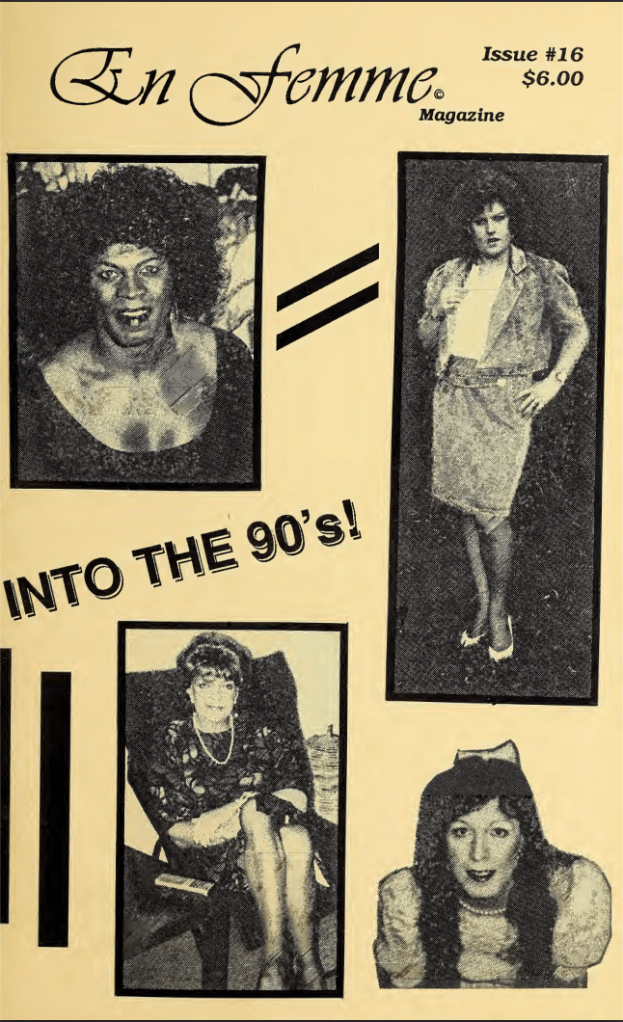
By the time I was prepared to enter a university, I was keenly aware of the detrimental psychological effects and consequences my pursuit of a surgical solution could have on my immediate family and other people I had grown to love, respect, and admire.
For many years it seemed my desire to become a socially and legally accepted woman was in direct conflict with my responsibilities to my family. It left me unhappy, depressed, and bitter most of the time. My only emotional release was, from time to time, to be able to go out dressed as the woman I believed I was destined to become. […]
Today I am (although still pre-operative) a successful freelance and technical writer, living and working as a woman on a full-time basis. I maintain a very nice household with a loving male companion.71
Note that the first two paragraphs are occasioned before Roberta began to live as a woman full-time in 1974.
Despite motioning towards surgery, Dee had been happily living full-time as a woman by 1990 for sixteen years without ever getting it. It’s interesting that she lays the blame for her lack of surgery on the “psychological consequences” it would have on her family, given that elsewhere in the same article she decries the field of psychology, calling psychotherapy a “pagan practice,” scorning the idea of penis envy, and stating:
If you accept the notion that a transsexual is an individual suffering from a gender dysfunction, then you can comfortably argue they are confused as to whether they should be boys or girls. And there are those who believe this indecisiveness can be reversed with electricity, much the same as Dr. Frankenstein believed that death could be reversed.
To make matters worse, one prerequisite for a sex change operation is to spend a year in therapy! Talk about being between a rock and a hard place!72
A clear set of antipathies begins to emerge here. Dee took a principled stance against conversion therapy, but also a broader stance against trans therapy in general. Having at this point lived as a woman with a penis for nearly half her life, there’s a defiance in the way she claims her womanhood – the parenthetical in that last sentence about her success as a writer and a woman seems to sum up her attitude toward The Surgery well. A footnote in her life, lip service towards an expectation that desiring SRS is the base condition for trans womanhood.
This article also has an actual footnote, printed in slightly ominous smaller black text:
My motivations for writing this column is to have a forum through which I can, hopefully, enlighten women and men, regardless of their lifestyles or sexual preferences, as to the psyche of most transsexuals. And although transsexuals tend to be quite varied, as to their degree of commitment towards becoming, legally and socially, accepted as women, my emphasis will be on those with only the most serious commitment.73
Remember that Virginia Prince told Christine Jorgensen in 1953 that she had a “missionary complex.” So to, it seems, did Roberta Angela Dee. And it seems notable that Dee’s progression after this column seems to somewhat mirror Prince’s progression after writing that letter. What I find really interesting here is that when Dee talks about writing for “those with only the most serious commitment,” it’s a commitment to womanhood specifically. It’s also extremely important to note that Dee was very open-minded about “lifestyles or sexual preferences.” Dee was a bisexual woman involved in the BDSM community, and her idea of what it meant to be a ‘woman’ transcended issues of erotics and sexuality.
But it was two months later, during her second column for En Femme entitled “The Pitfalls of Perfection,” that Roberta’s true views began to really take public shape:
The feminist movement, per se, is not a bad social development. However, its philosophy has generated several negative results. The movement neither wants to accept the blame, nor accept the responsibility for its mistakes. The inability or unwillingness of the feminist movement to be fully accountable renders it somewhat irresponsible. Initially, the feminist movement included the lesbian movement. To a lesser degree, it included the struggle of African-American women. To an even lesser degree, it included the struggle by cross-dressers and transsexuals to achieve social acceptance and respectability. It has since abandoned these ‘lesser’ causes.
Lesbians try to achieve social change and acceptability through the somewhat broader gay political movement. The gay movement, however, is neither as powerful, nor as well-organized as the feminists. Nevertheless, gays continue to make efforts to improve their image and acceptability. Transsexuals and crossdressers, on the other hand, fail to align themselves with any of the existing alternative cultures. They fail to work together to achieve acceptance. As a result, transsexuals and crossdressers form a pitifully unorganized and uninspired subculture.
We profess to seek social acceptance. Yet, we do nothing to achieve that goal. As separate groups, transsexuals seek to merge with society after they have had their final operation. They shed their past identities as though it were an old ragged coat. Only within a very limited scope do they ever attempt to reach out to those who have not yet realized their goals.Crossdressers (transvestites) are even less inclined to emerge as an organized political group. The objective of most crossdressers appears to be fantasizing about men, or gathering for parties to discuss only the most superficial attributes of being a woman. They wonder why they are so often scorned, even by the gay community. They are scorned because they represent nothing that is truly meaningful. There is much more to being a woman than simply being able to look like a woman. There is much more to being a woman than merely having a relationship with a man.74
There is a paradox intrinsic to the way that Dee is writing about the political prerogatives of the trans liberation movement here. On one hand, she absolutely has a point. 1990 is a very significant turning point year in the history of trans organizing, and one where the transgender coalition had not yet truly been built. This was before Holly Boswell’s 1991 article “The Transgender Alternative,” before Leslie Feinberg’s 1991 novel Stone Butch Blues or 1992 pamphlet “Transgender Liberation: a Movement Whose Time Has Come,” and before the 1992 popularization of Sandy Stone’s famous article “The Empire Strikes Back: a Post-Transsexual Manifesto.” The largest centralization of trans discussion was Tapestry magazine, started in 1978 and by 1990 circulated by the International Foundation for Gender Education (IFGE). By the standards of 1990, “The Pitfalls of Perfection” was ahead of its time.
On the other hand, Roberta Angela Dee was and would always remain fundamentally a writer, and not an activist. She was not involved with in-person transsexual activist groups, not did she belong to any of the Princean or post-Princean transvestite advocacy groups. She did not have the Marxist and activist credentials of Leslie Feinberg, nor the academic heft of Sandy Stone. Living in Augusta, Georgia, Roberta would have been far-flung from most trans organizing spheres, and I have not found any evidence that she traveled much, or had the financial means to do so. One open question mark: the Southern Comfort Transgender Conference took place in Atlanta, Georgia on a yearly basis from 1991 to 2016. While I have not found anything to suggest that Dee attended the event, it would have been within her geographic range. But that also would not have begun until after the publication of this article.
In the introductory note to this issue, En Femme editor JoAnn Roberts (who we will discuss in significantly more detail later), had strong criticism of Roberta’s own failure to organize politically, though it is to her immense credit that she ran the column anyway:
One significant area of feedback was The Transsexual Trail. We knew from the start this would be a controversial feature, but, then, I’m not one who shrinks easily from controversy. If you disagree with Roberta Dee, write her and tell your side of the story.
This month Ms. Dee has some harsh words for transvestites. I strongly disagree with her opinions, being a transvestite myself. It seems to me that Roberta either had a bad experience with a TV or she is basing her conclusions about us from the trash “literature” written about us. In either case, I doubt that she has any idea of the community networking that goes on at gatherings like the IFGE Coming Together Convention, the Be All, or the Texas T Party, to name a few. Our community has made great strides in the past five years to gain acceptance for all transgendered lifestyles. And, the future holds much promise for us all.
If Roberta doesn’t want to be classified with transvestites, or even associate with us, I can understand that. Transsexuals are truly very different from transvestites. But, honey, don’t trash me till you know me.75
This passage is important for a lot of reasons. Firstly, it provides us with a very important genealogy that situates both En Femme and Dee’s work within the broader scope of the trans organizing community at the time. Secondly and more importantly, JoAnn Roberts is the first one to use the word “transgendered” in conjunction with Roberta’s ideas, not Dee herself. To me, knowing the central role that Roberts played in Dee’s career, this suggests that Dee may have gotten the word from her, not Prince, even if Dee used the word ‘transgendered’ in a Princean sense. Thirdly, “don’t trash me till you know me” suggests that Roberta was not closely acquainted with JoAnn before beginning her En Femme column.
But we’re not at all done with this column, as Dee had a lot more to say:
There is little that is metaphysical about being a woman. It is not a magical realm that one enters and exits at will. We can afford to play dress-up as children; to play the same game as adults is a little more than ludicrous.76
I think this little passage is an important clarification to the way Dee understands “spiritual feminism” as I outlined in the last section of this article. While I’m not exactly sure what Dee sees as the difference between metaphysical and spiritual womanhood, it’s a question I’ve tried to keep in mind throughout my analysis. We continue:
The crossdresser dresses for erotic pleasure or to satisfy some very real psychological obsession or need. I personally cannot associate wearing or dressing, or putting on a bra with anything that is sexually erotic. For me it is simply clothing myself for warmth or modesty. Some clothes are pleasant to wear. And, I enjoy wearing some outfits because they are pretty, or because they make me feel pretty. However, I derive no sexual satisfaction from these garments.
The one real problem we all share – we who are becoming women and who simply dress like women – is the desire to achieve some impossible degree of perfection. This pit fall of perfection is common to the female psyche. We all desire perfect breasts, perfect faces, flawless hair styles, and so on. We are all victims of the Madison Avenue hype, the manufacturer’s advertisement and publicity. For a variety of reasons, we are preoccupied with becoming that Playboy-perfect air-brushed concept of femininity. […]
So, let’s return to reality. Rather, let’s return to the fantasy of being perfect women. That’s an attribute we all have in common. Whether we are genetic women, pre-operative or post-operative transsexuals, or crossdressers, we all live in a male dominated culture which dictates that women (ladies) must be demure, slim, full-breasted, scented, colored, cheerful, graceful, elegant, intelligent (but not too intelligent), good-natured, obedient, kind, maternal, sophisticated in public and whorish in bed, dependent but well-organized, submissive, yet always protective of the male ego, and so on, and so on, and so on.
If an individual can master all of the aforementioned attributes and get along well with other other women, with children, with cats and dogs, and not wear garments that offend animal lovers, she stands a fair chance of being crowned a lady. It’s one thing to write about, and another to try to live out. Yet, these are the qualities and attributes all women are expected to master. Worse yet, most of us feel that if we fail to master these attributes, or if we do not bear children, look pretty enough, stay slim enough, or practice all of the Miss Etiquette techniques we were instructed to practice by our mothers (or developed through some other means), that we are less than ladies, less than women, and less than human beings. […]
What is wrong with being a motherless lady? What is wrong with being a lady who wears a sweat suit, no make-up, no earrings, no accessories, but is judged a lady on the basis of character and personality alone? We accept a man as a gentleman, even if he is wearing overalls. Why then do women need to wear a sun dress and make-up to dig in the same garden, just to be considered a lady? Is there a double standard?
Most transsexuals and genetic women would agree with this argument. However, the crossdressers would be placed at somewhat of a loss. How could they be feminine without the trappings of femininity? How could a crossdresser crossdress without wearing a dress? That’s the real question. And as a practical answer I suggest they could not.
It would be a wonderful world if anyone, regardless of their genetic origin, could be judged a lady solely on the basis of their behavior, personality and character. Personally, I consider myself to be as much a lady in jeans as in an evening gown. That’s the attitude I’ve adopted; and I feel totally comfortable with that attitude. I wish more of us could adopt the same philosophy.77
I’ll tell you what I see when I read this passage. I see the earliest articulation of transmisogyny I’ve ever read, published sixteen years before Whipping Girl.
Roberta Angela Dee understood herself as a trans person, yes, but she understood herself as a woman first and foremost. Across all of her writings, there is no idea more consistent. What I find really remarkable about the way she writes about all of this, especially for a member of the Boomer generation, is how Dee seems to have a knack for finding the productive spirit in Virginia Prince’s ideals, while leaving behind some (but not all) of their odious implication. Dee’s strict divorce of clothing from sexual pleasure seems to very much echo the Princean move. But there also seems to be influence from the Civil Rights Movement of her childhood in the way she talks about her trans ideal: “solely on the basis of their behavior, personality and character.” It’s very Martin Luther King coded. This is made explicit a few years later:
As the late Rev. Dr. Martin Luther King, Jr. suggested, judge an individual not by the color of his or her skin (a physical attribute) but by the content of their character (a spiritual attribute).78
Notably, just like her first column, Dee situates this argument in the context of blackness. In the above passage, she notes the exclusion of Black women from feminist organizing. And toward the beginning of the column, while talking about societal expectations of perfection, she notes the following:
Some of America’s most premiere cosmetic manufacturers depict one model in all of their advertising campaigns. The woman is always Caucasian, fair-complexioned and blonde, sometimes a red-head. She always has blue eyes and “classic features.” Ironically, the women who pack and ship these beautifying ingredients are often African- American, Hispanic, middle-aged, minimum wage earners. Although the product is used by women of all nationalities, the manufacturer intentionally portrays an image marketed to white, upper-class women. Why? Because they spend millions of dollars each year to preserve and perpetuate that image.79
Once again, a critique of whiteness is implicit in her critique of transvestism. And we’re not done, because the conclusion of this column gets even spicier:
Of course, there is also the argument that crossdressing is only a supplement to an otherwise full and complete life. If that is the case, then one needs to refer to himself as a transvestite or a female impersonator, not as a woman. Female impersonators and females are in two totally different categories, with totally different responsibilities, scopes and obligations.
I have little respect for the metaphysical, surrealistic, transcendental transvestite who dares to call himself a woman. He is not a woman and hasn’t paid the dues to deserve that title. As they say in France, ‘pee or get off le pot.’
I hate labels as much as the next woman. Labels are often used to segregate groups of people from other groups of people and to severe communication. It prevents two intelligent cultures from having intelligent dialogue. It’s intellectual censorship. It’s American Apartheid. It’s stupid. I am not in favor of labels. However, I do believe in making distinctions between the needs of different social groups. I’m not Nancy Reagan. I can’t, intelligently, “just say no;” because that’s not the answer for all segments of American society. The needs of the working class differ from the needs of the privileged class, as much as the needs of African-Americans differ from the needs of whites, or the needs of the homeless differ from the needs of people living in Beverly Hills. […]
We all want to be perfect. We women especially want to be perfect. Men, on the other hand, are taught to live with their imperfections, to make the best of their fat, little penises, and so on. They are taught that it’s not the size of the tool, it’s how you use it. Women are instructed to seek cosmetic surgery to enhance small breasts, or to cover an uneven complexion, or to highlight their hair color, and so on. What women really need to do is to address these inequalities in society, and redefine what being a woman is all about.
I know by now that I’ve upset a lot of people, and have probably burst a balloon or two. As is customary to my gender, I apologize. I’m sorry. Still it’s necessary; we cannot move into the twenty-first century carrying the same illusions and fantasies from the sixties and seventies, nor the same disillusioned concepts that carried us through the eighties. Sisters, it’s time to wake up and smell the coffee. None of us are perfect. None of us need to be perfect. What we all need to do is to formulate realistic and practical objectives, and to work rationally towards reaching those objectives. The next decade will include a number of new obstacles for all women. Although we have made many strides during the eighties, we must continue to work towards total equality. We cannot enter the next century carrying the manipulating elements that have plagued us for so many generations.
Will we all recognize that we face a common problem, or will we continue to work in separate little groups? That is the question.80
And god, reading this is as frustrating as it is tantalizing. It’s frustrating to read Dee cast scorn down on the ‘apartheid’ of labels know that she’ll go on to spend the latest years of her life embroiled in discourse about how being ‘transgendered’ is more cogent than ‘transsexual’ or ‘transvestite.’ It’s frustrating to watch a woman who so clearly had radical ideas, ones way ahead of her time, alienate her potential coalition in the same breath. It’s frustrating to read a call to action that has all of the right notions, but lacks the political or academic vocabulary to express it with the specificity needed to cut beyond En Femme‘s narrow audience. It’s frustrating because as much as I can see the brilliance of this essay, and Dee’s work in general, I can also see why her life’s work has been left to rot in obscurity.
I don’t know what conversations JoAnn Roberts and Roberta Angela Dee had in between April and August of 1990. But this is, by far, the most radical or political that Dee’s En Femme column ever got. After an issue off – maybe waiting for a response article to be written – Dee’s column returned, now lacking the Transsexual Trail title. It was not an elaboration on any of these ideas, but a relatively inoffensive short story about a lesbian affair in New York City, an autofictional piece entitled “Nadia” about dating a Hispanic woman. What was political, however, was the response piece that JoAnn Roberts published beside it, entitled “The End of the Transsexual Trail: Or the Pitfalls of Being Deaf, Dumb, and Transsexual” by Veronica Brown.
The response starts off racist:
Ms. Dee’s observations about the workings of Madison Avenue are sophomoric. Her generalizations about the real world and the gender community are juvenile at best. She claims that the ideal female model is usually white, blond, has blue eyes and “classic” features. Has she never driven through a black neighborhood and noticed the color of the billboards? Has she never read Ebony or Jet magazine, or even watched a cable television channel designed by and run for African-Americans? I ain’t never seen no white people in those media. I seriously suspect the people who package hair sheen and other beauty products for Afro-Americans probably include Afro-Americans, Hispanics and Caucasians who are also middle aged, minimum wage, workers.81
Makes a similar point as I did above about Dee’s personal inaction:
How can she say, further, that when 300 crossdressers in full plumage descend upon a mainstream, big city hotel, that this makes for a “pitiful and uninspired subculture.” What about all the TVs and TSs who have marched in gay pride parades round the country? There is a lot of activity out there, some of it is very good and some of it falls short, but to make sweeping negative generalizations is most illogical and erroneous. But then, if you’ve never been involved in anything, it’s easy to sit at home and create disinformation for the gender press. Quit complaining that the bear dances poorly; at least it’s dancing.82
Proceeds into calling all transsexuals men:
The next question might logically be, do I consider myself to be a ‘real’ woman. No, I don’t, and I may be the first post-operative, M-t-F transsexual lesbian, New Age Wiccan woman to admit it. (It’s a dirty job but someone has to do it.) You now have to ask the next logical question. Do I feel comfortable in my present female role (real life situation); do I enjoy my recently acquired biological pseudo-feminine physical attributes and current social standing as a woman Yes I do, very much, thank you.
The natural laws of birthright and biology unfortunately do not apply to me and they never will. Neither do they apply to Roberta Angela Dee, the late Christine Jorgensen, Canary Conn, or any of the other simulated, surgically created women out there.
Which carries more weight, the temporary, yet physically very real, female clothing that a transvestite wears to create the illusion of womanhood, or the permanent, and physically very real, changes a transsexual gets to create their version of the illusion of womanhood or masculinity? It seems to me while all transvestites may create some degree of illusion of being a woman, no matter how imperfect or successful, the transsexual also seeks to creates that same illusion but for a different reason, with different methods, with varying degrees of success and for a different end result. Just because the latter’s methods are more permanent, does that make their transformation and their sense of reality more valid or ‘real’ than that of the transvestites?
Ms. Dee states the reality that most crossdressers hate to admit is that no one can be a weekend, or part time woman. She speaks of ‘degrees of commitment.’ In the same light, most transsexuals are afraid to admit they are not, and never will really be, women (or men), or be ‘real’ women (or ‘real’ men), no matter what they say. A few transsexuals have actually admitted this to me, but I won’t mention any names. The next best thing to the real thing is to be a darn good simulation like the Space Shuttle computer program I mentioned earlier.83
Baudrillard called, he wants his simulacra back. It’s worth noting that in 1990, Baudrillard was still the new philosopher on the block; Simulacra and Simulation had been published just nine years earlier, and The Matrix wouldn’t come out for another decade.
Lastly, Veronica wraps up her argument by telling Roberta that pre-op transsexuals should sit down and shut up, and let post-op transsexuals do the talking:
Let me leave you with one last thought people. I’ve observed a lot of pre-ops out there who, not having experienced the total transsexual transformation, nevertheless bumble along, write all kinds of flowery words, and pepper the gender press with boring, first person revelations and pseudo-intellectual book reports as if they are the absolute authority. Those who know even less sometimes accept their word as gospel, because “Why, Good Golly Miss Molly!”, they’re self- proclaimed transsexuals and aren’t they just the biggest frogs in the gender pond? It takes a long time for the dust of the transsexual transition to settle. Most post-ops don’t hang around long enough, and aren’t willing to divulge this kind of occult information, so no one ever hears about it. But who am I to talk?84
Rough.
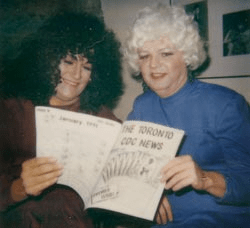
Now, Veronica Brown is another interesting minor figure from this period in trans history. Across the late 80s, she ran several trans publications and organizations in Massachusetts, including the group Twenty (XX) Club and its newsletter Twenty Minutes. Her primary historical impact, however, is in Canadian queer history. In 1987, cis woman Paddy Aldridge opened Toronto’s first cross-dressing store, Wildside, which is still open today. She seems to have been a major chaser, and fell in love with Brown during a visit to Massachussetts, bringing her back north to Ontario.
Paddy and Veronica claim to be the first openly lesbian couple to get married in Canada, around a decade before the first marriages between two legally gay couples would happen in 2001. This seems unlikely, and given that Brown seems proud to call herself a man in this article, it’s not a huge stretch to imagine why their loophole marriage may not have been recognized as such by queer historians. Their marriage would be short-lived, as Aldridge very publicly cheated on Brown with another transfemme in 1995, seemingly one who she feminized herself. Aldridge’s biography proudly states that “Veronica moved out on the same day Roxy moved in.”86 Frankly you couldn’t pay me to write that in my memoir, but pop off I guess. I do not have any information on Veronica’s life after that, but I can’t imagine that losing your support network in a foreign country went well for her.
During her marriage with Aldridge, Veronica Brown would be jointly responsible for several transvestite organizations in Toronto, including the Toronto organization Canadian Cross-dresser’s Club; four magazines: Canadian CrossDresser’s Magazine, Drag Queens International, Fetish Night, and Mondo Bondo; and three books: Queens of ’93, Why Do I Crossdress?, and The Illustrated Crossdresser and Drag Queen Makeup Guide. By 1990, Brown had clearly already moved to Ontario, but it’s unclear how deeply she had gotten into publishing cross-dresser materials. Either way, “The End of the Transsexual Trail” seems like the beginning of a motion away from identifying with transsexual communities and towards cross-dressing communities – and not one with a happy ending either.
Paddy Aldridge writes about how JoAnn Roberts helped to facilitate this publishing spree, which apparently lasted for fifteen “workaholic” years:
We also began to publish colour magazines; Drag Queens International, Fetish Night and Mondo Bondo. These were printed in New York City and distributed worldwide. I did the layouts, the interviews and the photos. I owe this opportunity to my friend JoAnn Roberts, publisher of Ladylike Magazine, and owner of Creative Design Services.87
Paddy was also friends with Virginia Prince. Here’s a photo of the two of them together.
All of this should continue to start to give you a sense both of JoAnn Roberts’ centrality in this story, as well as the convoluted web of transvestites, transsexuals, cross-dressers, and adjacent cis people to which both Roberta Angela Dee and Virginia Prince belonged.
My point being, Veronica Brown’s rip-down of Roberta Angela Dee’s fledgling trans radicalism – a condemnation at the hands of another transsexual – clearly had a major effect on Dee’s early career in these circles. Her first two pieces for En Femme were both raw and political. Across the next five issues which I gained access to, Dee’s subject matter involved three short stories including the Halloween short story from the last section, a vapid column about shopping titled “Shopping,” and the “My First Job as a Woman” article that we’ve already discussed as probable bullshit. Furthermore, while all five of Roberta’s 1990 En Femme columns were printed near the top of the issue, her two 1991 columns were moved to the second to last slot in the magazine. Not a single one of these later columns contains any substantial commentary about gender or race. I could not find any archives of En Femme past August of 1991, but given that the magazine is considered marginal in trans history, it’s entirely possible that the periodical ended shortly after that. JoAnn Roberts certainly had no shortage of other projects to focus on.
Was this a classic case of structural racism? It’s clear from JoAnn’s editorial notes that En Femme was flooded with angry letters, especially after Dee’s second column. Veronica Brown’s response column was definitely racist. I don’t believe that JoAnn herself was bigoted towards people of color, but she was also a business woman, and always identified as a cross-dresser first and foremost. Roberta Angela Dee’s The Transsexual Trail column was never allowed to breathe or mature. In time, it was completely forgotten. While we do not currently have sufficient archival materials to prove this, this 1990 incident also seems like a primary candidate for when Dee began to grow disaffected from the ‘transsexual’ label.
Here’s what I do know – in December of 1990, just a few months after Brown’s column, JoAnn Roberts published the Gender Bill of Rights. Given that it was written after Dee’s two columns, it’s possible, though improbable, that Roberta Angela Dee could have influenced its creation. It’s also possible that the document had a major influence on Dee.
A preamble excerpt from the Gender Bill of Rights:
It is time for the transgendered community to take a stand, a strong stand, against all gender-based discrimination simply because some people are different and simply because some people do not fit into current social norms of gender roles. It is time the gender-based community articulate this stand in words that clearly define exactly what our gender rights are.88
Once again, here is JoAnn Roberts using the word ‘transgendered,’ coming on the immediate heels of a fiery blow-up toward Dee from both the transvestite and transsexual contingents of Roberta’s trans circles. While we do not currently have the evidence to prove or disprove the impact this document had upon Dee, I would suggest that this may be one of the major factors that led her to stop identifying as ‘transsexual’ and start identifying as ‘transgendered.’
If you’ve never read the Gender Bill of Rights, I’d suggest checking it for yourself.
Dee’s Theory of Transgendered Being
By 1993, while Roberta had not yet begun to refer to herself as transgendered (at least in the material I have found), she had clearly begun to mature away from her claim of having “little respect for the metaphysical, surrealistic, transcendental transvestite who dares to call himself a woman.” In the issue of the serial story “After the Shower” found in her Roberta’s Recollections column in The Transvestian, the trans tabloid published by Tania Volen, Dee wrote the following:
The weekend crossdresser sees little more than the cosmetics of being a woman. It’s a somewhat superficial reality. However, when one begins to live full time as a woman, and begins to take female hormones, only then is it possible to experience the deeper, broader, and more complex structure of the female personality. Having been born a male, the experience is more difficult to encounter. Still, once an individual attains a certain level of femininity, they cannot help but embrace it as part of their soul, their perspective, and their personality.
I don’t know how Gloria Steinam, Patricia Ireland, Belia Abzug, Whoopi Goldberg or any of the active feminists feel about those crossdressers and pre-operative transsexuals who live as women on a full-time basis, but I’m sure we have a lot of common ground upon which to build a philosophy that serves the best interests of all women.89
While Dee still isn’t using the word ‘transgendered’ here, there is a clear shift in her thought on who the ‘we’ of her putatitve audience has become. Rather than writing as a transsexual in response to the transvestite, Dee suggests that ‘cross-dressers and pre-operative transsexuals’ share a mutual understanding and feminist positionality. While this is assuredly fascinating, we don’t have any other writings from 1993 to cross-reference this against. Further into the 90s we go.
As we enter the trans early internet era, which I would date to around 1995, it becomes increasingly challenging to find precise dates on when certain articles went up online. This is especially a problem for Dee’s work found on Transgender Forum and TG Guide. While we fortunately know that Memoirs of a Transgendered Lady began publication in 1997, it’s very unclear when and in what order Dee’s other articles on the site were published, which makes the kind of tracing work I’ve done thus far challenging. Given that by around 1998, Dee seems to have fully figured out her positions, let’s switch gears to looking at her mature ideas on gender.
Like Virginia Prince, Roberta Angela Dee came to identify by the end of her life as a transgender woman who did not want to surgically transition. “Transgendered” was her word of choice to articulate this extra detail. However, unlike Virginia Prince’s continued stubborn insistence upon the immutability of her own manhood, Dee’s philosophy regarded sex as more flexible, and more importantly, completely separable from gender:
Virginia’s philosophy is more anatomically based than mine. He feels he can live as a woman and still be a man. I disagree, particularly if one takes female hormones as we both have done for most of our lives.
Female hormones do more than redistribute fat and decrease muscularity. They influence the
emotional state of the individual and causes changes to the structure of the brain. A male to female transsexual might, under the influence of female hormones, become less aggressive, more emotive and intuitive — more like a woman. Hormones combined with lifestyle obviously produces a marked change in an individual. He is no longer a man in the traditional sense — certainly not in terms of gender, regardless of anatomical difference with those of a genetic female. Consequently, I say I am transgendered and female, because it is who I am in mind, heart and soul.It would, however, have been unfair to expect Marilyn to understand that I was a woman. She accepted me as such mostly because I presented myself as a woman. In her heart of hearts, however, I knew that she believed me to be a male. Marilyn continues to represent a majority of people who fail to distinguish between sex and gender. Yet, even under present definitions, one can be a male and a woman. In other words, one’s sex can be male while one’s gender is decidedly
female.90
To a trans person in 2026, most of this may seem like common sense. But it very much was not common sense in 1998, and for the vast majority of cis people, it remains a radical, almost unthinkable stance. This was at the height of the ‘gender is a performance’ era. In contemporary trans circles, Judith Butler and Kate Bornstein were in vogue. On the flip side of the coin, transsexuals who wanted to fully transition often had no choice but to follow the Harry Benjamin Standards, with a full Real Life Test, a strict pathway toward SRS, and everything in between. There was no ‘middle ground’ between performance drag/stone butch/cross-dressing and a full commitment to the transsexual lifestyle. Women with penises were the joke on every sitcom, in every movie. It would be another eight years before an idea of “subconscious sex” would take root in the community; but even then, it would be framed as subconscious sex, i.e. the idea that the transsexual already has their spiritual female body before they ever get the surgery. An XX of the heart.
We can draw a clear line between Roberta’s concern for the “psychological effects and consequences” upon her family by getting surgery in 1990, and her assertion that it would be “unfair” to expect Marilyn to see her as female in 1998. This is, I think, a moment where Roberta’s historical period really makes itself known. In 2026, I do think that trans people have begun to understand that maybe it is unfair to them if others refuse to accept their transition, or endeavor to prevent them from receiving care. But Roberta did not transition in the 2020s. She transitioned in 1974. There is a weariness to the way that Dee frames the inability of others to separate sex and gender, and it’s hard to blame her for not expecting better of the cis people around her, given that the situation wouldn’t really start to change until a decade after her death.
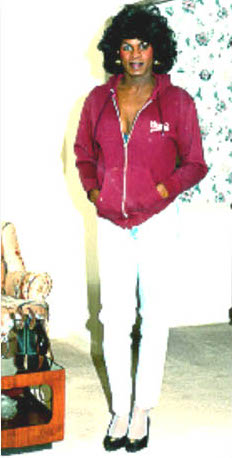
For better or for worse, Roberta Angela Dee had zero interest in arguing that people with penises and XY chromosomes were not sexually male from an anatomical standpoint. She was equally unimpressed with the notion that gender was a performance, or that it lacked essence. For Dee, gender was just as material as sex was. I find it notable that Dee associated hormones and HRT with gender instead of sex, which is a major divergence from our popular discourse on hormones, literally ‘sex’ hormones. It’s a clever little bit of linguistic subversion.
It’s also important to note that Roberta’s decision not to get surgery was also limited by economics and medical technology:
I had a number of reasons for not having surgery. Good surgery by a well informed physician was expensive. It would easily have cost me $12,000 dollars back in 1982, and $12,000 dollars was considerably more difficult to come by than it is today. There was also the factor pertaining to the quality of surgery. No surgeon, even today, guarantees that the results will measure up to the patient’s expectations. Back in 1982, the expectations were not nearly as high as they are today. Yet, even if the surgery was perfect and there were absolutely no complications, the new vagina would still not be the same as that of a genetic woman’s vagina. The surgical vagina would be more prone to infections, lack depth, and was considerably more fragile. So, the question I asked myself was: did I have to exchange a satisfying sex life and a life as a woman, for surgery that was at best risky and could produce unreliable results?
“But how can you be a woman, if you have a penis?” transsexuals persistently asked. And I would tell them that my gender was determined by who I was, not how I was constructed. If you surgically added a penis to a genetic woman, she would in fact be a woman with a penis. The main point was that surgery could not change who I was as a woman. It could only change how I looked.
I had never challenged any transsexual’s decision to have surgery. For many I thought it was a fruitless measure, but I never disputed their right to make that choice. Over the years, however, I had begun to strongly resent the number of transsexuals and so called androgynous transsexuals who had questioned my right to make a choice that differed from their own.92
Further elaboration of Dee’s position on anatomical sex can be found in 1999 Transgender Forum article “Transgendered Women and Lesbians:”
Sex is anatomical. It identifies the organ between my legs. It identifies my reproductive and skeletal systems. It does not identify how I define myself, nor the gender I embrace as a human being,
So, what have I been saying for the past 35 years? Have I been saying that I could be anatomically male but psychologically female? Absolutely! I am a woman because my heart, mind and soul are the heart, mind and soul of a woman. Who we are is determined by our state of mind – not by our internal or external organs. Many agree with my idea. They call themselves male-to-female transgendered women, or female-to-male transgendered men. They do not dispute their anatomical sex. They simply assert that their sex does not define their gender. And, I believe they are totally correct.93
For a real sense of how strongly Dee disagreed with the prevailing language around transsexuality, we have the instructive TG Guide article titled “What Does Transgendered Really Mean?”
I have never liked the word transgendered. I suppose I could wait for some distinguished scholar to write a thesis and explain why the word is inaccurate. However, that is likely to take another 10 or 15 years. Therefore, I will do it now.
When a young girl realizes that her feelings are more accurately identified with males than with females, she is beginning to define her gender. She is anatomically defined at birth as female, and it is assumed that she will identify with becoming a woman. However, if she does not identify with being a woman, then the scientists arrive with their labels.
If the scientific analysis is that she is “a man in a woman’s body,” they label her transsexual. If the scientific analysis is that she simply does not understand which gender she is supposed to be, then they label her transgendered, and suggest that she is suffering from a gender identity disorder, or from gender dysphoria.94
Immediately followed with her incredibly funny distaste for the term ‘gender dysphoria:’
Of all these terms, “gender dysphoria” is my absolute favorite. Why? — Because it infers that she has a gender but that her gender is dysfunctional. This is so far removed from being scientific that it astounds me that anyone can even utter these words. How can gender ever be dysfunctional?
At this point, the psychologists, psychiatrists and sociologist explain that the phrase does solely apply to gender, but rather to the individual’s association with their gender — which, of course, I already understand. This being the case, the scientific community is suggesting that it is not the gender that is dysfunctional but rather the individual.
They call it “gender dysphoria” anyway, because you can do that when you really do not understand what it is you are talking about in the first place. What they are really saying is that the individual is dysfunctional.95
With the satisfying conclusion:
Well, the doctor says, “Her dysfunction is established by the fact that she is anatomically female and is unable to socialize as a normal female. That is her dysfunction. Is this not correct?”
No, my distinguished colleague, that is not correct. It is true that he is anatomically female. However, he is not able to socialize as a normal female because he is a male. You confuse anatomy with gender. That is your misunderstanding, not his. The only problem or dysfunction this individual has is with getting the scientific community to distinguish between sex and gender, and educating the public to be able to make the same distinctions.
The problem is not with the individual. The problem is with the scientific community, and with society.
Another problem is that this individual must pay a psychologist $75 dollars an hour, for a year, merely to be misinformed. That, however, is another issue.96
Dee’s disdain for therapy is another point of continuity with her 1990 positions.
It is here that the central essence of Dee’s philosophy on gender really begins to reveal itself. The two central tenets of her beliefs: trans women are women first, trans second, and it is individuals who are dysfunctional, not their genders/bodies/sexes. This is the central animus behind her lifestyle writing, which makes up a large body of her work. I find the second point especially poignant, as Dee was a fan of disguising basic self-care tips and self-love as “transition advice.” For example, in the article “Twenty Ways to Look More Beautiful,” Dee gives expert feminization tips such as ‘go outside,’ ‘talk to your loved ones,’ ‘exercise,’ ‘start a journal,’ and ‘read a book.’ She also advises her reader to arrange all their panties on their bed and take photos, but that’s neither here nor there. Her final tip:
Be yourself. Be true to yourself. And be happy being who you are.97
It really seems to capture the essence of what Dee considered ‘beautiful.’
Let’s return to “What Does Transgendered Really Mean?” Dee proceeds to outline three distinct definitions for ‘transgendered,’ which she describes as “using the word red to mean blue, green, gray, and sometimes red.”98 The three definitions follow as 1) someone more comfortable living as the opposite sex who still self-references as their anatomical sex, i.e. the Prince definition, 2) someone more comfortable living as the opposite sex who self-references as their preferred gender, and does not want SRS, i.e. Dee’s own conception and 3) a stone butch, i.e. the Feinberg model. Dee further expands on the second definition as sometimes being described as a ‘nonoperative transsexual,’ which she saw as a contradiction of the stated desire to change sex in the word ‘transsexual.
What I find most interesting about this article, however, is how Dee both understands that trans men and woman are implicated under the flaws of these definitions – her above example about dysphoria involved a trans man – while still articulating the differences between trans men and women in their treatment within the system:
Female-to-male transsexuals, and female-to-male transgendered men are not simply “the opposite” of male-to-female transsexuals and transgendered women. And here lies another problem: If the legal solution for allowing a man to become a woman through a surgical procedure, what it the legal solution for a woman who wants to be legally recognized as a man? Is it constitutionally acceptable to require men to have surgery but not women? […]
As I have said, the issues affecting transsexual and transgendered men are different from the issues affecting transsexual and transgendered women. Women who are anatomically male have different medical issues from women who are anatomically male. The transition into society as the preferred gender is also different. In other words, society looks differently at men who prefer to live as women than it does women who prefer to live as men.
I am a woman, in spite of the fact that I was born anatomically male. I am not a clown. I am not a freak. I am not dysfunctional.99
Once again, we see an early formulation of transmisogyny. I find it very notable that Dee’s understanding of what we might now call ‘transmisogyny’ twenty years later began from the standpoint of both trans men and woman as implicated by society’s inability to articulate the difference between sex and gender, and its insistence on placing the blame for dysfunction upon the individual, not their genderr. Across her later career, Roberta Angela Dee wrote about the relationships between trans men and women, most notably in her 1999 novella Roberta & Ren, but also in a number of articles posted across Transgender Forum, TG Guide, and a variety of other digital forums.
Unfortunately, while Dee was broadly accepting of both trans men and women, she was decidedly close-minded when it came to non-binary identity and other forms of non-normative gender expression. We can see the underpinnings of the binaristic nature of her philosophy on gender in “What Does Transgendered Really Mean?”
The law also fails to understand that gender is not always restricted to 100% male or 100% female. A man can be 75% male and 25% female, in terms of gender.100
And maybe you would think that for a woman who extensively wrote about the pitfalls of prejudice, lack of societal imagination, and rigid inflexibility of popular conceptions of gender and sex, endorsing the gender queer movement of the 90s would be an easy win. But remember that Dee believed it was ‘unfair’ to expect the people around her to change their viewpoints to accommodate her gender needs. I believe she thought that demanding such mental labor of cis people was ‘male privilege.’ What does that mean? A passage from her essay “Transgendered Woman and Lesbians,” which we have already briefly referenced, may give us insight:
Within the lesbian community, the term transgendered is used more to the liking of Virginia Prince. Some lesbians use “transgendered” to refer to the butch lesbian who takes on a masculine and male persona without identifying with being a man. S/he wants to be addressed as a male while still maintaining her (or her) status as a woman. S/he wants to exhibit the physical and cosmetic characteristics of manhood but has no desire to be a man. In some instances, s/he might even assert that her gender is neither male, nor female. It is simply butch.
So, when a male-to-female transgendered woman announces that she is a woman-loving woman, and therefore a lesbian, she is not always accepted as such within the lesbian community. Why? – Because lesbians define woman and transgendered differently that it is defined within the community of transgendered women.
Transgendered butch “men” continue to identify as women, and they remain within the lesbian community. Conversely, male-to-female transgendered women leave the community of men and dare to venture into every community of women that exists. Unfortunately, some transgendered (and transsexual) women continue to carry a demeanor characteristic of one who once held male social privilege. Genetically female women naturally resent this behavior.101
While there is a clear thrust of protesting trans exclusion from lesbian spaces here, it comes with an ugly subtext that Dee holds the butch identity category not as a subversion of gender roles or a proto-nonbinary identity, but as fancy language that dresses up a fundamentally Princean view on gender, one where trans men in the lesbian community occupy such spaces at the expense of trans women. While in a vacuum, we could potentially handwave this as an isolated view, a number of concerning Usenet posts from the early 00s suggest a deeper antipathy towards theories of queer and nonbinary gender on Dee’s part.
We have already briefly touched on Leslie Feinberg and Kate Bornstein, whom modern readers are likely still familiar with. Slightly more obscure among contemporary young trans people is Riki Wilchins, who still works as a journalist today, but who was magnitudes more famous in the 1990s. If you want to get a sense of the scope of their influence in the 90s, here’s a trans studies syllabus from the time that’s full of Wilchins’ work. Feinberg, Bornstein, and Wilchins are all various flavors of nonbinary, and form the core of what I might consider pop trans theory at the time.
I also want to give you a brief perspective on the other side of this Usenet exchange: Cathy Plantine, who runs an obscure neo-Pagan movement called the Cybeline Revival that started in 1997, around the same time that Dee’s gender theory writing began to get really prolific. Platine is still alive, and describes herself as a “former trans activist”102 in the bio of her blog For The Record. For a sense of Platine’s movement, here’s a recruitment pitch from her main website:
Look around, the American dream is now dead and the social experiment started in the fifties has failed.. We at the Maetreum are attempting to create a new model of living, a community of spiritual women working together cooperatively. We have room for several women to move here. We have a ceramics studio set up already and are acquiring the tools to spin and weave our own fabrics. We are planting fruit trees and gardens and grape arbors. We have a larger family of laying hens. But in order to succeed in this we need Goddess women willing to join us in our efforts. If your life is falling apart because of the economy, consider a visit to see if you can join us. We need you and I suspect, many of you need us. We welcome all genders to our services, celebrations and for visits.103
I’d call the Revival a cult, but hey, they won a New York Court of Appeals case in 2014 that recognized them as a religion. So what have you. Lots of colorful characters on the early 00s internet.
Anyways, jumping ahead to the Usenet forum soc.support.transgendered on August 5th, 2002, less than a year before Dee’s death. When Platine told Roberta that she ought to read Wilchins and Bornstein, and that both identified as third genders as post-op transsexuals, Roberta would write the following:
Wilkins and Bornstein attempt to combine science with social politics. The results of their efforts are flawed, inconsistent and have done more to confuse gender issues than clarifying these issues.
Gender, to a large extent, is based on teh culture. It has to do with the way that an individual accepts specific cultural roles, and combines a role with their own gender preferences.
Where is the “third” culture upon which any individual could draw perceptions of a role? What roles are assigned to an individual who is neither a man, nor a woman?104
I’m still scarred from that one line from b. binaohan’s trans/gender 101 that went ‘teh trans men,’ but given the source medium, I’m pretty sure that’s a typo, not mockery.
I think it’s important to recognize that Roberta Angela Dee was not necessarily opposed to the idea of nonbinary identity. She did, however, believe that gender was grounded in culturally defined social roles, and that identification outside of those roles could be detrimental to the efforts of trans people organizing for better living conditions. I suspect that if she could see the state of American culture in 2026, when nonbinary identity, while still stigmatized, is at least a broadly understood social role, she might express a different position on the matter. But at this point in trans history, nonbinary selfhood was very much still new and poorly understood, and completely unknown beyond trans circles.
I find Cathy Platine’s response post to be very measured and reasonable:
Ok, I’ll attempt discourse. Riki, Kate and Les Feinstein, to name a few, do in fact mix politics with gender. Like it or not the two are very much enmeshed and that’s the basis of most feminist thought. If one lives in the real world, culture, politics, gender roles and identity are interconnected, that cannot be escaped. While I don’t identify as “third”, their ideas are very useful in breaking the mold of binary thinking (bipolar), a key to a wider world view that enables one to step outside the box and experience the gestalt. Garber’ book is
another somewhat flawed, but very interesting none the less.What roles are assigned to a “third”? In other, older cultures the roles were teachers, healers and spiritual leaders. The Hijra of India spring to mind immediately. Your own church demonstrates this quite well. Priestly robes are essentially dresses, a holdover from the older Gallae priestess of Cybele upon who’s temples the Vatican was built. Celibacy of the priesthood, yet another.
My point is, binary thinking is a logic trap. It matters not if you identify as “third”, others do see transfolk in this light and many transfolks do identify in this manner. Your original comment was you were unaware of anyone who viewed themselves in this manner. I provided examples. Don’t dismiss them out of hand.105
Roberta’s response suggests to me suggests that the two women were speaking past each other, making two separate points that did not necessarily contradict:
I don’t have a problem with anyone combining science with politics. I to live in the real world. However, I do have a problem with people who allow their socio-political agenda to distort the science.
Wilkins and Bornstein alienate people because theit science is wrong, and people simply can’t accept their distorted concepts. […]
Returning to the real world, like it or not, agree with it or not, we live in a
bipolar world. When asked to designate sex, we are given two, not three,
choices. We are men or we are women. We are not men, women, or “other.” […]I’m addressing present day American culture. I do not live in India. I do not live in the 18th century. […]
Your examples were not relevant to the context of this discussion. I could create, imagine or refer to allusions of sexuality. However, my impression was that you wanted to confine the discussion to the real word, or to use your own words: ” If one lives in the real world, culture, politics, gender roles and identity are interconnected, that cannot be escaped.”106
As I stated at the beginning of this section, Roberta Angela Dee was first and foremost a realist. Her primary concern was not with what ought to be with regards to trans liberation, but with how trans people could articulate and advocate for themselves within the bounds of their culture and society they inhabited. I do think that this social pessimism does have a certain level of racial implication behind it, where Feinberg, Bornstein, and Wilchins, all white authors, were able to advocate for the expansion of nonbinary identity and the renovation of American cultural conceptions of gender in a way that Dee was not. In another Usenet post titled “Prejudices Affecting Each of Us,” Roberta expresses an exhaustion that seems to frame her suspicion of third genders within bigotry and oppression:
In four months, I’ll be 53 years old. As an African American transgendered woman, I’ve endured and suffered over a half-century of hate, prejudice and bigotry. I’m too sick and tired of it to put into words. Enough is enough already. We preach tolerance, my only question is when will we learn to put it into practice?
On this note, I merely want to say that it doesn’t matter to me if you are a cross dresser, gay, transgendered, transsexual, intersexed or androgynous, I love you. And, I believe God loves you too. The real sinners are those who use God’s name to spread hate and prejudice.107
So one could very much make the argument that Dee’s antipathy to the 90s queer movement is more the resigned frustration of a crabby older woman than any sort of exclusionary bigotry.
I also think it’s important to recognize that, like most trans people in the 90s, Dee had come into full contact with a wide variety of third genders as they were used to legitimize the trans liberation movement in the works of thinkers like Feinberg and Rachel Pollack. In her article on Women on the Net entitled “Transgendered Men and Women,” Dee articulates a more cogent position on third genders that elucidates her later forum posts:
Transgendered people have been known throughout the course of human history. The North
American Cheyenne refer to the he man eh, the Lakota refer to the winkte, and the Navajo refer to the nadle. These are merely different names for the same “two-spirited” individuals.Many cultures perceive transgendered, or “two-spirited” individuals are perceived as being
blessed. It is unfortunate that in our supposedly “enlightened” Western culture, transgendered
people are frequently perceived as “mentally ill.” […]A growing body of literature regards gender as a social construction, not a biological imperative.
This literature suggests that there are many examples of “supernumerary gender” precedents in
non- western cultures. Such individuals were accepted and often highly respected societal roles.
Gender variation and fluidity were even considered a normal part of human life.However, there is a danger in perceiving gender orientation as a social construction. The danger is that it encourages one to believe that the affected individual can change their behavior and conform to whatever is perceived as the social norm or status quo. Most of the evidence suggests that gender preference cannot be altered, and that transgendered individuals are predisposed to their condition.108
It is somewhat ironic that I actually find Dee’s position on third genders to be progressive in 2026, in a post-Talia Bhatt paradigm that articulates the dangers of ‘third-sexing’ trans cultures in the Global South to win rhetorical points in Western countries.109 Likewise, Dee’s insistence that trans women are women first also seems to echo many of Bhatt’s points. Dee demonstrates a clear principled understanding that the only culture that can commentate on the state of American gender politics is American culture and society, and that any push for change must occur within it. Further, it seems clear that Dee’s insistence on the primacy and immutability of a gendered spirit leads her to hostile conclusions about any theory, progressive or otherwise, that holds gender as a malleable sense of self. This is further evidenced in her 2002 essay “What Does It Mean to Be a Gender-Defined Woman?,” where she writes:
The problem with the word transgendered is that the so-called transgendered individual never “crosses over” as the term applies to gender. The transgendered woman is born with the predisposition to be a girl. The transgendered man is born with the predisposition to be a boy. Their orientation never changes. There is never any “crossing over” as there is for the transsexual. Consequently, it is erroneous to say they are transgendered because their gender remains fixed. All that changes is how they choose to accept or adapt to the conflict.
Another problem with the word transgendered is that it is used to describe everything from gender variant behavior, to casual cross-dressing. In the case of those individuals who believe they are neither male, nor female, but rather some other variation, they assert that they are “transcending” conventional definitions for male and female. My perspective is that they are ‘expanding’ the definitions, but I do not believe they are transcending being male or female. So, again, transgendered is incorrect terminology, incorrectly applied.110
Dee’s beliefs of gender clearly exclude the possibility of gender-fluidity, gender-fucking, or other forms of queer transgression popularized in her time. I have a very funny mental image of the expression on her face if someone ever handed her a copy of Kate Bornstein’s 1996 novel Nearly Roadkill. While I do certainly believe that her views could be harmful to a nonbinary audience, I also think it’s undeniable that Dee had a very consistent worldview when it came to the subject, one with both benefits and tradeoffs. Her conviction on the subject was a major part of what allowed her to write so much over the course of the 90s, and it gave her voice an extremely distinctive and memorable flair, one that attracted a lot of like-minded people, especially in the trans of color community.
On Autogynephilia and the Michigan Womyn’s Music Festival
Some random notes before we move on to talking about the rest of Dee’s career:
Although I have not fully managed to capture it here, trawling through old Usenet posts has made it apparent that Roberta Angela Dee was embroiled in The Discourse with the best of them, which was at times indistinguishable in the 90s from its 2020s incarnation. She was chronically online by the end of her life, had tons of petty rivalries with other online trans people, and bickered constantly about transsexual vs. transgendered vs. transvestite and other definitional debates. I am just as frustrated by such discourses then as I am when I see them today, so I haven’t lingered on them. But know that Dee’s Obedient Femme handle would have absolutely popped off on old Twitter if she’d lived to see it.
Thanks to an insane 2002 crackpot conspiracy theory on Usenet that Dee was secretly Emi Koyama (no, I’m not kidding), we know that Dee had not read Koyama’s work.111 While this is very much a footnote, I do also think it’s instructive as to the magnitude of weird racism she faced on the early internet. It makes a comment from one of Dee’s frequent online interlocutors, this one on a different 2002 conspiracy theory that Dee had committed suicide, hit harder: “I swear, if ‘RAD’ didn’t already exist, these groups would have had to
invent her.”112
Despite her aptitude for discourse, which I would call one of the more sour elements of her corpus, Dee resisted the urge to organize the various trans labels in terms of hierarchy:
Transitioning to become what, Julie. You seem to be suggesting that there is some sort of hierarchy: An individual begins with being a cross dresser, then becomes a transgender, and then becomes transsexual, and then becomes a postoperative transsexual woman.
First, you should understand that wearing women’s clothing for the male-to-female transgender or transsexual is not cross-dressing. These individuals are simply wearing the attire appropriate to their gender.
Cross dressing is a totally different issue and a totally different behavior. A male cross dresser does not want to become a woman. However frequently or infrequently he wears female attire, he continues being content with being a man.
There is no hierarchy.113
Furthermore, her belief in the necessity for distinct and articulated identity categories stems from her belief that each group had different needs out of trans organizing, and that the specificity of labels supports that imperative:
I agree with you to a degree. Every attempt to classify transgendered individuals along with transsexuals and cross dressers by using the “umbrella term” transgendered has met with disaster, in my opinion.
I am transgendered, not transsexual; and, I no more want to be considered transsexual than to be considered a cross dresser.
If there was a way to identify each specifc group, and to identify the concerns of each specifc group, while still asserting that for each group there are human and civil rights violations, then I would say unification would be a good way to garner forces. However, I simply don’t believe we will ever get along well enough to make that strategy doable.114
Whether Roberta would have considered the modern trans community successful on this front very much remains an open question.
Before I began writing about her legacy, the primary thing that Roberta Angela Dee was remembered for was a 2002 investigation into Anne Lawrence, one of the primary proponents of the autogynephilia theory. We can attribute this largely to Andrea James, who wrote a 2003 article about the expose that received some coverage on the trans news circuit115. In a 2004 issue of Transgender Tapestry, the staff of IFGE wrote a response piece that of course did not cite Roberta’s contribution to the story, where they said:
In June 2003, Andrea James published on her website, http://www.tsroadmap.com, a disturbing article about Anne Lawrence’s behavior. Although James’ article is in part an ad hominem (i.e., personal) attack, her allegations about Lawrence’s conduct are nonetheless of concern; in fact, they mirror our own long-held apprehensions and provide corroborating evidence to previous allegations we have received about Lawrence’s behavior.
In her on-line article, James describes and links to images of supportive documentation for an incident that occurred in 1997, in which Lawrence, who was employed as an anesthesiologist at Seattle’s Swedish Hospital, allegedly performed an inappropriate and unauthorized vaginal inspection of an unconscious patient. This action resulted in an investigation by Washington officials and was followed by Lawrence’s resignation from the hospital staff. Lawrence no longer practices as an anesthesiologist.
Lawrence told Transgender Tapestry, “The circumstances of my departure from Swedish Hospital were investigated in detail by the Washington State Medical Quality Assurance Commission. The commission found no evidence of unprofessional conduct. I was not reprimanded or disciplined in any way and there was no action taken against my license. I maintain and have always maintained an unrestricted Washington state medical license.”116
We only know about Dee’s contributions to this story because Andrea James herself cited Dee on her website. Here is an excerpt from Dee’s original soc.support.transgendered post, which I found through James’ website:
I am in receipt of the document from the State of Washington, Department of Health, concerning the allegations that Anne A. Lawrence, MD, had inappropriately examined a female minor. Of the 10 page document provided to me, I have reproduced the most pertinent three pages as text. Appendix G indicates that Anne Lawrence plea bargained in order to avoid a complete investigation. This, in my humble opinion, is not indicative of someone who is innocent.
If a charge of sexual impropriety had been directed at me, I would seek a thorough investigation to clear my name and remove any suspicion. Why would an innocent person do any less?
Lawrence, at one point, had two attorneys defending her. I doubt that the little girl’s parents could afford the ensuing legal battle. Consequently, Lawrence is cleared by default.
Each of us, I’m sure, will reach his or her own conclusions. However, I must say that the activities do not sit well with me. I’ve seen this kind of thing before. A dirty doctor walks away unscathed but an innocent child, though not physically harmed, is emotionally scarred for life.117
It should also be noted that the patient in question was Ethiopian.118 Regardless, given the fact that this episode, while potentially contributing to Lawrence’s departure from the Swedish Hospital, seems to have had minimal impact on Lawrence’s broader historical footprint, I am inclined to regard this more as a minor incident in Dee’s life than the primary thing she should be remembered for.
Dee’s hatred for Anne Lawrence, and for the autogynephilia theory more broadly, seems to trace back to the mid-90s. In 1996, Anne Lawrence created a number of digital “resources” for trans women that promoted autogynephilia as a self-help resource. Roberta Angela Dee considered it a life mission to promote useful information for trans people online; it is not beyond imagination that this may have driven her both to create her Women on the Net site and to advocate against Lawrence’s work online. In her article “The Myth of Autogynephilia,” Roberta came out swinging against Lawrence’s gender theory with many of the same ideas we have already articulated:
In attempting to create a correlation between androphilic and autogynephilic behavior, Blanchard fails to distinguish between sex and gender. Such oversight is excusable among the lay public. However, it is inexcusable for any scientist or researcher. Androphilic behavior has to do with sexual preference. Autogynephilic behavior has to do with gender preference. How can anyone present a study on gender and fail to understand the difference between sex and gender?
Ironically, Anne Lawrence fails to see this as a problem. In fact, Lawrence physician embraces the idea and later elaborates on it in subsequent articles.119
Just as important, however, is the fact that Dee critiqued Lawrence for racial bias, a fact which neither James nor the IFGE capture in their discussion:
This disturbs me. However, what disturbs me even more is the total absence of cultural diversity in any of the research by Blanchard, and any of the writings by Lawrence. They both seem to live in a world where everyone is subject to Anglo Saxon norms. No other cultures exist. Furthermore, neither the doctor, nor the researcher seem capable of acknowledging that what might be gender dysphoric in one culture might be totally acceptable in another.120
This is corroborated and built upon elsewhere in Dee’s work. In Usenet correspondence with one of Lawrence’s associates, she wrote:
About a year ago, while researching information that I was writing for an article on electrolysis, I came across some information on the topic at Anne’s website. I noticed that there was no cautionary statements as to how electrolysis could lead to the formation of keloids.
Keloids are raised scars that some African Americans experience when the skin undergoes any sort of trauma whether from a needle, a knife or a surgeon’s scalpel. The can be very unsightly and disfiguring.
I wrote to Anne, and requested that she add a cautionary statement to warn people with dark complexions as to the possibility of keloids. She wrote back,stating that the scars could be removed with some silicone gel. That’s utter nonsense. I sent her information attesting to the fact that the silicone gel would be ineffective. She neither responded, nor added the cautionary
statement.121
Anne Lawrence is not the only popular transphobe who Roberta critiqued during the later years of her career. While she never attended Camp Trans (likely due to a lack of financial resources to fly to Michigan and back), Dee was an outspoken early critic of the Michigan Womyn’s Music Festival, one of the critical movements that led to the centralization of trans activism in the late 00s. In her article “The Michigan Womyn’s Music Festival,” she wrote:
It would seem that women who have suffered discrimination as a result of their sexual preference would be more compassionate towards women who have suffered discrimination because of their preference of gender. Unfortunately, this has not been the case. While boasting about a willingness to get their opinions “stretched,” little has changed within the lesbian community to improve their relationship with transgendered and transsexual women.
It is a case of the oppressed oppressing the oppressed.
Prejudice is prejudice. You can’t ridicule society for directing prejudices at your group while you direct identical prejudices towards another group. Prejudice is wrong. Bigotry is wrong. It’s not something that’s unjustified in one group but justifiable in another group. Bigotry is wrong wherever it exists.122
One must imagine that our understanding of Dee’s role in the history of trans literature would have been very different if she had attended Camp Trans alongside many of the other pioneers of the Topside movement. But I digress.
We’ll talk in the next section about Dee’s writings on trans lesbian identity across the 90s, but it’s worth noting here that she criticized the woman-born woman argument in many of the articles I cited in this section.
Reading Black Transfeminism into Dee’s Life
Roberta Angela Dee sits in a weird place with regards to trans history and trans politics, likely because none of the theory was written with a successful working-class black trans author writing in the 90s in mind. I don’t believe her politics can be described as strictly progressive, and they certainly don’t map cleanly onto the trans leftist sphere of her time. She is, by most historical narratives and metrics, an outlier and an anomaly.
But this is precisely what makes Dee’s life such an important topic to study and theorize. The fact of the matter is that Roberta Angela Dee challenges the dominant narratives in the trans community about what black trans life did and could look like across the second half of the 20th Century – doubly so if future archival work can recuperate her writings from the 80s and 70s. It troubles the geography of such inquiries, shifting the locality away from New York City or California to the South. It gives us an incredibly valuable portrait of how trans women of color moved through historical trans spaces that are broadly considered extremely white, with direct and well-evidenced connections to key figures like Prince and Roberts. And while I will leave the question of how to interpret such things up to the black trans community, I do want to at least suggest some modes of inquiry that might facilitate those discussions in the work of Black trans scholars in the quarter-century since Dee’s death.
The obvious starting point here is the work of C. Riley Snorton, specifically his landmark 2017 text Black on Both Sides: A Racial History of Trans Identity. As longtime readers will know, I have repeatedly cited Snorton throughout my work – but there are several places where Dee’s writing seem to jar with Black on Both Sides.
Firstly, the scope and depth of the archive I have uncovered here is quite different in nature than the archives that Snorton worked with in his book. It is remarkable not only for the quantity of records left to us, largely thanks to the modern internet, but also for how much of Dee’s own writing we have. We do not have to piece together her thoughts and life for news articles, not that there are any news articles. We can take her ideas from her words. In the introduction of Black on Both Sides, Snorton wrote:
Just as ‘transitive’ invokes a number of concepts that denote impermanence, it also names the materials that constitute this book’s archive: partial and ephemeral, subject to change, and altered by changing conditions. Like the postcard, they occur ‘through negation,’ or what José Muñoz described as ‘a process of erasure that redoubles and marks systemic erasure.’ The figures explored here are likewise transitory, percieved through glimpses and furtive glances, by fictive traces and fugitive moves.123
Importantly, I do believe that Snorton’s theory of fugitivity does come through in Dee’s life, most strongly through her autofiction and her deliberate fudging of the specific details of her own life. But what distinguishes our archive of Roberta Angela Dee is that we can see the life writings that existed around that fugitivity, giving the traces and glimpses Snorton describes a concretized grounding that has less in common with Mary Sewally, the woman in his work I have previously written about, and more in common with very well-documented figures in Black trans history like Miss Majors.
Because so many of Dee’s writings are told from the first person perspective, and so little of note has been written about her beyond her own work, the archive has a far more personable and agentic voice than anything theorized in Snorton’s work. On an equally relevant note, Dee’s life never received the contemporary mythologization experienced by the participants of Stonewall or the subjects of the Paris is Burning documentary. While she lived, she was never reported upon or otherwise documented. She did not go on talk shows, and no filmographer ever took interest in her life. We do not know about her work through police reports, court hearings, or newspaper exposes. Even in death, Roberta Angela Dee retains near-complete control over her own authorial voice – and that is the single most remarkable thing about her life’s corpus. It is an aspect that I hope I have captured and preserved through the format and presentation of this article.
In Chapter Four of Black on Both Sides, “A Nightmarish Silhouette: Racialization and the Long Shadow of Transition,” Snorton writes on the impact of the Christine Jorgensen story and its relation to contemporary black trans narratives. This is of obvious and prurient interest, given that Dee provides us with an additional relevant case – albeit Jorgensen’s impact upon a child rather than an adult. He writes:
[I]f Jorgensen’s media figuration came to represent a form of freedom, it also signified upon the various kinds of unfreedom that marked and continue to animate black and trans temporalities. […] Jorgensen not only exemplified what some men could potentially lose, she also portrayed an ability to transgress national and somatic borders that were simultaneously counterindexical and intrinsic to a set of racial logics (an ordered arrangement of dark and light) that would maintain Jim Crow regimes within U.S. borders and rationalize antiblack and white-supremacist imperialist policies and military interventions abroad.124
Given the ways that Dee wrote about Jorgensen, it seems pretty clear to me that this signification was central to how she understood the conjunction of trans and racial identity. Further, I find the way Snorton concludes this chapter fascinating when read against Dee’s absolute belief in the separability of gender from embodied anatomical sex:
There is a growing consensus in transgender studies that trans embodiment is not exclusively, or even primarily, a matter of the materiality of the body. Where one locates a ‘transsexual real’ […] sbifts in relation to racial blackness. In apposition with transness, blackness, as, among other things, the capacity to produce distinction, has come to structure modes of valuation through various forms, producing shadows that precede their constituting subjects/objects to give meaning to how gender is conceptualized, traversed, and lived.125
Roberta Angela Dee’s writings on gender may not have been progressive, or even politically correct, when held against the views of her white trans contemporaries under the normative lens of the trans academy or progressive sphere. But understanding her views on gender – first as a primarily spiritual mode of being, and second as entirely disconnected from the embodiment so central to the ‘transsexual real’ Snorton motions towards – as figured by Dee’s writings on Blackness and her influence from Christine Jorgensen, may be the single most valuable contribution in her writings toward the broader field of Gender Studies/Trans Studies.
What one has to remember is that we don’t have a cohesive or formally articulated body of Black trans scholarship on gender theory from this period. If it exists, I have not come across it in any of my readings. Dee’s work on gender is unique in this regard, and demands consideration, not in the least for the influence it had upon her trans of color contemporaries.
Of equal importance is the question posed in Snorton’s chapter on the 90s, which looks at the history of black trans death that undergirds Boys Don’t Cry and the death of Phillip DeVine:
[T]his chapter enacts in language a pivotal transitivity of blackness and transness, as it takes expression in the form of a question about invention. Constructing DeVine’s life in the context of the Humboldt killings, which are viewed as a necessarily unfinished geography of human praxis, this chapter, following Sylvia Wynter’s work, asks, What aspects of DeVine’s figuration, as a matter of sociogenesis, constitute a usable history for more liveable black and trans lives?
The archive here, as in previous chapters, is both extensively documented and underdeveloped for the questions I seek to address. To focus the discussion on DeVine requires nothing short of intervention, which is to say that what follows is a narrative composed from fiction, as fiction, and as fiction as ‘facts.’ […] In what follows, my consideration is not concerned with producing a new philosophy of life so much as with naming a condition of possibility for black and trans life through sketching a temporality of emergence for DeVine in the Brandon archive.126
When searching the 1990s for a ‘usable history for more liveable black and trans lives,’ I have found no finer example than Roberta’s work. As a lifestyle writer, as a constant advocate for the amelioration of the trans of color quality of life, Roberta Angela Dee is among the least death-touched (so to speak) trans writers I have ever read. Her work glows with vitality, even when it treats with the deceased. Though she died relatively young at 54, even her death seems largely absent from her biography – I have not been able to find a single source that indicates how she passed, and her departure went largely unremarked. If anything, the work one must do when reading Dee’s work is almost the opposite; death must be introduced, it must be read out through the cracks of her writings. Roberta has already done the work of ‘invention’ Snorton describes for herself. Further, the idea of a narrative “composed from fiction, as fiction, and as fiction as ‘facts’” seems a remarkably apt way to understand Dee’s own life-writing – an archive in motion, self-produced over the course of a long and productive life.
In a way, I almost think this orientation towards life-writing could explicate why Roberta has been forgotten while her contemporaries are remembered. As Snorton elaborates:
Because Say Her/Their Name(s) functions both as a digital repository and a catalog to those whose exposure to violence has precipitated their premature deaths, it is worthwile to reflect on what assumptions and politics about memory are fomented within various political movements, including Black Lives Matter, Trans Lives Matter, and Black Trans Lives Matter, which are invested in securing the existence of black and trans people in the present and into the future. The practice of remembering and saying their names is also a demand for new structures for naming that evince and evicerate the conditions that continually produce black and trans death.127
Unless there is a dramatic turn to be found in the archive, which I doubt, Roberta Angela Dee’s life and death exist outside of this paradigm of violence and premature death. Saying Dee’s name gives us connection to history, yes, but it does not evoke the history of black trans death that construct the narratives of Trans Day of Remembrance or Black Trans Lives Matter or other political expressions of grief. Dee lived a good life over a very substantial period of modern trans history, and she died in relative obscurity, likely of natural causes. Monica Roberts was not shy about calling out premature trans of color death – if Roberta had been killed, I would imagine we would know about it. It’s possible she committed suicide, but I haven’t found anything to corroborate that.
I am not arguing that necropolitical forces of black trans death did not impact Dee’s life. There are clear applications of such ideas when reading the archive of her life. But I will argue that Dee troubles such narratives, enough so that it demands further consideration.
Where do we say Roberta Angela Dee’s name? To this point, the answer has been ‘nowhere,’ and that’s definitely something that bothers me.
One major critique that can be made of Roberta Angela Dee is that she represents an early manifestation of black trans respectability politics later embelmatized in figures like Janet Mock or Laverne Cox. In 2017, Julian Glover writes:
Mock and Cox deploy respectability politics in two primary ways: a reliance on heteronormative beauty standards and an emphasis on heterosexual womanhood. During a panel discussion, Mock refuses “to take on any man’s issues about my identity, about who I am. I am a woman. I happen to have been born a boy, and that’s just what it is.” Cox agrees. Their refusal establishes boundaries for conversation about their identities in a way that naturalizes their womanhood and creates space for them to also assert their heterosexuality. […] While Mock and Cox’s appeal to heteronormative womanhood creates space for transwomen within dominant society, it simultaneously produces a definition of transnormativity in which transgender people are led to believe that they too can integrate into dominant society by situating their gender embodiment, grooming practices, physical appearance, sexual practices, and sexuality (heterosexual, preferably) alongside heteronormative standards and respectable behaviors.128
While Roberta Angela Dee was very open about being bisexual and wrote consistently about BDSM, transbian identity, and other non-normative sexualities, she conversely also maintained a very normative ideal of how to present womanhood. Her lifestyle writings may have paid special attention to the needs of trans people and TWOC, but they were still about dressing pretty for the male gaze, presenting oneself in public as a lady, makeup and hair tips, dieting advice, and other various notions of traditional femininity. Many of her articles insisted upon the natural competitiveness between women toward men, the need to smile, and any other measure of dated misogynistic expectations placed upon women.
Here’s a representative quote of this mindset, but know that there are dozens of examples I could pull from any theater of her work:
We’ve all seen the cross dresser who’s built like a construction worker but insists on wearing the tightest Lycra mini-dress. The result is always disastrous. No cross dresser can look sexy wearing a garment that focuses attention on a masculine physique. It makes no difference how short or how pretty the garment appeared while on the rack. Even genetically female women understand that the garment must match the physique. Consequently, without the proper foundation and preparation, the most determined cross dresser can only make a mockery of women – and such mockery is likely to be deeply resented.129
What distinguished Dee’s work from Mock or Cox is that Roberta Angela Dee was not recieving national media attention – she was writing for an insular audience of other trans people, largely within a millieu where this was the normative and expected meter of the ‘gender press’ as it was called at the time. One could argue that compared to the other writers around her, her insistence that trans women are women (no matter whether they transition or what their body looks like) and that trans lesbians are real and worthy of attention could be understood as a transgression of the normative environments created by white publishers like JoAnn Roberts. Cis people were not reading and absorbing those parts, or any part, of Dee’s work. At the same time, though, it’s hard not to look at Dee’s oeuvre without seeing the early threads of ‘Transgender Tipping Point’ style rhetoric, and wonder if she had a hand in framing it.
It’s important to note that Julian Glover frames the respectability politics of Laverne Cox and Janet Mock in the direct lineage of Christine Jorgensen and another historical black trans woman, Delisa Newton, further situating Roberta’s work within that conversation.130
In 2023, Glover further argues that the production of gendered normativity papers over the shaky foundations of Black gender, citing Spillers and McKittrick. Given that their theory centralizes Black nonbinary femmes, I would imagine they would take significant umbrage with Dee’s writings on gender:
The valuation of gender normativity not only perpetually fails to protect Black communities from myriad forms of violence, it also neglects to consider how Black gender lacks any foundational “symbolic integrity” at all (Spillers 1987: 66). To this point, Hortense Spillers reminds us that white supremacist capitalist systems valued notions of labor so much that agents of these systems required that all Black bodies meet labor demands irrespective of gender—a far cry from the explicitly gendered divisions of labor that defined white societies. That is to say, labor demands within the context of enslavement reduce Black bodies to fungible flesh in ways that still haunt Black gender and its lack of coherence today. This is why, despite the ongoing investment in protective strategies like gender normativity and respectability, safety remains elusive for Black people. […]
Nonbinary femininity’s lack of an ontological reality accepts that allegiance to gender normativity—and investment in further defining genders—is a fruitless endeavor, as there is no bodily comportment rife with the power to refract violence in its myriad forms. Further, nonbinary femininity finds strength in harnessing a boundless combination of embodied gender contradictions and complexities—all of which heteronormativity despises and desperately seeks to annihilate. […] In this way, the relational ethic that nonbinary femininity yields offers a way to grapple with the condition of Black life that is mourning without wholly succumbing to the ever-present grief and despair that come to steal the possibility of boundless joy despite existing on the demonic ground on which we were never meant to survive (McKittrick 2006; Lorde 2022).131
I believe that Dee’s work levies two primary objections to this construction of gender. Firstly, Dee’s thought occupies a strict dissociation between rhetorics of gender and sexuality in a way that challenges the figure of heteronormativity as central to the construction of womanhood. Secondly, as I motioned towards in the section on Black feminism, Dee’s ideas about spiritual gender also have some level of theoretical articulation in Spillers’ work as a way to think about the power of blackness and transness intersecting in reconstructing a once-stolen gendered sense of self. I might further venture that given Dee’s disdain for a ‘metaphysical’ notion of gender, she would also take umbrage with a claim that her notion of womanhood is ‘ontological’ in nature, though that very much leaves an open question as to what precisely Dee indicated by a ‘spiritual’ gender or feminism.
Lastly, I want to read Dee’s corpus against the work of Marquis Bey and their landmark 2022 book Black Trans Feminism, which immediately problematizes Dee’s work within the consideration of what we might call ‘Black transfeminism’ today as I have labeled this section:
The black trans feminism I want to begin to theorize, nonexhaustively so, is one that, again, as Raha notes, “is not simply about the inclusion of trans bodies or transfeminine people into feminism,” and also one that is not simply about assuming that one’s embodied marginalized identity is sufficient for proffering a radical politics. To do black and/or trans and/or feminist work is not done solely or monolithically by those whom historico-sociality has deemed black or trans or women, or all three. Indeed, if the project of radical trans feminism, and most certainly black radicalism, is characterized as a “heterogeneous, decolonising anti- capitalist feminist project,” then black trans feminism here wishes to think itself and its adherents as those who commit to engendering themselves through these performative enactments. […]
An ontological blackness and ontological gender are anathema to those abetting the proliferation of black trans feminism, as these ontologies tend toward a reification by which race and gender in particular become treated as if they exist objectively and independent of historical contingency or subjective intentions. Resultant is a categorically essential racial and gender consciousness unable to hold difference and hostile when met with critique, leading to a nebulously and inconsistently exhaustive principle of Racial and Gender Identity, their “thoroughgoing index” entrapping more than liberating132
Ultimately, what Bey observes here is the most obvious and damning critique of Roberta Angela Dee’s work. Her life can be described as many things, but ‘radical’ is not one of them. Even in moments when there are flickers of radical thought in her work, they are almost always followed either by rhetoric that undercuts her own point or harsh external condemnation that nipped any buds before they could be watered. And Dee’s absolute insistence on the integrity of a gendered selfhood, a binary one no less, will and likely should be the single biggest stumbling block for anyone hoping to work with her thoughts and ideas.
At the same time, are Dee’s ideas the pure “anathema” to black trans feminism that Bey claims? I will again motion that as a white scholar, I’m not particularly interested in answering the question. However, what I will say is that in Dee’s work, I see the shadows, to borrow Snorton’s verbiage, of what a different history of black trans scholarship could have looked like, had Dee’s work managed to break out of her insular circles and reach a wider audience.
One primary way of understanding Dee’s work in relationship to contemporary Trans Studies is that of the composite parts of the word ‘transgender,’ Trans Studies has entirely centered itself around the ‘trans,’ while Dee loathed the ‘trans’ and sought to shed it from her notion of ‘gender.’ In a very real sense, then, one might think of this diverging conception as a fork in an evolutionary branch of thought. For example, when Bey states the following:
Okay, now let’s think transness. The transness integral to an understanding of blackness bears an intimate link to it by way of transness’s disruption of bodily coherence. If transness is distinguished from being transgender, and if transness marks primarily a movement away from an imposed starting point to an undisclosed (non)destination, then this emblematizes abolitionist gender radicality: the fixedness and presumed immutability of bodily bestowal is dissolved through a departure toward something else through the vector of gender—or, more precisely, through a generative warping of gender toward something else. Since a paraontological blackness expresses the inadequacy of a “given ontology,” transness, too, bears a referential relationship with blackness because of both’s refusal of enclosed coherence, rejection of imposed racialized gendered ontologies, and movement away from captivity.133
What fascinates me about reading Dee’s work against this is that there are distinct echoes here. Through her writings on Soujourner Truth, Dee also frames both blackness and transness as a move away from ‘given ontology’ and captivity. But Dee takes a completely different tack from Bey. She would disagree with the fundamental premise of the argument – the notion that transness is motion away from a fixed starting point, and moreover that the point which is fixed is a “bodily bestowal.” Dee would have seen the notion of ‘warping’ gender not as generative but distortive, an argument echoed her definition of ‘dysphoria’ as a dysfunction of the individual.
Throughout this article, I have made my best effort to read Dee generously. I do so because I believe that even if Dee’s thoughts on gender are entirely dated and wrong, there was a true kernel of wisdom to her thought that is worth study and debate. I read Dee generously not because she is an outsider to trans history, but because her work did have direct influence on a major part of trans history, and I want to understand why and how. Maybe Roberta was a poor feminist, with ideas that did more harm than good. But the premises of her work and thought are distinct enough from both her contemporaries and our current theories of gender that they merit at the least intensive scrutiny, one that materially engages with her ideas in good faith rather than dismissing them out of hand.
I also consider this work crucial because I remain unconvinced that Roberta Angela Dee was not making many of the same arguments we see today, albeit in language-limited and non-academic voicings. Two quotes from Black Trans Feminism:
It is precisely the goal of black feminism to decouple anatomical medicalized markers of gender (e.g., genitalia) from sociogenically gendered subjects (or black feminism as a refutation of mainstream, white “market-place feminism,” which implies that simply being female [transantagonistically reduced to having a vagina] is effusively celebratory and the extent of the work of feminism), and, I would argue, from epidermalized markers of blackness. It does not abide implicit assumptions about its biological grounding in either race or gender; instead it operates on the understanding that it, black feminism, is a theorizing first and foremost, one that suspends assumptions of race, gender, and sex because they must be approached with the posture of interrogation and destabilization.134
Similarly:
Hence, what might be most useful in the formulation of becoming- black-woman is its refusal of a passive reproduction of subaltern or marginalized status, a doubling down on being black and woman that maintains the validity of the normative systems that produced such a subject in the first place; it is a figuration that asserts the potential for radical reimaginings and political potencies of alternative, otherwise modalities that configure life and livability in ways not hitherto conceptualized.135
Thus we come to the end of the section on Dee’s writings about gender. I do not doubt that I have made mistakes, and that my interpretations may be both wrong and rosy in spots. As with most of the things I do for The Transfeminine Review, my primary aim is to spark future discussion, and to lay the groundwork for others to take this material to places I could not.
Erotics, Kinky Bisexuality, and Dee’s Lesbian Transsexual
Understanding the TV/TS Magazine Circuit
Let’s backtrack a bit. In order to understand the contours of Roberta Angela Dee’s career, we need to talk about three major publishers of trans fiction and lifestyle publications across the mid to late 20th Century: Virginia Prince, Tania Volen, and JoAnn Roberts.
We have already discussed Virginia Prince’s views on gender, her exclusion of homosexuals and transsexuals from Tri-Ess, and her complicated legacy. But Prince is no less important for her enduring impact as a major publisher of transvestite periodicals, namely Transvestia, the first trans magazine in the United States that helped to define the entire industry and propogate Princean gender ideals. Both Tania Volen and JoAnn Roberts’ careers can only be understood in the context of Prince and Transvestia, so that’s where we’ll start.
The Transvestia magazine was based off of a 1952 newsletter published by Virginia Prince and an assortment of friends and colleagues from Louise Lawrence’s circles entitled Transvestia: The Journal of the American Society for Equality in Dress. The original 1952 run of Transvestia only lasted for two issues, and by the time it would return in 1960, Viriginia Prince had largely distanced herself from Louise Lawrence and the growing post-Jorgensen transsexual movement. Transvestia relied heavily on the mailing list that Lawrence had created, but, Prince had shifted the tone and content of the periodical in many of the ways we have already discussed: no explicit content, and a policy of excluding those outside of Prince’s narrow definitions of transvestism.136
For about twenty years, Transvestia was the defining capstone publication of the transvestite (TV) and cross-dressing world, but it was known from the beginning as an exclusionary publication. A variety of attempts over the 1960s and 70s were made to supplant it, but none of them had the same longevity or impact. There were two major reasons that Transvestia had a longevity that other publications lacked. Firstly, through Tri-Ess, Prince had a cohort of regular and reliable customers who were the magazine’s primary audience. Secondly, Transvestia was only one publication by Prince’s publishing company Chevalier Publications, which also printed other periodicals as well as a wide variety of classic TG/TF fiction, some of which can still be bought online today. For better or for worse, Chevalier Publications was the first indie trans press in the United States, and almost every successful trans magazine that followed it had either an indie publisher or a non-profit foundation to fund it.
For example, one early competitor to Transvestia was The Transvestite magazine, which was edited by ‘Cathy’ Charles Slavik, who also owned early trans publisher Empathy Press. Like Chevalier, Empathy Press published both magazines and folio fiction, like the long-running classic TG/TF series Astounding Transvestite Tales. Over the course of the late 20th Century, there was a large consolidation among trans publishing houses that mirrored the broader consolidation in the New York publishing industry – almost all of the indie presses from this period are now owned by just two companies, Mags Inc. (Empathy Press, Reluctant Press) and Sandy Thomas Advertising (Chevalier Publications). The Transvestite began publication in the late 60s, though the exact dates are unknown. Other Empathy Press magazines include New Trenns (1969) and The Cross-dresser (Unknown).137
Another contemporary who I believe to have been published by a different company is He-She Magazine, which we have extremely minimal information about.
In 1971, a magazine called Drag would change the broader queer publication landscape. Unlike Transvestia, which existed in Virginia Prince’s little morally pure bubble, Drag had the credibility of a direct connection to the burgeoning gay liberation movement, published by the organization Queens Liberation Front led by Lee Brewsteer and Bunny Eisenhower. While it wasn’t purely focused on trans communities, its drag subject matter obviously drew in overlap, and as a New York City publication, it established a parallel publishing movement to the transvestite press, which at the time had been largely confined to California.138 But Drag was no more explicitly for transsexuals than Transvestia or any of its counterparts were, and for most of the 1970s, transsexuals were kept to the margins of the magazine sphere as the early TERF movement exploded and they found themselves excluded from gay and lesbian liberation orgs.
That would change in 1978, when a cross-dressing organization called the Tiffany Club began to circulate a nameless newsletter to its community – a newsletter that would become Tapestry magazine, also known at various points as TV Tapestry, TV-TS Tapestry, and The Tapestry.139 Though it had humble beginnings, Tapestry quickly grew across the early 1980s to become the most important – and most inclusive – trans periodical, featuring fiction, poetry, classifieds, journal articles, news reports, opinion pieces, and other miscelllany from figures across the trans political spectrum, from Virginia Prince to Lou Sullivan and everyone in between. For the first time, a magazine made an active effort to make itself what we would today call ‘trans-inclusive’ to the whole gender-variance community, and we are all better off for the fruits of its efforts.
It is not an accident that the rise of Tapestry coincided with the fall of Transvestia. As I have already mentioned, Virginia Prince was old as dirt, and by 1980 was already sixty-eight years old. Transvestia went on for a little longer after Prince stepped down as editor, but it would ultimately fold shortly thereafter, leaving a big vacuum in the market for other trans publishers to capitalize upon, leading to a big nation-wide boom in trans publishing that would spark many indie trans publications across the 80s and 90s, most of which are forgotten today.
This brings us to Tania Volen, the second of the three major periodical editors in Roberta Angela Dee’s career, and frankly the most obscure historical figure in this entire article.
We do not know if Tania Volen was a person, or merely the name of the publishing company, nor do we have any biographical information about Volen whatsoever. However, what we do know is that Volen was part of the publishing movement that began post-Prince typified by Sandy Thomas, the California-based TG/TF publisher who defined an entire generation of underground trans literature and bought Chevalier’s fiction catalogue in 1980. What separates Tania Volen from Thomas, however, is that Tania Volen’s publishing company seems to have published exclusively 18+ reading materials – which gives us a pretty good idea of why the historical documentation is so bad.
In 1981, seemingly in an effort to capitalize off of the disappearance of Transvestia, Tania Volen began publishing the R-18 tabloid newspaper The Transvestian, which ran a variety of trans lifestyle columns, transvestite stories, erotica, nude photos, and other trans-related paraphanelia. As Tania Volen was based in Tennent, New Jersey, she was on the outskirts of the New York City publishing ecosystem, and New York and Philadelphia were likely her primary markets. We are fortunate that Volen registered a trademark for The Transvestian on February 22nd, 1982, with an earliest use date for October of 1981140, which lines up with rare book listings for Volume One of the periodical. Unfortunately, despite the fact that the tabloid was published for over a decade, the earliest scan I have been able to find is from 1993, which gives us zero information about what the paper might have looked like closer to its founding, or when precisely Roberta began to write for it.
Nevertheless – at some point during the 1980s, Roberta Angela Dee became a regular contributor to The Transvestian. As we have previously discussed, Dee claims to have already been publishing on gender issues at the time, and wrote about finding an early platform in local Long Island queer organization publications. According to my research, Dee probably would have relocated to Augusta around 1985 or 1986. While this does suggest that she probably came into contact with Volen before leaving the New York City area, we don’t have any sources to confirm this. However, it is not unreasonable to think that Dee may have contributed to The Transvestian as soon as the early 1980s.
As I’ve already mentioned, we have zero records from this time. There are several queer archives across the US and Canada that have The Transvestian in their holdings, but I have not yet been able to visit any of them.
Like Tapestry, The Transvestian is also a reaction to the exclusionary nature of Transvestia and Tri-Ess, though one focused more on explicit depictions of transness than on including all forms of gender expression. Between its nude photos and graphic erotica, The Transvestian broke a significant taboo in the TV/TS magazine space against depictions of trans sexuality that once might have resulted in the FBI knocking on your door. But in a way, it was long overdue. Virginia Prince had been convicted in 1960 using the Comstock Act, a use-case that would be largely overturned by the landmark 1973 US Supreme Court case Miller v. California, which changed American obscenity law to only include material that lacked “serious literary, artistic, political, or scientific value.”141 Given that we’re talking about The Transvestian as a major historical publication over 45 years after its inception, I would argue it fully clears that standard – but this was long after federal convictions of trans publishers had stopped.
By 1993, the issue for which Roberta Angela Dee was the covergirl, The Transvestian presents an image of public trans sexuality that would have been objectionable to members of Tri-Ess in 1961. The cover is only the first course to the two-page slate of nude photos of Dee. No, I’m not including the photos in the article; yes, they’re in the primary source docs if you want to search for them. Further, Dee’s serialized story “After the Shower” is, well, exactly what it says on the tin, starting with a scene of the narrator taking a shower. While the story was serialized across several issues, and we don’t get to see the conclusion, it primarily follows the narrator as gets a call from a pre-op transsexual cocaine addict named Ursula to set her up on a date with a weekend cross-dresser, marketing her as a mistress, presumably for hire. The column, entitled Roberta’s Reflections, is a clear early example of Dee’s autofictional tendencies, and while we don’t know the exact substance of it for its full runtime, it seems likely that other columns were of similar substance: autofictional life writing, usually with an erotic twist. Also notable: Memoirs of a Transgendered Lady seems more or less like a thinly veiled renaming of Roberta’s Reflections, suggesting that the Transgender Forum column was more-or-less a continuation of Dee’s Transvestian work.
While racy periodicals like The Transvestian and increasingly centralized trans journals like Tapestry dominating the magazine market, there was still an open vacancy in the market for a true transvestite/cross-dressing successor to Transvestia. While there were some cross-dressing periodicals during the early 80s, none had quite adapted to the new national paradigm, and certainly there were no editors with half the organizing panache as Prince. That would change, however, when JoAnn Roberts burst onto the scene in 1985 and took the cross-dressing world by storm.
Like many of the most influential trans publishers before her, JoAnn Roberts’ success can be attributed largely to the company she founded, the blandly named Creative Design Services. While at first CDS was largely used to self-publish Roberts’ books, that would quickly change as she got into the world of magazine publishing in the late 1980s. On the company’s ten-year anniversary, Roberts wrote, “It seems that CDS has filled a need in the community for clear, well-written, useful, non-erotic self-help information.”142 And what’s remarkable about Dee’s career is that just as much as she was capable of providing tabloid trash erotica for Tania Volen, she was equally capable of fulfilling Roberts’ core mission of disseminating useful non-erotic information to a wide audience, appearing regularly in publications by both publishers across the 1990s.
Unlike Volen, who was not involved in trans organizing beyond her own company, we know a good deal about JoAnn Roberts’ life. JoAnn Roberts was almost exactly the same age as Roberta, born in 1948 in Philadelphia. Like Roberta, JoAnn learned about transvestites for the first time when she saw Virginia Prince on TV, though her exposure came several years later in the early 1970s. By the early 1980s, Roberts had already begun organizing, first by finding other transvestites local to the Philadelphia area, and then nationally by the mid 80s. She was an early subscriber and regular contributor to Tapestry, and by the time she founded CDS, she had already become something of a force of nature, founding more organizations and publications than I can reasonably print here. Roberts founded the nonprofit Renaissance Transgender Education Association in 1987, served on the board of the International Foundation for Gender Education (IFGE) and the American Educational Gender Information Service (AEGIS), and helped to found the National Transgender Advocacy Coalition, which we’ll talk about when we get to Monica Roberts. Of her work as a board member, Dallas Denny wrote:
What I most admired about Jo was her willingness to beard the lion in its den. She did this not with the sword, but with her pen, most often in the form of an editorial in one or another of her publications. Her most frequent target was the nonprofit International Foundation for Gender Education (She once famously titled one of her pieces “International Foundation for Gender Education: None of the Above”). Her criticism was always deserved. Jo was entirely supportive of ethical people and activities, but she didn’t take kindly to ineptitude, secrecy, and financial shenanigans.
Jo did more than write, however. When appropriate, she took direct action. As members of IFGE’s board, for instance, she and Laura Skaer brought a motion forward to have the organization’s finances audited. […]
When I learned of Jo and Laura’s proposal for an audit of IFGE, and in particular when I learned of the hostile reaction to that proposal, I invited both to serve on AEGIS’ board, for I was board-building and wanted members who would do the right thing and not work to cover my ass. Both accepted; Jo, in fact, became board chair and served wonderfully for four years.143
Monica Roberts also fondly memorialized JoAnn after her death, calling her “an early trans political activist and major leader during the renaissance of trans activism in the early 90’s.”144
If JoAnn Roberts was such a titan of the trans community in the 90s, why isn’t she remembered today? Much for the same reasons as Dee, I suspect. Roberts proudly and openly identified as a cross-dresser, never transitioned or voice trained, and was perfectly happy about it. A major part of the Gender Bill of Rights was about enshrining the right to gendered expression, and that very much included the right to be a cross-dresser and happy about it. It is a right that I believe the trans community has largely forgotten today. While Roberta may have self-identified as trans in a way still recognizable today, it’s important to remember that her desire not to go full transsexual was also non-normative at the time. Though nothing I’ve read suggests that JoAnn and Roberta had anything more than a working relationship, there are certainly kinships between their work that may have contributed to Dee staying in Roberts’ publishing orbit for over a decade.
While En Femme is an extremely important archival document while studying Dee’s life, it was a relatively minor publication in the scope of JoAnn Roberts’ career. In 1990, Roberts began the publication of LadyLike magazine, which had a much stricter cross-dressing focus and recieves far more attention in historical records. As we noted earlier, she also helped to publish magazines from a wide range of other figures like Paddy Aldridge, as well as books, classifieds, and other information.
By 1995, when the World Wide Web was beginning to come into vogue, Roberts would found the website that I have repeatedly been citing over the course of this article, Transgender Forum. Unlike En Femme, where Roberta seems to have been picked up for a column several years into the publication, Dee began publishing on Transgender Forum near the start of its existence, likely on the invitation of Roberts herself. While a lot of that material is poorly dated, I suspect that Roberta’s earliest pieces for the site were her informational guides on transition, namely the column Roberta’s Beauty Tips, before later expanding into Memoirs of a Transgendered Lady and other editorial work. Either way, JoAnn seems to have become Dee’s primary editor and professional contact in the TV/TS world by the mid-90s, supplanting whatever role Tania Volen had played in the 80s. Volen appears to have never made the transition to digital publishing, and faded into obscurity around the same time.
Before we begin to talk about the substance of Dee’s erotica work, we need to talk about the final major publisher involved in Dee’s career: Reluctant Press.
Reluctant Press was founded in 1989 by Mark Holden, and quickly took over the TG/TF world as the true inheritor of the legacy left behind by Chevalier Publications and Empathy Press. Unlike Sandy Thomas Advertising, their major competitor, Reluctant Press did not do nearly as much editorializing, and they gave their authors more credit and attention. Reluctant Press ads are a staple across the 90s gender press, regularly appearing in Tapestry and other publications from the time – including the occasional ad for Dee’s Reluctant Press novellas, of which there were five. Dee appears to have begun publishing with Reluctant early on in the press’ lifespan. Reluctant Press books are published with a serial number, and the number for Dee’s first novella, Roberta: A Lesbian Transsexual, is just #60.
How did Dee come across Reluctant Press? Maybe Tania Volen recommended her. Maybe there was a submissions call in The Transvestian that Dee answered. Roberta was an avid letter writer, so it’s possible she had already corresponded with Holden. Dee was, by this point, already an established name in the 18+ TG/TF space, and it’s possible that she was queried personally. We don’t know, but it’s clear that Dee’s work helped to establish the identity of Reluctant Press early in its lifespan. Given that it’s been 35 years and I’m still recommending her books, I believe it’s fair to say that she’s one of if not the most important writers in Reluctant’s whole thirty-seven year catalog.
It’s also noteworthy that Reluctant Press paid their writers, albeit poorly, which is not a certainty I have about any other magazine or digital forum Roberta wrote for. We have confirmation of this from an interview with another early Reluctant Press writer, Diane Woods, who stated of their business practices:
Then, about twenty years ago I wrote some TG novels for a specialty publisher called, I think, Reluctant Press. I wrote several of those books but never made more than a pittance so I concentrated on my day job.145
In a more contemporary Usenet post, Woods identified that payout as “200 to 250 dollars.”146
We have some evidence that unlike Woods, Dee may have actually moved some significant sales for Reluctant Press. We’ll get to that soon. But we also know that Dee worked for her entire adult life, so five novellas across a decade certainly wasn’t paying her bills.
It is enormously fortunate that Reluctant Press remains in business in 2026, meaning that anyone who reads this article can still purchase all five of Dee’s novellas in both ebook and print. You can find their storefront at magsinc.com. For obvious reasons, these are the only digitally archived writings by Dee I have not included in the primary source files.
Westwego, Louisiana and a Southern Erotic Imagination
While we don’t have any of Dee’s actual writings from the 1980s147, the next section of Memoirs of a Transgendered Lady does focus on a brief period where Dee lived in Westwego, Louisiana, a suburb across the Mississippi River from New Orleans. While as established earlier in the article, we cannot verify the truth of these pieces, I do believe that they hold literary significance, and may help us ground the beginning of Dee’s prolific erotica career in the actual text of her work.
We have enough dates to cross-reference Dee’s time in Louisiana around 1982. The two-part story “From Bourbon Street to the Boudoir” places Dee’s arrival in the area in June of 1982.148 This is supported by “A Lady’s Passion,” also dated to that June,149 and “Women are Like Rivers,” dated to July of 1982.150 While the dates in “‘To Tell or Not Tell’” are clearly flubbed, stating that Dee went full-time in 1981 and moved to Louisiana in 1984, she also states that she was thirty-two in 1984,151 when she would have actually been thirty-two in 1981. Could that suggest a 1981 move? Possibly. In any case, we have a large body of writing that places Dee in the region in the early 80s, and I believe it’s reasonable to take this as a relatively autobiographical fact about Dee’s life.
What was Dee doing in Louisiana? According to “‘To Tell or Not Tell,’” she worked “as an independent subcontractor for an electrical generating station still under construction.”152 Interestingly, this detail also seems to cross-reference a later claim from her Augusta, Georgia days, where she states that she worked human resources at a company called GTI Electronics, which this job would likely have built out resume experience for.153 I did some digging on “GTI Electronics,” and it seems like there was a company in the Atlanta area with that name in the 90s – definitely not an easy commute from Augusta, but at least somewhat plausible.
As motioned toward in the section on Dee’s childhood, the article “Women Are Like Rivers” takes place during this period of Dee’s life. Furthermore, “From Bourbon Street to the Boudoir” builds upon both the environmental storytelling and the symbollic imagery of “Two Wells:”
In June of 1982, I drove for 21 days from Long Island, to Gretna, Louisiana. Actually, I drove to a town called Killona where three nuclear power stations were positioned not far from the Mississippi River. The river provided cooling water.
Killona is an industrial town. Dow Chemical has a huge plant there. They manufacture an important ingredient added to anti-freeze. The entire area smells of chemicals and sulfur. Added to an already disagreeable smell is the stench from stagnant and chemically saturated pools of water.
The main roads to several of the plants are flanked on both sides by cemeteries. These cemeteries serve as the final resting ground for former employees. Most have died from various forms of cancer — possibly a result of the chemicals they had handled and inhaled year after year.
Louisiana’s high water-table makes it necessary to encase the bodies of the deceased in concrete caskets above ground level. Behind the fields of bodies, one can see fumes rise from tall stacks that rise above the production facilities. These stacks release the air-borne by-products of the production process. It all looks unhealthy and unsafe.
It appears that Mother Nature cursed this place and makes it obvious that she will not visit it again. It caused me to have a second thought as to why I had accepted a position here in the first place.154
Apart from being an ongoing environmental catastrophe, this part of Louisiana is notorious for being on the biggest centers of premature Black death in the United States. The region has the nickname ‘Cancer Alley,’ and is an epicenter for environmental racism:
Identified as a problem in the 1980s, Cancer Alley is an eighty-five-mile stretch of the Louisiana section of the Mississippi River, from Baton Rouge to New Orleans. The river’s waters have been central to attracting petrochemical companies since the 1940s; they make it accessible to not only trade and receive supplies but to dispose of waste in an unseen and cheap way. As of 2003, the area accounted for a quarter of the nation’s petrochemical production. What is not coincidental is the proximity of these plants to neighbourhoods where most residents are black.155
Unfortunately, if Roberta did work in the literal center of Louisiana’s Cancer Alley at an industrial power plant, then that suggests that her premature death at 52 may have been due to cancer or other related health complications. Her “second thought” may have come too late.
Just like the first well on her grandparents’ farm was poisoned by the extreme poverty of their rural post-Reconstruction lifestyle, the water table of Dee’s time in Louisiana was poisoned by industrial chemicals and all other matter of pollutants. Both examples of poisoned water were deeply inflected by racism and the violent legacy of American anti-Blackness. And just as in “Two Wells” there was a second well dug beneath a tree where all the animals gathered, so too in Louisiana was there a metaphorical ‘second well:’ New Orleans, where she could be free and open with her transness in the sexually liberated communities of the city’s downtown. But unlike her grandparents’ farm, where Dee’s choice to drink from the contaminated well was the foolish decision of a child, the river crossing we see during her time in Louisiana are not just into the city, but also returning from it, back to the suburbs:
We left the lounge and drove away from the French Quarter. Rebecca rode in a Chevrolet
Corvair, and I drove in a Mercury Capri. We traveled across the Mississippi River Bridge, through the parish of Gretna, and through the Harvey Tunnel. The Harvey Tunnel seemed familiar. Where had I seen it before? About midway through the tunnel, I recalled that I had seen the tunnel in a scene from “Cat People.” I also recalled the scene where Nastassia Kinski runs through the woods naked while being transformed into a ferocious leopard. Somehow Nastassia was always able to combine ferocity with femininity.Nastassia combined ferocity with femininity. What would I combine to intrigue Rebecca, or had I already intrigued her?156
Cat People (1982) is an absolutely fascinating reference in this moment of crossing: an erotic horror film about werecats who transform into feline form whenever they sleep with a human, and can only transform back by murdering someone. Aside from the obvious TG/TF allegories of transformation, I find this juxtaposition of horror and nature fascinating in conjunction with a return from Now Orleans. Against the backdrop of contamination, the idea of Roberta herself taking on the symbollic form of the animals framed in “Two Wells” unfolds a really rich thematic framework, a natural world at once lost and restored, a corrupted Eden only reached through sex, and only departed in death. In this, it seems to elaborate a passage from “Women are Like Rivers” that I didn’t quote earlier, one that adds a sense of melancholy and removal to the setting of New Orleans:
I shared my thoughts with Rebecca, the woman I had come to love so dearly. She invited me to take a walk with her. And so, we walked for nearly a half mile. Our trek took us to a river far behind the apartment complex and not far from some swamp land. She and I sat along the banks of a river that was too wide to cross.157
And it’s ironic for a section of Dee’s writing that spends so much time crossing the river, right? But I also find this very thematically significant for interrogating the way Dee wrote eroticism and sex. Dee’s forays into the French Quarter were stolen time, nighttime excursions carved out around the edges of her work at the construction site. For the vast majority of her time in Louisiana, she had no choice by to pass – of the dangers of being outed, she writes:
There were many days when I would be approached by my supervisor, and I wondered if he was about to tell me that there was a ‘discrepancy” concerning my social security number or employment history. It never happened, but I knew that if my womanhood was challenged, I would simply leave and allow them to conclude whatever they wished.
Legally, I had no defense. I would be charged with misrepresentation, and the charge would be valid because “legally” I was still a man. So, the law was not on my side. I knew, however, that without my admission, an employer could not specify the reason for my discharge. This would allow me to pursue employment with another contractor within the area where I had the most experience. So, although a discharge would be a major inconvenience, my life would at least be repairable.158
Of her schedule, she writes:
At the somewhat muddy construction site, I typically wore tight Western jeans and a white Poet blouse — a distinctively feminine combination, when you considered my environment. We worked 12 hours a day, and usually, 7 days a week. Yet, I somehow managed to find time to take the drive from Westwego and over the Mississippi River Bridge, to spend some time in The French Quarter where people from all over the planet came to party all night long particularly during Mardi Gras.159
And coming out for Dee was implicated in her search for lovers. She wrote:
Since we were in a very public place, I was less fearful of him reacting in any way that was hostile. So I merely told him that I was a trangendered woman, that I was born a male but had been taking hormones for several years. I also told him that in the masculine sense I was impotent, but liked both genders — male and female.
I told him because I firmly believe that every relation, even one fated for a single evening, deserves to be initiated on an honest footing. More importantly, if he truly liked me for my
personality, then my real or perceived gender should not matter. He had invited me out as a
gentleman invites a lady out for the evening. And I provided the companionship of a lady. So, the only question of important should be whether or not we would become intimate.In this instance, the gentleman had already suspected that I was transgendered. And since he
himself was bisexual, it did not matter to him.On other occasions, the gentleman did not know and was astonished to discover my secret.
Fortunately, I’ve always been careful about the demeanor of the individual with whom I’ve
conversed. And, I’ve always selected a public place to reveal my secret. On a few occasions, the
gentleman expressed some measure of disgust and left me to foot the bill, but mostly the outcome
has been favorable.That evening, Andy and I made love, and it was a beautiful exchange of physical passion and emotional eroticism. Some might say it was affair between two men. Others might concede that for all practical purposes, it was a man and a woman.160
If I have not already convinced you through my investigative work on the flubbed dates in Dee’s writing, I believe this passage clearly demonstrates one of Roberta’s key character traits that allowed her to succeed as a black trans woman in 20th Century America – she was very, very careful.
In these stories, New Orleans was an escape, not a destination. It was a space of fantasy that allowed Roberta to let down her guard and search for partners, even if only in the controlled and crowded public spaces of the French Quarter. It was a well to be drawn from – but just like at Dee’s grandparents farm, it was always further away from home. For me, this makes it all the more significant that the figure of Rebecca, Dee’s lover, is the only person we see crossing back over the river with her, and observing its impenetrable expanse. Unlike Dee’s male lovers, who fade to black while still in New Orleans, Rebecca brings Dee back to Westwego, where we get to see an actually explicit sex scene between them involving a large black strap-on which I will not quote here. Later, Rebecca and Roberta become roommates, suggesting a lesbian relationship that went beyond casual sex.
And we get some really interesting Edenic symbolism here:
There was a fragrance to Rebecca that was as clean and fresh as dew on Spring apples. It
was perfectly feminine, and remained so even after so many hours of passionate love. […]Who was this incredible woman? I had never imagined that any lesbian would ever find me
attracted. And there I was — in bed with a lesbian who had made love to me so intensely that I
would continue to be fatigued a full day afterwards. Lord have mercy! There truly is a God!A part of me — perhaps the more bitchy part — wanted to invite every transsexual who had
ever told me that I would have to have surgery before I could realize the splendor of the kind of
love I had just experienced with Rebecca. I wanted to invite them to watch Rebecca dismiss all their silly theories while she made love to me.161
Through sex, a human body become feline, become feminine. A river crossed, then crossed once more. An apple consumed. And through it, a promise: the river cannot be crossed again. Women are like rivers, and the river is too wide to cross. There is no ‘trans’ in gender, no crossing of the spirit; it merely flows. A transformation through sex, reversed only through death.
Memoirs of a Transgendered Lady is a really fascinating body of life-writing. If it had ever gotten expanded into a full work of autofiction, I imagine it would have been phenomenal.
While Dee’s time in Louisiana was only a small chapter in her life, it clearly made a major impact upon her. There is little to suggest that Roberta was considering a move south before this point, as her early life writings are almost wholly concentrated around Long Island and its surroundings. While we don’t have any specific information on why Dee moved to Georgia, her time in Louisiana seems to be the first moment where she fell in love with the South. Perhaps future archival work will be able to uncover more about this period of her life, and the 3-4 years in between her time in Louisiana and her move from Long Island to Augusta.
An Expertise in BDSM Erotica
Throughout this article, I have been using the term TG/TF, short for Transgender/Transformation, which refers to a specific substrand of trans fiction that emerged from an 1890s genre of erotica called “Petticoat Punishment.” Thanks to the exemplary scholarship of the late Peter Farrer, we have a pretty good picture of the historical evolution of the genre, which is rather distinct from the other major threads of erotica prominent in trans communities in the 1990s. As we have already noted, Roberta Angela Dee was deeply embedded within the TG/TF genre, with direct connections to many of her most important contemporaries like Prince. She was, however, also a writer of more mainstream forms of queer erotica, namely BDSM erotica with a focus on submission and master/slave dynamics, and that is what we will turn our focus toward now.
Over the course of her career, Roberta Angela Dee wrote a lot of erotica, and I was unfortunately only able to recover a small portion of it during my research. The primary sourcing for this section largely comes from her ten published stories on Nifty, one of the OG online queer erotica sites. Think Fictionmania in the 90s, but for the whole queer community. I have also recovered her sole publication on Fictionmania. I’ve found evidence that Dee published a significant body of work on the site Gay Library Cafe, but I haven’t been able to find a single record of the site – at this time, we’ll have to consider it lost.
Dee’s writings suggest that she may have been involved in the Long Island/New York BDSM scene as early as the 1970s. It’s hard to say for certain, as so many of Dee’s autofictional writing blur into various forms of erotica, smudging out the details around them. But Long Island plays a central setting for many of her most explicit stories, and many of the recurring characters in her Nifty erotica seem to have been real members of BDSM community, both locally and globally. Central to this inquiry is this fantastic passage from February 7th, 1998 story “French Mistress Emmanuelle,” which gives us an important list of Dee’s influences at the time:
Research for this story — in addition to actual experience — was derived from the following sources:
1.Amity Harris’s Femdom Short Stories Amity’s original short stories: femdom, female domination, male submissives and other erotica. http://www.tpe.com/~amity/shorts.htm
2.Pierre Silber’s in Santa Clara. They carry 6-inch heels, thigh-high boots, pumps, and platforms in sizes 5 to 15. http://www.pierresilber.com/
3.Mistress Rainy’s Den Mistress Rainy hence also known as Mistress R is a professional “fantasy facilitator” more commonly referred to as a bi-sexual domme. She resides in Indiana. http://members.tripod.com/~MistressRainy/index.htm
4.Modern Goddess Magazine http://www.teleport.com/~jake1950/index2.shtml jake1950@teleport.com
5.Camille Paglia: Women as Goddess http://www.matriarch.com/archive.htm
6.Pat Califia
7.Beth Young163
I find the general orientation to femdom that Dee outlines in this story fascinating. It not only demonstrates that Dee was very well-read when it came to her queer erotica contemporaries, but also that her approach disagreed with major figures like Califia along very similar lines as she did with gender theorists like Bornstein.
I began reading all I could find on female supremacy and female domination. I started with Amity’s Femdom Stories — a website. Her stories, however, were mostly concerned with female supremacy as a fetish and as a sexual act. I searched for something with a deeper meaning; and so, I turned to a female supremacy website called Matriarch.com. There I found writing from some of the most notable female supremacists in the world. Still, there was something too physical about their theories. They were neither spiritual enough, nor cerebral enough.
I also read material provided through Camille Paglia, Pat Califia, and Beth Young. Again, most of their material dealt with a woman’s superiority but their arguments were more sexual than intellectual. Furthermore, I could find nothing pertaining to the superiority of African women, nor women of African descent. So, in a sense, the same racist attitudes–however subtle or unintentional — pervaded thoughts on female supremacy as they had so much of Western civilization and culture.164
This discussion of racism in the BDSM world is striking because it is a topic almost never breached in popular forums on the issue. I wanted to bring forward a 2020 article from BDSM Studies scholar Katherine Martinez to give you a sense of how rare this was in the 1990s:
The whiteness of BDSM is evident in the extant literature dating from the 1970s on, in which most of the authors discussing BDSM appear to identify not only as white, but also westerners. In addition, regardless of study methods, the studies’ sample participants largely identify as white (see Bauer, 2007, 2018; Dancer et al., 2006; Kolmes et al., 2006; Martinez, 2016; Moser and Levitt, 1987; Mosher et al., 2006; Taylor and Ussher, 2001; Yost, 2007), indicating that BDSM is either a phenomenon practiced and researched mostly by white individuals, or at the very least centers their experiences.165
Martinez quotes Patrick Califia in this section, drawing from a passage from Public Sex: The Culture of Radical Sex that states:
It is true, as I stated before, that society shapes sexuality. We can make any decision about our sexual behavior we like, but our imagination and ability to carry out those decisions are limited by the surrounding culture. But I do not believe that sadomasochism is the result of institutionalized injustice to a greater extent than heterosexual marriage, lesbian bars, or gay male bathhouses. The S/M subculture is affected by sexism, racism, and other fallout from the system, but the dynamic between a top and a bottom is quite different from the dynamic between men and women, whites and blacks, or upper- and working- class people. That system is unjust because it assigns privileges based on race, gender, and social class. During an S/M encounter, roles are acquired and used in very different ways. The participants select particular roles that best express their sexual needs, how they feel about their particular partners, or which outfits are clean and ready to wear. The most significant reward for being a top or a bottom is sexual pleasure. If you don’t like being a top or a bottom, you switch your keys. Try doing that with your biological sex or your race or your socioeconomic status.166
Martinez notes the shortcomings of claiming that BDSM relationships are somehow external to the “privileges based on race, gender, and social class,” and it seems to be the root issue of Dee’s frustration with Califia and his broader school of post-sex wars queer BDSM theorists. In my opinion, Roberta Angela Dee’s authority on this topic comes not just from the fact that she was a lifelong Black participant in her local BDSM scene, but further that she actively engaged in master/slave play on both sides of the coin, and never as raceplay. In fact, the way she approached BDSM was distinctly oriented against anti-Black rhetorics that existed within the subculture at the time:
From my perspective, female superiority was rooted in our ability to perceive the sensual relationship between two human beings, as well as between human and non-human attributes of life. For example, the relationship between human and technology. It was a spiritual power that could find its way into sexual acts, but was not necessarily rooted in sex, nor our ability to be sexual. Even a submissive woman retained these spiritual powers.
As a result, she was superior to a male in spite ofher submissiveness. Why? Because she could understand the sensuality involved in maintaining a perfect relationship with a domme. Men could simply obey. A woman, on the other hand, could make submission the force that drove her to incredibly erotic heights. She could serve her domme for 24-hours, 7-days a week, and still maintain the attributes important to her private life.
African women and women of African descent were perhaps more attuned to the spirituality of female domination. They were, after all, most likely to be oppressed — not only because of their gender but also their race. Still, they survived and many even succeeded financially and socially within a very hostile environment.167
It is not hard to imagine why Dee might be frustrated about Califia framing his discussion of the role of racism and sexism in BDSM only in the context of roleplaying “cop and suspect, Nazi and Jew, white and black.”168
Dee’s views on BDSM and sexuality are clearly inflected by her core understanding of a spiritual gender and a spiritual Blackness as mutualistic and intertwined. The role that Dee envisioned for Blackness in the BDSM context was not purely as a sexual vector for oppression play, inversal or otherwise, but as a core constituent part of sexuality and negotiation from the outset. In this sense, the bedroom or kink dungeon for Dee was not just a site of sexual escape or transgression, but an affirmation of both Blackness and womanhood as intrinsically empowering elements of embodiment in their own right, a spirituality emerging through sex.
I imagine Martinez would be very interested in Dee’s work, because a lot of Dee’s erotica writings hybridize the more titilating aspects of erotica with journalistic interviews with real-life BDSM mistresses from across the United States and Europe. Dee had an interest in documenting her BDSM community, and in studying femdom, master/slave dynamics, and other elements of her own sexual life. At times, this seems to have taken equal priority to writing for tittilation:
If you are looking for fiction, you will not find it here. The accounts I provide are based on actual experiences. If the ideas of female domination or female superiority are offensive to you, I suggest you read no further. This account is provided for the enjoyment and pleasure of bisexual women. Males can jerk-off to something else.169
Written a few weeks before the prior story, 1998’s “Bisexual Mistress” gives us a deeper insight into the thrust of Dee’s research on the BDSM scene:
Two years ago, I began studying Dianic philosophy. It is essentially a philosophy concerned with the superiority of women. I met Goddess Gwendolyn while researching the internet. When I discovered that she lived in Atlanta, GA, I contacted her, immediately. I told her who I was and she arranged for us to meet. […]
Goddess Gwendolyn was everything I expected and more. She is a statuesque woman with very full breasts which she proudly presents to the world. Most important, she is articulate and intelligent. For her, male domination is an art, and unlike most women — even those who work as mistresses — Goddess Gwendolyn has cultivated domination and developed it to
an art form.Our initial relationship was conditional. She agreed that I could work as her assistant and learn the art. However, she had never worked with a transgendered woman, and did not want to commit to a relationship until she was absolutely certain that I was as much a female in mind, heart and spirit as any other woman with whom she had worked. I agreed to this arrangement.
Goddess Gwendolyn wore a white long translucent gown that covered her without conceal her curvaceous proportions. I wore knee high boots a black silk thong and a black lacy demi-bra.
We are certainly a contrast in black and white, she quipped. This was as much as a reference to our attire as it was to our skin color. The goddess is Caucasian. I am African American.170
As with much of Roberta’s autofiction, her BDSM stories on Nifty are typically structured so that a tension between Dee and another person is resolved through the revelation of Dee’s spiritual womanhood. In her erotica, this is almost always demonstrated through sex, often with subtle attention to race, like with Gwendolyn’s observations of contrast.
Another of Dee’s favored formats was interviewing a mistress about their craft – here too with that same steady, submerged attention to race. In the piece “Mistress of Mistresses,” she describes her subjects as the following:
I was introduced to Mistress Tanya through Mistress Mir. Ms. Mir is a practitioner of the arts of bondage and discipline, as well as sadomasochism, collectively referred to as BDSM.
Mistress Mir is an elegant African American woman who resides in New Jersey. She owns one of the most elaborately fitted dungeons in the United States, and has been a practitioner of BDSM for more than 25 years.
Mistress Tanya is a Latin America mistress who wanted to discuss what she believed was her crowning achievement: the total feminization of a submissive male. Our interview took place at her home in Westbury, New York — an upper middle class region of Long Island.171
While, as with all of Dee’s work, we must be seriously skeptical about what in these interviews is fact vs. fiction, her list of sources in “French Mistress Emmanuelle” gives a concrete grounding that the Mistress Rainy of “Mistress Rainy”172 was a real person, heavily suggesting that many of these figures were also real. Given how close together many of these stories were published, it does seem like Dee sat down in early 1998 and decided she wanted to document her experiences in the BDSM community.
Interestingly, one of the least continuous Memoirs of a Transgendered Lady columns was cross-posted on Nifty, entitled “Lesbian Romance” and focusing on a liaison with a Latina woman in California. After an initial blowup about Dee being trans, the scene concludes with the following:
Selena listened intently. She took my hand and attempted in her own way to comfort and
console me. As the morning passed, Selena grew to understand that, in spite of our physical
differences, the same attributes that made Selena a woman had made me a woman as well.When we completed our conversation, Selena leaned forward and kissed me. I returned her
kiss. Our differences melted away. They no longer mattered. It made no difference that her heritage was Latin, for that mine was African. We were simply women capable of loving each other — women in love, prepared to embark on a long lesbian romance.173
While this is the least BDSM oriented of Dee’s Nifty stories, it does seem to contextualize a consistent pattern across them – the recognition of racial difference across people united by discipline and craft. None of these stories are about race, but they neither attempt to hide the racial aspects of the kink dynamics, nor to motion towards a separability between white and Black and Latina and other members of the BDSM scene.
Hidden amongst the Nifty stories are the fragments of an incomplete novella entitled Mistress Emmanuelle’s Seven Ladies, which unfortunately never got a published edition. We only have the first two chapters preserved. However, this section contains one of the most literary passages in Dee’s entire oeuvre, which tackles the broad thrust of how Dee saw dominance and submission:
The following morning, I arrived at the garden. I arrived, however, one half- hour earlier that the Mistress had decreed. I sat on one of several concrete benches and waited for the Mistress and the others to make their appearances.
While waiting, the total beauty of Nature, both earthly and cosmic, enveloped my body and my sense. There was, of course, the obvious beauty of Nature’s colors, fragrances, textures and sounds — those biological icons so evident in violets, the sweet smell of roses, the texture of a rabbits’ fur, and the gentle song of the morning dove. Yet, cloaked within the beautiful collage of
Life was the rest of the cycle — Death, as seen in the dead grasses and leaves, so far less obvious, but present. And I saw so clearly that it was those things that decayed that so selflessly nourished those things we cherish in life. Like dominance and submission, here too was a cycle.This completion of the cycle captured my intellect and emotions. As I sat there, bathing in the dawn, I understood that passions, like Life itself, was also composed of cycles. I — a woman who was always so adventuresome,assertive and arrogant in my relationships with nearly everyone, completed the cycle of passion whenever I submitted to the will of my dominant Mistress. Such a relationship was beautiful — not because one partner was dominant while the other was submissive, it was beautiful because it allowed both partners to complete the cycle of their passions. In a healthy relationship between a domme and a sub, the domme is “controlled” by the limits of the submissive. It is a part of the relationship that those outside of it, or apart from the world of dominance and submission, do not often see, and rarely understand.
Just as Life pursues Death, and Death nourishes Life, dominance pursues submissiveness, and the submissive partner nourishes the dominant one. Beauty without something ugly by which to compare can only be artificial and saccharine. Just as Life, without Death by which to compare, could only be a hollow existence.174
Which, like, first of all, oh my god? Trans girls really will drop the most profound shit on online erotica websites at two o’clock in the morning.
Secondly, there’s a direct textual link to be made here between the nature/death symbolism of this and “Two Wells,” as the image of the rose is a symbol of Dee’s grandmother:
Roses had always been a very special flower to me. My earliest recollection of this remarkable flower had been the day my grandmother was buried. Grandmother was relatively young and I was only 7 years old. The beauty of the ceremony, the image of roses, and the public display of so much sorrow, somehow linked to my fascination for these flowers. It was, however, only one of many fascinations locked in the heart and the memory of a little girl.175
Once again figuring a premature death through apparent natural causes.
Thirdly, this theme of the cyclicity of life and the importance of locating and recognizing death seems to me absolutely central to understanding Dee’s work within the Black transfeminist contexts I outlined at the end of the last major section. To pose death as submission unlocks an incredibly repository of subtextual meaning for the rest of Dee’s work; thinking about death as nourishment for life, as the base condition for beauty, as the force that keeps life from becoming “artificial and saccharine.” It also gives us powerful verbiage for understanding Dee’s legacy as “so far less obvious, but present” and “cloaked within the beautiful collage of Life.” All of this, of course, within the space of the garden, sitting on a concrete bench.
Dee’s belief in the cyclicity of BDSM went beyond just observation. Throughout her autofiction, she took on both dominant and submissive roles, and often flip-flopped between the two even within the same story.
There is obviously more to be said here about the actual text of the sex scenes in Dee’s work, but I’m broadly trying to keep this article away from Dee’s more explicit passages. I hope that this thematic overview will give at least some insight into Dee’s BDSM writings, and will serve as a useful guide for anyone seeking to dive deeper into its more NSFW aspects. Further, since most of Dee’s erotica is still lost, there’s a lot left to be uncovered on the topic.
Bringing Out the Lesbian Transsexual
The exclusion of transgendered and transsexual lesbians from lesbian communities does not make the lesbian community stronger. It makes it weaker, and sends a message of intolerance from a group that seeks nothing more than tolerance for itself.176
That was the conclusion of Dee’s 1999 article “Transgendered Women and Lesbians,” which we have already discussed in the section on gender. But as we have seen throughout the article so far, Dee’s writings about trans lesbian identity and transfeminine bisexuality span far beyond this article. It suffused her lifestyle writings, her erotica, her novellas, her activism, and everything in between.
Ironically, the fact that Roberta identified at various points as both lesbian and bisexual is something she critiques in her own writing:
Being bisexual doesn’t mean you’re a lesbian,” I explained. “Sorry, but it doesn’t work that way. Bisexuality simply means that you are able to enjoy an intimate relationship with either gender.
It doesn’t mean you can’t make a commitment. A lesbian can be committed to one woman simply because she only loves woman. The same is true for someone who is heterosexual. However, anyone who is truly bisexual is never going to be completely happy with one partner. It’s a fact of life. And it’s why bisexuality means — a love for both genders.
“So, I’m not a lesbian,” she inquired.
“No, you’re not a lesbian,” I answered. “You’re attracted to men and to women, and there’s nothing wrong with that. You just have to learn to be honest with both partners. And, if you’re with someone who can’t accept your bisexuality, ten you have to be honest enough with that person and honest enough with yourself, to let that person go.”177
There is a very obvious conflation between bisexuality and polyamory here, one that seems to be a broader outgrowth of prevailing stereotypes of promiscuity at the time. And while I very much appreciate Roberta’s central ethos of honesty in poly relationships here, it does significantly date her approach to sexuality. It also frustrates the way that Dee used the labels “lesbian” and “bisexual” throughout her life in a heavily situational matter, and seems to heavily contrast with how Dee saw labels of gender differentiation as distinct and articulable identity categories.
Regardless of sexuality labels, Dee was adamant from the beginning that the question was entirely separate from that of gender:
Both DSM III-R and Money reintroduce sexual orientation in the classification of gender dysphoria. This ignores the fact that gender identity and sexual orientation are two distinct phenomena in one person.
It is not the sexual orientation that troubles transsexuals, but the identity problem. All human
variants of sexual orientation are observed in transsexual subjects. Sexual orientation is not one of the criteria for diagnosis and/or treatment of transsexualism. Neither the DSM III-R classification nor Money’s classification is based on underlying causes since they are as yet unknown.178
Regardless of Dee’s insistence upon the differentiation between the L, B, and T of her advocacy, it is clear that she saw it all as intertwined, especially in regards to her lifelong participation in lesbian communities and spaces:
I had been writing about my experiences for nearly a quarter of a century and had perhaps reached a million people through my photographs, articles, novellas — in print as well as through the internet. I had succeeded socially, artistically and economically as a woman, and had done so in a culture that made success difficult for women, and most difficult of all for women of color. I had, for nearly a quarter of a century, helped in the struggle for the social equality of lesbians, as well as bisexual and transgendered women — and had done so most often without financial compensation, public acknowledgment, or even anything that could remotely resemble appreciation.179
There are two primary through-lines I want to explore as unifying factors. Firstly, as we have already extensively discussed and as is motioned in the quote above, what bonds together the three is advocating for women: lesbian women, bisexual women, trans women. Dee saw womanhood as the glue which could bind together queer and cis feminism. The second has also come up, but in broadly less specific terms: love. Love for Dee was the medium and terrain that cut through anti-trans discrimination to reveal an underlying shared womanhood.
In her article “Lesbian Love and Lust: Well of Womanhood,” Dee’s wordy title draws a distinct connection between love, sapphic identity, womanhood, and the image of the well that has haunted our entire inquiry. She writes:
The sliding door is slightly open, enough for us to hear Nature sing as we embrace upon my bed. I look to my left and watch our reflection in the pear-shaped, highly polished silver vase on my nightstand. The vase is filled with a lovely bouquet. Its delicate petals seem to stand above our
distorted image.I continue looking at the reflection as her face disappears between my thighs. Her smooth soft lips press against my flesh causing a flood that fills my body with waves of pleasure. She strokes me like an ocean pets its coastline. So sweet she is. So sweet and so sublime.
What is the sin? What taboo is violated? What kind of people can contain no compassion for two people in love? If loving is a sin, if it can be called a taboo, is not the greater sin the act of degrading love? […]
Love is an oasis somewhere in the desert we call Life. Felicia and I find our oasis in each other. We find it within ourselves and within the reflection of our bodies. […]
The next morning, as we regain consciousness, we return to a world that condemns us for having found the love that others seek so ardently. We, of course, are content to know that whether gay, straight or bisexual, love is love. We are content to know that love is love, whether one accepts their anatomical sex, or grows into the realization that he or she is transgendered. Most importatly, we are content to know that we will continue to bathe in the Well of Womanhood.180
I hope that you’re beginning to see how the thematic tapestry that emerges across Dee’s life weaves together.
~1998 is one of the earliest places I’ve seen the phrase “love is love” used in the context of defending queer romance. It has also made me realize that the history of the phrase is poorly documented, so it’s hard to say whether this was an isolated usage, or if Dee was echoing vernacular of the late 90s. Either way, Dee’s usage of ‘love as love’ is framed as a spiritual marriage, and comes against the context of the 1996 Defense of Marriage Act, which would have passed a few years before this column was published.
What I am much more interested in is how the figuration of lesbian sex joins together the Life/Death/Nature cycles that we examined in the prior section, and the oceanic and water imagery that we have followed throughout the article. There’s a fascinating shift from the idea of Life as a garden, and Death as something hidden immanently within it, and Life as a desert that hides away the oasis of Love, the contrast between the isolation of the oasis and the vastness of the ocean. As a dominant/submissive relationship wherein Roberta is the sub, there seems to be a further subtext that her partner Felicia is Life, water itself: she is “like an ocean,” her ministrations “causing a flood.” I want to bring forward the idea that only through contrast with Death can the beauty of life – the sublime, as figured here – emerge; the desert as a death-space, a vastness in which Dee saw herself lost.
Roberta frames this episode of love-making, one of the steamiest in her oeuvre, in the context of Love as a religious ideal:
Surprised, my eyes open, I am startled with disbelief. Felicia’s eyes open too, and in her eyes I see the same sense of climactic wonder I had experienced. A marriage occurs, a very genuine marriage, unhampered by tradition or ceremony. The marriage takes us to a higher place — a place where both our eyes and minds are opened!
How sad it is, even after so many thousand of years, that there are those who can not understand that love is love, and that it makes no difference whether a kiss occurs between a man and a woman, between two men, or between two women, so long as the kiss is honest, pure and between two willing adults.
Still, in my heart of hearts, I am more than aware of people who continue to carry — within the very core of their moral beliefs — words written eons ago by old men, words allegedly from a Divinity for which there is no specific proof of existence. How ironic that is through their God of love and mercy that so many people are comfortable to scorn, persecute, ostracize and punish. How ironic it is that through their loving and merciful God, certain human beings are told or forced to submit to genital mutilation and bizarre surgeries. Given this sort of God, where is the love and where is the mercy?
I fervently I wish for this age to end, and for priests, rabbis and ministers to cease making
sacraments of hate, prejudice, ignorance and distrust.181
This gives further context for Dee’s faith, where she later claims in the article:
The phrase “God is love” does not mean that God loves. It means that the idea of God and the idea of love are equal and should be perfectly interchangeable — with or without a joyful noise or a theology.
Notably, this conflicts with the Usenet post “Prejudices Affecting Each of Us” that I cited earlier in the article, where Dee refers to God as a loving figure, and states that “He has made me to know, to love and serve Him, as He loves me.”182 While it is possible that Dee grew more religious in between ~1998 and 2002, I would tend toward a reading that even though Dee believed that ‘God is love’ transcended particular theology, she herself had come to that belief through a Christian theology, which one can only assume informed her position in the first place.
Taking all of this together with the Edenic imagery of her Westwego pieces and the parable presented in “Two Wells,” an interesting reading can emerge on Dee’s perspective on sin and knowledge. For Dee, the well beneath the tree is pure, while it was the tainted well that nearly killed her, that brought her to death’s doorstep. It is the pure well, the “Well of Womanhood,” that we see repeatedly juxtaposed against Edenic imagery, and contrasted against the deception of the tainted well, which has soaked up the corrupted refuse of her family’s legacy of severe rural poverty and slavery. I find it thus fascinating that Dee insists that we are “made to know” by God, and the repetition that we are “content to know” the nature of love as something queer, as something actualized through lesbian sex. It reframes original sin from a lust for knowledge into a deception of knowledge, a knowledge already present within the garden-space, and absent in the desert of Life beyond it. Transness “grows into the realization” of itself – into knowledge, away from deception, either self or otherwise. The consistent imagery of the reflection, echoed both here and elsewhere, seems to punctuate this inversion.
There’s a fascinating comparative reading to be made here against Dane Figueroa Edidi’s Yemaya’s Daughters, but that would really be getting away from the scope of the article.
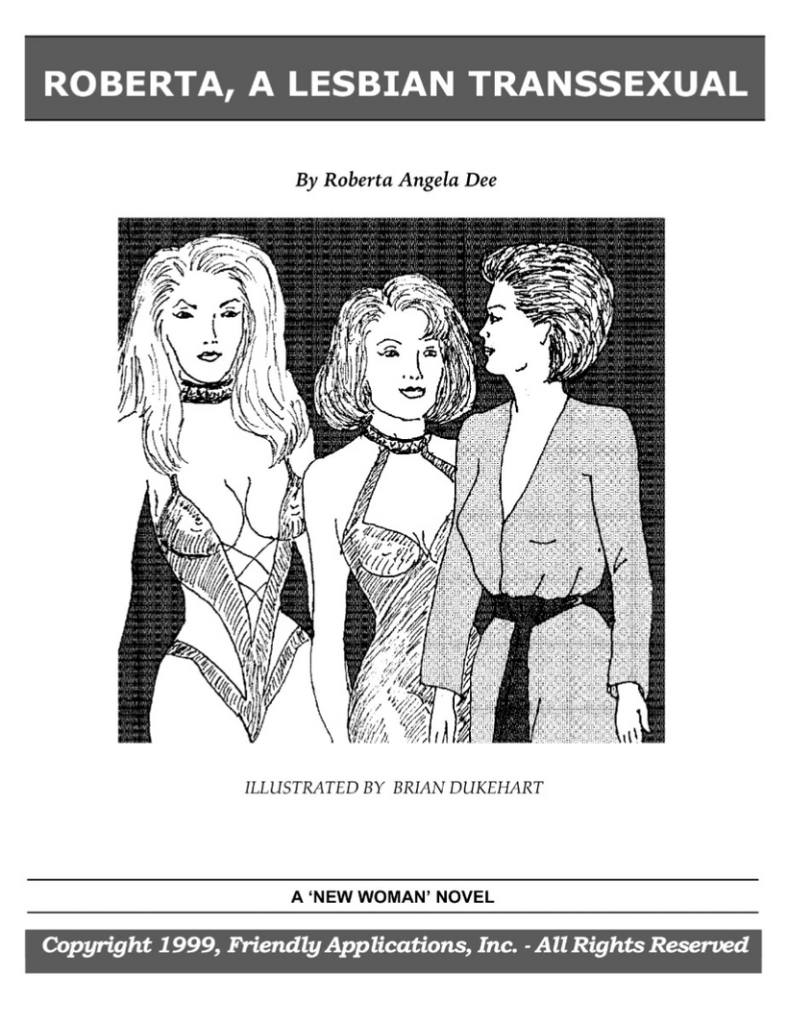
It is at this point that we can finally turn to the first of Dee’s five novellas with Reluctant Press, Roberta: A Lesbian Transsexual. While we don’t have an exact official release date for the novel, we can trace it through Reluctant Press advertisements to around December of 1991183. Reluctant Press advertised the novella in almost every major trans publication at the time – the advertisement that I’ve cited here was from Tapestry, but similar pieces show up elsewhere across the historical record. Early Reluctant Press advertisements listed out the company’s entire catalog, which meant that Dee’s novella was listed every time the company bought magazine space.
We get a tantalizing little scrap of information about the publication of this novella in the article “What Does Transgendered Really Mean?”:
About 10 years ago, I wrote a novella for Reluctant Press, titled, Roberta Angela Dee: Transsexual Lesbian. It was a story about a transgendered woman who becomes a sort of concubine to two lesbians. The phrase “transsexual lesbian” later became quite popular. It continues to be used by male-to-female transsexuals who have a sexual preference for women. More importantly, at least to me, the novella continues to be a good seller.184
Dee’s recounting of events here is misleading – the term “transsexual lesbian” has a very long history, and it was not popularized in the nineties any more so than other queer terminology. Jules Gil-Peterson’s article “Towards a Historiography of the Lesbian Transsexual, or the TERF’s Nightmare” is a good starting point if you want more detail.185 What I do buy, however, is that Dee’s exploration of the transsexual lesbian was ahead of its time by the standards of Reluctant Press’ target audience, i.e. the middle-aged Boomer generation white cross-dresser and transvestite readers who moved the most sales.
I also would not discount the sheer novelty of a book willing to advertise itself as “transsexual lesbian” in 1991. While there were other novels that covered the subject at the time, they were few and far between, and none advertised themselves so openly. As far as published fiction goes, it’s entirely possible that Dee’s debut was one of the first to ever explicitly advertise to a trans lesbian demographic as its primary audience. Furthermore, since Lesbian Transsexual was published so early in Reluctant Press’ lifespan, it means that any true connoiseur of the trans indie press circuit in the 90s would almost certainly have encountered the title in a catalog. Coming off the heels of exclusionary publishing companies like Chevalier Publications, Lesbian Transsexual strikes a distinct progressive tone for Reluctant Press, even off of the title alone.
That being said, Roberta, A Lesbian Transsexual is definitely a peculiar novella by modern standards, with plenty of dated quirks that make it a difficult text to tangle with.
Straight off the bat, Dee’s prose immediately grounds the reader in heteronormativity and misogynistic beauty standards, a typical trope for this era of trans fiction:
Men admire a lady from a distance and then determine if she would be a suitable partner for sex. Every sophisticated gentleman reserves his right to be judgmental and selective. A gentleman reserves his right to crave vitality in a woman, and for this reason younger women have an advantage over those who are more mature. Youth has its own vitality.
Being a lady does not guarantee erotic fulfillment. Refinement might attract a man, but rarely can it motivate him. Somewhere beneath the jewels and the silk a man needs to see a slut; or, he needs to see the essence of a slut. He needs to see the basic animal instinct that is so much a part of being a man or a woman
Men admire ladies, but they line up for hookers.
It is a difficult world for women. We are caught between a rock and a hard place. We are raised to be ladies, but soon learn that attracting a man requires specific flirtatious skills. Somehow, we learn to combine the two qualities in a way that is socially acceptable. Some of us master the techniques better than others.
We, women, are also very judgmental of each other. Judgmental and competitive. I am learning more about our gender every day. Oddly enough, the more I learn, the more judgmental and competitive I become.186
We’re truly hitting all the boxes here.
As with many TG/TF stories of this era, there’s a weird tension between the “I have always been a woman” and the “I used to be a man” rhetorics. This scene is ostensibly told from the perspective of a closeted Dee, our intrepid autofictional protagonist, and thus exists in the uncanny space between gendered standpoints.
After getting greeted at the door by our fully nude love interest, who’s named Lolita for some utterly godforsaken reason – forbidden desire? But they’re all adults – Roberta finds herself coming out to her neighbor, who spotted her cross-dressing through a window.
“I don’t have any sisters. The girl you saw was… was me.”
Lolita was quite surprised, and somewhat uncertain that I was telling the truth.
“What are you saying? Are you telling me that you like dressing up like a woman, or something like that? Are you a fag? A transvestite?”
“Honey, I wish it were that easy,” I answered, nervously. “What I’m telling you is that I am a woman. I’m a woman trapped in a man’s body. I know it sounds corny, but that’s exactly what I’m saying; it’s exactly how I feel. I feel I’m a woman … or that I should have been born a woman.” […]
“You’re a woman! You know how to be a woman,” I answered. “You know how a woman talks and how she walks. You understand what motivates a woman. All I ask is that you help me overcome some of the obstacles I face because of my male physique, my masculine anatomy, and behavior.”187
While a large part of this is tropey 20th-century TG/TF tripe, this passage is notable for explicitly staking out Dee’s transsexual identity as separate from transvestite or cross-dressed womanhood. The trope of getting taught womanhood by a mature woman is especially well-trodden ground here.
What immediately separates this story from many of its counterparts, however, is that Lolita is shortly revealed to already be in a lesbian relationship. It’s not femdom/authoritarian, it’s not a sissy situation, it’s not a psychoanalytic attraction between feminized and feminizer – just a pure and simple lesbian relationship between two cis women, albeit open and vested in the BDSM scene. Setting aside the dumb trope of Lolita’s partner Tanya being a nurse who can give Roberta HRT on a whim, Lesbian Transsexual sets up an immediate and fascinating tension between Roberta’s desire to transition and Lolita and Tanya’s closeted relationship. A certain contract forms between the three women: the cis lesbians agree to help Roberta become a woman, and Roberta gets more-or-less inducted into the secret of their relationship. While Dee describes this as concubinage in the early 2000s, it seems to have more in common with contemporary poly dynamics than the sort of one-sided sexual exploitation the concubine label might imply.
Another remarkable thing about this novella: it has very explicit lesbian and transbian sex scenes for a book from this era. By my token, this is Dee’s most compelling erotica, and if you’re interested in the history of trans erotica, I’d highly recommend checking this one out for yourself.
Both Tanya and Roberta are black, and Lesbian Transsexual contains some really interesting scenes between the two of them that explores the complicated intersections of race, sexuality, and gender that play out in the relationship:
She turned her attention back to Tanya, and inserted the ivory colored vibrator. Her head turned towards me, suddenly. “Well, what are you waiting for, girl? Hurry up and get your ass back in here. You’re next!”
I saw Tanya’s smile and wondered how this black woman felt about me. Did she see me as a faggot or a slave? I hoped for a time when I could speak with her, privately.
I was feeling the sense of sisterhood that exists between women of one nationality, and wanted Tanya to know how I felt, and how important it was for me to be a part of that special relationship, as well as the very special relationship between Tanya and Lolita.188
Again, I won’t go into depth, but there’s a lot to be said about the ‘ivory colored vibrator’ and how Dee uses racial imagery for effect throughout her erotica.
Equally aware is Roberta of Lolita’s whiteness, if the name weren’t clue enough:
There was a strange look in her eyes that I will never be able to describe. As long as I live I will never be able to describe the look in her eyes. Whatever the look meant, it transcended the fact the she was a woman. It transcended the fact that she was white. It transcended the fact that I did not know her past, and could not predict her future. Just a thing that’s all it was. A thing some quality of her being that was crying out to me, perfectly aware that I could not understand it. Perfectly, aware. Perfectly aware I could not understand, but that I wanted to understand, desperately.189
I absolutely love literature that explores the nature of consciousness, so this passage hits for me. The fact that it comes, like so many of Dee’s most literary passages, in the middle of a sex scene, only speaks to her skill as an erotica writer.
After some more erotica and feminization TG/TF, there’s a passage that has haunted me from the moment I read it:
During the two months that followed, I derived a great deal of knowledge from the underground newspapers and magazines that dealt with the subjects of sadism and masochism, bondage, transsexualism, and crossdressing. Many of the stories and articles were quite professional, as were the art works.
To the best of my knowledge, none of these magazines had ever received a literary reward for their intellectual content. Neither their comments on society, their creativity, nor any of the other creative and artistic qualities were awarded the tributes of other types of literary works.
It could only be the result of living during a Puritanical age. Our technology had advanced, but as a culture we were still defining sex and morals, gender and sexuality, with definitions acquired during the Middle Ages. It was absurd that no one should recognize these artists, and the people who referred to their works for entertainment, information, or ideas. Unfortunately, all of the people in decision-making positions regarding artistic merit were wrapped up in the tiny little prejudices of their own aristocratic world.190
There’s a certain affect to studying the work of an author who lived and died in obscurity, who was self-aware of her own marginalization, unable to break out from the constraints of her time. It becomes such a poignant frustration when one sits down to try and figure out how such literary recognition can emerge, even thirty-five years overdue. Even with contemporary trans literature more popular and visible than ever, it has not become any easier to return to this early 90s era, to resurrect the newspapers and magazines. It beggars a very real question: is there a place in our contemporary trans literature for the messiness of a writer like Roberta Angela Dee? I have been aware throughout this article that this whole endeavour may prove to be futile – that this article, even after months of labor, will tank, and that the community will continue on as it always has.
I do believe that historical work is valuable in and of itself. I have compiled this article from the collected detritus of decades-old sources that nobody ever thought would become relevant. Even if this work languished for decades, I have no way of knowing when the next young person like me might come by and take this forward. Perhaps my anxiety of forgetting is a personal one, then. I fear that I am insufficient to carry the memory alone. I can eulogize, I can speak good words – but when I am gone, who will speak for me? Will I leave behind a torch for the next person to light?
There’s such a yawning gap between the vast scope of Roberta Angela Dee’s life work, and the tiny fragment of it that I encountered before I began this project.
It makes you wonder how many other writers are obscured by the historical violence of a paragraph biography.
Anyway, let’s return to the confusion of lesbian and bisexual identity in Dee’s work. Around the midpoint of the novella, which had been extremely lesbian up until that point, the reader gets jumpscared by Roberta’s sudden desire for men.
I was unaware that they were discussing my readiness to have intercourse with a man. It was somewhere near the end of that four month period. Tanya and Lolita had returned to Lolita’s apartment, after a long afternoon of shopping. Both ladies were motivated to shop, whenever their favorite stores advertised a sale. […]
“You know she wants to be with a man, don’t you?” Tanya commented.
“Oh, yes,” Lolita replied. “That’s all she’s been talking about this whole month. ‘When am I going to be with a man? When am I going to be with a man?’ She’s become a regular little hot box!”191
This is a thorny tangle of an issue. On one hand, I can absolutely see how for a reader sold on the “lesbian transsexual” tagline, the sudden introduction of a desire for hetero romance might jar with the marketing pitch. It certainly reads like comphet from that standpoint, another victim of the TG/TF genre’s relentless undertow. On the other hand, 1991 was before the bisexual label had become a mainstream part of the LGBT umbrella (most spaces were still ‘gay and lesbian’), and the word ‘bisexual’ held a different meaning within traditional sexological thought. The repetition of ‘bisexual transsexual’ doesn’t make for nearly as catchy of a title, so I understand the decision.
Even with the introduction of a male submissive into the dynamic, Lesbian Transsexual retains its distinctly poly flair through its second half, now with the addition of a BDSM dynamic that much resembles what we discussed in the prior section. But I’m not gonna pretend I love reading passages like this in an ostensibly ‘lesbian’ book:
“Really! So, if Greg gives you any problems, any problems at all, you just whip his behind good. Remember, he’s a submissive. He ain’t gonna get nothing out of it, unless you tease him and taunt him a little bit. But, he’s just one kind of man. What you have to learn is how to size up different types of men. Learn what turns them on, then turn them on! That’s what it’s all about. Now, the only reason for being a woman is to be able to get that perfect cock for yourself. If you ain’t about that, honey, then, all that make-up is just show, and you’re wasting your time. `Cause the rest of us is out there competing for that prize stud. Now, are you with us or not?”192
A latter passage gives some depressing perspective on this sudden shift:
Transsexuals were always at the bottom of the social ladder. Of all the groups in American society, we were the most oppressed. I asked myself if there would ever be a transsexual President? Or, would a transsexual ever win a Pulitzer prize for what she had to say about society? I asked if a transsexual could marry without revealing her past as a genetic male? And, if a transsexual married, would she be ever be allowed to adopt children?
I eventually decided that all of these questions were secondary in importance. My goal was to live and to be accepted as a woman within the one year time period specified by my instructors—Lolita and Tanya. I wanted my candidacy for a sex change operation to be unquestionable!
Realistically, I was not rich enough to consider a political office. I had no fiancee. And the Pulitzer prize appeared, more and more, to be a reward extended only to members of a select community, and I was not a member of that literary club. So, I forced myself to dismiss my own fears, doubts, and insecurities. All they could do was keep me from ever attaining my goal. If I could not obtain my goal, I just as well preferred to be dead. My life would mean nothing. It would be empty, isolated, cold—like so many feet of old snow drift, blown against an empty house.193
I have no idea what Roberta would have thought of Andrea Long Chu, but a trans woman winning the Pulitzer did happen!
Still, this depressing passage gives a pretty clear picture of the mindset behind this sort of story structure. The ‘lesbian transsexual’ in this period of trans literature, I would argue, was as much an obstacle to achieving the goal of public passing and surgical reassignment as dreaming for lofty goals was. Lolita and Tanya were closeted, presumably also het-passing. The woman they were teaching Roberta to become was not a lesbian, but a closeted lesbian like them. They were teaching her how to survive. Bisexuality in this sense was not so much an identity category as a survival strategy – all the more fortunate, then, that Roberta happened to also like men.
The bleak, matter-of-fact suicidality of this passage also seems to be relevant when trying to understand the social positionality of trans lesbians at the beginning of the 1990s.
Where the novella concludes is a remarkably forward portrait of kitchen-table polyamory, deeply and unmistakeably queer:
Tanya and I woke soon afterwards and showered together. While in the shower, I told Tanya that although I truly loved Lolita, and was thankful to her for helping me complete my transformation, I still had special feelings for Tanya. […]
I didn’t, of course, want to say anything that would make Lolita feel left out. What I told her was that there might be times when I wanted just to be with her and times when I would want to be with Tanya.
She had no problem with my suggestion, saying that our relationships was not a formal marriage, nor would it ever have the restrictions of a marriage. We were all free to explore other people. Even if one of us were to marry, we would continue seeing each other. Tanya pointed out that many of her married girl friends had women they would share their time with, intimately. In several cases, their relationship with another woman kept the marriage alive! […]
So, it was agreed that in addition to the threesome, we could each have our own private relationships. I could never have asked for a better arrangement. I could have Tanya, Lolita, Greg, Earl, and anyone else I found to be sexually desirable.
Over the next several weeks, I noticed that Lolita and Tanya dated men quite often, but rarely had an intimate relationship with their dates. Men were simply a convenience, a free dinner, concert, or movie. Sexually, they preferred each other or the company of an attractive woman who wanted to explore a lesbian experience.194
Ultimately, while Roberta, a Lesbian Transsexual‘s title was its most groundbreaking attribute, I would argue that it also was its biggest pitfall. Lolita and Tanya are both lesbians, but Roberta is distinctly not. This is such a queer book, and yet its own marketing frustrates its longevity and impact. But there is real political power here in lesbian not as a sexuality label, but as a political label. It attempts to stake out something new from the gender politics of its time, and whether it succeeds or not, Dee’s primary aim seems to have been to emphasize that the relationship between Roberta, Tanya, and Lolita was a lesbian relationship between women, even for all its poly and BDSM aspects and the heteronormative lens of the storytelling.
By the end of the story, Roberta has fully come out as bisexual, and has started trying to navigate what that looks like within cis lesbian spaces:
They asked if I was a lesbian. I told them that I considered myself to be bisexual. I liked men, but had problems dealing with the macho mentality most men exhibited. They easily sympathized with that point.
Then I told them that my best relationships were with other women, and that I was presently involved with two lesbians. Again, their response was very sympathetic.
“Well, you’ll have to understand,” Becky commented, “that many of the women here are straight out lesbians. They don’t like men, and don’t have any affiliations with men, other than professionally.”195
It doesn’t go particularly well.
“Don’t you think you would be better off taking this up with a gay men’s organization?” Becky asked.
“No, I don’t!” I answered, somewhat adamantly. “Gay men are still men. And, I’m neither a man, nor do I have any affiliation with gay men. The men I’ve dated are bisexual. That’s not even the point. The point is that I’m a woman, and a transsexual’s right to be recognized as a woman seems more aligned with women’s rights than with the rights of gay males. Wouldn’t you agree?”
“Yes, but many of our members are still going to see you as being a man,” Linda replied.196
And doesn’t that just cut to the heart of the matter? Thirty years on, and we’re still politicking the definition of ‘lesbian.’ Roberta’s bisexuality was maybe permissible on its own, but when taken in context with her transness, it’s used to invalidate her womanhood, taken as evidence that she ought to organize with gay men (where she would undoubtedly be no more welcome). The radical lesbians that Dee interacts with are, ironically, “straight” about their sexual identity. They’re looking for lesbians who fit into simple boxes, and Roberta was never going to fit that pattern. Frankly, neither were Lolita and Tanya: an interracial polyamorous pair of professional dommes happy to adopt a trans woman into their home. Roberta’s primary impetus is to organize on the basis of their mutual womanhood first and foremost – but that is not, and has never been, how most queer feminists approach their work. Even today, the idea that a queer or trans feminism ought to center womanhood rather than queerness as a political identity is controversial and nouveau.
Roberta’s womanhood was never going to be “straight,” even in the lesbian sense. She proudly occupied a broad chunk of the LGBTQIAP+ acronym over the course of her life, and never seemed interested in dumbing down her self-identification to fit into community boxes. And that seems to be the central thrust of Lesbian Transsexual, however unprepared the trans community was to recieve it in 1991. Despite her bisexuality, her polyamory, her transness, her BDSM, Roberta was still a lesbian, a woman loving other women. ‘Transsexual’ may have made the title cut, but the political statement could have been equally made with any of the other labels. The ‘lesbian’ in Roberta, A Lesbian Transsexual is a political statement, a declaration of mutual interest. It demands a coalition that did not exist at the time of publication.
Was a TG/TF erotica novella published on the underground trans publishing circuit the right medium to accomplish that? Almost certainly not. But for the first time, it gave an author like Roberta Angela Dee the medium to say it at all.
She concludes:
They were Long Island lesbians. Most of the group members were probably from Levittown or Wantagh. They were entitled to be isolated from the rest of the world. They were probably raised to feel as though they were a special people, a chosen people whose needs and desires were important than anyone else. It would serve them right never to learn that we are all sisters and brothers. Deep down inside, beneath skin color and religion, beneath the banners of wealth and poverty, beneath the shields of intellectualism and ignorance we were all just people, just human beings looking for whatever happiness we can find, during our short time on Earth.
No, I didn’t want their sympathy. They could keep their Pulitzer prizes, country club memberships, beauty pageants, and all the others symbols of their frail reality. I was happy to be who I was and what I was. Unlike most people my life was more than a series of days and months strung together, like so many rosary beads. I had made a statement. I had testified to the fact that anyone can be all that he or she wants to be, including an accepted member of the opposite gender.197
Despite the political heft of it, Roberta’s defiance here does ring hollow, a consolation for an acceptance not gained. There is a sad irony in decrying the Long Island lesbians, who I can only assume were based on real-life experience, as a ‘chosen people,’ only to turn around with an ‘Unlike other people.’ For me, the truth in this passage emerges in its conclusion, which reads quiet and sorrowful:
While watching television later that evening, I decided I would educate people to the needs and desires of cross-dressers and transsexuals through stories. I would become a writer and share my experiences with anyone who would take the time to read the accounts of my life, while absorbing the hopes and dreams I would record on every page.
People need inspiration. People need a reason to grow, live, and explore. If I could offer them a bit of motivation, that too would make me happy.198
I understand that very much. It’s why I started writing about trans issues too.
Surveying Dee’s Miscellaneous Writings
That concludes my section on Roberta Angela Dee’s erotica and writings on sexuality. Before we shift into the final stretch of the article, which will tackle her literary fiction, her death, and her legacy, I wanted to take a moment to mention some of the other writings Dee left us, which I will not be discussing in depth here.
Over the course of the 1990s, Dee published five novellas with Reluctant Press, and they are not created equal. The worst of the bunch is Roberta Dee: TS Girlfriend, her second novella, which is stuck in an identity crisis about whether it wants to be a classic ‘forced as punishment’ TG/TF novella or a trans-positive story. In the pursuit of both, the novella accomplishes neither, and manages to be rather boring to boot.
While Dee’s third novella The Business of Being a Woman has significantly more going on, I also don’t feel that it contains enough substance to merit a full discussion here. It mainly concerns the relationship between Roberta and a woman named Ola, who serves as a thinly veiled foil and sounding board for Dee’s personal anxieties about trans womanhood. The saving grace of this novella is its humor – it’s the funniest thing that Dee ever wrote. But it falls back on the same annoying tropes as its two predecessors, and a clothing ad in the middle of the text killed my desire to treat it with any degree of literary scrutiny.
Reluctant Press claims to have published a sixth novella by Dee entitled Transwoman in 2022. This is a scam – it is the exact same text as Roberta, a Lesbian Transsexual under a different title and cover, presumably one where 100% of the profit is going straight to the publisher. I find this extremely disrespectful to Dee’s post-humous memory. Avoid purchase at all costs.
Dee wrote a lot of short fiction, and I have only covered a small portion of it here. Of everything I’ve found that I can’t cover, my favorite is definitely the story “Men Trapped in Transsexual Bodies” published in her Roberta Angela Dee’s Haven column on TG Guide. It’s a wry little sci-fi TG/TF piece about flipping transphobic language – nothing revolutionary or ground-breaking, but the sort of amusing thought experiment you’d still find on trans fiction sites well over a decade later.
In addition to all of her other writing, Roberta was also an occasional poet, though this seems to mostly be a hobby. I have only recovered three of her poems, two of them through Usenet. I would broadly describe her style as doggerel verse, though I will admit that she may just have been a bad poet. By far her most substantial poetic work is 2002’s “Eleganza II,” which may have a prequel lost somewhere in the digital wastes. Here’s a small sample:
I come to you, falsely accused of gender: male-born,
But female in mind, heart and soul;
And now — while even feminine in stature —
I bathe in your love and fully submit
To your female grandeur.
Need anyone deny me this right
To be your faithful partner,
My angel, my savior, my queencess, my Eleganza?199
Her most significant poem, however, is “Who Are We?” It was originally published in Passages, and then was later republished in Rupert Raj’s 2018 anthology of 20th Century trans poetics, Of Souls & Roles, Of Sex & Gender: An Treasury of Transsexual, Transgenderist & Transvestic Verse from 1967 to 1991. I believe this to be the only anthology of trans writing to ever include Dee’s work. Maddeningly, Rupert Raj neither dated this poem, nor included the exact issue of Passages in which it appeared. We do have some important details on Passages from correspondence between its editor Jana and Rupert Raj in 1987, suggesting that the poem might be our current earliest piece of Dee’s writing in the archive:
PASSAGES, monthly newsletter of The Gathering (New York’s independent transsexual support organization) offers 120 pages/year of articles, essays, advice, poetry, and book news of interest to both M-F and F-M transsexuals… plus six pages/month of local group news. Yearly subscription $15; sample copy of latest issue $1.50. The Gathering, P.O. Box 21052, Columbus Circle Sta., New York, NY 10023.
In the future, Veronica [CENSORED] and I hope to combine efforts so that the “feature pages” I’ve been running in might be “syndicated” to her Twenty Minutes, possibly to Karen [CENSORED] , and to any other TS organizations in the East who may be interested. We feel that by worldng jointly in a co-op effort, we’ll be able to get a lot more inputs from a lot more people than if each of us continued working alone. The idea is that each group would share a sort of “Sunday supplement” type of publication … while having to turn out only 4 – 6 pages of local club news each month. Who knows?: Maybe someday we can all share in producing a tip-top (inter)national monthly .. . and even afford to pay our contributors!200
Rupert Raj censored out the full names, but I can tell you that Jana’s friend Veronica is the same Veronica Brown mentioned earlier the article. Isn’t it great how even forty years ago, the trans publishing industry was small as a puddle? This adds general credence to my earlier claim that Roberta Angela Dee began publishing in the New York queer literary circuit, and further connective tissue on the insularity of these groups.
Either way, the poem is pretty mid:
I like men. I like their hairy muscular bodies.
I like their broad shoulders and the way they feel inside of me.
I like the way a man makes love to me and the different ways I can return that love.So I ask you: with the exception of a male organ,
how are we so different from any other woman?
And, why should anyone care?201
Bit of a jarring contrast from the whole lesbian section, but what can you do.
There are more pieces of Dee’s writing I haven’t mentioned, but I generally found them either lacking substance, or overlapping with other pieces we’ve discussed. You can sort through all of the primary sources I’ve found in the file dump at the end of the article.
A Legacy in Black Transfeminine Publishing
Sasha (1997), Dee’s Magnum Opus
[TRIGGER WARNING] This section of the article will discuss Childhood Sexual Assault. Please read with care.
I know that this is a crazy claim to make a full novel’s length deep into a historical dissertation. But everything I’ve talked about so far – the forum posts, the erotica, the articles, the journalism, all of it – would not alone have been enough to make me pour hundreds of hours of labor into researching Roberta Angela Dee’s life. At the end of the day, no matter how prolific Dee was as a writer, my first and foremost literary interest has always been with the novel form, and frankly, I would never have stumbled upon any of this if I hadn’t found Dee’s Reluctant Press novellas first. And if those novellas hadn’t been good, if I hadn’t seen that spark of greatness in them, I’m not sure I would have looked closely enough to realize the scope of the iceberg that laid beneath the surface.
I have poured this much effort into documenting Dee’s life not because she was an important historical figure, though she was; not because she was one of the first Black trans women in the publishing industry, though she was that too; but because Roberta Angela Dee wrote us a truly great novella, one that I would put into contention for the best trans novel of the 1990s across any genre.
That novella, Dee’s fourth, was 1997’s Sasha, and it’s the penultimate topic I want to discuss with you now.
Sasha is a major piece of literature in Dee’s broader corpus for a wide variety of reasons. Firstly, this is her longest novella, coming in at eighty-five pages – her second longest piece of published fiction is her final novella Roberta & Ren at just fifty. Despite the fact that Sasha is her longest novella by thirty-five pages, it also manages to be by far her best paced and plotted, with a tight and cohesive structure that relies on neither tired TG/TF tropes or autofictional stream-of-consciousness to pull itself along. While Dee was a prolific letter writer, we mostly only know about her epistolary habits through second-hand accounts. At the time of writing this article, Sasha is the only body of epistolary work from Dee I’ve been able to access, and it demonstrates an absolute mastery over the craft of letter-writing.
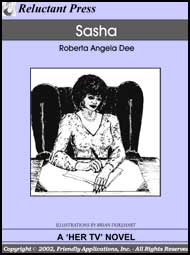
This is, bar none, the single best work of epistolary fiction written by a transfeminine author in the post-Stonewall era, and possibly in the 20th Century as a whole. While there’s an argument to be made that Jeanne Thornton’s Lammy-winning Summer Fun (2021) is a better book, and Kate Bornstein’s cult classic Nearly Roadkill (1996) is more iconic, neither of those books hew to the classic epistolary form of a novel told entirely in diagetic letters. If I had to place Sasha within the American literary tradition of women writers, I would argue it compares much more strongly to Hannah Webster Foster’s 1797 novel The Coquette, or The History of Eliza Wharton, and broadly echoes the stylisms of 18th and 19th century epistolary fiction moreso than contemporary epistolary novels like Alice Walker’s The Color Purple (1984). That being said, The Color Purple was a Black queer novel set in Georgia, and Dee would likely have read it.
The novella follows a series of twenty letters exchanged between Roberta Angela Dee and a woman named Sasha in between August 16th and December 11th of 1993. Sasha‘s publication year of 1997 is significant here. By the end of her life, Dee seems to have wholly embraced the new technology of email, with no fewer than three different email adresses popping up across her later work. As the trans community became increasingly online across the 1990s and early 2000s, Dee is the perfect representation of the changing communication and organizing methods of her time. But Sasha is an epistolary novel in the most traditional sense. It concerns a correspondence entirely held through the mail, between two people who never met in person or communicated online. There’s a certain melancholy tone that emerges through the medium of the novel, a datedness, a tension between the new and the old.
Throughout the novel, Dee punctuates Sasha’s letters with brief prose passages about her reactions and impressions. We will let her set the scene:
I had been living as a woman for more than 10 years when I started receiving letters from an English cross-dresser who identified himself as Sasha. Prior to that time I had also received written invitations to be wined and dined by an Intelligence officer named Karl. I had no reason to suspect any association between Sasha and Karl.202
The epistolary novel was the perfect medium to explore one of the most difficult and troubling themes that plagued the trans community in the 90s: deception, and the constant accusations thereof. While the early trans internet is often held as a space of anonymous gender transgression, it emerged from a tradition stretches back hundreds of years through the mail. For Dee, this was the perfect canvas for thinking about her familiar themes of spiritual womanhood and the dangers of interrogating anatomical womanhood. She writes:
The decision for a pre-operative transsexual to live as a woman is not easy. It is perhaps the most difficult challenge an individual can face. Psychologists will often insist that a preoperative trans-sexual cross-live as a woman for a year before permission is given for the individual’s surgery. It is as barbaric a practice as a Salem witch hunt. In both cases, individuals insist on a trial by fire. And in both cases, people are either persecuted or coerced into a trial by fire, before they are allowed to live the way they wish to live and love.
Like the alleged witch, the transsexual is asked to make a convincing presentation of sincerity and commitment. The test is regarded as a necessary precaution. And although the psychologist works within established guidelines, their judgment is easily influenced by personal, professional and community prejudices. These prejudices might work for or against the transsexual.203
The comparison to the Salem Witch Trials is fascinating to me, not only because of how it poses the “presentation of sincerity and commitment” as a lose-lose public trial, but also because of how it frames Sasha as a whole in an almost Gothic light. Beyond the formal Americanist structure of the epistolary novel, the transsexual-as-witch evokes questions of Puritanical repression and original sin. Further, Sasha‘s experimentation with deception and delayed communication seem to carry forward the ominous tone and the themes of perception that frequented early American fiction, specifically from the 1790s to the early 1820s. It’s the little touches like this that really give Sasha a Gothic feel:
This was the first letter from Sasha to actually leave me disturbed and suspicious. In some instances, she was very specific, while for others she was quite vague.204
About a third of the way into the novella, Sasha introduces a fascinating thematic idea that has great ramifications for both the novel and Dee’s corpus as a whole:
I had to read your autobiography a couple of times to grasp an understanding about you. You are a complex woman but have very interesting views. Very American views.
I have found that Americans can be for and against something at the same time. I am not sure that I understand why. Contradistinction is a word that I believe describes you: You are strong, and yet you advocate the role of the helpless female; against promiscuity, yet some of your actions are precisely opposite this conviction. Interesting!205
Contradistinction is an uncommon word, and I would argue it is one of the most distinctive ideas in Dee’s entire corpus – it is the introduction or usage of an example to make distinct another contrasting thing or idea, i.e. to make difference apparent through direct contrast. While Sasha’s criticism is batted down by Roberta, there’s a grain of truth to the idea. Throughout her corpus, Dee is constantly finding ways to contradistinguish gender with race, or race with gender; to use the example of one trans group to comment upon another. I’m fascinated by the notion that this is an American practice – the word ‘contradistinction’ has theological and philosophical origins, tracing back to British preacher John Saltmarsh in 1647. While I doubt that Dee meant to draw upon this specific etymology, examining it unlocks a lot of fascinating terrain, so it is a thread I will pursue nonetheless.
John Saltmarsh was a part of the broader Puritan movement in England in the 1640s, and participated in the First English Civil War as a chaplain in the New Model Army. He was a notable early advocate for freedom of speech and religious tolerance:
Alongside the process of polarisation in England, control over the press was thrown into dispute. In the 1630s, Laudians dominated the licensing system. Most Puritan works would be repressed, and if they were licensed, they would be likely heavily edited to a Laudian standard. With the outbreak of the Civil War, the control of the press was undermined for both the Parliamentarians and Royalists and there was an explosion of cheap print. Although attempts would be made to re-establish control of the print trade, the period of the English Revolution (1642-1660) would continue to produce large quantities of cheap print. For many scholars, this print culture was a public sphere where open debate over the nature of the English polity and the religious settlement could take place.
The legitimacy of this new print culture was heavily contested in the debates over toleration. These debates were over both the liberty of the press and the religious toleration of separatist religious sects, who were forming in opposition to national Church hierarchies supported by the Presbyterians. The Parliamentarian infighting highlights the competing visions of print culture that were at stake. For tolerationists like John Saltmarsh, “free debates and open Conferences” were a positive, “where doors are not shut, there will be no breaking them no open… there is a way of vent and evacuation.” This view provoked vehement responses from Parliamentarian Presbyterians like Thomas Edwards, whose Gangraena (1646) detailed the horrors of sectarianism that print had enabled to grow. In opposition to the growing sectarian heresies, Edwards wanted to promote a Presbyterian national Church system through his own printed work.206
The English Puritanism of the 1640s largely came after the divergence of the American Puritans, who left under the reign of Charles I in the 1620s and 1630s. English Puritans – and this is a broad term, not contemporary to the 1640s – did not have the luxury of an ocean of separation from the Church of England.
John Saltmarsh was a preacher of Free Grace, a theological school that holds that salvation occurs on the basis of faith alone, with the obedience of discipleship being a separable category with its own mandates and rewards. In his 1647 book Sparkles of Glory, Saltmarsh articulates a perspective on the spiritual nature of belief that feels resonant with the way Dee writes about religion and spiritual gender:
So as all demonstrations of Salvation, which are made to the soul by any rational persuasive or
argumentative way, and not in the mere evidence of the pure light or spirit of God, is but moral or human and traditional, and will fail; and all applications of Gospel promises and all Conclusions from the mere letter of Scriptures which are not the pure image or figure without, answering the very evidence and demonstration of Spirit and of God within, is but a literal and formal assurance, and will fail.207
There are two senses in which I see this argument reflected in Roberta Angela Dee’s work. Firstly, there is the literal question of a spiritual gender and its knowability, juxtaposed against the scientific approach of sexology and the social sciences approach of gender-as-performance both forwarded at the time. Secondly, it seems to echo Dee’s skepticism of trans women who see medical transition as a form of personal salvation, or any construction of transness that forwards a checklist of pre-requisites to achieve womanhood. Is gender a disciplinary pursuit, a form of good work, or is it a spiritual aspect of the soul regardless of one’s personal actions? As absurd as it may sound to pose a “Free Grace” view on gender, the school’s insistence upon the sole importance of faith upon salvation, while still recognizing the importance of following and acting out the teachings of Christ, rhymes quite strongly with Roberta Angela Dee’s belief that spiritual gender is solely based upon a similar internal faith, without discounting the importance of performing outwardly one’s womanhood and femininity through transition and social conformity.
Saltmarsh’s introduction of the term ‘contradistinction’ occurs in the direct context of this argument that salvation cannot be demonstrated through “rational persuasive or argumentative” means. It specifically follows from his arguments about the nature of the Gospels:
So as that distinction used concerning Ordinances, when they are called Gospel-Ordinances, Gospel-Commandments in contradistinction to the legal Ordinances is a great mistake and an advancing and exalting outward things into spiritual, and putting an image of Christ and divinity upon them, which they will not bear in such an opposition or contradistinction […] thus they rose up to play after their Idolatry with those administrations, as many weak Christians now, who having sat down to eat and drink in the administrations of the New Testament, as these in the Old, rise up to play, go away fed up with created refreshments rather than spiritual manifestations of God.208
Contradistinction in this original sense is used specifically to talk about dividing the word of God up into specific commands, rituals, or practices that attempt to achieve salvation. Saltmarsh references in this passage both Passover and communion, among others. But it is the verbiage of “advancing and exalting outward things into spiritual” and “go[ing] away fed up with creative refreshments” that seem to capture the core of Dee’s spiritual critique of trans identity. The extrapolation here is thinking about the image of womanhood, whether through a cross-dresser’s clothes or the transsexual’s surgical efforts, as a failure to capture the spiritual nature of gender so purported to achieve. Saltmarsh describes the administration of the Gospels as “clothing and appearance, as to men and as in the flesh,” and concludes that “things that are seen are temporal, things that are not seen are eternal.”209
In accusing Roberta of contradistinction, Sasha seems to want to argue that Dee is being a hypocrite, and more importantly a devil’s advocate. This echoes Saltmarsh’s accusation of contradistinction, which poses “counterfeit or resembled testimonies either by Satan […] or the mere persuasion of Nature”210 Sasha accuses Dee of acting like a “helpless female” and being promiscuous, despite arguing that trans women ought to act to the contrary. Besides the obvious slut-shaming overtones here, Sasha’s usage of the term clearly fails to identify the core theological thrust of contradistinction, which critiques the differentiation itself rather than a particular choice of one ordinance over another.
Roberta is quick to call out Sasha’s misuse:
The word contradistinction means “to be distinguished through contrast,” and not hypocritical as your interpretation of the word implies.211
But Sasha replies with a further disagreement:
If I had had anything derogatory to say about you or your life, I would have left no room for doubt. If I had intended to use the word hypocrite, I would have. I know the meaning of the word contradistinction and feel I used it correctly.212
It is in the elaboration of her original intention that we get to see the true thrust of Sasha’s claims:
Beethoven’s music is viewed, even today, as being very complex complicated to the point of being simple. If you sit back and listen to his compositions, each one is beautiful. If you start to analyze how they were developed and what theory was used to write them, they become complex, until you see that the theory is a mixture of simple mathematical formulas applied to art by a very soulful person. The contradistinction is science to art and the humanistic application of the two to create something wonderful.
You are a very beautiful person, and not just physically. The source of this beauty is how you have applied particular social values, your ethnic background, your education and your feminine values to create a wonderful human being. You are a symphony worthy of Beethoven!213
In a very real sense, Sasha’s argument here is exactly the sort of rhetoric that Saltmarsh sought to critique in Sparks of Glory. In the pursuit of a deeply spiritual ideal – beauty – Sasha frames the use of a rational argument that frames the contradistinction of art and science as the fundamental precondition for not just identifying, but creating beauty. The “source of beauty” in this worldview comes through the “applied.” Sasha is not sitting with Beethoven’s music as a source of beauty; she is taking away beauty as a “created refreshment,” overanalyzing its nature without actually experiencing the source of the music. Sasha further implies that Beethoven’s “soulful” nature is only what allows him to create beautiful art through contradistinction, the tool that allows him to use theory. The beauty that Sasha sees in Roberta, extending beyond the physical, is thus almost entirely attributed to the administration of her personal life, a rational and theoretical assembly of a human being that “creates” Roberta as a person. The end product of such a pursuit is not God or Spirit, but the artifice of a woman as an end unto itself, a symphony to be heard and consumed. A creation worthy of Beethoven.
Now, if you’re sitting here glazing over this discussion of theology and aesthetics because complementing Roberta on her “ethnic background” is an incredibly obvious dogwhistle, especially while comparing her to Beethoven, you’re not alone. Let’s analyze Roberta’s response to the contradistinction argument, which will unfurl these ideas further into the text.
Sasha accuses Dee’s contradistinction as an Americanism. Dee makes the following rebuttal:
Without a doubt, what you refer to when you identify an American point of view is that point of view popularized by Americans of European descent. It certainly does not include the views of native Americans, Latin-Americans, West Indian-Americans, Haitians, Native Americans, Cubans, South Americans, or any of several other ethnic groups that are all very much American. Furthermore, there are those Americans whose views are removed from those of the status quo by virtue of a physical handicap, an economic handicap, a particular sexual preference, or perhaps even an identity rooted in some cult or religion.
To speak of an American point of view with any degree of relevance one must specifically refer to what can only be called an European-American view. This is the point of view that dominates the Media, the literature, the art, and pervades the very culture too often pervasively. My views are those of a woman living in a country that exercises a racist and sexist philosophy against women and men of my ancestry at every available opportunity. Those views are hardly American.214
In the Beethoven letter, Sasha replies to Roberta with a clarification on what she actually views as “contrasting” within American culture:
You stated that your philosophy is rooted in your own history and ancestry. Does that mean that you advocate the forced circumcision of females in Somalia, Egypt, Sudan Djibouti, Ethiopia, Libya or Kenya? Of course you do not.
It is not because of their education that they have deemed that female circumcision is a barbaric rite, it is because they had had their values Americanized. Still, I recognize that there is the opposite side where positive cultural values have been lost. These attributes are contrasted from time to time. I came to America because of the contrasting cultures.215
To which Roberta is rightfully furious:
In speaking of the ritual performed on the females of several African cultures it is you who refers to it as being barbaric. It is you who imposes an American system of values on a culture you have no right to judge. […]
Why do you assume that I am so opposed to this ritual? Is it because some group of American feminists have deemed it as barbaric towards women? I do not own these African cultures, I can only draw from their experiences and use whatever good I can take from them. They do not, however, belong to me, nor are they mine to judge. […]
In your letter you spoke of an American point of view. Later, you elaborated on our many different and contrasting cultures. Yet, I must maintain that in spite of our plurality of cultures, they are exported essentially through a single point of view that of the white Anglo-Saxon Protestant. This is not my view. It is not an Asia-American view. It is not an African or Caribbean view. If anything, it is a European view as it is rooted in an ancestry that is European.216
I want to draw forward that Sasha claim contradistinction as the essence of American culture, which Roberta correctly identifies as a white Anglo-Saxon Protestant construction rooted in European ancestry. I would argue here that both sides of this argument are describing contradistinction – the primary disagreement is over the valence of the term. Sasha’s notion of “contrasting culture” represents a more common usage of the idea, a mere expression of difference through comparison. It also seems to contain an American Exceptionalist rhetoric, certainly strange coming from a Brit, of America’s greatness coming not only through their superiority over other cultures, but a certain mixing-pot ideal that holds the contribution of minority cultures as constituent to that superiority. A letter further into the book helps us make sense of this mindset:
I no longer need to explore who I am. I simply need to expand on my understanding of the attributes of being an American woman.217
Sasha’s dissociation of nationality is only one piece in a much broader facade presented over the course of the novella. It doesn’t matter to her that Roberta makes it very clear that she does not see “American woman” as a stable construct, especially for trans women or women of color. The white saviorism of her critique of ‘barbaric’ African cultures seems to echo the logics of salvation implicit to the contradistinction argument; Sasha does not see womanhood as salvatory, but specifically American womanhood. Roberta provides the ideal example: a black trans woman who, despite her “ethnic background,” has managed to assimilate into female acceptance in the American millieu. Dee’s greater marginalization gives the vocabulary for Sasha to fantasize becoming American as an escape from the reality of being trans, and the employment discrimination she describes facing at the beginning of this exchange. It is not a mistake that Sasha holds Roberta to a standard of beauty articulated by Beethoven, a classic symbol of white supremacy in the arts. For Sasha, contradistinction is the admixture that allows Roberta to overcome her blackness; her Black identity provides the contrast and friction against which her pure womanhood is allowed to emerge.
By contrast, Roberta’s argument shows a much deeper understanding of contradistinction as it exists within the Protestant rhetoric. The key lies in her understanding that even in a system where contradistinction is used to ‘noble’ ends, its primary purpose is to “export” a dominant culture that essentializes its many contradistinctory elements down into a single normative point of view. Her verbiage regarding how America “exercises a racist and sexist philosophy” directly mirrors how Saltmarsh uses contradiction to articulate how Christian systems administrate through ordinances extracted from scripture. Saltmarsh argues that the enforcement of ritual obedience through the law does not bring the Christian closer to salvation, but only delivers a false image of God, one that satiates without delivering spiritual revelation – written during his time serving in an army rebelling against the monarchy and the church. It is an essentially self-serving platform, of equal use to the monarch or the rationalist as it is to Saltmarsh’s hyperbolic Satan.
Dee’s usage of intersectional rhetoric to frame the subjects of American contradistinction is an absolutely brilliant way to take this argument and flip it on its head. Aside from being extremely progressive for 1997, one of the most forward-thinking passages in Dee’s entire oeuvre, it frames a refutation of a totalizing European-American identity not just as a rejection of the administration of discriminatory philosophy, but as an outright dismantling of rhetorics that seek to contradistict the needs and philosophical concerns of various groups of people that co-exist beneath the umbrella of American culture. I see distinct shadows of Denise Ferreira da Silva’s diffference without separability argument here:
An ethico-political program that does not reproduce the violence of modern thought requires re-thinking sociality from without the modern text. Because only the end of the world as we know it, I am convinced, can dissolve cultural differences’ production of human collectives as “strangers” with fixed and irreconcilable moral attributes. This requires that we release thinking from the grip of certainty and embrace the imagination’s power to create with unclear and confused, or uncertain impressions, which Kant (1724-1804) postulated are inferior to what is produced by the formal tools of the Understanding. A figuring of The World nourished by the imagination would inspire us to rethink sociality without the abstract fixities produced by the Understanding and the partial and total violence they authorize – against humanity’s cultural (non-white/non-European) and physical (more-than-human) “Others.”218
Contradistinction – distinction against – seems here to be a core part of the rationalist sociality that helps to produce the cultural Other. Sasha uses the Third World as a figuration of American separability, and as a fundamental component of America’s ability to produce difference and enstrangement where it need not exist. I am further interested in thinking about Dee’s literary approach as ‘imagination’ in the context of “unclear and confused, or uncertain impressions,” which seems to be one of the primary devices employed throughout her autofictional work. A contrast here emerges between Roberta, whose character presents her life story in a hazy, distorted manner, and Sasha, who appears to very clearly define herself, only to later be revealed as a total roleplaying facade. Given the themes of decteptive appearance that appear both in the contradistinction argument and through the thematic terrain of Dee’s corpus, I want to now turn our attention to how Sasha presents herself in her letters.
In the first letter of the book, Sasha establishes a core ambivalence about her sexuality, one that comes to animate the novella as a whole:
I still contend that establishing myself as a true woman in this silly world is more important right now than deciding a sexual preference. I agree that it is an important part of the identity, but to me being accepted as a woman means much more. […]
How do I categorize myself? I categorize myself as being a woman, because of the way I feel inside.
I started my new position today and took a large step forward. A great deal of freedom comes with this: No more pony tails, nor dressing as someone opposite to my true feelings.
Today, I begin a life as a legitimate woman living in America. Once I am comfortable in this position, I will begin hormonal therapy. I look forward to it.219
On paper, this looks like a gender self-identification that Roberta would understand. But there are a couple of additional factors here that temper Roberta’s opinion of Sasha: her unwillingness to make concrete statements on her sexuality, her focus on her job, her obsession with America, and the way she writes about clothing and presentation.
In her second letter, sent before Roberta has a chance to respond, Sasha describes her first day at work a little too rosily:
It was difficult discerning any reaction from my co-workers. Fortunately, my lab work-station was not located at the rear of the lab, and the two female lab workers within my proximity were friendly. I had lunch with them. […]
The toughest question came from a girl right out of college. Her name is Lori. She asked, “Are you gay?”
The others sat quietly waiting for my answer. I responded politely, saying, “A bit of a personal question for not knowing me. ”
She apologized and the subject changed to the possibility of getting together for an after work cocktail.
The men were nice but kept their distance. I could have sworn that one of them kept an erection the entire day. Perhaps it was just my imagination.
I noticed no whispering or especially startled stares.
I delivered blood test results to one of the doctors. He responded in a very friendly manner, saying, “You must be new. Well, such an attractive thing like you is welcomed around here.”220
Sure, Jan.
Roberta responds to Sasha’s initial letters with a healthy dosage of skepticism and concern, which broadly reflect ideas we have been discussing throughout this article:
Our entire social and cultural ideology is rooted in majority rule. We tend to feel that what works for the majority works for everyone. Consequently, bisexuality, homosexuality and transsexuality are deemed abnormal or at least apart from what is considered normal. This is neither logical, nor fair; but, it is the reality.
As a transsexual, you have enormous socially-motivated problems. Do you really want to confuse the issue with an indication that you might also be a lesbian? Trust me, Sasha. People have a difficult enough time with the idea that any man would want to be a woman. They are overwhelmed with the idea that a man might want to be a woman simply to be with other women.
It does not matter that this desire is perfectly normal for the individual, nor that it is totally logical. People ( and psychologists are included in this population), simply have a difficult time separating the issues of gender preference and sexual preference. […]
You must divorce yourself from any identification, real or imaginary, about being a transsexual or a lesbian. Learn to conduct business like a typical, heterosexual natural-born woman.
Are you gay? Was the question directed to you as a man or a woman? It was directed to you as a man! Had you been accepted as a woman, the young coworker would never have raised the question. Had she accepted you as a gay woman, she would not have asked the question. She would simply have avoided you, unless gay women were her own preference.221
The key to understanding these passages, beyond a kneejerk modern aversion to the idea of masking as a “typical, heterosexual natural-born woman,” is to understand how Roberta and Sasha are coming at gendered presentation from fundamentally different standpoints. Note how Sasha frames her presentation at work as “true” and “legitimate” womanhood. She sees the world as “silly,” and wants to find public acceptance before starting HRT – something that jars with Dee’s view that HRT, while not equivalent to becoming a ‘biological woman,’ is central to the development of a functional trans womanhood. The only categorization she highlights is her own.
By contrast, Roberta is very sensitive to the way people around her categorize her mannerisms and appearance, and emphasizes that they will be categorizing Sasha too. She does not link presenting as a woman with the truth or legitimacy of her womanhood. An August 2002 article entitled “Stealth” may help us to make sense of this:
I’ve accepted jobs and never told anyone that I was transgender. If I told them, I doubt they’d hire me. So, basically, I lied. Yes, I lied, plain and simple. I didn’t call it being stealth. I called it lying out of necessity. The necessity being that I had to earn a living.
I’ve never walked around with a sign that read, “Roberta Angela Dee is a transgender woman.” Yet, given the right circumstances, I was never ashamed to admit that I’m transgender and different from most other women. I’m not ashamed of who I am. I deal with society’s prejudices only because society leaves me no other choice.
Sometimes life forces us to be deceptive. However, if we are being deceptive, we need to be able to acknowledge we’re being deceptive. I’m not stealth. I’ll never be stealth. I’ll simply be as honest as society allows me to be.222
Even between 1993 and 2002, there was an enormous leap forward in acceptance and awareness of trans people, largely thanks to the 90s talk show circuit, the emergence of queer studies, and the explosion of gay rights advocacy in the public consciousness. But Dee’s positions in this article crops up time and again across her long career.
For Roberta Angela Dee, deception, or “lying out of necessity,” was a necessary part of surviving while trans in a world that disproportionately kills trans women of color from a young age. My reading of this passage is that her concern was largely directed at trying to help Sasha retain her new job. Without HRT or former experience, there are obvious reasons why Sasha may have put her new career into immediate jeopardy. Recall that Dee was against the classical real-life test, which forced trans women to live as women full-time before recieving adequate transition care – a similar logic emerges here. Sasha’s female presentation at work is, or should have been, an exercise in necessary deception; but Sasha frames it instead in terms of truth. It makes Sasha’s question in the following letter all the more circumspect:
The ad aroused my curiosity. Who was the real Roberta? Was she the Writer or the
lovely hot African-American princess depicted in the ad?223
This question is fascinating because I don’t have an obvious answer to it. Who was the real Roberta Angela Dee? Even after hundreds of hours of research, I still feel like my portrait is warped and incomplete. But what I do know is that Sasha establishes a fascinating dichotomy here between Dee’s writings and Dee’s appearance. One of the clever slights of hand of Sasha is that Roberta is almost always responding to Sasha, who has a habit of sending off more letters before Dee’s correspondence can arrive. While there are moments of genuine exchange, like the contradistinction argument I outlined above, Sasha seems more interested in the idea or appearance of Roberta – Roberta as a representation of womanhood, of beauty, of America – than she does is the actual substance of her writings. And Roberta seems aware that this is largely how other people have read her life’s work. In the response letter, she writes:
Regarding your question as to who is the real Roberta, that’s quite a difficult question to answer. Am I the Writer, or the African-American, barely clothed princess depicted in the cross-dressed magazines and swinger publications around the world?
Roberta is actually many shades of several personalities. She is first and foremost a Writer, but she is also a model, wife, photographer, feminist, social commentator, and civil rights activists. She is a devout Catholic and yet in some respect an individual who believes in human reason more so than so-called Christian revelations. As an adolescent, she was a member of Women’s Alternative Community Center, on Long Island. It was a woman’s organization consisting mostly of lesbian feminists. I also wrote for their newsletter. Her first article was titled, “How Do We Measure A Woman?” Her argument was that a woman should be defined by her feminine spirit and her allegiance to feminist ideals. She should not be defined merely by the fact that she has, or does not have, a vagina.224
I’m interested by the fact that both Roberta and Sasha capitalize “Writer” as a first-and-foremost identity, something that both precedes and explains every other facet of her selfhood and career. There’s a metatextual dimension to this, in that Dee’s self-description is itself written, both as a diagetic letter and as an epistolary novel containing those letters. And this is a metatextual thread we can follow throughout her work – across every platform, every necessary deception, every maddening contradiction in her oeuvre, the one throughline is that Dee wrote it all. Time and again, it has become apparent that the way Dee presents her own appearance throughout her work is a shifting and kaleidoscopic thing; it is the ambivalence that Sasha uses to accuse her of contradistinction. But much like how Dee never attempts to hide her transness, the one thing that she never decieves is her own writing. My thesis for this passage, and perhaps for Dee’s oeuvre as a whole, is that for Dee, being a Writer is the essence beneath the autofictional appearances within her own work, in much the same way that spiritual gender is the essence that undergirds all gender presentation and anatomy. It is the core ethos of Dee’s journalistic integrity, a belief in the raw honesty of the written word.
The genius of Sasha is a literary exploration of a discourse familiar to every transfeminine person at the time: a fight over realness, or who has the better claim to womanhood. Rather than the brute indignity of constantly calling other trans women men, what we today would call ‘fakeclaiming,’ Sasha poses a more intellectualized tension, a terse back and forth between two people testing the bounds of the other’s gender. Roberta accuses Sasha of acting like a man in the workplace; Sasha tells Roberta she’s holding misogynistic expectation for trans womanhood. Ultimately, the battle is not about gender so much as appearance; not about realness so much as reality itself, and its contentious weight in a post-structuralist trans culture full of gender fucking and cybogs and performance art. Reading Sasha as a discourse on realness thus asks what it even means for a trans person to be ‘real,’ seventeen years before Janet Mock would pick up the question in Redefining Realness (2014). Is Roberta the Writer? Or is she a hot piece of Black transsexual ass? I’m paraphrasing, but barely. You get my point.
It is at this point that Sasha gets fired for the exact reasons that Roberta warned her about:
Yes, it all centers around my former employment. And, yes, I have been sacked for being a disruptive personality. […]
I could have accepted the abuse without making a complaint, but chose to take a stand. The worse insult was having my picture taken as I stood near the lady’s room. The resulting photograph was placed on the hospital bulletin board with a caption that read, “We are an Equal Opportunity Employer. We even hire Queers. ”
Later that same day, I found a dildo on my desk. A card was attached that read, “A welcoming gift from the Staff. Go fuck yourself!”
All of the events were laid on my shoulders as being a disruption. I did not go off on a tirade and seek vengeance. I merely issued a complaint to my supervisor, and as a result I was dismissed.225
And decides to take it out on Roberta, beginning the contradistinction discourse.
It becomes very evident at this point in the novella that Sasha has posed the question of Roberta’s realness because she would very much prefer Roberta to be the “lovely hot African-American princess” than the sharp and intellectual writer percieving the contradictions in her dysfunctional life. Her engagements with Dee’s thought, as already noted, seem to contour toward imagining Roberta as a (white European) ideal of transsexual beauty. Even after Roberta has made her position on her own autobiography clear, Sasha continues to try and get Roberta to admit to putting her appearance as a woman above her pursuits as a writer:
If a man writes to you and desires your attention, do you imply an interest in him only to sell a picture or such? Or, are you straight forward with him? I wonder if you would be a different person if Charles never entered your life. Oh well, just a few surface observations. I hope I have not offended you. I really do have a deep appreciation for you, Roberta. You have overcome many obstacles to get where you are now.
A question: Have you ever mused about any of your neighbors seeing *your advertisements in the contact magazines? Is this not a bit risky to continue with the ads? Interesting. I am also amazed that Barry allows you to have selective encounters with others. I am assuming by your letter that you do, and that he knows.226
Aside from being incredibly passive aggressive, Sasha’s focus on “surface observations” is indicative of not only the depth of her writing (poor), but her general disposition toward appearances. Dee’s response is frustrated and takes obvious offense:
One final point, in sharing my autobiography with you, I did not expect it to be used as a source of arguments against the way I have chosen to live. So, for nearly all of this letter, I have defended what I believe to be credible value and moral systems. I will not reciprocate an attack on your value and moral systems.
You have made certain decisions and right or wrong you must live with them. My main point is that they are yours. They are not mine and do not belong to me in such a way that I have any right to arbitrarily change them, judge them, or alter them. I have not attempted to do so. All I have ever attempted to do, and I believe that all I have ever done, is to provide you with a different perspective one for you to compare with your own. I’ve returned your letter to you. I believe you might detect its sarcasm and bitterness, if you were to reread what you’ve written. To some degree, I understand your anger and frustration, but I do not believe it was fair to direct any of it towards me.
What can I say? These things sometimes happen even among the closest of friends. I continue to offer my friendship and if you want it’ll continue to share my advice and perspective.227
I love the shade in this book.
If Dee’s claim to serving a “different perspective” sounds familiar, it’s because it repeatedly crops up across her writing, both in Memoirs of a Transgendered Lady and elsewhere. There’s a really interesting cross-reading here about the similarities between her autofiction and memoiristic writing, but as we’ve already largely covered it, I won’t expound.
It is at this point that Sasha starts coming onto Roberta, calling her Mistress and fantasizing about having sex. Dee postmarks Letter Ten as “bizzare” and “completely inappropriate for what she is supposedly dealing with in her private life,”228 but the corresponce continues into the Beethoven exchange. By the time it concludes, Roberta is roundly suspicious of Sasha being who she claims to be. Two letters from Sasha follow in quick succession, full of their own paradoxes and contradictions, alongside a fair amount of casual racism. They also make it evident why Sasha pursued the Beethoven metaphor in the first place:
I have had a few entertaining notions about you, Roberta. Lately, I have been quite captivated with the idea of being submissive to you. Late at night I wonder, as I listen to classical music, what you would have me do as your slave. Your photograph helped to aid my imagination.229
It also begins to venture into a topic I haven’t seen anywhere else in Roberta’s corpus: childhood sexual assault, specifically as it pertains to trans women. It’s a massive and underdiscussed topic in general, but in 90s trans literature, it’s unheard of, and worthy of analysis. The exchange begins with Sasha sending Roberta photos of herself cross-dressing as a teenager with her father:
I have pictures of myself as an adolescent. I am standing next to my father and I’m dressed as a teenage boy. I also have some photos where I’m dressed as a teenage girl! In both settings, my father is smiling and appears quite jovial. […]
His arm is around my waist and his other hand is on my knee. And he has a large smile on his face. It was our last photograph together. I was 16 years old at the time.
I’ve often wondered how he would feel about the way I’ve lived my life. For several years, I’ve thought that he quietly disapproved of my search and subsequent decision. Then, I learned from Mum that it was he who purchased the white dress for me. Mum neither helped him, nor shopped with him. He went to the shop alone. I am quite touched by this memory.
Can you imagine a father going out to buy a dress for his son? I wonder how he must have felt.230
Roberta’s response is quite disturbed:
The photograph you mentioned that shows you sitting on your father’s lap while dressed as a teenage girl is alarming enough, but then you mention that he is smiling “and appears quite jovial”. This is not the typical father’s reaction to having his son sit on his lap. It suggests the possibility of sexual abuse. That’s quite a different issue.
If such is the case, then it means that there are events in your life for which I am not qualified to provide council. As I’ve said, child abuse is an entirely different issue from cross-dressing or transsexualism.
Have you never asked Mum to explain why your father was so accepting of you continuing to dress as a girl, at the age of 16 years? I would like to learn of her comments.231
Up to this point, I have not commented overmuch on Brian Dukeheart’s illustration work. But it becomes relevant here, for obvious reasons. Like most TG/TF novellas in the 20th Century, Sasha was published as a mail-order folio, typically stapled at the center fold. Most of Reluctant Press’ books were illustrated by the same few artists, and Brian Dukeheart crops up repeatedly across the catalog. This particular illustration is reminiscient of a 1995 photo in InStyle featuring Ivanka Trump sitting on her father Donald Trump’s lap232, which has cropped up in recent years for obvious island reasons. To my mind, that likely makes this illustration more disturbing now than it was in 1997 – but it’s not hard to see where Dee’s growing apprehension stems from.
It must be emphasized at this point that TG/TF literature has a long history of age dynamics that range from mildly disturbing to outright molestation. This has roots in the Petticoat Punishment literature of the late Victorian period. On the originary text of the genre, 1893’s Gyneocracy, Peter Farrer writes:
An ill-disciplined youth, having failed to settle down at school and having recently behaved indecently to one of the maids, is sent away to be educated with his three girl cousins under the control of their governess. Shortly after his arrival he is compelled to wear girls’ clothes as his normal attire. After much flagellation of all parties except the governess, and sexual interaction with all the women of the household, Julian marries one of the cousins, but continues to wear corsets and to remain under her dominion. A similar work, entitled The Petticoat Dominant, or Woman’s Revenge, appeared in 1898, possibly by the same author.233
Another example can be found in Fated for Femininity (1960), the first novella of the modern TG/TF genre published by Chevalier Publications, which features its teenage trans girl protagonist getting openly groomed the middle-aged male principle of her high school. The way that this was rationalized in the genre by figures like Virginia Prince is, in a word, disgusting:
Linda learned that Mr. Arthur’s penchant was a sort of mixture between transvestism and fetishism. He liked seeing boys and men dressed in girl’s clothes. His sexual desires did not extend beyond the kissing and caressing of these boys or men and treating them in every way as members of the feminine sex. Therefore, knowing this, Linda also discovered that he was satisfied to be a mere spectator and to be in her company. He took her out several times in his car, driving to nearby towns, to movies, plays, concerts, etc. After the events he liked to park in secluded places with Linda and engage in a little harmless necking.234
Nothing about this mindset is “harmless.” The normalization of the sexual assault of trans children and teenagers across the TG/TF press of the 20th Century (and into our own) has caused an enormous amount of damage, not in the least because of how it slots right into the “transvestism and fetishism” forwarded in the thought of figures like Prince and later Blanchard, Lawrence, and their ilk. It is an enormously pervasive theme, and deeply underdiscussed, handwaved away as ‘kink’ or ‘fantasy’ or ‘of its time.’
Roberta Angela Dee’s work in Sasha is the only 20th Century TG/TF novella that I have ever read to not only take the issue of CSA of trans children seriously, but to put itself in conversation and critique of the genre’s most problematic tropes. It is immediately evident from Sasha’s reaction to Roberta’s concern how unusual such an attitude was for the time:
I appreciate your concerns regarding my childhood, but must assure you that I have never been sexually abused. There is no doubt about this. I must admit that I was somewhat bothered that you would suggest that possibility, but I am not angry. You were asking what you felt you needed to ask as a friend.
At the age of 11 years, I was discovered by both parents while I was trying on some of Mum’s lingerie. I was mortified. My parents, principally my mother, were more than understanding. Rather than chastise me, they talked with me for several days about the matter. They told me that if I wanted to explore being a female, I could do so as long as I was discreet. Even before this incident, I had feelings of not wanting to be a boy. I was never fond of the activities that were engaged in by men and boys, nor what I felt they had to endure as the male members of society. I was very uncomfortable as I tried to be a boy. I felt it was a sort of trap or a sort of punishment for something wrong I had never done. […]
I already knew the best decision because of the way I felt inside. I did not want to be a boy growing into manhood. I could not even stand the thought of it. I hated male games and dressing like a male. I hated anything that had a masculine flavor. My decision was to be female.
It took my father longer to adjust to my decision than it took Mum, but they were both supportive.235
If this was where Sasha’s recollections had ended, this exchange would have been relatively innocuous – notable for mentioning the subject matter, but certainly not groundbreaking. But Sasha does not stop writing there. She continues:
On my 15th birthday, my parents removed all of my male clothing from my closet
and dresser drawers. They were replaced with girl’s clothes. Later, I was enrolled into a
private school as Nitasha.The summer before my enrollment, my mother provided me with instructions on how to properly act as a teenage girl. It was difficult and nerve wracking as well, but the desires inside of me urged me to make every effort to succeed.
I was happy to be removed from the male things around me. I was happy for the opportunity of expressing my feminine self.
The only rule was that as long as dressed as Nitasha, I did everything as a girl. I was never told that my decision was irreversible.
It was difficult acting out my new role, but I was so happy being Nitasha that any difficulty seemed minor. Again, I was never sexually abused. It is important to me that you understand this fact, Roberta.
I simply had supportive parents. They were not of a biased mind set regarding gender.236
Aside from all of the red flags raised throughout the correspondence – the racism, the lack of self-awareness, the sexual forwardness, the objectification of Roberta – this particular passage resembles strongly a number of TG/TF tropes typical to fantasies of adolescent feminization in the genre. Sasha’s parents replaced her entire wardrobe without her input. Sasha’s mother, mentioned throughout the letters as broadly ignored by Sasha, becomes a disciplinary figure here. Getting sent to boarding school for girls is another trope. The verbiage of never being told that her transition was “irreversible” is particularly concerning, as it entirely jars with the norms of the period. And all of those flags come before the biggest contradiction of all – if Nitasha was “so happy” being a girl and had “supportive parents,” then why does she seem to have spent a significant amount of her adulthood living as a man?
Still, despite all of this, Sasha manages to still conclude the passage with a picture of trans childhood that, as a former trans child, I resonate with:
There is no reason why gender has to be a determining factor in a parent’s ability to love a child. As to their upbringing and how it permitted their open-minded philosophy, I cannot provide you with an explanation. I only know that it is my belief that more parents should be as Dad was and as Mum continues to be.
They never initiated my behavior. They only helped me to search for an identity rather than to force one on me. I understand that there is no rule book for parenting. What is regarded as correct today might very well be unacceptable tomorrow. Like most parents, they did the best they could with what they knew and with what they believed would best express their love for me as their child. I am very proud of both parents. I have no doubt that if I had lived an opposite scenario, I would still have prevailed as Nitasha.237
If Sasha were a clear victim, this passage would not be interesting. What I find compelling here is that Sasha’s portrait of trans childhood is progressive, especially in comparison to Roberta’s, which we’ll discuss in a second. Of all of Sasha’s fantasies presented throughout the novella, this is the most heart-wrenching. True or false, it’s one of her most earnest moments, and Roberta seems to struggle with it in her response, which is no less heartbreaking:
I am, quite naturally, happy to learn that there are no episodes of child abuse or sexual abuse in your childhood. Your father and mother appear to be very loving and understanding parents.
You regard their responses to your cross-dressing as being the result of their love. I share your opinion. Still, I am sure that other people might interpret their responses quite differently. […]
The typical parent would either seek professional help for the child, totally ignore the behavior, or severely punish the behavior. It is most unlikely that they would be as supportive as your parents were with you. Quite frankly, there are many who would regard their encouragement as being a form of sexual abuse; that is, encouraging you to participate in an activity that would lead to deviant behavior later in life.
I understand that you perceive your cross-dressing to be a natural extension of your feminine soul your feminine self. However, there are many who would see it only as a fetish, a perversion, or as some sort of deviant behavior. Again, I do not find fault with the manner in which your parents responded to your desires as an adolescent. I am simply stating what I believe to be true regarding the opinion of a majority.
At about 11 years of age, my parents found me dressed in my mother’s clothes. They had also found a letter in which I referred to myself as being transsexual. Additionally, they found a jar of Helena Rubenstein female hormone cream that I inserted anally with the hope that one day I would wake up totally feminine. Yet, when they confronted me on this matter, I lied and lied ardently. I did not want them to suffer the hurt of learning that their only son was gay.238
There’s a lot in Dee’s corpus that has aged poorly, but these passages read as clearly today as they did in 1997. It digs deep on the issue of trans childhood in a way that nothing I’ve ever read in 20th Century trans literature does, making an early attempt to navigate the thorny intersection of parenting, gender non-conformity, and the very real phenomenon of sexual abuse that so many trans women face. There is a central ambiguity here about the actual nature of Sasha’s childhood that gives these letters an incredible amount of both tension and literary depth.
On the one hand, Roberta has taken it upon herself, intentionally or not, to become a voicepiece of the same animating anxieties about trans childhood that would not be out of place in a TERF’s rhetoric. This is clearly motivated by her own childhood trauma surrounding her transness, which forced her to stay in the closet until the age of 25, and remain masc-presenting at home well after her transition. One can easily read this passage as Roberta’s inability to accept that Sasha could have recieved such a warm and accepting childhood; that her paranoia about CSA could reflect internalized transphobia, or episodes from her own life. The sexualization by society of the relationship between trans kids and their parents is corrosive and destructive for all parties involved, and Sasha critiques this deftly long before a popular verbiage on the topic would ever emerge.
But there is another reading, one which holds that Sasha’s description of her childhood is not an earnest recollection, but a fabrication like so many other things in these letters. If this is the case, then these anecdotes take on a much darker tone. In a world that hyperfixates on the idea of trans childhood as childhood sexual abuse and ‘grooming,’ there is very little leeway to discuss the reality that trans women, and especially trans women of color, are at a massive disproportionate risk of experiencing childhood sexual assault. Roberta is obviously aware of this fact, and her anxiety bleeds off the page. The truth of the matter is that the entire subject is a lose-lose for the victims. A trans girl with the happiest childhood can have her parents accused of sexually assaulting her; a trans girl who has experienced horrors at the earliest age will be routinely not believed, her trauma marginalized and silenced, used as a weapon against her health and safety. No matter the truth of the matter, a reason will always be procured to invalidate her gendered selfhood.
Up to this point in the novella, Sasha’s lies about her life seem to be largely frivolous, concerning fantasies about the bedroom and the workplace, and adult disagreements over matters of politics and philosophy. This discussion is what truly takes Sasha’s facade and gives it stakes. Because for anyone who supports trans children, who understands how hard it is to live through a teenage transition, this is the moment where I began to want to believe Sasha. I want to believe that Sasha was not assaulted as a child. I want to believe that her parents were loving and accepting. There are few sympathetic attributes to Sasha’s character leading up to this point, and Sasha is structured to make you to doubt everything she says. But what does it mean to doubt this passage, as Roberta does? What does it mean in 1997 to doubt the very possibility of a happy trans childhood? Sasha’s entire appearance has begun to unravel, but only now, near the end of the book, as her letters grow longer, more desperate, and slightly unhinged, do we start to see why Sasha might be clinging to her lies in the first place.
The exchange continues with Dee asking more questions:
I must ask you to elaborate on your experiences at the private school in which you were enrolled as Nitasha. This might seem commonplace to you, but I’m certain that many readers will have a problem understanding how this could be possible. They might simply want to know how you avoided showering with the other girls, how you participated in physical education, or dealt with the boyish distribution of body and facial hair. You cannot gloss over this most significant portion of your life, Sasha.
Was the school provided with a doctored birth certificate? Were there any conditions that were a prerequisite to you being accepted as Nitasha? How did your mother go about teaching you how to behave as a teenage girl?
At some point, you obviously decided to return to living as male. With so much encouragement and support from your parents, what made you change back to a masculine lifestyle?239
To which Sasha responds with the longest and penultimate letter in the novella, a 14-page piece chockful of graphic sexual fantasy and more writing than we can cover in this article. Her response to the question is relatively innocuous, albeit confusing:
School days; how the memories come back. My school was established for the children of diplomats. I am assuming that the U. S. requires proof of birth since you mentioned it. My school did not. You were registered and went to school. My registration was as Nitasha. My records reflected this, so when it came time to go to the university it was again Nitasha. A bit of luck in my life to say the least.
Regardless of age, we all were in the same classroom but were taught in a group. I am not sure why you asked about showers. I never had to do this in school. We concentrated on academics and had no time set aside to play. Play time and sports were after school and not an organized event. Body and facial hair were never a problem for me. Mum showed me how to shave, which did not occur very often. I have never been hairy to the point of it being a problem. I used the girl’s bathroom when I needed to and never had any questions or encounters put to me about my gender.240
Of all the schools, it seems that a school for the children of diplomats, especially the child of a Russian diplomat, would be required to show proof of identification. But the emergence of class within the narrative seems to annul this:
She knew the real reason. Of this I have no doubt, nor did Mum or Father. The teacher did not make issue of this for a very simple and age old reason: money. The teachers were well compensated and were willing to overlook many things.241
Before dipping back into shades of adolescent sexuality:
I do remember that Mum had a difficult time with me when it came to selecting under garments. Sizing was a small problem, but the worse part was rolling stockings up my legs. I would tend to either stretch them too far, or shove my foot too hard towards the toe and ruin them. It was quite funny looking back on it. […]
I think the worse time of all of this was the interest I had to show in young men. The sexual identity question that is still to be answered. I was curious about boys, young men, and eager to learn how a young lady should act toward them. I enjoyed dancing with them, thought about their bodies, but something just did not seem right about them. They seemed so self centered, arrogant, a bit pompous, and insensitive.
Both of my parents tried to explain that it was a natural way for boys and some men to behave. I felt disappointed about this. Still I did have an interest in them. I did not feel as if it was a requirement since I was trying to be a girl, but had a natural interest in them. I still had (have) reservations about them though.
It is difficult to explain this. I know it was difficult for my parents to explain it as well to me. I do enjoy making love to a man and remember my first French kiss from a boy, but I simply can not look past the typical disposition of men.242
We learn later that Sasha’s mother owned a lingerie shop, which is a confusing profession for the wife of a diplomat to have:
Actually it was a perfect match between Marliz and I. She became the naughty school girl. After two years of this, we went back home to give it another go. Marliz fell in love with her distinguished gentleman friend and was set for life. I continued to have no luck and went to work for Mum at her lingerie shop.243
We learn in the passages immediately proceeding this that Sasha was doing prostitution work as a “Victorian mistress,” which seems to be how she met Marlitz, her transfemme friend who crops up throughout the text. This makes the subplot of Marlitz getting hospitalized in Egypt all the more concerning, and contextualizes Roberta’s anger at Sasha’s apparent lack of concern.
By the time Roberta sends her final letter to Sasha, her bristling anger at the way Sasha describes her sexual encounters bleeds through the page.
I realize that I must seem rather critical of you during the course of writing this particular letter. I wish I could ignore some of the things you have indicated in your correspondence to me, but I cannot. Some parts of your letter even left me disturbed. Your encounter with Lori is one example. If that encounter really took place, then I am disappointed at the way you handled it, even the way you discussed it.
I believe the phrase is “kiss and tell. ” It is essentially a masculine trait: seduce the woman, then brag about the conquest. […]
I know several lesbians or dykes, as some prefer to be called. None of these women
have ever discussed their intimate sexual encounters as graphically as you did in your
last letter. It’s not the way we talk about our relationships even those engaged in to
obtain information. […]You are an affront to everything she regards as morally correct. You were thrust into her world, then acted like a pious bitch towards her and to all the other women at the hospital telling them how they should wear their make-up, and what they should aspire to be, and how they should all want to take on more responsibilities. Is it any wonder that she would want to get rid of you? How would you react to some butch walking into the pub and telling you how to be more manly? Put the shoe on the other foot, girl friend. How would you react to someone you regard as a wanna-be-a-man telling you to live differently from what you find is comfortable?
I know I’m not sounding very literary, but this part of your letter has blown my mind. I’m shocked. I don’t even sense that you really feel a need to justify your behavior and that frightens me even more. For if you succeed at becoming a woman, what kind of woman will you be? Will you be a spiteful, resentful, manipulative and vengeful bitch or the kind of woman who take the time to understand the weaknesses and flaws in other human beings?244
While the tone and tenor of this is understandable, it does also problematize Roberta’s claim in the final chapter of the novel about why Sasha stopped corresponding with her:
Sasha’s final letter arrived a few days later. In it, she said she no longer desired my advice and would no longer write.
I suspect that Karl and Sasha are the same person. I also suspect that Sasha lives as a man. I doubt that he has ever lived as a woman, or will ever live as a woman.
The letters were all a part of fantasy that Sasha wanted to play out for whatever reason. When she felt my suspicions had become too strong, she stopped writing. It wasn’t fun for her any longer. It had become dangerous.
Maybe someday, Sasha will indeed attempt to live as a woman on a full-time basis. If so, I hope my letters will be helpful to her. I certainly hope they are helpful to everyone reading this novella.245
The suspicions in question:
Another 15 percent are men pretending to be women with the hope that I will send them a revealing letter or photo. They will include a photo of some woman but through their letters I can tell they are men. Immediately after I’ve pressured them for details, most will stop writing. A few have managed to confuse me for as long as several months, but eventually they slip up. They will usually stop writing shortly after the mistake is detected.246
The implication is pretty clear that Roberta believes that Sasha read this passage, grew alarmed, and cut off the correspondence. But it’s not hard to imagine that getting called a “spiteful, resentful, manipulative and vengeful bitch” may have also contributed to Sasha’s desire to stop corresponding. This isn’t to excuse Sasha for her sexual harrassment, but rather to emphasize that Dee’s conclusion and final letter are a continuation of the ambiguities drawn out across the second half of the novella.
By the end of the novella, Roberta believes that Sasha was an intelligence officer named Karl all along, and that she had never lived as a woman and only fantasized as such. This is never confirmed, and Sasha is ambiguous enough that it could be true or false. Much like the rest of her corpus, Dee expects the reader to draw their own moral conclusions, and that is what we will do here. Let’s take a moment to consider Roberta’s assessment of the events before turning to concluding thoughts on the novella as a whole.
Roberta’s belief that Sasha is a man stems largely from the fact that Karl crops up several times across Sasha’s letters, often in deeply questionable ways. We learn about Karl for the first time in Chapter Four, where Sasha informs us that Karl is her “roommate.” When Marlitz gets injured in Egypt, Karl is the one who travels to take care of her. He apparently then travels from Egypt to Somalia, which is one of the countries included in Sasha’s racist argument about female circumcision we discussed earlier. She writes:
This Somalia thing is terrible. Is it not? The amount of violence can do no good for either side. I listen to the news broadcasts as best I can. I try to understand the reasoning what’s going on. Perhaps I’m not as intelligent as I would like to believe, because I cannot understand the policy of hunting a man down in his own country. Karl, my roommate, is in Somalia now. I talked to him before he left and he could not explain it either. He’s a military man. He specializes in intelligence. Yet, he cannot understand the violence on both sides. For this reason he did not want to go, unless it was solely to help the hungry get food.
Did you feel any outrage about the body of an American soldier being kicked and abused? To me this proves our mutual feelings about war even if it is disguised as a peace keeping mission.247
Roberta’s response to this question is iconic:
You mentioned that Karl would check on Marliz while in Egypt. That’s quite a distance away from Somalia. Karl apparently does an incredible amount of traveling.
Regarding my feelings about an American soldier being kicked and abused, I am
as outraged by that incident as I am about Pakistan soldier’s shooting down innocent
Somalian men, women, and children on the premise that they could not be sure that these people were not loyal to one of the so-called war lords.Anyway, you must have quite a behind! Everyone wants to squeeze it.248
It should be noted that this passage is directly adjascent to the illustration of teenager Sasha sitting on her father’s lap I included above.
Rather than responding to Roberta’s skepticism, Sasha responds with this insane admission:
I was initially concerned about having Karl, as a member of the military, living with me. I wondered if I would hear endless preaching on how our military institutions are so perfect and grand. My experience has been quite unexpected. I am surprised at how quiet he is when he is here. We discuss many issues, but he has never promoted the military.
Yes, Karl does travel a great deal. He is an officer in charge of an intelligence operation for Delta Force. I don’t know very much about the American military, but I have heard about the Delta Force through the Media.
What intrigues me more is that Karl is also a member of the Knights of Templar. It is a very powerful organization based in Europe. Their origins go back to the Crusades (circa 1100 A.D.). It is essentially a secret society that significantly influences events in Europe. Only a few select Americans belong to the organization.
Their goal is a united Europe. Karl must have an enormous amount of clout to be a member.249
I’m honestly not sure whether it’s more absurd that Karl is in the Delta Force, one of the most elite and secretive branches of the American military, or that he’s also a Mason rooming with the child of a Russian diplomat. Well, a Mason or a white supremacist. You can’t really tell from the level of detail provided here.
But by far – by far – the most disturbing passage in the entire novella comes in Sasha’s final letter as pertaining to Karl:
Yes Roberta, it is my roommate. He simply is not interested in being involved with me outside of being friends.
We talked when he was back the last time. He has no interest in any relationship with anyone.
I ask him when was the last time he had sex (I know, a rather personal question). It was nine years past. He has been celibate for nine years.
He explained that he has too much to do in his work to become involved with anyone. Actually it is a good thing that he travels so much. If he spent more time here, I would probably rape him.250
If Roberta’s theory about Karl is wrong, this paints Sasha in a horrifying light. If Roberta’s theory about Karl is right, then it opens the can on so many brainworms that I don’t even know where to start.
There is also a third possibility, one that Roberta doesn’t seem to consider, which is that the entire correspondence may have been a honeypot opertation aimed at baiting her into incriminating herself. Sasha is constantly soliciting Roberta, and asking her probing questions about her feelings on the American military, her general political opinions, fishing for her stance on prostitution, asking how she solicits men, and so forth. For me, one of the biggest discrepancies is Sasha’s claim to being the child of a Russian diplomat. As a forty-year-old in 1993, Sasha would have been fifteen in 1968, right at the peak of the Cold War. Despite this, Sasha never once refers to her family as Soviet, despite these letters being written just two years after the fall of the Berlin Wall. It genuinely seems like her entire story could have been concocted to determine if Dee was a communist or socialist, or otherwise had sympathies with enemies of the state. Aside from adding an entire dimension of intrigue to the novel, this reading has historical valence with the criminalization of trans publishing in the mail.
An epistolary novel documenting a failed honeypot operation would be one of the most unique novel concepts ever written, especially one that isn’t fully exposed at the end. While I don’t think this was an intentional approach, certainly not a part of the marketing for the book, the text seems to lend itself to the possibility.
If Roberta’s interpretation of events is correct, then Karl’s admission of wanting to be raped by his female alter ego is… so many dimensions of self-loathing. I would describe it as a blazingly obvious symptom of severe sexual trauma, and would strongly caution against a more dated psychoanalytic reading. Even if every single personal anecdote that ‘Sasha’ wrote about to Roberta is a complete lie, it doesn’t change the clear kernel of truth within Karl’s sexual malaise that rots beneath the surface. Trans or not, they would need an exceptional amount of therapy. To me, it also indicates that Roberta may have been spot-on about the childhood sexual assault question. It also seems noteworthy that Sasha was published at the beginning of Dee’s activism against AGP and Blanchardian theories and her quest to share accurate and medically current information about trans identity to a wide audience. 1997 is about when Roberta began fully adopting the internet and moving her presence online; it is the year she founded Women on the Net, and concretely within her work for Transgender Forum. While it’s not explicit, Sasha seems to contain an early formulation of many of the critiques we discussed earlier in the article.
I would also argue that this is the most tragic of the three readings. Aside from potentially lying about being sexually assaulted as a child, it also implies a much darker life story, one where Karl would have enlisted in the military from a young age, with minimal opportunities for self-exploration or acceptance. This assumes that Karl is at least somewhat gender non-conforming, which I would argue these letters are far too eggy to imply anything but. A total fabrication of any trans identity would lean more toward the honeypot interpretation. You don’t get into Delta Force – assuming that’s not also a fantasy – without intensive training and experience. Reading Sasha as a fantasy, rather than a honeypot or an honest accounting, gives us an incredibly difficult mix of contrarian desires to sort through. The innocence of the trans childhood fantasy and the violence of the sexual fantasy are hard and painful to reconcile – yet oh so very revealing in the process. What emerges through contradistinction? Is it the andsymphony or the composer? Sasha or Karl? Has Sasha’s deception left us with only the hollow appearance of a woman, or has the act of writing – Sasha-as-Writer – revealed the essence of a deeply traumatized and tortured transfeminine egg underneath?
There are no answers to those questions – which I imagine is exactly how Roberta Angela Dee would have liked it.
The final interpretation is that Roberta’s suspicion of Sasha was wrong, and that Sasha was a real trans woman, in equal parts alienated and exposed through Roberta’s relentless interrogation. While this view is not as interesting or complicated as the other two, it is no less revealing about the themes and concerns of this novella. In this interpretation, Sasha reads as a predator, a workplace harrasser who can’t take no for an answer and who fantasizes about raping her roommate. Sasha becomes a story about a woman whose life has gone very wrong at some point – a brutal descent from a happy and accepting childhood into a miserable adulthood in the closet, and how it slowly destroys one’s sense of self over time. The interesting paradox of this is that Roberta’s desire for Sasha to be a man – the notion that only a man could act this shittily toward women – seems to absolve some level of responsibility Sasha holds for her own misconduct. Because the fact of the matter is that trans women are more than capable of the shittiness that Sasha expresses in her letters – the harrassment, the racism, all of it. Further, Sasha would hardly be the first trans woman to go on a negative character arc away from healthy transfemininity, or to more generally become a bad person.
Because Roberta Angela Dee is both the author and the protagonist of Sasha, the reader is primed to believe her interpretation of events. But while Roberta’s fantasy may not be as objectionable, I do believe it remains fantasy nonetheless, as we have no proof that Sasha is lying about her identity. The fantasy is a popular one. It holds that trans women who exhibit all of these negative traits associated with masculine and patriarchal violence cannot be women; that rape and sexual violence are disqualifying when assessing the veracity of trans identity; that the path to trans liberation lays in sussing out the real women from the fake, the pretenders from the disciples. It promotes social death as a way to escape the stain of transphobic association. In the 1990s, this fantasy was much more visible than it is today, with gaping fault lines between various trans identity categories that laid bare the lateral violence our community has always been willing to enact against itself. But it continues on today, even now that its primary impacts have been pushed to the margins.
Sasha is a complicated character. In many ways, I find her morally repulsive. But one of the most powerful and challenging things that Sasha asks the reader to do is simple: to judge whether you believe the main character is a trans woman in the first place. It presents us with a messy and inconclusive portrait, and demands that we assess her realness. Does she pass? Not pass as cis; does she pass as trans? Is she even a person? Does she exist? Because if we take Sasha at her word, then she may be a terrible person, but she is indisputably a person. She has a disastrous employment history and a trans best friend and a complicated but close relationship with her parents. She’s upper class and white, but also an immigrant struggling with her family’s history. Her father passed away when she was young and she never got over it. She has always known herself as a woman, and yet the violence of the world seems deadset on stripping it away from her. It is a violence that Sasha may be participating in. It is a violence that you may be participating in. Maybe it’s a cycle that neither of you can break.
I’ve written more than 15,000 words of this article just analyzing this novella, and yet at the end of my study, I must leave you with the conclusion that Sasha does not have a correct or even textual interpretation. That’s what makes it a great book. Not only does the nuance and ambiguity of Sasha far outstrip anything else in Dee’s catalog; it lets this slender novella stand with the best trans fiction of its era. Ultimately, if you’re going to read anything from Roberta Angela Dee, I would recommend starting here.
An Emerging Trans of Color Consciousness
The final novella by Dee, Roberta & Ren (1999), never quite recaptures the literary highs of Sasha, returning to the more disorganized and trope-y structure of her earlier novellas. I find the book rather frustrating for rehashing for the millionth time Dee’s life story, her ideas about transness – the basic justificatory work of early trans fiction that abandons technical heft in the pursuit of self-explanation. If Sasha was a brief flicker of transliterary brilliance years before its time, then Roberta & Ren represents a crashing back down to earth, an Icarus with melting wings plummeting toward the roiling sea.
Dee’s old anxieties about the burdens of her transness resurface in full force:
What kind of woman would intentionally make another person’s life so miserable? This was an ethical consideration.
As a Catholic, and as an ethical human being, Roberta was bound to resolve this conflict. Yet, there seemed no easy or realistic way to break away and preserve the lifestyle to which they both had grown accustomed.
Life could be far more complicated for a transgendered woman than for a crossdresser. A crossdresser was only donning a costume from time to time. He dressed for the fun of it, or perhaps, the adventure.
A transsexual assumes a new life and completely severs herself from her past life. If there are children, then their relationship is determined by the degree to which they can accept their father as a woman. If they cannot, then she moves on into her new life. If the transsexual continues to assume a moral responsibility about the life he created as a man, then she will carry enormous guilt if the transition from male to female doesn’t leave the affected individuals content.251
Most of Dee’s self-identification as Catholic comes within her autofiction – I haven’t found a non-fictional source to confirm it. That being said, Catholic guilt recontextualizes a lot of her internalized transmisogyny, and once again brings up the paradigm of sin. Sin emerges in the final paragraphs of the novella, where the titular Roberta and Ren are in the woods on an early morning, attempting to find a future together.
“Absolutely!” Roberta answered. “And society can have double standards, too. Society supposedly condemns adultery and promotes family values. Yet, did you notice how quickly the National Organization of Women raced to defend former First Lt. Kelly Flinn when she was facing a court-martial? What happened to the sin of adultery? What happened to family values? Were they temporarily suspended to pretentiously support her rights as a woman? That’s a lot of crap. Adultery isn’t a gender issue. It’s a moral issue. Did the society suffer momentary amnesia? Did Lady Justice temporarily become blind?”
“All these so-called Christians quote the Bible,” Ren added, “but forget the greatest commandments of all: To love God, and to love thy neighbor as thyself. Instead, they use the Bible to oppress people and steal happiness from anyone who fails to fit their perceptions, whether they have to do with gender, race, or behavior. It’s worse than hypocritical.”
“And all these so-called feminists running around preaching about how terrible it is to live in a patriarchal society!” Roberta commented. “They’re the first ones to expect a transsexual to undergo major surgery so they can be deemed a woman by a panel of male judges. Now, tell me that isn’t hypocritical as well.”252
I found these passages difficult to write about, and I had to take a few weeks just to sit with them. Dee’s insistence upon a moral approach to gender – an approach rooted in a Christian belief system that attempts to reconcile a personal virtue ethics with the thoughtless bigotry of amoral transphobia – seems to be at the root of her worst brainworms. She has such a clear-eyed view of the moral hypocricy of institutions, and yet not five pages earlier is utterly steadfast in her conviction of the moral imperatives within and toward her own family, even when they seem to cause her continuous pain and abnegation throughout her work.
It’s often said that early trans literature comes from a place of deep existential pain and self-loathing. Despite Dee’s best attempts to portray herself as a successful and actualized career woman and lifestyle columnist, I think it rings true here. Ultimately, what I see in these passages from the end of her final novella is deep agony, the cold and certain knowledge that her relationship with her family is conditional. The paragraphs leading up to this quote about hypocricy confirm this:
“I know I’m right,” Roberta asserted, confidently. “Did you ever stop to think how many millions of people either live miserably, end up committing suicide, or end up in a mental institution simply because they try to conform to society’s idea of what is normal? Sometimes, being an individual means being able to tell yourself that being ‘normal’ just isn’t worth it; certainly not if it degrades the quality of your life or drives you mad.”
“There must be millions of men in America alone who have kept secret their desire to be intimate with another man,” Roberta continued, “merely because society considers it to be a perversity. I personally know at least a hundred women who consider themselves to be ‘bi curious’ but remain in an unhappy relationship with a man rather than experience the joy they might have with another woman. Why? Because society condemns such relationship.”253
Isn’t it funny what a difference a little editorialization can make? By “asserting confidently,” Roberta’s autofictional slight-of-hand places her in the commentator’s seat, removing her fictional self from the weight of implication. It’s easier, after all, to advise than self-reflect; to minister than question. But her inability to move beyond the declaratory salvos of an exploration of trans identity – and who could blame her, it was the 90s – leaves her on the perpetual precipice of self-exploration, unable to ever delve into the depths of her own sense of self. The final paragraph of Roberta & Ren is laden with unanswered questions, small impossibilities. It is one of the most thematically resonant passages of her entire life’s work.
Ren stood and searched for dry drift wood. She found enough to start a campfire. They sat together and stared at the stars. They wondered how they would find happiness in a world with so many individuals determined to destroy their happiness.
The End254
What made Nevada such a breath of fresh air in 2013 was the fact that it was entirely unafraid to explore trans life in the aftermath: after the loss of family, after the destruction of happiness. Nothing in Roberta’s oeuvre was able to make that leap. The abrupt end of Roberta & Ren reads in many ways as archetypal of 90s trans fiction; there was an invisible threshold, a point of no return that could not be crossed.
Despite its own internal conflict, Roberta & Ren is a ground-breaking text in the transliterary canon for a number of reasons. Not only does it contain one of the first depictions of a T4T transmasc/transfemme relationship – it is possibly the first published piece of trans fiction to ever depict a T4T relationship between two trans people of color. The only real comp text that proceeds it on the topic are Virginia Prince’s anonymous novellas, namely Double Switch (1965).255 This genuine novelty provides the subtext for Roberta & Ren‘s ending – the impossibility of a public relationship between a Black trans man and woman. By leaving the reader in a moment of melancholic uncertainty, Dee’s conclusion creates the possibility for a better future, one that remains unknowable and unwritten, yet evades the certain cruelty of a story played out in the reader’s eye.
Framing this abrupt ending as a point of no return, crucially rejected, lets us pose the work Dee does in Roberta & Ren as an evasion of the ‘rupture’ that Christina Sharpe outlines within the trans* as framed earlier in the article. One could also tie in Snorton’s fugitivity, though I believe a better reference here comes from his “Trans Necropolitics” article: “Trans of color positions in particular are as yet so barely conceivable that trying to articulate them (or even marking their absence) almost automatically becomes the ‘p.c. that goes too far’ (Haritaworn 2005).”256
Roberta & Ren predates the term T4T, and in broader keeping with her writings on Black trans identity, Roberta never explicitly tells the reader that the convergence of race and gender here might hold broader significance. Despite this, Dee’s final novella is by far the most explicit piece of fiction on race she ever wrote. While Roberta’s side of the story is the tired recitation of her trans coming-of-age, as already mentioned, Ren’s side is a fascinating exploration of Black family in the Deep South, with feminist themes of abortion and motherhood that have really interesting implications upon the discussion of Black trans intimacy. The pregnancy of Ren’s mother, undertaken in Mississippi, is immediately situated within the Civil Rights Movement and the pre-Roe era:
There was tension in the world, and especially in Mississippi, much of it between blacks and whites. It was a bad time for a 20-year-old woman to be having a baby.257
Then further against the closing discourse on sin:
Sandra’s mother wasn’t a very well-educated woman. She didn’t know the words to explain how much a woman’s life is altered when she’s had a child with no husband to provide for her. A woman is looked upon differently from the man who fathers the child. The man remains untainted. Only the woman is tainted, as if she commits the sin alone, as if, somehow, she impregnates herself and no one else should bear the responsibility. But how does a daughter understand what her mother is unable to explain?
The feminist movement was still in its early stage. An unwed mother was still frowned upon, socially. She wasn’t the “nice girl” a woman was supposed to be. Her sin left her spiritually tainted, as though her soul could somehow be dirtied by her act. A tainted soul was just a tainted soul. No one needed to explain how it was tainted, nor explain how a tainted soul was logical or tangible. It was decreed by God, and that was that.
Still, when Brenda’s mother fell in love, all that mattered was being in love. For the young, love has no penalties, no consequences. Love is timeless, endless. Love is the only perfection in a flawed world. It’s ignited by its own flame, and it burns without fuel.258
As a feminist argument, the implicit contrast between historical discourses on wedlock and abortion and more contemporary discourses on trans issues is the backbone of Roberta & Ren‘s thematic landscape. Dee poses the antifeminist thrust as a ‘spiritual taint,’ as opposed to the ‘perfection’ of love – and one might source a Black feminist perspective on love here, bell hooks etc., though I will confess that I am not well-versed enough with those arguments to rearticulate them here. The importance of this passage is to locate Dee’s notion of sin within her notion of the spiritual as it pertains to gender, and to pose an analogy between the absence of feminism experienced by Ren’s cis mother during her pregnancy, and the absence of feminism experienced by Ren in his relationship with trans identity and the world.
Despite our broader thematic concerns, I think it’s important to center how the actual storytelling here is anything but abstract:
“I just want somebody I can love, Mama,” Sandra answered desperately, as though she was pleading for her own life as well. “I just want somebody I can love, and somebody who will love me.”
Her words reached deep into Esther and grasped her heart with a hold that squeezed out memories she wished she had forgotten. She resisted, but almost immediately embraced her daughter. Both cried now. The two women shared the same fears.
Finally, while still sobbing, Esther pleaded with her. “Pray on this, child. Ask the Lord for direction and for forgiveness. I’ll have to tell your Daddy soon enough. And I don’t know how he’ll react. It’s in God’s hands now. I’ve said all I can say, and I’ve done all I can do.”
“We’re Catholics, Mama,” Sandra blurted out, attempting to defend her position. “Catholics don’t kill babies. It ain’t right, Mama. It ain’t right to end a life that God’s already started.”
“Well, that’s a fine idea for the Pope,” he mother answered. “The Pope ain’t having no baby no time soon. And the Pope don’t have no idea what it’s like for a black woman in Mississippi to be an unwed mother with no job, and no place to stay. If he did, he might think different’.259
Ultimately, in the absence of an abortion, Sandra is forced to give up Ren for adoption anyway. The section of the novella about her pregnancy ends with color imagery that deepens the thematic heft of Dee’s perspective on race:
One of the nurses lifted Brenda and held her securely in her arms. She turned and looked at Sandra. Sandra quickly realized what was about to occur: The infant would be taken away and later surrendered to its adoptive parents. Sandra would never see her daughter again.
Suddenly the whiteness of the room became whiter and more sterile. She assumed a fetal position beneath the cotton sheet. She cried. She continued crying more than she had ever cried her entire life.260
I’m fascinated by this figure of the “whiteness of the room,” especially when taken in the context of the metaphorical space of feminism’s absence. The structural injustices experienced by Sandra are not necessarily racialized, but blackness inflects them, and the end result is still the room getting “whiter.” This is the primary device that unlocks the rest of the novella, making sense of the seemingly abrupt turn to a more conventional literary TG/TF story. A large chunk of the novella is further taken up with a new sort of room – the chat room, which has its own form of whiteness. Roberta and Ren get to know each other online, and spend most of their time discussing transness:
What transpired between Roberta and Ren for the next few months centered on Ren’s claim to manhood and Roberta’s claim to womanhood.261
But their rapport emerges from an episode of Roberta calling out online trans spaces for racial bias and discrimination. In an epistolary excerpt to the head of the TransGender message board, Roberta writes:
What I resent most about the list is its racist policy. I’ve noticed that several African-Americans have left the list or have been suspended from the list. Those who have left confided in me that they did so because discussions of racial issues affecting their lives were discouraged.
African-Americans were suspended because they continued to discuss how racism and sexism affected their lives as transgendered women. I understand that you claim they were suspended for being hostile. However, race and gender are inseparable issues for transgendered people of color. This may not be true to other transsexuals, but it is most definitely true for people of color.
Your insensitivity is racially motivated. Therefore, I too will unsubscribe from TransGender and allow it to remain a homogeneous group of people who fear discrimination for their beliefs, but who have no reluctance to discriminate against others.262
By 1999, Roberta Angela Dee had begun to develop a clear sense that even though trans issues cut across racial lines, the presence of racist and anti-feminist rhetorics within the online trans community had the persistent effect of making the room whiter. After the exploration of traumatic Black motherhood in the first two chapters, much of the second half of the novella is told from within the room-space of the online chatroom, where both Roberta and Ren have found escape from the heteronormative constraints of their day-to-day lives. There’s an interesting echo in that normative life – marriage, expectation – with the exploration of Sandra’s blackness as occuring prior to and outside of the whiteness of the hospital room. Just as Sandra has rejected an abortion, the solution forwarded by her Black mother, both Roberta and Ren have rejected the perils of coming fully out as Black and trans in a deeply anti-Black and transphobic world. When Sandra gives birth to Ren in the white hospital room, she’s forced to give away her child. But Roberta refuses to give herself away to the whiteness of the room.
Instead, Roberta and Ren leave – with the child, so to speak.
In Sandra’s story, there is a third option other than abortion and adoption: Sandra keeping the child, where Ren could be raised by her biological mother. This is the future Sandra wanted – but an idealized future, a future that overlooks the destitution of raising a child alone as a poor Black woman in 1960s Mississippi. Realistically, Sandra’s third option was no better than the first two, and Dee clearly understands that.
Roberta & Ren is a frustrating novella in my view because it was handed an impossible task – to find a future for its Black trans main characters that involved none of the predetermined outcomes. Dee attempted to find a future where Roberta and Ren would neither A) be forced to remain closeted and miserable in thier cis black communities, B) end up destitute and miserable on the streets, or C) quietly assimilate into the misery of the online trans community, disappearing into the whiteness of the room. Given that the novel ends with dark uncertainty, it would appear that Dee could only succeed in rejecting all three options, unable to find a fourth path onward into the starry unknown. In this sense, I am almost tempted to label the novella as a failed thought experiment; a research question without an answer. I believe, however, that Roberta & Ren represents a turning point in Dee’s thought, a shift away from advocating for an idealized general trans audience and more toward a specifically trans of color audience. Even though the novella ultimately fails to deliver a satisfactory answer for its reader, an escape from transmisogynoir and the whiteness of the room, that does not mean that Dee failed in her late career to find an answer.
While Roberta & Ren appears to have crystallized Dee’s understanding of the problematic of trans of color identity, it clearly emerges from the dozens of submerged threads and writings about trans identity and race we have already highlighted across the 1990s. The 1997 creation of the Women on the Net site is the moment Dee seems to have emerged as a leading figure in the online trans of color space, but as we have shown, her writings on the topic date back to at least 1990, likely earlier. There are two other developments across the late 90s that begin to develop the issues outlined in Roberta & Ren – we shall briefly discuss them both before moving into Dee’s solution, and everything that followed from it.
I have a lot of hypotheses why Roberta Angela Dee has not been well-remembered, but one of them is because the bulk of her work was erotica and lifestyle writing – two deeply feminine disciplines, neither of which are taken seriously by historians or archivists. It is to my vicious satisfaction, then, that the core ethos of Dee’s emerging trans of color theory seems to have fomented and coalesced through her regular beauty column on Transgender Forum, Roberta’s Beauty Tips.
One of the most quietly radical passages of Dee’s entire oeuvre can be found in her column “Before Makeup:”
Girl friend, if you’re planning to go out and want to look your prettiest, you need to remember one thing: You’d better listen to Roberta Angela Dee. Because when it comes to makeup, I don’t play. Being a woman is serious business. So, if you’re not ready to be serious, all you’re doing is playing dress up. Thank you.
OK, now this article is intended primarily for African American women or women of color, but fair-complexioned sisters can learn a lot too. So, loose your preconceived notions about skin care, and read Roberta’s solutions to many of your skin care problems.
We begin with determining your skin type. Many people believe that more darkly complexioned women can only have oily skin. Not true, sweetie. Skin type may be changed by genetic, hormonal or environmental conditions. So, it’s important to examine your skin closely at least once every month — not just seasonally as most of the books suggest.
Perspiration on black skin tends to give the appearance that it is oily. In reality, the skin could be quite dry. So, don’t be deceived. And, another thing, ladies: when you look at your skin, make certain that you have sufficient light — preferably sunlight.263
Time to put down your internalized transmisogyny. When Dee says that her beauty advice is “serious business,” she’s not being pithy or vapid. What Roberta Angela Dee means is that her articles on beauty and lifestyle for trans women are some of the most deeply researched, scientifically rigorous pieces in her entire corpus. Dee understood that beauty for trans women was not a vanity concern, but a matter of basic health and safety, and she treated the subject matter accordingly. Our patriarchal society will try to convince you that women’s lifestyle writing lacks substance, that it contains little depth or worth. I know I internalized that as a teenager. Dee would entertain none of it. Lifestyle was the beating pulse of her journalism, no matter how thankless the job was, and she treated it with a professionalism and dedication that I cannot help but find admirable.
Trans lifestyle writing is a lost art, and I hope we can treat the subject with the historical gravity it deserves.
While this may not be the first place that trans of color writing has centered TWOC, it’s the first place I have found that does so to a broader audience primarily consisting of white trans people. This article was published on Transgendeer Forum, where the whiteness of the room was omnipresent and inescapable. “Before Makeup” isn’t just radical because it centers the embodied needs of TWOC; it’s radical because it is an open invitation to its white trans audience to learn from the embodied needs of TWOC. The title is a quiet entendre; after all, does our skin color not come before makeup too? When Roberta asks the reader to “loose their preconcieved notions” about skin care, there is a quiet – or not so quiet – implication that the true biases to be loosed are racial, and go far beyond primer composition.
In another column, Dee gives us further insight into the thrust of her concerns:
It might surprise the majority of Americans to learn that most of the world’s population is non-white. Media and the entertainment industry might lead many of us to believe that the everyone on the planet has blonde hair and blue eyes. This is simply not the case.
Thirty percent of the US population consists of non-whites. Given that the present US population is about 270 million people, this means that 81 million people are comprised of African, Asian, Latino, Pacific Island and other ethnicities. We are all equal but we are not all the same. […]
Using the probability statistics provided by the Diagnostic and Statistical Manual (DSM) of Mental Disorders of the American Psychiatric Association, there are no more than 10,000
transexuals in the entire United States. Frankly, I believe their estimates are ridiculously low. However, I’m certain it will take the medical profession another decade or two to come to this realization.Yet, even if their figures are correct, it means that there is a possibility that 2,000 – 3,000 transsexuals are people of color. That’s a sizable population and I would hope that at least one of the doctors who cater to our community would be concerned about the quality of information they dispense to two or three thousand people. Yet, as I repeatedly review the information the most popular physicians provide, I’ve yet to find one who seems appreciatively concerned.264
While there are no comprehensive or authoritative demographic statistics of global trans population, it’s safe to say that Roberta was correct that the DSM statistics are a gross undercount. An August 2025 study suggests that the number is around 2.8 million people265 – but it’s simply impossible to compare current estimates against the 1990s, before trans issues hit the cultural mainstream. Either way, it’s clear that Dee’s understanding of the demographic was far ahead of her time.
The structural exclusion of trans women of color from online trans spaces like Transgender Forum was not an intentioned outcome on the part of organizers like JoAnn Roberts. It was a systemic absence that had been predicated from the start. When JoAnn Roberts was founding promoting her Gender Bill of Rights, Marsha P. Johnson had turned up floating face-down in the Hudson River. Sylvia Rivera was homeless, and had been for a long time. An entire generation of trans women of color had died in the AIDS epidemic. Trans of color life had long since congregated away from the ‘trans community’ of the 90s; this was the decade of Paris is Burning. Black trans community had its own subcultures and communities, and they didn’t involve internet access. There was no dial-up internet on the street.
For all that Roberta Angela Dee’s presence and participation within these communities was an anomaly, the mere fact of such was the symptom of a much, much larger under-representation of trans of color voices in community spaces. It was an under-representation carved out in violence and exclusion and sex work and murder and more pre-mature death than our contemporary trans community is able to reconcile or comprehend. It was not that Dee’s hopeful audience did not exist – it was that they were dead, or did not have internet access. But the lack of resources and representation thus created a vicious and self-satisfying feedback loop to further preclude the possibility of that audience. In essence, Roberta Angela Dee’s job as a Black trans journalist in the late 90s was not just to speak to her trans of color audience, but to prove that such an audience could exist and matter in the first place – to break through the whiteness of the room.
Around the same time that Roberta & Ren was published, Dee seems to have begun to take a greater interest in documenting the ongoing murders of trans women of color around the United States – although much of that documentation occured on listservs and forums which have not yet been documented. I was able to turn up one example from 2002, where Roberta posted on Usenet about the murders of Ukea Davis and Stephanie Thomas, a case repeatedly covered by Monica Roberts on TransGriot across the following years.266
While a full genealogy of Dee’s early attempts to chronicle Black trans death will require deeper research, her political output onto the public internet intensified in the wake of 9/11, and had taken on a sharply political tone toward the end of her life. Dee was of course alive during the pivotal 1995 murder of Tyra Hunter in DC, which is often cited as an early tipping point toward the movement, and would have been aware of the founding of TDOR in 1999. She was not, however, a member of Gwendolyn Ann Smith’s circle that created the holiday, and had critiqued Smith’s publication Trans Gazebo for lack of substatial engagement with trans of color issues in 2000.268 Regardless of how she came to it, Dee demostrated a clear concern for the growing awareness of the violence against trans women of color, and her reaction to the Thomas and Davis murder seems indicative of a broader attitude toward the subject as a whole:
It should be clear to each of us that there has been a frightful increase in the number of hate crimes in the United States. Whether motivated by race, gender or religious beliefs, these hate crimes or apparent hate crimes threaten each of us in the most horrific way.
Understandably, it’s not an issue we like to discuss. It’s not comfortable. It certainly isn’t pleasant. However, so long as these kinds of crimes continue to escalate, each and every one of us has the potential for becoming a victim.
As a result of the tragic events of September 11, America is still clinging to the mindset that all firefighters and police officers are heroes. The article posted below suggests that this is a myth, in the true and most meaningful sense of the word. What frightens me as much as the murders, and the attitudes of the public servants involved, is the total absence of any outrage in any community, even ours.269
To a certain degree, I do find this response from Dee to be sheltered, even a little tone deaf. The murder of trans women of color was not novel or undocumented in 2002, and there was a large chunk of the community who were very vocal and furious about it. Further, it seems to bookmark Dee’s separation from the black trans spaces of her time, the privilege to have never been forced out onto the street. But this becomes once again a question of audience. On the Usenet board alt.transgendered, Dee would be writing to the whiteness of the room: negotiating, seeking acknowledgment and rupture. Further, I hope my literary analysis to this point has proved that Dee had a deft hand for rhetoric and double meanings; posting on often-hostile forums like Usenet served a purpose for her, and it was not her primary audience by 2002.
Where was her primary audience in 2002, then?
By 2002, Roberta Angela Dee had come up with a solution to the impossible problem she had set out for herself in Roberta & Ren. If the whiteness of the room could not be escaped, then it would fall upon trans women of color to create a room of their own – a space of solidarity, of sisterhood, of community togetherness and care. On the early trans internet, that looked like an online forum and chatroom. The forum was called TG Woman, and it would become the nadir of Dee’s long and complicated career.
Monica Roberts, TG Woman, and the Birth of a Legacy
By the time Roberta Angela Dee founded TG Woman in 2001, she was already in her fifties and had been living full time as a trans woman for over twenty-five years, placing her firmly in ‘trans elder’ territory. This was especially true for her relationship with Monica Roberts, community icon and founder of TransGriot. While Roberts was only around fourteen years younger than Dee, she did not transition until 1994 – making her significantly younger than Dee in ‘trans years,’ so to speak. Both Monica Roberts and Roberta Angela Dee were from the South; Roberts was living in Houston when she began her transition, and lived in the region for most of her adult life.
For Monica Roberts, Roberta Angela Dee was a community pillar, a trans elder, a mentor, and a friend. While our present understanding of their relationship comes largely from Roberts’ second-hand posthumous accounts, her writings display a clear admiration and respect for the impact that Dee had upon her life and work. In my research, I was struck by the insight of Amira Lundy-Harris in her article “‘Necessary Bonding: On Black Trans Studies, Kinship, and Black Feminist Genealogies,” where she writes:
The possibility that these connections provide is not just for those younger folks, like [Janet] Mock. For Black queer and trans elders, the process of building intergenerational kinship bonds can serve as a movement of return. Savannah Shange (2019: 50) highlights the possibility that these kinds of connections offer while reflecting on the bonds she and her students built: “The fullness of the moment sent me back through the wormhole to my own adolescence, and I felt the bite of how badly I needed a space like the one we co-created.” For some elders, the process of building intergenerational kinship bonds—of making a path, a way—for those who come after provides an opportunity to build a space they didn’t have.
Mock’s description captures two points that characterize this form of intergenerational kinship bond. First, this bond provides a sense of mentorship/“femmetorship” made possible because these older women had navigated similar experiences themselves. The knowledge these women bestowed via resources, advice, and perspective helped guide Mock through an uncertain period in her life. Second, this bond across age provides a knowledge of the past. This sense of connection to one’s history is characterized by Mock’s description of a longer tradition of trans women in her community. This deep legacy is exemplified by Black trans activist Raquel Willis’s (2018) characterization of Sylvia Rivera as her “transcestor.” Willis names and Mock describes the particular intergenerational connection they have to those trans femmes of color who have gone before them, those who felt it necessary to pass their resources and knowledge on to folks like Mock and Willis who would come up after them.270
This feels especially poignant knowing that Monica Roberts was a mentor and influence on Janet Mock, placing Roberta Angela Dee within the scope of this quote as a direct intergenerational influence. Upon Roberts’ death in 2020, Mock wrote about Roberts’ impact:
For many, TransGriot was a beloved bookmark, but for Black trans folks its founder was much more: a fearless storyteller, a passionate historian, a fierce advocate, a sister and auntie, a comrade and friend. Now, Monica has reached the highest distinction as an ancestor, serving as a beacon of how to uplift your people without apology.
Monica showed us to ourselves by providing us with our history. Her legacy will live in the myriad of ways each of us go out in the world, emboldened by the knowledge of our great and long existence as Black trans folks, knowing that because of her, we can make history of our own. For this, we celebrate you, Monica. Thank you for all you gave us. Rest well, our dear Moni.271
History is a funny thing. Roberta Angela Dee worked tirelessly for the trans community for decades, and yet up to this point, the scope of her historical impact has seemed little more than a personal influence on one woman – a woman who just so happened to be one of the most influential figures in contemporary trans history. But even if all of Dee’s life work comes down to little more than a minor influence in the scope of Monica Roberts’ career, there’s nothing ‘just‘ about that. Her influence may have gone unrecognized and unobserved, but we are all sitting in the shade of trees that Roberta helped to plant.
As we begin to bring this article to a close, I want to pose Dee’s legacy in all of the ways framed by Mock and Lundy-Harris. I want to understand her impact not as an isolated historical anecdote, but as a lineage and ancestry whose effects are still felt in our present day.
Roberts and Dee never met in person, and appear to have come to know each other online at some point before 2001. One possible connection is through JoAnn Roberts, who both knew and worked with Monica in the late 90s and early 2000s. Monica met JoAnn272 at the 1999 Southern Comfort conference in Atlanta, Georgia,273 and JoAnn would become instrumental in helping the National Transgender Advocacy Coalition get off the ground in the same year, of which Monica was a founding member.
Prior to her involvement with Roberta Angela Dee, Monica Roberts seems to have primarily worked as a lobbyist and activist, not as a writer. In her writings about Roberta, she confirms that Dee was her primary inspiration for her writing career:
She’s the person who I picked up the trans writer’s torch from in terms of being an advocate for our rights and telling our stories through the power of the written word.274
Roberta also seems to have solved a longing for Black trans role models for Monica, who spoke in 2013 about why her transition didn’t occur until the 90s:
Because I didn’t see people like me, I wondered where they were and realized they were there but well hidden. If I had open out and proud peers I would have transitioned earlier than 1994. Today we have role models like Janet Mock, Kylar Broadus, and me, and many others to look to that are trans people of color to emulate. I didn’t have that when growing up. We are a part of a legacy; we just didn’t pop up in the late 20th century, we have been here all along.275
And like, yeah, I’ll corroborate that – Roberta Angela Dee may have been out-and-proud, but she was, and continues to be, very well hidden.
So was the Yahoo group that Dee founded on July 21st, 2001, the innocuously named TG Woman. There was absolutely nothing in the name or branding of the group to suggest it was a haven for the trans of color community. It seems that the group’s eventual identity as such was largely an accident, the product of a slow whitening of the room across other transgender forums that attracted many TWOC to a forum run by a known Black trans woman. On the homepage of the group, its description text gives few clues about its general identity:
Are you transgendered and living full-time as a woman or as a man? Do you have concerns about the lifestyle you have chosen? Would you like an opportunity to discuss the challenges and obstacles facing those who are transgendered?
Transgendered Woman Full-time is an unmoderated discussion group for individuals living full-time as a transgendered woman or man.
TG Woman is open to anyone who is transgendered, whether or not he or she is living full-time in their preferred role. The Group is also open to the partners of a transgendered individual.276
Despite this, it had a clear draw on the TWOC community from the beginning, as Monica Roberts attests to:
I was a member of TG Woman from its inception. Roberta created a place that was different from the average transgender group. There wasn’t the whiny, ‘woe-is-me’ tone that tends to permeate some transgender groups. We talked about issues beyond just transgender ones and it had over 2000 members at one point. When I started Transsistahs-Transbrothas on New Year’s Day 2004 I patterned my group on that TS Woman model.277
We’ll talk about Transsistahs-Transbrothas in a moment. I want to discuss Monica’s estimate of the size of the group, which is more of a median number. I managed to track down two different screenshots of the frontpage of TG Woman – one from November of 2001 a few months after creation, when it had 345 members, and one from April of 2003 after Dee’s passing, where it had ballooned to 4175.278 Roberta seems to have advertised the forum primarily on other digital trans forums like Usenet, and by the end of her life consistently signed off her posts with “Founder of TG Woman.”
Between July of 2001 and March of 2003, TG Woman saw a staggering 14,885 posts, of which I have no doubt contain irreplacable insights into Dee’s relationship with Roberts and this late period of her life more broadly.
I regret to inform you that we have none of them, and are unlikely to ever recover the archive.
As someone born in the 21st century and raised in the social media era, I have a hard time understanding how anyone could consider a public online forum a “private” exchange. I will confess that my concept of “digital privacy” is six feet under in this day and age. But during the research for this article, I’ve learned from trans elders who lived through this period that these online groups were often considered private and vulnerable spaces, more akin to a Discord server than a modern forum. When Yahoo Groups was discontinued a few years ago, only a select few groups were preserved; every group on the platform had metadata saved, but only enough to confirm its existence, not to reconstruct the forum as a whole. Further, looking through the snips on the Wayback Machine turn up 404 errors as early as the late 00s, suggesting that TG Woman was deleted long before the platform as a whole went down.
What this means: unless one of the 4000 members of the group saved a large amount of archival data from the group, the posts on TG Woman are almost certainly lost media. And even if they were preserved, they would have been saved on a trans person’s harddrive in 2003, which is now 23 years ago. Even if the archivist is still alive, the chances of them being online enough to be found and the data secured are low. And if they are dead, it’s hard to imagine that reams of old forums data from an obscure early 00s trans forum with less than two years of history would have been preserved.
I’m not saying it’s impossible. But it’s such a vanishingly small chance that we have to treat the data as lost.
What that means for our inquiry is that we will have to weigh Roberta’s impact upon Monica’s life and work largely in terms of its resulting products, without strict primary sourcing to indicate the direct nature of her influence.
As we have already discussed, Roberta Angela Dee appears to have died of natural causes. If she was having longterm health issues, she kept them fairly private. Our last major publication from Dee comes on January 18th, 2003 in an article on HRT, less than two months before her death. It’s an impressively well-researched primer on the topic, but generally a dry nonfictional scientific article, one which I don’t have much commentary to add other than ‘it’s very good.’ After that, we have one or two sporadic routine Usenet posts, but nothing of any substance.
On March 13th, 2003, Roberta Angela Dee would pass away of unknown causes, and the trans community would be a little darker without her presence.
Dee’s death is not well-documented or remarked. Monica Roberts’ first memorian piece that we currently have access to was published in 2007, around four years later. While it seems likely that news of her death would have spread through the forums at the time, we have none of those forum posts. There was not a single posthumous remark about her in the Usenet files I went through. I have not found any sort of obituary or article about her passing, which feels especially disappointing for the breadth and substance of her contribution to Transgender Forum. The only contemporary source about her death I have been able to find is a small note on the front page of TG Woman from April 2003, which reads the following:
TG / TS Woman is dedicated with many thanks to the memory of its founder, Roberta Angela Dee.
She was a writer. Her works have appeared on a number of popular online publications, including TG Forum (http://www.tgforum.com)
She was a truly incredible woman, whose spirit in love and friendship will remain forever.279
That’s it.
It’s possible that there’s a better memorial squirreled away somewhere on the depths of the early internet, but as it stands, I can’t help but find the anti-climax of her death extremely frustrating, if not a little upsetting. With the TG Woman group falling apart within months of her death, and Dee’s life’s work forgetten the moment she died, it’s not hard to imagine how Monica Roberts might have felt similarly.
Unlike TG Woman, which evolved organically to become an online hub for the trans of color community, Monica Roberts’ Transsistahs-Transbrothas group was explicitly designed as a trans of color space from the outset. Though the original Yahoo Group went defunct with the rest of the platform, the group has a Facebook presence that can still be accessed today. As motioned in the quote above, Monica founded the group with the explicit intention of carrying out the legacy left by Dee. Given the apparent collapse of the TG Woman group in mid-2003 and the creation date of January 1st, 2004, the intent seems to have been to start off the year strong in the wake of loss.
While Monica Roberts didn’t create the blog iteration of TransGriot until 2006, a precursor column also began in 2004. While we don’t have quite as explicit confirmation of the intent, it seems to have originated from a similar place, perhaps as a New Year’s Resolution. For the first two years of her career of writing for the public, Roberts wrote for a local queer newspaper in Kentucky, The Letter, which has not been well-digitized or preserved.280 While future archival work will be able to determine exactly when Roberts’ Letter column began, and whether she mentions Dee’s influence, it will have to remain a well-positioned inference for the moment.
While the creation of the TransGriot platform can be attributed to many factors, it’s clear that Roberta Angela Dee’s journalism, organizing, and untimely death played a notable role in the blog’s form and conception. Most queer media treats Monica Roberts’ writing career as though it began in 2004 – but there’s a tendency to focus only on TransGriot and ignore Roberts’ crucial activism and lobbying work in the late 90s that leaves me dubious about the rigor of that information. We don’t have a good biography yet of Roberts’ life, and it’s quite possible that future research will problematize or add nuance to the narrative that Dee inspired Roberts to pick up the journalistic pen. For now, though, Monica Roberts’ recountings and the timeline of events give us a strong case to pose their connection as a major piece of connective tissue in the history of Black trans community organizing.
Conclusion
Final Thoughts
Doing archival work on historical trans people can sometimes feel like trying to find a needle in a haystack. In the absence or paucity of primary sources, our academics are taught to find anecdotes, vacancies, and vignettes, to emphasize particularity and absence over a more cohesive or grand portrait of history.
I think it’s safe to say that studying the life and work of Roberta Angela Dee does not follow that historical trend. It does not fit neatly into pre-existing wisdom about studying the Black trans archive. While recency plays a large part in that – we are very fortunate to be re-examining Dee within living memory – there are countless examples of trans of color life histories vanishing five years, three years, even months after death. Twenty-three years may not be much in the grand scope of global history, but it’s a significant gap when trying to reconstitute the level of detail and understanding we find here.
After spending nearly two full months on this project, with years of research and groundwork leading up to it, what strikes me the most upon reaching the end is how this is the incomplete archive of Dee’s life. After two decades of attrition, we are still left with so many primary sources and writings that it took a full book’s length of study just to give an overview and primer. It is absolutely marvelous and maddening in equal measure. Marvelous, because I have been beyond honored to work with so much fascinating and diverse material from an author I’ve truly come to respect. Maddening, because of the sheer degree to which Dee’s work has been ignored and overlooked.
My most sincere hope is that this article, in all of its messiness and sprawling complexity, can put a definitive end to that omission.
As amusing as it is to say 74,000 words deep onto the topic, this is only the beginning of the work on this subject. If you’re an academic, a student, a researcher of any stripe, I would encourage you to pick up the research where I’ve left off, as this is about the limits of my personal skill and ability to do this work. This is an open conversation, and I hope you continue it. To this end, as previously mentioned, I have included a massive primary source dump of around ~150 sources at the end of this article, so that you can access the full Roberta Angela Dee archive as it currently stands, and draw your own conclusions about the material.
Before I turn to outlining the primary targets for future research, I want to take a moment to comment on the utility and importance of studying Dee’s life and career in the way I’ve done here. As I hope has become evident, I believe that Dee is worth reading on her own merits. Her work is nuanced, textually and thematically complex, stylisticially distinct, and cuts across a wide range of genres and forms. In addition, it represents a number of historically significant firsts for the trans publishing industry, which have been enumerated throughout the article. While Dee’s fiction is more notable for excellence than influence, it can also be used as a representative sample for studying the underground trans indie press circuit of the 1990s as the marquee text of Reluctant Press, which has next to zero scholarship on its influence and impact at time of publication. Dee’s novellas have potential for versatile usage in curriculum, whether for studying Black trans literature, 90s trans literature, or the history of indie trans publishing; and I would argue that her best novella, Sasha, contains enough literary depth and substance for inclusion on even the broadest trans or queer literature syllabus.
Dee’s journalism had a much more substantial impact than her fiction, and is of equal interest and merit. Her work directly influenced one of the most important trans of color institutions of the 00s, and TransGriot’s broad impact on the trans movement alone makes it a necessary object of further study. Beyond that, this article now constitutes one of the most substantial and significant bodies of historical work on the trans magazine circuit of the 20th century, which shaped trans life as we know it today. Dee’s multi-decade career within the trans publishing industry tells us an invaluable story about trans publishing as we know it today – how it came to be, why it takes on its current form, and who helped to shape it along the way. Because we have so much work across multiple publications from a single author, we can perform comparative work that allows us to more effectively trace the political and cultural impacts of each publication, and to observe historical and material trends that undergird the often-mysticized early history of how modern trans literature came to be.
Dee’s life gives us new avenues to explore the history of the second half of the 20th century from a trans lens, challenging current narratives about 20th century Black trans life and adding depth and diverse context to the current narrative of American trans history. It presents us with the portrait of a woman who cannot rightfully be stated as a ‘great ex-man,’ so to speak; not a famous figure, not a national organizer or activist, but a career woman whose dedicated work influenced the people around her in ways often left out of the narrative. Between her deep literacy and her correspondence with more famous trans activists at the time, Dee gives us a further unique window and perspective on her contemporaries who are included in that historical conversation.
But beyond all of this, I found an immense amount of joy in studying Dee’s life for the simple pleasure of getting to know this remarkable woman. Roberta Angela Dee was a charming, sharp-witted, deliberate, and calm presence on the page. Her work touched the lives on thousands of people, and it’s left a true imapct on me as well. I appreciate her frank wisdom, her no-nonsense demeanor, and her absolute commitment to the betterment of the lives of those she wrote for. In a world where trust in journalism has degraded beyond prior recognition, it is such a pleasure to read the work of a woman wholly committed to her principles and craft, a woman who wrote for the people tirelessly and selflessly for the entirety of her adult life. Roberta is such an inspiration for what writing for the public can be, and did so for a trans public barely in its infancy. Who can blame Monica Roberts for being moved to pick up the pen? Roberta Angela Dee makes me want to write, and that’s an honor reserved for only a select few I’ve read as a student of trans literature.
That’s what I’ve accomplished. That’s my elevator pitch, after months of work. I hope that you take away as much joy and purpose from Dee’s corpus as I have. I hope that her writing moves you too.
Notes for Future Research
Let’s talk about where the research goes from here.
At the end of my research, I have sources that contradict Dee’s birthdate to three different years: 1950, 1949, and 1948. Additionally, I was not able to find birth or death records, nor was I able to turn up a cross-referenced obituary or family history. Given this, there are certain things about Dee’s life that we may never know without figuring out her legal name. It’s important to caveat here that such a question comes with major ethical questions. Do we need to know, especially given the possibility that Dee died with her deadname? I don’t have a good answer for that. But choosing not to search leaves a number of major questions about Dee’s life unanswered.
This is an issue especially pertinent given that Dee’s earliest publications, which are cited to the early 70s by her account, may not have been published under her chosen or current name. As mentioned earlier, Dee cites on several occasions the article “How Do We Measure a Woman?” claimed to be published by a local lesbian publication on Long Island in the early 70s. I do not know if this is a real article, but it’s a concrete enough lead to be worth looking.
I’ve done a little bit of research, and briefly reached out to the Long Island LGBT Community Center, which runs regular events for queer Long Islander elders, some of whom probably were active in the community in the 70s. While I wasn’t able to schedule a meeting or anything, it seemed like a really promising place to learn more about the period and search for publications. If anywhere has a storage or collection of paraphanelia from the era, it’ll probably be here.
As a general rule, searching for Dee’s 70s publications will probably be very challenging until we collect more records and writings from the 80s. However, if you’re interested in the challenge, I would recommend searching local queer publications from the period in New York, and especially in Long Island, as Dee’s trans publishing career seems to have begun in the hyperlocal queer press. This will probably take the form of newsletters or other loose paper zines or publications from the era. It is important to note that Dee may not have published at all in the queer press during this period! We simply don’t know right now.
Another potential early source might be found in Dee’s correspondence with Virginia Prince, which should be buried somewhere within the expansive and diffuse Prince archives. We don’t know when they corresponded, but it could have been any time between the 1970s and 1990s. Total needle in the haystack. But if you’re in the Prince archives for any reason to read her correspondence, please keep an eye out for Roberta Angela Dee’s name, and make sure to let people know if you find anything. Your discoveries will be eagerly recieved.
Moving into the 1980s. The biggest and most obvious source of research is The Transvestian, which contains an enormous amount of potential writing from Dee. Major details that remain unknown: what year did Roberta begin her column? How did she meet Tania Volen? Who was Tania Volen? Did Roberta write for other publications during or before The Transvestian? When did she stop writing the column? To answer all of this, I would recommend that any issue of the tabloid, from its 1981 origins to its mid-90s demise, ought to be checked for informaton or writing from Dee. Given that we’re looking at over a decade’s worth of a low-circulation newspaper-print tabloid, this is probably an exceptionally difficult task, but a thorough study will likely yield a significant quantity of Dee’s corpus.
We have already also discovered Dee’s writing in one other 1980s-era New York periodical, a newsletter-magazine called Passages. So far, we’ve found one poem and one short article, but given the casual submission of both, I’d wager a bet there’s more. Further, since Rupert Raj was responsible for reprinting Dee’s Passages poem, his archive in Toronto likely contains correspondence about Dee. I also have an anecdotal account of seeing Dee’s name in Raj’s letters as a direct correspondence, but take that with a grain of salt.
Roberta Angela Dee was extremely prolific, and published her work anywhere she could land it. Further, she seems to have preferred less formal publications like The Transvestian over formal publications like Tapestry as her medium of choicee. For more speculative research, I would check out some of the other small queer publications from the era, especially those publishing fiction and poetry. If there were a lot of trans-friendly queer NYC litmags in the 1980s, I certainly haven’t heard of them – but that doesn’t mean they don’t exist.
One major missing piece: while we haven’t found any sources yet, Dee mentions in her writing occasionally that she runs classifieds, and it’s suggested in Sasha that she may have done so in swinger magazines. Given our extensive proof of Dee’s involvement in BDSM and poly subcultures in New York across the 80s, I would not be surprised to find her name cropping up on a deep dive. I am very much not equipped to research that topic, but for historians of queer BDSM, another thing to look out for.
One thing to look out for in these magazines are photos. We already have photos of Dee in the archive, and she’s written about her desire to model before. I am primarily a scholar of written media, so I don’t tend to overly focus on finding photographs, but I know for a fact that there are probably dozens of photos of Roberta lurking out there. A lot of these early trans magazines were big photo spreads that had journalism as an afterthought – if you find a written piece from Dee, it’s always worth flipping through to look for pictures of her.
Now for the 90s. Most of the 80s-era print leads carry on into the early 90s, so it’s not until the rise of the trans internet around 1995 that the research goals really shift. The biggest and most obvious starting point is to continue the archival work I have started with Transgender Forum, for a number of reasons. I focused primarily on Dee’s written work in the TG Forum’s library section, and I did so using a pretty scuffed method by trying to scrape data off a site reconstruction rather than a text dump. I am 100% certain that I missed pieces of Dee’s writing in the process. Further, since I could only access data through early 1999, there are potentially up to four full years of publishing output still to be found in the site archives.
On a Usenet post, Dee herself lists off the following articles which we currently do not have archived:
- A Celebration After fifty years of crossdressing forty years of writing about it
- Cross-Dressed School Teacher
- Cross-dressing and Guilt
- Crossdressing: Still A Taboo
- The Purge!
- The State of the Gender Community
- The Transgendered Mindset: Male-to-Female Female-to-Male
- Transbeauty World: Beauty and Love
- Transgendered Memories: Non-OP or Non-Sense
- Views On Gender: CD Secret Garden
- Views On Gender: Prejudice And Gender
- Views On Gender: Transgendered Lady Transgendered Gentleman
This is noted in the post as an incomplete list, but it should give a scope of just how much work is left to be excavated.
In addition to missing articles, Transgender Forum likely also contains photographs of Dee. Many of the articles I archived from the site had photos, which I will confess I did not do a good job at preserving when I found them – my access was very low-resolution, and I figured that a crummy screenshot wouldn’t be of much use when the source files I used are publically available. Further, I haven’t searched the actual ‘forum’ aspect of the site, which could have any amount of posting from Dee.
Another major body of missing work from the 90s internet comes from the erotica site Gay Library Cafe, which is basically undocumented in our modern day. I found the site difficult to search for, and unfortunately we don’t know the URL. However, if the site can be found, it will likely contain a significant amount of Dee’s erotica, so it’s a major priority for any researcher focusing on Dee’s fiction.
A major question mark – did Dee’s career in print media end after her move to online? It’s possible that even after moving her primary work to the internet, Dee continued to publish in print publications. However, it’s also possible that Dee made the choice to focus on digital publishing due to her move to Georgia, which would have taken her further away from the local New York publishing circles where she began her career.
As we move into the 00s, the obvious holy grail for research would be if we could find an archive of the TG Woman Yahoo group. I won’t linger on this, since I just laid out why it’s unlikely to be found, but it would be a massive find if records were discovered.
Lastly, while it won’t be for primary sources, I would strongly recommend that future scholarship should access the archives of The Letter to read Monica Roberts’ 2004-2006 predescessor column to TransGriot. Roberta Angela Dee pops up on the blog early in its lifespan, 2007, and it’s likely worth reading through the entire newspaper column to look for mentions of her name.
One final consideration: while 2003 was a long time ago, and most of Dee’s more famous friends and collaborators have since passed away, it’s likely that friends and acquaintances of Dee are still alive in 2026. It’s quite possible that there may be additional information or sources that could be turned up through interviews, though I’ll confess that there doesn’t seem to be an obvious starting place for that.
Did you know Roberta personally? Do you have memories of her writing or work? If you’re an older trans reader, please don’t hesitate to share your experiences in the comments below.
Suggested Reading Order
If you’re interested in reading Roberta Angela Dee’s work, then the best place to start for anyone is with Sasha (1997). Not only is Sasha her best and most cohesive work, it’s also quite accessible for the reader. You can purchase Sasha‘s eBook directly from Reluctant Press on the Mags Inc digital storefront for $8 USD.
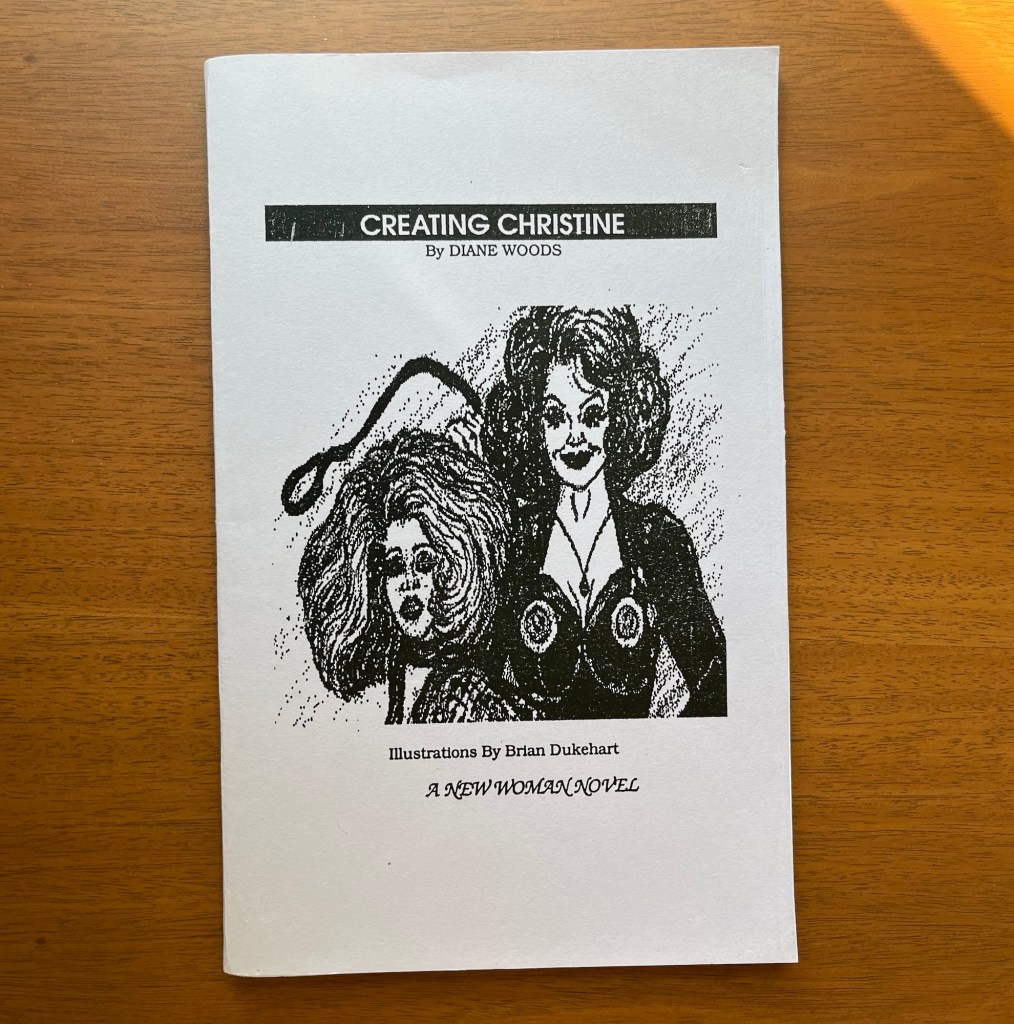
One important note – while Sasha is available in both eBook and print, you should be aware that the print edition will not resemble a traditional paperback found in a brick-and-mortar bookstore. I don’t have a copy of any of Roberta’s novellas, but I do have one Reluctant Press book in print, pictured left. This style of printing is folio, but the print quality is closer to stapled printer paper than it is to a trade paperback. Be aware of the product you’ll be getting before you buy.
If you’ve read Sasha and enjoyed it, then I would recommend moving on to either Roberta & Ren (1999) or Roberta: A Lesbian Transsexual (1991), which will likely appeal to different people. If you’re curious about Roberta’s erotica and TG/TF writing, then Lesbian Transsexual will give you a good sample of what she’s capable of in the genre. I also suspect that it will be the earliest published piece of trans fiction that many readers will have ever encountered.
On the other hand, Roberta & Ren continues the more literary tone struck by Sasha, with some really interesting social commentary and a quixotic structure that’ll be novel for most readers. It’s also quintessentially 90s in a way none of Dee’s other novels are, capturing the unique contemporary feeling of digital chatrooms, early online dating, and the general social culture of the 90s trans internet.
If you’re not interested in reading a full novella and just want a casual sample of Dee’s work, then her style writings may be of interest! I’ve compiled most of them in the file Roberta’s Beauty Tips, which can be found in the primary source documentation. I learned about the column from a random tweet on Bluesky, and it seems to have aged pretty well for a modern reader. Alternatively, I found that Dee’s articles for TG Guide were broadly more fluffy and casual than her work elsewhere, so if you’re looking for some casual reading, it’s a good place to start. As I briefly mentioned in the article, I quite enjoyed her short story “Men Trapped in Transsexual Bodies,” which can be found online at the link below.
If you’ve read one or two of Dee’s novellas and you’re still interested in delving deeper into her writings, then I would highly recommend reading her Memoirs of a Transgendered Lady column as a good intermediate starting point into her corpus. I found these columns delightful, and they cover a significant swathe of Dee’s life with rich insights about sex, gender, and trans lifestyle in the late 1900s.
Remember that this is an incomplete compilation of the column, only including articles published before early 1999.
If you’re interested in Dee’s theory work, then I would highly recommend reading her article “Spiritual Feminism” (1997) found on the Women on the Net website. The piece was an important framing device in structuring this article, and it’s a rare moment where Dee’s writing turns away from trans issues and focuses more on broader race and gender concerns.
I also found a lot of value in reading the exchanges in En Femme magazine between Dee and Veronica Brown, which can be found in the En Femme folder of the primary source files. At present moment, those articles represent the best picture of what Dee’s work with traditional print media looked like.
From there, you’ve got a lot of options! There’s a bunch of erotica, the rest of Dee’s novellas, and some of the other random sources I’ve collected, like poetry and her more scientifically-inclined journalism. While this is the end of what I would consider Dee’s accessible writings, I did draw upon the entire corpus when putting this article together, and the whole body is available to you too. If you want to browse the complete primary source files I have archived while researching this article, you can download the full archive below. THIS IS A 175MB .ZIP ARCHIVE.
Alternatively, if you would prefer to view the archive without downloading the entire thing, you can also view it on my Zoho Drive at the link below:
It’s important to note that this is a growing archive, and will probably expand in the months and years after the publication of this article. If you find any of Roberta’s writings not included in these files, please don’t hesitate to share them with me! I want to continue to grow and expand public access to Dee’s work, and I will be more than happy to continue maintaining this after the article goes live. Be aware that if you’re reading a long time after initial publication, the Zoho link will likely be more current than the .zip archive.
A Note of Gratitude
This is by far the largest project that I’ve ever done for The Transfeminine Review. I’ve been working on this article for nearly two full months, and there was a long reading period leading up to it that made it possible.
When I’m working on a long, labor-intensive project like this, I’m not always able to make the shortform daily or weekly content that succeeds in our modern attention economy. There’s always an opportunity cost to working on this kind of piece, and the only reason I was able to sacrifice so much time and effort to working on Dee’s life work was because of the support of my amazing and patient Patreon subscribers, who trust me enough to shut the door for two months and create something ground-breaking.
If you enjoyed this article, or if you found my research useful or interesting, it would make an enormous difference if you would consider supporting me on Patreon. For just $4 a month, you can access over 100 exclusive book reviews, where I review every book I’ve read since February of 2025. No matter the tier, my Patreon income gives me the freedom and flexibility to make this kind of project sustainable.
It’s cliche to say, but this article really was made possible thanks to readers like you ❤
And of course, the biggest thanks has to go to Our Sponsors, whose generous contributions made this research possible.
If you’ve read this entire sprawling article, thank you so much for going on this labyrinthine journey with me. Writing about Dee’s life pushed me to my academic and journalistic limits, and while it’s certainly not a perfect piece, I’m very proud of the final results.
With love, Beth
SUPPORT OUR WORK ON PATREON | OUR SPONSORS
- Roberts, Monica. “Roberta Angela Dee.” TransGriot. February 8th, 2007. https://transgriot.blogspot.com/2007/02/roberta-angela-dee.html ↩︎
- Roberts, Monica. “Happy Birthday, Roberta Angela Dee.” TransGriot. March 13th, 2013. https://transgriot.blogspot.com/2013/03/happy-birthday-roberta-angela-dee.html ↩︎
- Karsten, Bethany. “15 Black Transfeminine Novelists You Should Read.” The Transfeminine Review. October 9th, 2024. https://thetransfemininereview.com/2024/10/09/black-transfeminine-novelists/ ↩︎
- Note: The date is still unclear. While the copyright on the currently available ebook lists the novel as a 2002 publication, it appears on Reluctant Press adverts dating back to 1997. As this is the earliest confirmation I’ve found, it’s the date I’ve listed – but it could very well have been published earlier. ↩︎
- Westenra, Steve Hugh. “A Year of Reading, Transly: 24 Books to Tickle Your TBR.” Before We Go Blog. January 26th, 2026. https://beforewegoblog.com/reading-transly/ ↩︎
- Karsten, Bethany. “Bethany’s Masterlist.” The Transfeminine Review. Review likely written on October 4th, 2024. https://sheet.zohopublic.ca/sheet/published/9ef836282ae8e6b7f4f50b5951f948ebd31a5?sheetid=0&range=A1 ↩︎
- Karsten, Bethany. “Black Transfemme Literary Springtime.” The Transfeminine Review. February 16th, 2025. https://thetransfemininereview.com/2025/02/16/black-transfemme-literary-springtime/ ↩︎
- Ibid. ↩︎
- Featured in: Wynn, Lori. “Roberta Angela Dee.” TG Guide. Accessed April 10th, 2026. https://tgguide.com/roberta-angela-dee/ Photograph: Date unknown. ↩︎
- Transgender Forum: The Worlds Largest Community Resource. Vol 1-4. 3D Communications Inc. Accessed at: https://archive.org/details/transgender-forum ↩︎
- Riedel, Samantha. “This Archive Offers an Incredible Window Into the Early Trans Internet.” them. November 22nd, 2023. https://www.them.us/story/early-trans-internet-archive ↩︎
- Ibid. ↩︎
- Dee, Roberta Angela. “Re: Trans Radio.” soc.support.transgendered. Post #311462. Posted on Usenet on June 9th, 2002. See in primary source files: “Giving the name of the Transvestian column.pdf” ↩︎
- Roberts, “Roberta Angela Dee,” 2007. ↩︎
- Dee, Roberta Angela. “The Blue Dress.” Transgender Forum. 1998? See in primary source files: The Memoirs of a Transgendered Lady. ↩︎
- Dee, Roberta Angela. “Two Wells.” Transgender Forum. 1998? See in primary source files: The Memoirs of a Transgendered Lady. ↩︎
- Dee, Roberta Angela. “‘It Ain’t Necessarily So.” Transgender Forum. 1998? See in primary source files: The Memoirs of a Transgendered Lady. ↩︎
- Dee, Roberta Angela. “The Cross-Dressed Spirit of Hallowe’en.” En Femme Magazine. Issue #21, Dec. 1990. 4. ↩︎
- Ibid, 22. ↩︎
- Sharpe, Christina Elizabeth. In the Wake: On Blackness and Being. Durham: Duke University Press, 2016. ↩︎
- Dee, Roberta Angela. “Women are Like Rivers.” Transgender Forum. 1998? See in primary source files: The Memoirs of a Transgendered Lady. ↩︎
- Dee, Roberta Angela. “Prejudices Affecting Each of Us.” soc.support.transgendered. Usenet. June 26th, 2002. See in primary source files under title. ↩︎
- Dee, Roberta Angela. “Spiritual Feminism.” Women on the Net. 1997. ↩︎
- Ibid. ↩︎
- Roberts, “Roberta Angela Dee,” 2007. ↩︎
- Dee, “Spiritual Feminism,” 1997. ↩︎
- Dee, Roberta Angela. “What is a Man?” Usenet. alt.transgendered. June 15th, 2002. ↩︎
- Dee, “Two Wells,” 1998. ↩︎
- Ibid. ↩︎
- Francis, Dania V., Darrick Hamilton, Thomas W. Mitchell, Nathan A. Rosenberg, and Bryce Wilson Stucki. 2022. “Black Land Loss: 1920−1997.” AEA Papers and Proceedings 112: 38. ↩︎
- Dee, “Two Wells,” 1999. ↩︎
- Dee, Roberta Angela. “Crossdressed and Stranded.” Transgender Forum. 1997? See in primary source files: The Memoirs of a Transgendered Lady. ↩︎
- Dee, Roberta Angela. Roberta & Ren. Sherman Oaks: Reluctant Press, 1999. 14. ↩︎
- Found here: https://brankobrand.com/products/tc-company-west-hempstead-new-york-lesbian-bar-70s-and-80s-long-island-lesbian-bar ↩︎
- There is a Facebook group for queer elders who used to frequent the bar, which is where I sourced the opening date from: https://www.facebook.com/groups/135883http://groups.yahoo.com/group/tgwoman/995360/ ↩︎
- Dee, Roberta Angela. “Coitus at College.” Nifty. January 22nd, 1998. ↩︎
- Dee, Roberta Angela. “‘It Ain’t Necessarily So.’” Transgender Forum. 1998? See in primary source files: The Memoirs of a Transgendered Lady. ↩︎
- Becker, Paula. “Negro Repertory Company.” Historylink.org. November 10th, 2002. https://www.historylink.org/File/3976 ↩︎
- NOONAN, ELLEN. The Strange Career of Porgy and Bess: Race, Culture, and America’s Most Famous Opera. University of North Carolina Press, 2012. JSTOR, http://www.jstor.org/stable/10.5149/9780807837337_noonan. Accessed 11 Apr. 2026. ↩︎
- Daphne A. Brooks; “A Woman Is a Sometime Thing”: (Re)Covering Black Womanhood in Porgy and Bess. Daedalus 2021; 150 (1): 98–117. doi: https://doi.org/10.1162/daed_a_01836 ↩︎
- Pitman, Jack. “Lorraine Hansberry Deplores Porgy.” Variety. May 27th, 1959. https://archive.org/details/variety214-1959-05/page/n239/mode/2up ↩︎
- Cruse, Harold. The Crisis of the Negro Intellectual. New York: Morrow, 1967. 102-103. ↩︎
- Spillers, Hortense J. “The Crisis of the Negro Intellectual: A Post-Date.” Boundary 2, vol. 21, no. 3, 1994, pp. 92-93. ↩︎
- Dee, “It Ain’t Necessarily So,” 1998. ↩︎
- Winslow, Olivia. “Dividing Lines, Visible and Invisible.” Newsday. November 17th, 2019. https://projects.newsday.com/long-island/segregation-real-estate-history/ ↩︎
- Spillers, Hortense J. “Mama’s Baby, Papa’s Maybe: An American Grammar Book.” Diacritics, vol. 17, no. 2, 1987, pp. 66. ↩︎
- Ibid, 72-73. ↩︎
- Sharpe, Christina. In The Wake: On Blackness and Being. Durham: Duke University Press, 2016. 30, 32. ↩︎
- Ibid, 13. ↩︎
- OLD TIME TELEVISION RADIO. “WNEW CHANNEL 5 ALAN BURKE SHOW OPENING.” Youtube. August 19th, 2020. https://www.youtube.com/watch?v=slLeZ2o5EA0 ↩︎
- Brooks, Tim and Marsh, Earle F. “Alan Burke Show, The (Talk).” The Complete Directory to Prime Time Network and Cable TV Shows, 1946-Present. New York: Ballatine Books, 2007. 26-27. ↩︎
- Cowan, Zagria. Virginia Prince: A Conflicted Life in Trans Activism. Self. 20http://groups.yahoo.com/group/tgwoman/13. https://www.academia.edu/43755193/Virginia_Prince_A_conflicted_life_in_trans_activism ↩︎
- Dee, Roberta Angela. “The Secret Garden.” Transgender Forum. 1998? See in primary source files: The Memoirs of a Transgendered Lady. ↩︎
- Dee, Roberta Angela. “Mirrored Erotica.” Transgender Forum. 1998? See in primary source files: The Memoirs of a Transgendered Lady. ↩︎
- Ibid. ↩︎
- “RXR Plaza (formerly EAB plaza) in Uniondale, New York in 2021.” Photo. Wikimedia. June 10th, 2021. By Antony-22 – Own work, CC BY-SA 4.0, https://commons.wikimedia.org/w/index.php?curid=106469395 ↩︎
- Dee, Roberta Angela. “Roberta Angela Dee.” The Transvestian, Vol. 8, Issue 10. 1993. 16-17. ↩︎
- Ibid, 17. ↩︎
- Dee, Roberta Angela. “My First Job as a Woman.” En Femme, Issue 23. April 1991. 20. ↩︎
- Denny, Dallas. “Remembering Virginia Prince.” Transgender Forum. February 16th, 2015. https://tgforum.com/remembering-virginia-prince/ ↩︎
- Meyerowitz, Joanne. How Sex Changed: A History of Transsexuality in the United States. Cambridge: Harvard University Press, 2002. 181. ↩︎
- Stryker, Susan. Transgender History: The Roots of Today’s Revolution, 2nd Ed. New York: Seal Press, 2017. 68. ↩︎
- Meyerowitz, How Sex Changed, 182. ↩︎
- Ekins, Richard and King, David. Virginia Prince: Pioneer of Transgendering. International Journal of Transgendering, Vol. 8, No. 4. 2005. 9-10. ↩︎
- Ibid, xii. ↩︎
- Cowan, Virginia Prince, 50. ↩︎
- Cristan Williams; Transgender. TSQ 1 May 2014; 1 (1-2): 232–234. doi: https://doi.org/10.1215/23289252-2400136 ↩︎
- Dee, Roberta Angela. “Re: Trans Radio.” soc.support.transgendered. Usenet. Post #311462. June 9th, 2002. See in primary source files: “Giving the name of the Transvestian column.pdf” ↩︎
- Dee, Roberta Angela. “The Transsexual Trail.” En Femme. Issue #16. February 1990. 9. ↩︎
- Ibid, 8. ↩︎
- 12-14. ↩︎
- 12. ↩︎
- 14. ↩︎
- Dee, Roberta Angela. “The Pitfalls of Perfection.” En Femme. Issue #17. April 1990. 8-9. ↩︎
- Roberts, JoAnn. “From the Publisher’s Pen.” En Femme. Issue #17. April 1990. 2. ↩︎
- Dee, “The Pitfalls of Perfection,” 9. ↩︎
- Ibid, 9-10. ↩︎
- Dee, Roberta Angela. “Transgendered vs. Transsexual.” Usenet. alt.transgendered. June 17th, 2002. ↩︎
- 7. ↩︎
- 11-12. ↩︎
- Brown, Veronia. “The End of the Transsexual Trail: Or the Pitfalls of Being Deaf, Dumb, and Transsexual.” En Femme. Issue #19. August 1990. 7. ↩︎
- Ibid, 8. ↩︎
- 9. ↩︎
- 10. ↩︎
- Aldridge, Paddy. “Paddy Aldridge’s Biography.” wildside.org. Accessed April 13th, 2026. https://www.wildside.org/paddy_bio_01.php ↩︎
- Ibid. ↩︎
- Ibid. ↩︎
- Roberts, JoAnn. “The Gender Bill of Rights.” December 1990. https://web.archive.org/web/19991114044734/http://www.transgender.org/stlgf/gender.html ↩︎
- Dee, Roberta Angela. “After the Shower.” The Transvestian, Vol. 8, Issue 10. 1993. 19. ↩︎
- Dee, “The Secret Garden,” 27-28. ↩︎
- Photo of Roberta Angela Dee. Geocities. Date Unknown. Found at https://web.archive.org/web/20010711184735/http://www.geocities.com/WestHollywood/Heights/5725/photo.html ↩︎
- Dee, Roberta Angela. “‘To Tell or Not to Tell.’” Transgender Forum. 1998? See in primary source files: Memoirs of a Transgendered Lady. ↩︎
- Dee, Roberta Angela. “Transgendered Women and Lesbians.” Transgender Forum. 1999. ↩︎
- Dee, Roberta Angela. “What Does Transgendered Really Mean?” TG Guide. Date Unknown. ↩︎
- Ibid. ↩︎
- Ibid. ↩︎
- Dee, Roberta Angela. “Twenty Ways to Look More Beautiful.” Transgender Forum. Mid-1990s. ↩︎
- Dee, “What Does Transgendered Really Mean?,” date unknown. ↩︎
- Ibid. ↩︎
- Ibid. ↩︎
- Dee, “Transgendered Women and Lesbians,” 1999. ↩︎
- Platine, Cathryn. For the Record. Accessed April 14th, 2026. https://cathrynplatine.blogspot.com/ ↩︎
- Platine, Cathryn. “Maetrum of Cybele, Magna Mater.” gallae.org. Accessed April 14th, 2026. ↩︎
- Dee, Roberta Angela. “Re: For Those Transgender or Transsexual.” soc.support.transgendered. Usenet. Post #310218. August 5th, 2002. See in primary source files: “On Bornstein, Wilchins, and third genders.” ↩︎
- See Ibid in primary source files. ↩︎
- Ibid. ↩︎
- Dee, “Prejudices Affecting Each of Us,” 2002. ↩︎
- Dee, Roberta Angela. “Transgendered Men and Women.” Women on the Net. 1997? ↩︎
- Bhatt, Talia. Trans/Rad/Fem. Self. 2025. ↩︎
- Dee, Roberta Angela. “What Does It Mean to Be a Gender-Defined Woman?” soc.support.transgendered. Usenet. May 31st, 2002. ↩︎
- Dee, Roberta Angela. “Re: Diane and Other Rednecks.” alt.support.srs. Usenet. September 14th, 2002. See in primary source files: “Insane 2002 conspiracy theory that Roberta is secretly Emi Koyama.” ↩︎
- TransCOYOTE. “Re: Roberta is Dead.” soc.support.transgendered. Usenet. September 27th, 2002. See in primary source files: “If RAD didn’t already exist, these groups would have to invent her.” ↩︎
- Dee, Roberta Angela. “Re: Changing Gender.” alt.support.srs. Usenet. August 10th, 2002. See in primary source files: “On hierarchy in trans community.” ↩︎
- Dee, Roberta Angela. “Re: Transgendered vs. Transsexual.” alt.transgendered. Usenet. June 18th, 2002. See in primary source files: “On the need for specification between trans subgroups.” ↩︎
- Unfortunately James has kept her website regularly updated, so I don’t have an original source here. She probably could be queried for the original text though. Update: Thank you so much to Andrea for sending me the links to the source, which can be found here: https://web.archive.org/web/20030711072800/http://www.tsroadmap.com/info/lawrence/anne-lawrence.html As well as here: https://www.transgendermap.com/people/andrea-james/defining-moment-in-our-history/ ↩︎
- International Foundation for Gender Education. “Concerns about Dr. Anne Lawrence.” Transgender Tapestry. Issue #104. Spring 2004. Accessed at https://info.ifge.org/?q=node/186. ↩︎
- Dee, Roberta Angela. “File on Anne M. Lawrence, M.D.” soc.support.transgendered. Usenet. October 10th, 2002. See in primary source files: “Anne M. Lawrence M.D. expose.” ↩︎
- James, Andrea. “Anne Lawrence and Transgender People.” Transgender Map. Accessed on April 15th, 2026. https://www.transgendermap.com/people/anne-lawrence/ ↩︎
- Dee, Roberta Angela. “The Myth of Autogynephilia.” TG Guide. Date Unknown. ↩︎
- Ibid. ↩︎
- Dee, Roberta Angela. “Re: Autogynephilia.” alt.support.srs. Usenet. July 16th, 2002. See in primary source files: “More critiques of Anne Lawrence.” ↩︎
- Dee, Roberta Angela. “The Michigan Womyn’s Music Festival.” TG Guide. Date Unknown. ↩︎
- Snorton, C. Riley. Black on Both Sides: A Racial History of Trans Identity. Minneapolis: University of Minnesota Press, 2017. 7. ↩︎
- Ibid, 142. ↩︎
- 175. ↩︎
- 183. ↩︎
- 195. ↩︎
- Glover, Julian Kevon. “Representation, Respectability, and Transgender Women of Color in Media.” Black Perspectives. April 27th, 2017. https://www.aaihs.org/representation-respectability-and-transgender-women-of-color-in-media/ ↩︎
- Dee, Roberta Angela. “Getting Hip.” Transgender Forum. 1999. See in primary source files: Roberta’s Beauty Tips. ↩︎
- Glover, Julian Kevon. “Redefining Realness?: On Janet Mock, Laverne Cox, TS Madison, and the Representation of Transgender Women of Color in Media.” Souls. Vol. 18, 2016. p. 338-357. https://doi.org/10.1080/10999949.2016.1230824 ↩︎
- Erique Zhang, Julian Kevon Glover, Ava L. J. Kim, Tamsin Kimoto, Nathan Alexander Moore, æryka jourdaine hollis o’neil, LaVelle Ridley; A Tranifesto for the Dolls: Toward a Trans Femme of Color Theory. TSQ 1 November 2023; 10 (3-4): 328–349. doi: https://doi-org.proxy.bib.uottawa.ca/10.1215/23289252-10900872 ↩︎
- Bey, Marquis. Black Trans Feminism. Durham: Duke University Press, 2022. 12-13. ↩︎
- Ibid, 44. ↩︎
- 52. ↩︎
- 78. ↩︎
- Stryker, Transgender History, 2017. 65, 73. ↩︎
- There’s a useful article that talks about this, but overlooks the fact that all of these publications were printed by a single transvestite: Cieslik, Emma. “How Magazines Served as Sites of Trans Community-Making Fifty Years Ago.” Audiostraddle. August 8th, 2025. https://www.autostraddle.com/how-magazines-served-as-sites-of-trans-community-making-50-years-ago/ ↩︎
- FingarE. “Here, There, and Everywhere: How a 1970s Magazine Created LGBTQ+ Space, Community, and Paved the Way for Change.” Smithsonian Affiliations. August 10th, 2023. https://affiliations.si.edu/here-there-and-everywhere-how-a-197was Latin, for that mine was African. We were simply women capable of loving each other —
women in love, prepared to embark on a long lesbian romance.0s-magazine-created-lgbtq-space-community-and-paved-the-way-for-change/ ↩︎ - Denny, Dallas. “A History of Tapestry Magazine, Part One.” Transgender Forum. November 28th, 2022. https://tgforum.com/a-history-of-tapestry-magazine-part-1/ ↩︎
- Tania Volen Inc. THE TRANSVESTIAN. US Trademark. Serial #73351177, Registration #1228463. https://uspto.report/TM/73351177 ↩︎
- Miller v. California, 1973. https://tile.loc.gov/storage-services/service/ll/usrep/usrep413/usrep413015/usrep413015.pdf ↩︎
- Roberts, JoAnn. “Roberts’ Ramblings.” Ladylike Magazine. 1995. Accessed through the Digital Transgender Archive at https://repository.digitaltransgenderarchive.net/files/1v53jx34v ↩︎
- Denny, Dallas. “Remembering JoAnn Roberts.” Transgender Forum. June 10th, 2013. https://tgforum.com/remembering-joann-roberts/ ↩︎
- Roberts, Monica. “Trans Pioneer Joann Roberts Dies.” TransGriot. June 10th, 2013. https://transgriot.blogspot.com/2013/06/trans-pioneer-joann-roberts-dies.html ↩︎
- Raven, Jenny. “Meet the Author: Diane Woods.” Jenny Raven. March 18th, 2023. https://jennyraven.com/meet-the-author-diane-woods/ ↩︎
- Woods, Diane. “direction.” soc.support.transgendered. Usenet. May 8th, 1999. ↩︎
- This is technically not true. Very late in the research process, I recieved a 1989 clipping from Passages magazine. It features a four-paragraph piece discussing breasts and Premarin. For a number of reasons, this piece did not make the cut for discussion. ↩︎
- Dee, Roberta Angela. “From Bourbon Street to the Boudoir, Part One.” Transgender Forum. 1998? See in primary source files: Memoirs of a Transgendered Lady. ↩︎
- Dee, Roberta Angela. “A Lady’s Passion.” Transgender Forum. 1998? See in primary source files: Memoirs of a Transgendered Lady. ↩︎
- Dee, “Women are Like Rivers,” 1998? ↩︎
- Dee, “‘To Tell or Not to Tell,’” 1998? ↩︎
- Ibid. ↩︎
- Dee, Roberta Angela. “Lesbian Love and Lust: Well of Womanhood.” Transgender Forum. 1998? See in primary source files: Memoirs of a Transgendered Lady. ↩︎
- Dee, “From Bourbon Street,” 1998? ↩︎
- Layden, Samantha. “Land of the free? Environmental racism and its impact on Cancer Alley, Louisiana.” Keele University. Accessed April 16th, 2026. https://www.keele.ac.uk/extinction/controversy/canceralley/ ↩︎
- Dee, Roberta Angela. “From Bourbon Street to the Boudoir, Part Two.” Transgender Forum. 1998? See in primary source files: Memoirs of a Transgendered Lady. ↩︎
- Dee, “Women are Like Rivers,” 1998? ↩︎
- Ibid. ↩︎
- Dee, “‘To Tell or Not to Tell,” 1998? ↩︎
- Ibid. ↩︎
- Dee, “A Lady’s Passion,” 1998? ↩︎
- Wynn, Lori. “Roberta Angela Dee.” TG Guide. Accessed April 25th, 2026. https://tgguide.com/roberta-angela-dee/ ↩︎
- Dee, Roberta Angela. “FRENCH MISTRESS EMMANUELLE.” Nifty. February 7th, 1998. ↩︎
- Ibid. ↩︎
- Martinez, Katherine. “Overwhelming Whiteness of BDSM: A Critical Discourse Analysis of Racialization in BDSM.” Sexualities [London, England], vol. 24, nos. 5–6, September 2021, pp. 735. ↩︎
- Califia, Patrick. Public Sex: The Culture of Radical Sex. Pittsburgh: Cleis Press, 1994. 169. ↩︎
- Dee, “FRENCH MISTRESS EMMANUELLE.” ↩︎
- Califia, Public Sex, 169. ↩︎
- Dee, Roberta Angela. “BISEXUAL MISTRESS.” Nifty. January 20th, 1998. ↩︎
- Ibid. ↩︎
- Dee, Roberta Angela. “MISTRESS OF MISTRESSES.” Nifty. February 1st, 1998. ↩︎
- Dee, Roberta Angela. “MISTRESS RAINY.” Nifty. February 14th, 1998. ↩︎
- Dee, Roberta Angela. “Lesbian Romance.” Transgender Forum. May 3rd, 1998. See in primary source files: Memoirs of a Transgendered Lady. ↩︎
- Dee, Roberta Angela. “Mistress Emmanuelle’s Seven Ladies.” Nifty. August 4th, 1998. ↩︎
- Ibid. ↩︎
- Dee, “Transgendered Women and Lesbians,” 1999. ↩︎
- Dee, Roberta Angela. “So You’re a Lesbian.” Transgender Forum. 1998? ↩︎
- Dee, Roberta Angela. “Transsexualism.” Women on the Net. 1997? ↩︎
- Dee, “Lesbian Romance,” 1998. ↩︎
- Dee, “Lesbian Love and Lust: Well of Womanhood,” 1998? ↩︎
- Ibid. ↩︎
- Dee, “Prejudices Affecting Each of Us,” 2002. ↩︎
- “Reluctant Press offers the following crossdresser novels.” TV/TS Tapestry. Issue #61. December 1991. pp. 103. ↩︎
- Dee, “What Does Transgendered Really Mean?” ↩︎
- Gill-Peterson, Jules. “Toward a Historiography of the Lesbian Transsexual, or the TERF’s Nightmare.” Journal of Lesbian Studies [England], vol. 26, no. 2, 2022, pp. 133–47, https://doi.org/10.1080/10894160.2021.1979726. ↩︎
- Dee, Roberta Angela. Roberta, a Lesbian Transsexual. Sherman Oaks: Reluctant Press, 1991. 3. ↩︎
- Ibid, 5. ↩︎
- 10. ↩︎
- 11. ↩︎
- 18. ↩︎
- 21-22. ↩︎
- 24. ↩︎
- 32. ↩︎
- 38-39. ↩︎
- 41. ↩︎
- 42. ↩︎
- 43. ↩︎
- Ibid. ↩︎
- Dee, Roberta Angela. “Eleganza II.” Usenet. alt.transgendered. June 14th, 2002. ↩︎
- Jana, “Letter from Jana to Rupert Raj (October 30, 1987),” The ArQuives Digital Exhibitions, accessed April 28, 2026, https://digitalexhibitions.arquives.ca/items/show/2234. ↩︎
- Dee, Roberta Angela. “Who Are We?” In Of Souls & Roles, Of Sex & Gender: A Treasury of Transsexual, Transgenderist & Transvestic Verse from 1967 to 1991, ed. Rupert Raj. Victoria: University of Victoria Library, 2018. 53. ↩︎
- Dee, Roberta Angela. Sasha. Sherman Oaks: Reluctant Press, 1997. 3. ↩︎
- Ibid. ↩︎
- 14. ↩︎
- 29. ↩︎
- Crosswaite, Jack. “Print and Popularity in the Tolerationist Debates of the English Revolution.” The York Historian. June 28th, 2024. https://theyorkhistorian.com/2024/06/28/print-and-popularity-in-the-tolerationist-debates-of-the-english-revolution/ ↩︎
- Saltmarsh, John. Sparkles of Glory (1647). Supralapsarian Press, 2017. 117. ↩︎
- Ibid, 116-117. ↩︎
- 115-116. ↩︎
- 117. ↩︎
- Dee, Sasha, 31. ↩︎
- Ibid, 42. ↩︎
- 43. ↩︎
- 32. ↩︎
- 43. ↩︎
- 45. ↩︎
- 57. ↩︎
- da Silva, Denise Ferreira. “On Difference without Separability.” In Catalogue of the 32nd Bienal de São Paulo, ‘Incerteza Viva,’ edited by Jochen Volz and Júlia Rebouças. São Paulo: Fundação Bien, 58. ↩︎
- Dee, Sasha, 5. ↩︎
- 7. ↩︎
- 10-11. ↩︎
- Dee, Roberta Angela. “Stealth.” Usenet. alt.support.srs. August 3rd, 2002. ↩︎
- Dee, Sasha, 12. ↩︎
- 15. ↩︎
- 28. ↩︎
- 30. ↩︎
- 34. ↩︎
- 35. ↩︎
- 49. ↩︎
- 49-50. ↩︎
- 54. ↩︎
- Marshall, Leslie. “Breakfast Above Tiffany’s.” InStyle Magazine. December 1995. ↩︎
- Farrer, Peter. “Part One: Before Gyneocracy.” Petticoat Punishment in Erotic Literature. petticoated.com. Accessed September 5th, 2024. ↩︎
- Unknown (Viginia Prince?). Fated for Femininity (1960). Capistrano Beach: Sandy Thomas Advertising, 1973. 81. ↩︎
- Dee, Sasha, 57. ↩︎
- 57-58. ↩︎
- 58. ↩︎
- 63. ↩︎
- 64. ↩︎
- 66. ↩︎
- 67. ↩︎
- 68. ↩︎
- 70. ↩︎
- 82-83. ↩︎
- 85. ↩︎
- 84. ↩︎
- 50. ↩︎
- 55. ↩︎
- 59. ↩︎
- 78. ↩︎
- Dee, Roberta & Ren, 1999. 45. ↩︎
- Ibid, 50. ↩︎
- Ibid. ↩︎
- Ibid. ↩︎
- There is a graduate thesis that discusses Double Switch, but I was unfortunately not able to track it down for this article. If you’re interested in the novella, I would recommend trying to hunt it down. ↩︎
- Snorton, C. Riley and Haritaworn, Jim. “Trans Necropolitics: A Transnational Reflection on Violence, Death, and the Trans of Color Afterlife.” In The Transgender Studies Reader Remix, ed. Susan Stryker & Aren Aizura. New York: Routledge, 2013. 67. ↩︎
- Dee, Roberta & Ren, 1999. 3. ↩︎
- Ibid, 4. ↩︎
- 6-7. ↩︎
- 11-12. ↩︎
- 29. ↩︎
- 28. ↩︎
- Dee, Roberta Angela. “Before Makeup.” Transgender Forum. Late 1990s. See in primary source docs: Roberta’s Beauty Tips. ↩︎
- Dee, Roberta Angela. “Caution: Online Medical Advice.” Transgender Forum. Late 1990s. See in primary source docs: Roberta’s Beauty Tips. ↩︎
- Herman, J.L. and Flores, A.R. (2025). “How Many Adults and Youth Identify as Transgender in the United States?” The Williams Institute, UCLA School of Law. https://williamsinstitute.law.ucla.edu/wp-content/uploads/Trans-Pop-Update-Aug-2025.pdf ↩︎
- See Monica Roberts at the following links: https://transgriot.blogspot.com/2008/08/stephanie-and-ukea-anniversary.html, https://transgriot.blogspot.com/2009/08/rest-in-peace-stephanie-and-ukea.html, https://transgriot.blogspot.com/2011/08/9th-anniversary-of-stephanie-and-ukeas.html, https://www.huffingtonpost.com/monica-roberts/stephanie-ukea-10-years_b_1770311.html ↩︎
- Trina. “Day of Rememberance.” Real Talk Real Issues. August 18th, 2008. https://realtalkrealissues.blogspot.com/2008/08/day-of-remembrance.html ↩︎
- Dee, Roberta Angela. “Subj: Magazine Does Not Reflect the Gay or Transgendered Communities.” soc.support.transgendered. Usenet. March 16th, 2000. See in primary source docs: “2000 exchange with Gwendolyn Ann Smith.” ↩︎
- Dee, Roberta Angela. “Hate.” alt.transgendered. Usenet. August 15th, 2000. See in primary source docs: “On the 2002 murder of Stephanie Thomas and Ukea Davis.” ↩︎
- Amira Lundy-Harris; “Necessary Bonding”: On Black Trans Studies, Kinship, and Black Feminist Genealogies. TSQ 1 February 2022; 9 (1): 84–100. doi: https://doi-org.proxy.bib.uottawa.ca/10.1215/23289252-9475537 ↩︎
- Mock, Janet. “A CELEBRATION OF A LIFE OF ACTIVISM AND EDUCATION.” Transgriot.com. 2020. https://transgriot.com/tributes-2/tributes/ ↩︎
- Sideboard: Writing about two women with the last name Roberts and their relationship to a woman named Roberta is incredibly annoying. ↩︎
- Roberts, “Trans Pioneer JoAnn Roberts Dies,” 2013. ↩︎
- Roberts, “Happy Birthday, Roberta Angela Dee,” 2013. ↩︎
- Haywood, Mari. “Filling a void in the blogsphere: Monica Roberts for TransGriot.” glaad. February 28th, 2013. https://web.archive.org/web/20161222152027/http://www.glaad.org/blog/filling-void-blogsphere-monica-roberts-transgriot ↩︎
- Dee, Roberta Angela. tgwoman. Yahoo Groups. November 2001. See in primary source docs: TG Woman 2001 Homepage. ↩︎
- Roberts, “Roberta Angela Dee,” 2007. ↩︎
- Dee, Roberta Angela. tgwoman. Yahoo Groups. April 2003. See in primary source docs: TG Woman April 2003 Homepage with acknowledgment and dedication of Roberta’s death. ↩︎
- Ibid. ↩︎
- The best detail I’ve been able to find comes from the scholarship of Emma Johansen, who delivered an accessible lecture on the topic a few years ago: https://www.youtube.com/watch?v=SgFOc1f5xv0 ↩︎


Join the discussion! All comments are moderated. No bigotry, no slurs, no links, please be kind to each other.