[Trigger Warning] This article contains remembrance and frank discussions of anti-trans violence and suicide in observance of Trans Day of Remembrance. Please take care of yourself and read this article at your own pace. If you’re struggling, you can call Trans Lifeline at 877-565-8860 or find other crisis resources here.
Today is Trans Day of Remembrance, our community’s annual observance of the lives we’ve lost in the past year, and those who have been taken from us too soon by violence and suicide.
This year, the trans community remembers the 373+ people who have passed away due to transphobic violence around the world. As always, memorial project Remembering Our Dead keeps a full list of the names, which you can read here. They should all still be here with us today, and tonight we light candles in their memory:
🕯️🕯️🕯️🕯️🕯️🕯️🕯️🕯️🕯️🕯️🕯️🕯️🕯️🕯️🕯️🕯️🕯️🕯️🕯️🕯️🕯️🕯️🕯️🕯️🕯️🕯️🕯️🕯️🕯️🕯️🕯️🕯️🕯️🕯️🕯️🕯️🕯️🕯️🕯️🕯️🕯️🕯️🕯️🕯️🕯️🕯️🕯️🕯️🕯️🕯️🕯️🕯️🕯️🕯️🕯️🕯️🕯️🕯️🕯️🕯️🕯️🕯️🕯️🕯️🕯️🕯️🕯️🕯️🕯️🕯️🕯️🕯️🕯️🕯️🕯️🕯️🕯️🕯️🕯️🕯️🕯️🕯️🕯️🕯️🕯️🕯️🕯️🕯️🕯️🕯️🕯️🕯️🕯️🕯️🕯️🕯️🕯️🕯️🕯️🕯️🕯️🕯️🕯️🕯️🕯️🕯️🕯️🕯️🕯️🕯️🕯️🕯️🕯️🕯️🕯️🕯️🕯️🕯️🕯️🕯️🕯️🕯️🕯️🕯️🕯️🕯️🕯️🕯️🕯️🕯️🕯️🕯️🕯️🕯️🕯️🕯️🕯️🕯️🕯️🕯️🕯️🕯️🕯️🕯️🕯️🕯️🕯️🕯️🕯️🕯️🕯️🕯️🕯️🕯️🕯️🕯️🕯️🕯️🕯️🕯️🕯️🕯️🕯️🕯️🕯️🕯️🕯️🕯️🕯️🕯️🕯️🕯️🕯️🕯️🕯️🕯️🕯️🕯️🕯️🕯️🕯️🕯️🕯️🕯️🕯️🕯️🕯️🕯️🕯️🕯️🕯️🕯️🕯️🕯️🕯️🕯️🕯️🕯️🕯️🕯️🕯️🕯️🕯️🕯️🕯️🕯️🕯️🕯️🕯️🕯️🕯️🕯️🕯️🕯️🕯️🕯️🕯️🕯️🕯️🕯️🕯️🕯️🕯️🕯️🕯️🕯️🕯️🕯️🕯️🕯️🕯️🕯️🕯️🕯️🕯️🕯️🕯️🕯️🕯️🕯️🕯️🕯️🕯️🕯️🕯️🕯️🕯️🕯️🕯️🕯️🕯️🕯️🕯️🕯️🕯️🕯️🕯️🕯️🕯️🕯️🕯️🕯️🕯️🕯️🕯️🕯️🕯️🕯️🕯️🕯️🕯️🕯️🕯️🕯️🕯️🕯️🕯️🕯️🕯️🕯️🕯️🕯️🕯️🕯️🕯️🕯️🕯️🕯️🕯️🕯️🕯️🕯️🕯️🕯️🕯️🕯️🕯️🕯️🕯️🕯️🕯️🕯️🕯️🕯️🕯️🕯️🕯️🕯️🕯️🕯️🕯️🕯️🕯️🕯️🕯️🕯️🕯️🕯️🕯️🕯️🕯️🕯️🕯️🕯️🕯️🕯️🕯️🕯️🕯️🕯️🕯️🕯️🕯️🕯️🕯️🕯️🕯️🕯️🕯️🕯️🕯️🕯️🕯️🕯️🕯️🕯️🕯️🕯️🕯️🕯️🕯️🕯️🕯️🕯️🕯️🕯️🕯️🕯️🕯️🕯️🕯️🕯️🕯️🕯️🕯️🕯️🕯️🕯️🕯️🕯️🕯️🕯️🕯️
As always, the true extent of transphobic violence remains unknown. We can never know the full toll taken by the denial of basic healthcare access, ongoing global rollbacks of trans rights, unreported murders and suicides, and the toll systemic transphobia takes on our minds and bodies. Tonight, we honor not only those in the global trans community we know to mourn, but also those who we do not.
🕯️
May their memory be a blessing.
Fortunately, this year I don’t have any deaths of self-identifying transfeminine authors to report, though if there’s anyone we ought to remember here, please don’t hesitate to let me know. In lieu of that, I’d like to take a moment to remember trailblazing transfeminist icon Emi Koyama, who never let others put a label on her genderqueer and intersex identity, and whose pioneering work helped to shape transfeminism as we know it today.

Every time I bring up Emi Koyma on Bluesky, I’m always surprised by just how many trans folks aren’t aware of the importance of her work. Born in Japan in 1975, Koyama moved to the United States with her family, where she went to college and eventually began working across the queer and intersex advocacy sector. She helped to found or organize several organizations and major events, including the intersex advocacy group Intersex Initiative Portland, the inaugural 2003 Intersex Awareness Day, the trans and intersex sexual violence awareness nonprofit Survivor Group, the sex worker mutual aid initiative Aileen’s, and the ground-breaking transfeminist website transfeminism.org – and that’s just what’s listed on her Wikipedia page!
Aside from her domestic work in the United States, Koyama was also an important bridge between the American and Japanese trans communities, releasing many of her articles in both languages. While we never interacted directly, I took quiet joy in following her on Bluesky in her later years, where she often translated summaries and thoughts about English-language transfeminine literature into Japanese. Koyama’s work in transfeminine literature wasn’t always flashy, and it didn’t attract a lot of attention, but I deeply appreciate her commitment to sharing our literature to those who might never have found it otherwise.
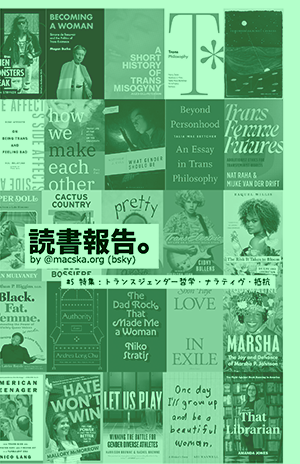
To get a sense of the scope of her Japanese-language work, here is a section of the index from the fifth volume of her English-language nonfiction review series:
PART 1 — TRANS PHILOSOPHY
- Feminism Against Cisness (2024) ed. by Emma Heaney
- Trans Philosophy (2024) ed. by Perry Zurn, Andrea J. Pitts, Talia Mae Bettcher, & PJ DiPietro
- A Short History of Trans Misogyny (2024) by Jules Gill-Peterson
- Becoming a Woman: Simone de Beauvoir and the Politics of Trans Existence (2025) by Megan Burke
- When Monsters Speak: A Susan Stryker Reader (2024) by Susan Stryker
- Trans/Rad/Fem: Essays on Transfeminism (2025) by Talia Bhatt
- Trans Femme Futures: Abolitionist Ethics for Transfeminist Worlds (2024) by Nat Raha & Mijke van der Drift
- Beyond Personhood: An Essay in Trans Philosophy (2025) by Talia Mae Bettcher
- What Gender Should Be (2024) by Matthew J. Cull
- How We Make Each Other: Trans Life at the Edge of the University (2025) by Perry Zurn
- Side Affects: On Being Trans and Feeling Bad (2022) by Hil Malatino
Trust me when I say that Emi Koyama read everything. From one book reveiwer of transfeminine literature to another, I greatly admire her work.
Of course, we can’t talk about Koyama’s legacy without discussing her two most important essays, “The Transfeminist Manifesto” and “Whose Feminism is It Anyways? The Unspoken Racism of the Trans Inclusion Debate,” as well as her wonderful blog eminism.org. If you haven’t read both of these essays, then I would highly recommend doing so, as they’re crucial to understanding the history of transfeminism. If you have, then Koyama’s blog is an absolute treasure trove of wisdom and knowledge.
Transfeminism is primarily a movement by and for trans women who view their liberation to be intrinsically linked to the liberation of all women and beyond. It is also open to other queers, intersex people, trans men, non-trans women, non-trans men and others who are sympathetic toward needs of trans women and consider their alliance with trans women to be essential for their own liberation. Historically, trans men have made greater contribution to feminism than trans women. We believe that it is imperative that more trans women start participating in the feminist movement alongside others for our liberation.
“The Transfeminist Manifesto,” published in 2000, was a radical text for its time, and helped to pioneer the term ‘transfeminism’ into the trans academic consciousness. In a powerful piece on Audiostraddle after her death this June, a number of major trans thinkers cited Koyama’s importance and influence to their own work: Susan Stryker, Julia Serano, Marquis Bey, and more. While Sandy Stone’s 1991 manifesto is far more frequently cited, Koyama’s manifesto breaks down the urgency of transfeminism into more concrete, material calls to action: rejecting the male privilege argument, deconstructing essentialism, combating violence against women, fighting for reproductive freedom. She writes:
While we have experienced more than our share of rejection within and outside of feminist communities, those who remained our best allies have also been feminists, lesbians and other queers. Transfeminism asserts that it is futile to debate intellectually who is and is not included in the category “women”: we must act, now, and build alliances.
Every day, we are harassed, discriminated against, assaulted, and abused. No matter how well we learn to pass, the social invisibility of trans existence will not protect us when all women are under attack. We can never win by playing by society’s rule of how women should behave; we need feminism as much as non-trans women do, if not more. Transfeminists take pride in the tradition of our feminist foremothers and continue their struggle in our own lives.
Earlier this year, I published an extremely long examination of the life of Roberta Angela Dee, a major figure in 90s transfeminine literature whose social circles embodied so much of the community in-fighting and cattiness and impossible transition standards that defined the trans community of her time. For my trans siblings who aren’t familiar with what the early-internet trans community was like, I cannot emphasize enough how powerful Koyama’s assertion was that it did not matter who was or wasn’t a woman. As a call to action, “The Transfeminist Manifesto” reads well even today, but at least a decade ahead of many other works of its time. Action and alliances – we could still do well to remember that.
I no longer feel that continued education about trans issues within women’s communities would change their oppressive behaviors in any significant degree, unless they are actually willing to change. It is not the lack of knowledge or information that keeps oppression going; it is the lack of feminist compassion, conscience and principle that is.
Speaking from the perspective and the tradition of lesbians of color, most if not all rationales for excluding transsexual women are not only transphobic, but also racist. […] The racist history of lesbian-feminism has taught us that any white woman making these excuses for one oppression have made and will make the same excuse for other oppressions such as racism, classism, and ableism.
“Whose Feminism is it Anyway?” manages to be somehow even more radical, a polemic that powerfully invokes both the history of trans activism and Black lesbian feminist scholarship to present one of the earliest formal critiques of what would eventually be known as ‘transmisogynoir.’ Koyama critiques several of the highest profile trans thinker/activists of her day, including Kate Bornstein and Riki Wilchins, calling them both out for making equivocations that take structural racism off the table for discussion.
To Wilchins:
The pattern is clear: when they say “feminism” and “sisterhood,” it requires any important issues other than “the celebration of femaleness” — i.e. racial equality, economic justice and freedom of gender expression — to be set aside.
To Bornstein:
While I appreciate their supposedly feminist good intentions, I must remind them that their arguments support and reinforce the environment in which white middle-class women’s oppression against women of color and working class women are trivialized or tolerated. I must remind them that it is never feminist when some women are silenced and sacrificed to make room for the more privileged women.
Obviously both Wilchins and Bornstein, along with most of the prominent white trans academics of the 90s and 00s, have massively evolved in their thinking on transmisogynoir and racism in the trans community since then. But it must be emphasized how Koyama’s work helped to force the topic on understandings of intersectional racism and transphobia that we still hold today. It probably also explains why Koyama’s work is so poorly remembered in the trans mainstream – from the very outset, Koyama’s vision of transfeminism refused to paint inside the lines to enter a white feminist or transsexual normativity, and never compromised on the conviction of her thought. The most important feminist work is often unpopular, but we ought not to forget it as such.
Koyama’s life work is filled with moments like these, crystal clarity that still seems prescient in 2026. She was a community icon and a beloved presence, and she will be dearly missed.
As in past years, my hope is to leave the comments section of this article open to reflections or grief. If there’s something you’d like to share about Emi Koyama’s impact on your life, or if there’s another trans author or community member you’re honoring today, I welcome you to comment below.
I see you. I love you. It’s going to be okay ❤️
Beth
If you’re struggling, you can call Trans Lifeline at 877-565-8860 or find other crisis resources here.


Join the discussion! All comments are moderated. No bigotry, no slurs, no links, please be kind to each other.